Bridging Physical Vitality & Mental Peace with Peter Crone (Audio Only) @WellnessAndWisdom
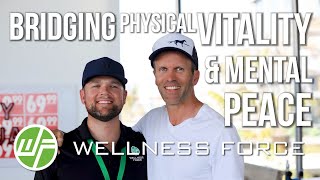
This is a transcript of Wellness Force Radio episode 199 (host Josh Trent) featuring Peter Crone, recorded live at the Surf Movement Masterclass (Hurley Headquarters). The interview explores emotional hygiene, working with high performers and pro athletes (including long-term work with the Diamondbacks), methods for reducing resistance and suffering, and practices for bridging physical vitality with mental peace. Peter describes his background (early parental deaths), his therapeutic frame (holding space, questioning limiting thoughts), his daily "emotional hygiene" influenced by Ayurveda and minimalism, and his stance on social media, attention, ego, and freedom. The episode includes sponsor mentions (IntelliSkin promo code WF20) and links to petercrone.com for courses and a forthcoming book.
Questions this video answers
199
Recorded live at the Surf Movement Masterclass at the Hurley Headquarters (episode indicates date May 18, 2018).
WF20
petercrone.com
The Arizona Diamondbacks — "on contract with the Diamondbacks now for like 10 years."
Chapters
For me, I always say failure is an event, not a person. And even that I would break down to no, failure is just something that happened. I love that distinction. It was something that happened. So the way that we as humans articulate events is usually to our detriment because it's way that the ego reinforces its sense of inadequacy or whatever it might be. So yeah, you're right. For me, failure is something I never, never, never will consider as part of my life or any of my clients life. It's just something they did or something they didn't do.
That's Peter Krohn and this is episode 199 of Wellness Force Radio. What's up my friend? It's your host, Josh Trent. And welcome back to another episode for your weekly access to global experts in all things wellness as we discover the physical and emotional intelligence we need to live life well. In this podcast we bring you a special episode recorded live at the Surf Movement Masterclass at the Hurley Headquarters in partnership with Intelliskin. This was one of the biggest movement and physical intelligence events I've ever been to and I'm so excited to share this world class. And when I say world class, I mean a man who serves athletes and top performers at the highest levels of sport and human performance. This world class leader. We're bringing you an in depth and compelling conversation with Peter Krohn, a thought leader in human potential and performance as well as the founder of Be Alive. Peter has devoted his life to sharing insights and strategies for athletes and high performers to live an inspired life by awakening new levels of awareness. Peter's work redesigns the subconscious mind that drives human behavior, better performance and ultimately better results. This resume he has, it's over 200 pro athletes across all sports as well as leaders of global organizations. His commitment is to share a pioneering perspective that inspires the realization for a new way of living to go from a life of survival to to one of thriving. I got to sit down with Peter in person. Make sure you check out the YouTube video over at YouTube.comwellnessforce to see live and in person how Peter explains his mindset and approach towards high performance, not just for athletes, but for all of us with an athlete inside. You'll learn how you can apply this mindset to your life and by the end of the podcast, you'll have a deeper understanding of how to bridge physical vitality and mental peace, how to navigate this slippery crazy slope of social media and its tentacles that are costing Americans incredible amounts of FOMO and losses.
Of productivity.
You'll learn how you can embrace an inventory of honesty and how to avoid what Peter calls the six stages of disease, and how he teaches performers and everyday people to transcend those through a practice called emotional hygiene. So whether you're curious about the physical or emotional intelligence that unlocks higher potential, this podcast is going to deliver not just an incredible story of how Peter transcended his parents death, but also how to let go of the things, people and energies that might be a blind spot for you. And the narrative might be quite surprising. Be sure to check out the show notes today@wellnessforce.com199 and explore more about this incredible postural technology that pulls your shoulders back throughout the day, whether you're working out on the weekend or sitting at the desk. This human technology, Smart Compression through IntelliSkin allows you to have better posture so you can breathe, move and live your life standing tall. Go to intelliskin.net and enter code WF20. That's intelliskin.net, wF20 is the code to save 20% off this smart compression. All right, let's drop in live and in person at the Surf Movement Masterclass with legendary Peter Krohn.
Josh Trent, Wellness Forest Here with Peter Krohn. You have been sharing so much wisdom for these past two days. I have been so enamored with the way that you communicate and articulate your thoughts from a place of love and calm confidence. Yet you work in an industry and in a field with athletes that don't always think that way. Can you tell us like, how you even got into this in the first place, being at this high level of coaching and working people through really their emotional intelligence?
Yeah. Well, firstly, thank you. I appreciate your acknowledgment and your awareness. I genuinely care about what I do and I think that's probably very pivotal in terms of how I got to where I got to is that I genuinely want to make a difference and that I genuinely do come from love. So when I'm dealing with these high end performers, whether it be in a sports arena, in business, in entertainment, I think one of the biggest sort of obstacles to entry in that world is that those people struggle with trust because they're just these icons in their industry. And I think it's very difficult for them to find people that they can really open up to and be vulnerable to and yet at the same time not feel exposed. And so I feel like I hold a space. I know I hold a space where not to sound callous, but I really don't care what anyone's got going on. I care that much that I can hold a space for it.
So, yeah, you were walking people through many exercises. One of them was a question that I've heard Byron, Katie, ask a lot. And you asked someone in the crowd after they proposed something that was giving them tension, making them short of breath. You said, is that true? Is it actually true, the thought that you're thinking, how did you come up with that? What's been your inspiration to ask that powerful of a question?
I think, you know, like a lot of us who are teachers, it's invariably through our own life experiences. And I can remember distinctly as I shared with the group, something I'd gone through in a relationship situation in my own life, where what occurred to me was that the underlying foundation for the reason that the relationship didn't work or one of the components was a deep belief that I wasn't enough. And it drove so many of my behaviors and the compensation patterns that I was always trying to be somebody for this woman. The irony, of course, is she loved me for me. It was just me against me, it was me not loving me. And so really, to answer your question, I recognized, well, where is that? Where is that not enough? And I recognize it's just what I call a linguistic construct. It's something that I made up. So at that moment, I recognized the actual falsehood of my own identity, which then gave rise to the question that I now pose to people. And yes, I've since heard it. You know, I don't want to claim stake to it. I'm sure even before Katie, there was people. But, you know, I was asking the question well before I even knew she existed on the planet, but I was like, oh, that's great. Someone's up to the same thing. So really, it's just understanding how we create language that is a negation of our own true, limitless, boundless possibility or potential.
I would think with the type of performers you work with, a lot of these people have gotten to where they are because they have tenacity, they have grit, they know how to push their bodies, they know how to shut off and really push through the monkey mind messages that say stop. But for those type of people that operate with that much output going within is something that I would probably think most challenges them. Have you seen this to be true?
There's definitely a tendency for that. And also, when you get into that level of expertise, the world doesn't necessarily help you. Right. And by that I mean, you Know, the higher you get, the harder the fall. Right. And so the world starts to try and it supports you in a way that is really what I would consider more egotistical. Right. So it's like you can never maintain the imagery that the world can create on your behalf. Does that make sense? So, like, if you're an incredible athlete, if you're an incredible actor, if you're a wonderful recording artist, the technology that we have around us now that can create the marketability of somebody we can never live up to. And so I think what I help, I know what I do in terms of helping is allow people to embrace their humanity. So regardless of their abilities, regardless of their talents, to bridge the gap between this sort of this, this man made fabricated image that supersedes any human capacity and their humanity. Right. Because I think, you know, obviously I don't work with everyone out there, but I think we see it that so many people become so blown up that their downfall is that they're trying to sustain that and it's just impossible. So for me, helping people find that vulnerability, which is our humanity, none of us are perfect. And that's a beautiful perfection.
We're perfectly imperfect. Exactly.
And to help people who are put into a pedestal position of perfection embrace their imperfection, maintains their humility, it maintains their balance, it maintains their health and allows them to sleep at night.
This balancing act we're always trying to achieve, whether we're a pro athlete or an everyday warrior. And I say warrior because right now, we've probably never been under so many attacks for our attention. Attention is really a currency which many people have talked about on the show before. So this currency of attention, how do you disseminate where you focus, where you put your attention so that you don't succumb to the depths of decision fatigue and maybe share with us how you work with athletes and high performers in that same regard so that they don't have so much decision fatigue. Prioritizing the things that really just mean the much.
I mean, I guess it's one of the reasons I don't have any social media.
Because you don't have an Instagram or a Facebook.
I do not. No, I mean, listen, I understand it and it's sort of tongue in cheek because I probably am going to develop a corporate Instagram, at least just by virtue of demand. You know, people are like, please, please, please, like, I want to be able to watch your stuff or I want to be able to listen to what you're up to. And so I do understand it's sort of one of these necessities in this day and age. But I do believe if you unders. If you look at it like, you know, the liking, like, the actual mechanism of the software and the technology is like me, right? And so talk about attention seeking. To me, that is a facet, an extension of the egoic part of a human being, which by design is not liked, it's not loved, it's not enough. And so here is this external validation which will never, never, never, and did I mention, never actually overcome the belief that I'm not that. Right. And this is the catch. This is the addiction. You can never get enough of something that almost works. Right, Is the way that I said. So it doesn't matter if you've got a million likes. You want to get a million point five. Right? Because you're being driven by something that is inherently not something. And so in terms of attention, you know, we could look at it in two ways, right? Like, I'm seeking attention, or where am I putting my attention? Was also part of your question. You know, so for me, I'm putting my attention on what I'm creating. I, you know, not sound callous. I really don't. I just don't worry about what people think about me and probably why I don't have Instagram. Like, I just know what I do. I know the difference I make. I have an incredible group of people that I help, and I want to just expand that. So that's where my personal attention goes. In terms of getting attention, I'm like, kind of the guy who lives in his, like, home as a sanctuary. You know, it's like, don't bother me. I don't go out, and I certainly don't need attention. Attention. That kind of attention, yeah, to me, becomes a little bit of a bolic.
How have you encapsulated the majority of lessons in your life? In other words, has there been a certain path that you can describe for us that you've walked to be able to operate at this high level and coach the kind of people you coach, what does that path look like? What's that?
A lot of trauma, a lot of suffering. I mean, listen, I think, you know, the adage of the wounded healer. My mom died when I was 7. My dad died when I was 17. I was an only child. And that gave me the visceral experience of isolation, which I would assert is the fundamental experience of the ego that I. The I that we associate ourselves with is a separate entity. And so I kind of had the physical experience of separation. And it's a horrible experience and I wouldn't wish it upon anyone, but it was the precursor to an immense amount of love and compassion. Because I recognize that albeit people may not, quote, unquote, have their parents past like mine did, that their experience is still the same. Meaning they're looking through a lens of separation. And it's a lonely place to live, and it's an exhausting place to live. And it's a trying place to live where you're wanting to fit in, you're trying to be who you think you should be for society's current standards. And it's all unnecessary.
This lens that kind of gets clouded. You know, things either happen through us.
To us, or for us.
I've heard from many different people. So when events happen, these traumatic events.
We lose a parent.
You know, I can't even imagine what that would be like to go through. How does one begin to re imprint and see the lens as I'm full, not I'm broken.
So I think even in language which, you know, we both use the word just this, you know, in the last minute or two, like losing. And I shared that with the group today, like, people would often, out of love and compassion, come up to me and say, I'm so sorry for your loss. And to begin with, that would actually feed my ego. Right. Like, meaning, oh, like I'm getting a little bit of attention to go back to the attention. Like, the ego loves that kind of molly cuddling. And what I realized is I didn't lose my parents. I wasn't in a shopping mall and couldn't find them. My parents passed. And that may seem a little cold or a little callous, but it's like what I consider my relationship with reality is I'm dealing with what is. I'm not dealing with my story about it. So I didn't lose anything. My parents passed. And as far as I know, no one is free of that game. Right. So what where it gave me immense amount of freedom and the path that I had as part of that was recognizing dealing with reality. And these are the laws of the game. You know, if you go and play basketball with some people, you don't pick up the ball and run to the other end.
There's rules to the game.
Whoa, whoa, whoa. You know, it's like, that doesn't work.
Yeah.
So one of the rules of being human is you're going to die. It's inbuilt. So I think it bred a huge amount of acceptance, similar to me, recognizing this experience of separation and isolation. And so that's definitely been part of the path of helping people. And I hold a space of love and acceptance for them.
Let's talk about hygiene then, because we all know about physical hygiene and physical training. But for emotional hygiene, you know the practices every day. What does that look like for you now?
Hygiene. Wow. I've never looked at it like that, but I do like that word. I'm a clean freak.
Some people might describe it as a daily ritual or a morning ritual, a night ritual. There's been so many incredible speakers, you being one of them this whole weekend at the surf movement masterclass here. But what's that daily hygiene practice look like for you now?
You know what part of my practice is. I'm an Ayurvedic practitioner. And some of your listeners might not know what that is, but it's a beautiful science. It's sort of the mother arm of yoga. Yoga is misunderstood. It's not the physical practice, it's really a self realization practice. But Ayurveda is sort of akin to traditional Chinese medicine. So we look at individuals and life through the lens of elements. And why I share that is because there's this beautiful tenant in Ayurveda where they recognize the stages of disease. And there's six stages of disease. And the first stage is accumulation. We accumulate too much of something in our system. So for example, we get too much heat from spicy food, alcohol, stress. And then that looks like, okay, acid reflux would be the second stage. I'm now getting an aggravation. So really that speaks to your hygiene. So my practice is I just avoid accumulating. Does that make sense? So whether it be mentally, emotionally, physiologically, materially, in my environment, I love to have a minimal, very clean home. Not ocd, but because I recognize that space affords me a sense of lightness and possibility. So for me it's, you know, just letting go of stuff on every level. And you look at these shows that I've seen on whatever, National Geographic or I can't remember, but you get these hoarding shows. Like, I mean, it freaks the crap out of me. Oh my God, it's just awful.
It gives me a shortness of breath when I look at these rooms.
And that's just somebody's actual environment. Now think about the hoarding that people have in their physiology and their biology, in their psychology, the unprocessed emotions. Humans are hoarders. And ironically, because we come from a mindset of scarcity. So if you're coming from a mindset of scarcity, what do you have to do? You have to hold on to things. But the mindset of scarcity is the lens that is fictitious. You're. You're complete in yourself.
Connect, connect this emotional, hygienic dots to the athlete. Because for everyday people and they deal with, you know, checking their social media when they get up. You don't even have social media, but the athletes are still human beings too. They kind of have the same draws, the same energetic pulls to get distracted from their process, too.
Yeah.
How have you seen those dots connect with high performers?
Well, I love baseball as one of those examples because I've been on contract with the Diamondbacks now for like 10 years.
How have they done since you've been with them?
I mean, obviously the perfect answer would be they've kicked ass. You know, you're as good as your latest victory. Right. And this year we're doing super well. We've won nine series in a row, which just matched the record from 1907, the Chicago Cubs. The last time a team.
I would say you are kicking ass.
Yeah, well, I. Seriously, anybody, anybody who's anybody would know. I am just a very, very small cog in a very big machine. So I cannot take claim to any of that. But I, I play my part and I love my guys and I do try and change the whole mindset, but there are many incredible people as part of our organization. But anyway, to get to your point, I love baseball because it is a sport of failure. If you do not know how to have hygiene, using your term meaning if you don't know how to reconcile loss, let go of failure. You will never succeed in baseball because like death, in life, failure is part of the sport. The best players in the world, they miss seven out of 10 times. If you're batting.300, you're a Hall of Famer, that means you've got way more, 250% more failure than you do have success.
Wow. What is the. What is the feedback loop for this? Then we look at how the brain works, how our different regulatory systems help us actually get through these failures, which maybe failure is a word that gets to be let go of in athletics and in high performance.
Yeah.
What does that look like for them to actually push through and know that 7 out of 10 times they're going to strike out?
If they're great, by the way, if they're great. If they're not so good, it could be 8/9. So, yeah, for me, I always say failure is an Event, not a person, you know, and even that I would break down to. No, failure is just something that happened. I love that distinction. You know, it's just really, it was something that happened. The ball, you didn't hit the ball. Right. So the, the way that we as humans articulate events is usually to our detriment because it's way that the ego reinforces its sense of inadequacy or whatever it might be. So yeah, you're right. I mean, for me, failure is something I never, never, never will consider as part of my life or any of my clients life. It's just something they did or something they didn't do.
Let's shift just a tiny bit because you've mentioned ego a few times and it's come up in so many discussions here. It's not that we want to kill the ego. We don't want to squash the ego's existence. We want to learn how to dance with it. We want to learn so that it's not in the front seat, but it's still part of us on the ride. How would you describe your relationship with the ego now and how that relates to athletes?
I love that. It's a beautiful metaphor, one I use myself, which is, you know, putting like a child. You don't put the child in front of the steering wheel.
You'd crash the car, man.
Yeah. And that's how most people live their lives. Yes, a lot of crashing. So yeah, with my athletes it's a fine line because much of their success is driven by ego. Like there is a certain degree of I'm the best in the world as a subtext which allows them, gives them the confidence, but then to not hold on to that in terms of how it defines them. So for me, in terms of how do I dance with the ego? I love the expression of the ego doesn't want to be healed, it wants to be held. And so the ego is by its design an entity that every human being's got. And its foundation is inadequacy, scarcity, insecurity. These are just its qualities. And if we can just reconcile that and go, it's not going to change that. But I, the bigger being, you know, without getting too philosophical, the self, the, the pure awareness that I am, I hold the space of I can be with that. It's just like a parent, you know, and I'm sure many of your listeners will be parents. When their child is screaming, their child is upset, their child is scared, the child is sad, they hold a space, they don't Push the child away. Maybe some do, but let's not get into that today. But, you know, they would hold a space for. They would hug the child. They would say, it's okay. The human adult, when they have their woes and their sadness, they tend to go into judgment, they tend to go into resistance. And that's where all the suffering, or a lot of the suffering comes from.
And this space between us breathing and accepting what actually is versus trying to fight and be in that handout, arm locked, resistance. That's actually what I felt from your work that describes what suffering truly is. Can you expound upon that just a little bit more?
For sure. I mean, I really use those words interchangeably, which is suffering is resistance, and resistance is suffering. And resistance to me is that it's. That I am negating, I am resisting what is. Now, if you really understand that it's so futile, right? Like, you know, it'd be like me getting up in, you know, the middle of the day and going, damn it, like the sun is overhead. Like, I just don't want that. It's like, well, you know, how's that working out? Not wanting it. So when we don't want things that are the way they are, we're gonna suffer. So for me, I have this, what I call this intimate relationship with reality. I allow things to be what they are. And simultaneously, I am what I consider a master of my own destiny. Not in a egotistical control way, but I am doing the best I can to generate, create, design the life that I choose. And it doesn't always work out. And there's harmony with that, this model.
Of constant, almost iteration. You're constantly, you know, discerning and then iterating what's going to be working next instead of falling into a failure model. And I think for athletes especially, there's probably a lot of people in that community that might think, what is all this feeling stuff? What is all this talking about emotion actually going to do for my performance? How can the everyday athlete use some of these emotional tools that you talk about in their life practically?
I think they're just indicators, you know, if you're feeling a certain way, like, you know, you're going to know to what degree, what state are you in if you're feeling sad, if you're feeling apathetic, if you're feeling resigned, if you're feeling depressed. These, to me, are all indicators that you're in some form of resistance. And that's a gift, right? Because otherwise, how are you to know what is your relationship with reality. Conversely, if you're feeling joy, if you're feeling freedom, if you're feeling a sense of peace, if you're feeling a sense of love in your relationships, then to me these are sort of references to what I would consider the soul, the true essence of who you are. And so that's my guiding force is I know because I've now practiced living in this state of like non resistance of freedom, that whenever I slip into these emotions or states that might be sort of under the umbrella of stress, it's like a, you know, a punch in the face. However, most people are in a mild state of stress all the time. So therefore they don't notice it unless it's like really traumatic. It's a panic attack. It's something that's like super anxious inspiring because otherwise that, that frame of reference, there's no relativity. So, you know, when I'm working with my athletes, I help them get to that state of freedom so that then they can relatively notice when they're in a state of stress.
One thing I love that you said is we get to become sensitive to our suffering, not desensitized. Which is, let's be honest, a lot of the kind of positive memes on social media, which I know you don't have a social media account, but there's so many messages out there around good vibes only, only focus on the good, you know, focus on what you want to create and just choose happiness. It's just not that easy. We can't get to that point where we can flick the switch for happiness. But yet we can. If we do our inner work beforehand, when that moment really matters. Can you take us to one of those high threshold moments where someone's done the inner work and they get to that moment where they can just choose, they can just choose their state.
Yeah, I mean that takes a lot of practice. But as you spoke, the thing that I thought about is like, it is like, you know, old, old sort of sports psychology was like, think positive, think, you know, and it's just, it's just a joke. It's like, like I only want to live like in the light, right? It's like, let's just get rid of like the night hours, you know, it's like, it's just totally nonsense.
How would we even know what the light was if we didn't have dark?
Right? So the laws of relativity are what give us our experience. So for me, it really is that integration of the parts of us we love and the parts of us we don't love the beautiful soul full of love and a little human that's full of fear. It's all okay and to make space for that. So for me, it's, it is really about integration. It's about embrace. It's like the Taoist sign, you know, of Yin and Yang and recognizing that you just can't have one without the other.
So in Major League Baseball, what are you most stoked about in your work, in your line of coaching, These high performance, really guiding them through what it means to be comfortable and to love themselves in these moments that matter so much. What are you most excited about for the work that you're doing this year and next?
I mean, it's just, it's like I just got a text. I've got a show jumper who just competed in a huge Grand Prix and she just texted me. So elated, she jumped double clear. So what does that mean? It means, you know, when you go through the first round, you have to jump over all the obstacles, calls, and if you hit a rail, you get a fault and you don't go to the second round. So she went double clear, meaning she went clear the first round and she went clear the second round. So she kicked ass. So that's what I get out of it. I know you asked about Major League Baseball, but I, you know, I equate that to any client I'm working with is the joy of somebody's sense of accomplishment by recognizing what was holding them back, integrating it, recognizing the futility of it and the, the falsehood of it, and then what becomes available on the other side of that constraint. And for me, the biggest experience is freedom. So whether it be a baseball player, a show jumper, an NBA guy, a PGA Tour guy in sports, it could be a businessman, a hedge fund guy, an actor, it could be a stay at home mom, a kid with add. What makes me me in terms of my joy is watching other people find an experience of life they did not, they just did not know was available to them. And that's freedom.
I think people misconstrue freedom and happiness. I think they're two separate terms, but they do kind of interrelate, almost like a Rubik's cube. How would you define happiness in this life?
I think it's one of these sort of buzzwords a little bit, and I don't have a problem with it, but I think, you know, happiness. I prefer the word joy. You know, I can remember seeing, and this may seem like a weird segue, but I can remember being In London.
And.
And I was with a girlfriend who I dearly adored. Not a romantic situation, just a friend who was a girl. And we were at a pub, and she picked up her phone and her whole face went this sort of ashen gray, and she just started bawling her eyes out. And I can distinctly remember watching her. And it may seem weird, but there was a degree of jealousy because she was feeling so deeply that what I found out after she got off the. Was it was her dad saying that her grandpa had died. And clearly there was a strong connection. But why I share this in the realm of joy is that she was feeling. And even though the feeling looked like sadness, to me, it was a reflection of love. And that, to me, is freedom versus happiness is sort of more in that positive scale, right? Like, oh, everything's going my way, and that's great. But there's something beautiful about grief, you know, there's something beautiful about missing somebody you love, whether they're here or they're not, or, you know, and that, to me, is the full gamut of human experience. And so I think that, to me, is. That's joy. I'm not resisting any of my feelings. I'm allowing all of my feeling. Why kids so happy? You know, they fall over.
They feel everything.
They fall over, they scrape their knee. It's like the end of the world. And then they see their buddy who's got this new toy, or he's eating an ice cream, and now this suddenly just full of, like, happiness, you know, like, they go, that's the scale. Happiness is on the scale, but beneath the scale I consider joy and freedom.
Wow, Peter, thank you so much for the work you do. I think this conversation about emotional hygiene, intelligence, whatever kind of semantics you want to put on it, really what you're allowing people to do is feel their feelings when it matters the most, which is these high levels of performance. Where can people learn more about you, man? Where can they dig in?
Well, we clearly established I don't have.
Social media, so I'm sure you're on the Interweb somewhere.
Yes, I am on the Interwe. Just my name. Peterkrone.com p e t e r c r o n e.com soon to be joining the dizzy ranks of the millions of people on Instagram.
Yes, yes, yes. But I'm sure that you will teach us how we can defer this attention in social media, which is kind of plaguing everyone. And I see a lot of athletes talking about this, too, where they've had to Put an arm out to social media.
Yeah. And I think, you know, and again, it's like anything in life. I think it's the way you do it, it's the underlying energy. I, you know, I'm not going to do a personal Instagram. I will of course feature, but it will be more about this, actually, this new brand that I'm going to be launching here soon.
Can you tell us about the new brand or is that to be continued?
That's going to be continued, but it will be the title of my book and it's going to be online courses and I'm super, super, super. Did I say super excited? You sound excited. Yeah, it's really my raison d'. Etre. I think it's my purpose. And so that will be the Instagram feed, but I will obviously feature as the founder and the inspiration behind it.
So.
But if people go to my website, they can enter an email and they will be updated with online courses. And when my book comes out and eventually when I join the dizzy heights of Instagram. So to finish the point though, it is the way that you do it. Right. So I think a lot of people create Instagram as a means to trying to find value, as a means to trying to get attention, as a means to trying to find love. It's not wrong, but they will never be fulfilled. I'm creating it purely as a means of self expression and sharing. I, you know, Whether I have one follower or 1 million followers, it's just, I'm just expressing.
Last question then for you. At this intersection of emotional and physical, really intelligence. This is what we talk about on the show, man. This is why I was so excited to get downloads from you.
Yeah.
How would you define it? Wellness. What's your definition of wellness? I like to drop the bomb.
I was going to say, now we're wrapping up. Gosh. Wellness to me is, I think it is. It is that intimate relationship with what is. I would say wellness is the byproduct of the absence of resistance. Think about that. So if there's not absence, if there's not resistance in my life, then things flow. And I would consider that wellness. When the body is in a state of resistance, when there's a block, when I'm holding onto something, when there's fear, there is not wellness. There is the absence of wellness. However, if I remove the resistance, if I remove the suffering, then wellness flows. I would consider our inherent nature is wellness. But because we look through a lens of limitation, we become sick, we have dis. Ease There is a lack of ease which then manifests in the body as dis.
Ease.
So for me, it's all about freedom. It's about peace. It's about recognizing our true nature. Is that. And to, as the Buddhists say, neti. Neti. Not this, not that. To negate, to remove all of the constraints that we've made up over life.
Wow. Fantastic man. So enjoyed spending time with you this weekend and we're gonna link so much information about you in the show notes. So what a joy to connect with you. Peter, Josh, thanks so much.
Thank you for having me. See ya.
Hey my friend, thank you for hanging out and growing with me on today's show. Remember to hit subscribe. Subscribe. Share this podcast with somebody you care about that you think gets to hear this message. Support the show by leaving a five star review for the podcast right now simply by tapping on your show artwork. On your iPhone, click that purple link that says review this podcast. It helps the show reach more conscious and smart people like you and your voice will attract more world class guests that want to come on the show. So let them hear your voice. For all the downloads, videos, links and free resources mentioned on the episode, go to wellnessforce.com radio. And while you're at my house on the web, join us in the Wellness Force Community newsletter on that page and I'll send you four free guides around staying healthy with your eating, moving and sleeping while you travel. But don't let this conversation stop here. Join a group of people like you over at the Wellness Force Community Facebook page. This is where we talk about the things that really matter. We share our wins, inspirations, struggles and a lot more. So join us. Tap on the show artwork on your phone and hit that purple link that says join the Facebook group and I will welcome you at the door. Okay. Now you get to go out into your world and create impact for the people that you care about. So until I see you again real soon, I'm wishing you love and wellness.
More from Josh






Your child's future start before pregnancy... and even before conception! #podcast

MD Reveals: Your Healing Creates Your Child's Reality (The Souls Coming In Need Strong Bodies)



