Creating A Life Worth Living With Michael Strasner
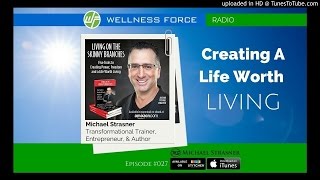
Transcript of a Wellness Force Radio episode (host Josh Trent) interviewing Michael Strasner about his book Living on the Skinny Branches and methods for personal transformation. Covers themes of emotional presence, vision and purpose, breaking limiting beliefs, commitment vs. feelings, feedback, medication (using food/alcohol/behaviors to numb), money and self‑esteem, and practical tools for building integrity and relationships. The episode includes listener questions and closing information about the book release.
Chapters
Wellness force radio episode 27 who doesn't.
Want to eat healthy when they're happy and they're empowered and they feel good about themselves? Everybody. Who wants a pizza, who wants the couch, who wants bon bons, who wants, you know, to sit around and not take care of themselves? The unhappy person or the unmotivated person or the insecure person or the sad person. And so what I'm saying is, is that feelings are essential, but they can't dictate our actions and our behaviors in life or we're gonn have erratic and inconsistent results.
Wellness Force Radio welcome back for another episode. I am your host and digital health coach Josh Trent. Thanks so much for sharing a slice of your day here on the podcast. If you're here for the first time, Wellness Force Radio is where I bring you the most inspiring and passionate experts in behavior change and wellness technology. These are the thought leaders. They dedicate their lives to empowering others with the knowledge and tools that drive real transformation in our physical and emotional wellness. Today's show is brought to you by wellnessforce.com where@wellnessforce.com you'll learn how to change old habits with new technology. Explore wellnessforce.com today to see if digital health coaching is right for you. Now, quick question. Are you using the podcast app on your iPhone right now? Go ahead and tap the screen where you see the show logo and you'll discover all the links and show notes from Today's show with Michael Strasner pop up easily on your screen. Hit the review link in purple and take just 60 seconds to leave an honest review to be published live on itunes. Your amazing review allows me to keep the lights on for the show and to keep serving this community by bringing on world class people who are making a difference and changing lives. Today's show with Michael Strasner I am both honored and excited to welcome him to the Wellness Force Radio Show. Michael's new book, Living on the Skinny Branches. We'll talk about transformation and how to create a life worth living. Michael Strasner, welcome to Wellness Force Radio.
Thank you Josh. Thank you for having me on. I'm super excited to be here.
I'm extremely pumped. I spent the majority of the weekend in the library reading your book and thinking about all the fun questions I would ask you. I wish our show was like four hours today but we are going to stuff it into 60 minutes or less. And Michael, I just want to ask you right off the bat, you have trained people for 30 years. I'll read your bio in just a bit. But if there is one common theme that you've seen in all the transformations and all the workshops and all the hundreds of thousands of people that you've trained, is there one thing that comes up where you could say this is just one thing that people could start to turn their attention towards being more aware of?
Yeah, I would say that it's how often they limit themselves or prohibit themselves from creating the things that they want in their lives and, and the experience that they want in their lives and how easy they do it. They get engaged in these conversations, these limiting conversations, and they just essentially zap their energy and take all their attention away from the goal, away from the result or the experience they want.
This is a perfect way to segue into your bio. I want to read this in case anyone hasn't heard of your work or your contributions to what I consider to be part of the wellness industry, which is the self development arm. Michael Strasner is one of the most respected leading experts in personal and organizational transformation. Through his mastery of coaching and understanding the psychology of leadership and human behavior, he's been able to facilitate and design extraordinary workshops dedicated to the art of life and living on the skinny branches. In the past 30 years, Michael has worked with over 100,000 students and people from all over the United States, South America and Europe. His personal vision is to create a world of peace, love, unity and abundance. It's reflected in the work he does in the domains of personal transformational training. He's also authored several workshops, Mastering the Art of Relationship, the Entrepreneurial Mind, Mastering Leadership for Teenagers, the Master's Course and the highly regarded LP PhD program. He's been a featured guest in articles, podcasts and radio shows to share his expertise on diverse topics that we'll go over today such as effective communication, connection, intimacy in relationships, building self esteem, the Power of authenticity, personality adapting through style, flexing, powerful and impactful public speaking and jumpstarting your passion for life. Michael, such an eclectic bio. I'm so excited to have you on the show. Is there anything that we can add to that bio? Something fun that people might not know about you?
You know, probably that when I'm not in a training or I'm not coaching people, I'm really an ordinary person. In other words, I don't see myself as better than other people. I don't see myself as having this resume. I don't walk around thinking about my resume. I basically am enamored with life. I'm enamored with life and living it and the wonders of life and connecting with the people in it, whether it's the person at Starbucks or the person that is going to be doing my taxes. It doesn't matter what level or status that people are at in life. I love people. I love life. And I appreciate the little moments and being present to them.
And what I hear from you is just being present in the moment. A lot of that is a cultivated skill. It's something that I learned in a workshop that I was fortunate enough to be led by yourself. And I want to just start the show by saying the profound impact that I had from your coaching and training, literally, Michael, changed my life forever. And I'm very comfortable saying that on the air to thousands of people because I had a relationship that did not exist with my father for two years plus. And through some of the work that I did in transformation, I was able to create a lasting and connected relationship with what never existed before. And I have you to thank for that. So I just want to publicly thank you from the bottom of my heart for the transformation that I've had in my life from this work.
Josh, I really appreciate you saying that. That means a lot to me, and I don't in any way take that for granted. It doesn't matter how many times I hear it or how many times people say it to me in my life and over the years, it still really touches me and means a lot. And I know exactly how that feels. I mean, 30 years ago, when I started in my journey in transformational work and working to alter the way I was living my life, I had a relationship with my father that wasn't working either. So I can totally relate to not only the breakdowns in that relationship, but also the breakthroughs that are available and what it feels like when that happens. And I am completely thankful to the person that made the difference in my life and to the coaches that I had and the trainers and the facilitators that I worked with in my own transformation.
And really, when we look at human behavior and transformation, I obviously made this step with my father. You've made the steps with your family and friends in your community to start off with what transformation actually is. I know that's a word we hear a lot, you know, transformation, transformation. But how would you actually define transformation not only as a vehicle for change, but just the definition of it and how it plays out in your life?
Transformation essentially, is letting go of habits, behaviors, attitudes, beliefs, conversations that we have going on in our mind, in our heads. You know, we all have a little voice in our head. And if you're asking yourself right now, you know, what is that voice? It's the one that's talking to you while I'm talking to you. So we always have a little voice in our head, and those conversations are limiting, and they hold us back. And when we can alter them, when we can change them, when we can transform them, when we can redesign them, then we have the power and we have the confidence in ourselves and the courage to take risks and take actions in our lives that we've never taken before. I mean, think of it like a roller coaster. When we're going up the roller coaster, we're tense, we're afraid, we're in control. We experience fear. Fear. We're hanging on for dear life. Maybe we even have that little voice in our head that says, oh, my God, we're going to die. And then two minutes later, we're screaming and yelling and releasing and letting go. And now we're enjoying the ride, enjoying the journey, and we're so lit up and we're so excited that by the end of the ride, we're saying to our friends, oh, we have to do that again. That was amazing. So it's essentially going from fear to exhilaration, from I can't to I can, from I always have to be right to I get to be open and I get to be vulnerable, and I get to consider other possibilities. So transformation is altering our attitudes, our behaviors from one to another. And then when we do that, we have access to a whole world of possibilities that we didn't know existed.
And a lot of people listening to this show are looking for, seeking the education and tools to get transformation, Whether it's in their body, their mind. Transformation is not linear. There's many different segments in arms. But I loved how you wrote in your book, which we'll talk about in a moment here. One of the quotes I'd love to pull is that you say, transform your life by transforming how you see and experience yourself, how you see and experience the world, and ultimately how the world sees and experiences you. For this to occur, you must learn to harness, redirect, and transform the following negative energy from their past fears and insecurities, real and perceived limitations, tendencies towards survival, the need to be right, the resistance to abandoning control. I have to say number five, the need to be right. Like, that is my edge. That is my practice. Is there one of those that you work on most in your life, or would you say it's a cumulative effect of all six?
I would say that you know, today in my life, after, after being in the work, it's. It's not just doing the work. So, yes, I'm a trainer, and yes, I'm a facilitator, and I am working, coaching other people to transform their lives and to break through what's stopping them and holding them back so that they can transform their lives. But I'm always in the work myself. So I practice what I preach, and I live it personally and I live it professionally. I think the biggest challenge that I have is letting go of history when something is established, when I am having certain results or certain experiences, whether they are positive or negative. Like, let's say things are really working with my wife and we're really experiencing love and connection and intimacy. I mean, in a perfect world, we would love that to continue. We would love to press the button and go on automatic pilot and never, ever have to do any more work to make that experience, be alive, to be able to sustain it and to control it. But the thing is, we go to bed and when we wake up in the morning, it's not just a new day physically. And let's say literally, it's a new day and a new moment in our relationship. For example, the way I slept or the way my wife slept, the dreams that we had, how well we slept, could affect how we feel about ourselves or the energy level that we have. And maybe one of us wakes up a little sleepier. Usually would be me. So let's say I wake up a little sleepier. My wife wakes up and she's like, on fire. And it's 6:15, and she's on fire, and her brain is firing on all pistons, and she's ready to go, and she's ready to take on the world. And I'm in slow motion. I'm in quicksand, you know, I'm like, you know, looking for that first gear, and I've got my foot on the clutch trying to get it in there. I mean, we essentially might just not be on the same page, but not have it be a bad thing. But it could become a conflict. You know, she wants me to respond to her. She's got some questions for me, some things that are on her mind, and she is on fire and wants them now, and I want to give them to her. I'm just not up to her speed yet. So in a perfect world, we would love to live in a constant state of love, a constant state of joy, a constant state of connection, and everything's working great, but it just doesn't work out that way. And the same thing is also true for things that don't work. You know, we get into a habit of something, a behavior. Let's say you make commitments to yourself to work out and you negotiate with yourself all the time. When you do that enough, then you break your word. And now your word loses its power. And not just you don't work out and your health is not where you want it to be, and you're not having the look that you want in life and you're not having the energy level that you want as a result of working out. But you now also have doubt about your own power, doubt about your confidence, doubt about the power of your word. Do you believe what you say? Is anyone else going to believe what you say? And we don't realize how these conversations impact every area of our life. If I break my word, whether it's small or large, it not just affects my power and confidence, but it affects my credibility in life, my credibility professionally, and then my credibility affects my ability to produce results.
You mentioned the fact about physical change. You know, if you're not keeping your word when it comes to a workout, when it comes to taking care and giving your body, nourishing food, one of the things that got me pretty emotional, something that I dealt with as a young man, was medicating from food. When I felt stressed, I ate. When I felt sad, I ate. When I was uncomfortable, I would use food to numb. And there's a section in your book where you hit this. Specifically you mentioned it doesn't start with the food. It starts with our mentality, our attitudes. We're eating to numb, avoid, or pacify our pain. Our mothers and fathers are also eating to medicate and cope with their pain that they have held within from their past journey they are now passing on to their children. Can you expound upon what you meant by that and kind of dive into what that meant for you?
Well, yes. First of all, medication is not just a pill or in a pill form. Medication is a. It's a psychological term and a term that I use in coaching and transformation and the work I do. You know, we medicate. We look for ways to make us feel better about what's going on in our life that we don't like or we don't want or that we hate or that we feel sad about. And we look for ways to do it. And some ways to do it are, as you're alluding to our eating habits, Other ways to do it are avoiding by watching television or Going on the Internet for excessive amounts of time, or working or cleaning or sleeping. I mean, we have lots of different ways that we medicate and some it's by food. And the thing is that medication is that, is that desire that we have to have the pain go away. Human beings don't want to be in pain. So we are always looking for ways to avoid pain. And there's many different kinds of pain. It's not always at that catastrophic level where I'm depressed or I could do harm to myself or others. It's little pains where I didn't get the sale that I wanted. I've talked to so many and coached so many salespeople who have drinking problems. They're not necessarily alcoholics, but they have a drinking problem. They have a drinking issue. And what happens is it could be just as simple as they didn't get the sale. They went on this sales meeting, this sales presentation. It was really important to them. They were expecting to get this result, they were counting on this money, they were counting on this bonus or this extra compensation that they were going to get. And it didn't happen. And so, so it's not necessarily, let's say, the end of the world for that person. But what do they do? They go to the bar and they don't just have one drink, they might have two or three or maybe even four. Okay. And when you do that enough times, let's say on a weekly basis, a monthly basis, then what we're doing is we're using alcohol as a form of medication, or like I said, food as a form of medication. And what we're doing is we're doing these what I'm going to call unhealthy and dysfunctional and ineffective methods of resolving those painful feelings that we're having. All we're doing is compounding them and making them worse. You know, obesity in America is a tremendous issue. It's actually a multibillion dollar industry in America. And it shows that we as a society and as a culture are not making responsible, effective and healthy decisions, not only regarding what we eat and how we eat and what we give our and feed our children, but we're also not managing our own stress. We're not managing our own day to day discomforts, day to day issues, day to day arguments, day to day fights, day to day feelings of insecurity, or day to day feelings of not fulfilling a vision or a purpose. You know, it could just be as simple as that. But that, that need to medicate comes from that desire to make whatever it is go away.
And how would you define, when you talk about paying the price of not having this ability to enact your vision because you're numbing it with alcohol or any of the modalities, right. Cleaning, working, things like that, how would you actually define who pays the price for that? I mean, who pays the price when a dad is so focused on his sales and closing deals and drinking and dealing with the pain that he's feeling that he doesn't have a clear vision? I mean, who pays the price Just besides the family, it's other people that pay the price, right?
Yeah, everybody pays the price. Because, you know, first of all, we don't live in a vacuum. You know, even I like to use this as a reference. You know, even in the movie Castaway when Tom Hanks was on the island by himself, he wasn't really even by himself. He turned his volleyball into. His friend Wilson called him Wilson. So even so, it's, it's like this, it's this inauthentic view that what we do only affects us. It's not true in any way. So even if you're single and you have no children, how you are in life affects everybody around you. Look at California and the highways, the 405 Freeway. If you're in a bad mood, if you're disconnected, if you're being selfish or self centered, those people will be speeding. And I don't mean just speeding. Like the speed limit's 65 and they're going 70, I mean like 90. Okay? They're driving in the emergency lane. They're disrespecting the traffic laws. They're not giving signals. We put out a toxic energy into the world around us and we also happen to work with other people. And then we bring that toxicity into our work environment and people avoid us and they don't want to be in relationship with us. And they can feel that negativity. It's like a black cloud that carries over us. And so if I'm married or if you're in a relationship or if you are working in an office environment where you have the opportunity to be part of, let's say a team or work with others, how you are and how you're showing up in your life directly impacts and indirectly impacts everybody in the world. So it's like a micro. And it goes to the macro. Let's say there's 6 billion people in the world and hypothetically this isn't the case. But if 6 billion people are walking around the world selfish, disconnected, Sad, lonely, unhappy, negative, judgmental, mean spirited. Then if you think that the wars we're having in Iraq and the Middle east and in other parts of the world are a problem, now imagine what the problem would be like. Then imagine what would be happening at that level. So it affects everybody and everybody and anybody that we come in contact with.
So would you say that having a clear vision and having a clear purpose in life is essentially refracting energy from emotional presence? I mean, do the two go hand in hand or is emotional presence completely separate from having a clear vision?
Well, I think emotional presence can be connected to vision. But I think if my vision is driven by my emotions, then it's going to be a, you know, going back to the roller coaster analogy, it's going to be hot and cold, up and down and inconsistent. When I think of a vision and I think of a purpose in life, then I'm so clear about this. Whatever this is, this declaration of the life I want and the future that I want, that I'm committed to it. And when I'm committed to something, it doesn't matter how I feel. Feelings are irrelevant. Now, I'm not saying it doesn't matter how I feel. I'm saying that feelings can't dictate my action in life. If feelings dictate my action in life, then when I'm hot and I feel good about myself, I'm going to go to the gym. Who doesn't want to work out when they feel good about themselves? Everybody who doesn't want to eat healthy when they're happy and they're empowered and they feel good about themselves. Everybody who wants a pizza, who wants the couch, who wants bon bons, who wants to sit around and not take care of themselves. The unhappy person or the unmotivated person or the insecure person or the sad person. And so what I'm saying is that feelings are essential, but they can't dictate our actions and our behaviors in life or we're gonna have erratic, inconsistent results. If I'm vision driven, then what is present there is the distinction of commitment, the distinction of living my word. And when I'm committed, I think of a mother, for example, you know, a mother who's got a child that they're carrying in their womb for nine months. Does it matter if she is happy, sad, or feeling good or nauseous or having energy? For most of those mothers, it doesn't matter. She's having that baby. It's a non negotiation. There is no way out my baby and I are one. And we are having this baby, no matter how I feel, moment to moment. So the commitment is there. And she might be nauseous. I mean, I remember, you know, nausea from my wife when she was pregnant. I mean, she was nauseous for four months. I mean, couldn't keep anything down, could barely eat. Couple of times. Times we had to take her to the emergency room to get hydrated because she couldn't keep anything down. And I'm looking at her going, oh my gosh, thank God I'm not having a baby. I don't know if I could do it.
I have so much respect for moms, so much respect.
And that's what I'm saying. And the respect for me comes from that incredible commitment. When I think of commitment, I think of that. It doesn't matter what I go through. Think of the body changes a woman goes through. You know, maybe she's, you know, 112 pounds before she gets pregnant. And she loves her physical body and she worked on her health for her whole life and now she's 25 years old and weighs 160 pounds and she's pregnant. I mean, it's not just the physical aspects that they go through of being pregnant and carrying a baby. It's also the changes in their body and how that affects maybe their self esteem, their confidence, their emotional state, their joy, their happiness, their love of themselves. But I can tell you right now that the commitment is there. And that level of commitment, imagine if we had that same level of commitment regarding our vision in life. So do feelings matter? Absolutely. Do we want to feel joy and happiness and empowerment and inspiration on a daily basis? Yes, of course we do. Nobody wants to walk around with sadness or, or insecurity or anger or pain. But those feelings cannot be bigger than the vision and the commitment to make that vision real.
And vision is something unique and specific to every person for a set of circumstances only they understand. How does one go about formulating a vision? A lot of people might think their career is their vision, but it's not. So, I mean, as you wrote in your book, the career is actually a part or inside of the vision. If somebody's just starting out and they're just beginning this journey, how do they go about creating a vision for themselves?
Well, I think vision begins with looking at the overall picture of my life. And I'm talking about all aspects, professionally, personally, health, relationships, money, what I do with my time. It's taking a global perspective of my life and not just looking at it at 20 years old or 25 years old or 30 years old. I think looking into the future, a solid 10 or 20 years, and looking at if I was living my life a certain way, what would be the guiding attitudes, the guiding beliefs, the guiding principles, the guiding ways of being, the guiding distinctions that I would want my life to embody no matter what I do? Literally no matter what I do. And in my book, like you referenced, one of the things I talk about is Martin Luther King and something he said that moved me. And I read this 30 years ago, actually, you know, he said, if you're going to be a street sweeper, then you want to be the best street sweeper that ever lived. And I thought about that at the time and I was thinking, wow, what an incredible concept. Because society would look at a street sweeper and say, wow, you know, what a horrible job, or wow, that guy or that woman really made some poor choices, or what a disappointment that that's all they have in. But what about that perspective that it doesn't matter if I'm a doctor, a lawyer, a street sweeper, an accountant, a singer, I'm a dancer, I'm a Starbucks barista? What if it doesn't matter what I do, but matters who I am and matters what I stand for in life and matters what experience I'm committed to generating? And so when I think of a vision and I think of a purpose in life, I think that people, people should stop, get off the treadmill, breathe and take some time and write without editing. Most people think editing. They don't just write editing, they think editing. In other words, they start criticizing and putting down and cutting down before they even get started. If I start cutting down, criticizing, putting down, negating, holding myself small before I even begin, then what's the point of even talking about it? What's the point of even saying it? Most people don't talk about their vision. They talk about what's wrong. What are we doing in happy hour? Are we talking about how happy we are? When was the last time you were in a happy hour where there was no alcohol being served and there was utter happiness in the happy hour?
Never.
Never. Because nobody's sitting in happy hour talking about how happy they are unless it's alcohol induced happiness. Everybody's sitting in happy hour and they're talking about how they hate their job or life is hard or life is tough, or men or dogs or women are so hard to deal with. They're doing that and they're doing it with their friends and they're doing it with their friends. And their friends are commiserating. They're not just saying, oh, that's just your interpretation, or maybe you should look at it from a different perspective. No, they're going, I know what you mean, girl. I have been there. They're saying, I know what you mean. I know exactly how you feel. I agree. I went through the same experience with my previous girlfriend, and that's happy hour. What you don't see is people talking about 10 years from now, what do you want people to say about you when they meet you? What do you want people to say about you and the kind of man you are, the kind of woman you are, the kind of father you are, the kind of mother you are, the kind of human being you are, the kind of citizen you are in society and in the world, whether it's professionally or personally, Every human being owes it to themselves. They're not entitled, they owe it to themselves to connect with and look at what is their purpose in life, what is their vision in life, what is their life truly about? And then once they formulate what that is, then we can start and they can start really looking at. So what careers are aligned with this conversation? What careers are aligned with this vision and aligned with this purpose? And what health is aligned and what choices regarding health are aligned? And what relationships, what kind of relationship and what kind of family do I imagine myself creating that's aligned with the vision that I see 10 years from now, 20 years from now, 30 years from now? I mean, go as far as you want. Most people are standing, and this is really what my book is all about. Most people are standing at the bottom of the tree, at the base of the tre. And basically they're so close to the base of the tree and they're looking at it and up, and the only thing they can see is the tree, this ginormous wall in their way. And that ginormous wall represents all the obstacles that stop us in life, everything that's in our way from having what we want. But what we don't imagine is that if I climb this tree, if I work my way up one step at a time with full commitment, full passion, full energy, full courage, face my fears and do it anyway, that every step I take as I climb that tree, that what will happen is all of a sudden I'm going to start to see light. I'm going to start to see possibility. I'm going to start to see what life could really be. And when I get to the top of the tree, I can see Anything, everything. The future is clear. My vision is clear. There's no more hindrances, there's no more obstacles, there's no more circumstances. The sky is the limit. And imagine living that way. You know, we've all heard those terms today, especially with social media. Everybody talks about how the sky is the limit. Everybody's got the slogans, everybody's got the jargon. I mean, forget bumper stickers. Facebook, social media, it's like one ginormous bumper sticker. But do people actually live that way? You know, when we walk around the world, are people actually living their vision? Are they living their purpose? How many people do you know that are truly living their vision and truly living their purpose?
I gotta jump in because you touched on so many amazing points in there, and I feel like the key aspect that you touched on so much was people that have a lack of integrity. There's the postings on social media. There's the things that people say versus the things that people do. And this is a perfect time for one of the Facebook questions. This is from Amy, and Amy asks. Michael is a role model to me because of his integrity in all areas in life, especially in his marriage. I want to be a transformational trainer someday, and I would like to know about some of the early lessons he learned in balancing stress, love, quality time, and work. With all the traveling he's done, I find I tend to fall back into old learned patterns. Despite being committed to my vision. In the first few years after becoming a trainer, were there still negative stories present for Michael?
Of course. All of my historical ego conversations, unworthiness, insecurity. I'm not good enough. I don't have what it takes. Do it. I've never done it before. I'm Larry's brother, you know, I've got an older brother, Larry. You know, I've had all these stories and, you know, it takes time. And not just time. It takes rigor and it takes commitment to face the conversations or stories and to bust through them, not sell out to them. It's not just about being aware. Look, it's great to be aware, but once you're aware and you hear it and you see it it, and you know that if you listen to it, you're gonna sell out. That's when it takes commitment. It takes rigor and courage to bust through it and not let that conversation stop you. So I trained myself when those conversations came up, basically to say, thank you for sharing and then do it anyway. You know, take action anyway. Be responsible anyway. Look, we're inundated in our world with victim conversations. So it's so easy to be a victim if people are being a victim. My little voice goes, hey, I can chime into that victim story easily. Let me add this. Well, how about not getting enrolled in or selling out to those conversations and attitudes at the office, by the water cooler, or with your friends or with family about your mother, mother in law? I mean, how often do you hear people talking about their mother in laws and things like that? Instead of chiming into the conversations and then losing your focus, losing your vision, losing your integrity, interrupt those conversations and take the appropriate action that will have you have the life and the vision and the results that you want. 100% is possible. 100% of the time it is possible, but it requires consciousness, intervention, interruption, and consistency.
I love that you touched on essentially what you wrote in your book. You said, people don't hire me to tell them what they want to hear. Many of them have employees, family members, and friends who will do just that. It's having this courage, this strength to take a stand for someone else's vision and their dreams that they've openly shared with you. Those are hard conversations to have. Michael, I'll be honest. I've had to cut friends out of my life because they weren't willing to take a stand for me the way that I was willing to take a stand for them. How have you seen that play out in your own life? Or maybe some powerful subjects and stories from people that you've transformed? How does that work to actually let go of people that won't take a stand for you in the way you'll take a stand for them?
Well, I think early on in my transformational, you know, let's call it career, and when I began in this work 30 years ago as a trainer and a coach, you know, it's so interesting. When I first went through the process, obviously I. I thought I had, let's say, I mean, I'm just randomly throwing out a number, hundreds of friends. And, you know, if you asked me if I had, you know, a lot of friends, I would have said yes. But what happened is I found out not only who my real friends were, but I also found out what kind of friends I really had. And being responsible because this goes back to responsibility, I had to really take a look at myself and look in the mirror and ask, ask what kind of a friend was I and how was I showing up in life that I considered this person a friend or I considered, you know, that I made the choices to hang around with certain people and doing certain things. And the thing is, I didn't just cut people out. What I did is I took it on as a challenge for myself to go and make a difference in those relationships. And not all of them were 100% receptive. I mean, I'm going to tell you, you some of them were incredibly receptive. Waiting for the conversation, so excited to have it, nothing to clear up, nothing to clean up. But I remember one in particular, a friend of mine, her name was Mary Louise. I called up Mary Louise. I thought Mary Louise would be so excited. I thought she'd be so happy to hear from me. And I was letting her know how I'm so excited about our future and the kind of relationship and friendship we're gonna have. And I wanted to be so much better. And she stopped me in my tracks and gave me feedback back and basically told me that I was the worst friend ever. And I remember how shocked I was initially, but then also incredibly humble and appreciative that she gave me that feedback. And obviously I had a choice in that conversation. I could have said, forget it, thank you, I appreciate it, and we're done and let's move on. But I really took it to heart and I took it as a challenge to myself to create a relationship with her. And ultimately, I asked her to give me a chance, give me a second opportunity to be willing to forgive and see if it's possible for us to create a new relationship and a new foundation. And she did give me that chance. But I'm not going to say every person that I went to did give me that opportunity. Certainly that was a huge wake up call for me. I think there's always value in not just confronting those situations and working to break through them and to have new breakthroughs not only for myself, but the other person. But it's also okay to let certain people go. It's not a bad thing. We could let them go and say, I love you and I wish you well, and I'll always be here. It doesn't have to be a hostile goodbye. You know, it could just be a, I wish you well, my friend, I will always be here, or I'm available if you'd like to, you know, reconsider or reconnect at some point in the future and wish them well. You know, again, going back to toxicity, we don't need to make those people wrong. We don't need to add pain to the situation or add an element of judgment or wrong to that situation. We could Just let them go with a hug and that's okay.
And you mentioned feedback. That's something that I feel is almost an art form, the ability to give and receive feedback. And that's a lot of the work that I've done this year, starting with the transformational and the leadership course that I was able to be in, where you coached us to actually be able to receive feedback without being triggered, without wanting to lash out at the other person. Can you talk about in the early moments for someone who's going through what it's like to actually receive feedback? How does one do that? How does one actually receive feedback without being triggered?
Feedback is information. Let's just be clear about the definition of feedback and what it is. Feedback is information. We receive this information all the time. You know, when we're driving a car, the dashboard and the instruments are giving us feedback. When we're on an airplane and the pilot is flying the plane, he or she is receiving feedback from the instrument panel, feedback from the air traffic controller. When we were younger and we, let's say, played soccer, or we played basketball, or we played an instrument and learned to sing, we were receiving feedback all the time, which is essentially, essentially just information. And then it's our responsibility to use that feedback and interpret that feedback. There is no such thing as good or bad or right or wrong feedback. Now when I say that, I'm saying in my perspective, there are plenty of judgmental people in the world who love to judge feedback and everything else for that matter. But what I'm saying is there's no value in judging it. If I say, hey, that feedback is good, or hey, that feedback is bad, it doesn't produce any value either for me who's receiving it or you who's giving it. There's no growth there. There's no lessons learned. So whether it's good or bad is really irrelevant. Whether I like it or don't like it also is irrelevant. The question is, what can I learn from it? What can I learn from this information? How can I use this information to help me to get from where I am to where I want to be? And when we're committed to our visions, when we're committed to creating incredible relationships, personal relationships with our husbands, wives, our lovers, when we're committed to creating intimate relationships with our children and connection and excellent communication with our children, especially in their teenage years, when they are going through all their changes. I mean, it's essential to not just give feedback, but also receive feedback and have it be a two way street I mean, I ask my kids for feedback. I ask my wife for feedback. I never walk around and just assume that everything is working because I think it's working, and everything is wonderful because I'm happy. I mean, if I'm happy and my wife is not, then the way I look at it is because we are a partnership, then there's a breakdown, and I'm responsible to clean it up. I'm responsible to do something about it. Now, the wonderful thing is she feels the same way. So we are both full partners working together to create the most amazing relationship and most incredible family life and experience possible. And so feedback is essential. It's information. And if we use it, we can learn from it, and that's the key.
And if someone's not used to receiving feedback in the beginning, it might be a little unsettling. I mean, we might be a little rocked from it. But I can assure you, and I just want to open this up to the audience to start doing the work of actually giving and receiving feedback, because it's been extremely transformational in my life. And this is a phenomenal segue into a question that was asked on Facebook from Jack. Jack asks Michael, how do I have emotional presence when being triggered by something or someone? It varies for me from someone driving carelessly down the freeway, maybe on the 405, to certain words that may be said during a conversation that I may be perceiving as threatening. I'm just starting to explore how to better manage these situations when they arise, and I feel you'd be able to offer positive feedback to me.
Okay, I've got two ways to answer this, you know, really clearly. One is my mother. You know, when I was a kid, my mother used to tell me to count to 10 before I say something. And just talking about me, I was definitely in reaction, in reaction to my mother, in reaction to my place in my family, in reaction to my brother. I was absolutely hot under the collar and ready to react to virtually anything. So my mother could see it. Very intuitive, had her hand on the pulse, and she could see me. And she would sit, say, michael, I think it's a good idea if you count to 10 before you say what you're going to say, because it could actually make a difference. And that stuck with me. I remember her telling me that when I was probably 10 years old. Now, as a trainer, I would also say this. Breathe, you know, take a breath and breathe and refocus yourself on your vision, refocus yourself on your purpose in life, refocus yourself on Your value. Refocus yourself on what you intend to cause in the world around you. I look at somebody maybe cutting me off on the 405, and yes, my immediate reaction might be to yell or scream or maybe say a bad word or whatever, but if I could actually stop myself and breathe, that person, probably more than anyone around me, needs a hug. That person, probably more than anybody in the area, needs to be reminded of how special they are, how much they matter, how important they are, and maybe even that whatever they're going through in life is going to be okay. And if somebody could get that, maybe they would calm down, maybe they would let go of whatever it is that's going on with them. Maybe they'd be more sensitive to the people around them and the world around them. So I think that when I'm in reaction and I'm committed to creating love or I'm committed to creating connection with people, sometimes the world throws us curve balls, and we've got to learn how to turn those lemons into lemonade.
And for Jack, maybe it's something where in the moment, he can actually do a breathing exercise. And the action steps for people are going to be unique, right? I mean, some people get triggered for different reasons that are based on the story they've created and things like that. What does that actually mean? And I know you talk a lot about this, and living on a skinny podcast branches about people who carry around the past with them and create this story about how that's going to play out in the future. And lo and behold, it plays out in the future. What is that like? And what did you mean by writing about things like that?
Well, what happens is that when we're a child and we come into the world, we come into the world basically as a blank canvas. We don't have any beliefs, we don't have any interpretations. We don't have any points of views. In other words, we've literally made nothing up. A newborn baby doesn't come into the world having made anything up. It's all new. It's all new to them. And then what happens is, as we grow physically, we're not just our. It's not just our body growing. It's also our brain and our brain function. And one of the big functions of our brain is to gather information and to interpret the information, so much like a computer. So we gather information, and then we interpret that information. And what happens to us as we're growing is we begin to interpret information. And some of the things that we start to believe we eventually believe to be fact. And when we believe those interpretations to become fact, now what's happening is we're operating and living our life out of that fact as if that fact is real. So when I was a child, I made up that I'm not worthy. Nobody said. Like, my mother didn't look at me and say, michael, you are unworthy. My father never said, michael, you are unworthy. But I made that up as a result of different experiences and different events that occurred. And so when I made that up, by the time I was 15 and 18 and 21 years old, I wasn't telling myself, hey, I know I made up. I'm not worthy, but I know I really am. No, I made up I'm not worthy. And I was believing it like that was true, that was a fact. And there is no other possibility other than than that. And so transformation is breaking through those kinds of conversations, those kinds of limiting beliefs and altering them and shifting them to a whole new set of beliefs, a whole new paradigm to operate from. Think of it like this. Most people in the world, I say, and I'm saying this from 30 years of coaching and training and working with thousands and thousands of people, most people are driving their car. Like, think of it as a metaphor. They're driving their car by looking through the rear view mirror. So you've got this ginormous window in front of us, and we could be looking out that window and focusing on our vision and focusing on our future and focusing on not only where we're going, but where we want to go. Because I'm driving the car, I could take this car in any direction, any highway to any part of the world, because I am the captain of my ship, I am the leader of my life. I am the one who is making the choices and making the decisions. But that's not how we operate. What we do is we put the car on automatic pilot and then we look through the rear view mirror, and what we do is we live our life recycling the past, recycling the past, recycling the past over and over again. All you've got to do is look at your relationships over the last 10 or 20 or 30 years and ask yourself, what do all of those relationships have in common? Look at how you've recycled the past. Look at your job, look at your results in your job. Look at your health, look at your results in your health. Look at your experience and how you live your life. You know, when you're out and about in the world and look at how a you're on Automatic pilot. And B, look at how that automatic pilot is actually past decisions and past interpretations that we call beliefs that you're choosing unconsciously to live your life from. And then imagine what it would be like if you could become conscious and make a whole new set of choices.
When we look at what dictates our habits and our behaviors, it's incredibly important to have an understanding of why we do what we do, as you had mentioned, whether it's conscious or unconscious. And I'm curious if you've seen an overarching theme with people that you help in coaching and transformation around money and finance. Because money and finance are a direct impact to your ability to have time to, to practice health, your ability to have time to pay for a gym membership and things like that. So when we look at money and the relationship that money has towards transformation and personal health, how have you seen people's limiting beliefs or memories of the past of how money is bad or money is evil? How has that played out in the transformational work that you've done with your clients and with thousands of people?
You know, I'm going to say that very powerfully, number one, most people, people that have high level self esteem issues, have money issues. And I could use professional athletes as a perfect example. Just because somebody's a professional athlete doesn't mean that they have self esteem or high self esteem. They might have a strong ego and they might be phenomenal in their skill or their talent. But if you look at the news and watch and see what's going on in sports, there are so many examples, I mean hundreds of examples of athletes in all sports who get huge contracts, big, big, big contracts with multi millions of dollars and then by the time their career is over, within two to five years, they're completely broke and poor. They've lost it all. If I'm not worthy, then it doesn't matter what I have, I'm going to find a way to lose it. If I, if I have a conversation that I'm less than other people, I'm not good enough, I don't matter, then it doesn't matter what I have, I will break it down, I will disable it, I will destroy it. And it happens in our relationships, it happens in our careers, it happens with our health, it happens in our finances, it happens with the choices that we make. So there are plenty of people who have incredible skills, incredible, incredible tools, incredible potential, but most of them are not fulfilling it. I look at the people that come to the work in the trainings and seminars and workshops that I do. And I can't tell you how many extraordinarily talented people I see, whether it's actors and musicians, singers, artists, authors, business people, entrepreneurs, I see so many incredibly talented people who are, have all of the tools. But something is missing in their day to day actions that they take. I don't know if it's fear of failure because in many cases that could be the case. Fear of success, it could be flat out laziness. I mean we are living in a new world and new world in terms of technology in the last 20 years, 20 years ago there was no social media at all. The Internet wasn't even here. Now there's all these stories about about so and so made millions and millions or billions of dollars on the Internet. And so now everybody looks at that and they go, I could do that. And so I look at people as looking for a home run, looking for that let's call it Hail Mary miracle. And it's almost like an entitlement to have it. And it's not happening, it's not working. So it doesn't mean that there's no, not an infinite number of, let's call it Mark Zuckerberg's out there, but there's an infinite number of really talented people who have incredible gifts, who are in scarcity and in survival and not financially abundant. And what's the fundamental difference between Mark Zuckerberg and those people? I'm going to tell you one of them. Mark Zuckerberg probably worked 23 out of every 24 hours a day to get where he gets got. He didn't just phone it in, he didn't text it in, he didn't do it when he felt like doing it, probably to a fault because he obviously had some relationship challenges and so on. But if you want to talk about putting the commitment in and the rigor in to becoming an excellent person or an expert at something or to be an entrepreneur and to develop something, something no one could ever say. He phoned it in, he half assed it, he went through the motions. He was waiting for that bluebird to fall in his lap. He worked super hard, he was super rigorous and now he's worth mega billions. And how many other people now work with Zuckerberg who are also worth mega millions and even billions of dollars? So look at the opportunity that this one guy created for so many people. But it isn't because it happened to him, it's because he made it happen. There's a huge differ. So can people get to a Financial abundance, yes, but they've got to alter their relationship with money, They've got to alter their relationship with commitment, and they've got to alter their relationship with self esteem.
And our last Facebook question from Shauna ties into some of the things you've already talked about. She says, I understand money has no values unless we give it value, and that money is energy and it comes and goes. My question is, how can you continue to follow your passion, follow your dreams, create a life by design when you are not currently experiencing financial abundance, living paycheck to paycheck?
That's a challenging question because I going back to what we talked about earlier, I believe that my vision and my purpose in life isn't about my career, but my career could be involved in that. Maybe what I do, or maybe what somebody needs to do is find a way to fulfill their vision, find a way to fulfill their purpose in life so that they're having that. That emotional satisfaction, that authentic pride that we have in ourselves when we're doing something that is bigger than ourselves and we're doing something that makes a difference in the world. And we're doing something that contributes to society, contributes to the culture, and to the future of life and living. And that could be how I manifest my vision and purpose. And then maybe I have a career that supplements it. So maybe the career is not per se directly connected to the vision, but I also don't need to have this profound vision that makes a difference in the world and be out of integrity and have a job or have a career where it's against my values and it's against my principles either. It just may not be the vehicle to fulfill it. So there's nothing wrong with a hobby, a hobby that I'm incredibly passionate about. Look, take me. When I was a child, if I couldn't be a rock star, I wanted to be an athlete. I used to balance it between the two like a juggling act. What do I want more? Do I want to be a rock star in a rock and roll band or do I want to be a professional athlete? Professional football, basketball, baseball, golf or whatever. So here's how I look at it now. Golf is a passion of mine and I really love it and I really enjoy it. And when I play it, I get to have that fulfillment and have that experience and create that joy that I want. Now, am I a professional golfer? No. But what I've done is I've made a distinction between living my values, living my purpose, making the difference that I intend to make in the world and being emotionally and spiritually satisfied with what I'm creating. And when I play golf, it's a hobby, but it's a passionate hobby. So maybe somebody needs to make that kind of an alteration for themselves.
I love when you talked about, you know, passions and hobbies, because sometimes people can operate in a state of delusion. I can think back to a piece in your book where you had a very close friend whose dream and whose vision was to be a transformational trainer. And you had to have that difficult conversation with that person to let them know that in honest feedback, you don't think that's in the cards for them. Giving feedback, being able to recognize when one is actually going in the right path. It's not always intuitive. We need human beings to give us that feedback, that directive feedback. How would you say people can be more open to receiving that type of information from people they care about?
I think that we need to drop the walls. Let's just talk about on a cultural and societal level. I think we need to drop the walls. I look at media, and not just social media, but I'm talking about mass media news in particular. Thirty years ago, when I was younger, there was the 6 o' clock evening news and then there was the 11 o' clock news. Now we have news virtually 24 hours a day, seven days a week. And it's not on three channels, it's on 50 different channels. And I mean, literally the moment the President says something, it's out. It's tweeted within a second of it happening. And I bring that up because I say that if we look at the news, we are inundated with fear. We are inundated with. The world is a big bad place, that it's dangerous out there, that it's scary out there. And the headlines are always about shootings and, and deaths and bombs going off and ISIS and gun violence and fear, and we're inundated. And what's happened, I think, as a result of that is that we have a society where we have walls up. We don't trust, we don't know who to trust. It's like even with our friends, we don't know who we can really trust. We trust them to a certain level. We think they care about us, maybe to a certain level, but I don't think we're nurturing the relationship relationships as we did and as we once did. And I think it's showing up with our children. I think it's showing up with how our kids are showing up in Society, how they're being. I mean, I'm going to give you, like a tiny, small thing pet peeve. When I was a kid, I was taught in one of my very first jobs that when I return money to a customer, that I always take the dollar bills, line them up. Ones, fives, tens, twenties, line them up in order, and you hand it to the person in an excellent way. Now it's just kind of a funny pet peeve. Literally, nobody hands me money the same way. I'll get a 21 direction. I'll get a five. I'll get a one. It's crumpled up dollar bills. And the thing is, it's like thrown at me. It's not given to me. It's not like it's a small thing. But I'm connecting with you. I care about you. I care about my job, I care about. About my life and my role in society here. And I want to have this moment where I show you that I'm a professional or where I show you that I care about myself and care about our life together in this world. It's like this disconnected lack of caring. It shows up in texting and not being in relationship. And I'm saying that how we can do it is drop the walls and take risk. Be courageous. Open your heart. Reach out to the people in your life. Life is a team sport. There are people in your life. Everyone has people in their life who are fantastic, who are excellent, who are experts at so many wonderful things. And one of them could just be they're a great listener. One of them could be that they are so affectionate to their children. God, I really would love to learn how to be more affectionate with my kids. They're so neutral in the way they communicate with each other. I want to have that with my husband. I want to have that with my wife. I mean, there's just so many ways that we can learn from the people around us. We have to take the time, we have to put in the effort and the commitment and the work. And if we do it, I think it'll bridge that gap.
God, Michael, thank you for sharing that. I think that was the most powerful thing you talked about today. I mean, what comes up in me when I hear you say, say this is about dropping the walls. I want to drop the wall now to everyone and just let the entire audience know. I was reading Michael's book in the library, in the public library, crying in the corner of the library about reading this one specific sentence, and it says, being in denial and suppressing your emotions never resolves pain or suffering. It actually makes the feelings worse, and they can become toxic and permanent. That's something that I've always dealt with in my life, Michael. Allowing myself to feel an emotional emotion. You know, men were always taught not to cry. I was in sports a lot in high school. And I know you're a jock as well. And showing weakness through vulnerability or crying or that you're in pain, all these things we get to let go of as men. And if there's wives listening, if there's men listening, this is the part that really makes the difference in my life, is my ability to show my emotions, because I know that vulnerability is not weakness, it's strength. So thank you for teaching me that and thank you for writing this amazing book. Book. I want to give people the ability to buy the book. I've been already letting people know in my current circle where they can get the book. It's@the skinnybranches.com but I know you have a personal strategic plan newsletter. People can get that. Where can they find the personal strategic plan from you?
Personal strategic plan is going to be available for people once they buy the book, and they can get that on my website.
The book is coming out on the 17th. This show is going to launch on the 16th. So if you're listening, guys, put down your phone or actually use the Amazon app on your phone and just buy the book. Send a message to me, Josh, wellnessforce.com and let me know the impact that it made for you. Michael, I want to ask you two quick questions before we let you go. You've spent so much amazing, valuable time with us here. The first question is life on the skinny branches. What does that actually mean for you? I mean, what do the skinny branches represent?
The skinny branches to me represents the exhilaration of life and living. And when I'm on the skinny branches of the tree, I am at risk. I am being courageous. I am going for it. I am stepping out and stepping up and stepping into what I really want and what I am passionate about. And I call that my vision and my purpose in life. And when we do that, we are alive. We can feel the blood going through our veins. We can feel our heart beating and. And the level of energy and juice and passion that we have is overwhelming. And we get to share that with the world around us.
What does wellness mean to you? What's your personal definition of wellness?
It's mental, it's emotional, it's physical, it's spiritual. When I think of wellness. I think of a commitment to living in integrity with myself and my purpose in life life and to not just take care, but to nurture my body, nurture my mind, nurture my heart, nurture my relationships and nurture the way that I live my life and the way that I show up in life. I think of a farmer who is planting seeds and tilling the ground and the soil and watering it and having it grow and flourish so that it becomes a bug.
Michael, I just want to take a moment to thank you so much for the impact, the incredible impact you make in the wellness industry via personal transformation and coaching. And I want to thank you from the bottom of my heart for the transformation you've made in my life and the ability that I now get to do with other people that I know. So thank you again, Josh.
It's been a privilege and a pleasure and I look forward to working with you in the future on other projects and other commitments as well. Thank you.
Michael's new book, Living on the Skinny Branches, five Tools to Creating Power, Freedom and a Life Worth Living, goes on sale tonight at midnight, November 17th. What an amazing show. Honestly, probably my favorite show I've had to date with. Michael. If you're hearing this after the 16th, you guys, I've actually put the link in the show notes for wellnessforce.com skinny branches. There's the link right there. You can pick up Michael's book, do it right now. As soon as you do, email me, Josh, wellnessforce.com Let me know what you think. I would love to see what's up for you, what impact the book made on you and anything else you want to share in regards to personal transformation. We talk a lot about behavior change on the show and I know in my life behavior change is just a replication of the knowledge I've learned from the people that I spend time with. And I'd love for you to spend some time with me and most importantly, with Michael by reading his book. Now you get to go have an amazing day with all the tools and inspiration and knowledge that Michael has given you today, as well as all the other episodes and the amazing guests we've had on the show. So until I see you guys again real soon, I'm wishing you love and wellness.
More from Josh






Your child's future start before pregnancy... and even before conception! #podcast

MD Reveals: Your Healing Creates Your Child's Reality (The Souls Coming In Need Strong Bodies)



