How To BEAT Decision Fatigue With Nootropics
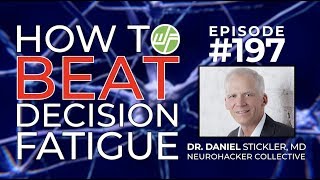
A live interview (May 10, 2018) where Josh Trent speaks with Dr. Daniel Stickler about the "human potential medicine" movement, nootropics (notably Neurohacker's Qualia and the newer Qualia Mind), and practical approaches to cognitive enhancement. Dr. Stickler describes his transition from vascular/bariatric surgery to systems-based precision lifestyle medicine, explains cycling strategies for nootropics (e.g., 5 on/2 off; rotating products), emphasizes whole-system optimization (sleep, exercise, nutrition, stress resilience), and discusses biomarkers and tools they use (QEEG, HRV, psychophysiologic stress profiling, DEXA, genetics). The transcript includes product mentions (Qualia, Qualia Mind, Solastris, NewPeP), a promotional trial URL (wellnessforce.com/mind), and several hyper-specific facts (see Answers).
Questions this video answers
May 10, 2018
52
wellnessforce.com/mind
100 days
Over 3,000
Chapters
Foreign. Sports here on Facebook, I'm sitting with Dr. Daniel Stickler. Daniel, welcome to the show. Welcome to Facebook Live.
It's great to be here. Thanks for having me.
I want to read a little bit about you. If people don't know about Qualia, if they haven't heard of Nootropics, if they don't understand who the key influencers are in human potential, let me share a little bit about you with the audience. Dr. Daniel Stickler, M.D. is the C.O. founder of the Aperion center of Human Potential in Asheville, North Carolina. He's the medical director of Neurohacker Collective right here in Encinitas. He's also a visionary pioneer behind the human potential medicine movement. A shift away from the disease model, the sick care that we all see, to more of a peak performance in healthcare in all aspects of life. Dr. Stickler, he is a physician to high performing entrepreneurs who want to optimize their life, who want to have superhuman capabilities. Now today we're talking about Qualia, his role with Neurohacker, and also understanding the deeper aspects of, of how to cycle nootropics, who they're for, and what are some of the biometrics and the biomarkers that can lead us towards the path of becoming our most radically and superhuman self. So, doctor, we mentioned in the bio about this new movement, this human potential medicine movement. What is that? I've never heard of that before.
Yeah, it's because I think we coined the term. Actually we started doing this about four years ago. It was a transition from my allopathic training. So I started off as a general vascular surgeon, started getting into wellness and stepped away from the surgery, focused on that, gradually grew the practice to what it is today. And what we do is we take a. I guess the easiest way to describe is we take a systems based precision lifestyle medicine approach to, to optimize health. It's not about the disease model. It's about optimizing the human state to first get it into homeostasis and then take it to the next level. But we tend to stovepipe everything and try to treat one piece of the whole puzzle rather than treating it all together. And that's what we're doing. I mean, we train coaches in this model, we've got clinicians in this model. We're opening centers around the country using this model.
So I see you're wearing the Hylead. For those of you listening on the podcast for itunes, we're here live. So Hylead is a company right here in Solana. Beach. What is your connection to this fascination you have with human potential? Athletics. Do you mind me asking your age? Because you're super fit, man.
Thanks. I'm actually 52 and I'll tell you my story about this because it was eye opening for me after being a surgeon, going through medical school residency, going through my 10 years of being a surgeon, where my sleep was terrible, my eating habits were terrible, I exercised pretty regularly, so I was not overweight or anything like that. But I got my telomeres measured and I came back at 10 years over my age, which was eye opening and shocking to me. Started doing a real deep dive into my own health at that point and said, something's got to give here because I'm not feeling this necessarily, but my body is aging more rapidly than time is passing. I became a biohacker. I became a transhumanist. I experiment with all kinds of things just to help mitigate this disease we call aging and optimize it to a point where we can take the human state to another level of function rather than just try to stave off disease. And it's been working. I mean, I'm down to about two years over my chronologic age on my telomeres now and still working at it, getting ready to try some new stuff that's supposed to be extending telomeres.
The fascination that I've always had with this n equals 1. We hear it about a lot in the health and wellness world. N equals 1. I am the person who's actually trying the different devices, the different supplements. Over a year ago, I got the pleasure of interviewing Daniel Schmachtenberger from Neurohacker. That was when you had the regular Qualia product. This Qualia Mind, which, by the way, it's available right now, just came out and there's a special discount. While we're watching the show today, you can link in the top Comments here. It's wellnessforce.com mind. It's a deep discount. It's a radically enhance of product for our cognition. Why did you guys make the transition to the two stages to the one? What is qualia mind?
Well, there were a couple of motivating factors behind that. One, a lot of people prefer not to have synthetic products for their enhancements. So the Solastris was a step back from the synthetic new PEP that is in qualia, but they also work a little bit differently in people. And I'm not sure what your experience is with trying both of them, but I actually cycle the two because I can't really pinpoint exactly what's happening. That's different. But I do get a different feeling with each one. And my productivity is still strong with both. But for me, I don't like to do something so regularly that my body gets into what we call the familiar zone with it. I like to push it outside of that familiar zone periodically. And when you're on something that continuously, it can kind of stall in that regard.
Is this kind of like the cellier model, where there's general adaptation, there's a response, and if it's too long of the same stimuli, then the body gets used to it quickly.
Right. And you know everything about the human state. And this comes down to epigenetics. We teach a lot of epigenetics. And that is the premise behind our teaching in epigenetics, is that, and here's the classic example, somebody comes in and they're deconditioned, and they start a weight loss program, which involves exercise. So they're exercising aggressively, and in three months, they're losing, you know, a couple pounds a month. They're doing great, feeling great, and all of a sudden their weight loss stalls, and they're like, I don't understand. I'm doing exactly the same thing. And now the weight's not coming off. Well, it's because your body has established a new familiar zone. You initially were down at this level, and you were periodically bumping out of that level in order to stress the body. So you're exercising, which the body was not used to. That's not its familiar environment. And so gene expression needs to change to accommodate that new zone. And so the zone gradually moves up, and suddenly, once you're in that zone, the body says, hey, I'm comfortable. I don't need to change anything to function and thrive in the environment that I'm in right now. So you've got to constantly push outside of that in order for productivity and improvement in the human state. And it's the same with exercises, same with, with brain health. All aspects of the human are about adapting to an environment. And if you're not stressing outside of that environment periodically, you're not in a growth phase.
This eustress and distress with this hormesis. These eustress, distress, and hormesis. Explain these three, because I think a lot of people don't understand that cold showers, these different ways that the body adapts to stress, these are actually really healthy for us. And how do nootropics play into that? Let's contrast those pieces.
Well, not sure exactly how to put how nootropics play in necessarily. But in eustress, I mean, it is a stress that you are, you're inducing in order to create change in a positive regard. It's just like, you know, we eat vegetables and vegetables we think, okay, these are healthy because they have all these vitamins and nutrients in them. Well, to be honest with you, or to understand the true nature of what we're doing with vegetables is we're getting low dose toxins on a regular basis in those vegetables. And those low dose toxins upregulate our detoxification process. So our enzymes, our cytochrome P450s, our glutathione, our catalase, our thyroidoxins, they're constantly getting a low dose exposure without getting into a detrimental toxic level. They're in what you would call eustress, where it's stress, but it's not damaging stress. It's at a point where the body's adapting in order to be better.
We're at this point of humanity too, where the foods out there, they're not necessarily even healthy from a nutrient standpoint and there's so many chemicals that are sprayed on these pieces. Is that kind of adding to the eustress and distress model or is that more distress?
Well, you know, I have this discussion a lot because I'm involved a lot in the ancestral health and the paleo world, evolutionary biologists and all this, and have long discussions with Daniel Schmachtenberger on it as well. You know, if we took somebody from today and we said, okay, we're trying to live like our ancestors did, and we took them and we put them back 12,000 years ago into that world that existed at that time, we would not be well adapted to that world, period. So it's not like, oh, this is the ideal world that we need to be in because over time, through genetic adaptations of epigenetics, not gene mutations, because our code has remained the same over these tens of thousands of years, but our gene expression is changing. Those epigenetics and those epigenetics change through transgenerational. So what you do now is going to affect four to seven generations out as far as gene expression. So if you're exposed to a lot of toxins in this environment, your gene expressions, they'll tend to adapt better. You know, it's not necessarily healthy, but they're adapting to that stress of that environment, of what they're experiencing in order to thrive in that environment. So over the tens of thousands of years, we've gradually adapted under dietary changes, under the manufactured chemicals that we're exposed to, the air pollution, all of this. We're gradually adapting to that. If you don't adapt, it's the whole Red Queen theory. You have to continually adapt in order to, to thrive and survive.
What's the Red Queen theory? I don't think we've heard of that before.
It's an evolutionary biology term and it's about why we reproduce and die, essentially. But it also applies to adaptation because in, in Alice through the Looking Glass, the Red Queen race, Alice was running with the Red Queen and the ground was moving underneath and they had to run faster and faster just to stay in one place. And if we don't have competition, if we don't have stress that forces adaptation in the environment, we will basically become extinct. We constantly have to adjust to these environmental changes. That's one of the theories as to why we age and die too. Because the major push right now is that it's programmed into our genetics. If we didn't age and die, we wouldn't have the ability through these transgenerational processes to develop adaptation to the changing environment that we live in. So we have to turn over the code and the expression of that code.
And we're constantly under stress. Either it's emotional stress, physical stress. And this is why this is such an exciting show because we're talking about this blended intersection where you live, doc, at human potential, cognitive enhancement and this renewal of true healthcare, going away from sick care. So this human potential, this movement here, nootropics, they're something that add, they're a supplement. They're not possibly. Well, maybe they are the holy grail, I don't know. But they're definitely something powerful that can help all of us as the demands of our day increase, as the really attention deficit disorder that we're all kind of under. Our phones, our calendars, everything else. How do nootropics play a role in eliminating some of the decision fatigue, some of the monstrosity of stimuli that we are attacked with all throughout the day?
I think a good example, and I'm probably misquoting this, but it's pretty close. But we're exposed to more information in one day than the people in the late 1800s were exposed to in a seven or eight year period. That's how much information that we're actually needing to process throughout a day. And that amount of information requires a lot of metabolism in the brain. The brain. Think of the brain like muscle. The more you use it the more fatigue it gets, the more it uses up nutrients. And our brain is 20% of our daily metabolism. But if you start doing a task, you're up regulating that. So people like me and you entrepreneur types, those kind of things that are constantly reading, constantly learning something new, constantly watching something new. Our brain metabolism is actually really high and we run out of gas frequently. That was the great thing about qualia when I first found it was it was the first nootropic I found that actually took a systems based approach, like we do in our health and our medical practice, but they took a systems based approach to say, okay, how do we optimize the brain? So it's great that we can upregulate all of this processing power, but are we going to run out of gas? Do we have enough acetylcholine to be feeding that system? And then with all that metabolism, we're producing a ton of free radicals. Do we have something in place to mitigate that free radical production? And I mean, they looked at probably 20 different pathways that integrate and came up with a formula that. It was interesting because before I reached out to them, I had many clients trying it because I've tried cognitive enhancement in my practice for many years and 50, 50 on most things. You know, with the, the products that were out there, we would get about half the people that said it worked well for them. Half said, you know, even with the prescription medications and with quality, we were seeing about 95%. And. And I was like, okay, I gotta, I gotta reach out to them and find out what they did different here. And that was when I had the conversation with Daniel Schmachtenberger and just, I was blown away because it was finally somebody who had a philosophical approach similar to mine and had applied it in brain chemistry, which just was amazing. And we actually did QEEG analysis studies to see what happens before and after taking qualia. And the results were pretty consistent with what we saw in clinical practice. We're getting ready to do something like that with the mind product too, see if we're getting similar outcomes.
This is really exciting to me because I'm really a data and a Quantified self geek. 2014 is when I really dove in. And so I love data. I know you do as well. You work with people for a year minimum at your human performance center. Really, you're, you're at this bleeding edge of people that want to have the best quality of life possible, but not just energy, not just clarity in their mind, but also their physicality the way they interrelate to their wife or their husband or whoever it might be. Like, why a year, Doc? Why is a year at the minimum time that you work with people?
Well, I've. I've tried different processes to see what works best. And apeiron actually means limitless. That's the Greek term for limitless. And it's about the limitless nature of the human state and what we've seen. And we're actually seeing the science behind this with the epigenetics. But what we've seen is the ability to really upregulate the human state through this process of lifestyle factors, through this process of technology, through this process of research chemicals and things like that. We've got some great stuff that can improve vitality. Smarter, faster, stronger, greater longevity. And that's what it's about for us is really how can we have youthful longevity as we age? Because the worst thing for me or for my clients is to not be functional. And thing is, we have things right now that can actually upgrade the function. And people kind of cringe at the term transhumanist and all this, but really transhumanism is out there. I mean, people with hip replacements, people with cochlear implants, people have their cataracts removed and a lens put in. I mean, that's transhumanism. I just saw that there's a new bionic lens that just came out that's going to be available for human trials here in the next couple months that will actually be able to magnify and telescopically see things. And I'll be first on that list. I mean, I'm all about the sovereignty of the human state and being able to take this. And I have to be careful in the medical practice because, you know, standard of care is a pretty strict system that when you step outside of that. So a lot of the times I'll provide information for clients without recommendations. There's a lot of really good research chemicals out there that have really good trials, you know, experiment with them myself. Always try something before I even talk about it. So it's.
You are the ultimate n equals 1 too. In this year long, you're not just looking at their physical specimen data, you're looking at biometrics, blood work, emotional intelligence analysis. You're doing a barrage of different tests. What are some of the ways that you use tech to support the human condition? And also in your practice, how do the cognitive enhancers play into that role with your patients, with your clients?
Yeah, so we do cognitive testing yearly with our clients. So we look for what changes. We look at a baseline 22 lead QEEG analysis to look at brain mapping patterns, brainwave patterns. And we're not looking for disease model, we're looking for, okay, is this pattern going to be productive for you? Because most high achievers are going to have an abnormal pattern when it comes to looking at a normative database. You don't want to bring a high performer down by trying to normalize their brainwave patterns. You want to find out which ones are beneficial and which ones are not. So looking at the brainwave patterns in that regard, we do a psychophysiologic stress profile, which is really one of our most valuable tools. We hook you up to what looks like a lie detector. So we're measuring skin conductance, skin temperature, heart rate variability, breaths in the belly and abdomen, muscle tension, expired carbon dioxide levels. And we take you through five stressors, and we see what happens to the physiologic parameters during the stressor. We see what happens when the stressor is removed. Do we get back to baseline? Because that's what it's all about. Stress is not a bad thing at all. Stress is really an amazing thing for performance. But when the stressor is removed, you want to be back to that Hindu calm state of, okay, I'm back in idle and I'm ready to go again. And we see a lot of problems with people in getting back to that baseline. And they kind of what we call stair step during the day. So this stressor added on this stressor added on this stressor tends to really tax the system pretty substantial.
This is why when people get to the end of the day, they, they reach for the chips, right? Because their, their, their decision fatigue is completely spent. Their cognitive capacity is diminished, Their physicality is under load. They just want to rest. And so in this process, do you walk people through how to avoid that? And then how do nootropics play into that?
Yeah, I mean, we use, we use nootropics because one of the, and, and this was the philosophy of neurohack is that, you know, how do we make the greatest change in the world? Well, we improve brain capacity. You know, when people are smarter, when they're more productive, when they're able to reason better, when they're able to connect consciously better, then the world changes. You know, that's, that's a big step of it, and that's a big step of taking the human system to, to the next level. I work, I do video calls with each of my clients, 30 to 40 minutes a month, once a month. So every month I'm on a video call with them, and they're all wearing tracking devices. So I'm monitoring their hrv, I'm monitoring their sleep patterns and monitoring their activity levels. And when I'm on a call with them, I can actually pull them up and see what's been happening over the last month. So, you know, I had this guy the other day. He'd been doing great and everything was fantastic. And then I looked. And the weekend before, his sleep, even though he was getting seven and a half hours of sleep on a Friday and a Saturday, he only got. His quality of sleep was severely diminished, and his actual sleep time was only like four and a half hours both nights. And the next three days, his heart rate variability just plummeted into the red. I mean, it was just way down. He said, I felt like crap. And I said, well, what happened? What happened on Friday and Saturday night? He said, well, I was at this conference and we went out drinking both nights. And I see that pretty routinely with alcohol is that even one or two glasses of alcohol, HRV drops off pretty dramatically and sleep quality drops. So if I see that, I try to recommend people to cut back or eliminate the alcohol as much as they can. But this quantified self stuff is so valuable in the coaching. And I say, I'm working with clients on these calls. I'm not working so much as a medical doctor. I mean, I use my medical expertise as a background on it. But I'm a coach. You know, it's no different than a business coach. I'm a lifestyle coach. I am working with you to interpret these things. Every month we say, okay, what's working? What's not working? You know, are we seeing. Not only are you feeling this, but are we seeing biometric markers that are indicating that this is something that's truly positive for the. For your system. And if it's not, we step back, reevaluate, and say, okay, let's try this. Let's try this as a next step. And so this ongoing process, and I found if I went every three months with that, I wasn't. People will lose focus. But once a month is intensive enough that people retain the focus through the year. And that's why we do the year program with monthly calls.
Yeah, this year long, it takes real behavior change. No matter who the influencer says that's blocking it out for the different segments of contemplation, pre contemplation, taking inspired action and all the different Pieces that go in there. It takes time, doc. It takes time to really change the human. And this bridge that you've connected with data and with your medical expertise, it's fascinating to me because you used to be in a completely different branch. You used to be actually in weight loss surgery, and then you left all that behind, and now you're the medical director at Neurohacker. You're also the co founder at your human performance center. How did that even happen? I mean, you went from a completely different time, really a different land. You went from the land that time forgot.
Well, it actually isn't that divergent as you would think. I mean, I got into medical school and quickly disenchanted with what I was experiencing. Disease model, stepwise postponement of death. It wasn't about enhancement or making life better for people. And the two options I saw were pediatrics and surgery. I had no interest in pediatrics surgery. I loved. I loved the technical aspect of it. Became very adept at laparoscopic surgery. And then I actually discovered one aspect of surgery, which was weight loss surgery, where you could take somebody from a baseline and you could bring them up in quality of life through a procedure very rare for that in medicine at all. And so I started down that path. I did over 3,000 weight loss surgery operations. And then I came to that kind of conclusion that it wasn't the right thing to be doing. I mean, it worked for a very small percentage of people, but overall it was not inducing a lifestyle change. It wasn't the right way to correct a system that was out of homeostasis and started gradually overlapping a little bit with doing wellness as a hobby on the side, and realized that that was what I was passionate about. That's what I really wanted to do. So In December of 2009, I walked out of the operating room and just said, I'm done. No warning. I just quit.
And shock to your colleagues or you just like, peace out, I'm done.
Yeah, the staff, my family, you know, my wife was. Was great with it. She knew it was going to happen, I guess, but she said was very happy about it. But the. Everybody else around me thought I had lost my mind.
This is like you really felt your soul's calling. And when I experience you now, my experience of you as somebody who's living their life well, you're helping other high performers and everyday people live their life well. What's the contrast then between nootropics and weight loss? You came from this world where there was weight loss surgery. Now you're in this world of optimization and how dootropics play the role for weight loss.
Well, number one, if you are doing something for the purpose of weight loss, you've already failed. Weight loss is not a goal, it never should be a goal. Your goal is to get healthy. Weight loss is a consequence of achieving or that path to healthy. So never look at anything as weight loss. That's the one thing I have learned from being a bariatric surgeon and a bariatrician as well as that you can't do weight loss. It's just an automatic mindset failure from the get go. So when we look at weight loss, we don't look or we look at getting healthy and losing weight. We focus on body composition. So we do DEXA scans and we look at muscle mass, we look at fat mass, we look at changes in those over time. We're focused on that dynamic of the human system and not oh, what's your weight on the scale, you know, what are we doing here? Now cognitive enhancement is again a piece of that. So I am not going to have success if the person isn't sleeping, if the person isn't eating right, if the person isn't exercising, if the person is not mitigating stress and optimizing stress response, if they're not optimizing cognitive function. So I don't focus on anything. I mean even when people come in with, they say, oh, I have diabetes. No, you don't have diabetes, you have, you have insulin resistance because of a lifestyle and we're not treating your disease. We're going to treat the human state, we're going to bring you into homeostasis and let the body do what it's designed to do, which is to correct the systems that are not in alignment. And so we do that by getting them sleeping again, getting them eating right. We do genetic testing. I mean we look at 600 gene variants and we see what propensity wise is going to be the best diet, the best supplementation pattern, the best exercise pattern based on probabilities. Genetics is nothing more than probabilities. And it's a guide, it's just another biometric we use. But it is never an absolute. Epigenetics is the magic. That's where we understand certain things can change expressions and that's what we shoot for.
The epigenetics model. There's the epigenome, but then there's also different things that are happening with microbiota and how that's expressed and how literally we're changing every single Day these signals to our genes through epigenetics are changing so consistently. I mean, do we even need to know? Do we even need to map the epigenome? Is that even a thing?
It's not a matter of mapping the epigenome because it's such a dynamic process. I mean, you eat one meal of fish and you alter expression of several hundred genes. You eat that fish meal for six months on a regular basis. You alter expression of 3500 genes. You exercise one day, you change gene expression sometimes good and bad. It depends on the stress that you create. You exercise regularly for six months, you'll change over 7,000 gene expressions in a positive way. 7,000. That's a third of our genome, of our genes, just from exercise. From exercise, meditation. We always knew, hey, meditation is great for you. Why? Well, I don't know. It's really good for health. We know health outcomes. Well now we understand what meditation does in the short term in an eight week cycle versus what meditation does over six months as far as the changes in expression of genes. But I mean this process is so dynamic that even if we could, there are certain methyl marks that are kind of written in pen versus written in pencil. The ones we have control over are written in pencil and we can erase, we can add, change the expressions of genesis, some of the transgenerational stuff like early childhood trauma, trauma of the mother during the pregnancy, exposure to envirotoxins during the pregnancy, some of those can actually put marks on that are pretty well written in pen that we have to kind of work with. And we can measure those sometimes on blood tests. We can look at changes in methylation patterns on blood tests when we look at the epigenome. But to actually map the epigenome itself is a daunting task. And then once we get beyond that, then we have to get into the transcriptome and the metabolome, the microbiome, the virome, the exposure, a lot of ohms. Yeah, it's a complex process.
It's not getting away, man. And not getting away. They're just part of who we are. It's not like they're getting away. We're really, we're in this process of evolving, of optimization. The human. I want to set a pin for that because that's fascinating to me. We had a question that came up for you around the quality of mind. Lynn Marie says this is awesome. Looking forward to trying mind would love to know why they took lithium out of the new formulation and how they.
Decided what stays that was that was a difficult process and a lot of it was. It's not real specific. There were a couple products that we took out based on synthetic aspects or a couple products we took out based on some newer research that showed like, like terrastilbene. There were some issues with the Terrapur that it was being pulled from the market. So we that out. But the, the lithium, you know, I like lithium and we didn't really have any complaints about the lithium in there. I just don't think it was when we looked at the, the mapping of it. I mean I have to get really specific with, with Daniel on that, but it just wasn't necessary in the product when we tested it. And I've been, I've been on the mine for six months now intermittently because I got to try some of the early samples of it and a couple renditions of it.
You were an early adopter.
Yeah, I really liked it from the get go, especially the fact that I landed take one which was. Or one dose rather than have to remember that second dose of the Qualia. That was very helpful for me and a little bit less in the volume of the pills. But yeah, some of the stuff was taken out just because we said, well, you know, how important is this in this whole process? And looking at the whole map of it, we just said, you know, this is probably something we don't need to have in there.
It's fascinating too because you went through this change Celestrous as a plant, which replaced new pept, a synthetic. This was a big change. And what I've noticed, I've been taking the new product here for about a week. I take two to three and I don't have to take any more throughout the day. And it's that same focus, clear energy without the deep crash that I get from coffee. Do coffee when I do qualia mind or regular Qualia. Do you still implement caffeine when you're taking nootropics?
Yeah. You're asking the wrong person. I go through about 10 to 12 cups a day of caffeine. I am a caffeine fiend. It is the nectar of life.
You don't seem like you're spazzing out though. You seem very clear, very present.
Well, you know, my comfort zone is up here with caffeine, so I'm well established in that zone of 10 to 12 cups a day, I think. But no, I mean, you know, I like that, I like the mind product, but I also like the, some aspects of the, of the Qualia. So I rotate the two usually, usually I'll, I'll do two days, two days in one week of one and three days in the week of the other. Usually taking the weekends off. I just don't like to, I like to keep my system out of getting into a new comfort zone with it and, and that seems to work well for me. Everybody's a little bit different in that regard though.
Let's circle back then because we know that there's been some changes to the product formulation which by the way like iterating a product. We respect that. If you just had the same product for years and years and years, it probably means you're not doing your diligence. So I think people in the health and wellness community, especially with paleo effects coming up, there's going to be such a buzz around. What kind of things can we actually consume that'll help the human and so helping the human physically and emotionally. You talked about childhood trauma in Childh, how that can imprint certain parts of our genetics that might express and that might lead us down an unhealthy path. How does the work that you do and how might nootropics play into that, that trauma, that imprinting in the nervous system?
Yeah. So one of the biggest things is BDNF imprinting brain derived neurotrophic factor. And BDNF is highly susceptible to kind of cpg island methylation in the developing state. So trauma during the pregnancy trauma or child neglect in childhood tends to methylate the BDNF and methylation means it turns that gene down, turns expression down dramatically. And BDNF is one that you definitely do not want decreased production of. It's memory learning, neuroplasticity, neuroprotect and it's important for athletic performance. I mean it's just a ubiquitous protein. And so what we'll do, I mean when we get genetic code, I may see, oh they've got a bdnfcc so they've got a normal code. But I'm talking to them and they've got all these expressions that indicate that there's a problem. So I'll say, you know, did you. Was there anything in your childhood that was trauma? Like I had a woman the other day who said yeah, my father died while my mother was pregnant with me about midway through the pregnancy. So it was a high stressor and she had obvious signs of BDNF downregulation. And so now we say okay, what can we do? Well we know that like Bacopa moneri which is in the mind and the qualia product, very good about boosting BDNF production in the brain. We do things like Holy Basil or Tulsi, you know, ancient ayurvedic herbal. That is just amazing with what it does. I have everybody take Holy Basil. This is the cool thing. I have to diverge here for a second. Go off on a tangent on Holy Basil. Holy basil is this neat thing because it's the ursolic acid in the Holy Basil that when we take it, it goes into muscle and within muscle it upregulates growth hormone expression in the muscle or IGF1 in the muscle. So you're actually getting more IGF1 in the muscle. You induce a gene called FNDC5. FNDC5 then gets out into the blood, goes to the liver, gets converted to something called irisin. And irisin goes to the brain and gets converted into BDNF or upregulates BDNF expression. And so exercise boosts bdnf, but it boosts it through this process. And now we can take a pill, an herbal that will actually replicate a bunch of that process. So we know how to upregulate BDNF expression. So if you have methylation and you have a reduced expression of it, are there things that we can do to boost that? And that's what epigenetics is about.
The bdnf. Tell us what that is and why that's so important to optimizing our emotional intelligence.
Well, brain derived neurotrophic factor is important in all aspects of stress, adaptation of memory and learning, sleep. It brain derived neurotrophic factor. Just all the processes it's involved in in the brain are about. You want plenty of it. We know that deficiencies of this memory impairment, difficulty learning, higher incidence of depression, suicides, it's just, it's one of those ones that, that upregulates neuroprotection, upregulates the growth of new neurons, upregulates the connections between new neurons. So it's something you definitely want to have as much of as you can. I mean, there's definitely limits in that regard, but you certainly don't want to have a deficiency in brain derived neurotrophic factor.
I love how excited you got when you started talking about Holy Basil. You're like, hold on, we need to circle back, right? So, so we talk about this bdnf, how it can really support our best emotional selves. This is in the qualia mind. Was it also in the first version yes.
Well, Bacopa, Yeah, Bacopa was in there. That was one of the things I was so impressed with because a lot of companies use Bacopa, but they use too low of a dose. When I started looking at the product qualia and I was like, wow, they actually, they use the right dose of these ingredients, so 300 milligrams of Bacopa, adding uridine to really help with upregulation of choline uptake in the brain. Nobody does that. And I was just like, okay, these guys know what they're doing. This is. This is really impressive. And that's what kind of drove me to connect with them.
It's funny because there's this sick care system, there's the healthcare system, and then there's optimization. Do you think as time moves forward, we're going to have the healthcare system, the true, you know, real proactive healthcare system that we all deserve? Is that going to start to combine? Are we going to start to see more care and more money that's given to human optimization, more proactive care? What are you seeing in that regard?
No, I think you're going to see a divergence in the field. We say, basically what we're creating is not a. We're not fixing the broken system, we are creating a whole new model because it's so broken that it's not fixable. And here's my philosophy on it. The human system is a complex system and I want to explain the difference between complex and complicated. Complicated systems can be modeled. Complicated systems, when you have X input, you will have y output with 100% predictability. And medicine has taken this approach that the human system is complicated. That's why we have all these algorithms. Oh, you have a blood cholesterol 200. Okay, well, here you go on a statin drug. That's a algorithm that is only applicable to complicated models. The human system is complex. And the example of the two systems I always use is a flying machine. So we have a plane here, we have a bird here. We can take a reductionist approach and break every piece of that plane apart and tell you exactly what will happen based on any input into that piece and how it creates an output, 100% predictability. Whereas the bird, you can't do that. You know, you fire a cannonball under the exact same environmental conditions, the same amount of gunpowder, the same weight of the cannonball, you can predict with 100% certainty where that cannonball is going to land. You release a bird under the exact same conditions every time you're not going to predict where it's going to land complex system. And you know, right now we're heading towards AI in healthcare in sick care. And there is a role for AI in sick care, but we're going to see this taking over the whole system within five years. AIs are going to be managing most of our sick care system and it'll work well for people that are seeking sick care. And you know, when you're truly ill in an acute illness, our sick care system works well for health. It doesn't. And so what we're seeing is that this new model is going to be about coaching lifestyle. I mean think about this top 10 reasons that you're going to die here in the United states. The top 10 leading causes of death. Seven of those top 10 causes are 100% lifestyle related. The other three have lifestyle as a huge component of them. And yet that we're not addressing lifestyle, we're not addressing sleep, we're not addressing stress, we're not addressing nutrition. You know, and, and there is not a universal answer for everybody because we are not a uniform species. There's inter individualized approaches that we have to use. Because your genetics are different than my genetics. Even though it's less than a 2% difference, it's a huge difference when it comes to how we interact with our.
Environment then really this is the most powerful tool I can imagine because everything that we experience emotionally is through our physical lens. If we're taking care of our eating, moving and sleeping for the physical, then we can have clear thoughts and feelings and actions from the emotional side. They blend in hand. So how do we cycle this then? I mean I'm in. I've been using this for a while. I'm really stoked on the new one. I like not having to remember. I always used to forget to take my stage two later on in the day. So now I'm glad I could just take it in the morning. But how do we cycle this? Doc, what's the cycling component of Nootropics again?
That's an individualized approach. I certainly don't recommend taking it every day. Your brain needs a break from this and mainly because of the adaptation that will occur, you will get adapted to the point where you will not derive those great benefits from it every time you take it. So cycling through it is kind of ideal. I like the 5 on 2 off approach, but I've really been liking using the combination of the mind and the qualia for different things. I mean, you know, if I'm and this is weird and it's probably very subjective to me, but qualia works. Qualia mind works better for me for creative and qualia original works best for get things done.
Got it. Thank you for that clarification too because.
But that's, that is certainly just me. That's not something.
Yeah, everyone's got their own unique signature. Right. I always think about, you know, we have this thumbprint and our thumbprint is unique to us. Well, it's the same thing on the inside. And this is what you really have dedicated your life's work to is to understanding our internal thumbprint, how we're operating at this most high state. And just thank you for the work that you do. People can pick up a deep discount for this. They can go to wellnessforce.com mind doc. Did we miss anything? We talked about cycling, we talked about why you left the weight loss surgery industry to come now. To serve people at their deepest core, to produce at the highest level. We went a lot of places in this conversation. But for people that maybe are just tuning in or they came in late on the Facebook Live, what did we really talk about today that you think is most important to reiterate?
Well, I think it's most important to really understand that it doesn't matter whether it's upgrading the human system, improving cognitive performance. You can't take it as a, you know, focusing on one aspect of how to do that. You've got to look at the whole system of the human state and say, you know, I can upregulate this, but at what cost? And if I upregulate this, I'll have to upregulate this in order to sustain, sustain that. So look at the, everything that you do and don't, don't focus on, oh, I need to eat better. If you're not going to exercise and sleep, sleep, you know, it's just not going to be a complete picture for the body. And so I think working with that and you know, are you going to be a Paleo?
I'm not going to be at Paleo this year. I'm announcing it because I'm going to be at the Hurley event with Intelliskin and we're going to be meeting with all these world class surf athletes. It's going to be amazing. Brian McKenzie is going to be there. But I'm so bummed, I'm so sad because all my friends and you are going to be at PaleoFX so I'm sure people can learn more. You're going to be there probably speaking. Maybe even doing some lunges down the walkway, competing with Monsal and everyone else in the athletic area.
Oh, I. I don't know if I'll be competing. I'm training for a Spartan right now, so I've got to get that under my belt next month. Cool.
Well, we've so enjoyed this time. And for the people that are just tuning in at the end here, make sure you go to wellnessforce.com mind give this a trial. There is 100 days where people get to try it. So if you want to have more presence, more emotional connection, more connection to what's really going on in your body. This is not the Holy Grail. I pose that as a question. Like, is this actually the Holy Grail? No, it's not. But if you eat, moving, sleep, and you're taking care of your thoughts and your feelings and actions and you supplement with something like quality of mind, well, you might be living from a better place. And maybe that's the holy grail for all of us, Doc.
Yep, that's the bottom line. It's just about doing the best we can do and making the effort. But, you know, also, I like enhancement, too. And let me close out with one thing, because this is something that you touched on a couple times we were talking about Solastris versus New Pep. And I've had this discussion pretty in depth with Daniel as well. We tend to look at things as natural versus synthetic, and we need to try to dissuade that, that thought processing. And the reason I say that is we need to start looking at things that what does it do to the system? So if I have this input that I put into the system, what's it going to do? Don't look at it from a value judgment of natural versus synthetic. You know, Daniel has the argument that, well, there's. There's evolutionary testing of these more natural products. And I agree with that. You know, we've had adaptations to those over time, but that doesn't mean that new things aren't beneficial. We have synthetic sarms right now. We have other synthetic peptides that we can use that have some amazing outcomes of the human state and in fact better than some of the more natural products. So don't look at things from a natural versus synthetic state. Look at them as an input to the system. Does it create the desired outcome? Does it have any side effects to the system with it. It. But I'm just trying to get that. That kind of thought processing kind of shifted in people because I think people limit their access to things because they get focused on, oh, it's better because it's been chemically tested and all this, versus it's better because it's natural. And there's not a right answer with either of those.
I love that you said that, because this is about trying on the sweater and seeing if it itches.
Right.
We have to go through the learning process, process ourselves. This is part of all of our hero's journey. Doc, thank you so much for joining us on the show today, man.
All right. It's great to be here.
More from Josh






Your child's future start before pregnancy... and even before conception! #podcast

MD Reveals: Your Healing Creates Your Child's Reality (The Souls Coming In Need Strong Bodies)



