How To Change Beliefs That Keep You Stuck... And Stop Suffering
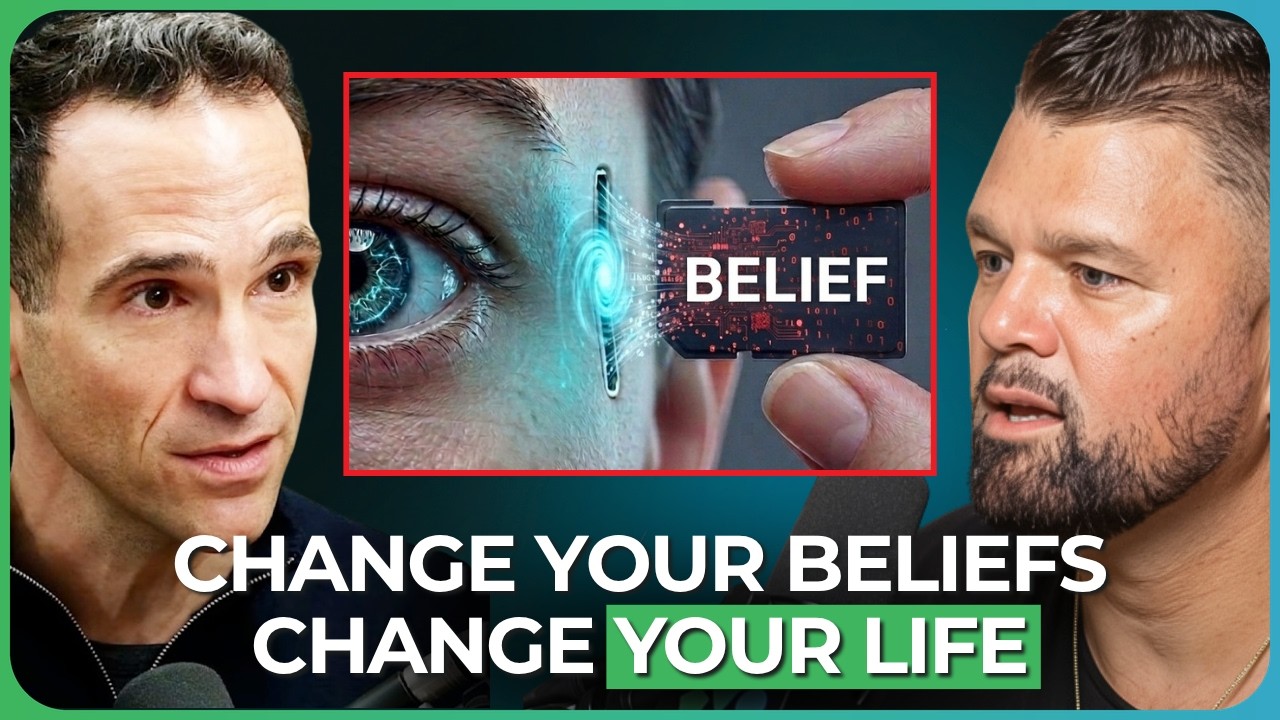
In this interview, Nir Eyal and host Josh Trent explore why people remain stuck despite having resources and information, arguing that the root cause is the way beliefs shape perception, motivation, and behavior. Eyal introduces the "motivation triangle"—knowledge of what to do, why to do it, and the belief that holds the triangle together—and shows how faulty beliefs generate suffering. He walks through the Byron Katie "turnaround" method and the modern, research‑backed Inquiry‑Based Stress Reduction (IBSR) process, illustrating it with a personal story about his mother and a broader example of Daniel Gistler’s hypnosedation surgery, which demonstrates the brain’s ability to separate pain from suffering. The conversation then expands to related tools: the placebo effect, the distinction between pain (data) and suffering (interpretation), mental contrasting used by athletes, the power of prayer (studied across faiths), and the ancient concept of Maya as a mental simulation driven by predictive processing. Eyal also outlines the three powers of belief—anticipation, feeling, and agency—and shares three core lessons for his daughter: intellectual humility about the limits of perception, recognizing one's untapped capability, and understanding that beliefs shape perceived reality. He illustrates how applying graceful, liberating beliefs transformed his relationships with his mother and daughter, reducing suffering and fostering connection. Throughout, Eyal emphasizes that beliefs are malleable tools—not immutable truths—and that changing them can unlock persistence, reduce suffering, and improve outcomes across health, performance, and relationships.
Chapters
Beliefs are tools, not truths. You know, did you ever notice that the word belief has lie right in it? One of the biggest lies that our brains tell us is that we see reality clearly. Yeah, none of us do.
Nir Eyal is a New York Times bestselling author and speaker who focuses on the intersection of psychology, technology, and business. Why do so many people stay stuck for years and call it fate?
We don't fundamentally understand what we need to succeed. If that's all it took was knowing what to do and why you want to do it, well, then we would all have 6-pack abs and be multimillionaires. There's clearly something else missing. And what's missing is that you make a vision board, a 5-year plan. It starts from a place of lack. And until I am wealthy, I suffer. Until I shed my weight, I suffer. Until I have love in my life, I suffer. That's not true. You don't lack anything unless you believe you do. This is the unlock. Daniel Gisler. He does this 55-minute surgical procedure where metal screws are wrenched from his bones completely awake. No anesthesia, no topical. Tens of thousands of people have done it. It's not that uncommon. Here's how it works.
I want to start with a quote from Carl Jung, and I know you've heard it before, but he says that until you make the unconscious conscious, It'll rule your life and you'll call it fate. And so I'm curious for you, Nir, why do so many people stay stuck for years and call it fate?
Oh, what a great question. And this is really the fundamental question of my work over the past 6 years is why is it that we can succeed in one area of our life and we feel like we have things under control, we can excel in one area, and yet in other areas we're stuck? Why is it that some people succeed and others don't, even when they have the same access to resources, the same information, the same skill, the same talent, and yet One can excel and one doesn't. And I think the answer is that we don't fundamentally understand what we need to succeed, that we think that if we just knew the right answer, right, there's some kind of magic secret out there. If I just watch the right YouTube video, or if I just, you know, bought the right book, if I just stumbled across the right secret that successful people are holding on to, then I would know. Then I would know. I just need one more course or one more, you know, insight. Yeah. And that's clearly not true. I mean, all the secrets are out there, right? Anybody who has anything to say, they write a book about it. They, you know, they make some kind of YouTube post on it. Like, you know, the information is all out there. If you don't know, you know, Google it, buy a book about it, ask ChatGPT. The answers are all out there. So it can't just be information. It's, you know, the model of how we stay motivated, I think, is outdated and wrong. That I used to think, you know, I, I took, uh, I was an econ major in college and they taught us that if you want some kind of benefit, some kind of incentive, you'll do the behavior. That's all it takes is a behavior to do the benefit. There's always a straight line. If you want a particular benefit, you do the behavior. And if you want, and if you do the behavior, you get the benefit. That's, you know, straight line between the two. But there's clearly something missing that if that's all it took was knowing what to do and why you want to do it. Well, then we would all have 6-pack abs and be multimillionaires. There's clearly something else missing. And what's missing is that motivation is not a straight line between behavior and benefit, that motivation is a triangle, that in order to sustain motivation, we have to not only know what to do, we also need to know why we're doing it. But most importantly, we need to have the belief that holds that motivation triangle together. So for example, Uh, if you don't believe that your boss has your best interests at heart, if you don't believe in your boss's leadership, you don't believe they're gonna give you that raise or that promotion, well, are you gonna stay motivated to keep working hard for them? Probably not. You'll eventually quit. Conversely, if you don't believe in your own ability to do a particular behavior, right? I'm no good at this. This is too hard. I'm not cut out for it. That's not the kind of person that I am. If you don't believe, even if you know exactly what to do, if you don't believe you can do it, you'll also quit. So fundamental to, to sustaining motivation is understanding the powers of belief, that beliefs change what we see, what we feel, and ultimately what we do and who we become.
In writing this book, what's a belief that shifted for you?
I think for me it was the beliefs I had around my relationships. So one belief that I hung on to for a very long time was that My mom was very judgmental and hard to please. Uh, you know, that's been around for decades that I believe that, you know, I carried that for a long time. And I remember a couple of years ago while I was writing the book, I wanted to do something nice for her. So I sent her some flowers. The problem was I was here in Singapore and she was in Central Florida where I grew up and sending flowers to the other side of the world, not so easy.
Yeah.
But I did it. I stayed up till 1 in the morning calling up the right florist, getting exactly the right bouquet that I was sure she was going to love. And I honestly went to bed that night thinking that she was going to call me up the same day, or sorry, the next day for what I, and tell me what a wonderful son I am. And that's not what happened. What happened was I called her up and I said, hey mom, happy birthday. Did you get the flowers I sent? To which she said, I did. Thank you. But just so you know, the flowers that you sent were half dead. So don't order from that florist again. To which I said something like, well, that's the last time I buy you flowers. And, uh, my wife who was sitting right next to me, you know, we work together, she's my editor and she knows the research that I've been working on, uh, for this book. And she looked at me, uh, having heard this entire conversation and she turns to me and she says, Nir, would you like to do a turnaround on this? To which I said, no, I do not want to do your touchy-feely hocus-pocus mumbo-jumbo. I need to vent.
Yeah, right.
That's what we're told to do, that if somebody hurts our feelings, if someone offends us, we can't hold it in. We're supposed to speak our truth. We're supposed to tell them how we feel. We're supposed to get it off our chest. Well, thankfully, I knew enough at that point that venting doesn't work. That actually what the psychology literature tells us is that when we vent about people, we're just reinforcing our beliefs about them. So when we say to ourselves, there she goes again, she's doing it again, she's so judgmental, that's so like her. We are distorting who that person really is because we don't see people as they are. We see people as we are. In fact, we see reality not as it is, but as we believe it to be. So constantly, you know, venting about people reinforces this effigy of them, which doesn't allow us to see them clearly. And so I took a step back and I took my wife's advice and I did a turnaround. And that turnaround, I can kind of walk you through how this works. But, uh, that turnaround has changed not only the relationship with my mom, the relationship with my daughter, the relationship with, uh, various people in my life in a way that I never imagined. And I can walk you through kind of how that worked if you'd like.
Before you walk us through, I remember reading that. I think it was in chapter 1 or 2 when you shared it. And I was like so honestly proud because you've come from, you know, early video games, then Hooked, then Indistractable. I read both those books as well. Our last podcast was seven years ago, and I have probably quoted you. No shit! I've probably quoted your model fifty to a hundred times. Even with new guests that sit down here, I'm like, "You have to check out Nir's work." Even Paul Chek, a mentor and a friend of mine. I believe you guys have podcasted. So this work is so needed when it comes to beyond beliefs. The reason I'm giving the backstory for the audience is you talk about Byron Katie. with the turnaround and the 4 questions. And that was the model that, that I think really shifted your relationship with your mom and the flowers. Now, can you please share first how you found Byron Katie? I would never imagine that you as an academic, as a researcher, as an author would find Byron Katie, but it also makes perfect sense. It makes perfect sense that you found— so how'd you find her? And then please walk us through the questions.
Well, I, I actually, I heard about it because I heard about the work, uh, from my wife actually, cuz she used it on the relationship she had with her mom, and I saw what a tremendous impact that had on her life, but I still kind of dismissed it as a little woo-woo. And then I actually, you know, in the research for the book, I came across what's called inquiry-based stress reduction, which is, is her work. It is the work by Byron Katie used in a scientific context. So now it's been actually validated with several studies into kind of a methodology. And to give full credit, not only does Byron Katie deserve credit, but the technique that she's using is very old. There's nothing new under the sun. I mean, Aristotle used a very similar source of inquiry 2,500 years ago. What Byron Katie did, and then inquiry-based stress reduction did, was really to kind of formalize it, codify it, and show the tremendous impact it can have in a controlled scientific setting. So here's how it works. It sounds It sounds highfalutin, but it's pretty simple. What it does is first ask you, where are you stuck? Okay, where's an area of your life where you're suffering? Okay, something that you think you're capable of doing, but you're not. You know, maybe it's that relationship that you know needs repair. Maybe it's that goal you've had for year after year. You know, that, that thing on your to-do list, uh, that, that keeps coming up as a New Year's resolution. That dream that you've deferred— writing the book, starting the podcast, starting a business, working on the relationship with your kids, whatever it is, some area of your life you know you could do better, but you're not. Okay. Then what you do is you ask yourself, where are you stuck? And then ask yourself why, right? And you're going to hear the excuses, not that they're necessarily invalid. They're a lot of times very good reasons, right? I don't have enough time. I'm not ready for this. I need more information. Who do I think I am?
All right.
There's all kinds of beliefs that we have around why we are not doing something. For me, Where the reason I was stuck with this relationship with my mom, the reason it was causing me suffering in my life was because I believed that she was too judgmental and hard to please. So we write down that belief, okay? Whatever it is that belief that we're working on, okay? What, what is the reason? What's the excuse? Now it's going to feel like a fact, and for me it certainly did. So inquiry-based stress reduction asks us to consider 4 questions. The first question is, is it true? Well, duh, obviously it's true. What a dumb question. Clearly, my mom was being super judgmental. If someone sends you flowers from the other side of the planet, you say thank you. You don't, you don't argue. You don't, you don't, you know, ask, uh, for the flowers to be better. Clearly she was being too judgmental, right?
Right.
Back me up.
Yes. Yes. No, I was listening. Yeah.
Thank you. Thank you. You're my friend. Okay, excellent. So to me, that was a fact. It was clear that she was being super judgmental. Okay, dumb question. Let's skip, uh, question number 1. Maybe this whole process isn't, isn't so worthwhile. Okay, let's go to question number 2. Is it absolutely true? Okay, so it sounds like the first question. It's a little bit different. Is it absolutely true? Absolutely true means in all instances, without exception, 100% of the time. So am I 100% certain that this fact is a fact, that there's no other possible explanation for why my mother did what she did? I couldn't be 100% sure. There might be a 1% chance that there was a different reason. I don't know what that chance would be. I don't know what the reason would be, but I, I can't, I can't say it's actually a fact, right? A fact is an objective truth. It is something that is true whether or not you believe it.
Yeah.
But my mom acting the way she did, that's not a law of physics, right? That's not a law of nature. It's my perception of what she did. So it wasn't actually a fact that she's judgmental and hard to please. It's a belief. It's in my mind. It's a subjective perception. Okay. The third question, who do I become when I hold onto this belief? When I believe that my mother is too judgmental and hard to please, how do I feel? Well, I feel impatient. I become kind of rude. I, I, I, I don't like who I become. I become this like 13-year-old version of myself.
Yeah.
Now finally, the fourth question. Who would I be without this belief? And you can do this for any belief that you're struggling with, any excuse. Just imagine, just, you know, you don't have to change your mind, but just, just pretend that that belief didn't exist.
Okay?
Whatever that limitation might be. I don't have enough time. I'm not ready for this. This is too difficult. That person's a schmuck. Whatever it is, right? Free yourself of that belief just for, for pretend. Okay? Imagine I have a magic wand. Poof. That belief disappears. Whatever's causing you suffering. So. If I just imagined that somehow that belief that my mom is too judgmental and hard to please just evaporated, even just talking about it, even just imagining it, I felt lighter. I felt calmer. I felt more like myself. So what did I learn in just those 4 questions? Number 1, that that fact wasn't a fact. It was just a belief. That 2, holding onto that belief was causing me suffering. And number 3, I was much better off without it. Okay, so now it's time for the turnaround. The turnaround asks you to do something that your brain absolutely hates. Okay, your brain hates changing its mind. Your brain hates changing its mind. You see, the primary job of this 3.5 pounds of fat that we're all carrying around with us in our heads, the primary job of your brain is one thing. It's not to keep you happy. It's not to help you flourish. It's not to help you meet your full potential. Your brain could care less about that stuff. That is not your brain's primary job. Your brain's primary job is to keep you alive. So your brain is going to try and get you to do whatever you did yesterday, because whatever you did yesterday got you here today, and you're still alive, aren't you?
Mm-hmm.
So you have to recognize that your brain is constantly pulling you Towards your old beliefs, towards passivity, towards your limitations. Why? Because limiting you from changing your mind keeps you safe. Doing something new is risky. It's dangerous. You might get into trouble. Okay? So your brain is constantly pulling you to keep thinking and doing what you have always done. So we're gonna recognize that and we're gonna do it anyway. And the way we're gonna do it, the way you do a turnaround, is to ask yourself, could the exact opposite be true? Okay, could the exact opposite be true? So for example, in the case of the suffering that I, I had from this relationship with my mom— and again, you could substitute this for anything you're stuck with in your life.
Yeah.
Anywhere where you're, you're in the muck. That belief that my mother is too judgmental and hard to please— what could be also true? What— that, that's the opposite. How could the opposite also be true? Okay, my mother is too judgmental and hard to please. How about my mother is not too judgmental and hard to please? How could that be true? Well, she did thank me for the flowers, right? And she was just saying a statement of fact. The flowers weren't very nice. Okay, that's a fact, right? So maybe, maybe she was trying to help me. Maybe she just didn't want me to get scammed by this florist. Could be, right? Could also be true. Okay, now I have 2 beliefs. Let's go for a 3rd. The opposite of my mother is too judgmental and hard to please. The opposite of that could be I am too judgmental and hard to please. How could that be true? I didn't want it to be true, but how could it be true? Well, wasn't I the one who at 1 in the morning was rehearsing the exact script of what I thought that I deserved to hear from my mom?
Yeah.
Telling me what a great son I am. And when that didn't come, when I didn't hear the exact phrasing that I thought I deserved, I lost it.
Mm-hmm.
So who was being judgmental? I was. Okay, here's another turnaround, a 4th one. The opposite of my mother is too judgmental and hard to please towards me could be I am too judgmental and hard to please towards myself. That one actually turned out to be the most true.
Huh.
Because when I did all this stuff, when I worked on this thing and, and it didn't work out the way I'd wanted to, and I put all this time, money, and effort into doing something, and it didn't work out, I thought it was my fault, that I'd done something wrong, that I was incompetent. And this is a very important concept called misattribution of emotion, that when we feel bad on the inside, we immediately look for an attribution for something on the outside. She said that he hurt my feelings. How could he do that? Uh, what's happening in the news? AI is taking our jobs. The economy sucks. Inflation, the conflicts. We look for stuff outside that makes us feel bad on the inside. And that's what I did to my mom. I felt crummy and the first person I could blame it on, attribute it to, was her. That's what I'd done. Now, which one of these 4 beliefs— now I have 4 new beliefs. I started with 1, now I have 4. Which one is true? Which one is false?
The one that's most useful is the one that gets to be true.
Well, yeah, in a way they're all true. They're all false. It doesn't matter because the most important thing I learned in my 6 years of research on this book is that beliefs are tools, not truths. That's the most important takeaway.
Okay?
Even if you don't read the book, beliefs are tools, not truths. Okay? Facts, truths are facts. You cannot change facts.
Mm-hmm.
Beliefs are malleable, right? Beliefs are defined as convictions that are open to revision. Based on new evidence. So you can make up beliefs, right? And so as opposed to, you know, we spend so much time saying, well, when you said that, you meant to hurt my feelings. How could she do that? I can't believe it. What are we arguing about? We're arguing about subjective perception. We don't even see our own reality clearly, let alone someone else's reality. So when I locked on to that first belief, my mom is too judgmental and hard to please, there was only one way out of my suffering. In order for me to be happy, in order for me to stop suffering, she had to change. Now, I know you don't know my mom, but that ain't gonna happen, right? When we wait for other people to change so we can be happy. Yes. If you hold your breath, you're gonna suffocate. That's not how it works.
There's so much good. There's so much good in what you're saying here. I wanna jump in because I could definitely connect with the relationship with my father and what you're saying. And this is why I think this book is perfect timing. We are in— I don't know how this will resonate with your academic mind. I believe we are in an awakening of consciousness that is unlike anything. I'm 46 years old. I've never seen it in my life. It's not just because I'm here in Austin. I think that people are so thirsty and so hungry for this book and the concept of malleable beliefs, that beliefs are essentially a story, and are these beliefs useful? And I have a bunch of other questions that even stems to the Hindu philosophy that you wrote about with Maya. But, but I want to reflect with you something here that is really present in my life and definitely in the audience, in the comments that people leave. There is this concept of suffering. A lot of what you're describing here, Nir, is what the Buddha went through. And when he was under the Bodhi tree and he was questioning suffering and all these beliefs are essentially stories that we're writing. Yet there are things that happen in life that are inherently sad. You know, such as death or disease or cancer. All of these things happen, but it is inherently the story that we tell ourselves, the meaning that we create, that informs the belief. And this evidence gathering— the Buddha has done it, Alan Watts has done it, Carl Jung has done it, you're doing it with, uh, your book. I think we're all doing it in our own way. So the big question here, the big question that I think the world is most hungry for Is, well, if my beliefs are just a story, then why is everyone telling themselves a story that is hurting themselves and others? That's really the core question. Why do you think that is?
That's it. I mean, and, and I don't think I understood how deep it goes. So deep that you're, you're absolutely right that, that, that, um, these, many of these concepts have been repeated, uh, in various faiths, uh, throughout history by various thinkers. But I look at the research, uh, and I, I want to see the studies, right? I want, I want to see the studies.
Sure. I get that about you. And yeah, I understand. Yeah.
You know, a lot of this stuff is right for the wrong reasons. Like a lot of the stuff about manifesting and vibrating at the quantum, blah, blah, blah. That's, that's a lot of hocus pocus. Even positive thinking, it turns out, has negative effects. And we can talk about that soon as well. But what blew my mind that is real, that is not magic, that has nothing to do with cosmic vibrations, is the tremendous power of the mind to separate pain from suffering. This is the unlock. This is the thing that is real, is science, but is, is on the border of magic. And if I hadn't seen it with my own eyes, I wouldn't believe it. And what I'm talking about is a case of a guy by the name of Daniel Gistler, who in his 50s, he had this freak accident and he broke several of the bones in his ankle. Now, Daniel is a super analytical kind of guy. He's a commodities trader, like the exact opposite of anything woo-woo.
Okay.
Like doesn't believe in any chakras or like a super cut and dry black and white kind of like mathematical thinker. Right.
Yeah.
Anyway, he, he's watching YouTube, uh, after his surgery. He had a surgery to heal his, his ankle where he had several pins put in his bones so that they're allowed to heal. Now, during that healing process, he comes across these videos and he starts delving into this technique called hypnosedation. And hypnosedation is this technique that he learns that he uses to separate pain from suffering. And what he is able to do by the time his surgery, uh, uh, date, uh, uh, comes where he has to have these pins removed from his bones, Daniel Gistler is able to undergo a 55-minute surgical procedure. And I've seen the video. It's amazing. He does this 55-minute surgical procedure where scalpel is cutting into flesh, where metal screws are wrenched from his bones. And he does the entire 55-minute procedure completely awake. No anesthesia, no topical, nothing. There's not even an anesthesiologist in the operating room. And I've seen the video. Okay, this is real. And what's so remarkable about it is how unremarkable it is that in fact, tens of thousands of people have done it in Switzerland, in France, in Italy. It's not that uncommon. We just don't do it in America, but lots of people do it in Europe all the time. And so why do I tell this story? I'm not, I'm not trying to advocate for it. I'm not doing it.
Yeah. Yeah.
I'm like, I'm, I'm, I'm fine with anesthesia, but I tell you this story and, and it's very well documented. I mean, you should look up the research for yourself. It is real. The reason I share this is because if we can do this for surgery without anesthesia, Right? Can you think of something that could be, that could cause more suffering than the terror of surgery without anesthesia? If human beings, and there's nothing special about Daniel, right? It's a skill like any other. It's like riding a bike or learning to read. Anyone can learn it. There's nothing special in his genes. There's nothing special about him biologically. He just has learned a skill that all of us have. And there is example after example after example of how people can use this amazing power of their beliefs to change their perception of reality. So if people can undergo surgery without anesthesia, what are we complaining about?
You know what I loved in that story too that you wrote about? It wasn't until the doctor said, we're almost done, 10 minutes left, then all of a sudden he had a pain response. He was in that transcendental state where he had separated pain from suffering. But then when the doctor said, I'm almost done, it snapped him back into pain. Isn't that interesting?
Yeah, you read it. Super closely. Yeah, because he had, he had, he pulled himself out. So the way he does this, and, and, and not just him, lots of people are doing, is that, you know, one thing that people don't realize, one of the biggest lies that our brains tell us is that we see reality clearly.
Yeah.
None of us do. Why, why don't we see reality clearly? Because we can't handle reality, that there's too much information in reality. So right now your brain is absorbing 11 million bits of information. 11 million bits of information. That's the equivalent of reading War and Peace every second twice. So imagine 2,000 pages of text every single second. That's a tremendous amount of data.
Yeah.
The light entering your retinas, the sound of my voice in your ears, the ambient temperature of the room. Your brain is processing that information, but your conscious awareness, what you call reality, Is only 50 bits of information. So your brain in under conscious awareness can only process about one sentence per second. So 2,000 pages versus one sentence. So you can't process it all. So what happens is we don't see reality. We see a version of reality filtered through our beliefs through this tiny pinhole that we call the real world. Okay. And so what people like Daniel have been able to do is to consciously guide that pinhole of attention to separate pain from suffering. And it turns out you can do this for how you experience pain and suffering in your body, how you experience pain and suffering around your goals. And ultimately, the reason this is such a big deal, you know, we talked about earlier, the big question of this book is how do some people succeed and others don't? Why do we succeed in one areas of our life and, and in others we don't? And it primarily comes down to the fact that we quit. That's it. It's persistence. Yeah. So why do we quit? We quit because it hurts, right? We quit because of some limiting belief that tells us this is too hard. I'm not ready for this. I'm not good enough. I should stop. It's our brains trying to protect us by creating the pain that we are interpreting as a, as suffering.
Yeah.
But it's not suffering, it's information. The suffering is the interpretation of that data. So once you know that disting— that, that, that distinction, you can control it. And then you start entering the matrix.
I can see the code right behind you. I, I mentioned earlier that for me in my life, and this is why I loved reading your book, I felt like I was living a different reality. The last time we podcasted, I was in debt. I was still going through porn addiction. I wasn't married. I had no kids. I now have an incredibly different life in every way. So, you know, judge someone by their fruit, right? Whether you're Christian or not, just see the results of someone's life. And if you feel that they're modeling a good example, then go ahead and learn from them. I always say that if a belief is useful, then it's a great belief. And by useful, I mean near. And I'm curious how you feel about this. Is it creating abundance? Is it more connection? Is it more heart-opening? Is it more grounded in truth? Not just my subjective truth, but objective truth. It, can you look 30,000 feet above your life and say, yeah, that was actually a good thing. That was actually a good belief that informed that decision. What came alive for you in writing this book that maybe was not alive for you before you wrote it?
Hmm. I, I'll tell you another area that I really changed my belief system around. was the power of prayer, you know, because as, as scientifically minded as I am and how I want to see the evidence, and, you know, just to be very clear, you know, beliefs are not pulled out of thin air. That, you know, that, that beliefs are different from faith. Faith is a conviction that does not require evidence. God rewards the righteous. There's no amount of evidence that's going to convince somebody to abandon that, that faith, and nor should they, right? It's a matter of faith.
So good.
Facts are objective truths. Those are things that are true whether or not you believe in them. But belief is in the middle. Belief is a conviction that is open to revision based on evidence. So you still need evidence there. And the evidence that I couldn't stop seeing was around the incredible power of prayer. That, you know, for me, I, I stopped praying when I was 6 years old. And I remember that prior to writing this book, the last time I prayed, I prayed Was when my family, you know, I came to America when I was 3 years old, and I remember my family got scammed out of almost every penny they had. There was some scam artist who saw this family who barely spoke English, and he basically took them for a ride, and they basically had nothing left, and they were on the verge of losing their home. It was a really tough time for my family. I can still remember my parents screaming at each other, all the arguments they used to have. And so I'm the youngest of 3 boys. And I would, I would go outside in the morning and I would lay out on my driveway before anyone else woke up. And I would kind of look into the sky and I would talk to this voice that to me was very comforting. And that was the last time I prayed because as I got older, I thought, well, if I can't prove that somebody's listening, then what am I praying for? And I kind of just abandoned that, that faith. I just stopped doing it. And I didn't have, I didn't really grow up with a very strong faith tradition. So I, I just kind of gave it up until I started writing this book about beliefs. And I kept seeing this, these, this incredible amount of evidence about how powerful the power of prayer is, that it turns out that people who pray live longer, they're happier, they have fewer incidences of mental illness, they make more money, they contribute more to their community. All this good stuff seems to happen to people who pray. But I kind of thought, well, that's not for me, right? I, I don't, I, I don't have a faith tradition, so I can't pray until I came across this study that changed everything. You see, they took 3 groups of people. One group of people were people who prayed out of a faith tradition, so they're Christian or Buddhist or Jewish. They had some kind of faith tradition. Another group, no prayer. A third group were people who did not have a prayer practice. Who they taught how to pray. And they said, if you want, you can substitute the word God for whatever's meaningful to you. So the sum of all forces, Mother Nature, the universe, whatever's meaningful to you, substitute that word. And what they found was, is that people who prayed with or without faith in the supernatural both had a much higher pain tolerance. So it appears that just the practice of prayer seems to have psychologically protective effects. And so here's what I did. I went to 5 religious leaders and I asked them all the same question. It sounds— this sounds like a setup for a joke, but this is really what I did. I went to 5 religious leaders, a rabbi, a monk, a swami, an imam, and a priest.
That is how a joke starts.
Walk into a bar. Yeah, right. And I asked them all the same question. The question was, can I pray even if I have doubts about God? And I thought that they would all say, get out of here, you're a heretic, you know, like blasphemy, get out of here. That's not what they said. You know, I remember the rabbi, he was awesome. He said, he kind of looks at me and he says, okay, so there's this omnipotent omniscient, all-knowing, all-seeing being, uh, that's eternal, and you don't have any questions? You're just gonna accept that hook, line, and sinker? You're not gonna have any doubt? I'm like, good point.
Yeah.
And, and so that's what I found across these religious leaders. They kind of all, almost all of them said, of course, doubt's, doubt's okay, right? Like, that's, that's all right. That I remember one of the lessons was that, you know, on Mount Sinai in the Book of Exodus, and I'm not, you know, I still don't have a supernatural conviction, but I thought this was a very telling story. You know, in the Bible, in the Book of Exodus, when the Israelites receive the Ten Commandments, they get the Ten Commandments from God on Mount Sinai. And you know what they say? They say in the Hebrew, it's na'asev nishmah. Which means we will do and we will hear. This is what the rabbi told me. And he says, that's backwards. If you think about it, if I'm trying to convince you of something, right, first you hear, then you do, right? If I'm trying to convince you, I have to tell you why. And then you say, okay, I'll do it if you agree. But that's not what they say. They say, first we will do and then we will hear. And that was his point. And that's what I kind of heard reverberated through many faiths, is that the practice itself is where you get the revelations, is where you get the benefits. So now I started praying with or without faith in the supernatural. Why? Because beliefs are tools, not truths. I don't have to know for a fact that everything in their holy books happened exactly as they said.
Exactly.
You know, nobody asks the Pope if he has 100% conviction in everything in Christianity. Nobody asks him. So why do I have to ask myself that question? It's okay for me to pray, to participate, to, to find the value of religious ritual without having to have perfect conviction. And so for people like me who turn out to be about 30% of the US population, you know, the largest religious denomination in America today Are the nones, not, not the Catholic nuns, the N-O-N-E. And it turns out that there's some real downside. Did you know that people who call themselves spiritual but not religious, a lot of the New Age people, like spiritual but not religious, did you know that they have much higher incidences of depression and anxiety disorders versus people who, who, who participate in some kind of faith tradition?
Why do you think that is?
I think it's because You know, there's an old saying, you don't remove a fence until you know why it was put there.
Yeah.
And so a lot of people have had a bad experience with their faith tradition because it came with a lot of baggage.
Yeah.
And, you know, frankly, I think a lot of religious institutions make people who have doubts feel unwelcome because they demand perfect faith. Yeah. I mean, that's what I experienced. If you don't belong, if you don't buy everything we're selling you, then you don't belong.
You're going to burn in hell forever.
Yeah, exactly. Exactly. And so I can't have any doubts. Like, I can't let logic and reason enter my brain and say, wait, could there be like, is there a cultural context here? Did this story come from other traditions? Like, you know, no, you have to have perfect blind faith. Well, I think that's really off-putting. And so a lot of people have, have, but, but people have left their, their faith traditions, but they're, they're missing something.
Yeah.
And what they're missing, I think, is that community. For example, you know, the priest I talked to, he said, you know, people come to church and they pray for miracles. They ask for things, you know, uh, please heal me. Uh, uh, please help my business succeed. Please help me find love. And they think that God is like some kind of cosmic slot machine. I'm, I'm, I'm trying, I'm telling, I'm summarizing what he told me. He said, you know, they think that God is some kind of cosmic slot machine. Gimme, gimme, gimme, gimme.
Yeah.
But that's not the way God works. That he says, you know, by coming to church, by participating in a congregation of some kind, what you find is, is that those miracles happen in the pews because the person next to you could be your future love. The, the guy across the way could be your next business partner.
Yeah.
That, uh, you know, you, you, you can find somebody who can help you, or you could help in that relationship. And that's where these, these, these, these wishes are granted. That's where the miracles happen. And, and I think that, to answer your question, that's why people who are spiritual but not religious are missing out. You know, to go to an institution where, you know, leave all the dogma behind, but to go to a place where you know that people have a commitment to take care of you and you have a commitment to take care of them, that is special. And we're losing that.
I can flash back to when I think you said you're in the driveway. When you were a young boy and you decided, well, if there's no evidence, then I'm not praying anymore. And I think that's probably the corollary to the people that are, oh, I'm spiritual but not religious, is they get wounded. And that wound, it's just really energy in motion. First law of thermodynamics: energy cannot be created or destroyed, only transmuted. But energy can come from a form of trauma, microtrauma, lowercase t trauma, or capital T trauma. That was very traumatic what your parents went through. Extremely traumatic, and you were feeling that as a young boy. So you made a decision. You you crafted a belief that probably served you very well as a coping strategy. And now in your forties, you've crafted a new belief that prayer is actually a beautiful, healthy thing for you. This delta of time is only I think afforded to the true seekers. So I don't label myself as anything. I I don't. I mean, Young even was being interviewed. And this interviewer was like this old black and white film, and he's like, do you believe in God? And Jung says, believe? I know God. I have a relationship with God. So that was his mental heart and spiritual connection to the ether, to the omnipotent creator of all things. Do you have a relationship with God yourself, or is prayer just something you do because you know it's good for you?
I, so I've, I, for most of my life, I wanted to know the answer. Like, let's, let's construct the evidence pro and con for does God exist? And you know what the biggest revelation for me was? That it's semantics.
Yeah.
That we're just struggling for words to explain something that we can't explain. And so the thing that has most helped my life is to be able to compartmentalize certain questions as unknowable.
Yeah.
Right. They're, they're not, they're never going to be facts.
Yeah.
Right. Like, unless something else happens, unless there's new evidence. And this, I think this is very important because I didn't abandon my, my, my skeptical mind. Like, I want to maintain that. And, uh, I don't, I think blind faith can be a very dangerous thing.
Yeah.
But you can also compartmentalize things to say this is unknowable. And so I choose a certain belief that serves me because beliefs are tools, not truths. So, for example, when I walk by a church or a temple or a synagogue or a mosque, if the door's open, I go inside, right? If they'll welcome me, I'll go inside and I'll pray.
Yeah.
In silence. I'll just pray for a few minutes, and I don't ask for things. Like, I don't— to me, it's not, it's not useful to say, gimme, gimme, gimme, like this cosmic slot machine. That doesn't give me anything. It doesn't feel good. But to, to problem solve, to contemplate, not, not to meditate. Meditate is something else, right?
Yeah.
Meditation is, you know, in its traditional form, is you're trying to control, uh, the mind. It's kind of like you're trying to, to, to To not think in a way, like leaves on a stream kind of thing. But that's not what prayer is. Prayer is a form of problem solving. So what I ask for, I'm not asking some kind of supernatural force to give me things. What I'm asking for are attributes that will help me overcome whatever might come my way. So what do I pray for? I pray for patience. I pray for perseverance. I pray, uh, for the right beliefs that can help me get through things. And I think that doesn't require things outside of me to change. It, it, it requires me to elevate myself, to focus on what's really important as opposed to all the petty noise and distraction out there. I think that recentering practice is, is incredibly useful, uh, whether or not it depends upon this, this, this, uh, this whether this thing is real. Like, God can be a metaphor and be very useful. So I, to answer your question, I, you know, there's, there's a million different names for what God is and everybody has a different interpretation, right? Even people who profess the same faith have slightly a different interpretation of what God can and can't do. So to me, I think it's a very useful metaphor. And so that way I believe, but if you say, do you believe in God the way I believe in God? I don't know.
Yeah. No, well said. To any parent, I think if you were to say that a creator didn't exist when you hold your newborn child— I'll never forget holding my son for the very first time. I know you're a father as well. When you hold a child, you will have no doubt that there is a creator. And that's why for people that have wounds around the word God, I fully respect that many people have a wound around God. I went through Christianity. You know, people speak in tongues and they go like this. And at 12 years old, I was like, this shit's crazy. I'm not, I'm not, I'm not down with that. But, but what I'm saying is, and what I'd love for you to expand on, is this concept of the ineffable, the things that we can feel that we create beliefs from, but yet can't always be explained. You touched on it earlier. How does the ineffable inform this book and our understanding of beliefs in the first place?
Where? people rightfully, uh, bristle is when we try and make our faith, try and impose our faith on others.
Yes.
That, that's, I think, where we get into trouble. So I have no problem with anybody believing whatever they want. If it's useful for you, go for it. And, and I, you know, there's a lot of things that I used to think were stupid that I now do, that I now believe in.
What's one of them? What's one of them?
For example, you know, So my wife, my wife's family is Chinese and I used to constantly say, you know, this stupid Chinese medicine with the acupuncture and the herbs and all that hocus pocus. Come on. It's, it's mumbo jumbo. And then I started researching the placebo effect and the placebo effect is incredible.
Yeah.
The placebo effect will blow your mind. It is incredible what the placebo effect can do. Now, placebo effect, you know, just like There's a difference between pain and suffering. There's a difference between sickness and illness. Sickness is in the body. Okay, a broken bone, cancer, God forbid, like those are in the body. Okay, that's sickness. Placebos are terrible at sickness. Placebos can't cure cancer. Placebos can't cure a broken arm. But illness is in the mind. So pain and, and the, the, the interpretation of suffering That occurs in the mind. So placebos are incredible for fibromyalgia, for irritable bowel syndrome, for anxiety, for depression, for insomnia. There's, you know, 80% of our healthcare spending is to treat illness, not sickness.
Yeah.
80%. Yeah. So we should be using placebos more. And did you know, we, we used to think that placebos required deception, that you had to lie to people. In order for them to have the effects of a placebo. Turns out it's not true. Just a few years ago, Ted Kaptchuk at Harvard did this study where he brought in patients who had irritable bowel syndrome and he gave them a pill, you know, in a jar that said placebo on the label. And he said, this is a placebo. It is an inert substance that has been shown to help some people with the symptoms of irritable bowel syndrome. And guess what? It was as effective as the leading IBS medication. Not only that, people came to him after the study and said, Dr. Kaptchuk, can I get some more of those amazing placebo pills? No, it gets even better.
Yes.
If you go onto Amazon right now and search for placebo pills, you will see them for sale with 5-star reviews that talk about fast-acting relief. For placebo pills.
Wow.
So you think, you know what? Are we lying to ourselves? Are we delusional? Like, this is ridiculous. Well, look, you know, did you ever notice that the word belief has lie right in it?
Oh, right.
I don't know if that's a coincidence. I've never— it's right.
I've never— I'm 46. I have never heard that. I love that belief has the word lie inside of it. Get out, dude.
You can't spell belief without a lie.
Oh my God. Mind officially blown. Don't you think that, that this— that's so good. Don't you think this physician that did the pills with the label, he was already switched on to what Maxwell Maltz did with Psycho-Cybernetics? That was already proven like 4 decades earlier. So we've known, and even the New Thought movement with like Wallace Wattles and, and, uh, Think and Grow Rich, things like this. Right. They all were switched on to it in some way, but it seems like they were trying to mold it into esoteric language that wouldn't land with people's psyche.
There is a dark side. Okay. So there, there is a, a, a something we do have to be careful of, which is, you remember how we talked about how sickness and illness are 2 different things and placebos do not work for sickness. They only work for illness. They only work for the, for, for the perception of suffering, not for actual damage in the body. Now it turns out a lot of what we think, like for example, chronic pain, pain that has no, uh, known, uh, physical cause that lasts for more than 6 months. It turns out that, that you can cure your own chronic pain. There's this thing called pain reprocessing therapy, which is revolutionizing pain science and completely changing the way we view pain. You know, a few years ago, when you would walk into a doctor's office, they would ask you like this, this was a vital sign, right? They took your heart rate, your blood pressure, your temperature, and they ask you how much pain you were in. And so what that caused people to do was to hyperfixate on their pain because they were constantly asked, are you in pain? Are you in pain? Pain is bad. Pain is bad. Are you in pain? And that would actually produce more pain. That was part of the cause of the opioid crisis, was that we were shoving, you know, if you have any slightest pain, take some medicine, take some medicine. It turns out to have terrible consequences.
That was just a cash grab with the pill mills in Florida. They were just, they were just taking advantage of people.
But in order to do that, you had to convince people that pain is bad. Pain is not bad. Pain is information. Remember those 11 million bits of information? It's just data, right? It's just data. That— did you know that there's no correlation between whether a, a bone doctor, a spine surgeon, can identify whether someone has a slipped disc and whether they have any pain? So you can— a doctor can look at your spine and you can have a slipped disc, and there's no correlation between whether or not you have pain. Isn't that amazing?
Wow.
That it's, it's based on these interpretations of the data that people who hyperfixate on the pain, it's not their fault. They're not making it up. All pain is real and all pain is in the brain. So where do we get into trouble over, you know, positive thinking and Think and Grow Rich and The Secret and manifesting? Where do we get into trouble? Because there really is a distinction. Turns out there's a right way and a wrong way to use positive thinking and visioning. Okay. So Gabrielle Oettingen did some amazing research where she connected people to heart or to blood pressure monitors as they were doing a visualization exercise, as they were envisioning, you know, abundance or, uh, love in their life, or I'm gonna get a good grade on that exam. And what she found was, is that people's blood pressure and heart rate lowered when they were doing these visioning exercises. They became more relaxed. And the brain was receiving this message that order was received. Okay? Like you, you called out for takeout and now the universe is gonna start delivering you stuff. And what happened was that these people became less likely to go do the hard work that was required to get what they were visioning. So the students, for example, in one study who envisioned and manifested an A on an exam, they got worse grades than the students who didn't do the vision exercise.
Oh.
Because they didn't study as much as the students who didn't you do the visioning exercise. So there's a right way to do it, right? Another problem with, with manifesting— and you know, it's like religion, you know, there's lots of different forms of Christianity, lots of different versions of Islam, lots of different forms of manifesting— but the popular version where, you know, you just envision it, you make a vision board, a 5-year plan, you like, you know, cut out things that you want— the, the other thing that's a problem with this is that it starts from a place of lack, that it implies That I can't stop suffering until I get that thing.
Yeah.
That until I am wealthy, I suffer. Until I shed my weight, I suffer. Until I have love in my life, I suffer. That's not true. That's appearing. It's a belief. Suffering stops now if you want it to, because it's a belief. You don't lack anything unless you believe you do.
Yeah.
So a much better way to do visioning comes from what athletes do. Athletes spend zero time manifesting the gold trophy. They don't care. That's not what athletes do. Athletes will visualize what they will do psychologically when something difficult gets in their way. That's the right way to do a visioning exercise. It's called mental contrasting. So the right way to do it is not just, I want, I want, I want, and I suffer, suffer, suffer until I get it. It's what will I do on the path to getting that thing that I want? It's okay to want stuff, but what will I do when invariably something is hard, something is difficult? And that's where what I call liberating beliefs are so powerful.
Hmm.
You have to have a liberating belief in your pocket ready to go. that says, this is what it feels like to get better. This is what it feels like to get better. So it's not bad, right? Studying is hard, right, for that exam. Working to, to get financial freedom can be difficult. Dieting, not so easy. It's pain. Doesn't have to be suffering, right? Remember I talked about how that is the unlock? That is when you unplug from the matrix, when you act— when you understand that pain is not suffering. That happens because of the belief set that you change, not I have to stop suffering until I get this thing, but rather I can stop suffering now based on the beliefs that I keep.
Oh, earlier you mentioned the person that, you know, visualized the A, they got worse grades. Is that, I'm guessing that's because there was something installed, there was a presupposition that it was already an A, right? But then that inherently tanked the whole test for them. So it's like the difference between that, that I'm getting from you is kind of like the, the fighter pilots do with Top Gun. They'll go through every turn. Mentally before they ever get into the cockpit. And I, I remember Mark Divine was talking about that. So there's a huge difference between the first example and the second. It's very clear that one of them is about the process and the other one is about the end destination.
That's exactly right. That's what mental contrasting does. So what do fighter pilots do? What do athletes do? They not only visualize what happens when everything happens perfectly, more importantly, what am I gonna do psychologically?
Yeah.
When things don't go well, right? The emergency procedures when other people lose their mind and freak out, right? How— what am I going to do during that procedure, right? I'm going to calmly follow the checklist. I'm gonna, I'm gonna go step by step. I'm not gonna lose my cool.
They—
because they've rehearsed it a million times. So Michael Phelps has that famous story where he was in the Olympics and his goggles fall off. Now, for most people, they freak out and, and lose the race, but he didn't because he had rehearsed exactly what he would do, and most importantly, what he would feel when that happened, because he had a different belief. The belief wasn't, oh my God, my goggles fell off.
Yeah, right.
The belief was, it happens.
Good.
Now I'm going to win the race and have this awesome story to tell.
That is such a great story. I cannot end this conversation before we talk about Maya. You mentioned it in the book, the illusion, the Hindu philosophy of illusion, essentially. And I've heard it talked also about samskaras, you know, people, go into these big karmic loops, but essentially it's just a belief. It's like, if I'm believing that I have a karmic debt to pay, then I'm gonna fall into that illusion that I have a karmic debt to pay. If I believe that my mom hates me and she hates the flowers, then I'm gonna be in suffering. Can you expand on this? And, and how did you even come across this philosophy, um, about Maya?
Well, you know, it's what's amazing again and again and again is that, uh, there's nothing new under the sun, as the Bible tells us, right?
Yeah.
That, you know, these ancient traditions have known this for so long that, that, you know, many religious faiths, that, that the world is an illusion, that we live in this matrix, that, uh, that, that our suffering is, is something we create for ourselves. And we, I mean, we don't, we don't get liberated from that until we learn that truth. And I don't think it necessarily requires faith in the supernatural to, to understand that. And now Science shows this is the case that, that we do live in a simulation. Now, it's not like in The Matrix where there's, you know, computer code that we're all plugged into, but we absolutely are running a simulation in our own minds all the time. Because again, our brains can't handle reality. There's too much data. There's too much information. Yeah. So we have to constantly create this simulation based on what's called predictive processing, that the brain is constantly assuming what will happen next. Right? So that, um, if I said that we finish each other's—
Sentences.
Sandwiches.
Oh, sandwiches. Okay.
You got me on that one. You expected— how did you— no, no, no, that was exactly what you were supposed to say. That you, you thought sentences, I said sandwiches. Remember the movie Frozen? Because the way we perceive reality is based on what we expect to happen, right? Because you know that typically we finish each other's sentences.
That's the conditioning.
Is what typically comes. Exactly. So we will see, why do I tell this? Because we will see reality not based on how it is, but on how we expect it to be.
Mm-hmm.
So the powers of belief, the 3 powers of belief are the power of belief to change what you see. We call this the power of anticipation. The power of beliefs to change how you feel. We talk extensively about how it changes our physical as well as our psychological state. And finally, your power of agency. The power to change what you actually do.
And so how does all this relate to Maya? Because the illusion is something we fall into because we inherently become, let's just, let's just say for this term, let's say we become unconscious, right? If we're conscious, then we're aware we're not in the game that's trying to defeat us all the time. If we're unconscious, then everything's happening to us and we're the victim and can be a very low vibrational state. Just a terrible way to live, right? So what were they saying in the Hindu philosophy that science is now starting to really grok and understand?
I'm not a Hindu philosopher, but as I understood it talking to the Swami, and again, I don't have much more depth than other— what I talked to the Swami about was that how we don't see reality clearly, how the Hindu faith has known for quite some time. You know, then this is something I didn't understand as well. You know, when you walk into a Hindu temple, You see all these gods and goddesses and you think it's a polytheistic religion. And that's not the case at all, that these are metaphors, right? That, that some people, you know, I'm not speaking for all Hindus. Of course, I'm not even Hindu myself, but that's not from what I understood talking to the Swami is that these are metaphors for traits and attributes that we are struggling with, that it's just another way to understand reality. Uh, and I think that, that, that concept of Maya is, is, is another example of, of one of these faiths that's been, uh, that's, that's now, uh, being scientifically validated. You know, predictive processing, this is just like a few decades old. Uh, we used to think that the brain was a machine. You know, we used to say during the Industrial Revolution, you know, blowing off steam. We said that kind of thing, right?
Yeah.
Whenever we have, uh, a metaphor that we, for the brain, we base it on some kind of modern technology. Uh, that's what we've always done. So the ancient Egyptians, uh, thought that the brain was, was about channels. You know, they didn't even know the brain was useful. They thought the heart was the seat of consciousness because they saw all these veins coming out to the heart, and they thought it was like the Nile River. And then, uh, Freud, you know, had, had, uh, uh, came up with these illusions during the Industrial Revolution that we talked about, blowing off steam, etc. And then during the computer age, we thought that, uh, we have all these illusions that the brain is like a computer. And so the latest metaphor that we have is that the brain is actually a prediction device, that as much as we can understand it today, it's all about creating this simulation of reality because we just can't process what's actually really happening.
It's so good. Let's end here because the next evolution of everything, by the way, inside of, inside of the word belief is lie. I love that. I'm going to take that to the bank. Inside of the word evolution is love. And so as you evolve, as you evolve, and I remember, I believe it was how you even wrote Hooked. It was a moment with your daughter, right? And you were completely distracted. You were, you were maybe in some Maya. You were worried about what was on your phone and, and it disconnected you from her. What do you want for your daughter, and honestly for all children in this world, to understand about the power of belief?
Well, I think we're all grown-up children. And so the message I would give are, are 3, I'll give 3, 3 things that I learned, uh, in the 6 years doing this research is number one, that you don't see reality clearly. None of us do. And we need the intellectual humility to acknowledge that, that I think the majority of our problems today come from Uh, too many people not having the intellectual humility to understand that their faith is not a fact, that it's a, it's faith. That, and they, and they think that the things that they think are facts are actually nothing more than beliefs. That's, that's, I think that's very important for people to realize. That will give us much more intellectual humility. I think a lot of our problems come from that, those misunderstandings. Uh, second, that you are capable of far more than you know. And then finally, that your beliefs shape your perception of reality. Not, not actual reality, but they shape how you perceive reality.
Do you think your daughter would listen?
Uh, yeah, actually, we've had many, you know, I have to give her credit. I know not only would she listen, uh, she, I, I give her credit. You know, you can see in the acknowledgments in the book, uh, we talked through this entire book together. Uh, it was a really wonderful journey because You know, I told you that story about my mom and how I changed my relationship with her and how I no longer suffer in that relationship with my mom. And you would not believe how it changed my relationship with my daughter. You know, when I gave my mom that grace, my new liberating belief that I now repeat every time I have an interaction with my mom is we're all working with the tools we have. We're all working with the tools we have, right? That how, how could I expect my mom to be any different?
Yeah.
Why would I, why would I base my suffering on what she does? It's like asking her to speak Chinese. She doesn't speak Chinese. Why do I expect her to act and say the things that I want her to act and say?
Yeah.
Right. That she's operating with the best tools she has.
That's so good.
And when I realized that, I started offering that loving grace to my daughter and stopped judging her and expecting her to behave the way I wanted her to behave so I could stop suffering. Oh, and so that doesn't mean I have to accept everything and that, you know, that everything is always hunky-dory. No, no, sometimes I don't want to be around my mom. That's okay, right? It just means I don't have to suffer anymore.
Yeah.
And so when I gave that grace to my mom and our relationship improved so much, I also started giving that grace to my daughter. And, uh, wow, everything changed. I mean, I'm— I can't tell you, there are— there's nothing in this world That is more valuable to me than, uh, there's one thing, my relationship with my wife. Second to that is my relationship with my daughter. When a teenage daughter wants to spend time with her father, man, there's nothing better.
Ah, I agree. I have a—
Like when she wants, wants to tell me what she's struggling with, like, you know, like nothing. And let me tell you, she would not have done that with the old me. No way. Before I wrote this book, I know because we used to have all kinds of arguments and disagreements. She was a typical teenager and I was reinforcing my beliefs about, oh, it's hormones. How disparaging is that? It's so stupid. It's not even true, uh, let alone the belief. And now I don't judge. I don't—
I'm—
I don't suffer. And she can see that. And that's really attractive, right? Like, people want to be around those who, who don't suffer, right? Because suffering is, is, is contagious.
Yeah. Wow, what a great model of masculinity that is for her. And I can only see how that would ripple out. I mean, that's my goal with my daughter and my son, right? Like, the moments I have with my children, that's why I ended the podcast with the question about your daughter, because the most important thing that this book is going to leave is an imprint. It's an imprint that change is not just possible, it's a belief set that you agree to a story upon. And I've really enjoyed this conversation a lot, maybe even 10 times better Than talking to the previous version of Nir.
Thanks. I appreciate that. Yeah. We're, we're all evolving. I'm going to take that as well, that you can't spell evolve without learning. That's really good.
And, and y'all pick up this book. It's on Amazon. It's everywhere, right? Is there a special link you want to send them to?
Yeah. You know, there's actually a 5-minute belief change guide that can get people started. I'll give you the link for the show notes. It's totally free. There's no obligations. It's just, we didn't put it in the book, but there's a, a special guide that anyone can get.
It's on the screen right now, y'all. So please share this podcast if it resonates. I mean, I think it does. I know it does, actually. I have a belief that all beliefs are changeable, and I have a belief, Nir, and, and I hope y'all will share this belief with me, or at least explore the belief for yourself, that everything in your life is a byproduct of a story you tell yourself, and that story is either useful or not useful. So let's make it useful. Let's make it a useful story. Thank you so much for coming on the podcast again. I've really enjoyed this conversation, Nir.
Thank you.
Awesome.
My pleasure. Thank you so much. Appreciate it.
Welcome. All right, y'all, until we see you next week, I'm wishing you love, wellness, but most importantly, as we learned from Nir today, peace and power. You cannot have power unless it comes from peace. We'll see you next week.
More from Josh






Your child's future start before pregnancy... and even before conception! #podcast

MD Reveals: Your Healing Creates Your Child's Reality (The Souls Coming In Need Strong Bodies)



