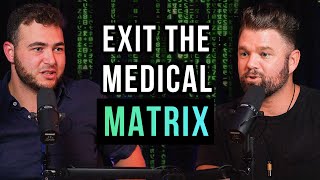
A conversational interview (Josh Trent with Mike) advocating a shift from a reactive, one-size-fits-all Western medical model toward data-driven, at-home personalized health monitoring. Mike describes designing a broad yet affordable blood-panel product to cover inflammation, metabolic, cardiovascular, and hormonal markers, arguing that frequent biomarker data lets individuals and clinicians ‘debug’ health, tailor diets (e.g., keto) and track effects on metrics like cholesterol and ApoB. The speakers contrast stagnant US life expectancy despite rising healthcare costs with improvements in other countries, and they position the product as empowering people to act as N=1 self-experimenters rather than relying solely on expensive physician-level scrutiny.
Chapters
Most people that have the traditional insurance, Western medicine paradigm, the lens is so fixed. Mike, in that world of if you need blood tests, you go to the doctor. If you need care, you go to the doctor, how do you even start to bridge the gap between the current, I guess you could say consciousness around Western medicine and the paradigm of if you want to get well, you have to see a doctor versus this is true health. Because you're an empowered citizen scientist. You're the true N equals one that actually is taking control of their health. And you can do it for like, a fricking fraction of the cost. Some of my labs that I've run are thousands of dollars. You can get 17 biomarkers from dripping your blood on a piece of paper. I mean, I know I'm being reductionistic, but it's fricking incredible where we are in the technological world. So how do you begin that conversation with, you know, this global audience and just, you know, at this table, man of like, real empowered health between the old model versus the new model? Because the new model is where it's at.
Well, I think, you know, one thing we really thought about a lot when we were designing this product is basically, okay, we're going to give people a very broad panel, like the broadest we can for the amount of blood, the amount of money, that kind of thing. And that's going to cover, you know, inflammation, metabolic health, cardiovascular risk, hormonal. And we actually have some expansions where you can do more hormones. And the reason we did that is because there's this already, this existing, very powerful movement of people taking control of their health. And it's happening through all these different channels. So it's everything from podcasts to doctors coming out and saying, there are lots of doctors writing books and so on. They're kind of dropping out of the standard approach and saying, okay, we need preventative medicine. If you look at actually the graph, this is incredible. This graph alone kind of says it all. If you look at life expectancy versus dollars spent. So the US Is now plateaued. So life expectancy is not increasing. And we're not even talking about health span. This is like being alive at surviving, just surviving. Forget even health is like a different story. Yeah, but life expectancy is not increasing while cost is increasing in the standard medical system. And that is not true in Europe. So if you look at all the European countries, I think if you can include, like, Israel and a few other countries, the graph has a bunch of, you know, basically your typical Western country. Everybody's life Expectancy is increasing and the cost is not increasing that much. And so America is just, it's, it's obviously broken. Like, no, I don't think anybody can argue it's not. We don't have a very strong opinion of how to fix it. Besides that you need more data and you need more control over the situation. So essentially I think a good example is like diets, right? So the USDA food pyramid diet obviously failed everybody, right? Miserably. That was a disaster. The question is like, what's a good diet, right? I think that's very hard. I mean, people, there are camps, right? There are all these like tribal camps of diets. But the reality is what you really need is to figure out what's working for you because people are just very different and they've had a different history in their body. Like you may have a really high insulin resistance, you might not, right? So, and this is something we see all the time. We're testing thousands and thousands of people, right? So we see a lot of variability for how people respond to diets in general. Like what their body, how their body can process food metabolism and so on. And really our belief, I mean, as engineers is just that you would never really try to fix anything without having sensors on it, collecting data. And if you can't afford to have a physician that's incredibly highly trained looking at you like a prized racehorse, which some people do, and that works, right? Like we have an 80 plus year old president, right? So that's not something that was feasible 100 years ago. So medicine is getting better, but it's too expensive for most people to get that kind of scrutiny. Having more data makes it easier, right? So if you give a doctor lots of data, here's five years worth of blood tests. Why am I feeling bad? The chances that they're going to give you a good answer quickly are very high relative to you coming in. They don't know any. You've had one blood test a year, they haven't even tested you for most of the interesting things because you haven't had symptoms, now you're not feeling that great. So that starts a debugging process. If you have a baseline that you've been optimizing against and you see something change that's much easier to deal with. And it's even something that people can take into their own hands so they can say, okay, you know, I'm going to try the keto diet, right? Let's see what effect this actually has on me. Like, does this have an effect on my testosterone, does it have an effect on my sleep? Like, is my cortisol?
Sure.
Actually.
Or the big one. Cholesterol.
Yeah, lots of people. Exactly. Lots of people are worried about their apob and cholesterol when they go on a keto diet and tracking that and seeing whether, you know, they can optimize it even while staying on that diet and so on. And so all of these things are just made easier and more quantitative if you're doing blood tests. And I think that's a big missing part. In general, like, there are a lot of people proposing solutions like how to fix the fact that Americans are generally very sick. You know, six out of ten Americans have chronic disease. So there are a lot of solutions, both from the medical system and also from kind of alternative and holistic medicine. Everything else, diet, you know, from all angles, like exercise. So our position is just trying to look at what, you know, we do make recommendations based on the blood test, but we kind of stick to the ones that are so well known that they're not really controversial. Everything else, we basically leave it to people to take control of it themselves. I mean, we're just giving you the data, showing you the context. Like, what does it mean? Yeah. And then you can go out and essentially find what works for your, like, for your unique system. Right. Because human body is incredibly complicated. And like all these one size fits all systems usually don't work for people.
It blows my mind because you and I, Mike, have unique thumbprints. Right. So we are biochemically individualistic, yet we have so many blanket fucking approaches in the traditional system. That's like, if you're sick, take this pill. There's almost like a flowchart which essentially leads to pharmacological intervention. That's just kind of how it goes. And so that system is broken because if you go 30,000ft above it, you can obviously see that there's really no customization, there's really no data driven decisions. And to be honest, I'm curious how you feel about this. Most physicians, it seems like, don't even want to do full blood panels because then they'd have to spend time interpreting that panel. Did you find that when you were going through the creation of this company? Check out some of the videos on this screen that are perfectly curated based on the video you just saw. Make sure you follow me and I'll see you in the next video.