Josh Trent: A Force of Wellness
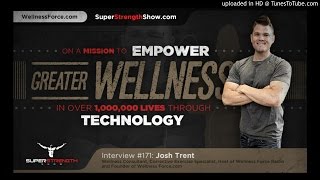
Interview (YouTube, June 8, 2016) with Josh Trent (founder of WellnessForce.com, host of WellnessForce Radio). Ray Tulaney and Josh cover Josh’s personal transformation from ~280 lb in youth to fitness professional, his move into personal training after 2002, burnout after ~9–10 years in gyms, and discovery of digital health (inspired by the film Personal Gold). Josh describes a 2010 elbow injury (epicondylitis) that required about a year of daily soft-tissue and mobility work to rehabilitate, and emphasizes mobility, soft-tissue/manual therapy, and active flexibility over static stretching for recovery. He recommends quantifying training (heart rate variability) and specifically the Athlete HRV app plus a fingertip sensor (device cited at ~$60–75). Training staples Josh endorses: deadlifts, back squats, dead-hang pull-ups, push-ups, and bilateral cable rotations. He links WellnessForce.com and WellnessForce Radio for more resources and mentions an upcoming 120-day course launching Feb 15 (course details on his site).
Questions this video answers
June 8, 2016.
Named a top 50 digital health influencer in 2015 by Analytica.
About 280 pounds.
2002.
2010.
Chapters
Get ready to build strength, power and.
Slabs of lean muscle.
Welcome to the super strength show featuring motivating stories of success and no bs Straight talk from the greatest in the iron game today.
Now here's your host, Ray Tulaney.
What's up strength maniacs? And thanks for tuning in. I'm pleased to welcome today's guest, Josh Trent. Josh is the founder of WellnessForce.com and host of the number one iTunes rated new and noteworthy podcast Wellness Force, awarded top 50 digital health influencers in 2015 by Analytica. Josh is a wellness consultant, corrective exercise specialist and quantified self enthusiast and expert in fitness technology. Along his personal and professional health journey since 2004, Josh has trained with numerous world class fitness professionals including Juan Carlos Santana, Paul Check, Todd Durkin and Mike Boyle. With national accreditation from multiple fitness organizations and with over 10 years of high level experience in the health and fitness industry, Josh provides content for multiple fitness and digital health publications such as Wellness fx, the National Academy of Sports Medicine, Digital Health and the Fitness Industry Technology Council. Guy's a busy man. Josh continues his own personal and professional transformation through interviewing passionate and inspiring thought leaders on his ITUN podcast and online as a digital health coach with a clear mission to empower greater wellness in over get this guy's 1 million lives through technology. You can connect with him by visiting wellnessforce.com Josh, welcome to the show. It's great to have you on here. We talked about having those bhags, those big hairy, audacious goals and a million plus people. I love it man.
Thank you, Ray. That was cool hearing. I haven't heard that bio in a few weeks and I just flashbacked all the things that I've been up to, man. It's just nice to pause and realize, oh yeah, we're doing some great things, man.
All kinds of good things. It's good, man. You got to have that written down somewhere. You could walk by with a couple blank spaces to remind you to keep adding to it. Right?
Put it on my bathroom window.
There you go. There's a good spot that way there. The neighbors aren't looking in on you. Okay. So I'm wondering, how about you share some more info? I mean there's a lot there what got you on this journey. But you give us a couple quick minutes before we get into the main questions of the show.
Yeah, I found digital health after being in gyms for 10 years. I mean I've always been curious about my health and wellness. I was £280 at one point when I was A kid flashing way back. I never got the psychological nutritional tools that I needed. I think a lot of people can resonate with this. When you're a kid, you're just kind of modeling a parent's behavior. And what happened was with the different mindsets that I had and the poor habits for health and nutrition, even when I was an athlete, I was still eating pretty poor foods. And to no surprise, I mean, I'm 22 years old and I'm almost 280 pounds. So I got so frustrated with how I felt my body that I just left. I left my whole life, moved to Hawaii, started training in a gym out there. And a fitness manager approached me. This is 2002. And he said, hey, have you ever thought about being a trainer? And my answer was, what's a trainer? And I looked into the whole field of training, and I realized it was already a path I was on myself, you know, trying to change my body, trying to get my health and wellness improved. And so that was it. I mean, for the next nine, 10 years, I was training in gyms and running teams and working, working in different facilities. But I started to get really burnt out at about the 9th or 8th or 8th or 9th year of my training career. And I was not getting the results from my clients that they deserved. And I had every certification you could imagine, you know, from functional diagnostic, nutrition, movement certifications, corrective exercise, personal trainer certifications. But something was still missing. And I realized it was because I didn't know what my clients were doing outside the gym. So they'd see me for two and three hours a week. But it was frustrating. So in 2013, at the end of 2013, I saw a film by two Olympic athletes, and it was called Personal Gold. It was a story of how they used digital health and quantified self with these two Olympic athletes of a team to essentially have the women's cycling team in 2012 win the silver medal in the Olympic Games. And I had this flash moment. I remember I was driving home and I had this lightning bolt go through my head, and I thought, if digital health and wellness tech could help Olympic athletes win a medal, how could that help clients and average people? And so that's when I dove into almost two years. It's been about 18 months of research on what digital health apps, wellness technology devices can actually move the needle for people's strength gains, for people's weight loss. And that's really what I've created with Wellness Force. So it's not been a linear pathway. That's for sure, man.
No, but it's always that way, isn't it? We many times assume it's a straight line, right? But it's not. It's a zigzag. Zigzag. Zigzag, yeah.
People feel like, oh, you get this certification, you work in this club, then maybe you have a team of trainers that you work with. And it doesn't always work like that. And I feel like hitting rock bottom. Having moments in our lives that teach us a lesson about where we thought we were going, it opens up the space for a new journey. And that's really what I've been on for the past couple years.
I would agree with you. And not only that, I think that, again, that zigzag pattern, what it does is it allows you to pick up a lot of life experience which you can alter, ultimately apply to whatever it is that you finally realize is. I guess you're calling to a degree. Right?
Everything's a lesson. Everything's a journey. It's like wherever we are, it's exactly perfect. I know it's hard to feel that way when you're in a position of pain or a loss or relationship ends or whatever it is. But, gosh, there is a lesson in every single moment.
Yeah. And, I mean, look, like you said, it's easy to say, almost to the point of sounding corny, but, I mean, it's true. I think it was Hill, Napoleon Hill, who said, every adversity has an equal and greater seed of opportunity in it. Something of that nature. And there's a lot of truth to that.
Yes. I mean, how are you, you know, as a coach or a trainer or an athlete? How are you supposed to know what it feels like to be successful unless you felt complete and utter defeat?
Yeah. Again, we're quoting back and forth, but I think Muhammad Ali said the same thing. I mean, a champion's not a champion. I'm paraphrasing like crazy right now. But you gotta have that taste of defeat, you know? You gotta taste that. Right. And it just gives you this fire to realize. I do not wanna go back to that. So great. If you can learn from others and their shortcomings and maybe failures. I mean, we should. Ideally. We don't need to necessarily make every mistake in the world by any means, but getting burned a couple times, maybe. Maybe even just once is enough to, especially if it's something that you can remember, kind of give you that fire in the belly to say, you know what? No, no, no, I need to, you know, I got to do something else in my life. This is not. I'm much more than this.
Yeah. And those moments come when we're least.
Expecting it, usually and least want it.
Yeah. Like there's no room for this happening while it's happening.
Yeah, exactly. Okay, Josh, let's jump into this and get you to share one of your favorite success quotes. Maybe a saying, a motto, and an example of how you've applied its meaning to your training in life.
You know, I saw this question and I thought, I want to give you two the first one that I always say to myself when I'm nervous or when there's a question of self worth or whatever it is coming up, I always say, you know, it's not about me, it's about the mission. So the feelings that I'm feeling, they're really just ego driven, you know, oh, I won't make it. Or what happens if something doesn't work? That's not what's important. So that's kind of a mantra or a motto that I use. But honestly, my favorite quote ever is by Ralph Waldo Emerson, and it's do the thing and you will have the power. And how I've applied this in my life is at the edge of the cliff of progress. No matter what I'm doing, whether it's a weight training goal, a business goal, a life goal, there's completely that thought process that happens in my mind where I say, well, what if. If it doesn't work out, Do I have enough power to make this happen? Am I strong enough to lift this weight? Can I make this pr. Can I make this happen? And it's just by doing the thing. Do the thing and you'll have the power. And it's like, just do the thing enough, and eventually you will be strong enough, you will be powerful enough, you will be cognitive enough to make whatever happens in your life completely your creation.
Yeah. Because you're not going to get to that point by sitting on the sidelines. Just not going to happen.
Absolutely not, man. I mean, the game happens 24 7. So doing the thing and you will have the power. I think how that's shown up for me is just the doubt's always going to be there. The fear is always going to be there in some certain situations. And just by the repetition of doing, that's actually what gets you the power. There's no more certifications that people need to get. Typically, there's no more information that people need to get. There just has to be a course of imperfect action that people need to take. And that's what's going to give them the power.
Just do it. Right. Nike, I think they kind of figured that out a while ago.
Whoever figured that out, I wonder if they were sitting there and like tapping on their shoe and they were like, you know what? I'm just gonna do it.
Yeah, exactly.
And then that was it. I think it was some guy's garage where he started Nike.
Yeah, you know what? That would be interesting to find out exactly where they're.
Let's figure that out, man. Let's figure out how this shoe with things started.
I guarantee you could figure that out in three seconds with a Google search in Wikipedia. It's probably out there, no doubt. But anyway. Okay, so next one, Sharing a story of a time in your training, in life when you encountered a major challenge. If you could take us back to that time, paint the picture for us, and explain to us not only the story, but the lessons that you learned from it.
So 2010, I was training in a CrossFit box here in San Diego, and I was learning kipping pull ups. So something that I've always had with my physiology is that I have a little bit of a swayback, and that's led to some postural issues in my right shoulder. So I damaged my shoulder earlier in life when I was an athlete in high school. And when I was doing the kidney pull ups in 2010, I was going home one night and my elbow started to hurt so bad, and it hurt for a while. And then I went to the doctor and the therapist and I realized that I had epicondylitis and inflammation at the tendon where it attached. And I did all this different work and I stopped doing pull ups and I stopped doing any kind of healing exercise, really. But it was super painful for me to just grab anything. And even when I was using my forearm extensors, it was still painful. So I did all the different modalities of healing that you could imagine. I went to an acupuncture guy, acupressure guy. I went to a therapist. Nothing was really working. And it was depressing because, you know, part of how I make my living is by being able to demonstrate movements and being able to be health and healthy and fit myself. So I started to kind of spiral into, like, what's wrong? Like, why can't I figure this out? I was doing mobility work and I. I found a guy who was an HLC practitioner, holistic lifestyle coach, and that's through the check Institute. And he started doing a little bit different assessments The Czech model for people that might not know, looks at the body from a high view, from a holistic view. So there's FMS and there's different certifications out there for movement. But I needed something a little bit more stringent, and that's what this practitioner offered me. So we actually found that it wasn't my elbow and it wasn't anything going on with my shoulder. It was actually my scalenes and my traps. So we did a lot of mobility on my scalenes and my traps, Some form extensor work.
Hold on. What are scalenes? And maybe even if you reverse it a little bit further than that. Sway back. I should have probably asked you that when you first mentioned it.
Sure. So I have just a little bit more of a arch in my back. I have a. Where people. Where the thoracic spine. The thoracic spine is obviously right kind of in the center of your back. I have a large chest cavity. My grandpa was Italian, so he blessed me with a really big chest cavity. Thanks. Thanks, mom. Thanks, grandpa. And the mobility, the lack of mobility that I had from an early age, it just kind of compounded that sway in my back. So a sway back is when you have a larger hump almost. You could look at it like being somebody who has upper cross syndrome, where they have forward shoulders and there's kind of a rounding of the shoulders.
Gotcha.
So by birth, I kind of had that naturally. And so the scalenes are the musculature that are essentially right below the chin, right above the clavicle. So the scalenes are what flexes the neck. They help to flex the neck or drop your chin. And I realized that it was something that was posturally, that was already defeating me for a lot of years. But it was really a hard time because talk about a major challenge. How am I going to demonstrate movements for clients if I can't hold onto a barbell? And I've seen other trainers that have had the same thing where there's inflammation at that elbow joint and things like that. So it took a year. It took a year, Ray, for me to actually do the work every day. Rolling out the scalenes, foam rolling everything that I had to through my chest, making sure that my pec minor, my pec major was rolled out and just really diving into what it is to have soft tissue work and mobility a part of my life. I thought I was kind of too good for it before, but I learned my lesson, that's for sure.
How do you roll out your scalenes in your Neck, because I mean, we're talking about the front of the neck, right? Isn't that a sensitive area?
Yeah, I wouldn't roll my neck. I really just soft tissue work, like meeting with a therapist. I also had some, some different exercises that I would do where I would hold a bar with my right hand and then flex my neck towards the left and then just work on my own Scalenes for five to 10 minutes.
Gotcha. Like, kind of almost like stretching and PNF type.
Yeah. I mean, if somebody saw me in the gym rolling at my neck, they'd be like, what are you doing, man?
Yeah. Okay, so I, I think you mentioned something that's really important. A year. A year of day in and day out doing this stuff. And that's sometimes what it takes. Yeah.
One year. Oh, and by the way, this whole time I'm not doing any more kipping pull ups. I'm not doing any heavy deadlifting. I'm not doing, I'm essentially not holding anything heavy because my forearm extensors and flexors are just not working properly. So it was a year of like lighter weight. I started exploring more functional movement. I actually took a move nat course that year. So I just changed my training because I knew that what I was doing wasn't working anymore. And I think honestly, if I look back, it was a lot of ego, like, oh, I don't need to do the tissue work like other people, but we all get to do that.
Yeah, yeah. And look, I think a lot of us may look at that and say, a year, that's crazy. That's 365 days, 52 weeks. Yeah, you know what, I don't need to do that. But the reality is one of two things are likely to happen. If not both, your performance is going to drop and you're likely to probably get injured even worse to the point where you can't come back from that injury. And if you don't get injured, that's great. Hopefully that wouldn't happen, but just to kind of end up losing a percentage of your capabilities or your abilities. So now I can't perform at 100%. Really. I can only perform at, I don't know, 80, 90, 75. Because I think there are people out there who would settle for that as opposed to, okay, it's a year. I just got to make this a routine part of my routine, daily routine, whatever it may be, and just stick with it, man.
Yeah, we talked about this a little bit before the show, Ray, where there's this mindset of, well, If I just get this one program or if I just have this one periodization table or protocol or whatever it is, then I just do it. And then in a month, I should look a lot better, right? Or I should be able to perform better. But, you know, it doesn't work like that. Nature in our physiology, in our bodies, that takes weeks and months and sometimes years before you see tangible changes. And a lot of it has to do with an epigenetic component. You know, you know, what we bring to the world, our environment, you know, some of it is just our genetics we inherit from our parents. But the day by day, brick by brick work that we do as coaches or trainers or athletes, it's something that just takes ultimate commitment. You know, if we. If we want to change, we have to be humble enough to learn the new tools and to let go of old mindsets and old things that are. We identify with, you know, people that might lift only heavy weights and not do any mobility, or people like myself who had been training for a while and didn't think that tissue work was a big deal. And then we get kicked by the universe and we realize, oh, my God, this is a big deal.
Yeah, yeah, exactly. And I mean, ideally, if you're in a good gym, if you have a good trainer that really understands a holistic approach to your training isn't allowing you to neglect any one area, you can avoid this. But if not, then you got to be proactive with this stuff, because if you're playing hard, you know, at some point that can come back and bite you in the butt if you are not doing things intelligently. So all the more reason to really make an effort to learn and check out different things and not brush stuff off, for example, like you did with the mobility work.
Yeah, absolutely.
And I mean, things can get brushed off just simply because, you know, oh, I think I'm above that. Or maybe just, oh, well, I see it. But I don't think that's, for me, just that's not the thing that I do. That's not a part of what I do. Just, you know, it might be even like an innocent reason as to why you brushed it off. But sure, yeah, I mean, definitely having some curiosity and understanding that there are more aspects to training than just simply whatever it is that your specific endeavor focuses on, whether that's endurance or max strength, there's other components that you need to combine. For the longest time, they said a complete training program involves some type of resistance training, some types of cardio, and some type of stretching I mean, that was the old axiom. They used to say that for years and years and years. And the reality is they're not that far off. I mean, you really should be doing some combination of that stuff. And for me, when you say stretching, to me that counts as mobility, stretching, posture, some body work as well.
Yeah, I mean, I even throw in some active stretching there, some active flexibility drills and whatnot. Because, I mean, in my opinion, I don't really feel like the static stretching moved the needle for my recovery. On that issue that I had with the epicondylitis. I think it was more the soft tissue work, actually. Getting the tennis balls out, getting the racquetballs out, going to the soft tissue worker, doing the active flexibility exercises is what really made the difference for me. I think static stretching is great post workout, but that's just my opinion. That's just kind of what I believe in.
I know some guys, they. They don't even believe in static stretching. When you say active, what do you mean by active stretching? Then we'll hop into the next question.
So, yeah, I mean, if you look at some of the work from nasm, when we look at the different planes of motion, let's take a lunge, for example. So someone's doing a sagittal lunge, they're taking the body in just this straightforward range of motion. They're not going to hit all the heads of the top of their biceps femoris. They're not going to get anything involving the laterally flexed head. So if they go transverse and you're twisting with a medicine ball, it's not the intensity that you work out with. If you were doing a strength training set or if you're doing a functional movement set. It's just active stretching is where you're taking the body past its normal range of motion. You don't even need a load. You just need to move it through all the different planes. So that's what I would do. I would do a lunge matrix. I would do a matrix from my shoulder that I learned from Gary Gray. Taking the shoulder through all those three planes, you know, transverse, sagittal, and lateral. And just making sure that I was addressing all the three movement hinges on my joints for my shoulder. And, and just I do that. I try to do that before I do anything, really. I'm not a big fan of static stretching.
Yeah, yeah. Otherwise things start to seize up because you're just not using that range of motion.
Exactly. If your body, if you take your body through a range of motion, that it normally doesn't go in and there's a load. I mean, now you're looking at injury. So I think that you should be able to. In my opinion, you should be able to do a hundred body weight squats, 30 to 40 pushups, 10 to 15 dead hang pull ups before you really start adding the load anyways. And if during those body weight movements you have pain or you have range of motion issues, those get to be addressed through the active flexibility exercises.
Yeah, I agree with you on that. There are some very fundamental baselines that a lot of us overlook when we get into training. And before we know it, we're starting to add one of our guests. Geez, I wish I could remember who it was so I could attribute this quote to him. What you don't want to do is add resistance to dysfunction. That's looking for trouble. So as you were saying, if you can't even achieve those reps with just your body weight.
Sure.
And especially with good form and proper range of motion, now you're starting to add resistance to this. Well, now you're looking for trouble because you're already not lined up correctly and things are already not working properly. Now you're just accelerating the rate at which you may potentially get injured.
I think this is where the ego steps in. The same reason why I didn't think I needed soft tissue work or why I didn't need mobility work might be the same reason that somebody might come into the gym and just go right to the bench with no warmup. You know, there's a little bit of ego involved sometimes on the fitness floor. And if we can just take a step back from the ego and start looking more at the functional side of why we're moving and what this exercise is for, I think there's going to be less injuries and just a better experience overall.
Yeah, yeah, I would agree. Either ego or you just don't know.
Any better or you don't know.
Yeah, yeah. Again, that's why you gotta. Man, you gotta check the ego at the door, have a good coach, keep an eye on you, and have that curiosity to explore. And I mean, just be really. I think you just got to be cognizant of who you're learning from ultimately and why is that that person is teaching you the way that, you know the information that they're teaching you, where's it coming from? So, sure. Anyway, all right, next question here. Sharing a story of a time in your training when you had a breakthrough moment. If you could take us back and like the Last one. Share the steps that you took and kind of paint the picture out for us there and let us know exactly what happened. And what was that light bulb moment that you were able to turn into success for you?
Yes. So this moment for me, I was actually training in Vegas my first year and a half of being a personal trainer. I lived in Las Vegas. And this is right around the time that functional movement was hot. I mean, you'd go to perform better, you'd go to all these different seminars, and everybody had the mini bands out and all the different tools or the medicine balls. And I got swept up in that. And I thought, oh, my God. Most of my clients are body composition change or weight loss clients. So I'm going to start taking people through dynamic range of motion and doing, forget about closed. I'm going to start taking people through lunges with twisting and all these different things. And I just went down this rabbit hole myself where I started doing the functional movements that I was training my clients to do. And I lost a lot of lean body mass. I think I lost like 10 pounds of lean body mass because I was just doing too much functional movement and not enough of the basics, not enough of the fundamentals. And I think this happens to a lot of fitness professionals because they're so hungry. And did they care? At the end of the day, they care. They're always searching for the new trends, for the new tools, for the new things that are coming out from the trusted leaders. And that's what I did. And so for about 26 years old, for about a year, I just did functional movement. And I had this aha moment where I was, like, looking in the mirror one day. I'm like, where did my muscle go? Where is my biceps?
I don't know if that's an aha moment. That's a oh, no moment.
But anyway, aha. Oh, no. Whatever you want to say. I mean, it wasn't that my size dropped. I think I started to notice that when I went to go do a heavier lift occasionally that I couldn't lift it. And I didn't like that. So I just went back. I essentially just went back to the basics, traditional strength movements. I actually got a little bit leaner by doing these three. My. My favorite three, which we'll talk about later, is just the deadlift, the back squat, and cable rotations, Heavier cable rotations, I love. Those are my favorite three. But that's what I did. That was my oh, no moment. As you had said, my aha moment was doing too much Functional movement and reverting back to doing 6, 8, 10 repetition of traditional strength and doing the things that I know build not just lean body mass and muscular density, but increase my metabolism without me having to work so hard and do so many out of the box movements.
Right, interesting. Yeah. I mean, it doesn't take much. And we were talking about this too before we started. You get off track inch by inch, inch by inch, and before you know it, you're miles off course. Right?
Yes. Yes.
All right.
You know what I listen to, and I'm sure you do as well, Ray. I listen to a few podcast and I think it's John Lee Dumas, I'm in his podcasting group and he says, you know, if you're off just 1% on a course and you're trying to fly to France, then you may end up in Africa just by being off 1%. So you're right, man. It's like one little thing that we change and we continue to do that one thing that's not in alignment with where we want to be. Well, we learn a lesson from that. And I mean, that was a lesson that I learned.
And you don't notice it. Right. You just don't even notice.
So small. It's such a small change. Right. Maybe for someone it's just that they stop doing back squats. Well, I mean, there's, there's a recipe there that you're probably not going to see some changes that you want to see if you cut out back squats.
Yeah. Depending on what it is that you want ultimately. And that's why having something that, you know, some form of checklist or something like that that you could check in on to make sure you are doing what you should be doing. Or again, having some type of training partner, a coach of some sort, somebody to keep an eye on you to help keep you on track. Because the reality is if you are able to stay on track, the overwhelming majority of time, your progress, I mean, the rate of progress just goes through the roof as opposed to meandering to the left, to the right, to the left and you know, zigzagging. And the closer you can keep it to a straight line, the quicker you're gonna reach your end goal. So that's another reason to have again, some people kind of helping you, building that team around you or bare minimum, just have some form of a, I don't know, even like a pre flight checklist of some sort. You know, keep your eye on stuff. All right, we're going to a break, right? Now, Josh, we'll be right back. Sound good to you?
Awesome.
All right, guys, you are listening to the Super Strength show and we got our special guest today, Josh Trent from WellnessForce.com, we'll be right back. The world of working out is seriously confusing at first. It punishes uneducated lifters with years of poor gains and injuries and rewards smart ones with slabs of lean muscle and superhuman strength. If you don't know if you're using the right form, have hit a plateau, or things just seem a whole lot more confusing than you thought they'd be, I want to help you out. Let me save you from wasting time and money on BS advice and sweating away in the gym with little to nothing to show for it. Head on over to www.instantstrength.com to get access to your free report titled Instant Strength. The one little trick that will instantly boost your strength by 10 pounds or more in your main lifts. Whether you are a novice lifter or have years of experience in the iron game, this is a very helpful resource that you can either apply to your own training or use as a helpful guide to teach others. Stop wasting time and effort in the gym and get the info you need to maximize your gains and minimize your risk for injury. Visit www.instantstrength.com and get your free report today. Alright guys, we're back with our guest Josh Trent, host of Wellness Force Radio on itunes. I would highly suggest you go check him out. Josh, I'm wondering if you could recommend one training resource for our listeners and it could be anything, a piece of equipment, course of some sort, you name it. What would you recommend?
You know, we were talking earlier and you had mentioned that it's really nice to have a checklist or a pre freight checklist. And I feel the same way. I mean, that's why I'm so passionate about quantifying our activity, putting some data down with our activities. And that's why I love the one thing I want to recommend to Super Strength is the Athlete HRV app. And that's spelled I T H L E T E I thlete. So you go there, you put a fingertip sensor on. I'm sure that your audience is no stranger to heart rate variability, but what I like about Athlete is that it's a quick reading. You place it on your finger, you get your readiness for athleticism in the morning and you know whether to go light or heavy that day. And I love it.
Yeah, we've had a few guests before talk about heart Rate variability. And this has some real science backing it up, right?
Absolutely. I mean, the quantified Self conference last year in San Francisco, there was a doctor that was there, and I forget his name right now, but he actually proved that tracking HRV can not only be a sign for athletic readiness, but you can use HRV to track coronary heart disease. You can use HRV to track emotional intelligence. I mean, HRV is a mirror, right? And in the Quantified self movement and in the wellness technology and fitness technology movement, there's just mirrors of activity. And all these activity or data sets are doing is just being a mirror of mindfulness to people. You know, how are you showing up on your training? How are you showing up in your life? How are you showing up with your sleep? How are you showing up with your heart rate? And the more ways that clients and trainers and just people, just human beings, can have mirrors of mindfulness in their life, then the better they're going to be able to show up for life. So that's why I love using heart rate variability. There's a bunch of other ones out there, and I was thinking, what's going to be the best for people that listen to super strength? And I think heart rate variability is going to be probably at the top of the chart.
All right, there you go. You just find that in the itunes store? Is that the best place to find it?
Yeah, I think it's a free app. And then the device is 60 or 75. Joel Jamison has one as well. I don't know if he's been on the show.
Yeah, actually. Okay, so that's easy. Then you just sign up for the app, you buy the sensor for your fingertip, and off you go. Right?
Off you go, man. It's pretty self explanatory, too.
Sounds good. It's just crazy that something so basic can be so helpful. It almost sounds too good to be true, but actually it isn't this time. So interesting. Is it complicated to implement that information? In other words, does it really throw a wrench in your training if you have a preset program? So let's just say Monday, Wednesday, Friday, Monday, Tuesday, Thursday, Friday, you're doing certain workouts. You get this reading that tells you that you should probably back off today. So what do you do? You just simply just not go hard on that specific workout, and then on the following week, you hit it hard or how does that work?
Yeah, I think you bring up a good point. If you have a periodization table or a program that you're working on whether it's with your coach. I mean, first of all, if you're with a coach and they are using HRV with you, they should be able to adjust the template or the program that you're using. But if you're training by yourself and if you just want to stay accountable to your program, by all means, I would say just go train. Just don't go as heavy on that specific day because there is something to be said about HRV. And really after 30 days, then you can start taking HRV as truth. But it's not the gospel. It's not something that you, you know, if you're feeling great and your HRV is a little bit lower, maybe your HRV is in the low 70s or mid 70s and not in the 80s and you still want to go for it, go for it. But just be mindful of your body. Listen to how your body's feeling. And this kind of touches on something that is in another question where it's like, yes, we have this mindset as people that want to grow and have super strength that our mind is stronger than our body sometimes. But there's a double edged sword to that because sometimes there's days when you go into the gym and you could actually be using your mind to push through too hard of an exercise or to make yourself not get the gains that you should be getting because you're exhausted. If you're exhausted, your HRV is low, your sleep is bad, all these different things are going on that are attacking your progress. And you go in there and you still try to knock it out of the park with your workout. Well, that's not smart training. And I think, I think really what, what HRV does is it's just a tool for us to be a little bit smarter with our training. Long winded answer, Ray. But the short, the short answer is if your HRV is low and you still have a heavy training day, go to your training, Just back off and listen to your body.
Yeah, yeah. And as you said, it's not the gospel, but it's a data point one you definitely should pay attention to.
Sure, man. And it makes us more mindful. Right? We have hrv, we have heart rate, we have different training load, we can look at our tables and we can see like, okay, how are we really showing up on our workouts? How is our weight sets been? How has our PRs been? Then let's start incorporating HRV as well. Because like I said, the mind can sometimes stop the progress of the body.
Okay, do you got Any recommendations for sources of information to learn more about HRV and how to implement that?
I love Joel Jameson. Actually just did a webinar about this8weeksout.com I think is his site. There's lots of information about HRV there for the audience.
Okay, there you go. Easy. We'll have that in the show notes page. Next question one. We like to have some fun with man to goof around and mess around and whatnot. And you were saying that you were doing some kipping pull ups, all right? And also I should preface this by saying if you could zero in on a couple points specific so we could really take this stuff and put it to use right after hearing it. So. Okay, gonna get a little silly here, as I normally do. You were doing your kipping pull ups and you were saying that those caused some pain, right? It's kind of hurting you and whatnot. And you're doing some pull ups now. You're healthy, you're back into the gym, and all of a sudden you catch a whiff of something and it's like, what is going on here? And it's causing some real pain. And you kind of turn around, you see me walking in the gym, and you kind of like, is that really Ray? Like, what is that smell, man? I don't know what the heck that smell is. And I look over at you, I'm like, hey, buddy, what's going on? Give you a big hug. And you're just like, oh, my God, this is terrible. And I look at you and I'm like, it's bad, isn't? He's like, dude, I mean, it was more painful. That messed up my elbow or whatever it was shoulder when I was doing those givings. What the heck is this smell, man? And I hand you the keys. I'm like, relax, man. I just. It's the DeLorean's outside. Full tank of hot garbage. Probably want to bring some extra deodorant with you. Depending on where you're going. You don't smell the greatest, but hit 88 miles an hour. We all know what ends up happening, right? So this is me getting a little goofy with this question. But anyway, if you go back in time knowing all that, you know now, what would you do and how would you set up your training to get the best results in the shortest period of time and set you up for long term success, man?
I was like laughing as you explained that. I'm thinking about like the smelly garbage.
And I don't even know where that was going. I was just kind of pulling that out of everywhere.
So I like it, man. Well, to be honest, like, the way that you ask that question is going to be the same way that I answer the question. And I was thinking about this, and really, if I could jump in that silver car and then catch the wire and have it light on fire, and then I show up 30, 30, 40 years in the past, I would explore reckless abandon to staying completely hungry about what's out there in the industry. But I would also, in tandem, stay grounded and focused on the fundamentals and the basic lifts. Deadlifts, squats, pull ups, pushups, and cable rotations. I'm gonna break down each one of those because I know that these are lifts that no one is a stranger to. But I want to talk about why, in my opinion, these four in particular are really what I think I would just focus on if I had to go back in time. Deadlifting for me is something that works my entire body, but it also makes it so that I feel energetic, and it makes it so that I feel like, chemically, biochemically, hormonally, I think it's the best lift for me. Now everyone's got their own lift, but the deadlift for me is the one where I feel hormonally, you know, my testosterone, my free testosterone, my hgh. When I do deadlifts on a rooster regular basis, I just feel stronger. I just feel better squatting. Secondly, when I do squats, it's difficult for me because I have really tight calves. And if I were to go back so I can give some action to people that may just be in the first couple years of their training before you do your squats. And if I could go back, I would. I would make myself absolutely force myself to foam roll and mobilize my soleus and my gastrocnemius. So the soleus, the space right below your calf and your calf, your gastrocnemius, your calf. Because if those two musculatures are shortened and tight, you will not have ankle mobility and you will not be able to go as deep on your squat. It just won't happen. This is why you see people put plates under their heels and whatnot. So I would definitely explore what that was for me. Second is just dead hang pull ups. Dead hang pull ups are something that have always been a challenge for me because of what I talked about earlier in the show with my sway back. Well, because of that, I have a tendency to round my shoulders forward. So pull ups for me are difficult because I have to Force myself to extend my chest and to retract my shoulders as I do the pull up. And so going back, if I could look back in time, I would tell that 26 year old trainer, focus on dead hang pull ups. Dead hang pull ups with your shoulders retracted and your spine neutral, or as neutral as I could have been at that time. The most beneficial thing, this is something I've been incorporating in the past couple of years. It's been, been, it's been great. The next one is push ups. Push ups. Because, man, is there really any exercise that's more challenging than loaded or explosive pushups? I mean, I can't think of something from a metabolic perspective then that really challenges your triceps, your front delts, your chest, then the pushup. And I think just doing pushups with elbows in is going to get a lot more chest recruitment. It's going to get a lot more power out of my chest. Love that one. And then the last one, Ray, is cable rotations. Cable rotations with a bilateral stance. Not a split stance, no, no crazy footwork, just a nice bilateral cable rotation. Think of closing a heavy door. Think of how many times in our lives, women or men, that we have to push something aside or move something over to the left or right. Cable rotations are a building block. And I think if you can do cable rotations without your hips swaying, with your hips locked in place, you're going to use your abdominis to just be a bracing musculature. And it's going to, it's going to make you have the six pack. If your nutrition's on point, it's going to make you have that pelvic floor strength. I think it's the most beneficial exercise. I think it's better than side ISO abs. I think it's better than a plank. So those are really what I would do if I could go back in time and give myself a little cheat sheet and say, hey, focus on deadlifts, squats, pull ups, push ups and cable rotations. And I think it's not really like, oh, am I going to change that from my past? No. Because my past taught me how important those things are now. So I would just set things up a little bit differently.
Yeah, I got to tell you, I don't think anybody yet has recommended those cable rotations. And the way you describe them, I mean, that is definitely, I would say, one of the best ways to train the core. A lot of people don't realize the core's job is to brace your body, brace your Core your spine so you're not twisting around like a limp noodle. When you're trying to move things, it's really not. The main function is not to do sit ups, not to do crunches. They're fine. Those will work your abdominal muscles and whatnot. But that bracing, as you described it. Yeah, that is actually pretty darn interesting. So basically what you're saying is get a band, maybe a functional trainer, cable crossover machine. And you're saying do that kind of twisting movement, maybe even a Russian twist with a barbell with one end of the corner and you hold the other end up in your arms. You kind of do twisting, maybe something of that nature.
Yeah, that could be one. I'm preferential to cable rotations because I can watch my form in the mirror. I can make sure my shoulders are retracted. I can make sure I have a neutral spine. I can keep my hips locked because. Let's talk about this one piece. If your hips are moving, then you're not going to get as much isolated core core strength. If you're moving your hips, you're gonna get kind of dynamic total body strength, which is great. I mean, there's nothing wrong with that. But when we're really looking at building brute force strength in the core, it's gotta be a hard brace. You gotta brace your body by locking your hips. If your hips are locked and you're rotating the cable outside the hips, left to right, right to left. I think that's where I've seen the most strength increase.
Interesting. All right, maybe we could get you to provide us with a link to maybe an article with images or maybe even a video showing how to do that correctly. We'd really appreciate that. Sure, yeah, we'll have that on the show notes page. That'd be great. All right, we are pretty much at the end of the show. Josh, this zip by pretty quick.
That was fast, man. Well, good things happen when you're talking about things you love. It goes by fast.
I agree 100%, man. Love training, love talking about all this stuff. Now, before we take off, two things I'm wondering if you could tell us, where can we find out more about you? And also if you would give us some parting advice afterwards.
Sure. You can learn about me@wellnessforce.com, so wellnessforce.com, i have a ton of articles around nutrition, strength, some around body composition. So if there's anyone listening to the show that you know is in their 20s or early 30s or even older, that's just starting the journey there's some great, great pieces of info there. There is a couple articles on HRV as well. So you can find all the content@wellnessforce.com and you can just go to WellnessForce. It's up at the top of the website. The podcast is Wellnessforce Radio and if you look in health, fitness and nutrition or self help, it'll typically be there. You can always just type in wellness on itunes and I'm always in the top, top five or top ten there. And yeah, I'm really excited about what's coming up for the year. I'm launching a course on the 15th of February. It's around 12 people and it's using technology to empower greater wellness and body composition changes in my clients. And it's been something I've been building for 18 months. So I'm really excited about that. If anyone's interested in using specific technology for fitness and wellness to get to their goals a little bit faster, to have increased accountability, they can learn about that@wellnessforce.com 120 it's 120 day program. Now you asked me about a final question, like a wrap up here, some piece of little gem, maybe like a nice nugget for the audience, right?
You got it.
Party advice of some sort for a lot of men. And I'm speaking to the men right now. I know you have men and women that listen to the show, but I really want this to drive this point home for men. The same way that we approach our business, our workouts, we're doers. I mean, men are problem solvers, action takers. So we go really hard in the gym, we get fit. But our body language is way more important than our mind. And I'll tell you what I mean by this. Let me unpack this a little bit. The body language that we have being willing to go a little bit softer on our bodies, have a little more compassion, a little more awareness of actually what's going on with our physicality is more important than being perceived as a weakling or someone who's hesitant to not go balls to the wall every session. So listen to your body, quantify your training, use hrv, pay attention to what you're doing. Use these technological devices to be more mindful. Use these devices as little mirrors for how you're doing and incorporate some meditation into your training. Because during meditation, when you sit and you breathe for 10 or 15 minutes, you're going to be a lot more in touch with how you're feeling. And if you're in touch with how you're feeling, then you'll have an intuitiveness about when to go hard in the gym and when to relax in the rest of your life.
I got to tell you something. That bit of advice, not everybody learns it, and many people don't end up learning it until they kind of take things too far and get injured. So I would suggest a lot of us to listen to what you got, what Josh just shared with us. You've been through a lot, Josh. I love having guests on this show who've overcome adversity in one form or another or have achieved certain goals. You said that you were at a point in your life where you were quite heavier and you had to overcome that and figure that out. And then you unfortunately had that injury, which, yeah, you had an elbow injury. It wasn't the end of the world, but it was a year to rehab that thing, and you stuck with it and made it happen and got yourself back and better than ever. Having guests like yourself come on the show, share the information that you do. I just can't stress enough to the audience that this person is coming from a place of experience and wisdom, and if anything he says resonates with you, even at the slightest level, go back, re listen to the show, go check him out, check out his own show, and really consider putting what he's saying into implementing it, putting it to work for you, because there's no need for us to have to necessarily go through everything that somebody else went through to get to reap the benefits of whatever lesson they ultimately learned. It's crazy, because there's no way that any of us could live long enough to learn everything on our own, especially so being able to spend time with somebody like yourself, it's just, again, it's the closest thing to a shortcut, as I always say, is to have a mentor, a coach. I sound like a broken record. I know. But the reason I keep reinforcing this and making this point is because I truly believe the best way to achieve success is to model somebody else who's done it before, proven successful methods, and ideally have a guide along the way who's been there, done that, taken others there. Ideally, others in your situation can do the same for you. So thank you, Josh. I really appreciate you coming on the show.
Thanks, Ray. This was a lot of fun, man.
Same here. I'd love to have you back on again. Great energy. I could tell you really love what you're doing. When it comes to the technology side of things, there are probably thousands and thousands of devices. I Went on the other day to look up some heart rate monitors and it's just incredible, the amount of them that are available and all the features. I went looking for a scale that will also do body fat percentage. I end up realizing there's scales that will tell you what your bone density is, heart rate. And I mean, the list just went on and on and on just for scales, bathroom scale, you know what I mean?
It's overwhelming. Yeah, it's overwhelming.
It's like, well, which one is worth my money? Which one's a waste of time? You know what I mean? It's okay. I got the money to spend on something, but is this thing even accurate? I don't know. I don't have a lot of money. Which one should I spend my money on? So having somebody like yourself who can help people cut through all that noise and determine what which item fits their goals the best so they're not spending their money on, you know, bs, that's really helpful because you can spend a long time researching this stuff and just one item. And if you're looking to buy a couple different items in different categories, I mean, it's ridiculous. So it's either a roll of the dice or spend some serious time trying to figure it out, because that's one of the wonderful things of capitalism, right? There's so many options out there, but.
So many, so many.
And it's a blessing and a curse in a way. I said that earlier in some ways in terms of the amount of information that's out there, but having somebody like you to help us cut through all that's great. So definitely a resource I'm going to use, that's for sure. And I suggest everybody listening does the same guys. So wellnessforce.com and wellnessforce radio on iTunes. Go check him out, man. A fellow podcaster. So I got to give a lot of love there, a lot of respect. And guys, the show notes page will be on superstrengthshow.com in the search bar. Put in Josh Trent. T R E N T Josh is J O S H Show notes page will come up. You will have the show there. You could re listen to it, you can download it. There's links to the various podcasting platforms that we are on. Highly recommend you sign up to them so that way the shows come directly to you. There is actual social media sharing buttons there. We really appreciate it when you go out of your way to share this with others. It's a great way for us to grow. So if you can do that, whether it's on Twitter, on your Facebook, you name it, we really appreciate it. Also, there is the option to leave a review. There's a little link there you could press to leave a review. That'll take you to itunes. If you're on a mobile device or on your desktop, you can do the same thing as well. Stitcher allows you to leave reviews as well. But if you think we deserve it, a five star review goes a long way for us. It puts the show higher up in the rankings, which is great. More people get exposed to it. But I would say even more important is that it shows potential guests that it's worthwhile to come on the show because we have an engaged audience and ultimately that benefits all of us. It gives you guys more of the great information that you want to hear. It allows us to have great guests on, to produce great content. And obviously for the guests, it gives them a platform to share their message. And something I want to go back to is, you know, Josh isn't messing around. He's saying he wants to help a million plus people, you know, so this guy, he needs to get out there, he needs to spread his message. He needs the help of all of us to help him do that as well. And having a good platform to do that from is beneficial to him. And obviously an engaged audience to help with that as well is very beneficial. So if you believe in what he's saying, after you check him out a little bit further or just from listening to this alone. Spread the news. Spread the newslet. People know who you think would benefit from what Josh is talking about and what he's all about. Also, when you're on the show Notes page, we're gonna have links to ways to get ahold of Josh, various ways to connect with him, whether social media is websites, his podcast. We will also have links to all the goodies that he mentioned. He mentioned quite a few of them. We'll have them all on there as well. Feedback. Good, bad or fugly, guys, send it all. No, send it on over. We'd love getting any bit of feedback that you'd like to send us our way. We appreciate it because it gives us the information we need to know whether it's guests you want us to have on, questions you want us to ask, things, maybe even you want us to change. Good, bad or fugly, guys, let us know. Also photos, before and afters, your current gym that you train at, maybe you got a home gym set up, whatever it may be. Even links to videos that you've posted of yourself. Send it over. We love sharing that with our audience as well. And you can send that to infouperstrengthshow.com and when you're on the website, don't forget to sign up for the newsletter where you get all kinds of great tips and the free report. All right, guys, so with that being said. Thank you one more time, Josh, we'd love to have you on. It was great.
Thanks, Ray. This was a great time, man. You know, there's one thing that came up for me when you were talking about what the audience can do for action, and I realized, like, I'm gonna create a guide, just a list of the best technology apps and devices that can help the super strength audience grow stronger. Get some more lean body mass gains. And I'll make that@wellnessforce.com superstrength nice and easy.
Wellnessforce.com superstrength and just to be clear, guys, these are not just things to spend money on. When you can quantify your progress, it gives you objective data that you can use to plan, you know, what am I going to do next? How are things working? Assess what it is that you're doing. So I really appreciate that, Josh. Thanks. I'm actually looking forward to taking a look at that.
Yeah, my pleasure. This is a great show and I love what you're doing. So thanks for having me on.
Thank you. The feelings are mutual with you and what you're doing as well. All right, guys, so that's it for today. As I always say, put this stuff to use. Until next time. Train smart, train hard. Talk to you then.
Thanks for listening.
To learn more about the Superstar strength show and get access to all inclusive interviews and courses, visit superstrengthshow.
Com.
More from Josh






Your child's future start before pregnancy... and even before conception! #podcast

MD Reveals: Your Healing Creates Your Child's Reality (The Souls Coming In Need Strong Bodies)



