LIFE CHANGING Laser Therapy (Emotional)
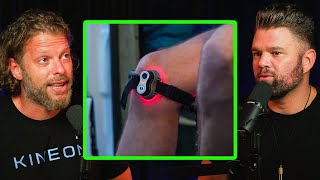
YouTube video (Feb 15, 2024) where Josh Trent interviews a guest about photobiomodulation (PBM) and the Kineon product. The discussion covers FLIR infrared imaging showing increased local blood flow, short-term vasodilation, mid-term restoration of endothelial blood delivery (noted ~5–6 weeks), and long-term angiogenesis; PBM's balancing effect on inflammation and oxidative-stress signaling; and emotional user stories of restored mobility. A promotional mention directs viewers to joshtrent.com with code Josh10 for 10% off.
Chapters
Right now on the screen, there's a picture of pre Kineon ankle and then post kidion ankle. And we'll give the credit to the blogger that did this. It's really cool. I mean, you can actually physically, visually see the increase in blood flow, but there's way much more going on than just the increase in blood flow. And this is really like, I guess this is the crux of the conversation, right? Because photobiomodulation, yes, it does help with inflammation, it does help with the soft tissue and a myriad of other things. But if you were to like put your finger on one thing, scientifically, physiologically, that's actually happening, when that laser starts to penetrate the skin, it starts to move the blood to the area. What is actually going on there? And why does that heat map show such a radical difference? That cannot be ambiguous. I mean, you can't, you can't say that it's not there. It's like literally black and then red.
Yeah, we actually, we did a. And I'll try to send you some more photos of it when I can, but we, we have, we use flir. FLIR makes infrared cameras and we use to kind of see how we're treating people's tissue. And a couple of things that happen really effectively with this is we dilate those blood cells, we deliver more blood to the area. The other thing that's very exciting about this is that you're also coaching that tissue back into how to deliver blood more effectively to the area. And so as an example, when we did those FLIR measurements for people's quads where they've had an ACL tear, it was 1 to 2 degrees colder, which again, that doesn't sound like a lot. That's really a lot for your, your body to be constantly in that state of under delivering oxygen and blood to that area. And when you start treating these acutely, you see blood rushing to the area and it opens up and over time, and I think we, I want to get it right because we had the study for it. But five to six weeks in, you start seeing that level out that blood flow, that, that endothelial tissue has now been taught how to deliver blood to the area again. And the last thing that happens even longer term is angiogenesis. So you start growing new blood cells or new, new blood kind of cardiovascular delivery tissue to bring more blood to the area as well. So you get it really kind of short term that, that, that burst of blood because you're, you're dilating the cardiovascular tissue and delivering more blood and oxygen in the area. Middle term, you're increasing the efficacy for your own tissue to do that without the lights. So to do it by itself, to fix itself longer term and long term is that you grow more blood vessels to the area.
It's so cool, because I was doing a ton of research for this podcast because it was necessary. This is such a vast freaking subject, and really, you could spend your entire life studying the effects and the science of photobiomodulation. One of the things I loved, though, and it's very simplistic, was that pbm, we'll just use PBM as the acronym. It balances the body's inflammatory response without impairing acute inflammation, which is the critical mechanism that's right. For the body to heal itself. So this is not like, you know, you've heard the old adage, if you wear a brace, then you make it weak. And that's true. If you always wear an ankle brace, if you always use a belt when you're lifting your core in, all the different muscles in your sailboat right there, they're gonna get weak if you always have a belt on. This is. Can you talk to us about the acute inflammation pathway and how this is not a brace. This is actually that coach, which is a cool way to say it, it's a coach that trains the body in that acute site to heal itself, and it does it in a way where maybe it would take longer or maybe it would never happen at all without the light actually coming in.
I love it. I think it's a much better way of saying what I was trying to say earlier with the oxidative stress is that when you see something that's bringing these systems back to normal, what you're not seeing is you're seeing if your oxidative stress is too low. So, you know, exercise brings oxidative stress to your cells, but it brings it in a healthy way. When your ox. When your oxidative stress is too low, you don't have that. And so this actually can get things back up from a, A, a low oxidative stress standpoint, but the same thing when you're. And this kind of goes back to what you're saying about the, the, the acute versus chronic inflammatory cytokines. It's helping you find balance in these systems, in these signaling systems, and it's unblocking the. The bottlenecks for how those signals proceed and, and do what they should be doing in the first place. So it's really helping your body just find balance through the signaling Systems that it, that it already has.
And in those signaling systems, maybe the part that was most confusing for me, I had to read a few studies a few times for me to actually get it, because when it comes to certain subjects, I'm thick. Because I was taught a certain way about how things work when I was a personal trainer and, you know, shout out to nasm. Their, their model was great back in the day when I learned it. And I think it 2003, 2004 was when I first became a trainer. And we were always taught that when you have inflammation, you either ice it depending on its local area, or you heat it. And that was it. There was no photobiomodulation talk at that time. Like, you know, the tech maybe didn't exist, or if it did, it was in its infancy stage. What continues to excite you the most about this field? Like, maybe from an emotional standpoint, like, you know, improving the quality of lives for as many people in the world is not an easy task. And I'm sure when you meet natural roadblocks and hurdles as a founder, like, you know, it can get pretty challenging. Like, there's got to be something in your heart that makes you want to do this on a super deep level, because just to quote Steve Jobs, when you do something you love, it's not always going to be easy. And you have to love it so much that you actually can get through the hard times.
One of the things that really picks me up on a daily basis is the stories we hear from our users. You know, and it's. It's things like, I've seen my wife walking through the. The grocery store again, and she hasn't walked through the grocery store. She's been in one of those little carts for 10 years, and she can walk again. And it's just. It's amazing to hear that.
Ooh. And I can. Like, you're tearing up right now, which is like, it's so beautiful, man. This is why I connect with your company. This is why I feel a special connection with you, because I'm here to help people live their life well. You have that same mission. What are you feeling right now emotionally? Like, what is that for you? It brings up a lot of emotion for you.
It does, it does. It's just. It just means that we're doing what we came. Like, we. We're doing what we came to do. And, and, you know, that means success. That's, that's, you know, growing the size of the company, like, that's, that's great to See, and. But for me, that's kind of vanity metrics. That's something where you're like, hey, we're. We're making more money. Yeah, that's. This is what we came to do. We set out to, to solve these problems, and we're seeing that on a daily basis, really, with, with people. You know, their lives are changing because of this.
I. I bet you didn't think you were going to cry in the podcast today, but that's how. I mean, honestly, that's how the best things in life are really articulated, is through human emotion. So I just celebrate, I totally celebrate the fact that you're doing what you're doing, because, gosh, this world of science can get so heady at times. And the fact that you can connect your head to your heart in the way that you just did, I mean, that right there speaks volume volumes about how much you believe in this technology. And that is. Is really infectious. Like, when a human being believes in something so much that it brings up tears and emotion in them, how could people not take an honest look? It's on the screen right now, you guys. Joshtrend.com Kineon and the discount that. Thank you, by the way, the discount is huge. It's not cheap. To make this, you had to travel the world and circumnavigate the globe. The, the code is Josh10. So it's 10% off. It's on the screen. We're going to keep talking about it, but I wanted to, you know, inspire you to do that because obviously this works. You have thousands and thousands of people that have shared stories with you. And I'm just visualizing this woman in the store right now, like, getting out of her motorized cart. Holy shit, that's amazing.
Walking up the stairs again. Who couldn't walk up the stairs? You know, you know, even one of our co founders from the company, he's. He's in his 70s, played rugby for his whole life, and now he can go. And he, at this point, was not able to walk up and down the field and follow the play anymore. And he can now. And he's. He's back into. And like, this was early into our company where we, we got our first betas in and, you know, everybody's, you know, our. Did. Did our model work? Have we dialed this in? Is the. Is it right? And he gets one of these and he's like, two weeks in, he's back up, no pain. Walking up and down the. The sidelines of the rugby field again. It's. It's those things that, like, it just makes it much easier to come into work and face whatever you got you. Like, that's, this is, that's the foundational passion of the business is, you know, and that's why we've, we spent so much time even before we started developing, even before we selected the product or the technology to go into, to set the mission. And, you know, I think we've stayed as true as we can to the mission with our, both our current products and our product roadmap going forward. And we're, we're, you know, we're in every day, seven days a week, hammering this because it's, it's great to build something and again, it's nice to have something where you can earn money to pay for your family and take care of things. But when you have something where you're able to see the outcomes and the, the success that you've been, that you've been shooting for, impacting people's lives like that, it's just a different, you know, it's a different ballpark.
Check out some of the videos on this screen that are perfectly curated based on the video you just saw. Make sure you follow me and I'll see you in the next video.
More from Josh






Your child's future start before pregnancy... and even before conception! #podcast

MD Reveals: Your Healing Creates Your Child's Reality (The Souls Coming In Need Strong Bodies)



