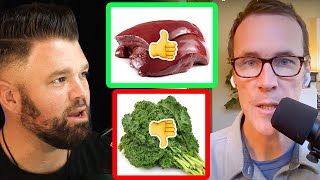
YouTube conversation (Josh Trent host; guest Chris Kresser) arguing that organ meats—especially liver—are far more nutrient-dense than most plant foods (citing a March 2022 study by Ty Beal in Frontiers of Nutrition). They describe a product (Biovale Organ) that blends five organs (liver, heart, kidney, pancreas, spleen) from 100% grass‑fed, grass‑finished cows, freeze‑dried into a powder and encapsulated; a serving is presented as equivalent to ~4 oz of cooked organs per week. Freeze‑drying is presented as a way to lock in nutrients and improve shelf/stability; NASA’s use of freeze‑dried foods for astronauts is mentioned as corroboration.
Chapters
Organs, as it turns out, are the most nutrient dense foods we can eat ounce for ounce. So Biovale Organ is one of our other products that we launched with. So this is a blend of five organs, liver, heart, kidney, pancreas and spleen from 100% grass fed grass finished cows. There was a landmark study published in 2022, March of last year by Ty Beal, Frontiers of Nutrition, and he works for an NGO that's concerned with ending malnutrition around the world. And so their mandate is, what foods will give us the biggest bang for our buck? If we're going to advise governments on how to feed their populations and end hunger and malnutrition, what foods should we be using? Is it Kel, is it blueberries? Is it, you know, is it all of these plant foods that, you know, get most of the attention? No, they're organ meats. And in fact, four out of the top seven foods from a nutrient density perspective were organs. And they were not just a little bit ahead. They were hugely ahead. Like liver on this scale. A lower score was better. Liver had a score of 11. And then you had some of the other foods in the top 10 were in the 6, 7, 8, 9 hundreds. So we're talking about even within the top 10 foods, more than tenfold, more than tenfold difference, sometimes 20, 40, 50 fold difference, between the amount of nutrients in liver and even other very nutrient dense foods. So our ancestors knew this. Josh, like many of our grandparents, probably ate liver and other organ meats. Almost all traditional cultures that you look at consume organ meats, liver and onions as well. Big dish. Native Americans used to throw the muscle meats, which is pretty much all we eat today, like steaks and chops and things like that. They used to throw those to the dogs and just eat the heart and the liver and the organs themselves. But we both know that not many people are eating organ meats these days. And I can tell you, yeah, unless.
You'Re the liver king, he likes to do that for show. But most people aren't going to put a heart on the plate and eat it.
Most people are not going to do it. I know from treating patients for my entire career, people would actually, it's funny, people would come in and kind of sheepishly say, I know you're going to tell me to eat liver. Because they had read my blog posts or books or something, they'd just like, I can't do it, I've tried, I can't do it. So I wanted a way to give people access to the incredible nutrient nutritional benefits of organs without having to eat or prepare them, because I knew that just almost nobody will do that. And so taking bioavail organs equivalent to eating a four ounce serving of these organ meats a week, which is about what I would typically recommend, they're so potent that you don't need a lot of them to get the benefit and you're getting them in their completely bioavailable food based. It's just food in a capsule. Basically it's food freeze dried organ meats that have been turned, they're frozen, freeze dried, made into a powder and put into a gelatin capsule and that's it. There's no other ingredient. So it's basically superfood in a capsule. And that gets you the most bioavailable forms of iron, zinc, copper, choline, many other B vitamins and amino acids and almost kind of gives you that unfair advantage that we all want to have.
I want to reference something you said before and I'm curious how this applies to organ meats you'd said. Like for example, when carrots are sold in stores, it could be two, three weeks with them on multiple trucks before they get down into somebody's mouth. How does it work when you take beef heart, kidney, liver and you freeze dry it and you encapsulate it so that it still has its vitality inside of it. In other words, how do you get something from walking around in an animal to a capsule and still get the benefit of its vitality in your body?
Well actually in a way it might be superior to eating it if you're cooking it at high heat, for example, because the organs are harvested and they're very quickly frozen. And then once they're frozen, you're basically locking in that nutrition. The process of freezing it does not deactivate any of the nutrients. Whereas higher temperature cooking, you're still going to get a lot of the nutrition from eating cooked organ meats, but there is some degradation in the case of some nutrients. Whereas with freeze drying you're getting that nutrition in a very fresh and vital way. And once you freeze and then freeze dry the capsules or the powder, you're just locking that in. So it's actually, it's, you know, I'm not suggesting that people don't eat cooked organ meats. I think it should if you can't, if you, if the taste is amenable to you and you're in the texture and you're able to do it. Absolutely. It's a phenomenal way to get that nutrition but freeze drying is a great way of locking in the nutritional value of many foods. Not just organs, but it's interesting, lots of foods.
NASA does this with their astronauts because people don't realize this when, when astronauts go into space, they lose so much lean body mass because of the lack of gravity that they have to train really hard. I mean, these, these astronauts train like athletes up there, Chris. They're doing deadlifts. There's like special machines. It's on the screen right now. There's a special machine of an astronaut doing a deadlift in outer space. And you know what? They feed them. They feed them, I believe, and y' all can quote me on this, I believe they do feed them organ meats and they also feed them specifically freeze dried food. So if it's good enough for NASA, it's good enough for me. Because there's a lot of money that's pumped into these astronauts. And I think that's a really good corollary to us here where there is gravity on planet Earth.
Absolutely. And it's also about consistency. It's pretty easy to take a supplement every day. But I have a lot of patients, even patients who like to eat organ meats. It's hard to stay consistent with doing that, especially if you have a family and you're not on your own. You know, like you, and no one else in your family likes to eat liver. If you, if you cook up liver, you're gonna have to do it separately. And, and some people really don't like the smell. And so, yeah, it's, it's just an easier, easier route.
Check out some of the videos on this screen that are perfectly curated based on the video you just saw. Make sure you follow me and I'll see you in the next video.