NOW OR NEVER | Alexi Panos | Preston Smiles | Wellness
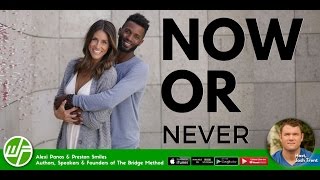
This is a December 27, 2016 Wellness Force Radio interview (episode 92) where host Josh Trent speaks with Alexi Panos and Preston Smiles about their new book Now or Never and the Bridge Method — a five-step approach to personal transformation. The conversation covers the five principles (choice; radical responsibility; act now; own who you are; have a blast), personal catalyst stories, emotional processing/trauma work, conscious relationship practices, and program/book launch details (including a free five-week live training tied to purchases).
Chapters
Wellness Force Radio Feelings are essential, but they can't dictate our actions.
We literally inspect each other with our emotions. We came here for a special purpose. Let the purpose unveil itself. Knowing without doing is the same thing as not knowing.
They're not just trackers. I'm gonna wear this, and it's gonna.
Help me do the right thing.
Wellness force radio episode 92 with authors and motivational speakers Preston Smiles and Alexi Panos.
Does wellness always feel good and look, quote, unquote, good and right and happy? No. But wellness means accepting what is and being in alignment with what's here so that you can move forward powerfully.
One of the things we teach and we support people in understanding is that the body is a living library. It stores every trauma that you've ever been through. And until you literally face off with these things and allow the experience to complete itself, it will show up in all, all areas and aspects of your lives. These traumas take up emotional real estate. And so our signal, our frequency, everything is energy. Our frequency is not as strong when it's being occupied with traumas that are still in the body. They show up all over.
Cultivating wellness in relationship is really about being willing to see yourself and being willing to sidestep the ego and go, okay, how am I responsible for this? How did I create this? How am I the context for this, the space for this to show up? And what am I committed to?
Whatever you resist, you grant reality to.
Welcome back to another episode, my friend. I am your host, Josh Trent. Thank you for spending your time with me here on the podcast. This is where every week I'm bringing you access to global experts in all things wellness, behavior change and new technologies. On this podcast, you'll learn from exceptional people who are dedicating their lives to being a positive force for our physical and emotional wellness. My intention with the show is that together we'll discover the connections between our emotions and healthy habits to live our best life life and enjoy the process. This episode is brought to you by Perfect Supplements, a company I'm stoked to partner with who actually walks the talk with their values of non GMO pesticide free real food supplements that fuel us for the wellness journey. Head on over to perfectsupplements.com wellnessforce Enter code wellnessforce to save 10% off your entire order. What's up, my friend? It's your friend Josh. And you have arrived to 60 minutes of elevated entertainment today because we're closing out 2016 with some fireworks and talking with my Friends, authors, motivational speakers and world class coaches, Preston Smiles and Alexi Panos. Today I'm talking with Preston and Alexi about their new book, now or Epic Life in five Steps which happens to be launching today. This morning, this show is all about creating the bridge from where you are to where you want to be. Now or never. Alexi and Preston are both internationally recognized next generation thought leaders who redefine what's possible in relationships, career and life. This is a duo who's been recognized as personal Development's power couple. World renowned innovators and pioneers in the emergent wisdom movement, they founded the Bridge Method and have created a movement of transformation that has taken humanity by storm through a unique and passion filled approach to sharing age old wisdom. They use social media as a main source of connection and distribution for their inspiring video series. And they've built this incredible tribe of loyal fans around the world who aren't just inspired by their work, but are empowered by it. So today on the podcast, you're going to discover how Alexi and Preston both went through periods in their lives where they felt like they were doing all the right things, but never got the results they desired. They read all the books and self help and positive thinking, took classes and sought advice, but there was always something missing. So after decades of their soul searching and development, they realized that they were missing a connection between mind, body and soul. Alexi and Preston both got deep with us today, sharing vulnerably and powerfully as we Talked about their 12 week online program, the Bridge Method course, which combines these years of training into five principles that can help us navigate the real world, learn how to overcome inner obstacles and become our best self. This is a book that's filled with narratives and stories from both of their own lives, as well as the lessons they've learned from helping thousands of clients along the way to attain the personal freedom they've been seeking. And as we move into 2017 and beyond, a show like this one is one you can keep on repeat. Let's jump into this uplifting and inspired conversation with Alexi and Preston. Preston, Alexi, welcome to the show.
Yeah.
So excited for this. You know, I read the book. I got one of the coolest copies ever. It says uncorrected proof, so I got kind of like some cool stuff in the beginning. On that note, there is so many videos. I think you guys have reached millions and millions of people by this point. But what's something fun individually that we don't know about you? There's so much about you online. You know, what's something fun that you typically don't share? Preston, let's get you first.
Oh, you guys. You let her have time to think about her. You just screwed me, man. So something fun. I mean, there's so much. Dude, I'm pretty weird and, like, all over the place, and that's also a part of my genius. And that's what you get to see in video as well. Something that most people say wouldn't know about me is how much I actually love people. Like, I literally can sit with anybody, and I am so curious, and I like messing with people. Like, she talks about it all the time, but, like, there isn't. It doesn't matter if they're at a grocery store, if they're, you know, shopping next to us, if they're. No matter who it is, I will find a way to sort of get in there. I just like talking and connecting and sort of being. My friends make fun of me because they say that I'm, like, the king of uncomfortable. Because I'll say stuff that, like, he likes to instigate. I'll just say stuff that's, like, obvious for everybody in the room, but nobody's saying it, and so.
Oh, that's so cool. I used to do that as a kid. Like, go up to a stranger who, you know is having a bad day and just say hi, like, in an excited way.
Yeah. Yeah.
Lexi, what about you? I mean, what's something we don't know about you? There's so many videos of you online.
There's so many things. Like, I. I'm actually an extremely private person, which is interesting because I live this, like, incredibly public life online. But things I like to do in private are watch videos of fluffy dogs.
She does do that.
I laugh until I cry.
Particular type of dog that she watches all the time.
They're called sammies. Samians, Samoyeds. There's five different ways to say it, but they look like polar bears, and I'm kind of obsessed with them. If I'm ever feeling down or low or low energy, I will find a video of them online. Like, I cry because I love them so much.
Wow. This is passion in motion right here. Well, it's obvious that you guys have a really bright light that you shine not only on the personal development world, but specifically the wellness industry. You know, wellness linking the body, mind, and spirit together. Why this book, though? Preston, let's. Let's ask you this first question. I mean, this book. You wrote a book called love Louder. You're a motivational speaker, you travel this planet.
Yes.
Shining that bright light. Why the book? Now, was there a message or a fire that was coming through you to get this out there?
Yeah. First of all, I'll say that this is the greatest writing I've ever done in my life. And one of the reasons why it's so good is because it's not just me, it's her. And so with that sort of balance of the masculine, feminine, that balance of. I know I call myself a sexy chocolate drop. And that there are certain experiences that you would never understand, per se, that I bring into this book. And there are certain things, even just being a woman and navigating, having a period and things of that nature you and I have no clue about. And so to have two people bringing in 10 years, not just 10, really, 36 years for me, but let's just say 10 years of diving into what it means to be human and what makes us tick and speaking to that human of today. This book for me is like the four agreements of our time with practical, really easy, down home, like, funny, biting, witty ways in which to operate and navigate our planet. And so for me, this was a calling on my heart. This had to be done. This was one of those things, you know, people learn many different ways, and I know that one of them is having a book that you can sort of navigate through in a linear process.
These five steps, they're very powerful, and they're kind of principles, I think, that we all can follow. The first one is you always have a choice. Next is be radically responsible. Third act. Now love that. Fourth, own who you are. And five, have a blast. Alexi, why did you include have a blast in there? I mean, how is that a powerful step to put at the end? And we'll go into each of the steps as well.
Yeah, you know, that's. I think that's the piece that most personal development books and trainings are missing because it's serious work, you know, and we're not taking that away from any of the work that we do. This is real hard stuff because you're facing off with your demons, your darkness, your shadow, your past, your stories, all of it. But if you're missing the point of life during the process, which. The point of life is joy. The point of life is to have fun, to explore, to expand, then you've missed the whole point. Yeah, you could be totally transformed and do all this work and be totally enlightened. But if you're boring and not having fun in life, what Is the point. We really wanted to include that because we feel like that's where a lot of people miss the mark. They get to so into this work that they get so serious and they almost start repelling people because they're so serious about it. And we. I think part of our draw and part of our magnetism of why people watch us is because they can tell that we actually enjoy ourselves. It's not an act we're putting on. It's the fact that we truly enjoy life and we're having fun. We're playing, we're getting the whole cosmic joke of this thing that none of it matters and all of it matters.
I love that cosmic joke. That is such a cool verdict right there. Well, you have this new take on transformation. I mean, there's been personal transformation since the 1800s and before. Right. So Zig Ziglar, all these trusted people that I think you both have learned from. I know I have, but on your site you talk about being over the whole boring personal development thing. What do you mean by that?
Well, it's just, it's like this whole self help personal development. I have the answer. I'm your guru and you should listen to me. It's like, yes. And we all know the answer. We all have an innate wisdom within us. And that's what the emergent wisdom movement is all about. That's why we created that term. Because we didn't want to be called self help authors or personal development people. We really wanted people to get that this is your journey and it's about uncovering your magic and your wisdom. And we're just here to remind you and facilitate the remembering process.
So the old paradigm, what she's speaking about, the old paradigm is I have the answers, you don't. I am the gatekeeper. Therefore you come to me. Give me your money. I'll give you little pieces like a little rat here and there to keep you just high enough where you'll keep coming back to me. But I'll never actually support you in seeing and experiencing your own power. And so for us, that does not work. That paradigm is gone. It is time for all of us to come together, stare at the same mountain, enjoy the journey while we go towards that mountain and realize that the gifts were already here. It wasn't about becoming, it was about revealing. And so this book is about revealing. It supports people in revealing what's already there.
I'm thinking of the title from Tony Robbins. I am not your guru. I don't know if you both have.
Seen that we have. But what's interesting about that is, like, while that's the title and I love Tony, like, Tony is the dude that. He was the gatekeeper for me that opened up.
He was your original G. Yeah, he was.
He was OG personal development guy. But the thing about that title is it still gives us a sense that he is our guru. And people still go to Tony thinking that Tony's got the answer or Deepak or whoever. And it's the way that we've been training people in this field of personal development. Like, you don't have the answer, so you need to go to this person to get the answer. And we really want to reframe that and, like, kind of call B.S. like, we all have it. We all have it. We just have to say yes to. To revealing it ourselves.
There's a good point that you made in the book, and it was about having a choice. And you came from Erie, Pennsylvania. This is not like the linear road for you. I mean, you had meant you were in New York. Then you had, like, a moment when you came out west and you're in LA and you didn't exactly know what was going to happen. And we're going to dive into Preston's story, too. This is one of the beautiful things about getting you both at the same time, because I think people are interested in the depth of the story. I think that's what people can really relate to. What was that road like? I mean, you're an Erie. You were in modeling for a while, and then you transitioned out to New York. But take us to that moment in New York and why you made the shift out to California.
Oh, man. You know, there's. First of all, Erie, Pennsylvania, if I stayed on the life path of most people from my hometown, I would have been pregnant and married at 18, which. There's nothing wrong with that. But that's basically what happened in Erie. You know, people didn't leave. People didn't do much of anything else. You got a job for Erie insurance or, you know, that was, like, considered a good job. And so for me, at a young age, I was blessed to have par parents who were entrepreneurs and thought out of the box. So I always knew that I wanted to leave because my mom had taken me to New York. She used to live there. So I spent summers there and started modeling at a young age, got into the music industry haphazardly and ended up traveling the world from 17 to 19 as a singer. And it was like this whole different life path with Ja Rule, with Ja Rule. Yeah. Who at the time was like, top of his career. He was, you know, in songs and.
The top voice, too. Yeah, yeah, exactly.
So all that led me back to New York City. I got out of the music industry, I started killing it in New York, using all these mindset principles of success and leadership, and built an entertainment career as a television host and model. High six figures. Killing it bought my first place in New York. Like, I had all the success I could have thought that I ever wanted. Like, on all my list, all my visioning list, I had done everything, like, traveled to all the places I wanted to go to, did all the adventures. I had my nonprofit, like, I was, quote, unquote, living it up, right. And then at 26, it started to hit me where I was. Like, I have everything, but I still feel this, like, thing that I can't put my finger on, but something's not right. And I couldn't figure out what it was. And so I started deep diving into this spiritual side of who I was. Not just the mindset, because mindset's great, but that's only like. That's the masculine side of who we are, is the very linear, direct, logical, reasonable reason person. But then there's this whole, like, feminine side of me, which is the creative, the flow, the unknown, the mystery. And I wasn't truly willing to dive into that until I hit that point and I started going down that rabbit hole and recognized that New York wasn't conducive for that. It wasn't conducive to explore that side of me. Because New York was a hustle place. You know, it's a place to get shit done and, like, kill it and crush it. And I was doing that, and I was doing really well at that. But I hadn't yet played with the whole question of life. And that really excited me. And I think, you know, at 29, it hit me where I was like, okay, I did three years of playing with that side in New York City and then in a meditation one day, I got so clear that I needed to be near nature. I needed to be near the mountains and the beach. I wanted nice weather because it affected how I showed up. I wanted to just explore and put myself completely out of my comfort zone. So I literally removed myself from my. My safety net. You know, I built this incredible life in New York City. And I literally left it all. I left it all. And people thought I was crazy. I had no idea what I was coming to LA to do, but I knew that it had something to do with this alignment.
What did your parents say? Because I know your mom is a relationship and life coach, so, I mean, how did that affect you? You know, being an adolescent, having your mom be such a coach and powerful lead other people? Did you feel like you pulled on that wisdom to make the movement?
Yeah. Well, you know, my parents have always been super awesome. I left home at a very early age and was on my own at a very young age. So my parents trust me. They know that while my decisions may not make sense to them in the moment, they trust that I know what I'm doing. And they've always kind of given me that grace. And I think my mom was excited for me, but she was a little nervous. Like, her scarcity conversation came in, like, are you going to leave this career that you built for yourself and all your clients, and what are you going to do? And I was coaching people in New York as well, so I literally was leaving everything. And she's like, you don't have any money saved. Like, you haven't planned for this. And I was just like, well, I'll figure it out. Sure enough, I came to la and it just hit me, like, I get to do my podcast. And that's when I started Transformation Nation, which has now turned into Videocast, which are my videos. And I just wanted to explore what this whole thing meant. And as I explored it, I started sharing it with other people.
And let's take a little, like, a little book right there. Bookmark. Because with Preston's story, Preston, you were nine. You had a transformational point where you used the power of choice. You're nine years old. You got moved to a class that was for tough learners, for kids that had disabilities. But you reframe that story. You guys talk about this, and now we're never a lot reframing the story. You always have the Choice. It was 1989, and you ended up graduating from college with a 4.0 and a master's degree.
Yep.
What was that like? How did you reframe that? What did that mean to you then?
So here's. I also want to offer something, because a lot of what Alexi talked about was what her logical mind could see. And what I'm about to say is, all of what my logical mind could see. But there's something that's bigger than all of us. Our science still doesn't know how to name it. Our religions try to nail it in, but there's something that's always moving ahead of us that knows something, that is listening to our innermost thoughts and co creating with us, but moving a thousand steps ahead. And so while what was calling her forward was new pastures in this great unknown, a part of that also was so that we could meet each other, join forces, support each other, and reflecting back what still hasn't been healed, stare at the same mountaintop, write books, make videos and do trainings so that we can support humanity. So in my opinion, whatever it is that is out there moving this planet that is rotating, growing the grass, and you know those little whiskers on your beard when you do decide to grow that thing out, whatever that is, is actually we're in communion with it. So I'm going to share some of this. But you know, my deep, the underbelly of this conversation is I know that I'm being used, that I'm a vessel for something bigger than myself. And so, yes, at nine years old, I made up some stories that I wasn't as smart as everyone else, that I was the dumb kid. And understanding that we're always looking for approval, security and control if we don't have those two experiences. And so out of those wounds, I began to seek approval outside of myself. So I joined a gang. And from there I had some awesome friends who were just as misguided and brainwashed and conditioned as I was. And one particular night, I made a decision not to go with those friends like I did the night before and the night before and the night before. And all of them were shot. And one of them was shot in the head and died. And that opened up a space because at 15, it got all too real. I didn't know how to hold that. I don't even know if many people can hold that now, let alone at 15. And so I ended up in Pittsburgh, Pennsylvania, in a small town called North Allegheny. I went to this high school that happened to be all Caucasian, so I was the only black male in the school. And I was treated like this amazing alien that everybody wanted to hang out with and had a realization there that shifted my entire life. What I got to understand was that the kids at North Allegheny High were smoking weed, drinking, listening to Outkast, Tupac and Biggie. And the kids at my former school were doing the same thing, but getting two different results based on the environment and the expectation. And so I got to understand at 15 years old in the back of a BMW, headed to a party, that there is no separation, that we're all being with the same stuff. And while some of the kids at my current school were going To Yale. The kids at my other school were going to jail and that the system wasn't set up for any of us, let alone people who happened to be cockade, who happened to be ethnic, to win. And so that led me on a path of following my dreams and ending up in college and then choosing acting as a career because I wanted to express myself and the acting. What's interesting is people ask me all the time, do you miss acting? And the answer is no, because what I really loved about acting was the psychology. What I really loved about it was diving into the human experience. And so I just cut out the middleman and went straight to the thing. And now that's what I do for a living.
And I was looking on YouTube, you know, there's a video early on, it was from 2012, and it was what you resist persists, Carl Jung's work. And, you know, you were talking about as an actor, you had all these opportunities. There was people that were giving you opportunities, but you felt the resistance.
Yes.
And we've talked about the resistance on the show before. I know both of you teach this to people across the world. What is the resistance? What were you feeling in 2012 when you did that video? And then unpack what resistance is for us.
So. Wow. Wow, you went back in the archives, man. Fantastic.
There's some good ones back there.
Yeah, for sure, for sure. And I leave those up so people can see the evolution and see how I found my voice even further. But for me at that time, the resistance was. There was something that was calling me forward, and I was still out of alignment. I was still doing what I thought I needed to do in order to go to the thing that really made my heart smile. And so I didn't see. And, you know, social media wasn't that big. People weren't making careers out of what I was up to at that point. So I was making those videos as a service. I wasn't trying to become a coach. I wasn't trying to make money. That had nothing to do with that. In my mind, I was still going to be an actor. And the resistance was unconscious resistance at that point. And also this. I was going for jobs. Every time I would go on audition and I'd read the sides, it would say something like, gang banger number seven or drug dealer number 12. And it was perpetuating a stereotype that I did not want to support. And so for me, the resistance was, ah, I have a complaint. And therefore, now I have a mission. And we talk about this in the Book that whenever you have a complaint that comes up, it immediately points to that you have a solution for it. So your complaint is your mission. And so I had this complaint, but I didn't know what to do about it. And so I was in resistance, playing in this industry that wasn't supporting me outside of that. What we talked about in the book, I'll let Alexei dive into it. But the main conversation is that whatever you resist, you grant reality to, you further plant it into your life. And so for us, it's about really unpacking what that means and then stepping boldly into what you do or what you would like to experience.
Yeah, and the resistance, what's interesting is there's this, like, insidious form of resistance that most people don't pick up on, but most people are actually in resistance to all of life. And we talk about this in the book as well, where people think that life should go a certain way, and they're kind of living their life based on that, like, unconscious expectation. And they are walking around feeling like life isn't fair, or this person should have treated me that way or this should have happened that way. Well, that's right. Well, that's wrong. And all of that judgment and expectation is actually resistance to what is. And when you're in resistance to what is, that's what causes suffering. So alignment with what is is coming into acceptance. First awareness of what is, and then accepting it as, okay, this is currently the fact. This is what's happening now from an empowered place. What do choose to do with that information? Because it's just information. Do I choose to react and to be fearful or angry or broken down and depressed, or do I choose to be empowered and happy and joyful about this experience? And I think that's the big thing that people don't get. There's the obvious resistance. Like, I'm resisting this relationship, or I'm resisting this next step up the ladder because I'm scared of what will happen or what will come of it. But then there's that insidious resistance of where are you resisting life?
And I'm feeling that because full transparency. Before every podcast episode, I have resistance. Before we got on the line, I felt the resistance. I mean, there's no finish line for resistance. Would you agree? I mean, how do you guys put a strategy? You talk about a lot in the book, the things that come up based on the conditioning of our mind and our past. You know, event A happens. I believe you even call it like this catalyst moment where you Know, Alexi, in your early 20s, you had a catalyst moment. It was this very serious moment where something happened that rocked you to the core. And it was a sexual abuse moment for you that became something that allowed you to grow stronger. But my curiosity is, how did it do that?
Yeah, well, you know, I think moments like that can either make us or break us. And it's our. It's our choice, right? So When I was 20, I was sexually assaulted and raped at gunpoint. And it was like a super crazy, I almost can't believe this is happening to me type of moment. So much so that my subconscious mind buried it and stored it away for six years. What's interesting, as I shared earlier, around 26 years old, is when I really started to do the deep dive work. And that's when all that resurfaced, all of it came back up. And we call it a catalyst moment. Because when you truly face off with the moments that are hardest or most triggering or just really tough to be with, when you face off with those, there's this element of freedom that comes with it because it no longer has you. And I think a lot of us think if we put it somewhere in the back of our mind or if we stuff it down, it won't bother us and it won't infringe on our life. But in actuality, it's bleeding out everywhere. That's what was happening with me, is that this thing that happened at 20 was bleeding out in my relationships where I didn't trust men or women. It was bleeding out in my lack of vulnerability and authenticity because I felt like it wasn't safe to be who I was and so many other ways. So for me, when I actually faced off with that, it forced me to get clear about what true forgiveness looked like. It forced me to get clear on what true compassion looked like. Because if I was to be radically responsible for being with that situation, how did I create, allow, or perpetuate that to happen? And I recognized how I played a role in the whole thing, how I was dragging it along into my present moment, the whole time thinking that that somehow was going to fix it or justify the situation. But when I actually took radical responsibility for it and got the compassion for this other human that was obviously hurt to do something like that to someone else, it, like, unlocked all of humanity for me in this very strange way where I started to see people as their wounds. Like, I started to see people as these people walking around who had been hurt, who had been through traumatic life circumstances, and my Heart just like totally opened and expanded. And I felt this immense amount of compassion that I would have never felt before. And that actually catalyzed this whole career that I do now. Because I started to see that if we could address these wounds and if we could go back in and dig into them and face off with them, then we could actually change the world. We could change how we relate to one another. Because hurt people, hurt people. And I started seeing it everywhere. I'm like, oh, that's why we're at war. Oh, that's why there's corporate greed. Like the whole. Because I was like deep into conspiracy theories and all that stuff. And it all made sense for me. We were all acting out of our pain. And if I could somehow support others in healing that pain, then the world could look so different. And it was just like such a catalyst moment. Without that, I would not be here.
And I'm feeling that so much because a lot of people can relate. I mean, sexual assault. And this goes beyond just America. This is something. This is a world issue, right? And so, like you're saying, hurt people, hurt people. And so the healing that you're doing, one of the ways you do that is through this bridge method. So for people that don't know about bridge method at all, tell us more about the bridge method. This is a workshop series. This is an online training. This is something that people can do no matter how old they are. Can somebody below 18 do it or is it 18 plus?
We've had younger people do it. The online program you can do as a younger person. The in person workshops, you do need parental consent just because it's pretty hardcore. And we get deep.
Tell us about the hardcore.
Yeah, we get deep into the hardcore stuff.
Yeah. So this is an interesting point because to the conversation that Alexei was just having, one of the things we teach and we support people in understanding is that the body is a living library. It stores every trauma that you've ever been through. And until you literally face off with these things and allow the experience to complete itself, it will show up in all areas and aspects of your lives. This is one of the things, and one of the reasons why men, especially, have such a hard time because they're not processing their feelings. Especially men who grew up in Western cultures that are taught not to cry or to show. Yes, show their feelings. So what happens is, is that. And we have a process called the freedom process that we break down in this, in our. In our book, now or Never, a neutral event happens. We make a story up about this neutral event, right? Oh, I'm stupid. I'm not good enough. Let's take me for example, right? So the neutral event was they took me from one class and put me in another class. The story I made about me, made up about that, was that I wasn't good enough, that I was stupid, that I was less than now. In that moment, I didn't allow myself to actually feel what that would feel like. Instead, I justified, stuffed it down and overcompensated by befriending the nerds and beating up the bullies. So what I made up about that and how I operated as a nine year old unconsciously was I never allowed myself to just cry, to just go, am I stupid? I never went to my parents and said, these kids are playing with building blocks and they're slobbering on themselves. Does that mean I'm like that? Like, I never actually allowed that thing to complete itself. So it wasn't until I was 26 years old in a workshop called Mitt, which you also have done, where I actually faced off with that in a major way and allowed myself to grieve for that little boy. And in doing so, I created more space. You see, these traumas take up emotional real estate. And so our signal, our frequency, everything is energy. Our frequency is not as strong when it's being occupied with traumas that are still in the body. They show up all over and then they spill out. As she talked about, it's like a beach ball trying to push a beast beach ball into water. It just slides out the side. And so, you know, when I was 17, this guy was essentially taunting me on the freeway. And I pulled up on the side of him and I got. I was so enraged that I pulled. I put my hand in my back seat and I reached for whatever was back there. And there was an orange. And as he rolled up and called me a nigger, I took that orange and I threw it as hard as possible from my car into his car, hit him in the head. He hit the center divider and crashed. And so this guy, thank God, did not die, but I could have went to jail for the rest of my life. And there was a point when I actually could breathe where I was like, where did that come from? That was 17. I had been kicked out of three schools by that point. There was a lot that was going on, but it's because I never processed it. I never allowed myself to complete. I never allowed it to complete itself. So this is a big deal and this is why the work that we do is deep in work. We invite people into some spaces. That brings up quite a bit.
And what's interesting too is like we've seen, like you said, people from all over the globe are being with stuff. And it's so crazy because a lot of it is the same universal stuff. And at the core of everyone's wounds and traumas is this am I worthy conversation. Am I worthy of love? Am I worthy of success? Am I worthy of living my potential? And what's interesting about that is through the bridge experience and the bridge method online, we really start showing them what's possible when they just put that conversation aside for a second after clearing their past and create in the present moment. Which is why now or never, now is the big part of that. Now is the present moment. This is what we have to work with. And when we really create in the present moment, we're not thinking about am I worthy? Because that's conversation based on our past. We're not thinking about will I be successful? Because that's a conversation in our future. We're in the present moment and we're creating powerfully now. And the more we continue to do that as a practice, the more that practice becomes a habit and the more that habit becomes our life. And that's when the game really shifts.
A big part of our emotional health comes from how we feel in our body and how satiated we are throughout the day. I mean, it's hard to treat other people well and think good thoughts if you're walking around hangry. One of the best ways to cure satiety and satiation is to add in powdered collagen to your drinks, your waters and into your foods. I use perfect supplements, collagen. It's sourced from 100% grass fed cows. That means there's no hormones, pesticides or synthetics because these are healthy cows that eat grass while the sick cows eat corn. So beyond these healing powers of collagen for digestion and joint health, it also has 20 grams of protein in two scoops, which helps to curb appetite and increase that satiety. One of the cool things about this collagen is that there's individual packets you can, you can mix in water and you know what it tastes like water. I mean, all of a sudden my glass has 10 grams, 20 grams of protein and all the health benefits of having this non GMO pasture raised collagen in my bloodstream. So don't walk around hangry, pick up your grass fed collagen. Feel better in your emotional body and your physical body every day. It's part of the Wellness Force Radio bundle, and it's heavily discounted just for you. Click over to perfectsupplements.com wellnessforce to save 10% off the already discounted package and get more wellness in the process. One of the things that I just want to compliment you both on, you know, I've seen you in person. I saw you at Thrive, the very first Thrive they had, and you ended up speaking the next year. One of the things you do on this podcast, as a video podcast, and also in all your media is that you lift each other up as you create. And I think that's rare because, you know, you've been called this personal development power couple, even though we know you're putting a new spin on personal development. There's this piece in your book, one of the steps, one of these principles, and it's own who you are. And my curiosity is you both have these dynamic personalities. How does that work off the camera versus on the camera? There's this duality that exists. Right. In all of life. There is. And so, you know, triggers come up for all of us. So how do you remain consistent with your personalities on camera and off camera? Are we seeing the same thing?
Yeah.
Well, no, it's all a fake. It's all a lie.
But, no, I'm sure what's interesting is, like, who we are on camera and on these interviews and on our partners in Shine Live show, that's who we are off camera. Now, do things happen off camera that we don't always catch on camera? Sure. You know, like, we're two type A personalities, and we're both really headstrong, and that can absolutely get in the way of creating and, you know, creating love and continuing our relationship. But the interesting thing is, is what supersedes all of that is our commitment to living our highest truth and our highest greatness. And for us, we know that each other is committed to that, and we know that we're committed to that as a partnership, romantically, but also in our business. So while things do come up and while, you know, comparison can creep in, because we're doing the same thing and we're on the same platforms and the same levels, and we're doing it next to each other all the time. So it's like, oh, shit, should I implement that? Well, if he's doing that. Well, she's doing that. And, you know, it comes up.
This is what I've been feeling, what I've been watching.
Yeah, yeah. And the cool part about how we work is when it comes up, we have a conversation about it and it's like, hey, so I've been recognizing that I've totally been in comparison the last couple days when this came up or that came up. And what I'm committed to and working on for myself is realizing that I'm totally capable of doing that too. But I just wanted to let you know if I seem a little off, that's why. And it's full responsibility in that conversation. And it's also stating a commitment, like, what am I committed to? Moving forward. And that creates a space for compassion from the other person. And go, ah, I see your humanness. And here's some of the humanness that I've been up to and that I've been up against. And let's be in this together. How can I support you? And for us, that's been a really powerful way to kind of navigate this whole thing. Are we always doing that perfectly? No, but we have the tools at our disposal that once we're ready to be out of our ego bullshit, then we can access the tools and go, okay, we're in. And the more we practice that, the less our ego is the first one to answer the call, man.
And the power is what I'm hearing from you is this is almost like a mission focused conversation.
Yeah.
So it's not about you, it's about the mission. And that's what's most important. That's what rises above the things that happen. Can you give us an example though? Because I think a lot of people are listening. They see you out there in media. Your videos are super high quality. Right. So you're using all your skills, all your communication skills and your videography skills. But I think what's really important is that people know you're still human. You still have arguments about the toilet seat and the wrong towel and all these things that are going on in life. So give us an example that people can really relate to. I mean, I know I'm kind of asking you to be vulnerable, but hey, this is what you do.
Yeah, for sure. We even speak about that in the book, which is what you're probably referring to, but one of our first big fights that we ever had was about a kitchen towel. And it was never about a kitchen.
It's a big deal.
It wasn't never about a kitchen towel, but it was about a kitchen towel. And it's one of the things that is. I think it's the second thing we talk about in Our book, which is Conscious and Unconscious Agreements, because what that taught us was that we both had unconscious agreements that had not been brought to consciousness. And here's the story. We were in the kitchen doing something, and I reached for a towel. I used the towel. I put the towel back in my version of neat. Alexi saw that towel. She didn't believe that towel was neat. We had a conversation about it. My ego flared up. Her ego flared up. She's an A type. I'm an A type. When we go into our conditioned tendencies, which is another thing we teach and support people with, my first conditioned tendency is fighting. Her first condition tendency is fight. So that's clearly going to create something in a relationship. And so our egos, which are always fighting to be right, went into this, you know, joust. And what ends up happening is that, you know, in that process, and this happens a lot with couples, we race to see who's the victim. Right. So I would have never done that if you wouldn't have done this. And we're playing this blame game, and this. This really was. We ran in circles for a while.
For a while. And what we got under is, like, at the end of the day, we just had a different should around neat. Like, what does Neet look like for me? Well, what does Neet look like for you? Okay, here's where the disagreement happened, is that you have an agreement on neat, and I have one on neat, and they don't match. So our agreements were bumping up against each other because they were unconscious. So this is really like. And that's happened, you know, replace the towel with the toilet seat or with socks on the floor or, you know.
A thousand things kids or whatever it is.
Whatever. Just notice how all of those are me.
Socks. Toilets. I have my stuff, too, but I was the one doing the talking. But, you know, at the end of the day, it's really about saying, okay, again. What's the higher commitment here? Am I committed to a relationship with you that works, or am I committed to being okay, that's the first thing to get clear on. Second thing, what is my agreement around socks? What is my agreement around toilet seat? What is my agreement around being around the opposite sex? What is my agreement on how we argue? And then what's your agreement? Okay, let's figure out if we can find a common space to land on that. Feels good for both of us.
Yeah. And what's awesome about that is in that process, you may find. And I know this because it's happened for me, you may Find that some of the shoulds and agreements that have been unconscious that we have now brought to consciousness are coming from a wound. They're not actually something that I would actually choose if I was moving from my higher self. So let's just take for example, let's just say you're having an issue around how your husband or boyfriend is with the opposite sex. And so the conversation may go like this. Well, you should never talk to anyone or bring anyone to our house that is of the opposite sex because da da, da, da da. And fill in the blank, right? That's an unconscious conversation. My friends think that way, my mother thinks that way. Everybody, every guy I've ever dated thinks that way. So that's law. That's right.
That's how it should go, right?
And then the guy has a whole different conversation. Well, I just like people and da da, da, da da, and all of this stuff. And so these two unconscious agreements are fighting to be right. Then we get in the conversation of, oh, let's make this conscious. And in that process, let's say the woman realizes that because she's been cheating on five times because her dad left when she was seven and because, fill in the blank, her conversation is, women are not to be trusted. And I don't want to be hurt again. So in order for me not to be hurt, I'm going to attempt to control this relationship in this way. And so she may look in that backpack, which we call, you know, people bringing their backpack with their own wounds, and go, you know what? This doesn't serve this relationship anymore. Honey, could you support me? Now I'm not saying bring women home and have them at our house every day. But what I am saying is that I don't want to hold onto that story anymore. That doesn't serve me and that doesn't serve you. And I understand your truth. And so therefore I'm willing to meet you closer on your side than I am on my wounded side.
How do these agreements relate to wellness? I mean, wellness in a relationship? You've said in videos how you do one thing is how you do everything. So you have these agreements that you guys have talked about, you've gotten clear on. But then in relationship there are different challenges than in the single life, right? The single leg has its issues and then so does relationship. So this doing the deep work in relationship, I can relate. I mean, I went through a three year relationship, love and respect her so much, got so many beautiful lessons and I got more buttons pushed in that relationship than I did in any keystrokes in a whole year of computer class. I mean, it was like button after button after button. So how do we do this? How do we cultivate wellness in a relationship?
Yeah, it really comes down to your. Your willingness to see yourself, you know, in relationship. Like, if you want the best transformational workshop that you can ever go to get in a relationship.
A conscious relationship.
Yeah, a conscious one. You know, because especially if you have somebody else who's committed to the work and doing the work, there's nowhere to run, there's nowhere to hide. There's no room for victim mentality. And that's why your buttons got pushed, just like our buttons. But that's also why we've expanded so rapidly, because there's no room to play games. Like, we just hold ourselves and each other to such a high standard that it's like, sorry, that stuff that you used to do back then doesn't fly with me. And, hey, sorry, self, that stuff you used to do back then doesn't fly anymore. So wellness, cultivating wellness in relationship is really about being willing to see yourself and being willing to sidestep the ego and go, okay, how am I responsible for this? How did I create this? How am I the context for this? This, the space for this to show up? And what am I committed to? And that in itself is wellness. Does wellness always feel good and look, quote unquote good and right and happy? No. But wellness means accepting what is and being in alignment with what's here so that you can move forward powerfully. And resistance is the opposite of that, and that's the opposite of wellness to us. And we find a lot of people are searching for wellness and, like, looking for it and looking for everything to be good and everything to feel happy and light and, oh, well, I can't focus on the bad because that'll be putting attention on the bad, and I need to just get high on good. And what happens is they're actually in resistance, which is the opposite of wellness. So the number one thing is, are you willing to accept what is? Are you willing to have a, like, radical awareness for how you show up? And are you willing to be committed to something greater than your ego?
This is so powerful for multiple reasons. But something that resonates with me is around the law of Attraction. You know, I've been following Abraham Hicks work for years. Preston, you were at her seminar this year. You were actually on stage. I'm curious, man. Can you share what she. What lessons she shared with you? You know, what downloaded through Abraham, what did you receive about law of Attraction? That's beautiful. Yeah.
You know what's interesting is, funny story in the lesson. For me, it was like I got like 30 of them just in that instance, because we were in the last row. We were in the last row. Right all the way in the back in the last row. And it was her last question that she was going to take. And she's walking across the stage, and everybody's like, me, me, me. And I did like this. I didn't even have a question. I did like this. My hand just slowly kind of went up like that. And she was like, you in the back. And I was like. She was like, no, you. And like, I was like, oh, crap, that's me. I didn't even have a question at that point. And so for me, first lesson was that what's yours will always reveal itself. When you are chosen for something, that thing that is handwritten on your soul, it will find you. It will make a way out of no way. And so before I even hit the stage, that already had came through. Look at you. You weren't even trying, and you found your way here. And so I got up there and I asked her about the work that Alexei and I teach. And I said, hey, we've been supporting people and really facing off with what people may call their demons and their darkness and reminding them not to get high on good all the time and to embrace the totality of life. And I gave her this example that we use in our workshops about the little kid who has his swing stolen and goes to his mom and says, tommy stole my swing. And he cries and he goes through his experience, and then 10 minutes later, he's back playing with the kid in the swing. And Abraham really got lit up about that and went on this beautiful rant about how the kids have it figured out, and what we're teaching is right on. She's like, the issue comes when the parents of the kids get into it and start making judgments about how that kid is a bad kid and this kid's a good kid, and the parents end up separating themselves and separating the kids when the kids are just in the game. And so the big lesson was, stay in the game, stay in the game. And the game looks like all of the stuff we've talked about up until this point, which is really honoring the human experience in its totality.
I love that so much. I'm actually going to go to her seminar in a few weeks here, so thank you for sharing that, man.
Awesome.
I cannot Wait to go to that. That in a couple weeks. And what came up for me a lot in our conversation so far today is this paradigm of challenges that happened to me versus challenges that happened for me. And I really enjoyed when you wrote about this metaphor you crafted in the book. And the metaphor was around the comfort zone. You have the testing ground. You have the castle of possibility, and then you have the comfort zone. Whoever feels good, popcorn it. Who's feeling good about, like, describing this metaphor? Because I loved the way that you talked about it. Now or never.
Yeah. So the comfort zone is really interesting. It's that cozy, warm Netflix is on. Popcorn's popping in the microwave. Everything feels good. Everything feels safe. Everything feels sure and secure. And what happens is we've got the testing grounds. We've got this forest of the unknown, where, you know, that's the dream job, the dream relationship, the next level in your business, the next level in your own personal evolution. And what we do is, you know, eventually the comfort zone gets a little stagnant, and we're like, all right, I'm kind of sick of watching Netflix. I'm kind of sick of binging on Breaking Bad. Time to try something else. And we get inspired. We get inspired. We say, enough is enough. I'm ready. And what we do is we dip our toe into the forest of the unknown. And what happens is we get met with all these hard challenges, and we call them the dragons, the wolves, all these things that live in the dark murkiness of the unknown territory. And what happens is we maybe slay one of them, and then we're like, oh, my God, I'm still alive. Okay, that was really hard. Most people, after slaying one of them or even seeing a challenge come up, go right back to the comfort zone. Because the comfort zone is, like, at least I know I'm safe. Even though safe might mean miserable. Even though safe might mean, like, you know, totally disengaged with life. At least I'm safe. And then some people make it a little further, and they get all the way through the forest of the unknown, and they see the castle. The castle's right. Right in sight. And they're like, all right, there's my dream. There's my castle. There's a prince or a princess inside there that I get to rescue, the dream job, you know, whatever the goal is. And then we get to the castle, and there's a moat, and, you know, the moat surrounding the castle, and there's alligators in there, and there's all sorts of Things. And there's not a bridge. There's no bridge. So how do you get across? And what people often forget is right before you're about to hit gold, right before you're about to get that thing that you. That you've always wanted, you're tested in the most crazy way. And what people don't get is that frustration you're feeling that overwhelm, that stress. All that that's coming up is challenging you and testing you to make sure you're ready to handle the prince or the princess. And what most people don't get is they make it that far, and then they turn all the way back around because they say, oh, see, it wasn't for me. See, there was no bridge. Somebody told me that there'd be a bridge or there should be a bridge there. And there wasn't a bridge. So guess I'll just go back to what I know. And we go all the way back, and we repeat that cycle again and again and again and again. And we wonder why we don't ever get anywhere. Because we give up right before the magic happens.
And I know somebody's listening, and they're feeling that in the weight of what I felt it when I read the book, because the metaphor is so true. We'd look at the hero's journey. And I know you're both fans of Joseph Campbell. We've talked about Joseph Campbell with guests and on the show. This is something so powerful because, like, you're right at that moment when it's about to have your dream in sight, or maybe you're, like, climbing up the wall. Things happen. Someone might pass away. You might break a leg. You might get in a car accident. Like, all these things occur. How does one know? And I'll throw this question up for you guys, how does one know when they're at that moment of being tested, that it's okay and to surrender into the test and just to move forward. How do they trust when to move forward or to give up?
I mean, I would say the answer to when you're ever in a situation is always to trust and surrender and keep going. Giving up to me is never really the answer. The path may change. Sometimes we head in the direction of a castle and we take a right or a left, thinking that's going to get us there, and it ends up that we're somewhere completely different. And that place happens to be exactly where we need it to be. But the surrender and the trust and the letting go and the moving forward, like, that process, for me Works every single time.
Yeah. For me, I'd say whenever I'm in a position like that, the first thing I do is get still and listen. I'm in a practice of listening to first thought because second thought is the one that usually is like, wait, are you sure? And then third thought is like, dude, are you kidding me? And then fourth thought is like, turn around, go back, get in the comfort zone. By the fifth thought, I might as well. I shouldn't have even thought it in the first place. So for me, listening to that, you know, that innermost voice that is always calling me forward, knowing that, and this is the big thing, and we talk about this in the book, you cannot fail. It's just impossible to fail. And so for me, there's a trust and an ease in knowing that I'm always guided, guarded and protected by the ever present circle of agape love. That I'm always in all ways being spoken to and through and as. And so it's impossible to not be living your vision. Even if you can't see it clearly.
Right now, even if it feels challenging, even if it's testing you to what you thought wasn't even possible, it's still there.
Especially when even if you're doing something that you know, may have, quote, unquote, nothing to do with it. We've had many clients, and myself included, myself included. I started a surf school, right. But the surf school has everything to do with what I'm doing now. Now, in the middle of it, maybe I didn't see it, but in hindsight I'm like, oh, clearly I learned so much in that process. So yes, I was, you know, I needed money and I, and I reached, I reached towards something that was easy for me. I reached towards something that was still in alignment, but it wasn't what I was ultimately going to do. But in doing so, I learned more about business, I learned more about myself, I learned how to make money fast. And there's a whole process of being, quote, unquote, off the path.
Yeah. Because you're always on the path. And I think, you know, that's even again, like the sexual assault and the music career and the modeling career and the television career. Most would say, oh, well, you weren't doing what you were supposed to do. But I was absolutely doing exactly what I was supposed to do. Because I use all of the stuff that I learned there in what I do now, like everything about production and video and how to be in front of and behind the camera. I learned while I was hosting how to perform music and modeling, like, colors and how to make things visually stunning. Modeling. So it's like all of it played its role. All of it. And I think we get in trouble when we start thinking that we're off, off the path. We're always on the path. Always.
Mic drop. We're done. This is our last round. This is seven fast ones. Lexi, what do you think right now is your greatest edge? I mean, in other words, what are you currently in process of learning? What's your deepest lesson right now?
Ooh, my deepest lesson is surrender. Like, surrender. Surrender. Surrender. I was gonna say, like, letting go of. Of my old stories. Letting go and letting source move through. Letting go of the idea that it has to be done now or I'm behind or I need to get ahead. Just letting go of all of that and just really, really surrendering to the moment.
Preston, if you had, like, 60 seconds in an elevator with Donald Trump and he would listen, what would you tell him? Knowing what's going on in the country in 2017, what would you say?
Great question.
I would say, I love you. And I would listen to him because I find that that's probably, like, truly listen, listen with my heart, and I just be the space for him to share what's truly going on with him and remind him that, you know, he's a reflection and that we're all perfect, whole, and complete, but not finished.
Lexi, who's your mentor that you really feel resonated with the most? Is it Tony Robbins of the past or is it someone of the now?
Ah, honestly, my greatest mentor is. This is going to sound really esoteric and weird, but it's the source version of myself, like, my God self, because I find that that's the being that inspires me the most, the being that calls me forward the most. It's the being that challenges me the most and calls me on my shit. So I think that's truly the biggest mover in my life.
Preston, someone's going to workshops, they're reading books, they're consuming, consuming, consuming. They're on this path to live their best life, but it's been years, and they're at that moment we talked about where they're at the castle. How do they take that breath in that moment and recommit?
Just do it. How do they take the breath? They take the damn breath, and they slow down to the speed of wisdom. We move so damn fast in our society right now, and I can't say it enough. Slow down, slow down, slow down, slow down. What's for you is for you. It'll always find you just keep taking committed action without being in a rush or hurry. Because at that moment, you turn from a creator to a competitor. And the universe doesn't operate in competition. It operates from creativity. So just slow down.
Alexi, you have this massive vision that you guys are completing. How do you remain mindful when the attention towards you increases? How do you remain grounded as people and energy come towards you?
I think it's just about honoring where I'm at in that moment because it doesn't always look the same. Boundaries have been interesting for me because again, I find I'm a private person, but when I'm with people, I'm super present with them and can go for hours talking to them. So it's about boundaries, just honoring other of what's coming through for me at that moment. Like, hey, I'm not really feeling well, Just need a couple minutes before we speak on stage. Or hey, now's not really a great time. Or actually, I'd love to talk further about that and really getting clear on not doing it for other people, because I think the old me used to really want to appease and make sure everyone felt seen and heard and all of that. But what I'm realizing is the highest value that I can offer people is, is honoring where I'm at right now and being honest with them, because then I'm truly present with them when I'm there.
This is almost a mirror question for Preston, because, Preston, as energy increases, as people want to talk to you wherever you go, how do you decide who you give your energy to?
I listen. I listen. I slow down to the speed of wisdom and listen. And I listen to first thought. Some people ask to do podcast interviews and it's an immediate no, even if they have millions of followers and all of that stuff. And then some people ask and they're like, yo, I just started. Can you be my first interview? And my intuition, God voice, as I call it, says yes. If it says yes, it's a yes.
Last question. This has been so fun. I love this so much. Alexi, what is wellness? You know, feel free if you want to jump into Preston, but what is wellness to you? If you had to define wellness in a sentence, what would you say about wellness?
I don't know if it's going to be a sentence, but Esther actually channels this through in the law of attraction from Abraham that the source of well being is available to us all. And what it is, is well being. Wellness is our connection to Source. It's our alignment with that energy with the highest frequency of what's possible for us as human beings. And wellness, to me really is the embodiment of that. How open of a channel are you to the highest vibration of your being?
It's been an incredible time with you guys. So thank you so much for your work and just honoring the energy you're putting out there to the world. I mean, there's many signals that many people people put out. And I really like the signal you're putting out. I actually love it. Everyone's going to pick up this book, now or never. Your life, your epic life in five steps. Where can people get this book? And I think you actually are giving something away with the book if they're purchasing it. This is coming out, by the way, on the 27th, the day of the launch. So there's confetti in the background.
Yeah. So you can get it@noworneverthebook.com and we are doing a free five week live training with us to start your new year off powerfully. So if you buy the book on that website, there's instructions on how to get involved with that. We've got people from all over the globe who will be in that.
It's a $1,200 training that we're doing for free, essentially. And you join a book club, which is even more awesome because a, you're reading the book with a community, B, we're guiding you through it for five weeks live. And so this is a supercharged way to start your new year and actually do what you said you would do in 2016 and 2017 to end the show.
This is a quote from your site and then we'll say goodbye. We believe that the old days of self help are outdated. We don't need to help ourselves. We need to remember the truth of who and what we are. Thanks for coming on the show, guys.
Thank you.
You made it to the end. I am so happy we shared some time today together with Preston and Alexi. And as we close out this incredible year of growth, 2016. We made it. I want to give you more than just some takeaways from the episode. I want to give you gifts. Head on over to wellnessforce.com news. Sign up for the Wellness Force community newsletter, get access to the Facebook group and get four free guides that I'm giving away for 2017 around different wellness devices to beat decision fatigue, how to stay healthy when you travel and other quick and actionable steps you can take in 2017 to be healthy and well. All the show notes from today can be found@wellnessforce.com nowornever and get that copy of their book to join their live group as well. If this show sparks something in you, you have some ideas or some new direction for 2017, or you just want to give me a shout about the podcast in the next year, email me joshellnessforce.com or tag wellnessforce all over the Internet. So this is it. It's now or never. And with the things we learned from both Alexi and Preston today, there's. There is absolutely no doubt in my mind that 2017 is going to be an epic year for us. You're definitely going to want to listen to this episode again so that you can take time to reflect and record the things that came up. I know I will. This episode rocked me from my feet to my teeth. Because beyond just these five steps to make life epic, what I got most from Preston and Alexi was point number that. You always have a choice. We just got through with the holidays and typically this is a time where I'm triggered by friends and family. But this year was different because I consciously went into these interactions with people that have triggered me before and I took responsibility for my own happiness in these interactions. And I feel like that's what's going to make the difference for all of us in 2017 is remembering that we always have the choice. Not only how we show up in our power and own our own happiness, but how we affect other people. So as you move throughout the year, give yourself that self care and the love you deserve and remember the five steps that Alexi and Preston broke down for us so eloquently today. Number one, my favorite, the big takeaway for the entire year, you always have a choice. Number two, being radically responsible. Number three, act now. Number four, own who you are. And number five, have a blast. So here we go, 2017 and beyond. My friends, so much gratitude for what you and I are creating this year, the impact we're going to have on other people in a positive way. So until I see you again real soon, I'm wishing you love and wellness.
More from Josh






Your child's future start before pregnancy... and even before conception! #podcast

MD Reveals: Your Healing Creates Your Child's Reality (The Souls Coming In Need Strong Bodies)



