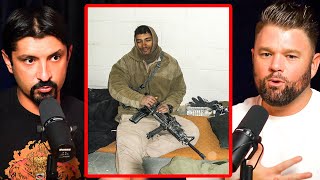
This is a transcript excerpt from a March 14, 2024 YouTube interview (host Josh Trent; guest Akshay Nanavati) about post-traumatic stress and growth. Akshay describes his experience returning from war, being diagnosed with PTSD, and reframing hypervigilance as a normal response rather than a fixed identity. He contrasts the common focus on 'post-traumatic stress disorder' with the lesser-known concept of 'post-traumatic growth' (citing Martin Seligman's West Point example), and offers practical exercises—sitting with discomfort, locking oneself in a dark room for an hour, or brief cold-water exposure—to build tolerance and promote healing.
Chapters
As an example, I was very honored. I was on the Dr. Drew podcast some time ago, and people were calling in while we were on the podcast and. Oh, cool.
I used to listen to that when I was a teenager.
Oh, no.
Adam Kolla and Dr. Drew.
Yeah, dude, that's a big podcast.
Congratulations.
Very honored. He's a great dude. Great conversation.
Yeah.
And we were having live calls coming in. So a woman calls in, and she had gone through the Boston bombing and was navigating some post traumatic stress around that. And we were kind of helping her offer some advice. At one point, I say, all right, the next time you feel loud noise, I just want you to. Because she was very hyper vigilant, right? Loud noises, yeah. And I was like, I just want you to sit and be with that. And she goes, yeah, but that's really hard. I go, I know, it's really hard. You can't get to the other side of the post traumatic stress without being with the discomfort of it.
So the point is, you've been through it yourself.
I have, but even that, like, coming back to everything we've talked about, the judgment or the second darts, you know, When I came back from the war, I was diagnosed with post traumatic stress disorder. I was struggled with survivor's guilt. Hyper vigilant of loud noises. Didn't like being in crowds. They were, I was told these were all symptoms of post traumatic stress disorder. As I went down the rabbit hole of research and studying neuroscience, psychology, spirituality, after I hit that rock bottom moment of wanting to take my own life, I started realizing, and you know, that. That the hyper vigilance of loud noises, it's not a quote unquote disorder. I spent seven months in a war zone where loud noises meant death. Hyper vigilance is a normal human response to said experience. So I started removing that identity of. Of post traumatic stress disorder and acknowledging, all right, I got post traumatic stress. I don't control my hypervigilance, but I'm going to refuse that identity of disorder onto myself. I'm not going to ascribe that to myself, because that creates a downward spiral of who I am. That's my identity. There's something wrong with me. Right. Instead, I'm just going to acknowledge and accept and be with the isness of this. Got it. I got post traumatic stress. Post traumatic stress can just as easily be a source of post traumatic growth. But the thing is, and Dr. Martin Seligman, he's one of the leading researchers in the positive psychology movement. He went to West Point, the military academy and asked cadets, how many of you have heard of post traumatic stress disorder? And something like 95% raise their hand. Then he asked them, how many of you have heard of post traumatic growth? Something like 5% raise their hand. The point he makes, which is 100% true, we've created a self fulfilling prophecy in this world that trauma, adversity, struggle leads to ptsd. Even here, when people, to this day, when people hear, I'm a veteran, and I get it, it's coming from a place of love. But there's this immediate assumption that, oh, like, poor, poor guy, he's messed up, there's something wrong with him. And again, it's coming from a place of love. So I acknowledge that. But we've created a paradigm that says trauma equals disorder instead of adversity, equals growth instead of trauma equals growth instead of suffering. Those characters like, right, whatever you want, however you want a term you want to use. So starting with is being with the discomfort of it. And that's as simple. Like if some. Sometimes people ask me after an interview, like, what's one action people should take? Go lock yourself in a dark room for an hour. Just do it for an hour. Guarantee you, especially if you're new to this, you struggle. Yeah. You will struggle tremendously.
Sit in 39 degree water in a cold bath.
Yeah.
For two, for a minute or two.
Do that.
That's, that's really hard for people if they've never done it.
It is really hard. Yeah, absolutely. Carl Jung says people will do anything, no matter how absurd, to avoid facing their own soul. And our, our world could not be more accurate representation of that.
Yeah.
And not just the bad things of drinking alcohol, drugs, or, you know, binge watching Netflix. Sometimes even the positive things, working out. Working is just a way to avoid facing our own soul.
Dude. The majority. I was a trainer. I was a personal trainer for 10 years. The majority of the fitness industry at that time. And I'm not in it now, so I, I can't say it now. I'm sure my buddies at Mind Pump could be like, yeah, it's still the same. It was all about shining light on others. To be in service of others, but to keep the dark parts of yourself dark. That was my role as a trainer. Like six pack shredded 13% body fat. But none of the things of my own darkness or fear had I ever explored really, like really, really explored. Because I was just using this kind of veil of being of service to others.
Check out some of the videos on this screen that are perfectly curated based on the video you just saw. Make sure you follow me, and I'll see you in the next video.