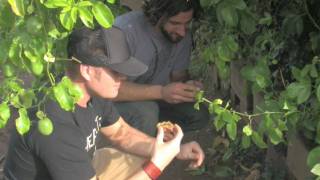
This YouTube interview ("TAKING IT TO THE ROOTS! ORGANIC FARMING PT1") features Josh Trent visiting La Milpo Organica Farms in Escondido, California, and speaking with farmer Matt Finkelstein. They tour the farm (goats, passion fruit), taste raw goat milk (from a goat named Kaia, about 4 years old), and discuss what "organic" means legally and practically — including that, per U.S. national organic standards, soil must be free from prohibited pesticides/fertilizers for roughly 3–6 years. The conversation also covers philosophical views on petrochemical pesticides/fertilizers, personal food choices, and challenges of scaling organic farming so it can feed more people.
Questions this video answers
Escondido, California
Mama Kaia; about 4 years old
Between 3 and 6 years
Chapters
We need to basically collectively make food more of a priority.
Hey, guys, I'm Josh Trent. I'm here with Matt Finkelstein from La Milpo Organica Farms up in Escondido, California. Now, we're here today to check out the farm, see how organic food is produced, see what's up with the soil, and check out the goats pet.
I'm not opposed to the eating of meat. I think we're all different. We all have different needs and considerations, like your interest in metabolic typing.
So what are their names? What are the goats names?
So this is Mama Kaia. Her name is Kaia, and I think she might be about 4 years old. Raw goat milk is one of the healthiest, leanest, most stimulating forms of milk.
That you can get. Raw goat milk's great.
And if you taste it, well, I'll let you taste it and you tell me what you think.
Very spicy. Something I get in a really nice restaurant.
Yeah, a really nice restaurant.
Like, a very nice restaurant, like, somewhere on La Jolla Boulevard. What does it mean when something is organic? What is the process that it has to go through? Because you see a lot of labels out there, you know, organic, this, natural, and they're not exactly the same thing. So when you have a farm, you know, like, let's say, how many years you have to go through and what's the process with that certification?
So under our current perspective and our current use, organic is defined as a legal term by the United States government. They constructed the National Organic Standards in the early nineteen nineteen sixties to lay out a set of criteria that deem what is organic food and what is not. I consider organic food as that which is grown without the use of chemical, or rather petrochemical pesticides and fertilizers. Petrochemical pesticides and fertilizers stem from the industrial agricultural complex and are made from oil. Essentially, it's oil. And to me, oil is an inedible substance that is better used for burning and driving cars. It's not good for growing food.
So the soil itself, how many years does it have to lie dormant without any pesticides or any kind of those petrols that you're talking about? How many. What's the time limit on that?
According to national organic standards, it's between three and six years.
What's the name of this one?
This is passion fruit.
Cool.
So the leaves and the flowers, it can be used for different teas and different herbal things and fruits.
When someone's in a restaurant and they're drinking passion fruit tea, do you really think that it's close to this at all? I mean, is passion fruit tea really made from a passion fruit or is it a powder? How does that taste?
Little sour.
Wow. Little sweet. That's awesome.
Isn't that amazing?
Can I just sit here and eat some of this for a while? Oh, yeah, dude.
Our bodies are naturally inclined. We were talking about this earlier to the major taste groups like sweet sugars, salt, savory, spicy, different things like that. We're naturally inclined to those flavors, that which are most rare in naturally occurring environments. If you're hunting and gathering in the.
Woods, well, let's face it, I mean, our bodies are still set up that way. So when we have a big hunk of meat in front of us, we're probably going to eat that because we did that thousands of years ago. If there's a bunch of sugar in front of us, which is something that happens in nature very rarely like you're talking about, we're still going to consume it.
We're all genetically inclined to different food availability sources. And as a mixture of. As someone of mixed European descent, I don't really know what that is. So that's why this personal approach of my relationship with my food has really benefited me. Well, I taste things, I try to feel them. Like, what did this make me feel like after I ate it? Did I feel good? Did I feel energized?
Did I feel slow? You're actually listening to your body a little bit. That's the one thing that I think people have gotten away from. We're low to the ground right now. I can actually smell how fresh this is. It's amazing. And I think what's missing in society now is people have actually lost touch with their feet on the ground. So here you are growing things, cultivating your food. It's a sustainable food project. That's one of the best things about human beings is that we are completely reliable and we're resourceful. We can make our own food, we can make great choices, we can eat good things. But you have to put your mouth in front of the money. You can't just think money first. So what's good for me is eating things that grow from the ground, things that walk around, things that I'm taking care of, things that I know where they came from. But when there's nothing going on that you know about, like you're sitting at a restaurant and it's cheap and it's good and you have a family to feed, that's the demise of the family right now. Exactly. So how are we going to do it? How are we going to take farming from this point and make it large scale so that everyone can eat organic? I mean, how are people going to do it?