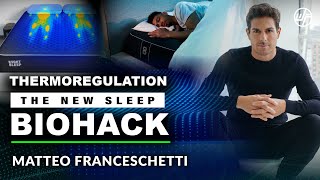
This is a transcript of a YouTube interview where Josh Trent and Matteo Franceschetti discuss how sleep quality—especially sleep-stage composition and bedroom temperature—affects hormonal appetite regulation (ghrelin/leptin), weight, and cognitive/physical recovery. Matteo emphasizes aiming for about 20–25% deep sleep and 20–25% REM rather than focusing solely on hours slept, explains thermoneutrality (neither too hot nor too cold) for REM and colder conditions for deep sleep, and describes non-wearable bed-embedded sensors (piezo, temperature, humidity) used to monitor and adjust sleep conditions.
Chapters
People that don't know about the ghrelin and the leptin. Right. When we don't sleep enough, we produce more ghrelin, which is like the hunger hormone. It makes us more hungry. When we're sleeping well, we have proper leptin. Leptin shows us that we're full. It's the feedback loop of being full. Can you talk a little bit about the ghrelin and the leptin in regards to appetite? Because I've seen research and we'll link this in the show. The show notes it can be upwards to 300 to 500 calories more per day that somebody eats when they're not sleeping well, which equates to about a pound of weight gain per week.
Yes. I like to use a metaphor to explain this. You know, when you exercise, when you work out, then you feel good and then you tend to eat healthier. Just because it's how you feel is the same concept with sleep. If you sleep well, if you had solid eight hours of sleep, good sleep, then when you wake up, there are some hormonal changes in your body where you will not crave carbs, you will not crave bad food, and you will very likely crave less food, which is exactly what you're saying. The point is it's not a placebo in your mind, but there are hormones that are justifying these behaviors. While instead when you're sleep deprived, you want to try to compensate that sleep deprivation and this lack of energy in your brain through food, in particular, sort of junk food. Wow.
I mean, like, the science could not be more clear too. I remember we had Rob Wolfe on the show and he wrote a book called Wired to Eat. And that's where I first learned Mateo about the leptin and ghrelin and how this can massively dictate the way that we actually gain or lose weight. So this is the hidden factor. It really is the hidden factor for most people. And if you're just joining us on Facebook and if you want to learn more right now, you can go over to wellnessforce.com 8sleep. You also gave us a huge discount, so thank you for the discount. It's a holiday time. It's like really important for us to get to sleep. So check the show notes right now. If you're watching on Facebook, just look right below us for the link. We hear anywhere from like 8 to 9, sometimes people that have chronic health conditions, even 10 hours of sleep. But what's the science showing you now? Because earlier you mentioned we want to get people to sleep less, but sleep, sleep more fit. Is there a standard, is there a gold standard when it comes to time of sleep? Or is it really more about the quality of sleep?
So these standardize and they just say, oh, you should sleep between seven and nine hours per day. But the reality is what you really need is a certain percentage of deep sleep and a certain percentage of rem. Light sleep is an inefficiency of your body to transition across the different stages. Stages. And that is where we believe we can compress your sleep and let you recover faster in less time by compressing light sleep at the end of the day strictly connected with your quality. If you can get your 20 to 25% deep and 20 to 25% REM and you translate that in minutes, that is what you really need. Deep is more for your physical body and REM is more for your mind.
People forget that there's stages, and I forget this too. You know, I just feel like, okay, I slept eight hours, I'm good, but it's actually not true. Right. We have these waves of sleep that we go through. Can you talk about the sleep stages? This is a really big one.
Yeah. So I mean, oversimplified is no. You have your light sleep and then you have DEEP and rem. In the first half of the night, you tend to have more deep than remember and a certain percentage of light, while instead in the second part of the night, you tend to have more REM and less deep. Deep is really important for your physical body, so for your physical recovery. While instead the REM is the moment for your brain to readjust all the information and readjust the storage of the information in your own mind. The interesting thing that is connected to temperature is to maximize your deep sleep, you need a really cold environment, and that is what we provide. While instead for rem, you need what is called thermal neutrality. And the reason is this, when you are in rem, your brain deactivates temperature control in your body. And so if it's too hot or too cold, it doesn't let you get REM because the brain is fearing that you might die. So thermal neutrality sends the signal to the brain, okay, everything is safe. You can get into ram. And that is why that temperature control is so important also for RAM phase.
So for the people out there who are watching or listening, you talked about this thermoneutrality. What does that mean in common terms? It's a very scientific word, thermoneutrality.
In very simple words, it shouldn't Be hot and it shouldn't be cold, while instead in the first part of the night for deep, you need a cold environment.
Yeah. It's interesting because I have always thought the colder the better, but it's not true. It has to go with the stages of sleep. And I think about the deep sleep component where I've measured it. This is something in your app which I think is fascinating. I for so long resisted technology because I thought, and I think a lot of people feel this way. Matteo, you know, why do we need technology? We've been sleeping great for thousands of years. As again I mentioned in the beginning of this podcast, we are not in that world anymore. We are in a world that we have totally different stressors than our ancestors had. Can you expound upon that a little bit?
Yeah. So when I think of technology for sleep, I think in two dimensions, right? One dimension is, yes, your phone with emails coming in, Slack Messages, text messages, WhatsApp. That gives you anxiety. That type of technology is bad because your mind keeps racing. Instead you just need to slow down. Our technology is a different concept. You don't see it, it's just embedded in the bed and it does some work for you. It enhances your sleep, but it's not that brings extra anxiety. And so we are in 2020, we just leveraged the power of sensors and machine learning to help our body recover faster behind the scene, we without impacting our brain and any sort of anxiety.
And I love it because most people, you know, we look at psychology, there's an internal locus of control and then there's an external locus of control. So setting a framework outside yourself so that you can actually do the things that you promised to yourself, like eat healthy food or sleep well, have good sleep fitness. So what is it about the actual sensors? And these sensors aren't harmful to the human body? Right. There's a PZO sensor for movement. But what are some of the other sensors that people may be hearing about for the very first time?
Yeah, absolutely. And let me step back for a second to say something that is really important to me. What I love of our form factor is you don't have to wear anything, you don't have to charge anything, you don't have to change your habits. So there is nothing that you need to remind to yourself there are no obligations. You just keep doing what you were doing last night. But this time your bed is smart and it will improve your sleep. Nothing else is going to be different. In terms of sensors, we have these piezo sensors. They are at the chest level and they really work like a stethoscope. Imagine that your brain is a WI fi connected stethoscope. Through that, we can pick any information about heart rate, respiration and sleep. Then we have temperature sensors in the bed, so we know the temperature inside the bed. And then we have temperature and humidity sensors in the hub, that is this unit that sits next to the bed, so we can have information about your bedroom temperature information. And based on that, we can adjust the temperature while you're asleep.
It's honestly like having almost a second version of yourself, like observing yourself and then making it so you have literally the best sleep quality possible.