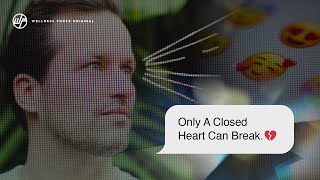
A conversational YouTube video (hosted by Josh Trent) featuring Mark discussing heartbreak, healing, and self-discovery. Mark frames a 'broken heart' as a closed, guarded heart and recounts a dramatic post-breakup near-choking incident that catalyzed his deeper healing and boundary work. The dialogue explores self-parenting ("the child can rest because the adult is here"), codependency, social conditioning, and questions around dating norms and reciprocity.
Chapters
To me, an actual broken heart is a closed heart. An actual broken heart is one that isn't willing to open again, is protective, guarded, walled, which I think can be important for the healing aspect. If you've been. If you don't have boundaries, if you've been walked on, if you've experienced trauma, abuse, all those things, there is actually an important boundary that is the complete individuation of self that doesn't allow anything in as you repair, and then you build up some level of confidence and relationship with self, capacity for self. Maybe you do it through different healing modalities. Maybe you see a therapist, maybe you do somatic work, but then you gently walk back into the world, protecting and preserving that wholeness. And right after we broke up, I remember I. You know, I had this drawer at home that had, you know, the marijuana in it. And I remember looking at a joint that was perfectly wrapped. It was just, like, beautiful. Singing my invitation. And I remember thinking to myself, like, okay, universe. And I don't. I didn't smoke a lot of weed every once in a while, but I was like, okay, universe, if I'm not supposed to smoke this, just show me a no. And, oh, my God. I'm with my buddy Jackson, who made this hat, actually, Jackson hell. And we're eating a steak, and I take a bite of the steak, and I start to choke on it. Wow. Now, I'm sure everyone has experienced, like, where potato gets stuck and you drink water, right. And you get it down. I go to do that. I can't swallow. I'm like, literally, my airway is blocked. I'm choking. Like, I'm now in this space. And this is a month after my breakup. This is, you know, chilling.
You're, like, really in the hurting of this at that moment.
Oh, yeah, yeah, yeah. Like, I'm right. I'm right in it. I think just after the closing ceremony. Yeah. What boundaries are in. We're not talking at that point. And I'm sitting there, and I, like, reach over and grab Jackson. I'm like, hey, hey, hey. And he's like, I grabbed my throat. He's like, are you okay? I'm like. And he gets up, and he's giving me the Heimlich maneuver. And it's. I'm thinking to myself, like, is this how I go? Like, will they get to me in time? Will my brain be damaged? Will I be able to ever. Will I be here again? And eventually it starts to go down, which I'm not sure if that's the right way. But either way, it got out of the way and I got air in. And I just remember being like, yes, like, I hear you. Like, this must be walked gently, and this must be walked present. And I. I think, like, everything. I remember talking to Gangaji and saying to her. She asked, what was I most afraid of? She asked, what are you most afraid of? And I said, going into silence, like, into stillness. And she said, what are you afraid you'll find there? And I was like, me, just more of me. And I get emotional saying that because there was almost like this. This, like, fear of really feeling everything. And that wasn't new, that was old, but it was like I was finally ready, you know, I really thought to myself, like, as things I could breathe again and life was coming back to me. And in the lighter side, I really had this beautiful meditation where I just was like, the child can rest the adults here. And so there was this completion of this initiatory process of really becoming an adult, like, not letting the kid in me, who wanted to people, please and was afraid of being left or not acknowledged or whatever, not being important. I was like, those fears are not going to run my life or my relationships anymore. And how I communicate. And I'm sure that's, you know, like, there's no better place to practice codependency than to have an Instagram based on helping people, you know, but then wanting people to agree with what you say as opposed to being okay with people not liking you. Well, it's the greatest healing of my codependency is saying things that people don't like, but knowing that they're true for me. And if they're not true for you, that's totally okay, you know, so it's been a. It's been a fucking journey.
The part that hit my heart and cracked my heart open was when you said, the child can rest because the adult is here. That is, like, something that I think people can feel. It's one thing to try to intellectualize a comment like that and say, okay, yeah, I know. I'm going to parent myself. Mark, I've. I've heard your teachings. I understand that I get to be my own parent. But to. But to actually embody and, like, have something click in physiologically, emotionally, spiritually, like, to have your meridians actually be connected to what's coming out of your mouth there. There's a unique process in doing that. And I'm curious if you could share, like, for you, what's that process? And how do you teach people that come to you to parent themselves, essentially. That's what this is. And we ask the universe, like, you know, what can I do to serve and what can I be? And the universe brings you hardcore challenges, doesn't it? Universe always brings you shit where you're going to be like taken down to your knees. You're gonna have to have your heart break in ways that you didn't know were imaginable. You're gonna have to choke on steak. We're all gonna have to go through our own initiations. So to bring it back around, like how do we connect spiritually and energetically to be the parent, like you said in these moments where, let's face it, society is set up to take us away from that, to pull us away from being our parent, to drink, to smoke, to shop, to fucking, to do all this other bullshit, how do we stay true to that?
Amen. You know, because the source of what fuels those things is the disconnection from self. It's the not acknowledging how you actually feel, not exalting, acknowledging that you were invalidated, that you were taught to self abandon, to belong, you know, but if you adjust yourself in any way to belong, which every human does till they wake up and have awareness and are like, wait, why do I do what I do and do I wanna still do those things? Are they conducive to my values? How I wanna live my life? Is my religion, my choice, or what I was born into? Is my occupation my choice or what I was born into? And those are really dissonance causing questions because if you can hold them and say they aren't, then you go, well, why the fuck have I been doing all this stuff? Because you were taught. Well, there's a big sadness to that and that's that grief and rage that we have to learn to access because that fuels the transformation. So the journey, which I'm sure everyone listening, if they're listening to your podcast, are on and likely deep within, is recognizing that there are some things we're taught that are good, you know, so it's not everything you're taught is bad, but it's like, what systems do you still want to participate in? You know, I did this Instagram, I did this question and answer. And one of the questions was, is it a red flag if a guy pays on the first date? Doesn't pay, sorry, on the first date. And I thought like, okay, well I know there was a lot of complexity to it because like if he invites you, then he should blah, blah, blah. And yeah, let's put all this I would pay personally.
That's my own story.
I get that. Yeah, I get that. Now it's interesting to start to question why we place value in that. Because we could say that it's a green flag for a man to invite, and I'm speaking heteronormatively, a woman to pay for half on her first date because he recognizes she can support and take care of herself, and he doesn't. Because the very act of buying, if we're just talking about it on an evolutionary perspective, creates reciprocity, an unconscious desire to want to owe you back. So if I invite you to my wedding, you're going to feel obliged to invite me to yours. That's human evolution. And that was designed. It's. If you look at Robert Cialdini's work, the book Influence, super interesting stuff. And there's tons of studies to prove this. And so there is one study. I can't remember the exact percentage, but, like, if a woman is open, if a man. If a woman is accepting of a man buying her a drink, she's seen as some really like 80, 90% more open to sexual advances because that's the dynamic that the system has created. And Esther Perel talks about this, you know, saying that, like, this is the greatest old trading system and the me too movement is the pulling down of the power dynamic and the inviting up. And I think that's a really important conversation to be having because. And I am sure we sort of got a little off topic here, but the point of this being that when we are even adamant that someone must, and it's a red flag if they don't, my question is, who taught you that? Just, can you be open to why? That's true. And if you're participating and choosing a mate based on it, which is totally different than intuition and red flags and all that stuff, then are you still participating in the patriarchy? And do you want to keep the parts you like and. And get rid of the parts you don't? Sam.