What Is The POINT of Fear?
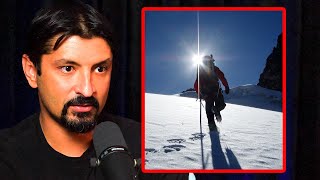
A conversational YouTube interview (Feb 28, 2024) between Josh Trent and Akshay Nanavati exploring why fear exists and how to relate to it. Akshay frames fear as an evolutionarily rooted survival mechanism (fear of death/negativity bias) that persists after survival needs are met and becomes a signal for growth; courage is required to act despite fear. They discuss reframing fear as guidance or part of one’s spiritual path, practicing acceptance by labeling emotions (which neuroscience links to reduced limbic activity/increased prefrontal engagement), practical exercises (set hourly check-ins, breathwork), and parenting approaches to help children feel and process fear rather than suppress it.
Chapters
What is the point of fear anyways? If you broke away all the definitions of fear.
Yeah.
And even look back on your life when you were a kid, like, what did you need when you were experiencing so much fear? Why did you even go to drugs in the first place? Did you need something different from mom or dad society? Was it part of the dharma? How do you, how do you context what you went through? And also what even is fear? Why, why was it there for you? Why is it there for all of us in the first place? Is it to source out the resources we need to teach us humility or is it something different?
Great. Yeah, great question. I think, you know, at the very core of it, at a very basic need, it's a primal need to keep us alive. Right. It's the fear of death. And evolutionary speaking, the brain wants to just keep us alive. Like I'd rather be. That's why psychologically there's the cognitive bias called the negativity bias. We're more scared of danger than we are attracted towards pleasure. We'll do more to avoid pain than we do to drive towards pleasure.
People stay in 40 year marriages they hate exactly. From that we will.
So we, we, we'll stay in that like. And because evolutionary speaking, it's more valuable that I, that I'm, that I'm conscious of the saber tooth tiger around the corner than missing a beautiful sunset. Who cares if I miss that, I'll still be alive, but I can't miss that. Right. So that's the core level. But clearly we've transcended survival needs. So what next? Now if you coming, like coming to Maslow's hierarchy of needs, the highest is not actually self. Self actualization. That's a misconception. What he actually said was self transcendence. So once we meet self, once we meet the survival needs, now we're seeking something deeper. Self actualization. Self transcendence. Right. And then to, to go down that path, to go do something we've never done before, it means taking a risk. If you want something you've never had before, you have to do something you've never done before. When you do something you've never done before, you will feel scared. That's normal because you've never done it. That's why I don't like the idea of always being, being confident to take action. How can you be confident if you've never done the thing before?
Hell no. If I waited for confidence, I would never accomplish anything.
Exactly. Confidence is the result of action, not the fuel of Action.
That's right.
I always even like to say, even belief. Like, I think there's sometimes weight. It is valuable to have belief at the right time. But when you are, wherever you are, on your spiritual and mental journey, you don't need to believe in yourself to take action. That's why I don't find it so valuable to spend so much time, quote, unquote, overcoming your limiting beliefs. Of my many mantras is your limiting beliefs. Take, Take action. And belief is built on the battlefield. So you will feel scared. You will feel a lot of fear. That's why Maya Angelou says, courage is the most important of all virtues. And I would agree, courage is the most important of all virtues because you will be scared emotionally, mentally, physically. Whatever this thing you want to do, to grow in some way, right. You mentioned mental, physical, emotional, financial, spiritual, you're going to be scared. You want to grow. You're going to have to do something new.
That's it.
That's a valuable place. But you have to step into the arena. And then belief is built on the battlefield, whatever your battlefield, the battleground and the playground are two of the same things. So don't get caught up in the semantics of it. Right. Whatever you want to call it, step into the arena. That's how you start growing. So fear is the mechanism that will. That will. That you will have to feel to enter the new arena. And courage is how you navigate that.
I am having such a flashback to, like, five or six years ago when I interviewed Gay Hendrix on the podcast for the very first time. He wrote the Big Leap.
Yeah. Yeah.
And he was also in one of my favorite documentaries that you have to see, Akshay, if you haven't seen it, it's called Finding Joe. I don't know. Oh, my God.
It's.
I think. I think they should do round two, and you should be in it. So, yeah, he said in this podcast, and at the time, I didn't get it. And then a few years later, it brought me to tears when I was going through a really dark night of my own soul. He said, josh, the way to actually live life is. Is not to, like, create a life where you don't have any fear or things aren't hard. It's actually learning how to love your fear. Learning how to love your fear is the secret. And at the time, like I said, I was not ready to receive that. And I wonder how you feel about this. How I feel about it is in order to love my fear, I have to see my fear as good for me, as actually part of the guidance from the creator, from God to. To put me on the path that I was meant to be walking. Anyways, instead of seeing fear as this, oh, my God, it's, I gotta get rid of this or I gotta push this out of the way.
Yeah.
Learning to love my fear has come through my own spiritual maturation process of like, dancing with it and actually, hey, fear's here. Okay, cool. Let's do this. Also, like, let's. Let's get into it. What do you make of what he said?
How to.
How to love our fear? How do you believe we can love our fear?
It comes back to a little bit of what I was saying is accepting the isness of it first without the judgment. And that's easier said than done. I get it. But the first step is becoming aware. And often you can just start by labeling the emotion. Neuroscience has actually shown, and I go way deep into the science of the brain and fearvana. But neuroscience has shown that when you label an emotion, it reduces activity in the emotional parts of the brain, the limbic system, and increases activity in the prefrontal cortex parts of the brain related to focus and awareness. Essentially what that means is it allows us to create a space between the emotion and us as the feeler of that emotion. Because this is the foundation. We're not our thoughts, we're not our feelings, we're not our experiences. We are the thinker of our thoughts, the feeler of our feelings, and the experiencer of our experiences. There's a space between what is and who you choose to be outside of what is. Awareness of what is. You can start by a practical way to do this. Set an alarm on your phone every hour. What am I feeling? Right. Especially if you're new to this. The more you practice it, the less you need to do things like that, because it becomes habitual. Right. Awareness of the isness of what's happening, then acceptance of it. Acceptance. And then now you can choose, because it's neither bad nor good. It is. And this is so like, if you. If you. The more you train yourself to accept what is, the more you can build around it whatever you want to create. That's how you fall in love with fear. That's how you fall in love with everything in the human experience. As another concrete example, you know, I was in the Arctic earlier this year on a training expedition for Antarctica. And I just been hammered by two days of massive polar storms. Lots of wind, just a lot of snow dumping on me. So next day I'm skiing, and I'm going up and down these kind of undulating terrain in Norway. The heavy sled and the snow is very soft. So it made it really hard to do that work. And I could say, I wish the snow was harder. I wish the conditions are better. Instead, I just kept saying, thank you, God, for these perfect conditions, because the conditions were perfect, because everything is perfect in its isness, for it cannot be anything other than what it already is. Everything is perfect in its isness, for it cannot be anything other than what it already is. When you accept the isness of things, you can now build onto it in whatever way you choose to create. That's how you start falling in love with it. That's how you create constructs of reality that serve you. And what I mean by that, to. To kind of build, to. To step back there when I say constructs of reality. Everything with how we view the world is a construct. Like, in the simplest way I look at this, this is a black glass, right? How do I know that? Because I've been taught. When I see this, this thing I'm seeing is a glass, and this color is black. That construct has been in, is given to me by my parents, by the world, how we think about the world, education, primarily school, all of that. Yeah. It creates the constructs of our reality. Those constructs define our reality. When we engage with reality, we're not engaged with reality as it is. We're engaging with our lens of reality. If I'm wearing red glasses, you could look at something green. The world's gonna still gonna look red. This is why two people can be in the same room in the same reality, and one person thinks everything is awesome and the other thinks everything sucks.
That's relationship.
Sometimes it is. Yeah.
Two people look at the tree and they see two different plants, completely different.
Things, because these are the constructs that shape us. But there is a pure, imperceptible moment between experience, between pure experience and the constructs we ascribe onto said experience. As simple as. This is a very simple example of the black mug. Right. But there's pure experience. It's imperceptible. You don't even notice it because the constructs are so embedded.
Yes.
But when you start to become aware of this, like when I really went down this rabbit hole, I would. As I was driving, I would keep saying things like, I'm awakened to the truth that all my reality is an illusion. I would see a red car, and I say, that's a red car, because that is A construct that's been assigned to me. So when I first got down, started this path, I would become, I would practice training myself in every setting to see that how I engage with reality is a construct. And the goal is not to say constructs are bad again, they are, they're valuable. Right. But now that I'm aware of it, I can choose what constructs I want to ascribe to my reality in every way. Like even as you know, as an ultra runner, when I did a, in the ultra running community, a 24 hour run is nothing crazy. It's fairly common in the ultra running world. When my family heard that I did a 24 hour run, they didn't think it was humanly possible. So in their constructs of reality, that's not even humanly possible. Now if you live in a world where this is normal, it completely changes the dynamic of how you engage with that feat because, oh, it's just what one does, right? So when you become aware of the constructs that shape your reality, you can now start to free yourself from the constructs that aren't serving you and build on them. Constructs that do serve you. To me, the answer to that question, the most existential question, who am I? There's no right answer. But my answer is I am the creator of my own illusion. The way I engage with reality is an illusion of constructs. So I'm going to choose whichever one I want to scribe by. I'm the creator of my own illusion.
When you were creating the illusion as a teenager, before the awareness came online and before the agency to choose it came online, most importantly, yeah. What do you believe the lesson was there and what might you or any person in your age or demographic might have needed then that you could actually say, well, I could still suffer in other ways and get meaning and wisdom from that. But maybe, just maybe, if I could fly in a time machine for myself or for another young man, what might he have needed at that time that could have made his suffering less and that could have still put him on the path and propelled him to where you are? What did you need back then?
Great question. Obviously, like you said, I didn't have much awareness or agency at the time.
And who does when you're that age?
When you're that age. Exactly. And my parents have asked, you know, what could we have done differently to have you not gone down that path of drugs?
Yeah, see this is, this is what I'm wondering.
They can again, they were great parents. It's not like I had some Traumatic childhood, Right? Yeah.
But no parents are perfect. I'm raising children now. I'm like. I really. I'm praying, like, let me not them up and let me love them as much as I can.
Yeah.
From a place of humor.
Old are your kids?
Two and two and four months and six months old.
Oh, wow. Okay.
Yeah.
Very new.
Yeah, very new.
Challenging, man. I.
It's our own Antarctic climb.
Oh, dude. Yeah.
Okay. But the sun is shining.
Absolutely. Okay.
So please.
So my parents, like, for me, you have to look at the uniqueness of each child. Like, I had a lot of energy. I'm like a sled dog. I kind of joke my fiance. I'm like a sled puppy that needs to have that energy expended.
You have a lot of prana. So even though you have this hemoglobin deficiency, your prana is very strong. That's what I meant with the question of your physiology and your dharma. There's some prana in you that's different than other people.
Oh, thank you. Okay. Yeah. Appreciate it.
It's neither a compliment nor not. I'm just. It's. In a way, I'm observing that your prana is different. You know, we're around people that have more vitality than others.
Got you.
So that's there.
Got you. Okay.
So I digress.
No, no. No worries. I think that. Yeah. So channeling that like my. My parents didn't know. The things I do now are things that one does. We grew up in India in a big city. You know, most polar travelers, polar adventurers, like, they're Norwegians who grew up in snow. I didn't see snow Till I was 14 and here from India. Yeah, exactly. You don't see much snow in Bombay and Bangalore or Singapore. Right. So I think channeling that into. Into those. Into those pursuits at a younger age would have got me down that path.
Okay.
At a younger age, like encouraging you.
More towards athletics or endurance, Something like that.
Getting into giving you an outlet for all that prompt. Exactly. Exactly. And this is harder to do, but I don't think it's impossible for parents. Is teaching your kids at a younger age to be with stillness and to not demonize their emotions for them. Like, parents do this all the time. And it's not your fault. If you do it, what happens? The best of us, you'll say, don't be scared. Don't worry, don't stress. We always say, don't feel what you feel.
From a neuro linguistic programming standpoint, all that we hear is the thing we don't hear any. We don't hear. Don't fear. All we hear is fear.
Yeah, the.
The unconscious mind can't process negatives.
Yeah, yeah.
So that's actually like harming someone with. With a hand of do gooding. It's harming someone.
It is.
Forgive them, they don't know, but.
Exactly.
Language is power.
It's not their fault. And it also, to your point, it does that and also denies them the opportunity to feel this feeling, which is a very human one. Like if I'm going for a talk, like let's say my kid's about to go for a public speaking, which is like one of the biggest fears.
Yeah.
Don't be nervous, don't be scared. What is that doing? He's feeling it, then he's thinking he shouldn't feel it or he or she, whatever, and instead. Got it. You're feeling fear. Tell me a little more about that. Okay, let's talk about that. What are you scared of? This, that and that. Got it. Be with that. Just sit with it for a second. Nothing fancy, nothing sexy about this, but sit with it for a second. Let them build that space. As Viktor Frankl says, there is a space between stimulus and response. In that space lies our power to choose our response. And in our response lies our growth and our freedom. There's a space between the stimulus that first start the thing we don't control of the emotion and who you choose to be outside of that. The more you master that space, the more you control your own destiny instead of being a slave to forces outside your control. Had kids master that, you know, and this, it's, it's, it is harder because neurologically their brain hasn't even fully developed yet. But this is far from impossible.
It's also especially millennial generation. In the generation before that, they've been programmed from devices. So the limbic system is wired for immediate gratification at all times. So to get somebody to. That's why I do breath work and that's why people in our Breathe program breathe with us. Because I'm like, hey, if you suck at meditating, try breathing.
Yeah.
Because at least you're doing something and you're centering yourself. I love that. Check out some of the videos on this screen that are perfectly curated based on the video you just saw. Make sure you follow me and I'll see you in the next video.
More from Josh






Your child's future start before pregnancy... and even before conception! #podcast

MD Reveals: Your Healing Creates Your Child's Reality (The Souls Coming In Need Strong Bodies)



