Why You Should NOT Get Titanium Implants in 2025!
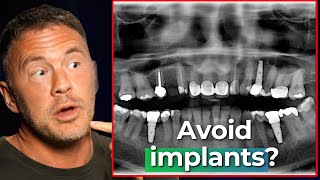
This is a YouTube interview (Josh Trent with guest Dominik Nischwitz, recorded Aug 7, 2025) arguing that metal dental work (e.g., titanium implants, gold crowns, amalgam fillings) can harm health. Key claims: metal in the mouth can act as an antenna for EMF and amplify signals (speaker cites '400–700 fold' amplification), create oral galvanism/battery effects (speaker claims up to ~3.5 volts between dissimilar metals in saliva), contribute to chronic toxic burden and allergic reactions, and alter the oral microbiome with downstream gut and behavioral effects (e.g., cravings). Practical recommendations discussed include removing prior dental metal/repairs, tongue scraping, and using biomaterials instead of metal. A policy note: Germany implemented an environmental mercury ban on amalgam in January 2025. The guest also emphasizes lack of standardized regulation/certification for biological dentistry and describes efforts to create a global standard (Biodentistry 3.0).
Questions this video answers
"400 to 700 fold" (as stated by the guest).
Up to 3.5 volts (as claimed in the interview).
About 140 billion microbes per day (as stated by the guest).
January 2025 (as stated in the interview).
Chapters
Metals in your mouth. Let's say in the 90s, probably not a problem because there wasn't too much epigenetic changes. There wasn't wi fi, no 3G, no 4G, no 5G, no electromagnetic fields. So metal probably was okay. And the immune system was able to modulate it and balance it. However, these days it's completely different. Like you're bombarded with EMFs. And if you have any metal in your mouth or in your body overall, it's going to be an antenna. And this antenna can lead to let's say electro hypersensitivity in making you in get more stressed and you don't even know about it.
This is crazy. Okay, we haven't talked about this. So the metal in your mouth can be an antenna for emf. How so?
It's just like every metal. Like you know how an antenna works? It's metal. Basically it's attracting electromagnetic waves. I mean usually if you, if you have a cell phone call, it goes to the tower, the signal goes to the cell phone, then to the tower back. Right. But if you have metal here, it will go to the cell phone, to your metal in your mouth, back to the cell phone. And what it does in the metal in your mouth, it amplifies it. Some there are studies, science showing 400 to 700 fold amplification. And if you understand that your body is a battery, as we know, like body electrics, it will change the whole flow of the system. It creates battery effects. It's oral galvanism. But it's again literally an antenna making you electro hypersensitive. There's actually people that can. It's crazy and it's off not often, but people can read really like amplify radio stations if they just go there with their mouth and stuff. Like there's real anecdotal stuff. However, this science, it's just simple. It's probably just physics and chemistry.
What was the oral galvanizing of which you speak?
Oral galvanism is, is a little bit different. Galvanism means like a battery basically. So if you have different metals, you know how a battery works. You have anode and a cathode and then there's electrolyte in between. And then these travel like the electrons travel so from one metal to the other one. And in your mouth you have an electrolyte too. It's called the saliva. And this saliva will obviously let, let the ions from your, let's say dental repair travel. That's for example, you have a gold crown right on top of A titanium implant. So there's a huge difference when it comes to the. The currents. So you can actually get up to 3.5 volts. It's a. It's a complete battery that you can run there just with one dental implant and a gold crown on top. But we don't think about this as technicians. Yeah, we just don't think about how can we as dentists be a contributing factor to the epidemic of the 21st century, which is chronic disease. We just don't think about it. That's not part of the dental curriculum. That's where we come in with what we're doing, what I just said, changing our profession from just a technician to the health expert. We still need to be the technician, but. But these days it's 20, 25. So we can use biomaterials. We don't need to use any metal in the moss. It's just not necessary anymore.
It's so good. Yeah. Who wants to turn people into antennas? We don't even know what we don't know about charging the body with that kind of electricity at that space. The deleterious health aspects that could happen. What do you guess? Or what do you know that might happen when the tooth becomes an antenna?
Yes, this one. But then also metals have more challenges. Like it could be super toxic material that's in your mouth, just building more toxic burden on your liver and your pathways. Also, you can become allergic to any metal because all the metals we're using for repair, they are completely foreign to the body. They have nothing to do in there. Like from titanium to mercury to gold to palladium, silver, copper, there's nothing to do in your body. So for repair and biting on it, it works.
However.
So would you be a terminator then, right?
I do not want to be a terminator. Me neither. And I am not Tim Ferriss. And I'm not all about transhumanism, where you put the electrodes in your skin like that. That's not my game.
No, me neither.
I'm not into that. So. So then, okay, so let's say that somebody has the titanium or the gold or whatever it is. What kind of relief would able to be not just felt, but measured once it's removed?
It's insane. Like the, the difficulty is it's silent usually. And you probably don't even connect all your symptoms with that in your mouth because it's there.
Yeah.
But I can tell you the biggest biohack is getting rid of previous dental repair. Because that stuff, you're just not able to biohack and it's with you, but you were not born with it. Right. You don't come out of your mom with metal in your mouth or a root canal or remove wisdom teeth. It's just not happening. So we just basically have to bring you back to your original state.
Would it possibly raise a 1C or would it cause like cytokine storm on a low level basis that you could measure?
Yeah, definitely. It's difficult to correlated if you have blood work, is that from that? So that's hard to do in studies. But however, if you have any elevated, let's say even elevated liver enzymes, it could be because of the toxins, chronic toxicity of metals in your mouth, or just the ions stressing you. And of course you probably going to me can measure innate cytokines such as TNF alpha interleukin ones and these things for sure. But you have to also have someone correlating this for you. Yes.
Somebody skilled, by the way, not just the average practitioner.
No.
Okay, so we, we know so much about the gut brain axis and also how this weaves into genetics and epigenetic expression. One of my favorite friends, he described epigenetics perfectly. He's like, you know, genetics load the gun, but environment and behavior pulls the trigger. Chris Kresser and I'm like, oh, it's so good. Like a child. A child can understand that. So. So yes, we understand the gut brain axis. And there's many realms in science where they're like, all disease starts in the gut. But what if it's not the gut? What if it's the mouth?
But what if the mouth is the entrance to the gut? If you look at an anatomical chart and you just see that this is the entrance and it starts here and then there's the esophagus and then there's the gut and then there's the rectum. That's just one tube and the end. That's why I always say it's like a, the mouth is like the hotel lobby to the complete hotel, which is then your whole gut system. So it's not possible to restore a gut when you didn't start at the beginning, like at the lobby. It's just literally important. You can imagine you haven't, you have a gut microbiome. We all talk about this, right?
Yeah.
But what about the oral microbiome, which is the entrance? So we are swallowing about 140 billion bucks per day, let's say microbes. And 50% is probably what happens in the gut afterwards. So it's all connected. It's the mouth body connection.
Yeah. How powerful is. I think we touched on it a little bit, but it's deeper and better to go now. The tongue scraping. The tongue scraping is big and you've talked about this a lot. There's a lot that's kind of waking and living on our mouth. That's why we have bad breath in the morning. Yes. Can you talk about the tongue scraping and the bad breath? Like there's a direct correlation there?
Yeah, of course. The tongue scraping is one of the oral healthcare strategies, strategies you should use because it's like a 10 second investment every single day.
You just have to do it, dude. It's pretty gross what comes off. It's like this tacky, cruddy film.
Yes.
Is that, is that bad bacteria? Good bacteria? What is that?
It's probably both. I mean, bad and good. That's not really, you cannot really distinguish. It's just your microbiome. It might be a dysbiotic microbiome because of what you have in your mouth. However, it's also food debris, it's toxins. And it just starts here at the, at the ground of the tongue and you just have to scrape it off. And if you do that for a couple of months or weeks even, it's fast, you, you want to wake up with too much fur anymore on, on your tongue. It's, it's just literally changing and then you have like a pinkish tongue and no white coating on top of it. It's. You just need to do that. And yeah, of course stuff that stuck get stuck there will affect your breath.
What would, what would be one of the clues or the considerations if somebody has a super white tongue even after they tongue scrape, even after they do coconut oil pulling, but yet their tongue is still white. What is that?
It could be multiple reasons. It could be the wrong diet for sure coming from the gut, but, but also, again, we can touch the dental repair side of things. So if you had anything done by a dentist, this can change the complete microbiome and just be the part. So your oral microbiome is actually the second largest to the gut and most diversified because it's the direct contact to the outside. You know, your little kids, they just play with dirt. They put everything in there and that's how you get built, you small dirt. Right.
My daughter will literally pick up dirt and just eat it.
Of course, my daughter too, she literally eats everything. Like she wouldn't even eat poo. Just test it. She would. She's below 2, like she everything. Like there's a little tiny animal, she will eat it.
Oh my God, they do.
That's what, that's actually also good. It builds the immune system.
Sure, sure, yeah.
But imagine this, like we could like for example, Chris, our common friend Chris Gethin, he had a lot of. He has a sweet tooth and we know that is connected to a microbiome. And obviously he was always able to control with his self discipline. I'm not going to have this. It's not going to be good for my body composition. But then he just lately told me after we removed all his oral interference, like the metals, the root canals and everything, he just hasn't no sweet tooth anymore. How is that even possible? He's like, why is that, Dominic? Why is there no more sweet tooth? It's from my perspective actually quite simple to explain. So if you had previous dental repair, for example a root canal or the metals, your oral microbiome changes, usually in favor of more pathogenic things, especially and fungi and parasites, mostly Candida. And this leads to dysbiosis in the mouth and then in the gut, you know, Candida, sure. And mold is all residual residue is also already in the mouth. So if you change this by taking out the whole crap, by far the biggest detox you ever do is taking out dental repair, changing this, changing nutrition diet, which wasn't needed for Chris. He's already on point. But yeah, just taking out the interference and then letting this heal. Dysbiosis is gone. No more cravings for the bad stuff. Because you know, parasites, viruses, fungi, they like to eat the processed foods too because they just, they just thrive on it. It's their pathways. So it's insane, right? But it's quite logic.
It's interesting. Yeah, it is insane, but it also is logic. Like you said earlier, we don't come out of the womb with metal in our mouth.
Definitely not.
So I'm just wondering, just from my own curiosity, have you ever thought about this? I mean, maybe you did in the beginning, maybe you don't think about this question now. When did it ever become standard to put metal in a mouth? When was that and why was that?
I think this was about 200 years ago. They only had gold back then, so they used little gold hammer fillings. They took a while to put them in. And then there was a group in Asian Europe that I think French guys that started this amalgam, you know, the black silver fillings, which is, it's actually a very easy material to work with. So instead of doing Tiny hammerings with gold in your, in your cavities. They just put it in there and it's like 10x faster. So this won over the gold and became the golden standard. As you know, it is still paid by insurances for the, the black fillings, which are 50% mercury. But for example, in, in Germany, since January 2025, we have an environmental mercury ban. So finally, the metal fillings are the, the silver, black metal fillings are not allowed anymore. So it's called amalgam.
Were you just so stoked when that passed that law finally?
I was waiting for that for like a decade because Sweden and all the Scandinavian countries had that already. Early 2000, Russia had it 30 years ago. They realized that mercury is not healthy for the body. I love that they did this. The way they, they obviously communicated with the public is a little bit off because they're telling you now it's going to be more expensive at the dentist. They don't, they don't tell you that they did something wrong, that it's really was a toxic idea.
Yes.
Because having mercury in your mouth is chronically intoxicating you.
Yeah.
And obviously if they would say that this is a problem, it's going to be too expensive to repair all this by the state. So. I understand. But it's good that it's gone now.
It's so good.
And not in America.
Yeah, I was going to. This is, the next question is like, okay, so in Europe and your practices in Germany, the ways in which you perform the biological dentistry, what is different about Germany and Europe compared to the bylaws and the practices of biological dentists here in America?
That's the same question at the beginning, biological dentistry, still, there is no standard, there's no trademark. Everyone can call himself even a dentist, a biological dentist.
And literally the same European.
It's like a wild, wild west. There's people that, that use it for marketing because it became a little bit of a trend name biological dentistry or holistic dentistry. That's why, I mean, I need to work. We are working on a true biological global standard, which is more than just a repair. So for now, if I tell any patient out there, just go see anyone, it's actually going to shoot the whole mission in the foot. That's why I realized, okay, we have to be very standardized, create a certification, ISO standard to literally be able to guide guests worldwide for optimal health. Because, yeah, you can do whatever. Like it's tiny little islands now. We have to bring all these islands together and build a new way of thinking a new profession.
Yeah, it's like that phrase, the road to hell is paved with good intentions. So there. There could be a traditional dentist that, you know, goes and takes a weekend course and biological dentistry, but then there's no. What I hear from you is there's no governing body that actually checks the quality of the work.
Exactly. And the thing is, I'm maybe like the one trailblazing that. That word for the last decade and only realizing because of that, because of all my teaching, that this is happening. They have good intentions. But now some people are not. Not always having the best, best intentions. Some just have a good marketing. They tell you they've. They were taught by myself because they read my book or whatever or listen to a YouTube video, but they don't really know what we're doing. So that's why I've created the Institute of Biological Dentistry and have a complete certification process now called Biodentistry 3.0. In creating a new community, I call them the real biodentists, the real bees. And there are obviously also certain levels to this. So it takes a while to understand everything.
Whoa. If you enjoy that one you just saw, you will love this one on the screen. Click it and enjoy.
More from Josh






Your child's future start before pregnancy... and even before conception! #podcast

MD Reveals: Your Healing Creates Your Child's Reality (The Souls Coming In Need Strong Bodies)



