Your Triggers Are Your Teachers! Answer The Call of Self-Mastery (Mark Groves)
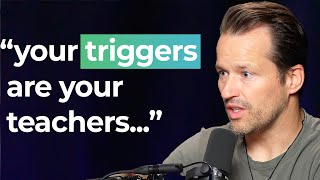
This is a long YouTube interview between host Josh Trent and Mark Groves (human connection specialist). The conversation centers on emotional triggers as opportunities for mastery, the maturation/ initiation process (answering the call), and how nervous-system regulation, boundaries, and community enable development of the space between stimulus and response. They cover related topics including attachment/hypervigilance, somatic practices (cold exposure, meditation), the impacts of childhood experiences and masking/social media on development, and practical steps for healing (timelines, extracting meaning, building small consistent self-promises).
Chapters
Behind every trigger is an opportunity for mastery. When we're the slave to our trigger, we're a child. The maturation process hasn't happened. And this is the wake up call. This is like, hey, do you want to be you or do you want to still be who you were taught to be? Mark Groves is a human connection specialist, author, podcast host, and founder of Create the Love. When you're triggered in relationship, there's an opportunity for you to learn a skill set, but also expand your capacity to hold the trigger because there's information there. The trigger is brilliant. So you don't want to remove your sensitivity because that sensitivity was created so you don't get abused again.
What is that that builds that agency or that power of choice in between the stimulus and the response?
The way to get to create more space between stimulus and response is things like most of us have shadow motivations, so they come from our wounds. But eventually the shadow leads you to the light. So what leads us is a deficit. There's something in me that needs to be resolved. It's like, how do we change from the motivation of something needs to be fixed to, I'm actually good. This is just skill sets I want to add on. This is just deepening of my wisdom. This is just further exploration. Because the previous view requires a wound, we become sort of the architect of our psyche and of our soul and of our beliefs, and we actually decide what input we're keeping and what input we're getting rid of. This shift is huge because then it's liberating.
Hey, everybody, it's Josh. Thank you for being here. And do me a quick favor, please. If you love this podcast, if you love what we're sharing, please subscribe to our YouTube channel. It just takes a second. And your little act of generosity reaches lives that you could not even imagine. Thanks for subscribing, Mark. Holy hell. We're here. We're in Austin.
I'm in Austin, Texas, y'. All.
Come on. You look great in a cowboy hat, by the way. I remember when somebody just commented on our Instagram and they were like, hey, do you remember when you wore the cowboy hat during the Facebook Live? And I was like, oh, yeah, I do remember that.
You did.
No, you were.
I did.
You wore it.
Really?
Yeah.
Was I in Austin?
You were. I was in Austin at that time. Oh.
And I was. We were on a call on a video.
We were doing an Instagram Facebook Live podcast.
You know, moving to Idaho has made me take on more of a country kind of vibe. I Haven't got the nut sack for a truck. But you know how people have that on the. On the toe?
Yes, yes.
Which is. I'm not into that. But I definitely like country music's mostly playing where I am. And cowboy hats. And I like them now I can't do anything with a horse, so it's a bit of false advertising. But.
But it's cool to have you here, man. Like, what a special fucking treat to have a friend like you to come in the studio to allow me to speak at your event. And this. This phrase that I was talking to your audience about yesterday, answering the call. Like, when we answer the call to something. Oh, my God, The. The ring can be ignored. Like, I remember that. Yeah.
Can't it? In that movie, it's like, to voicemail. You send God to voicemail.
You coming? You're like, no, I'm gonna just focus on what I'm doing right now.
Yeah, exactly.
But what was really cool. And I don't know if you've ever seen this movie before. I've mentioned it a few times. It's called Finding Gold.
No.
And it's about the hero's journey and Joseph Campbell. And there's this one scene in the documentary. It's like a bunch of people that you and I know, one of them being people from the Secret Dr. John Demartini and Gay Hendrix, who wrote the Big League. And he's talking about when you get the call. And it's like this young kid at the phone when you get the call, that's actually you being called for initiation. But if you're not ready for it, and it's no shame if you're not ready for it.
Yeah.
If you don't have the courage or you haven't developed the faculty to understand what even courage to answer the call is, then you're not ready.
Right.
And what's crazy about that is, like, so many people. There was like a hundred people in that room last night. It was such a special. It wasn't like a big living room of like a.
It did feel like pretty hot, though. Hot as fuck.
But when we get the call, man, it's like we may not have the courage or even the know how of how to facilitate the courage to pick up the phone. And I wonder, just based on the energy you felt from the audience last night, what. Where did you even get that phrase, you know, answering the call? Was it from the Hero's journey? Was it something that you just felt on your own? Like this phrase, answering the call? We all get calls. Right. But it's like, how do we actually know that it's the time to pick it up? Is it an intuitive thing? Because it ain't instinctual. It's not like we're a reptile running from another reptile when it comes to answering a spiritual development call. So what is that like? It's an interesting phrase, answering the call. I thought it was really cool that you named the event that.
I think it's. Because what I see time and time again is not that. Is that people are stuck. They're like, stuck, and they're. They're afraid to move forward towards something that they're being asked. You know, the idea is like an initiation, as you were alluding to about Joseph Campbell, which I didn't know answering the call was part of it, but it makes a lot of sense. Yeah, it's like the initiation, you'll be initiated either by choice or not by choice. And so that delineation of that is like a contained initiation versus a rough initiat. So trauma is a rough initiation. When someone leaves you, betrays you, lies, cheats you, you get an illness, someone dies, you know that those are the things that we can't prepare for. But what I see is that so many people, and this had been and has been true for me, is that, you know, because the three signs you're in an initiation is the world you once knew no longer makes sense. Who you are in the world no longer makes sense. And you can't go back to the way things were. And that's really the key. But most of us try to go back. So we, like, try to fit an old key in a new lock. You know, we try to go back to. It's like, let's say you felt the call to quit drinking, and then you go back to drinking. But you could feel the heaviness because, you know, this new world, this new possibility, and so the call just gets louder. And maybe that's why our rock bottoms tend to. To get deeper and harder because it's like we almost need to sometimes hit really hard. And sometimes, actually, I think we need to be left. We need someone, you know, because if someone leaves you, the relationship's not for you. Like, that's just the logical. They left you. Like, what are you gonna do? Go get, like, convince them to be in relationship with you. Like, the. The rule you have to make for every relationship you're in is that if someone doesn't want to choose you, they're not your person. Because the qualifier for someone to be your person is that they choose you. Like, that's a. It's funny to me that out of all the list of the things we write down, like 6, 2. I wouldn't qualify for that. You know, whatever. All the things like growth oriented, funny.
Charming, six figures in the bank, nice car.
Yeah. Like whatever. Which, like whatever your list is. Who cares? But at the bottom of the list is almost never they're fully available and choose me fully. Because why would you ever choose somebody fully who doesn't choose you fully? That. That means somewhere along the line, you learned that it's normal to show up fully for someone who doesn't show up fully for you. So the answering the call is like, you have so many invitations in your mailbox and you're like, I don't know what I should do. And it's just like, to bring clarity to that. Yeah, you do. You just don't like the invitation. It's not the party you want to go to. But you know, as the language is about initiation is that initiation doesn't give a about your feelings. Like, it just cares that you grow. It just cares that you become. And that's why the rock bottoms, the frictions, the challenges relationally. But in life, it doesn't have to be relationship.
Yeah.
Are like, hey, do you want to grow? Do you want to become? Like, do you want to quit selling your shit out? You ready to stop choosing unavailable people? You ready to stop being a prick? You ready to stop betraying people? You ready to stop hurting people? You ready to stop hurting? And. And so the. There's so many invitations, right? Like, where do you start?
Oh my God. And it's called forth through maybe one of a couple pathways. Like if you're in the eastern world, it might be using the phrase dharma. It's my dharma to live this out. It's my dharma to answer the call at this time. Or it could just be an unconscious manifestation of the healing that's being called forth to be looked at. In other words, somebody that grew up in a situation where their mom was absent, their dad was abusive or alcoholic, they're literally. And this is what I find time and time again, they attract the person to them that is going to poke and prod and dig into all of their stuff that is really just calling forth to be healed. And in the moment, it doesn't fucking feel like that. It does not feel like healing. It actually feels like a threat. So if somebody doesn't have the emotional intelligence to be able to recognize like, hey, this is Actually something I should look at, not bypass and put in a little box and then go hang out with friends that validate my bullshit further.
Right, right. Which is so easy because then you just hang out with people who are doing what you used to do and that's that fear of I can't go back.
Yeah.
But then you try to go back and you just, you know, it's like Ram Dass, I remember saying, like, here you are bowling and bowling isn't bowling anymore. Like you can't. It's like you just are different in the world. And we want to reject that because, you know, I think of that term ignorance is bliss. And like what a truth that is. Like when I used to be able to do a shot at tequila and dance on a speaker and try to have a one night stand. It's like I, I was so disassociated from my pain and the way that I was trying to anesthetized the pain was through things like arousal or alcohol. So that I didn't have to be in my body because if I was in my body, I had to hear, you're not great right now. You're not good emotionally. You're not acting in alignment with your integrity and your values. You're not learning the skills that you need to be a better partner, a better human. And you know, I think it's really the violations of our own values that lead to our addictions, you know, and that could be preceded by a violation of our values by somebody else. Like a violation of our sovereignty, a violation of our body, a violation. And, and so what then comes from that which I, Gabor Mate, has that beautiful phrase where he says the wrong question is why the addiction? The right question is, why the pain? And so if we can actually see that our pain, which we've been told, depression, anxiety is a problem. There's something wrong with you that you have these things. What a beautiful marketing campaign that is. And it's actually because you have a chemical imbalance that you inherited, which is total and has been always disproven. But it's a great message that if you have low serotonin, here's this product we have that actually makes it so you don't. You produce, you, you maintain more serotonin. Oh, we'll fix it for you. But what I'm saying is like the emotion you're experiencing, the depression, the, the sort of like immobility that you have, the freeze state you're in, the anxiety you have, those are all exactly the right response to what's going on in your life. And when we. Which is taught to us as children, not generally consciously, but unconsciously, but as children, when we develop the belief that I have this feeling, what's wrong with me that I don't trust dad? What's wrong with me that my mom can't be attuned and present to me? Because the child makes it about them. Because to think it's about the parent is too existentially confronting. And so what happens is, is we take that into our adulthood and we're like, what's wrong with me that I can't choose this? What's wrong with me that I'm anxious? And what a great thing to market to, like, here I have this product. It'll fix it. And I'm not saying there aren't incredible products that can be useful to help support the nervous system. To help support. Because you, like, whenever you go to change anything, you have to develop the resources to hold what change brings. And most of us get stuck there because our community that we tend to surround ourselves with, which is. That's the fastest way to learn how to change, is hang out with people who are already doing the you want to do, but also people who believe in your potential. Because when you hang out with them, their nervous system is like a bridge for you. It's like added to your web. It's like you're adding on.
Yeah.
To your potential. Because they're saying, we got you. Like, you never done this before, dude, we got you.
It's like the way you explain it. So simple. I heard Tony Robbins say, if you want to be successful, hang out with people that have had success. Like, success leaves clues. And it's like, like, I think on some level, we're like, yeah, of course.
Right. Right.
Yeah. This person, I want what they have in a way. And whenever I get mentorship or advice from anyone, I always do a vibe check. And I'm like, do I want not just the thing that I see in them that I want to have as a virtue or a value? Do I want their life? Are they great with their wife? Are they great with their husband? Do they have a healthy body? Like, what does their pentagon look like? Are they balanced?
Right.
Are they a kind of person that. It's kind of like going to a doctor that has a big beer belly and smokes.
Yeah.
And he or she is going to give you, like, advice about health. It's like, no, that's not going to work.
I know why you have high blood.
Pressure, even though People can be like perceived experts in their lane. I zoom way back. I wonder how you feel about this, looking at the whole of the person who's bringing forth the advice or the healing or the modality, or even like that bridge of the nervous system you mentioned and seeing them as a whole picture that I think is completely missed. There are people giving advice that they have really good strengths in one lane, but if you look at their life, it's a disaster.
Well, I mean, look at the proposed health experts who gave us health advice, who were world like country heads for public health. And look like if someone is obese, there's usually some sort of trauma that precedes that. Very seldom is it like genetic. And so. But we're not even allowed to talk about these things because we're so worried about hurting people's feelings. But I could tell you right now that the priority of people never feeling triggered is not productive for healthy relationships. Because we both know, and I'm sure all of you listening or watching know that like when you're, you are triggered, triggered in relationship. There's an opportunity for you to learn a skill set, but also expand your capacity to hold the trigger because there's information there. The trigger is brilliant. So when people start to do healing and they're like, I fucked up. I'm. I did all this work and I got triggered again, I'm like, of course you did. Because it's a radar. It's a hypersensitivity to a pattern that led to pain. So it's a lot like ptsd. So it's just a hypersensitivity. It's just, what do you do with the trigger that changes everything? So you don't want to remove your sensitivity because that sensitivity was created so you don't get abused again, or so that you don't find yourself in betrayal again. And so when I look at the fear that we have of actually standing in what is true and true for us and even the exploration of truth, because truth as a word can also be subjective. Because if I say tree, you could think of a spruce and I could think of a poplar. So we have to actually have a conversation to be able to discover that we have different paradigms. And so we'll argue, well, the tree is green. No, it's got a white bark. You're like, it's not fucking white. It's great, you know, and so there's this opportunity through dialog that all relationships are made better. And so I look at things like the different pillars that you're talking about that? Yeah, like as soon as you discover what wakes you up is usually one area. So yeah, right. So the call comes because you get sick. So then it's like, fuck, I'm sick. I got an autoimmune disorder. Okay, well, if I go to a traditional doctor, nothing wrong with traditional medicine. But if I go to allopathic medicine, they're likely going to be like, okay, you have this autoimmune, there's nothing you can do about it. Here's this biologic, here's this product that will put you in remission or help you or whatever it is. But if you go to someone who looks for root cause, they're going to see that your autoimmune is a symptom of something. If you look at the ACE study, the adverse childhood experiences exploration, it's like people who have trauma have higher autoimmune. Well, yeah, that makes sense because their nervous systems are dysregulated. They're stuck in fif life. Freeze, fawn. And if you're in fif life, Freeze, fawn. Are you going to be good at digestion? No. So, oh, you got leaky gut, you have ibs, you have diarrhea, you have constipation, you have bloating because your gut's not going, oh, there's a tiger over there. Let's process this. It's going like, get the out. Or let's hold on to it. And so we have to. What starts with the invitation over here is like, holy. I've sold my out. A lot of talk, but I've sold all my stuff out. And I hold on to everything. I'm at war with my own self expression. Of course there's inflammation in my body. I'm in relationship with inflammatory people. I'm choosing to be in high conflict relationships. I'm a high conflict person. Because if you're in high conflict relationships, you are, you're a match for them, which is not anyone's fault. It just is. But we got to do something with it. So then you start to eat better and then your body starts to feel more regulated and then you're like, oh my God, I'm more regular. I gotta. My body's changing. I feel good in my body. Well, if I feel good in my body, I can't be in relationship with the abusive person or the gaslighter or the person who doesn't want to build something with me. I now have to translate this alignment and integrity somewhere else. And the word integrity coming from the word integer. Which means whole. So like integrity is about maintaining and constructing wholeness and what develops wholeness, Knowing what your values are and then drawing boundaries around your values and learning how to communicate them and ask for your needs to be met and also meet other people's needs because it's not a one way direction and then protecting that. But if you do not stand for your values, are you going to feel healthy? No. Because in your own body you don't trust yourself. So if you don't trust yourself in your own body, you're going to feel inflamed and you're going to feel scared and it likely will show up as anxiety. And if that perpetuates over time because you haven't found your voice yet, it will show up as depression eventually.
And because it's such a hardcore input output, it's like so severe. Like I found in my life because of a more hyper vigilant dominance that I have, I'm sympathetic, driven. When Carrie and I fight, like for sure, maybe most people are.
Yeah.
And so I'll go to this place where. And I'm remembering it now, which is great. It's easy to remember stuff with you on a podcast. Right. But in the moment of trigger, it's really hard to, to let that wisdom that we've absorbed actually be present. But I remember in a call with Mark Wolin, he was like, whenever my wife get upset or we're in a fight, we just put our hands up and we say, different realities. Different realities. Because like you were saying with the spruce and the other tree, we could literally look at my, my lady and I could look at the same thing. And we have such a different physiological, neurological experience of what that thing is. And so when it comes to us communicating about a rupture or something in the relationship that's asking for attention. Can I just fucking breathe and be curious about it? Right? Can I just like, instead of me going into defense mode or trying to maybe even coach her, which is something that I'm aware of, can I actually just take a breath and pull back and just say different realities? Let's be curious about this, for Christ's sake. It's like curiosity becomes the fucking antidote to everything. But if we have a nervous system that's not regulated, curiosity ain't gonna come around that often if I'm stuck, if I'm literally so sympathetically driven that I never let curiosity in the door.
Yeah. And you think like the pathway to curiosity or the pathway to regulating the nervous system has so many different, like it takes a totality of, of the pillars that you're talking about, right?
Yes.
You call them pillars.
Yeah, it's a pentagon. It's just five aspects of us.
So these five aspects, it's like they actually all need to be intact in order to have robust regulation.
Yeah.
Which listen, getting dysregulated doesn't mean you've. It's normal to get regular dysregulated, especially under threat. But it's like we have a hypersensitive sensitivity. Then we go into dysregulation when a perceived threat is actually not accurate. So like we're having a conflict with our partner. The conversation is actually pretty normal. And then they say something that is just phrased or a tone. Especially for hyper vigilant people. Like people who are more anxiously attached and sympathetic driven are actually highly, highly attuned to facial expressions. But they actually are coding those facial like micro motor movements of the face, the eyes, the mouth, and they're coding them as threat or not. And so that's why you can be set off from a tone change from. But I would even argue that deeper what's going on even before the facial stuff is the recognition of the shift into dysregulation of the other person's nervous system. So because hyper vigilant people are constantly monitoring for threats.
Yeah.
On a way higher level. And they're actually sensing any change in the nervous system of the other person. And so it'll just make them get it into like. Oh, you want to go? Yeah, let's go.
Yeah.
Or. Or fawn and start to go into people pleasing mode.
Okay. One really fascinating thing about this, I haven't interviewed him yet and he's on the slate. It's Dr. Stephen Porges.
Oh yeah.
And I remember when he was talking about the, the micro muscles in the face, which to go back to the whole scamdemic.
Yeah.
When people were wearing masks, children for like a year or two, babies weren't allowed to see. I remember we were in the fucking hospital. We were in the NICU with Nova and we're in this curtain area with no one around and a nurse would pop her head in and say, you need to put your mask over your nose. And I'm just like the absolute insanity of this pseudo safety that robs a child, a brand new baby. My son like breaks my heart from seeing the muscles and the eye movement and the micro muscles movement that Por just talks about with facial recognition. Nova in his first week of life was robbed from that. So we would like aggressively just pull the mask down and just be like, go fuck yourself. Because my son needs to see us. That's how his eyes are literally forming in the first two weeks of his life. His vision is expanding like a rose. And he's looking at the way that my face is safe, his mom's face is safe. And it's just such a threat to just normal human relation for that to be taken away. It just, it really. It begs this deeper question of like, are we even aware in Porges work that. That this is even happening? This is why I'm excited to interview him, because I'm like, wow. The. The way in which I can consciously regulate with you, with my woman, with anyone, it allows them to feel safe. But I have to be mindful of what I'm doing. Is my face relaxed? Am I actually doing my best job of being safe for you or being safe for Kerry Michelle? Or am I squinting and putting out this message that I'm not safe? There's a lot there. There's kind of two parts. One, how it's robbed from children through masks. Curious how you feel about that. And then the other one is, what can you share with us about the way in which our face exudes either safety or threatening?
Well, the first thing about the mass with kids is what an absolute abysmal failure, potentially what was supposed to be every authority and adult in the room.
Wow.
It shows you when people are fearful of being judged, that they'll throw out what we know evolutionarily, what we know psychologically. Actually, I think it's the aap, the American association of Pediatrics or American Pediatric Association, I can't remember which organization, but they actually put out a statement that there was no research to show that masking children actually impacted surveillance, speech development, et cetera. But all you have to do is watch the still face experiment. And you know that when a mother doesn't respond to a child's cues and bids for connection, the mother, the baby actually escalates its attempt to get the mother to connect with them. That is a very famous experiment. But that experiment is obvious because like any parent or adult, when a baby is looking at them and trying to make a bid and a connection with them knows that you smile, you smile back, you respond to it non verbally. Verbally, you make cooing noises, you. You make different sounds because what it does is help regulate the baby's nervous system because the baby can't regulate its own nervous system. So it's like that is such a failure of mental Health professionals and child development experts, because we know that empathy is developed that way, that speech. Because then they went, oh yeah, there's been delayed speech issues because of the pandemic and the mass. And it's like, no shit, Sherlock. Like that to me is enraging and hopefully. Although I would argue that most people in that space who are in the sort of caretaking spaces tend to be codependent because that's what makes them good at what they do and have a natural predisposition to that type of work. Which hand up. It's me too. It's like, but if we are afraid of being disliked, we won't stand against stupid ideas. And you know, before I used to have more empathy or like would use language that was more gray to not be confronting about it. But it's absolute bullshit. And we all knew it was bullshit. It's just like when you went into a restaurant and you wore a mask and you took it off when you ate and when you went and pee you had to put it back on because apparently viruses have a certain height that they target. It's so stupid. But it's like that's when we throw out critical thinking like that in service of avoiding conflict, right? Much like I said earlier, if you like, if you're, if you prioritize feelings over anything else, your relationships are not made better, your society is not made better. Nothing is made better when you avoid hard conversations. And we are currently experiencing the product of prioritizing feelings over the exploration of truth. But I think that's now experiencing a backlash. You know, you are seeing that, but it's not modeled for us. Like look, during the pandemic. But this has been true for a while. No one modeled long form discourse about policy. Because if someone did a long form conversation about masking kids or masking parents of kids or closing schools or lockdowns, it would have failed abysmally to any policy argument. And so I look back and I go like, we better explore that shit. Because we study history so we don't repeat it. But it's like people should be angry. Like the people who were deceived, the children who were robbed of that, like, get mad. People like you should be upset, upset. But instead we're disassociated and upset that we got bamboozled. We're ashamed that we got tricked. But it's like the idea and I, this is also why I think that people get captured by ideology and are willing to do really hurtful things to humans is because when you don't believe you can be captured by an ideology or tricked by an authority figure, then that's exactly what makes you capturable. It's actually like what you believe is in unavailable to you is actually the doorway. And if you look at human history, that's the greatest atrocities were done under the guise of goodness. And so there's a shadow side to all aspects of humanity. But I think what we're really witnessing is that we know the shadow side of right wing. It's pretty obvious, it's explicit. I think it's overt narcissism. Right. But the shadow side of the left is covert narcissism. It's vulnerable narcissism. It's this like constant flipping of like, but we're just doing good. And if you look at the trauma triangle, it's, there's a victim, a perpetrator and a savior. Well, guess who's never the perpetrator. The far left. And that's, this is not advocating that the far right's any better. It's just saying like, you gotta at least know your own stinks. And that's the problem is when our self perception is that I'm not capturable and my doesn't stink and everything I'm doing is for goodness, that's actually, if anyone gets in the way of that, they're presented as immoral. Well what happens when someone's presented as immoral? Because if you're not for all these things that the far left stands for, then are you a good person? So if you're not a good person and you're getting in the way of equity, you're getting in the way of whatever the sort of virtue that's being presented, then it's actually okay to rub you out, it's okay to silence you because it's actually in the service of humanity. And so when I look back at the mass stuff, I'm like, that's just a symptom of the absolute that has happened. The second part of your question was.
What the actual biology and physiology of these micro muscles in the face moving so that children and also adults can know each other are safe.
Well, what's really beautiful is that you learn empathy, empathy through watching other people talk when you're young and through interactions with your parents. So that's why like even people looking at their phone a lot while their kid is trying to engage with them, their kid is not actually learning facial attunement, things like that. And we're also robbing them of the experience of attunement you know, and they're trying to engage. And here we are engaged with the world and we're saying that this world, the phone world, is more important than you. And so think they're all going to be adults who have to process that they didn't feel, you know, attended to by their children, by their parents, which I'm sure there's a lot of people listening or watching who have felt that in their own childhood experience before for smartphones. So it's like to me, smartphones, but especially social media, we will look back and it will be the smoking of today because there's an absolute addictive property to that. We know that. And here we did, as Jonathan Heights said, we like unleash the largest experiment on teenagers with. Without their consent. Yeah, like we just gave them these tools. And so you then now have, if you want to amplify it all, you have the fact that the platforms might celebrate things like booty pics and selfies and all that kind of shit, which. No, if I don't care if someone has a booty pic, that's not the point. My point is that those will get more engagement than often an intelligent statement. Sure. Right. So what happens is, is that you have these platforms where if I'm a teenage girl, let's say, for example, and I post a thought that I have and it gets 12 likes, and then I post like a selfie with my boobs out and that gets 500. Now I'm being socially programmed to actually feed an algorithm. And Jonathan Haidt talks about this in his book Gen Generation, the Anxious Generation. Really interesting. He said that the way that we learn behavior is through conformity, right? So like we look at groups that we interact with and if we interact with dynamic groups, we learn different behaviors for different groups. But we're learning how to survive in our culture, how to survive in our family, right? So we know this work is like the development of the unconscious. And who you build yourself to be is so that you're safe. And so Gabor Mate talks about how humans have two needs. We have the need for belonging and we have the need to be authentic. But if authenticity threatens belonging to belonging wins till it doesn't, right? And this is the wake up call. This is like, hey, do you want to still be? Do you want to be you or do you want to still be who you were taught to be? And that's really where I think all awakenings are, is that you're really saying, like, what pattern of behavior that's shown up as the symptom of the autoimmune, but is really self abandonment which is really not you expressing yourself. So you like come back to all that and you look and he says if you look the fastest, most effective conformity making machine is social media. Because one you see all your friends have Instagram, so you want Instagram and you're like let's say 13. And then when you go on there where it might have taken you months and years to get all of the data from human interactions in person, you now can scroll for an hour and a half on a phone and an average of 3 seconds per image. That's a lot of images. And what you're developing unconsciously is seeing which ones get engaged with. And so the ones that are getting engaged with are teaching you conformity. So think if and this I think is just the larger question is if one you're learning that booty pics and all that kind of shit is what does well then you're unconsciously just going to start doing that because you're learning what are the social norms. And if people get censored who have opposing views and I think this is really fascinating from like, like if every medical school made a vaccine mandate then that means that everyone who was questioning it is not in medical school. They might be now, but they weren't during COVID If everybody who questioned it is not in the military, then now we don't have people who. And it's. It's important that you have diverse thought. We fight for diversity of everything as Africa Brooks says but why not diverse thought? Like there's value in that. And so you look at what happens when we're only when, when you remove all opposing views, when you censor anything like that. And we all know that that's true. We all know that they shadow ban people who mention vitamin C and vitamin D and like yeah they or it said natural immunity is better than vaccinating.
Luke just got censored for mentioning.
Honestly. But it's like video got removed probably for some danger. Meanwhile, the article is about processed foods being good for you or beyond meat burgers. Those aren't like that's what I mean is like when you, when you wake up to that you've been taught anything but actual health. That's why the one pillar that wakes you up and, and someone tells you you can't cure this or you can't reverse type 2 diabetes. Like here, take metformin, take these drugs. And it's like. But the moment you discover you Can. Because that belief you can't will just become the way you live your life. So then you're now a victim of your biology of the environment. And so that means you have no impact on it. Which is the same as, like, someone comes from a childhood that they just. Maybe they don't even have to have a traumatic childhood. They could just not feel attended to. They could have a father who left, they could have a mom who worked all the time. But it's like at some point you have to decide that you were. Yeah, you weren't handed the cards you wanted to be handed. Carolyn May says that the greatest source of pain that people experience is the belief they deserved a different childhood than the one they had, but you didn't have it. And so, like, what are you going to do with what you were handed? So it might not be fair. It's not about the universe isn't fair, you know, but what are you going to do with the fact that you could sit here right now listening to this or watching this, and you actually get to say, I'm not sure I actually want to do that anymore. Like, what happens if it is possible, Just if the first insertion of possibility is, I don't have to be in relationships with dysfunctional people, which means I don't need to be dysfunctional. Oh, I don't. Maybe I can cure this thing. It's just the seed. It's just the seed. And if you can cure it, then now you're powerful. And that's why taking risk, responsibility for your life, which is not minimizing the experience of being victimized, but to, like, take responsibility for what you're going to do with it is actually the beginning of everything.
It's like wherever you start. And it seems to be the physical. Like you mentioned with disease. So with disease, you're told, you can't heal this, or, you know, we're the Thompsons, this always happens to us. You're predisposed to be.
It's in our genetics. And the patterns that created are.
Yes. And also the beliefs that are really, literally like, almost like you brand a calf, they're just like, burned into the psyche of the child. And it's definitely something I felt when I was younger. I mean, there's so much you just drop. We can go like, five different directions on that. One thing I love about you, man, is you connect dots really well. And I felt this from you for a long time. But I especially really loved it yesterday when I saw you speaking. You have this ability to take all These different subjects and tie them into the meaning that we make of them, which I think is utterly fascinating. And it pulls me to something that you shared with me as a friend, that you spent a lot of time with your dad. One of your fondest memories was being with your dad, talking about relationships, talking about life. You know, I didn't necessarily have that. So, like, when you said that, I actually felt a little bit of pain. I'm like, damn, I wish I had that.
Yeah, But.
But I don't use it as this reason to hate my father or be angry at him or. Or be a victim. But there is something really special there. So I don't know if you've ever talked about this before, but the relationship you had with your dad. What's his name?
Jerry.
With Jerry. So you and Jerry be hanging in the living room. He'd be dropping knowledge bombs to you about life and love and maybe, I don't know, Liberty in some ways. But what was that like for you? Because it definitely shaped who you are. Your ability to communicate, your ability to connect thought, your ability to connect emotion to thought. All these things you. You in some way were. Were imprinted through him. Yes.
Yeah. I mean, the neural pathways of exploring relationship and connection and my emotional. Like, he would ask me questions that would require me to check in with my body. Like, oh, how's that feeling for you? What's the challenge that you're having? Yeah, we would sit for hours, you know, like, throughout my teens and. And twenties. And, you know, it's interesting because eventually I developed through him, through his mentorship in his company, the same level of knowledge, and then in some areas, more knowledge. And so it's interesting to. Because we still have lots of great conversations. My dad asks really great questions. Like, every single person who meets and sits with my dad is like, he's my favorite person. Like, he just asks such good questions because he. My dad is never on his phone. He sits on his iPad when he's by himself and, like, reads. But when he's with you, he is with you. And so I think people are so, like, his level of presence and inquiry is just actually sincere. Like, he's. He'll ask you a question, but he's not just asking you a question because he knows to ask questions. He's, like, genuinely interested in how your psyche works. He's interested in what shapes you. And, yeah, I never knew that that would be, like, such a gift. And he was also this massive networker. You know, he worked in the hospital in Calgary and did Research. And that's why I ended up in pharma, because he used to work with pharmaceutical reps who brought education into. And he coordinated education after he did. He studied heart failure. And that networking ability he has, he's such a connector. And so, yeah, it's been. It's like a. It makes you. It's like just how what you don't have makes you value what you desire, you know, much like you're talking about, like, how you wish you had that. And it's like. And now you give that to your child because you had the absence of it. You know what I mean?
Of course.
And for me, it's like my motivation just comes from, like, I had that. And I really see. I don't know that I saw the value of it when I was, you know, when I didn't explicitly name it, but it's when people would ask me, like, tell me about your childhood. Yeah, and. And what was your dad like when, like, a men's coach would ask me or like, a men's therapist? Because then you're like, oh, my dad was pretty great. You know, I feel really blessed by that because I would imagine it's a small percentage of men who have a father. But I think that's changing.
It's definitely changing. I mean, like, you're. You're an embodiment of that change. So then what was one of the greatest piece of wisdom that your dad ever gave you?
You know, when I was like, 25, I was complaining to him about my girlfriend at the time, and, oh, my God, I. I have to share it, because I can't believe I said it, but she had said to me that she was complaining about something, which was for sure a viable complaint. And I said, well, if it's so bad, why do you want to be with me? Like, it was so bad, why don't you just leave? Which meanwhile, I probably wanted to leave at that point, but, you know, I put that on her, and then I gaslit her experience. Gaslighting wasn't a word then. It was just called dismissing somebody, turning it around on them, whatever. But I told him about it, and he said, no, no, no, no, no. And he said, mark, a relationship is a third entity. There is you and there is her, and there is what you create together. And he's like, you have to feed that. And I was like, sure, dad. But it stuck with me. At the time, I didn't really get it. You know, it's much like how you were asking earlier, like, why do you answer A call one time when you might have got the call 10 years ago. But it's really just because we're not ready, you know? But the. But the information, the coding of the. Or the frequency or whatever the language is actually gets in there, and it starts a program of awakening. And that's why, like, you could be 65 and get divorced and wake up and. And you might think, if I only knew this 10 years ago. It's like, it was available to you 10 years ago, but you needed to walk the developmental path, the soul's evolution that gets you to the place. You know, it's like that saying that when the student's ready, the teachers. The teacher appears. How true is that? It's like, you're scrolling, you're asking for a message from God, and all of a sudden you get, like, an email from someone that you study from or someone. A friend of yours shares something, and it's like this, holy shit. That's exactly what I needed. But that's available all the time. Like, that guidance is always there. But it's only there if you actually believe that the guidance is always there.
How do we make ourselves more attuned to when we're asking for that guidance to actually appear? How do we open ourselves up? Because, like you said, you can hear a message 50 times. On the 51st time, you're like, okay, now I'll. Now I'll actually use it. How can we shorten the pain curve on that? Right? Or is it just Dharma? Is it just our life unfolding organically as it is?
I think it's a bit of both. You know, it's like you talk about that quote from Carl Jung. Like, until you make the unconscious conscious, you're like, call it fate. Yeah, yeah. And so when you set a different baseline to how you orient to the world, then at least you'll be curious and open. It's like in. There's a great book called. And there's an article written on it called the Luck Factor. And the guy studied unlucky people and lucky people. And he asked, unlucky people, do you want to be studied? Of course. Unlucky people are like, yeah, please prove how unlucky I am. So he studied.
Validate me.
Yeah. And then he taught me unlucky people what lucky people do. And they became lucky. Because it's like the science of optimism. You know the secret that movie was like, imagine a red bike in a house. And then you just have those things.
Yes.
My brother, who I feel is like the ultimate cynic was like, oh, you can't just imagine a red bike and get a red bike. And I'm like, that's probably true. I don't know. But what I really like about that study, which I think studies at least allow people who start more logically or linearly, which makes sense because that's our world. It at least validates what is spoken about in maybe more of a frequency or spiritual realm. So it's like if you learn. Because what lucky people do is they look for different opportunities, they're open to different pathways. Like one guy, he said that at every party he would find himself talking to the most attractive woman in the room. Which I'm like, that makes sense. But so then he said, I'm just going to talk to people, I think he said with like red shirts. And so it put him into different circumstances that he never would have been in. And the stories are crazy because, like, one person starts to just talk randomly to another, that person ends up connecting to someone who buys his company. Like, just random. And like Ram Dass says that miracles just remind us that we don't know how it works. And I love that because if you're actually open to. If you start every morning and, and end every evening with today, there's going to be a miracle. Like, I am open to miracles. Like, miracles do happen all the time. We just, I think they make us really uncomfortable because if that's not the world we live in, then they don't make sense of the world we live in. So they challenge us. So instead we just shut it off. We like, it's like humans naturally bring in information that validates their beliefs and dismiss information that doesn't. So if we can start to just be more mindful of the curation of our information. It's like I could look at something on Twitter and get upset and know that I'm starting to get more mad at a certain group because I'm being captured by an algorithm that's feeding unavailability, a shadow within me, a wolf, or, you know, the two wolf story. So it's like that's being fed within me. And it's like we all have two wolves. Which one do you feed? Yeah, and it's so easy to feed the other wolf. You know, it's so he's hungry. Yeah. And like he's always. How easy is it to operate? Yeah, I mean, we need anger. Anger is important because it's an emotion that reinforces boundaries. It claims our life. But if we operate as a baseline of anger, that's challenging. So it's like when you can raise the. And change the way you see the world, then everything changes. Which I think that's Wayne Dyer.
Yeah.
If you change the way you look at things, the things you look at change so good. It's so good.
Freaking good. The law, the law of attraction is because you mentioned secret.
Yeah.
Law of attraction. Like, I don't know if you ever study any portions of the Bible. Is that even part of your work ever to study religious text?
No. But, you know, it's funny because I'm noticing a lot of people are becoming Christian.
A lot. A lot.
Which I like Russell Brand became Christian. My only challenge with it because I think any formal religion is usually exploited by the humans who run it. And then they. With people and they abuse them. And the Catholic Church is pretty obvious. And you look at the Crusades. Like, historically, Christianity is responsible for a ton of murder.
Yes.
Right. So a lot of bad is done under the guise of good, under God. Right. Which we talked about before. So I like, I think churches are great. I think collections of community are great. I just think like, when I know like people I've worked with who have porn addictions or like, stuff, they often come from Mormon families or Christian families or, you know, like hyper religious, hyper moralizing, extreme uses of shame and the detoxification you have to do from the programming that, you know, it's. We talked about the. This quote, I was talking about this quote last night at dinner that Alan Watts says that the greatest trick the church ever made was to make themselves the broker between you and God. Like, only through them do you get access.
Yeah.
And so that's why I have like a little.
Sure.
And I'm. I don't have animosity, but I have like, apprehension.
Or you have intelligent caution. Right. You just, you look at it through a lens of slight or maybe even massive ambiguousness because, yeah, dude, there's a lot of harm and torture and terror that's been done in the name of, quote, God.
Right. And I know a lot of good Christians, Muslims, Hindu, I don't care, Buddhists.
The reason I mentioned that is because I'm going to do my best to connect the dots. Yeah. So Loa is interesting because I think there was this flurry of people that watched the Secret and they were like, oh, yeah, I'm literally just going to manifest everything I want in life. But I was, I was interviewing this woman and her name is Danielle Catherine Haig. And she's so good. Like, yes, she's More of a Christian bent. But I told my audience, and I'll share this right now, like, don't put your wounding or your unintelligent caution about Christianity so that you can't get some of the wisdom from the Bible. Because I think in every religious text there is some good. Like, it's not all bad. And one of the things as it relates to loa is Mark 11:24. Whatever you pray for, believe that you have it and you shall have it. But it was cherry picked. There's actually one more phrase.
What is it?
And the phrase is, as long as it is in alignment with humility and God's will.
Oh, that's good. I heard Jordan Peterson talking about. So think about something like this recently.
If you just hear the first part, you might fall into the trap, like your brother, and he's like, red bike, what are you talking about? But if you combine the. The totality of the statement, and it's not cherry picked much like all the wisdom that we get, which is why we must be intelligently cautious. It's so powerful because it means in Mark 11:24 that if you are humble and if you're open, like you've mentioned, to being at a party and seeing red shirts and having a businessman buy your cup, if you're open, if you're. If your soul and your heart and your mind is open and you have a true relationship with God, not a bearded dude in the sky, but like a real relationship with God, you can manifest a lot faster. You truly can. This is a tactical thing. Can I be humble and can I ask God, is this in your will, Creator? Is this in your will? Universe? Is this whatever nomenclature you want to use, right? Is this in your will? This is my true desire. This is actually what I want to be of service for. I don't want to have a million followers just so I can be egoically puffed up. I want to have a million followers because I want to serve a million people. I want to reach the heart, I want to touch the soul. I want to bring some healing and some love so that people can think and feel differently. That's powerful. But you can't combine just one statement of like, manifestation, loa, which actually paradoxically just fed the ego of everybody that watched the Secret. They're like, yeah, I can manifest whatever I want. It's like you're missing half of the recipe here.
So.
So what are your thoughts? I'm sure you get asked this dude, Mark, how do we manifest the right relationship? How do we manifest you know, abc, a boat, kids, a house, wealth. I feel like most people are missing the other half of the prayer or the statement or the meditation. And that is, can I be humble? And is it in the will of God, universe, creator, for it to actually manifest man?
So many beautiful layers in there. The first thing I'll say is that we often ask for guidance, and then we don't like the guidance we get, so we pretend we don't hear it.
Yeah.
And so that's like, we want more guidance, but we really just want different guidance. And so when I did ayahuasca, I was in Peru, which, I know I'm the classic cliche, but I. When I did it, it's a good.
Place to do it, though.
It was great. Like, authentic shamans. It was. It was hard.
Yeah.
And I was with people who I loved and I knew, and that was important to me. I didn't want to be with random energy, especially when I'm, like, dancing in realms that are beyond. And when I asked for guidance from the medicine, my second ceremony was really hard. And when I asked for guidance before that ceremony, setting my intention, the medicine was like, why would we give you more? You're not even doing what we've told you. Like, you want more. You always want more. Like, do with what you have, complete what we've given you. And I was like, damn, that's. I just got. I just got slapped by ayahuasca. And I was like, I better go poop. And so that was really interesting to me because I realized, like, how much do we know that we don't do? And why would you get more if you're not doing what you know? So it's like, how much wisdom are we sitting on that is not implemented, that we then continue to make the same choices, calling them mistakes, but they're just choices. So I really. I'm like, man, if everyone could just awaken to the fact that they're all Yoda and they're, like, sitting on a pile of wisdom, then it would actually reduce their inflammation in their bodies and their lives. But they'd also start to value the experiences that taught them the thing. So if a historical experience of yours still holds heavy triggers, like, there's a heaviness and you don't want to look at it, or it's whatever. That's usually because we haven't extracted the skill set that we need to never get back there. But also the skill set we get from the experience. I remember Jordan Peterson said that behind every trigger is an Opportunity for mastery. And he also said, which to come back to what you were saying about prayer in the recent podcast he did with Joe Rogan. My friend Brandon Collingsworth sent me this clip which made me listen to the whole episode, but it was that the answer to your prayer will be dependent on the nature of your prayer. And I was like. And I might be butchering the language, but I really loved that. And I. I needed to listen to it, like, probably 20 times, because what he was saying was like, this overlap of. This is why I like the science of optimism, because the science of optimism and even the science of positive emotion, which is from Barbara Fredrickson, it was like, we know the value of negative emotion. We know the value of hyper vigilance. It's like, if I'm walking through a jungle and I'm hypervigilant, I'm the lineage that lives right? Like, if I'm the one who saw the tiger, we're all on ancestry.com the rest are not. And so there's a positive evolutionary benefit to being hyper vigilant. However, there's also a positive evolutionary benefit to positive emotion. And what Barbara Fredrickson posited was that when you are in connection and you're regulated, your vision expands, you see more opportunity. So if I'm in positive emotion and I meet another tribe, we now are engaged and we share resources. If I'm in positive emotion and I'm walking down the street and I'm not thinking, there's no good people out there. There's no, I'll never make money. I never get what I want. My vision is narrow, and I'm looking for affirmation of what I believe just because unconsciously, that's what we do. And Tony Robbins gives this example. It's like, have you ever noticed when you buy a fucking car and you're like, no one has this car, then you're like, everybody has this exact same car. Because your focus is actually looking for a thing that's familiar. And so if that could be true about cars, it's definitely true about what we believe, about possibility, potential healing, relationships, everything. That's why all five pillars are the same. They just show up differently. This is why, like, in my work, same thing. It's like we have pillars that you need to get into alignment with, and you just are more out of alignment with one than others. And I don't believe that you're ever fully. Because I don't think you can ever be 100% in integrity because you're always Learning deeper levels of your values, you're always learning better skills. You're always. You can never be the best ever and perfect at relationship. It's fucking impossible. But it's true of your fitness, it's true of your health. Like you can. It's not about the search for perfection. It's about the maintaining of exceptionalism. And not from a place of like, I need you to know I'm exceptional because when I eat well and when I relate well, I'm proud of myself. And that's healthy pride. Healthy pride is regulating. Now, I know a lot of people when guilt was leveraged on them as children, what happens is they have a hard time holding pride. They actually feel like it's. They fear narcissism in it because what was exploited from them was guilt. And so for anyone who that relates to that you fear being selfish if you prioritize yourself or love yourself or say, I'm so proud of myself. Like, what a beautiful thing it is to hear a kid say, I'm so proud of myself. But when we hear an adult say that, we're like, check your ego.
Oh, yes. Wow.
But we would never do that with a child.
Dude, just last week I was pressure washing the deck. I finished pressure washing the deck. And Nova screams from the pool. He goes, good job, daddy.
Like hell yeah.
And. And like my. It almost made me cry because I was like, wow. I tell him that all the time. But. But the way in which you're describing how we literally rob ourselves from feeling one of the Hawkins scale emotions, which is pride, which leads to self empowerment and love and actualization, based on what you said, that this really crucial rung in the ladder can be removed. Our inability actually to feel shame is a big one. And pride or anger, it's like the deafening and the dumbing down of our own emotional intelligence because of our unconscious incompetence from our parents. It's like literally just the same thing that all the contemporary and ancient masters are saying. They're all saying the same thing with different words. Right?
Right.
And that is if you train your child unconscious ways of being that you yourself inherited from your parents. I mean, this is the core of your work. I feel like the core of your work is about this one concept. And I'm really like, this is juicy, dude. I really want to know what you feel about this. It seems like whoever I talk to, it's like 700 episodes now we've done, and everyone is saying the same thing with different words. It's this concept of can I zoom up and be aware. Can I watch what's happening with the way that I'm regulated or not? With my behavior, with my children, with my life, with my man or my woman? And can I actually, in that moment, moment of pause, can I just. Can I have the courage or the knowledge or something? This is what I want to know from you. In that space between being aware of behaving differently with those that we love, or even behaving differently with us, the words that we tell ourselves, the narrative that we have, gosh, dude, how do we build that little moment, that little moment of pause in between the stimulus and the response? There's a really famous author who went through concentration camps and I'm forgetting his name right now.
Victor Frankl.
Victor Frankl. And he talked about like this space between the paws, how there were people in the concentration camps that were starving, emaciated, and they took joy in giving a slice of bread to their neighbor. Like that power is within us. Like it. I mean, the hair in my arms is standing up. Like, dude, it's so real, it's so palpable. That power of choice is so within us at all times. But there's something, and this is what I really want to know. There's something that deadens that or pushes that down in us that literally extinguishes our power of choice in that stimulus and response. Grand Canyon. It feels like sometimes, what is that? What is that that builds that agency or that power of choice in between the stimulus and the response?
I mean, there's so many pathways you could come to that because the first one is from a neurological perspective, right? Like what wires together? What fires together, wires together. So this idea that the familiarity is I follow. Like if we're just speaking specifically about a trigger in a relationship, I follow the trigger. The trigger leads me to get defensive, and then I end up with the same relational outcomes. I'm not sure where I fit in the relationship. So then I over pursue and over communicate because I'm afraid that I'll be rejected and they won't choose me. And then they leave me because I. I over pursued and over communicated. So the thing we fear experiencing from the trigger is the thing we create through the response to the trigger. So it's like, how do I create more space? Because as I said earlier, you don't want the trigger to go anywhere. It's actually important because like in those cases, it's sensing an insecurity or a lack of safety or security and it's desiring communication. Hey, What's. I would like to get more clarity and create more clarity on what's going on between us. And so what happens is, is that I start to insert behavior between the trigger and the response. So if my natural response is defensiveness or stonewalling, shutting down, then the, the antidote to defensiveness is starting with something like. And we've talked about this before, saying, I can see some truth in what you're saying.
Yes.
So now I've. I've actually ended up in a different conversation than the one I've ever been. Because all the other ones, if I never communicate and create clarity, not ask for clarity, because that's still putting someone else in authority, create clarity. So when I create clarity, now I'm having a different conversation than I've ever been. And the younger part of me who feared if I was too much to whatever and asked for what I needed, people would leave. I asked for what I needed and I stayed with myself. And they might have left. But what I'm starting to experience is deposits in my self worth. Because boundaries are symbiotic with self worth. If I lay a boundary, I send the message that I'm worthy of a boundary. And then the boundary itself feeds self worth. So then self worth feeds more boundaries. And so we start to expand and we take up more space. And so the way to get to create more space between stimulus and response is things like meditation, it's things like nourishment. Because if you're not well nourished, like if you're in a high sugar diet, you're eating high fructose corn syrup, you're eating, you know, high seed oil diet, you're eating if you're gluten intolerant, you're eating lots of gluten. If you, if those are all ways that your nutrition is, you're going to have a real hard time because you still haven't developed between the desire for sugar and the choice of what you eat. You haven't developed the choice there. So that's why it can start with, oh my A1C is high and I need to get that down. I need to eat less sugar and I need to prioritize protein. So it just seems like you're changing your diet for your A1C. But what you're really doing is saying there's something that matters more, more to me now, which is the development of, let's say, insulin resistance, that I'm actually going to engage in choice. But that choice actually will build the muscle for when you're in trigger meditation, cold plunging, cold water exposure might seem like bro y and all over the place. And everyone seems to need to tell each other about when they do it. But the good thing about cold water exposure is your body is saying you're going to die and you're not. And so what you're learning is how to increase cold, your window of tolerance. You're learning a skill set that's translatable. And there's a saying that the opposite of trauma is choice. Because usually where there's trauma or a rough initiation, there's not. There was not choice. So then what it does is it builds the unconscious thought that I don't have choice when it comes to intimacy, when it comes to connection, when it comes to relationship. And when you're three and your father is an alcoholic, eruptive human, there is no choice. You can't leave. So then what happens when you're in an adult relationship with someone who's dysfunctional and eruptive? And you probably thought, I never want to date anyone like my dad. And here I became like my dad, or I date someone like my dad. And you as an adult, there's an unconscious belief that I don't have choice. So that's why, as simply as. And people I know have many opinions on Jordan Peterson, but one of his principles is make your bed.
Clean your room.
Yeah, yeah, clean your room. And the reason something like that is so powerful to the rest of your life is because when you say you're going to do something and you do it, that actually increases the space between the trigger because now you've actually built the evidence when you thought you were just cleaning your room, but you actually built the evidence that you're someone who shows up for yourself. And that's why it's so important. And like, if you take that and even extend it further when you're in relationship to someone, because that skill set, now you have access to choice. You thought you were just changing your relationship to sugar, but you're actually accessing choice. And you're building equity, you're building evidence. And so what happens is now when you're dating someone who's unavailable, or you need to express a need and you do it and you say no to someone who's not aligned, you now have a true yes. Because if you're saying yes to someone who's unsure about you to do full circle, then what you're saying is you don't have access to a no. So I was working with this woman who was like, entertaining Chasing. Her pattern was to chase dudes who were unavailable. They didn't want to juice her. She's like, beautiful, kind, all the things. And she would chase these men and she would then end up with. In friendships with them. But they. She wanted more and they didn't. So I was like, wait, every time you stay in connection with these men that if they said they wanted a relationship with you, would you want one? And she was like, oh, yeah. I was like, so you leave your psyche and your body in relationship to people that every time you engage with them, they remind you that you long for them. Relationship with father, there's a lot of patterns in there. But what's fascinating is till she can say no to what is perceivably just a friendship, it's not a big deal. They didn't want what she wanted. Till she can say no to that and actually honor that they're not a match. Then when the guy shows up who is a match, she won't be able to choose him because her. Yes. Is still not trustworthy in her own being. That makes sense.
Crystal clear, dude. I mean, there's so much goodness there. Y' all rewind that and play that and share that and absorb that again because. Wow. The. The power of choice in between. What I heard from you, at least, was this power of choice in between. Stimulation response is actually a musculature that we build. And so in a linear way, probably from my linear mind, I'm like, okay, well then how do we develop the courage to do that? It's like we can't just mentally fabricate solutions all the time. Like, I've heard this before, and I don't know who said it, but you can't solve an issue or a malady of the spirit with the mind. You can't solve a spiritual issue using the construct of mental faculty. It just doesn't work.
Right. You can't use the mind to understand what it's created within. Beautiful, right?
So. So if that's true, and I believe that that is true, then really what we're talking about is this self. Not just soothing, but self promises that are kept over the course of time. And then you extrapolate that from like three years, five years, 10 years. Like, that's how you. You ever come in contact with somebody you haven't seen for a long time?
Yeah.
And you're like, wow, dude, you are so different. Like, I'm so. I. I love this person that you are. I love the other person too. But this person that you are, you've grown so much. It's like they inspire you just by their own promises that they've kept to themselves.
Right.
They wear on their body and in their being the promises that they continue to keep to themselves. That's honestly a big part of our friendship. Like, I feel like you keep your promises to yourself. I know you ain't perfect. There's probably some moments where you ain't keeping promises, of course. But on the regular, on the regular, what I get from you, and you even gave me a beautiful compliment too. You're like, dude, I really celebrate your abundance you're receiving. I really celebrate that for you. And it feels good to be in friendship like that because then we're actually always on the celebration of our friends improvement instead of the other way where there's this slippery slope where you can become friends with people and you actually validate each other's stuckness. And you, and you, you don't celebrate anything good that's happening for them. That's a muscle too. That's what I got from you. That there's this stimulus and response and in the middle there's a muscle and there's all these different ways. Like cold exposure for sure, dude. I mean, the cold plunge is not easy. It's not what I want to do in the morning when I'm freezing.
No, but that like at all builds so, so much. But cold shower, cold, whatever.
But like you said. And then take this thread and run with it. When we do something that makes us feel like we're gonna die, it's the same way for someone like myself that at times is hypervigilant. It feels like I'm going to die in my body. When I'm having an extreme moment with Kerri Michelle or I'm having a $10,000, $20,000 loss in business, it feels the same way in my nervous system as if I was in a cold plunge. I really think that's important for you to unpack a little bit more because it's this space between stimulus and response. If my woman yells at me, if my business is demanding, if I'm having a thought that I'm entertaining that makes me feel like shit. These all bring us to that space. But in the middle of that space, there's a practice. There's like this fuck. It's like a sacred practice. So sacred. This moment between the second, even between stimulus and response. So the way in which cold plunge is a tool for that there's got to be something else besides cold plunge that really, that really made an impact for you because you don't get to the level you're at without some hard hits. And that really force you to practice, to really practice that space between stimulus and response.
Well, I'd say initiation is what. Because that's an adult behavior. So like when we're the slave to our trigger, we're a child. And you can ask a lot of people, like when they're triggered, how old do you feel? And they'll give you an age right away.
Yeah.
And so we're still not at mature. The maturation process hasn't happened. And so, like initiation moves us into maturation, Initiation also moves us out of the self and into community. So it's like if I go through an initiation, let's say like a divorce, and my community is there to walk with me through the process of that. And my community doesn't an exile me for that, but rather says, I see you suffering. Teach us about what led to the relationship outcome you have, that you become a teacher through the experience, not shamed and exiled from the experience, which is very rare in a community because most people are afraid of divorce. So they can't see the value of divorce. But when you start to see the value of any relational ending, then you won't try to shame people out of their endings because it's really your own fear that you're trying to prevent. And so the. If you surround yourself with mature people who have been through initiation and walked through it, and we're going to get many initiations, but specifically have already done that, then the way they relate to what you're going through is from a place of curiosity. And that allows us to walk the maturation path, to be like, oh, it's not about self, it's about other. Like, I'm changing this. And what can create the courage? Because the thing that goes before a boundary that's never been laid is the courage to lay a boundary for the first time. So if I've. If I've been boundaryless the first time I have a boundary, that's like the greatest leap of faith I've ever had in my entire life.
Liberating, though, right?
Yeah. Because what precedes what is the old self that needs to die in the action of the new behavior. And it's going to feel like a death because you're gonna. When you lay your first boundary, you'll be able to see all of your life without boundaries. Because now you've experienced what a boundary life feels like. So when you have access to a. No, now you can see where you didn't have access to know. So you're going to grieve that. You're probably going to be angry about it. You might be angry about where you were first taught that. And usually the age that you feel when you're triggered is when that really was embedded as a reaction response. And that's why usually our response to things is really predictive of where did we developmentally get stuck? Like, is it more of a toddler? Is it more of a teenager?
Ooh, yeah. There's this phrase, Arrested Development. I think it was. I think it was actually a band. Wasn't there a band, Arrested Development that you show called? Yeah. Okay, so what I love about this phrase is that I heard it when I was a child. I didn't get it. I thought it was just like a cool hip hop group or something. And.
Wait, it was a hip hop.
It was a hip hop group.
Yeah. And what's his name was the Head.
I think it was like, take me to another place.
Yeah, take me to great. Mr. Wendell.
Mr. Wendell.
Yeah.
Great freaking group.
The people from Black Eyed Peas. Wasn't Wyclef ahead of it?
I think he was super artistic.
Anyways.
Loved it. Anyways, the phrase.
The first CD I ever owned, by.
The way, you remember, with the CDs, I got Pearl Jam in that long cardboard one. You go to Tower Records and you'd buy. You'd physically buy a cd.
That album from Pearl Jam.
Oh, yeah. Or even Vitology. I have a book right there.
Oh, my God.
You see that cover?
Yeah, yeah.
And that's the OG book from 1903. That's the COVID of Pearl Jam.
Oh, that's cool.
We'll put it on the screen right now for y'. All. This is super cool.
Yeah.
All right. So. So Arrested Development. It's so. And I mean, Levine talks about this. Porges talks about this. You've talked about this, too. It's like there's a trauma or there's. There's a really visceral experience that happened. It could be sexual trauma. It could be a loss of a loved one. It just like some kind of loss, some kind of traumatic event, and it arrests. It's. It freezes the development of the human. And they could be 50, 60 years old and still have that Arrested development that's locked into their nervous system and their unconscious. Yeah, that, I think, is something worth sharing, worth talking about. Because, man, look at politics. Look at the. Look at our leaders, dude. Our leaders are truly arrested in their development. They are so arrested in their development. It's so profound, just this one concept, that I wonder how you feel about the de arresting or the uncoupling of that. So there's the traumatic event which we create meaning for, which essentially is neutral. I know that's kind of esoteric speak, but it's a neutral event. If you're mature enough to see it as neutral and do the work on it being neutral.
But it does. You can go back and decide what it means.
You can go back and decide what it means. So the uncoupling and the healing of this, really for a lot of people, and I say this with like reverence and respect. Let's talk about the sexual trauma part of it. Like, it literally makes me want to cry. It brings so much. Like I can feel it in my heart. If someone were to ever try to violate my children, I would go to jail. I actually would. I would go to jail. I would physically act in a way where I'd be okay going to jail. But yet this happens. And God Creator allows this to happen, which is so mysterious, right? The fact that sexual trauma becomes this, this freezing point for arrested development in children and youth. I wonder how to even uncouple or take apart in a respectful, loving way these traumatic events that happen crazily for the person. If you resonate with things happen for you, not to you. But yet it deserves so much softness and so much care and so much reverence. How do you even begin? Because I'm sure this has come up in your work. You've had to have had people in your groups and even one on one clients that have been through sexual trauma that you can tell as a coach or a facilitator, it just arrested them. It froze them in that space. What does it even feel like and look like to take them to that and then make that for them instead of against them?
Yeah. I mean, first off, anyone who's been through that, I mean, it's the, the, the complexity of being able to hold for them is the real hard one. Right. Because you actually at the same time have to hold the juxtaposition of two and four. So that actually allows people to feel validated. Because like, if we believe that the universe is divine in its. We're like, well, that doesn't sound very divine, right?
Nope.
So it's like you can't even ask someone to hold that because it's, it can feel dismissive of their actual experience of not having choice. So remember how we talked about like the opposite of trauma Is choice. So it's like, how do I insert choice back? So it's like you said, the, the. Which I agree, it's like the event itself is an event. It's not, it's just an event. It's. It doesn't have meaning. But what happens is, is the unconscious mind. Especially if a parent, a mature adult, was not there to take responsibility with us and guide us through what we make it mean. We'll just make it mean whatever the child mind comes up. So you know, it's like when someone is looking back and they're exploring that their father was never around because he worked a lot. And you ask like, oh, is your dad around? And they say no, he wasn't, but he worked a lot to help take care of the family. So that's the 30 year old telling the story about what the 5 year old experienced. Because they don't want to touch the five year old's pain that their father wasn't around. And they also want to protect the experience of their father who they see him as. But what they're doing is actually dismissing the experience of the child. So if you look at any of these, it's like how do I actually access the emotion which. The nervous system is so key to all of this. This is actually why when we've experienced things that are pre verbal, we don't have words for them because we didn't have words yet. So the memory of the body. And I think it's Basil Vanderkoc who can, however you say his name. Yeah, brilliant. I think the number one book in psychology for like 10 years. The body keeps score.
The body keeps the score.
And he says in it that trauma isn't what happened to you, it's what happens inside of you because of what happened to you. And so if we can actually see, because the. The idea of like personal growth or spirituality or transformation often bypasses that we are biological beings with nervous systems. I love the perspective that the nervous system is actually the bridge between the esoteric and the human. So when you can start to clear out the debris in the nervous system, you open yourself. So again, coming back to like optimism, that's a great term scientifically that people go, oh, I want to learn how to be more optimistic, really. They're also learning how to get the law of attraction and how to be more lucky, how to see miracles. But it's like if I come to a very linear engineer and I say hey, you can create miracles. They're like, fuck that. It's like, but here's the science on optimism. Oh, science. Great.
Yeah.
So you meet people where they're at. So it's like if someone wants to transform something, I said this before, that like anything that's still sticky, it still has wisdom to be gleaned from it. So it's like, can I be with the reality that this did happen to me and can I. Because I can't change it. Can I actually change what it meant for me in my life? Like one of the exercises I do with people is a timeline exercise where they write out, and we talked about this when you were on my podcast, but it's like where they write out everything that's happened in their life that's sticky. And then the next one they write out a column of what did I make it mean about me? How has it led my life? What does it mean? What does it made me mean? Make what have I made it mean about relationships that I can't trust people I love. Wow. Then no wonder I end up in relationships with people who I don't trust and I can't trust. But I desperately want to because I still long for the person that if it was a family member or a parent that I desperately desired to trust, but they violated the sacredness of that connection. And we might have context to whether, oh, they were abused, they're an alcoholic, it doesn't matter. Because for the four year old or the two year old or whatever, like God forbid, but for that human, there needs to be a validation of the violation of what is sacred. And so the restoration of what is sacred is through the extraction of the wisdom that is available in the hardest moments. So, you know, there's. So in the one column you then write, what did you make it mean? How's it ruled your life? What didn't you make it mean about love and, and the people that you're supposed to love or you let love you has a blocked you. And then you write, what is the wisdom available? What could I learn right now? What's the skill set available to me? What do I need to know? Because most people who didn't have access to know then will become boundaryless or overtly walled. They'll become a, like a, a tin. And that's because like it's not safe. Like they bite, you know, they're keep people out. We know people like that right where they're sharp. And it's not because they're mean people. It's because they learn that assertiveness protected them and anger is significant. Most people are Afraid of people who are angry. So there's so much like the nervous system work happens regardless, right? Like if you start to work with a therapist or a coach. So if you like have unprocessed sexual trauma, you know, someone who's trained in the therapy, but also someone who navigates nervous system work in which there's a lot of people in the nervous system, somatic space, who do specifically that. And what a beautiful thing to start to actually, like, unwind your nervous system. No wonder things like, you know, I talked about the adverse childhood experiences study is like, they correlate all of that to like asthma to. Right? Because like, our nervous systems are so tight. Hyper vigilant in fight, maybe in freeze. And then as adults we're like disassociated in conversation, don't remember things, you know, so there's so many things that can occur. But it's like, what a beautiful thing to actually be guided with someone. Because I think we can feel we're going to get lost in it, and that's why a guide is helpful. But to be guided with someone who can go back and help you extract the wisdom so that you don't get lost in the pain. Which I think is why we need community. Because, you know, if you sit in community with people who have been through what you've been through or can just witness you in it. There's a saying from James Hillman where he says, we. We don't go to therapy to have what's broken fixed. We go to have what's broken blessed. And I think that's so important. It's like, that's why we do it. We need to be blessed. We need to restore what's sacred. And I think when we touch what's sacred, that's when, you know, the. We feel what we might call God. That's why I think humans need ritual like we need ritual. We need ceremony. We need a fire where we sit around and we tell stories and we talk and the community says, tell us about your suffering. I forget what tribe it is, but when someone breaks the rule of the tribe, they sit them down in the center of a circle and everyone tells them why they love them. Like, imagine that we don't do that. We tend to exile the person. Now, granted, it doesn't mean families can't have standards or communities can't have standards, but the invitation out of a violation, like a rule of a village or a value of a family is also to love the person through it. Like, I think it's crazy that under religious beliefs, they just exile people who go through breakups.
It's a great way to control people.
Right? I mean, don't get divorced.
Yeah. The. The fascinating thing here for me is, so I don't. I have gone to the well in many ceremonies, and I've even asked God and Ayahuasca in just many different ways did I ever get sexually molested. And there's no clear yes. But it was like my. My ego or my psyche wanted there to be a yes so that I can go, ah, that's why I'm hypervigilant. Oh, that's why. That's why it happened. And so as we close, I want to get your take on the actual journey of healing. Because God, man, I even our mutual friend Connor Beaton, he was on the podcast once, and he goes, we have to stop praying to the growth God. We have to start, like, actually going through the healing work and not having it be something that we worship. People that go from Tony Robbins event to Tony Robbins event, they're on their 55th ayahuasca journey. It's like they're still an asshole. So just. Just because you're. Anyway, in other words, just because you're doing the healing work or just because you're committed to the healing work, there's also a certain approach pattern. There's a certain level of maturity and curiosity and openness that one has to have because people come to you for this, and they probably. There's a bit of molding that has to happen in their psyche about what they even believe healing work is what they even understand that healing work is to. To counteract what Connor is saying. It's like, yeah, we don't want to just glorify healing because then we just have Instagram channels where we're victimizing ourself. And look how hard my healing is. Like, people that film themselves crying, I'm like, how could you actually be present to your tears?
People take selfies sleeping.
How could you actually be present to your real tears? And at the exact same time, look at how virtuous I am for crying. It's like the nurses. Have you seen this on Instagram where a nurse is like, I lost a patient today. She had to set up a camera to film herself crying.
Sell the comments in it.
Are you even present to your sadness? Are you even present to your grief? Anyways, as we close, I'd love for you to. To share that. Like, how do you. How does your heart and mind stay connected? And what's the maturity that we can even look at through a lens of what healing actually is. And the healing journey actually is, you.
Know, in the initiatory process, there's that. The three stages, the separation. Right. So it's like you're no longer a child. You're no longer the what you. Who you thought you were. Right. Because the world no longer makes sense. So now you're like, having to ask questions. And then the second part of that is purification. So you separate yourself from who you thought you were, your personality, who you were taught to be. Your name. Like, that's such an interesting exploration to be like, who am I if I'm not Mark? Mark's just a name I was given. Yeah, but it's like what's attached to when Mark was a pharmaceutical rep, when Mark wasn't. Right. So it's like, how do we start to tease out what we're taught that we want to keep and what we're taught that we don't? And so we become the decision. We become sort of the architect of our psyche and of our soul and of our beliefs. And we actually decide what input we're keeping and what input we're getting rid of. Which is why it's so important that we curate the information we bring in. Because if you're always watching murder, murder, murder, news, news, news, rape, rape, rape, you're going to have really negative feelings about the world. Take a month off social media, and all of a sudden you'll see what hope is again. You'll feel it again because you're not surrounded by all the. That is designed for you to be captured by. What I notice about what leads people into personal growth work is that. And it's a beautiful thing, is that they want to fix something. They want to resolve something. They want. Yeah, you know, they want a skill set. They want to be better at relationship. They're going through a breakup. I want to resolve this. I get that that's why so many people find my work is because they're like, I'm going through a breakup. How the. Do I process this and move forward? Or I left somebody. How do I deal with the shame? And it's actually. So what leads us is a deficit. There's something in me that needs to be resolved. So the other thing I get to do, especially if I surround myself with other people who are doing that kind of work, is I get to say, hey, I did that thing again. I went to ayahuasca again. I did mushrooms again. I did another breathwork ceremony. I went to another Tony Robbins. Event. Again, nothing wrong with any of these things. All everyone's path to healing is their path to healing.
Yeah.
But what's interesting is if the underlying belief and motivation that drives us is something's wrong with me that needs to be resolved, then what happens is, is that we get to a place, we just continue to do the work because the underlying belief is something needs to be fixed and if I don't have something to fix, I'm not going to do anything. It's like, how do we change from the motivation of something needs to be fixed to I'm actually good. This is just skill sets I want to add on. This is just deepening of my wisdom. This is just further exploration because the previous view requires a wound. And so the very action of doing the Tony Robbins thing again is still feeding the brokenness. So it's like, how do I actually take charge of the underlying intention of why I do things? Because, you know, I'll hear people say, I'm going to change so I can get them back. I'm like, well, if you don't get them back, you're not going to keep your change. You know, so it's like, you can. That could be the motivation. That's fine. But just know that if it's conditional to getting them back, you won't keep the change. So it's like, you actually have to be mindful of that. It's like, I'm pissed. They betrayed me and they left. I'm going to become everything so I can show them. But what has to occur in the showing of them is the showing of you. Like, what do you make breakups mean? What do you make the traumas you've experienced mean? So the change has to occur. And then what we notice is that you'll start to pick expansive experiences from the place of just desired additive skill sets rather than continuing trying to mend what's broken. And this shift is huge because then it's liberating, because then now you're like, I remember I talked to Sherry Salata, who used to be the producer for Oprah, and she was the president of the own network. And I said to her, like, you have like, Eckhart on speed dial. Like, you know everybody. Like, what's one thing that they teach that is just, like, common through all of them? Or, like, what's one thing that's true about all of them? And she said that you don't need them. And she said, actually, that's not true. You need them to remind you that you don't and so I think any growth work, which I think Tony Robbins works, does this. I think a lot of people's work does this. It's just that if we're not mindful of the underlying intention, we don't get liberated through. It is like if the work doesn't say you're actually complete and the authority over your life and you got this, then there's still a hook within us to need to do it make sense. So that's the part that we need to. We just need to take. You know, Connor, when we did a consulting gig once with a bunch of like, we did it with 10 leaders. I remember he said that most of us have shadow motivations. So they come from our wounds. And so our coping strategies are shadow based. They're alcohol, they're drugs, they're sex, they're whatever you say. But eventually the shadow leads you to the light, you know, on some level and not love and light, but just like leads you to healing. And then at some point your coping strategies have to actually be expansive because all choices are either pro life or life affirming or death affirming, which that's like a pretty heavy thing to consider. And if you look at the stimulus and response, the space between it is the question, is the choice I'm about to make creating the life I desire, or is it actually keeping me the same or actually making me worse? And so we just have to continue to ask ourselves that about everything. Because if you want to know why someone, what someone believes, just look at what they choose. Because for me, it's like self love isn't bubble baths. Although that's a great aspect of it. Self love is, are your choices in alignment with the fact that you love yourself? If they're not, you won't love yourself. So like in one moment I could be like, yeah, I got this, I lay a boundary. And then the next moment I could drink when I know I don't want to anymore. And now I don't love myself. And that's not a sign of inadequacy or brokenness, which is what would normally motivate us. And what normally motivates the Attic because they stay in the cycle of shame.
Yes.
Is that they actually go to, oh, there's still a chink in my armor. There's still a spot where I don't. I still, there's still access to me. There's still a way that I can be captured. And so it has to be brought forward. It's like at the event yesterday, that woman who was saying that? You know, I. I came to your event three years ago, and I left a relationship that wasn't aligned, and then I got back together with that person, and then I felt totally out of alignment, and then now I'm in the best relationship of my life after I left that one one. And it's like, yeah, you needed to go back, but if you're around, people are like, I can't believe you went back. That's why we need community. Because community says you had to. You had to go back to get more access to choice. And if the shame can cook you right, the shame could take you down. And then you can. You're like, I guess I need to get wasted and bang people.
Yeah.
Which, hey, like, if you need to do that and that's actually how you find the bottom, great. No judgment. But it's like we have so many of these things that are like, you just get to deeper knowing and trusting in your own self. And that's why you have to have access to choice, because you build the muscle that is like, oh, when push comes to shove, I got me. Because if you prioritize relationship and connection over you, you'll never feel safe, you'll never heal. I don't care how much green juice you drink, how many cold plunges you do. If you don't got you, you'll never fully heal. It's impossible because at the baseline of your own physiology is I don't even trust myself. And it'll show up as you don't trust other people. And that could be true, but they're just the experience that you need, you know, the make the unconscious conscious. They're the experience you need to actually get to the internal mechanisms that keep creating those circumstances.
Every single time in my relationship that I say to Kerry, Michelle, like, I don't trust you. It is 100% zero ambiguity that I'm not trusting myself in that moment. It every single time. There are some experiences, though, where she will say, I don't trust you, and then I will lean in and do the best I can to create trust in the space. But on my side, if I'm going to be in ownership and really liberation like you're talking about, that space for me is, can I imperfectly, perfectly stumbling forward, sometimes getting a bloody nose? Practice it. Can I just practice it? And also in your opening yesterday, I mentioned this. This phrase that I heard from John Wineland, which is really like the most beautiful hug to end our podcast. And he had been through such a loss, you know, he lost his daughter in her 20s from sickle cell anemia. And it was like a really emotional moment. Like, it was. It was raining and thundering outside. Like, it was like, literally perfect podcast weather. And it was like this tone like this. I'll never forget what he said. He was like. I said, how do you get through that? Like, how do you deal with that loss? And he's like, well, the wound is where you serve from. And it's like, yeah, we get that. I feel that from him. And what I said to your amazing community, I was like, well, gosh, my work is really just how to figure out how to embody this wisdom that's not clouded by my wounding. Because the wounding, if we're not careful, if we don't practice the stimulus response and muscle and attunement and all the things, all the amazing things you've shared, if we're not actually doing that work, it's really easy for. For us to be clouded, you know, for us to not actually embody the wisdom. So, dude, thank you so much for. For being here, for being a friend, for just doing this work alongside, man. We're all walking each other home, as Ram Dass says, so it's such a pleasure to walk with you, brother.
Same, man. Thanks for having me.
You're welcome. Tell people where they can discover more.
You can find all my work@markroves.com line. That's the community I have and where it's just like a group of savage humans that are all desiring to create epic relationships and. And alignment within their life. And I have the podcast, which you were recently a returning guest on, which is Mark Groves podcast. You can find that wherever podcasts are, and a YouTube channel that I post on. I have an Instagram, which is Markov. This podcast, which my producer is running, which is great so that I don't have to deal with it.
Mark said goodbye to a million followers. I mean, you left it up, but, like, you don't actively post on the channel anymore. That's ballsy. That's material for another episode.
Well, I appreciate it, man. Thanks for listening, watching. I appreciate it.
Okay, you guys, until we see you again, we're both wishing you love and wellness. We'll talk with you soon. Sa.
More from Josh






Your child's future start before pregnancy... and even before conception! #podcast

MD Reveals: Your Healing Creates Your Child's Reality (The Souls Coming In Need Strong Bodies)



