Zach Bush MD: Saving The Soil, Saving Humanity | Wellness Force #Podcast
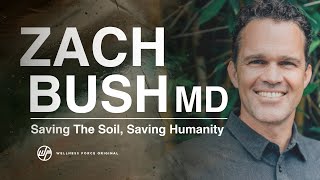
A long-form interview (Wellness Force podcast) in which Zach Bush MD links modern medicine and industrial agriculture to declines in soil and human health, argues the problem is systemic consolidation and loss of biodiversity, and explains Farmer's Footprint — a nonprofit aimed at decentralized, regenerative agriculture and community education. Bush describes how regenerating soil (carbon cycling, mycorrhizae, multispecies cover crops, no-till) restores plant resilience and human health, advocates decentralization and interstitial support for farmers, and offers practical entry points (backyard gardens, screening the film, non-toxic neighborhood campaigns). The tone is urgent, restorative and storytelling-driven.
Questions this video answers
September 15, 2020
Between 1996 and 2006 (ten-year period)
Bush states that roughly six companies control about 95% of the seed in the United States (verbal claim in the interview).
He cites ~40 million acres of lawn and says it's the third-largest 'crop' in the United States (behind corn and soy).
He references 1945 (end of WWII) and says about 40% of food was grown in backyard 'Victory gardens' at that time.
Chapters
And these cataclysmic events tend to be in these narcissistic moments when we think that we're there to dominate an ecosystem or we're there to dominate another people group. And we're there to create a new empire and extract more wealth for a few. Every time we do that, we collapse systems that are invisible to us. And so in our monopoly building of the chemical industry at large, we've created modern medicine and modern agriculture. But unknowingly, we eroded the foundation for life.
This podcast is brought to you by Ion Biome, creators of Ion Gut Health, a gut strengthening, brain boosting mineral supplement sourced from 60 million year old soil that naturally supports microbiome balance. This is something that's not actually even a probiotic or a prebiotic. You know, in all my research, I found that probiotics and prebiotics can sometimes be inadequate when it comes to really proper gut health. They simply don't do enough to affect the microbiome in the gut. Now, we learned from Zach Bush on the podcast and in our research for this product and this partnership, the active ingredient in the Ion biome products is called terrahydrite. It's a family of molecules made by bacteria, the same friendly bacteria that's found in our gut. Now, these molecules are derived from carbon frozen in 60 million year old, uncompromised, untarnished soil. The purest of the pure, completely free of modern chemicals. Why is this important? Terrahydrite is the missing piece in today's modern health puzzle. This is a way you can connect your head and your heart back home to your gut. Save 15% off your two month supply of Ion Gut Health. Just head over to wellnessforce.com biome that's wellnessforce.com biome Enter code Josh1K S. That's Josh, the number one, followed by a K and S. Josh1K S at the checkout cart to save 15% off and start feeling good from the inside out again. Dr. Bush, welcome back to the show.
So glad to be back on with you, Josh.
We've been here all day. It's been an incredible day. I've learned so much from you and all of us are going to be learning so much more. We're talking about this convergence of soil and human health and the microbiome and what's actually going on with our world. Four companies, four companies own 60% of the seeds share with us. You know, what is farmers footprint? Also, how is farmer's footprint actually taking that to a solution and giving more people soil Independence and seed independence.
Yeah, we've created, you know, in the agricultural system very much what we've created everywhere else in the world, which is a consolidation of wealth, a consolidation of control of companies, and ultimately the formation of just a few massive monopolies. And so the, you have Amazon, you've got Google and those are kind of ever present as kind of the monopolies that dictate our daily experience. But behind the scenes of very few companies you're talking about, six to ten companies like you mentioned mentioned are, are really creating the whole paradigm of western medicine and western agriculture. And those are the same companies. And so the same chemical companies kind of step up and create this incredible codependence of declining human biology on small molecule chemicals that are, you know, not are synthetic, non naturally occurring compounds. And not surprisingly, as we develop that codependence on non natural stuff, we become more sick. And that's why every drug commercial you've ever seen is followed at the end with a very fast, you know, list of the 32 conditions this thing might cause or including death. And so the reason why all those side effects and ultimately increase in mortality are so common for all the pharmaceutical drugs is because they're taking us further away from our natural state. They're disrupting millions of millions of different pathways when within our body to try to, to band aid up one particular condition. But it turns out that cancer never attacks a healthy human body. You know, a virus never attacks the human body. Illness, disorder and disease is the manifestation of a weakening immune system, health and vitality, ultimately the biophotonics of the body. And if you can't put biophotonic energy in the form of food into your body and can't be transformed into electrical energy by the relationship between the bacteria and the mitochondria inside your cells, your batteries go low. And so as the charge comes out of your physiology, your repair rate declines. And as you repair slower, the rate of injury exceeds that. You age faster and you develop disorder and disease. If you can put tons of biophotonic energy into that system and the bacteria explode in biodiversity out of demand for all these micronutrients that are being consumed and they turn that into electrical energy, your batteries go on and all of the energy state is flowing the now you have this healing potential that shoots up. And even with the same injury rate, you're now healing, not declining. And so that's the whole game we play in our clinics. And it's the whole game we're now playing with farmers around the country. If you're inundated with weeds and pests, it's because your rate of repair within that plant system has dissolved. The biophotonic energy within your soils has been depleted. And if we regenerate that biophotonic energy within the soils, now we're talking about a relationship between sun and soil and a plant between them. If we charge that whole system with resilience and energy, we're going to get to this point of extraordinary explosive delivery of health and vitality. And that's of course, what happens when you go into regenerative organic. You can see this soil becomes so vibrant that the plants that grow in it are so resistant to any problems. And the weeds that have been terrorizing your for two generations are gone within a single season because you create a biodiverse biophotonic energy within that soil system. And so when we talk about organic versus regen organic, what we're really talking about, what is the vitality of life between sun and soil? And how can you integrate carbon at all of those levels, carbon cycling in particular, to speed up the vitality of life within that system? If you do that, not only do you solve for human health crisis, you solve for planetary health crisis. The rapid climate collapse that we're currently in doesn't have anything to do with CO2 in the atmosphere. It has to do with the failure of the respiratory cycle of the planet. Our soils are dying and therefore CO2 is accumulating. We've been thinking that it's a greenhouse gas phenomenon, when in fact those greenhouse gases clear every year. Every summer, our greenhouse gases disappear from the atmosphere. We pull CO2 and methane down to baseline levels, and then it explodes again in the wintertime. But as long as we've got vibrant soils in the Northern Hemisphere, we've got, you know, we don't have a greenhouse phenomenon happening the same way that we do in the winter months. And so it's through the death of the topsoil that we're losing the ability to continue that cycle of biophotonic energy. Carbon cycling between the soil, the sun and the plant between. And so that's where we're at now is realizing that, wow, not only did we allow six companies to dominate and all the sad, tragic stuff of poisoning of our water systems and soil systems, and we see children dying prematurely from cancers they should have never had. And it's horrible. Like, this is the darkest chapter of humanity in so many chapters. But you look at World War II, you look at World War I, you look at you know, so many crises that have happened on this planet before. This is our history. We are a cataclysmic event. And we keep doing these cataclysmic things over and over again. And these cataclysmic events tend to be in these narcissistic moments when we think that we're there to dominate an ecosystem or we're there to dominate another people group. And we're there to create a new empire and extract more wealth for a few. Every time we do that, we collapse systems that are invisible to us. And so in our monopoly building of the chemical industry at large, we've created modern medicine and modern agriculture, but unknowingly, we eroded the foundation for life below it.
Farmer's footprint. For people that don't know, it's this really amalgam of educators and scientists and farmers and people that just care about everything that you've mentioned, but also how to regenerate, not just to like replace, but how do we actually let the earth breathe again, how do we let her breathe again, how do we let her grow and how do we repair what's going on? Like, this is a national movement, it's a global movement. So if people don't know about farmers footprint, just, just share with them how that even came to be.
Yeah, it was by accident. We didn't set out to make a nonprofit. We set out to tell a story of human health crisis. And so our laboratory had been working for years to understand the relationship between glyphosate, or roundup, the most common herbicide, weed killer, on and the human health crisis. And so we had mapped that down to the Mississippi river, understanding that the Mississippi collecting 85, 90% of this chemical, was taking the chemical downstream into the last 90 miles of that river between Baton Rouge and New Orleans was now cancer alley. So I set out to tell that important story of, wow, we reversed the cancer map in the United States for the first time, where suddenly the south was the epicenter of cancer death, where it had never been in the whole history of our nation before that. And we did that in a 10 year period between 1996 and 2006, we reversed the cancer map. And so that was, you know, should have been impossible if our model of cancer was right. We had to update our model of cancer to include the microbiome to find out that it's the microbiome within our gut and soil systems is predicting population expression of cancer, which is pretty amazing that we can boil it down to that level. But sadly, as we kill bacteria and fungi, the humans will manifest all diseases, including that end stage of cancer. And so this pattern was what I set out to tell. But as soon as we got out on the ground, I thought I was going to tell people, oh, everybody just needs to eat organic and we're going to be good to go. And then we stopped at our very first farm on our journey and the Soil Health Academy with these brilliant farmers were there showing the impact of poor soil management on farms. And they did these simple soil tests showing the resilience or the kind of architecture within a regenerative soil system that's done through multi species cover crops and no tilling. So you leave the fungi intact to do the build the mycorrhizae and the mycorrhizae support this biophotonic event and beautiful system. And they show that just sitting in this column of water and never dissolves. It's just like this, this ecosystem in and of itself dropping in the clod of dirt. Next to it is a chemical farm nearby that as soon as it enters the water just dissolves. There's no root system, there's no mycorrhizae, there's no mycelium, there's no bacterial network for supporting nutrient biodiversification or whatever it is. And it just dissolves into dust. And in the last one they drop organic soil and it dissolved even faster than the chemical farm had. And that was my aha moment of like, oh no, we set out with the wrong story, we have the wrong narrative. I just thought that the spraying was the problem. But it's a collapse of our entire understanding of how soils cycle and our care for that. And in the end it turned out to be very similar to what's happened in western medicine the last couple decades is in kind of recoiling from or in reaction to an increasing pharmaceutical kind of collapse. We birthed functional medicine and we kicked the allopathic model off and said they're just a bunch of pharmaceutical company jerks. Don't believe them, we're going to fix you. And they got back on the same stool and said, for your Lyme disease, I'm going to give you this $300 a month instead of their $300 a month. And I'm give you all these supplements, I'm going to give you all this stuff and I'm going to make you healthy because I'm going to give you bioidentical hormones instead of the pharmaceutical hormones. Whether those are different or not, lots of debate. But the end point is in kind of becoming reactionary to the current paradigm. We failed to reconsider a completely new paradigm and we became a reaction to the paradigm. And so we really fed more energy into that system, I think. And we can do the same thing with an anti vax movement. When we just polarize around a dead paradigm or a dysfunctional paradigm, we do nothing to move past it. And so functional medicine, I think has accidentally become this reinforcer of the old paradigm of you have a disease and you need me to fix it for you. I think what we should have done is created a new narrative which was you have all of the health and resiliency right in you. Let me show you how to get there. Let me show you as a physician, be your guide into your own intrinsic health. And that would have been a really powerful revolution. And we can maybe take that step now. And that's what our clinic is trying to do. We have the intrinsic health series doing that effort to try to like say, hey look, let me just show you into your own capacity for health and healing. But we should have done the same thing in the agricultural setting is instead of saying, oh, you don't want to spray all those chemicals, here's organic inputs. Instead we did the functional M. Madison move. We said chemicals are bad, but all these other inputs you need, instead of mentioning that you could just plant 32 species of biodiverse cover crops, leave those to their biologic mass, and then lay that biologic mass down either through animal management or through roller crimpers or other technology. And so keep that biomass on top of your soils, protect your soils, add back all that bionutrient mass, create an ecosystem within, above and below the soil for that, and then create this bio. It's basically letting the whole system find its intrinsic health, resilience and regeneration. And so we've slowed down revolution, we've slowed down the emergence of humanity and the planet's potential by creating antis. And so you can't be anti pharmaceutical. You're just part of the old dialogue. You can't be anti vax. You're part of an old belief system that the immune system is trying to sterilize the human body from all viruses and bacteria. Doesn't work that way. We know that, but we're having a hard time changing that narrative and just screaming at the old narrative and saying you're wrong and isn't helping us. And so same thing for farming, same thing for health, same thing for economics, same thing for politics. If we keep being anti to the problems that we see, we're not becoming different. And so let's not fall into the anti trap. And so as we started to tell the story, we realized we can't just be anti glyphosate and anti roundup. We need to imagine a new future. And that new future, of course, led us quickly into the realization where we need decentralization. And that, I think, is the story of everything. We shouldn't have six hospital systems that control 90% of health in the country. We shouldn't have, you know, three or four conglomerate insurance companies that control health in this country. We shouldn't have six companies that control 95% of the seed in the United States. We should have a diversified and decentralized system for all of these things. We shouldn't have centralized banking. No, that's a terrible way to do economics globally. We need a decentralized economic system. So all of these systems in the end are showing us what nature does all the time, which is decentralized life. Life happens in a fractal way on planet Earth, down at the soil level, within a single cubic centimeter, you're going to see the entire intelligence of what all of humanity could do. We could learn it from a single cubic centimeter of soil. And so that's, I think what farmer's footprint became was we need a big re envisioning. And what does a whole agricultural slash medical system look like as we decentralize into the template of nature? And so what happens when you create that? So the nonprofit is now investing. All of the wonderful donors that are flowing into this are, we're intelligently investing in the interstitium, the connective tissue between the solutions. I think we're the first org that hasn't swept in and said we have the solution. All you have to do is these six things. Do your cover crops, do this, do that. So many other organizations have swept in to say that, but it turns out that like a human body, everybody needs a different recipe at the beginning. No two farms are alike. And so we don't have a solution, nor do we want a solution for every farm. We want the intelligence to come out of the relationship between the farmer and the land. And we get to be the interstitium around that. And so we're trying to build a whole network of investment strategies and storytelling so that we all understand how do we create the ecosystem around our farmers and farms such that the only thing that could happen is regeneration, resilience. We don't have to prove it, it's just going to happen because we put the right interstitium in.
I love the stories on the Farmer's Footprint site. So it's farmers footprint us. One of them was a tale of regeneration. I forget her name. And it was about the soil health and how it's contrasted to human health. And there's a clear connection. I mean, one tablespoon of soil, like really true organic soil, has more bacteria, healthy bacteria, and protozoa and microbes and all these things that actually are the same components that are found in our body. So it's the same nature, but yet there's been a disassociation ever since. Earl Butz in 1960 and the Agricultural revolution you've talked about. What we need now is a real agricultural revolution. How is Farmers footprint doing that? How is it revolutionizing agriculture not just here in America, but, you know, across the planet, which is where it's most needed?
It's through human relationship in the end. And our executive director is incredibly brilliant human being, David Leon. And if you want to have your mind blown, you know, have an hour and a half discussion with him around what he's discovered about this whole industry in the last year and a half. Because what he's done brilliantly is hold tens of thousands of conversations every day. He's pumping on that phone, you know, he's flown all over. He's academic meetings, trade meetings, industry meetings. He's at these places listening and talking. And the result is an enormous exchange of information. And everything he keeps coming back with is the whole secret sauce of Farmer's Footprint is going to be to tell the narrative of healing at every level we're in. And we cannot extract the human health story from the planetary story anymore. It's so intermixed. You literally cannot create human health if we don't solve for these agricultural system systemic issues in the same way, we can't solve the agricultural problems unless we come to understand the value of human life and start to reallocate valuation of food, for example, correctly. If children's health is important, then why does school food look like school food? If children are important, then why does their school look like it does? Why does it look like a jail so much of the time? Why do we sequester them away from nature eight hours a day instead of putting them in nature eight hours a day? And so I really believe it's a failure to understand the value of life that's leading to the human behaviors that are driving the agricultural decisions we're making. If children are really valuable souls in exquisitely miraculous bodies, why would anybody give them a Coke, anybody. Why would anybody hand them a high fructose corn syrup laden anything? Why would anybody put them into an environment where they can't connect to the fresh air? Why would anybody sequester them away and mold ancient old H vac systems and then traffic them diseased meat that's dying at the time of harvest? You know, we have this grade D meet and I actually saw this when I was in college. I was running early one morning around the CU campus in Boulder and this truck pulled up at like 4:30 in the morning, just barely dawn, and backs up to the, to the, the cafeteria on, the main cafeteria on campus. And on the side of this truck, I couldn't even believe they had the goal to write. It is grade D meet for schools and prisons only.
Wow.
And I had, I wasn't even headed for a health career at that point, but I just, it struck me so much of like wait, what is that doing?
Shouldn't that be in school?
Like wait, why schools and prisons? Like why wait? That doesn't make any sense at all. Like that just sentence shouldn't exist. And yet today we pump the worst grade, you know, food systems, whether, you know, depleted vegetables, depleted, you know, everything into those trays of food that we're, we're feeding our children. And so we are failing to see the value of human life. And so we behave like we do. And so of course all of our mistakes are coming out of the failure of that golden rule. If we really loved ourselves, then we would treat our neighbors much differently. But sadly, whether farmer, physician, patient or commodities crop owner, it doesn't matter. Or chemical company CEO, we're not loving ourselves. And so in the end, farmersfootprint Us is a story about us. It's a story about if we don't start looking in each other's eyes and acknowledging the miracle of life within each of us, then we're going to keep making the mistakes. There's no scientist that's going to prove our way out of this. It is a fault of valuation. And that valuation is not of a crop, it's not of a soil. It's of the human standing on that soil. We have been uplight on this planet. We behave as a cancer on this planet because of our lack of care for ourself and those around us, ultimately of our children themselves. And so farmer's footprint, while it began with a story in soil, is the most human experience I've had. And I feel like I don't see my own humanity until I see it through the context of all of those stories that come out every week on another farm family that's doing the right thing. These farm families are working their ass off from 4am till 10pm, collapse in their bed and get up and do it again 360 days a year. It's just like this relentless journey of effort to be a farmer. And these brave problem solvers are out there doing it every day, putting it on the line, often with great joy, often with heartbreak, often with exhaustion, often with financial stress, often with all the things because we aren't surrounding them quickly with enough interstitium, without all the support system and the oxygen and the valuation. And so Farmers Footprint has really staked our claim on saying, we're going to show you the faces of these farmers. And if you can't see the beauty here, then you probably aren't our people. We can't help you change the world. But if you can see the beauty in the faces of these children and families that we are showcasing every week, you're going to see something of our potential as humanity. And we will not only solve for soil issues or human health issues, we're going to solve for a consciousness issue if we will do the journey right into us.
I love the way you're doing it because you're doing it by story. And children understand stories just like adults. So that's just a universal thing where story is the most powerful thing. It's not necessarily presenting the science. You could present the science all day long about what's going on with the soil and ourselves. But really a reconnection to ourselves starts with how we treat soil. My partner and I, we have a garden that we just started here. And like, she's learning and I'm learning, like, how to do it. And it's fun because I'm thinking, oh, man, I've never actually done this. Here I am, 40 years old, I've never grown a garden in my life. And it's the first time where I'm like, this could be a way we feed ourselves, like, truly feed ourselves. So for people that are inspired by this, how do they begin? Like, what does that even look like? And how does Farmer's Footprint educate people on how to grow their own gardens, how to love themselves by taking care of their own soils, how to have boxes if they're in food deserts, if they're in the city? Like, there's so many things that people would put up a flag to and say, well, I can't do that. You know, Farmer's Footprint obviously addresses this.
Yeah, well, we're trying to be the interstitial. We're not trying to reinvent any wheel, which means that we're functioning differently as a nonprofit as well. So instead of rushing out to say, hey, we have this little program to do this, we have this little program to do that. We've been learning for two years what's offerings out there and let's be the interstitium as an organization as well as a message. So as an organization, we're building relationship and learning how to identify what's working and start scaling that at the global level. One good example is kiss the Ground. They've got a great backyard gardener kind of education system. It's called the Soil Health Advocate program. It's a great course, four weeks or so and it gives you just like the nuts and bolts of lexicon, like what is soil? What do we mean by regenerative? What do we mean by what's the difference between regenerative or organic? Just giving you that nuts and bolts understanding of how do I even talk to my neighbors about what I now suddenly know is an important issue, or my kids, or how do I talk to their school systems so that they can have a garden in their schoolyard or whatever it is, you know. And so, you know, I would lift up kiss the ground as a good, you know, backyard gardener kind of thing. We now have found that there's a real paucity of education at the bigger level. So land management, ag management, agronomist education, you know, the big kind of pharmaceutical disease management paradigm. So we're now building the IT infrastructure for university. And so the nonprofit is partnering with for profit companies to build the IT framework for a cooperative education model which we think will go beyond ag. And really you should reinvent universities in that everybody becomes everybody's teachers. And so we'll have some guiding faculty at the beginning of this. But we're really trying to build this as a root system, as a mycelial network such that over the next 10 years we expect the whole community to be educating each other and somebody decides they're going to go regenerative organic in, you know, Oahu, Hawaii or the Philippines or Midwest United States. Ten farmers in that region will say, hey, here's the seed mix that worked for me. Let me take you through this. If you need any help, let me pop over to your farm. That's actually how farming used to work and still is working in the 70% of the world that's still being fed by peasant farmers is there helping each other. When we went into Chemical agriculture, we started to lose our identity as certainly physicians when we started kind of posing ourselves as the patriarch of wisdom and we stopped listening to our patients. When chemical agronomists became the educator to farmers, instead of farmers teaching farmers, we created isolation on those farms and we pitted them against each other with competition. And agronomists could come and say, well, your neighbor's using this much input. Would you like to double that? And put this much input? And so instead of farmers helping farmers, we created a system of co dependence with banks, lending systems and the USDA crop insurance. And all of this just due to a failure of relationship. And so in the end, again, the storytelling, the interstitium, we're going to come back to the communication network. So we're at each level as an organization. We're really envisioning a future where there is no dominant success. I hope that nobody knows Farmer's footprint in 20 years because it became irrelevant because there's so much interstitium that we put into play in the for profit realm that nobody needs to donate money anymore to create a false economy around this problem. In the short run, we need the philanthropic magic to seed all the right investments across the for profit spectrum to create that interstitium. I feel the same way for my companies. You know, when I start selling supplements out of ancient soil, I can tell right away that that is a band aid. That's not a solution. And so if I don't take all that science that we've learned from that supplement and channel that back into the intelligence of our nonprofit, I'm doing something worse for somebody, namely for the planet. And so in the same way, I'm hoping to put myself out of business on the supplement side over the next 20 years because we've built an agricultural system that supports such a diverse microbiome within the gut that nobody has to take the supplement from bacteria and fungi in soils because they're already got organic soil in their gut that's thriving. And so in my ideal scenario, I'm fully retired in 20 years and everything I ever did became irrelevant. I don't want a legacy because it would mean that I failed. If there needs to be some plaque about Zach's doing something important in 20 years, I'm afraid we're going extinct as a species by that time. And so I want to think about myself every day as part of the interstitium of humanity. And I should take no more credit for anything that's going on than any of the pixels that I'm just putting together. If I'm doing my job right, I will tell the story of humanity. Not because I'm intelligent, because, but because humanity is beautiful.
In our current paradigm, so many things are driven purely by finance. And I think that when you look at even what happens to movie stars when they have 10, 20 years of being adulation and getting love showered on them at all times, when they leave Hollywood, they're like, they go through depression, they go through a downward spiral. And I think about capitalism, I don't think at its core, capitalism is evil. I really don't. I don't think people created capitalism because they wanted to use it to control others. But there's got to be a more egalitarian way for us to be able to love each other. Interface, make profit, have business. What do you think that looks like for soil health, for agriculture? If you could wave a wand, Zach, what would that look like?
Well, I'm just trying to live it, you know. So I started a dozen companies over the last 10 years, and some of them are producing money, some of them aren't, some of them are losing money, but they all support each other in an ecosystem. And so I've created a parent company that can feed through a mycelial network, if you will, all of its progeny that are coming up to be solutions in all these different sectors of health, energy and ecology. And so I think corporations in the future are going to be able to do this where they can afford R and D over here in a very kind of blue sky fashion and expect that to lose. And then they're also going to have an altruistic aspect over here that never makes much money. In fact, probably loses a little bit of money every year like my clinic does. But that's okay because we can subsidize that with this innovation of a solution that the whole world needed. And so we're making a lot of money from that sector and we can distribute it out. And so I think the CEO of the future that's really going to be part of this is going to see themselves as a resource manager across ideas rather than a product developer. If you put all of your jewels behind one product and you make that thing your entire goal and you have to keep innovating that one product or you keep marketing better and better that one product to make whatever grow, you're going to inevitably become, you know, a slave to that thing. You, any competition that comes in and threatens that thing becomes your enemy. And you're going to become isolated and lonely in your marriage to the one thing. And so I would invite all companies to think about acting more like a ge, if you will, which is GE is really nothing but, you know, taking old capital and putting it in new and innovative spaces all over the place. I think their paradigm hasn't even reached 1% for the planet yet. And so they don't have a planet forward aspect. But now you reverse that paradigm and imagine not just a 1% for the planet type corporation ethos, but a capitalistic for profit environment where the idea is every dollar I make, I get to put 90% back into soil, water and air. And I get the joy of watching children run around on a schoolyard that's cleaner and more vibrant and has more diversity than anything I ever saw growing up as a child. We have 40 million acres of lawn. It's the third largest crop in the United States, right behind corn, soybean and lawn. 40 million acres of a single monocrop that we're pouring chemicals into. And then we make our children go out and run around on that for soccer and football and recess and everything else. And they're absorbing all those toxins through their skin. They are not in touch with any biodiversity. If we planted 32 species cover crops in all of our schoolyards and had the kids trampling that down every day, we would have a regenerative garden before we knew it. You don't need cattle, you just need lots of kids. And you'll, you know, trample that stuff down. They've got hooves of their own and, and let the kids be part of an ecosystem again. And we would see a completely different, resilient, you know, health within those children. So while farmers Footprint is the first portion of our nonprofit, the parent nonprofit is called Project Biome. We're developing soil, water and air projects in which you start to realize that there's a whole ecosystem within each of those environments that include human health, energy and ecology. And if you separate at any point one of those, you're going to fail the system. Our energy sector could be our biggest gift to the planet. There's hydrogen technology coming out that you can allow hydrogen and oxygen to come together through a catalyst, and it produces energy when it makes water. We could produce enormous amount of water that's perfectly clean in production of almost an infinite amount of energy. So we can have free energy and clean water in our energy sector, and that could be in the next 10, 20 years that becomes a norm. And so again, the energy sector has been too long. Damned as like the enemy is oil, coal and gas. It's not any more an enemy than chemical agriculture is. These were all stepwise, low vibration efforts at creating vitality on the planet. We failed. We created the opposite. But in learning from that, in the realignment of that, we could realize that all of these sectors are going to be leading us back into a template of life that we've literally never seen. And we could be part of a creative generative process over these next decades. And we could see in 200 years the most beautiful planet that's ever existed here on this little rock in the middle of space. Your.
Your passion is so infectious. The first time I had you on the show, I felt it the same way. And, and there's so many people out there that are just learning about Monsanto, they're just learning about soil health. They're literally just beginning, what do they do? Like, what's the first step? For someone watching this, Maybe this is the first podcast they've ever seen about organic foods or the truth about organic or soil. What's that beginning step for them? What do they take?
It's so cool that the world just did this. So, you know, for all the fear and all of the masks and all the crazy wild stuff that we've done as a, as a population over the last few months, we also ran out and bought every last seed in this country for the first time. So we bought all these companies out and thousands and thousands of families went out and planted gardens for the first time, including you. And so this first time gardening generation is moving us back towards the 1940s. So in 1945, the end of World War II, we were growing 40% of our food in our backyard Victory gardens. Not just in the U.S. but London, the whole Allied powers around the world were growing their food in their backyard. And the whole message that got us to grow those and call them victory gardens is our independence is actually going to come from our resilience. If we have food security, we're going to win the war. Because this is a war of attrition. If we can eat still in five years and the Germans can't, we will win this war. So it became a war of attrition through resources. And the secret was not through better technology and better railroads, it was through decentralization and backyard gardens. We could reclaim that in two years. I really think that if we decide in the United States that we're going to grow 40% in our backyards, it would take the first year to just get the practice in. But by year two, you can grow an insane amount of zucchini and cucumbers and tomatoes in your backyard, not to mention the mints and the radishes and the carrots and everything else. And so it doesn't take long to realize that seeds have all the magic. And it doesn't take long as a physician to find out that the baby has all the magic. The less we meddle in the garden, the more beauty will often come out of it. And so don't be overly concerned about how your garden looks and maybe ever, but certainly not in those first five years, because it should look like chaos. I don't want you to have like the manicured tomato plant growing there and a zucchini plant growing over there and then nice laid mulch. I want kind of craziness going on. I want weeds and I want all this stuff growing up in between. You have to weed and you have to keep it clear around there. But you've got biodiversity exploding on that soil. And next year is going to look different, not because you did anything right, but because you didn't try to control the system. So have some freedom and just plant a bunch of stuff out back and have no expectation of what that's going to look like. And if it produces some food in the first couple years, fantastic. But if it's just creating everything, anything but lawn next year, you're winning the game for the planet. And so I would say start simple, with low expectations on yourself. Don't ever call yourself a failure because nature knows how to do this. You don't and never will. Farmers are always the first to say, the more you try to fight Mother Nature, the more you're going to lose. The best farmers are always the ones that are making space for nature to do their work. Do her work and so do that in your backyard. Let her start to tell you, why does it look so manicured? Why does your backyard look like every other suburban neighborhood for thousands of miles? Well, let's do something radical. Let's start planting where there is lawn. Let's start creating multi species cover crops or low lying succulents or whatever your environment is calling for to create that biodiversity in the soil. So start small. And if you don't even have any plot of land or a pot out back on the porch or whatever it is, start in your window. A single mint plant is very hard to kill. And so if you want to start with mint, just put that in the window. A little bit of sunlight, they can handle some shade. So a little bit of dappled light in the window. One mint plant. And then I want you to bite a leaf off of that mint plant. Don't pick it, and then go put it on your salad. I want you to literally bite the leaf off the plant every day and experience everything there. You may have an aversion to it the first time you try this because it's not going to taste like the mint that you're used to having picked on your restaurant plate. It's got so much going on because you've never been connected with your tongue to a root system before. So before you bite it off the plant, let it sit on your tongue for a moment, and you're going to be connected to a biophotonic event between soil, sun and that plant right there. And you're going to realize a vitality in your body in that moment. I believe that mint plant could teach you how to garden better than anybody else could on the planet. That mint plant is going to take you through an experience of, oh, my gosh, it's just this connection of soil, sun, some water, and you're going to realize that it's just this cycle of soil, water and air that's producing this extraordinary electrical event on your tongue. And then you're taking that biophotonic energy and turning it into a healing power within you. That's the whole story of organic gardening. And one mint plant in the window. So that's how simple we can begin. And let's take this journey as us and see what we create out in the world.
What's most exciting for you when you look at the future of this real revolution? Because we had the revolution in the 60s, which was really about monocrops. It wasn't actually a revolution. It was where things were just subsidized. And it kind of broke the system. Like it really broke Mother Earth starting in the 60s. So now where does she heal? And what does that look like from a financial perspective? And what companies do you see that are in partnership with farmers footprint that are really doing a great job?
You know, I think corporate has been hesitant to attract us at the beginning because I think they've been wary of who are we, what are we doing, all of that. But we're very much in the vein of, of bridge building. Like, we've never told a farmer they're doing the wrong thing ever. I've never told a farmer that they need to stop spraying glyphosate today. Farming is complex and they need an education around that. They need a transition phase. They need, you know, and so you have to embrace the journey as much as you want the goal. And so Farmer's footprint is trying to be patient with that and identify where we want to go, is a bridge builder. And so as a bridge builder, we're building to corporate. And the first people that are rushing into this space, not surprisingly, are kind of the impact investment people that are seeing, oh my gosh, we can feel this afoot. As you know, anybody who saw the tech boom Starting in the 1990s, it was a good place to invest what everybody's feeling right now about soil and regenerative agriculture, but nobody knows where to invest yet. The definitions are poor and everything else. And so we're seeing people rush to us with a sense of like, okay, if these people are starting to build the interstitium, the connective tissue between this, we know that a $1.7 trillion US agricultural agricultural system is going to pivot in the next 20 years out of just, if nothing else, just sheer demand from the consumer. We need to be a part of that. And if we could get on the early side of that, we're going to make a lot of money. So you know, these are, you know, very forward thinking peoples, a lot of, you know, family funds, family foundations, philanthropic kind of minded, but also want to be part of the new future. And I think excitingly, the pandemic has put a really fine point on this and has excited, accelerated our mission radically. And so we see tons of philanthropic dollars being reorganized towards realizing that all of the hard hit neighborhoods that really suffered under the presence of this COVID virus, we can say that show very clearly that there was poor nutrient density within that food system and poor access to real air and water systems, soil, air and water. And so we can use the pandemic to show the world immediately where are hot spots of dysfunction. And, and if we start rebuilding there and start to build, build a decentralized system that can serve all of that simultaneously. Instead of just trying to like fix it here and then scale that one model, let's let it grow up through teachers teaching teachers, farmers teaching farmers, school systems teaching school systems, communities teaching communities, and let that matrix start really rebuilding itself into that future that, that can.
Come for all the parents watching. What lights you up about these children that you've raised and what are they going to do when it comes to their responsibility? How have you inspired them and how can we inspire all the parents to leave their kids with the knowledge that they can make the world better than we left it? They can actually do way better than we can.
Yeah, I would actually say that's the most exciting thing is both my children are pretty profoundly unimpressed by what I'm doing. They're just like, really? That's it? Like that's what you got?
Oh, come on.
You know, because it's just like they're looking at the world being like the problems are so much deeper than you can see, dad. Because they can see that the problems are about in human respect. My daughter recently taught me a lot about this. She's living in New York and has watched this whole thing go down with the civil unrest there around George Floyd's death and all of this. She's taught me so much about what her generation is seeing. And her, her generation doesn't see a thousand problems. It really sees one problem is we're not respecting human beings. And we're going to start to be the generation that just respects everybody for where they are, who they are, what they think they are. We don't care. We're going to accept them there and then we don't even worry about the rest because if we start there, we're going to get somewhere much different where you than where all you got to because you started at a lack of respect and a lack of seeing each other and a lack of that. And so that's my excitement about our children's generation is the sense that they've started with a completely different paradigm, a completely different chessboard and they don't see a linear career course ahead of them. They see a three dimensional space where they can impact the world at will. They can do anything, anywhere, all the time. And I think we see that just seeping up through that generation. But they are prone to depression because if we try to fit them into our old paradigm and tell them that they're failing, they will rapidly become depressed, unmotivated and really become non productive and not be able to create the transformation we need. And so we need to rapidly see this new generation coming up and say do it different. I don't even understand what the journey you're on right there. It doesn't look like success by when I was 22, but as long as you're loving everybody around you and looking for a meaningful and respectful space to be in the universe, I'm going to keep supporting you and encouraging you down that path. And so we need to really have a free hand and eliminate all of our tendency towards trying to imprint the past on this future of this generation. And for that we'll resolve their crisis of identity and their crisis of, of depression. And everything else they're in the suicide rates going crazy and everything else is largely because we're trying to fit them into an old paradigm. We're telling them they're failing, when in fact they're giving us the only opportunity we have to transform. So we have to have that loose effect or kind of hands off approach to our children, just as we would our backyard garden. Let it look messy, let the weeds come up, let the regenerative effect do its biodiversification, whatever we need to do. And let's go change the world through those kits.
Wow. The film that you made for Farmer's Footprint, people can go there to watch it, but if somebody's feeling inspiration, what's the next step? Obviously they can go to Farmers Footprint Us, but the film that you have on there, that can carry them on, that can carry them on their journey too.
Yeah, it's a good place to start. So there's a screening toolkit with the film. We kind of created some starter questions and some didactic information there for you to grab. But if you take the strict screenings toolkit, call together six or 10 people, whatever your municipality is allowing right now in the pandemic to get together and watch that film together and just start talking about, you know, here's school system. Nontoxicneighborhoods.org, we've been helping that project out a lot with Kim Conti. She's a superstar. She's created a simple toolkit for school systems or municipalities to ban Roundup and use organic inputs instead. So moving in the right direction through these projects and it has to start in this decentralized fashion. So non toxic neighborhoods.org farmers footprint us and see where we get to.
You are so connected to the earth and also to spirit. There is something that I've always felt from you ever since I first came across your work. And it's just a joy to be around. So thank you for coming on the show, Josh.
It's always a pleasure. Thanks for having me.
Sam.
More from Josh


Your child's future start before pregnancy... and even before conception! #podcast
MD Reveals: Your Healing Creates Your Child's Reality (The Souls Coming In Need Strong Bodies)