Manage Stress and Become Resilient, with Dr. Stephen Sideroff
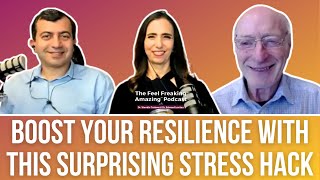
Dr. Stephen Sideroff explains how chronic stress diverts your body's resources from repair to defense, shortening your healthspan. He recommends 10 minutes daily relaxation at 6 breaths per minute, finding islands of safety, and shifting your mindset to see challenges as opportunities rather than threats.
Questions this video answers
Approximately six breaths per minute (about a 10-second full cycle; ~4 seconds inhale, ~6 seconds exhale).
About 10 minutes per day.
drstephensideroff.com
sidoroff@cla.edu (noted in transcript as 'sidoroffcla. Edu').
His 'nine pillars of resilience' (a resilience assessment booklet is available).
Chapters
Foreign. Hello and welcome to the five Journeys Feel Freaking Amazing podcast. I'm Wendy Trubo, one of your hosts. This is Edward Levitan, and we have an amazing guest today who's going to talk about stress. Dr. Steven Sidoroff is an internationally recognized psychologist, executive, medical consultant, and expert in resilience, stress management, addiction, neurofeedback, and longevity, which is, I think, what we're all really committed to. He's also an associate professor, Department of Psychiatry and Bio, Behavioral Sciences and rheumatology at the Geffen School of Medicine at ucla. Stephen, welcome. I'm so psyched to talk about this because I think all of us can attest to that we're experiencing stress.
Well, it's a pleasure to be here. I've been looking forward to it since we talked about this a few months ago at a 4M. So, yes, great.
Very exciting. So I want to know, how'd you get into this? You know, like, why did you focus on stress? What. What, Something has to have caused it, Right.
Well, I actually began my career as a neuroscientist and doing brain research and then really felt like I wanted my subjects and I was working with animals. I wanted my subject to be able to communicate with my subjects. So I moved into the. Into clinical work, and I wanted to have an impact on, a more direct impact on people. And as soon as I got into the clinical field, I realized that stress was the major modulator of everything else in our lives. Our lives could be going along well, but as soon as we got more and more stress, our coping abilities began to fall apart, our views began to deteriorate. Stress has a tremendous impact on all aspects of our lives. And that's really what led me to working with on stress, is that it touches all of us, and it's really one of the number one problems in our society today. So that's what led me into it. The interesting thing is, as I got into it, I realized that people have this tremendous ambivalence about stress. And, you know, we can get into this in more detail. And that's when I shifted my focus from stress management into resilience. Something that people are more. Yes, I want resilience. People are ambivalent about stress. So that's. That's what began my interest in my journey.
Well, let's first define stress, because I think everybody only thinks about stress as your boss yelling at you, your spouse, your kids. But I think it's bigger than that. Right. So what is the definition? Let's talk about that.
So Stress is any really demand on us to respond, react, to, make an adjustment to what's going on in our lives. We try and stay in a place of balance. Stress is anything that pushes us off of that balance. It's anything that makes a demand upon us. And stress could be good. You know, you get a promotion at work, you have a baby, you get married. These are positive stresses. And that's what makes dealing with it more complicated, because it isn't all bad. It's good as well.
So how does I think a lot of. I'll speak for my. I'll speak for my gender. I won't speak for your gender. You can speak for that. I think a lot of women are. Are kind of like an all or nothing. In an all or nothing group, you know, that, that it's got to be good, it's got to be right. They're not going to do it halfway. How does that impact our ability to deal with stress if we're just like, we got to do it right, not just right there.
So that approach, that mindset, that perspective amplifies our stress. Because as soon as it has to be a certain way, even if it's good or perfect, that puts more pressure on us. Putting more pressure on us increases our stress. And so you want to have a perspective in which you're doing your best, but then you want to be more accepting of the result. A lot of our stress comes from our judgments and our fear that we're not going to meet either our expectations or somebody else's expectation.
Yeah, I know. Tony Robbins talks about the only time you're going to be stress free is when you're six foot, six feet under every other time. We all have stress, and it's really, how do we deal with it and our response to it? Not necessarily if we have it, because.
You definitely have it. You all have it.
Right? Right. So, yes. So it's, it's your. Your mindset. So first of all, one of the first things I teach people about stress is you want to embrace the challenges of your life rather than shrink from them, because that in and of itself helps you with your stress. When you embrace. When you say, okay, I'm going to deal with this challenge, you are feeling more in control. And control is an important variable in terms of how well you deal with stress. The more you feel a sense of you're in control, the better you handle stress.
Haven't they shown they've studied employees and found that the less agency you have and the less control you have over your job, the more at risk you are of chronic diseases, bad outcomes, being unwell as a result of the stress from having no agency and control. So that's so market.
Yes. So that, that's a very important fact in the work setting. That is a very important variable in terms of how much stress people experience is how much control they feel they have in their work setting.
So, I mean, I always have a challenge with. Of course, we. We can all say we should go towards the stress and we should embrace the stress. And we all have pretty bad habits. Most of us have learned pretty bad habits of not doing that. So how do we actually go from a habitual state of avoiding stress, avoiding pain, avoiding unpleasantness, and therefore add the stress to, wow, this is a really cool challenge. I'm psyched to do it.
So, like, reframing it.
Yeah. How do you actually reframe it so that the body, like one, can actually do it? Because just talking about it, it's not usually enough.
Yeah. So, I mean, I think the bigger question is how do we move out of our old bad habits into new healthy habits? Which is really at the key of all of this, is new learning. And the first step is to realize that we've learned some habit patterns from our childhood that really don't serve us, and we can. And so it's important for each of us to identify all of those things that we do in our lives that really is not in our own best interest. And kind of shrinking from a challenge would be one of them. Because when we shrink from a challenge, we're actually sending ourselves a message. We're telling ourselves, I don't think I can handle this situation. That message to ourselves results in more situations being scary. To us, scary translates into stress. It has to do with our sense of capacity, how we feel we can handle. The only way that you are going to develop the sense that I can handle situations is by engaging in them. Well, if I'm going to engage in them, I might as well take the mindset of embracing that engagement rather than doing it reluctantly, which is where many of us come from. Yeah, I have to do this or I should do this. And we then do it. But then the memory of that experience stays as something in which, well, it was anxiety provoking, it was difficult, it was uncomfortable. If, on the other hand, we start out with, how I approach this situation will actually make a difference in my life. If I have the mindset that I'm going to engage in this process because I want to figure out how to do it, Better and better. Then when we look back on it, we remember how well we handled it. Not that it was stressful, not that we went into it with anxiety. Then we carry a more positive memory of it moving forward.
We need to back up Steven, because we never really talked about why stress is bad. And you know, you're the, the stress person and we're the detox people. And when you have stress, you don't detox. So, you know, I think we need to back up 20 steps and talk about, okay, if we all want an amazing health span, not just a lifespan, but a true health span filled with vitality, vibrance, true health, that managing stress is one of those foundational behaviors that will alter the body's ability to absorb nutrients, digest food, remove toxins, be in balance, sleep properly so that you can again detox and repair. You know, we kind of skip that initial step. So let's just remind the listeners, like, why does it matter? Is because if you are overly stressed, you will shut down detox, absorption, digestion and mess up your gut, which of course throws off the whole body.
Right. So to begin, as I said earlier, it's not about eliminating all stress, which is impossible, but it's about having a balance in your life. So we can begin by talking about how our bodies have a limited amount of energy, a limited amount of resources, and our bodies are always making choices of where they spend that energy. And we could break it down into a very simple dichotomy. We could spend that energy into defend and protect, which is where we go to when we're under stress. Or it can go into healing and maintenance and growth, which is what the energy is available, available for when we're not stressed. So if we're always stressed, then we're always putting our bodies into the defend, protect mode. And there's little energy for the, for the body to go into healing and maintenance. I mean, the body's making a choice, do I send blood to my muscles for fight or flight, or do I send it to the kidneys so that my kidneys can do a good job of detoxifying my blood? And those are choices that the unconsciously are going on all the time. And that's why stress is good. But it needs to be balanced by time where you're recovering from that stress, where you're giving your body the opportunity to restore, to maintain and to heal.
Is there some balance of as you're talking about resolving stress and having downtime? I'm thinking, okay, is there some formulaic thing, way we can approach this. Like for every three hours that you have stress, you need three hours without. Or is it. Yeah, individually. I'm looking for a prescription to take the weekend off.
Just for the record, you could take the weekend off.
I mean, you and I are both presenting at a 4M. I got Covid when the presentations were due and then had to catch up. And so, you know, these, these. You talk about stress like the piling on of the deadline is passed, it's due, and now I'm working seven days a week to get it caught up. So is there some formulaic approach we can take? Asking for a friend.
So first off, we can all assume that we're starting off where we're spending too much time in stress and we have to find some ways of restoring balance. And I like to say that we spend so much time in the day where we're dealing with one stress after another, we finish one. And for some of us, you know, we, there's another stress that hits us. But if we grow up in a, in a environment in our childhood that's dangerous, where, you know, our parents may be critical and judgmental of us, what happens to our, our expectation is that we're expecting dangers. And so even when we're successful in finishing us dealing with the stress, a meeting, you know, an appointment, a presentation, whatever it is, we're then searching our environment for the next danger. And so we don't give ourselves the opportunity to take that little bit of a break.
So we're primed. We're essentially primed, prepped locked and loaded, ready for stress at all times. So essentially you're talking about hyper vigilance.
Pretty much, I'm talking. Well, there are varying levels of it, but we all have a certain amount of it. And quite frankly, it's a certain amount of this is built into us and from the evolutionary perspective, because it allowed us to survive. Right. And we don't. And we don't mess with survival mechanisms. And that's part of the difficulty in dealing with stress because it does have survival mechanisms, but then we overdo it. So the first thing I tell people is look for islands of safety in your day. So for example, if you have lunch, make lunch an island of safety, meaning I'm going to, during my lunch, I'm going to relax, I'm going to eat, and I'm going to realize that all the stresses will still be there a half hour from now, but I'm going to give myself this island of break. You find these islands of safety throughout your day. Even if, even if it can only be five minutes after you finish dealing with one thing, any amount of time is helpful, is good. I like to tell people you want to find 10 minutes every day to practice a relaxation exercise because stresses are training your nervous system to activate. You need something to compensate for that. You need something in your day that trains your nervous system to go in the down direction, into the recovery direction. So that's for starters. Sleep is so important. Sleep is one of the primary ways we restore the resources used up during the day, during our stresses. And it's also one of the first. It's like the canary in the coal mine. It's one of the first symptoms we have that our nervous system is out of balance. What I refer to as autonomic dysregulation.
Yeah, I mean, there are times when it hasn't happened recently, but when I'm super stressed, I'll be like, why didn't I. Why am I up between 2 and 4 in the morning? Well, it's adrenal and liver time to jack you up. What were you going to say?
No, no. I think this kind of comes into the resiliency piece, obviously of how do we get resiliency. And I know you talk a lot about neuroplasticity. Can you kind of bridge that gap for us?
I like to say that we are all stuck with what I refer to as primitive gestalt patterns. These are the lessons of our childhood and these are our developmental lessons about not being good enough, about worrying about the feelings of others too much, being too sensitive to them. All of these childhood lessons. And because there are early lessons, they go in very deeply in terms of our neural circuitry. The good news is that there is also neuroplasticity. And neuroplasticity is about how we have the ability to, to change those patterns. It's not easy, but it's very doable. And it begins with holding the intention to make the changes. It begins with making that decision and saying, I know I have this pattern, but I want to do it differently. I want to figure out a way to do it differently. And then you begin by setting those intentions. When you set an intention to go in a different direction and you start following that will be successful. It won't be easy. I like to have people think about this forest and you're approaching this forest and there's this well worn path and you automatically go down this well worn path because every place else is thicket. Right. But that well worn path doesn't get you where you want to go. So it's easy and it's where we automatically go to. But if you want to engage neuroplasticity, you have to go over here and you get out your machete and you start whacking away. And that's doing some things that may be uncomfortable, that may be your boundary a bit, but that are the, the behaviors and the lessons and the learning that's going to make a difference in your life.
Was this like a. I'm still trying to. I, I hear you. I believe I 100 I'm with you. Is this. And a lot of us are stuck. So is this with a therapist? Is this just making a choice? How do people actually. What's the mechanism to, to go from like, I mean, sorry, a thousand percent. Yes. And I know even for myself and very much for patients, I see the stuffness is real and, and the emotions are real. And to them, the life they have created, there's not a possibility.
I mean, and also, you don't know what you don't know. Like, you have no access to being different, so how can you be different?
Right.
What's the access to. Not to doing something you don't know how to do?
Yeah. Well, intention begins with noticing that there's something wrong in your life. It could be a physical symptom, or it could be, you know, difficulties in relationships, but it's, it's something that isn't working the way you want it to be working. And a lot of the times what happens with people is they, they have that awareness, but either they don't feel like they could do anything about it, or, you know, they, they just assume that this is the way it's supposed to be, or they get scared about doing something other than the way they've been doing it all their lives. So it really begins by making a decision that you're willing to do something maybe that might be difficult in order to have a better life, in order to deal with the symptom. And so once you make that decision and hold that intention, then you need a plan, a program follow through and realize that this isn't like going to the wall and switching on or off a light switch. You have these habit patterns your entire life. It's going to take a while. It's going to be a developmental process to make these changes. And then it's about setting a plan to do it one step, one behavior at a time. You know, I just, I said to you, it's changing your mindset that I'm going to Engage in this process. I said, start out with taking 10 minutes a day to practice a relaxation exercise. When you do that now, if you do that for a couple of weeks now, you could say, look, I. I'm able to follow through now. I'm beginning to trust myself that I can make some of these changes. So that's the way you get the ball rolling. You have to start somewhere, and you have to be satisfied with the effort you're making. I've also said that you want to identify those parts of your old pattern that are getting in your way and, and then work toward making changes in those patterns. And, you know, most people need some help in that process, some guidance in that process, and that's okay.
I think we should. I think we. I'd like to make this real for people, meaning I believe that humans act when things are what I'll call bad enough. You hit the wall, you hit the bad enough point. And so if you're listening to this podcast, you might be thinking, okay, do I need to make a change in my stress? Well, yes, you're human, you live on this earth, and you probably have too much on your plate. So, yes, you need to make a change. But how do you know when it's bad enough? We've covered one where your sleep is disrupted, but what are some other signs and symptoms that people can map onto their lives and go, oh, yeah, this really does apply to me. You know, I would say weight gain, that kind of comes out of nowhere and isn't associated with the hormonal change in your life. You know, you're not going through menopause or perimenopause, and. And all of a sudden you gain weight. Could that be a sign? What are some other signs?
Well, I would ask the audience, have you used the word or heard the word stress in your life in the last 48 hours? And I imagine most people would say yes. Any survey shows that upwards of 70, 80% of the population find stress as their number one problem. You could notice it because you feel stressed out. Your body doesn't feel the way you would like it to feel. It feels uncomfortable in certain ways. Maybe vibration in your chest, maybe upset stomach. GI kinds of problems are all the result of stress headaches. Just physical tension. Overreacting in situations is another indication of stress. Suddenly things that you used to enjoy don't bring you the same level enjoyment. You're distracted. All of these are indications that stress is having an impact on you. But I will suggest that given all of what's going on in our world today that you have to be living on Mars to not be affected by all of these stresses. So if you don't notice it, then there's something that you're not paying attention to that you need to be paying attention to. So that's for starters. We're all. Everybody has to find their own way that it's impacting them and then decide that I don't want to live this way anymore. And realizing that if you don't do something about it, it will only get worse. These symptoms, these are signals to you that something isn't working right. There's some way that you're not in a place of balance. And so if you don't address it, whatever is causing you to be out of balance is going to keep engaging with you and causing you to get more and more out of balance. And the sim, the symptoms and the signals to you are going to keep getting louder and louder until there's some point where you're going to have to respond to it. As you said, Wendy, when you hit the wall, when you hit rock bottom. But the goal is for you to realize sooner than that, because the longer you go, the more difficult it is to recover, the more, the more you throw your body out of balance, as I'm referring to it, the more difficult it is to restore balance.
The thing I'll say just for the viewers, not only is it, it's also high cholesterol, because high cholesterol, some of it's genetic, some of its diet, but good 30 or 40% is stress. So. And we can tie it to autoimmune disease, cancer, things like that make stress, makes it worse. So it's not just psychological issues, it's your physical issues. So I just want to make sure that it's. That loop is tied because I, I believe, like you said, if your mind has a challenge, it will tell you in words. If your body has a challenge, it tells you in ouchies. And if you don't listen, the ouchies become stronger and stronger.
So, yeah, so, I mean, we, we now have literally thousands of studies showing the impact of stress on, on physical health as well as mental and emotional. The data is very clear. It's there whether it's impacting cortisol levels, whether it's impacting inflammation, whether it's impacting neuroinflammation and impacting the functioning of the brain as well as directly impacting aging. We know that stress shortens our telomeres, which is an important measure of how well or Fast or slow, we're aging. So the evidence is very clear. It's all there in all of these different areas.
Talk to me about how stress impacts our health span. I mean we, I think we've covered it, but I would love for you to specifically comment on the relationship between stress and our health span.
Sure, sure. Well, there, there are many channels, many avenues by which stress impacts health span. One for example, is I mentioned autonomic dysregulation and my colleagues and I have actually proposed a new diagnostic code, autonomic dysregulation syndrome as the underlying root cause of, of what most people go to see the doctors for, whether it's GI problems, whether it's neurological problems. We know that this autonomic dysregulation, where again, we're turning on the sympathetic branch of the nervous system without going into the parasympathetic recovery, triggers a whole cascade of processes that lead to all kinds of physical symptoms. So these shorten our health span, these cause more and more dysregulation in which we feel worse and worse. We have lower energy, it impacts energy, it impacts metabolism, it directly affects the andria in our cells, which affects how we use and have available energy. So these links are all there and they all lead to a shortening of our health span.
And how do relationships affect our stress? Ask you for a friend.
Answer quite carefully, Stephen.
The good news is that relationships can be an amazing source of, of what I refer to as emotional nourishment. We know that when you go into a positive emotional state, you actually improve your heart rate rhythms. When you go into a more upset emotional state, frustration, anger, you create dysregulation in the heart rate rhythm. So one of the things I do is biofeedback with my clients, which is a way of training them to be able to self regulate. When I have them go into positive affect, when I tell them to think about somebody in their life, husband, wife, for example, and have gratitude, have a feeling of gratitude, we see an improvement in their heart rate pattern.
You use heart math.
What's that?
Do you use heart math to do that or something else?
There are a few different companies and types. There's a thought technology. One is heart math. There are a few that all do similar things. So you want, you know, you may have stress at work, but when you come home at the end of the day, when you're with family, when you're with friends, you want those relationships to be supportive, you want them to be nurturing. And anytime that a relationship, there's a conflict in a relationship, you want to do your best to resolve that conflict so that that relationship becomes an island of safety, not an island of danger. Because all of our stresses are additive. So you want to. Where you have the potential to have positive relationships that actually lower your stress, you want to make sure that those relationships are doing that.
All right, so I have kind of the opposite.
Don't say problem.
Problem. No, I actually, I was thinking of something else entirely. So. Because we talk about positive and negative stress, I know for myself, we go into a sauna, I do cold showers or a cold plunge.
It's all him. I'm not doing the cold plunge, fasting.
Things that I on purpose stress my body. And my thought is either whether if I'm gonna have, I'm definitely gonna have stress throughout the day. So either I'm going to do it purposefully and create my own stress and as exercises stress or, or the cold plunge or whatever else, or the universe is going to create stress for me. So I'm not sure if it's a question. I guess it's more of a comment though.
Well, I can. I know what you're getting at and it's a, it's a good point. And, and when you challenge yourself, and that's a stress, but it's a, it's a manageable challenge. You engage in that challenge. Your brain and your body are learning, they are adapting to some new lessons and that improves your brain and your body's resilience. It's making your brain and body more able to do further adaptations, further adjustments. The goal when you're dealing with a stress is to be able to adapt to it, to adjust to it. It's when we pile too many stresses on top of each other that we go beyond the limits of the body's healthy response. And so you're talking about how consciously engaging in certain stresses and certain challenges can actually challenge the brain and the body to adapt and adjust, which literally improves your brain and body's ability to make future adaptations and adjustments. And that's an aspect of resilience.
There we go.
Boom.
What else can people do?
What else, what else should people know? What, what.
We haven't.
We asked you that.
So one of the things I've Talked about, a 10 minute relaxation process, one of the things that I can share, which I think is very important, is that there is actually an optimal breathing rate that facilitates heart rate, healthy heart rate patterns, that aligns a number of physiological systems, and that breathing rate is six breaths per minute. So it's 10 seconds for a full breathing cycle. It turns out that when we breathe in, we're activating the sympathetic branch of our nervous system and our heart rate speeds up. When we breathe out, we activate the parasympathetic and our heart rate slows down. When I was talking before about optimal heart rate rhythms, that's when we get this nice sinusoidal pattern of increase with breathing in and decrease as we breathe out. When we breathe at approximately six breaths per minute, we maximize that potential. If people are going to do 10 minutes of relaxation a day, they should set as their goal to breathe at about 4 seconds in and 6 seconds out. It varies from person to person, but that's a good approximation. I would encourage people to do that because when you do that, you're actually helping your cardiovascular system get healthier. That's one thing that I would say. The second thing is how you start your day for the audience right now. Think about how you start your day. Do you immediately think about what can go wrong? Do you immediately think of the problems, the difficulties? Is what. Do you start out thinking about what can go right? Thinking about the things in the day that you're looking forward to. I will encourage you to consciously shift into a perspective, a mindset for your day in which you're looking positively for what you can enjoy in your day. If there's something that you're. That's difficult or you're concerned about, plan how you're going to do it and then take the perspective that I'm going to handle it well. A positive perspective minimizes the impact of stress. Also, you want to have an intention of how you're going to do your day. Intentions set your mind in a, in a particular direction. Automatically we will go by our old, our old ways, which may be worrying, looking for what can go wrong. But if you start the day with an intention and you set the right intention, you begin your day in the right way. And it may mean that when you sit down to have breakfast with your family, you're in a better mood. It has a great, a better impact on those around you. All of this then has a positive snowball instead of a negative snowball.
Really cool. I think this is amazing, Stephen. Thank you.
You're very welcome.
Where can people find you? How can they?
My website, drstephensideroff.com they can also find me on social media. Dr. Sidoroff or Dr. Stephen Sidorov. I'm on Instagram and Twitter and Facebook, so people can find me in a lot of different places.
Awesome. Awesome. This is fantastic. Excuse me. This is fantastic.
Thank you.
I think it's given people something really concrete to work on, like, breathe in for four, breathe out for six. Like, I love that kind of thing because I'm very goal oriented. So if you tell me, breathe in for four, breathe out for six, I'm like, I can do that. That makes sense in my brain.
Yeah.
Start the day with intention.
Start the day with intention, not your phone. Get enough rest.
Complete. Most important, realize that it's a journey and it's most important to be accepting of yourself. My nine pillars of resilience. The first one is your relationship with yourself. And that's so important. In fact, what I would like to offer to your audience, I have a booklet, resilience assessment booklet, and it gives my model of resilience. It describes each of the components and it also gives a questionnaire that people can take and self score and they can get their profile along. My nine pillars of resilience.
Well, that's fantastic. We'll put that in the show notes then.
Yeah, they can email me at sidoroffcla. Edu and I'm happy to send that out to them.
That's fantastic. Thank you.
You're welcome.
All right then. So I'll stay. I'll sit up straight. Yes. So, Stephen, thank you for being here and for the listeners, thanks for listening to another episode of the feel freaking amazing Five for Five Journeys podcast. Our guest today is Dr. Steven Sidoroff, and you can see his information in the show notes is all about resiliency and stress. Thank you for being here.
Thank you. It's a pleasure.
More from Wendie




Support The Right Bacteria to Restore Your Gut Health, with Dr. Oscar Coetzee

Support The Right Bacteria to Restore Your Gut Health, with Dr. Oscar Coetzee@designsforhealth3090




Look and Feel Decades Younger by Removing Senescent Cells, with Dr. Jerry Mixon