Sent Home to Die at 19: How Dr. Nasha Winters Fought Back @DrNashaInc
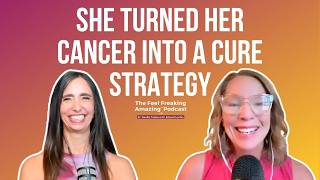
In this Feel Freaking Amazing podcast episode, host Dr. Wendie Trubow interviews Dr. Nasha Winters, a physician‑scientist and pioneer of integrative/metabolic oncology. Dr. Winters recounts her 1991 diagnosis of advanced ovarian cancer at age 19, when conventional medicine offered only palliative care. She describes a series of unconventional, self‑directed interventions that unintentionally saved her life: a prolonged fast (2½ months of bowel rest), an accidental high‑dose psilocybin experience that induced a shamanic death‑rebirth, and a “family fast” in which she cut off contact with her family of origin. While fasting, she independently discovered literature on long‑term fasting, the Warburg effect, extracellular matrix biology, psychoneuroimmunology, and other metabolic concepts, gradually building a personal scientific framework. Genetic testing later revealed a BRCA mutation, HLA‑related autoimmune susceptibility, and numerous SNPs that explained her early‑life health issues and cancer risk. Facing a broken healthcare system—no insurance, being turned away by oncologists, and suffering gadolinium‑induced kidney failure—she leveraged resources at a Planned Parenthood clinic for imaging and labs, and incorporated acupuncture, EMDR therapy, and a vegan/clean‑vegan diet (later refined after recognizing nutrient deficiencies). Over the next three decades she developed a clinical practice that blends metabolic therapies (fasting, diet, targeted supplements), mind‑body approaches (psilocybin, psychotherapy), and conventional oncology. She participated in early end‑of‑life psilocybin trials, treated hundreds of patients, and authored “The Metabolic Approach to Cancer.” Dr. Winters explains the non‑linear disease course: periods of stability (NEAD) punctuated by reactivations triggered by extreme stress, betrayal, COVID‑19 infection, and later lung involvement. She emphasizes that cancer biology must be understood in the context of a patient’s biography, genetics, and life experiences, rejecting one‑size‑fits‑all protocols. The conversation ends with mutual gratitude and a promise to continue the discussion in a future episode.
Chapters
Hello and welcome to this episode of the Feel Freaking Amazing podcast. I'm Wendie Trubow, and Ed's not here with us today, but we have an amazing guest. It's Dr. Nasha Winters, MD, FABNO. We're going to have her tell us what that is later. She's a leading expert in integrative oncology and the author of The the metabolic approach to cancer. She's also a pioneer in the integration of conventional treatments with metabolic therapies in cancer care, transforming the way we understand and treat diseases. So, Naysha, welcome. I'm so excited to have you here. I've been waiting for this for so long.
I'm so honored to be here, Wendie. I am just— yeah, this is great. And I love that you're— you're— you're— I went and looked at all of your other podcasts. I don't know why I've not been following you all along. You've talked to some amazing people, including many that are friends and mentors to me. So I'm very honored to be among your tribe.
Likewise. So, all right, tell me, how'd you get into this? But first off, wait, back up. What is FABNO? What is that?
FABNO stands for the Fellowship of the American Board of Naturopathic Oncology. So there you go. And that means I went a little extra beyond my education and beyond my residencies to dive deep and certify in and then actually recertify 10 years later to still carry this accreditation.
Okay, so how'd you get into oncology? Why oncology? I mean, literally, by the way, after in my OB-GYN residency, I came this close, like I was about to go into GYN oncology when I realized like I don't want to be in the OR all day. I love the patients, but I don't want to be operating all day. So how did you get into oncology and why?
Well, I think a lot of people think, oh, what a great career choice, right? It's not a light and fluffy topic and not a light and fluffy career choice, but I got there because of my own journey. And so interesting that your background is in OB-GYN. That was actually where my cancer process started, was in my OB-GYN. And so at the age of 19, just 2 weeks shy of my 20th birthday— and it would still be another 2 or so weeks beyond my 20th birthday to get the official diagnosis— I was diagnosed with end-stage terminal ovarian cancer.
What?
Apparently you haven't heard this story, Wendy, so good. I'm kind of glad. A little shock factor.
I don't gossip, so I'm never in the loop because I don't gossip. I don't want to hear it. I just want to know what you're committed to, how I can support you. So, oh my God.
Yeah. So it kind of gives me chills that that was your story, your version. You almost went down that path. It was a path that I never wanted to go down. Pre-med. I was a sophomore in college at the time of my diagnosis. I knew I wanted to go into medicine, but my own health crises took me on a very different path. I was very poised to go into standard of care, and unfortunately, that— I had a little bit of lackluster experience with standard of care. I'd been 6 months in and out of the ER begging for someone to look at me through a different lens because something was wrong, and they just kept telling me it was more of the same. And so context for your listeners, I think at the age of 9, I started— I will not think— I started menstruating at the age of 9. No one questioned that at that time frame. I started on the birth control pill at 11 to deal with my PCOS, my endometriosis. By the time I was 14, I had cervical dysplasia. 16, yet again, I was diagnosed with IBS. I was diagnosed with juvenile rheumatoid arthritis. I had a lot of thyroid issues, cystic acne, which was related to the PCOS diagnosis, I was on a lot of different pharmaceuticals to just deal with all of those symptoms. And the weirdest part is I say that out loud and I do not sound like I was a healthy person, but no one ever, myself included, thought I was unhealthy. It was just like, oh, here's a script for that. Just take that, you'll be fine. And so it was so normalized that I never asked why and I just trusted the doctors. And so by the time my diagnosis came on, Everyone just thought my symptoms were more of the same. I had all of the collection of disease processes that would very easily mask such a cancer diagnosis. And by the time my roommate found me unconscious and rushed me to the emergency room, that's when I had a different doctor who took a different approach and realized by taking one look at me, I was not dealing with IBS, you know, not dealing with polycystic ovarian syndrome. Did the proper workup and realized I had a grapefruit-sized tumor on my right ovary. I had huge, huge amounts of ascites, which is a malignant fluid buildup in my abdomen. I had 100% bowel blockage on imaging. My pulse oximetry and my oxygen levels at room, um, status was in the high 70s. Um, I had lesions all throughout my liver, all throughout my abdomen. I had what was known as carcinomatosis and peritoneal implants, so basically like shrapnel of tumors everywhere throughout my pelvis and my abdomen. Um, and I had fluid even built up in and around my lungs and in and around my heart. And it was a really bad and scary place to be. And yeah, how did you not curl up in a ball and just withdraw?
You know, it's so scary.
And it's funny that you say that. I think that was my initial instinct when I was told the diagnosis. By the way, the doctor, the ER doc came in crying because he had a daughter my age. So I honestly— you'll crack up at this— I took care of him, which is also such my nature.
You're like, oh, come here, honey, let me hug you.
Yeah, probably was part of my cancer process, right? As I could look back at my long-term history of kind of codependency in those pieces. What I think is also important for your listeners to know is for the years leading up to that diagnosis, I had not committed to actually wanting to stay on this planet and in fact tried to do something about that on two different occasions. And so what happened for me in that moment, there was a glimpse. So first of all, I was consoling the doctor. And then the second moment was, wow, this is a much sexier way to go than taking my own life. Like, what a way, what an exit. It kind of felt like almost more glamorous than the alternative. And So I had this quick moment of relief, and then something weirdly happened, which was unexpected for me, was I'm not ready to die. I don't want to die. They're telling me I don't— I probably won't see into— this was, by the way, the year was 1991. They weren't expecting me to see much into the year of 1992. That's how sick I was. And as a clinician looking back, I didn't have weeks to live by what was actually going on. So Those were the weird moments that led me in that moment, not expecting to survive it, not expecting to fight it. They couldn't offer me anything because I was too far gone. I was too sick to even handle a single dose of chemotherapy. I was not a surgical candidate. They could do palliative only. They could remove the fluid and give me pain meds. Um, that was about it. And so for me, instead of expecting to survive it, I just wanted to understand it. And that's been the beginning of now nearly 34 years. Of trying to understand this, not just for myself, but for tens and now hundreds of thousands of others on a similar journey.
Okay, okay, this is a lot. Okay, I'm really very blindsided here. I'm like, oh my God. So, so you didn't do the traditional path largely because you weren't eligible for the traditional path. So what did you do instead?
So that's again 1991. Yeah, no books, you know, there were no, uh, not even the internet.
You can't even look it up. You're going to the library in the Dewey Decimal System. You and I are the same age, by the way.
We are very—
Dewey Decimal System.
I— and it's so funny, you— I love that you said it because I was working work-study. So I was the first person in my family to go to college. I was working work-study in a library. Um, in fact, I was so poor— this is before they had like cameras and stuff. If my— if my college is listening to this, you have to forgive, you know, this— but I lived— I literally spent weeks living and sleeping in my library because there was a couple of comfy couches that I could kind of hide out in and hide out at night. But I would do my research in the Dewey Decimal System and on the microfiche. And I started looking into this. But I also took that first few months off and stayed home very sick. I couldn't function. So those first few months, I don't even know how to explain this except for the fact that I didn't eat. I think that's the simplest place to start. So I had a bowel blockage that was so severe the 2 weeks leading up to me finally landing in the emergency room that last sort of time was I kept explaining that every time I ate, I wanted to throw up or it would cause extreme pain, not knowing. And then I also, because your listeners may be TMI, but they need to know this. For me, I pooped once a month at that time, and that was also normalized. Wait, how often? Once a month? Yeah. Since I was a baby. And the pediatrician told my mom, which then became the story of my youth and the story of my teens and the story of my young adulthood, That was just my normal pattern. So did you eat once a month? No, I ate a lot. I ate normally. So again, this is the craziest part of how we normalize things. And so for me, not pooping was not a clue. Like, if I had a patient today not pooping, I'm looking for a bowel blockage. But for me, because it was so far and few between, that part was missing. And just me throwing up I just thought I was having like a stomach flu or something going on. Like, I just wasn't putting the pieces together. It wasn't until that moment of the bowel blockage. And now at that point, it was 100%. So there was nothing going in. And the only remedy, and even in standard of care today, if you ended up in the hospital, they usually put you on what they call bowel rest fasting.
Nasogastric tube.
Exactly.
Yeah.
Not eating.
Yeah.
That's what— so for me, because I didn't end up in the hospital environment, I just didn't eat. And I didn't eat for 2 and a half months.
But you—
and that always freaks you out.
But what's amazing is you lived for that 2 and a half months.
Exactly. And I was going in the first couple of weeks, I was going in a couple of times a week to get drained because my ascites would fill up very quickly. But over those weeks, as the fluid was getting pulled, I needed to pull it less and less. And it would result— it would come back slower and slower and less and less amounts. So I knew something was changing, and that even the, the people that were taking care of me were like, this doesn't happen, it gets worse, right? And then you die. That was like the usual. So I was already defying what everyone's expectations were. I was still too young in my medical career to know that that wasn't normal either. But I also wasn't aware that as I was fasting, I was letting that bowel obstruction— I was kind fostering it to heal itself, to remedy itself. And so accidentally that was happening. And Wendie Trubow, it would still be years before I started to stumble across the work of people like Dr. Moreshi from the— from 1909, who showed studies that just long-term fasting in cancer patients could debulk the tumor. So basically shrink the tumor. I didn't know that, but that was clearly what was happening. I didn't know that that break from eating all the foods that I had been incorrectly eating my entire life, especially my extremely standard American diet. But worse of it was at 16, I decided I'd be a vegetarian, which really should have been called a carbitarian, ultra-processeditarian, whereas there was really no real food in those things that I ate. So I was having a break from that. It was also giving me a break from what the primary food source for me was, which was bread, to understand later that I have celiac disease. And so all of these— right, there you go. Right? So these accidents, how beautiful. How many cool things have we actually learned in medicine because of accidents? But for me, it was a literal lifesaver. That bowel blockage saved my life. And what we also started, what we now know looking back, is that that type of fasting strongly lowers your inflammatory pathways. So I was resolving a lot of the drivers that create more fluid buildup. I was resolving a lot of the drivers that were leading to the blockage and the swellings. I was resolving a lot of the drivers that were causing me a lot of excruciating pain. And so slowly, as I'm still here, much to everyone's surprise, especially mine, it just made me more curious. Well, like, why is this working? What is this doing? So I would go to my Dewey Decimal System and look up fasting and cancer and run across, you know, all this work. And because I was pre-med, I was learning all the things like cancer is a two-hit theory, and then it's a genetic disease, and I was being taught that, but it didn't feel to me like it was all of the picture. And so as I started exploring, I started stumbling across the work of this obscure scientist by the name of Dr. Otto Warburg. I started running across the work of a doctor who someday I hope to meet this woman. She's such a hero of mine, Dr. Mina Bissell, who kind of coined the concept of the extracellular matrix and this sort of terrain tumor microenvironment as being where we should put our attention instead of to the tumor or the tumor genetics of the tumor. Started running across the work of Dr. Robert Ader, um, who was the father of psychoneuroimmunology, the work of Dr. Candace Pert. 20 years before his book ever hit the airwaves in 2011, I ran across the research of Dr. Bruce Lipton, and suddenly all these pieces for me started to come together. That suddenly I started to understand my origin story. My, my, my, my biography that led to my biology. I started to understand the, the lifestyle and dietary impact on my biology. I started to understand the places where I grew up. Like, later in life, I learned I lived on 4 Superfund sites, you know, like, like, that affected my biology. Just pieces have been brought forth over my 34 years since this started to happen. And I say this because back in 1991, there, there was no information about this out there. So it's been an ongoing journey. I keep learning things about myself. In '96, I learned I had the BRCA mutation. In 2003, I had my single nucleotide polymorphisms mapped. You know, by 2012, I could do access to certain types of imaging and other provocative testing that didn't exist before. So I always tell people I was able to kick can down the road just a little bit further to learn something new to apply to myself than to apply to the patients I served.
Yep. Nisha, I just have a question.
Sorry, that was a lot.
No, it's a lot. But I guess so. Okay, the first step was you fasted unknowingly, but it made a huge difference metabolically. And then what happened? Just for the record, I don't like to rush. I might have to have you back so we can actually talk about what you do because your story is really inspirational. And I'm thinking to myself, oh, I have a cousin who has pretty advanced ovarian cancer. I'm like, maybe she should see you.
And that story is what led to the things that I learned and the things that I apply today. So I think it is important to have some context. It's not like all of this information was out there and I just happened to stumble upon learning it. I was a living laboratory, continue to be, by the way, of that. And so my next critical step, in my opinion— well, there's two. So I think I can say this on this show, but I didn't really share this discussion until about 2021. So first of all, I should also start by saying that there were about 5 people in my life that knew of my diagnosis until 2012. So let me just plant that seed right there. I'll come back to the why of that in a bit.
What's your emotional— what's your ethnicity like? Are you Irish? Are you Jewish? Like, what are you?
Yeah, so I'm definitely a mutt, but I have a really— so I grew up in Midwest Kansas, you know, daughter and granddaughter of very like, you know, Methodist, you know, Christians. Learned later in my SNPs that there was an Ashkenazi Jewish gene coming through. So there was like, oh, there's a surprise. My grandfather, my mother's father, is almost entirely Native American. So I have a different component of that. There's likely my, some of my single nucleotide polymorphisms specific to metabolic health. There's a lot of Eastern European components in there. That's where most of my ancestry lies. So kind of Eastern European and Native American is really the bulk of it, which is a pretty interesting combination as far as some of the patterns and some of the even epigenetic triggers in those environments, because we can even look upstream 12 generations to know how those experiences in those parts of the world impacted how somebody's, you know, genetics are going to express. And so like one example is I carry a lot of the HLA genes, the human leukocyte antigen genes, multiple homozygous SNPs there, which set me up for a vulnerability to viruses, to mold, to autoimmune patterns in particular, and celiac disease.
It's all the same gene, right? The celiac, the juvenile rheumatoid arthritis, the Hashimoto's, it's all the same. It is. Gene 6, HLA complex on gene 6. It's all the same. So where there's one, there's others. Yeah.
Where there's smoke, there's fire. Right.
Where there's smoke, there's lots of autoimmune disease. Totally.
So I have that piece. I had tons of stuff in the COMT mutations. So catecholamines. So stress definitely wired into my system. I also have outside of the genetic pool, when we think about adverse childhood events, which is where I started learning about psychoneuroimmunology, stumbling upon this in my research, I knew somehow that trauma had to play a role in this. I just didn't know what. And back in 1991, that concept was very new, you know, it was out there, but it was new. To give your listeners context, when we look at folks who've had an exposure of more than 3 ACEs, okay, before the age of 18, so adverse childhood events, their likelihood of having an autoimmune or a cancerous process in their youth is higher, higher, higher for each you have. I had 10 out of 10. Yeah, girl, you're not a halfway good girl. Well, yeah, but, you know, exactly. I'm not— I don't do anything halfway, I guess. So that piece then made me start to get really curious about the psychoneuroimmunology piece as well as just my interest in my family of origin. I mean, I knew that there was a lot of cancer in a lot of different places, but they all hit the elderly in my family. They weren't hitting the young. Right. And so those were things that were getting me very, very curious. So my next step After the great, you got this diagnosis, have to fast. On my 20th birthday, I'm supposed to have a big party, canceled it. But to a couple of people, because we didn't have cell phones and internet and things, a couple of guys showed up at my house with a bottle of tequila and a bag of weed. And I was in my kind of eff it phase because I thought, I'm going to be dead anyway, I might as well. But then I realized I feel so bad. And because of how I was with my nausea at that time, I'm like, I can't eat or drink anything. And so I'm like, nope, nope, I'm not going to do that. And they're like, well, what about mushrooms? And I don't know why. I can't believe I'm telling you all this, but I accidentally ingested. And when I say ingested, chewed up and held in my mouth because I couldn't swallow them down. So chewed up and basically held them in my mouth like a big cud, right? Like a big cow. Because I wasn't swallowing things down, but I was definitely absorbing all that. I took in what we're guesstimating today was between 10 and 12 grams without me knowing. When the guys turned around and saw what I had done, they were so horrified. I'm like, wait a minute, you told me to eat them. They're like, not all of them. I was really confused. They were confused. And I'm pretty sure they were wondering what is going to happen here. And the next few hours, what happened is to go very, kind of in this crazy high level, I died. I died. That's the only way I can describe it to people. I went through an absolute shamanic death process and a rebirth. And as much as I can say, I'm pretty sure that saved my life as well. It saved my life through my perspective and my belief systems and my patterns. Because what I think I redid in that moment was rewire my entire nervous system to have a different experience and a different expectation. And the irony of that is that one of the guys that happened to be part of that night is now my husband all these years later. So he was also stupid enough and crazy enough to hang out with a dying girl. He would still not know for a good 6 months that I was dealing with this diagnosis. I wasn't going to tell anybody. I'm given 3 months to live. I don't want anybody feeling sorry for me. I don't want anybody knowing what's going on. I came from a very proud environment. I didn't want anybody having any, like, oh, poor me. I just wanted to go out and live the eff out of life. And so that moment for me, like, taking those mushrooms in that way was that I'm going to die anyway. Why not hype a vibe? Well, that was a pivotal moment. That pivotal moment led to the third, what I believe is why I'm still here having these conversations today.
But we got to pause for a minute because the medicine that you— the substance that you took actually has medicinal properties and can heal you at a cellular level, which is crazy.
It's so beautiful. Research in that department. I mean, here's what's so funny. So again, no one even knew about my cancer history, but also nobody knew about my heroic mushroom history. I was very private about that until 2021 when Michael Pollan let us all come out of the closet. Of it, of that piece. But in 2011 and 2012, I had 12 patients, um, matriculate into the, the Harvard trial for end-of-life psilocybin research, which was— it still took— it was almost another 10 years before that was published. But out of those 12 patients, that they all had to be hospice eligible 9 of those 11 were in-stage ovarian cancer patients. Because funny, even though I wasn't telling my story, I ended up with a lot of ovarian cancer patients somehow magnetizing that in, right? But these patients were coming through to meet their mortality. That's what they were going through this clinical trial, knowing that they had less than 6 months to live and knowing that they were not in any more form of treatment. And so because they all had various stories, they were really traumatized by this diagnosis and by this death process. I encouraged them because I knew I'd had my own experience and I'm like, here it is through a clinical trial that maybe you'll feel more comfortable. And they did. They were hesitant even with that. All but one of those patients are still living today. And that other, that, that 12th patient died about 4 years ago. And so that was another, like, those were moments that were playing into my brain of, okay, I wasn't just an N of 1. Maybe there's something else here. And to your point, Wendie Trubow, there's been so much research on— yes, we've done a lot of cool studies about its impact on end of life, facing your mortality, of PTSD, a trauma resolution. But there's also very clinical studies about what it's doing at the cellular level, what it's doing at even the epigenetic level. And so that's where I've gotten really interested in researching of the application of these ancient medicines that we co-evolved with, and that they literally are here to help us, right? And when they're used in the appropriate ways, because I do think that they can be used inappropriately, and I think that they can backfire in that they can be very powerful. And so those were my big 3. So my big 3 was— oh, well, I hadn't gotten to the big 3 because you paused me there. But the 3rd process that happened after my diagnosis and after that mushroom experience was I did a 2-year family fast.
Wait, what? A 2-year—
exactly. Family fast.
What does that mean? Like, does that mean you detox from your family, or your family and you did a fast? What does that mean?
That means I cut off all ties with my family of origin.
Oh, wow.
And in 1991 into 1993, that was very easy to do. You could hide your phone number. There was no way— like, there was nobody's could not know where I was. And so that was a very important time for me to really go into my emotional vault. And luckily, I had so many resources. I was the first patient of a therapist at my college who had just trained in, and I was her very first patient doing EMDR. Right.
Okay. That's really cool.
I know. 1992. Or 3, '92 or 3, I can't remember. It was early on in my diagnosis. It was within those first, those first year and a half or 2 years. I did trade for acupuncture for my pain management. I worked in a health food store, which is where I could get all the food they were going to throw away. I would take home and start eating in a different diet, something not so processed. I became the first couple of years. And for me, unfortunately, I think I made some mistakes, but I had to live and learn. For me, this wasn't the right fit, but I started out as a vegan. And then moved deeper into it. I told you I was kind of a practicing vegetarian, but I went deeper into veganism and that bit because that was the only information that was out there in 1991 as a potential to help. What I didn't understand, I was already so malnourished, I added insult to injury. And when I then got back to my vegetarianism, I was still hesitant to bring on animal protein. So I was doing a lot of soy and other things that were actually driving my estrogen dominance patterns even further. So my life has been like I'm a living laboratory. I now go by data, not dogma. I try to go by what my body was trying to tell me. And even though I was trying to override it with what I thought was right, luckily I started getting access to tools that helped me understand my body and how my body was responding to what was perceived to be the right approach or not.
So, Nisha, when— all right, so they initially were thinking, okay, you have a few weeks to live. Yeah. And then you lived 2 and a half months, and then you had your psilocybin healing.
Psilocybin was 2 weeks after this. It happened right after my diagnosis.
Oh, okay, okay. So I'm timing off. Okay, so 2 weeks after your diagnosis, you have the psilocybin healing event, and you continue to fast. And then 2 and a half months after, you, you essentially do a family detox.
Yeah, by the end of— yeah, about the end of October, after that, after my diagnosis, after the psilocybin experience A couple of weeks later, I realized I was— I did not tell anybody in my family, and I really agonized, should I reach out to my family on this? I was in another state from them, so that was helpful that I didn't. They weren't seeing me. They weren't seeing what was going on with my body. And so that's when I decided at the end of October of '91 to take that break. And it was an easy— it was an easy time to do that. And so that was kind of my— in that first sort of, let's say, 6 weeks from the moment I landed in the ER to the final diagnosis after biopsy results completely came in and confirmed to when I had done the mushrooms to the official leaving my family of origin for a period of time, that was a very short window. So again, I don't do things like— I'm that person, like, rip the Band-Aid off and do it all at once kind of gal, I think. But that's what happened in the beginning. And by the time December rolled around in early January, I am like, I'm still here. Now what? And because I took off the rest of the semester, I was just kind of waiting to die. While these other things were happening in the background because that's what they told me was going to happen.
Right.
And that's when I stumbled across the book right after my official— because the official diagnosis didn't come until October 21st, 1991, almost 3 full weeks because that was 1991. So the biopsy results took weeks and weeks and weeks at that time. They suspected the primary. Everything was pretty obvious. It all pointed, you know, all roads codes pointed to this, but the official— so when the official came, I kept thinking maybe there's a mistake. I waited. I still was kind of holding on that they're just going to say it's just a big cyst because I'd had multiple ovarian cysts and whatnot that had ruptured and caused problems. So I kept waiting for them to just say, oh, it was just a bad cyst that exploded and that's all the fluid in your belly. I don't know what the story was in my head. I was still like, denial is a pretty wide river. It's a huge river. That's when they told me on that day, nope, it's worse than we— I mean, it's bad. It's worse than we thought. But really, really, you're done now. And I was still getting drained pretty regularly. I was still very cachectic. I was still dealing with the bowel blockage. I ended up in my little public library and went to the alternative medicine section. I'd never even known what alternative medicine was, right? And this book jumped off the shelf at me, and I literally sat down and read it on the floor. I'm a speed reader, so that's not uncommon. But I sat down and read this book in 2 hours, and that book was a book by someone I'd never heard of, called by a man by the name of Dr. Deepak Chopra and a book called Quantum Healing. And so I say that I still get emotional when I say that. It's like these things that landed for me. I'm always shocked that there's still some tenderness there, like the accidental fasting, the stumbling across, you know, Otto Warburg's work, stumbling across Metabissel, stumbling across the world of psychoneuroimmunology, then getting this quantum healing perspective. Like, how does that happen? Like, there was something so intentional that within that first 6 weeks, I basically was given a roadmap.
There's no accidents, Nisha.
Exactly. And from a person who strayed very far from any faith because of where I was raised in a very conservative, extremely like fear and brimstone, and that belief system did not resonate with me, did not fit. I actually just turned completely away from faith. It was like in those first few months, it turned me fully back to it in a very different way and a very different understanding, and a different understanding to realize my approach to my faith is mine, and it didn't have to fit into the container of anybody else's. And that was also very liberating and also part of why I had to do that family fast.
And so did you tell them, or did you just ditch?
No, nobody, never. It— my, um, I'm trying to think of when my mom finally learned, went, learned It had to have been around 2008 is when I finally told my mom. Yeah, yeah.
Okay, so now walk me through.
You're like, we are so not on the path I thought we were going to be on today.
No. So, okay, so, so in 6 weeks you go on the fast, you have the psilocybin journey, you discover quantum healing, You continue to fast for 2 and a half months, and then what happens? Like, did you ever have surgery? Did you— like, what happened?
So here's where it gets weird. Like, not like this was weird, right? Like, oh, now it gets interesting.
Yeah, this has been really boring, so I'm glad you're gonna spice it up, chica.
Okay.
Oh my gosh.
Oh my goodness. So I— like, January, it's like literally New Year's. I'm here. Didn't expect it. I go back to the doctor because I, you know, I'm in the ER when I get diagnosed. They commit, they send me on to this oncologist. I go back to that oncologist. I'm like, okay, now what? So here's where it's weird. I don't even know how to quite explain it except for the fact that they were angry at me. That's about the only thing I can explain. That's what it felt like. It felt like I was meeting a wall of anger. They're like, I don't know what to do. You're going to be dead any moment. We've already told you there's nothing we can do. And I was like, well, I'm here.
Not dead yet.
That's your line in the book. Not dead yet. Seriously. And they're like, well, you're still not a candidate for this. Then I got the double zinger of not only are you not a candidate, you also don't have insurance. So you're uninsured. You're well below poverty level. Even though I was now of age, into my 20th year on on this planet, they were still, like, turning me away. So I worked at a Planned Parenthood in my local town. I would help send out, mail out the birth control pills, right? Because it was my way of me getting free birth control pills. Because at that time, I was still on the birth control, not for birth control, but to treat my PCOS and my endometriosis. Now, it would take me a few years to learn that those medications were actually driving my process more because everything I was reading was, well, shouldn't birth control pills be protective against ovarian cancer? Because that's what we were all taught. But the type of pills I was put on and the type of medicines I was put on were so different than they are even today. So, so high unopposed estrogen, just all the things, just really levels of highly synthetic, extremely high levels of estrogen. So I think that was one of those moments of realizing I pulled that off. But basically me working at the Planned Parenthood, I was able to labs, and I was able to get pelvic ultrasounds and abdominal ultrasounds for free regularly, like monthly. And as we started to realize the ascites had cleared up, I only had a couple of loculations left, you know, so little like pockets that we just couldn't drain, they couldn't tap into, and they were kind of resolving on their own. Everyone was like, well, we don't really know what to do. Your ascites isn't there. It seems to me from the imaging that the tumor on your ovary is a little bit smaller, but it's still there. Seems to me that the imaging of your liver, the lesions might be even a little smaller or less in number, but they're still there. No one knew what to do with me. Nobody did. And because then it was the you're going to die anyway. And then it was you don't have insurance. It was like I was left out there flapping of they don't know what to do with somebody like this.
I didn't know what to do. Such a metaphor. Such a metaphor for your whole life, right? That you Like, you are on your own, girl. Like, if that's not your story, your life story, then there is—
It is so much my life story.
It's such a perfect metaphor for your whole life.
Yeah, and it has been, and it continues to be on some level because I'm now like, even when people don't know my history, I'm always the charlatan of me talking that there's different ways to approach oncology than what we're being offered or ways in addition to what we're being offered. And then when people hear my story, then the other pendulum is she's lying, She was misdiagnosed. That couldn't have happened. I'm like, Jesus, like, I am— I can't win anywhere here. And so I just have finally given— I finally gave up. Like, I love Mel Robbins and her 'let them.' I started that mantra a long time ago. Let them believe whatever they want because I know what's true. I know what's going on with me. I know the tens of thousands of people I've directly impacted and the hundreds of thousands I've indirectly impacted. I know the data that we're looking at is legit. You know, it's I was like, okay, great, you can all still have those belief systems, but just because you don't believe it doesn't mean it's true or not true. You know what I mean?
Were you still fasting in the New Year?
What I was doing, I wasn't fat. So at that point, I started eating. And when I started eating again, I went to a really hardcore vegan, clean vegan.
Right.
And that's when I couldn't understand that, yes, I was still like, I was probably helping my body to some degree of getting rid of all the processed food that I had been living on, right? So I was getting some improvement, but I was also getting more and more depleted in other ways. But that would still take me years. That would take me until I got into medical school and started learning more about lab assessments and whatnot that I realized, oh, geez, I have— my B12 status is like 40. It was ridiculous. My ferritin was 3. You know, like, just, yeah, just crazy, crazy things like that that I would learn years later. But yeah, that was for me, it became a journey of curiosity, of, of asking different questions, of expecting different answers, and of persistence and resilience and resourcefulness, which has been also my life story. And so So I just seemed to gravitate in those types of patients that had similar stories to my own and could kind of learn off, mirror off of each other. They didn't know that, of course, at the time that I could say, well, this seemed to work well for me. I wonder if it will help them, you know, type of experiences. And in 2012, I had a patient come in in a wheelchair who was in stage— like, she was literally said, you've got weeks to live. You're in stage ovarian cancer. Like, she looked exactly exactly like what I looked like at that time. And it was just like she came to me because I worked with a lot of patients with cancer at that time. And I was working— I was hospice referred their patients to me, the patients who were not responding to opiates or the patients that refused them, because I could do a lot with acupuncture and homeopathy and just holding that space for patients. And so I got— I worked a lot with my community hospice team. And so when this patient was referred into me for end-of-life support, pain management, um, and just kind of mental, emotional support in her passing. Um, I started applying some of the things I did with me to her, and she was so resistant, a very much of an engineering brain, a very scientific. And I knew that for me to compel her to do any of this, I probably had to tell her a little bit more of the story, a little bit more context. And so I let a little bit of my story out to her. It felt like someone I could share that with. It felt a little bit time time to do so. And this is also shortly after reading, um, David Treveille Schreiber's book. He was really known for his work, Anti-Cancer, but his book that came out after he died called Not the Last Goodbye is what gave me some confidence and courage to tell my own story. Because he didn't tell his story, being a 17-year GBM survivor who'd had multiple recurrences. He didn't tell people he had another recurrence. Reoccurrence and ended up dying of that recurrence because he was so afraid that all of his life's work that he showed the impact of diet and lifestyle on somebody's overall quality of life and even overall time, quantity of life, he knew they'd all throw it away because if he died, they're like, see, it didn't work. Even though GBM, 17 years from multiple recurrences, he would have been perceived in his own mind as a failure. I had a similar tumor, like reading that—
hold on, GBM meaning glioblastoma multiforme? Yeah, so the highly aggressive brain tumor.
Yeah. And if you can get past the first 12 months of a brain tumor, um, and don't have a recurrence, you might be able to extend that up towards 24 to 36 months. That's the typical. This man had 3 recurrences and managed to eke out 17 years. And when he died of this, he waited for his book to be published to share that story of my biggest fear is that I will die and everyone will say this is bullshit, that this stuff doesn't work.
Right. But everybody dies eventually. It's not an indefinite conversation. But wait, can we go back, please? Nisha, I'm sorry to beat this, but—
No, I'm so glad. Yeah.
What happened? I mean, so at some point, did your tumor resolve or did it shrink or are you still dealing with it? What's going on?
In about 2, I'm trying to think here, 2000. So the other thing that happened from 1991 until about 1997 or '98 is I ended up with gadolinium poisoning. Yeah. So still dealing with that, by the way, all these years later, which is the type of contrast dye they use in MRIs. And in my little town, MRIs is how we were monitoring things. That's what I had access to at that time. Time. So in 1989, I had a CT scan which showed that I still had pretty extensive liver involvement and that there was still a tumor in my right ovary and that I still had some questionable lesions in my lymph nodes. But otherwise, the par— the other stuff seemed to have resolved. Unfortunately, that one and done CT scan shut down my kidneys and I almost died because of the contrast dye for that. So I knew I couldn't go back that route. I was able to then sporadically use— I mean, I kept going with ultrasounds. That was kind of a good go-to. Non-contrast dye MRIs. That's why I'm very excited about the more modern technologies using non-contrast dye MRIs that we have access to today. But I had to avoid all the things that had contrast dye. That was just— it was literally putting me in kidney failure every time. And so the other types of imaging I've had over the years has shown stability and resolution, although there's scarring. So I had a Prenuvo a couple of years ago and you kind of see where spots have kind of scarred up over, walled off, but no active disease in some time. But no, I'm not considered NED either. So there's NED, no evidence of disease, and then there's NEAD, no evidence of active disease. So that's what started to happen as I started to show, hey, there's still disease there, but it's not active. And that, Wendie, is what I started to learn about my own life as well as the patients that I serve. This isn't a linear process because there's also been at least, at least 3 times over the last 34 years after things stabilized and after I would have been considered NAD, I've had at least 3 other times when I was active again.
When you look at those times, were they triggered by some type of of either adverse event, toxic exposure, major illness? Like, what, what, what triggered those 3 things?
The first time was extreme stress, extreme stress. And that was at a time when there was a lot going on at my college, at my, at my medical school. And I was trying to call out the injustices that were happening there and got completely thrown under the bus. And it was incredible torture. It was like looking around realizing that you're all going— you're going to die here. Like the school is going to close down if we don't do something about it. But everyone's like, shh, don't, you'll make the school close. Well, the school closed down, right, for a period of time. And it opened up later. But, you know, to be really honest, like I was trying to be the messenger and everyone was shooting the messenger. And so that was so extraordinarily painful for me. Because they put— they were like, you be the guide, you're the person, you go for it, you're the person speaking for all of us. And then when I did, they all started shooting arrows at me, you know. So it was very— what is that, 1999?
Okay, so you are already 8 years in.
Yeah, yeah. And I'd been pretty stable from about 1997 until then, so like NEAD. And then it exploded, and it stayed exploded for almost 4 years. Like, it was really tough to get that back under control. And so then that really went pretty dormant. And then The next big wave was in 2018, also following a very— so there's 4 times— a very stressful, stressful period of time. Um, I had a business partner who walked with all my IP and basically stole all my stuff, and I had to start from scratch. 20-some years of my life, I had to start completely over. So betrayals are really a theme for me in that arena. And so that one, luckily, I had it by 2018. I had a lot more knowledge, a lot more tools, so I was able to stabilize that very, very quickly. The next one was in 2020, latter part of 2020, after COVID. And that's when I didn't have— I never did the injection, but I had the infection, which I didn't even know. It was so mild. But it— the weirdest thing is the symptoms of my COVID was all in my right pelvis and all of my lymph nodes in my pelvis and throughout my groin and in my pubic symphysis and everything there, including on an ultrasound, showed that all of that reactivated. Activated. And I was like, that's when I started getting curious, started going down what, what role does SARS-CoV have on the immune system, on cancer process? So that took me down a whole nother rabbit hole, which I did to save my own life, but then started to know how to do that for other people as well. That I started realizing there's something here and no one's talking about it. I'm not allowed to talk about it. And if I do, yet again, I get thrown under the bus or deplatformed or whatnot. So that was a big one. And then another huge stressor about a year and a half ago. It showed up in a different part of my body than I'd ever had before. And I'm— I can't believe I'm actually saying this here. This is not public. It's the first time I'm saying this very publicly. Showed up in my lungs. And what the process was that I went through at that time was, I think, the vulnerability from COVID but also lifelong vulnerability of just extreme deep grief, deep grief of some of the things that were going on. In my world, in my work, in my relationships that was so painful. And I do my work. That's the thing is I don't shirk away from diving into those things, but it just over— it consumed my physiology. And knowing my SNPs, knowing how I'm wired, knowing my ACEs, knowing those things, it makes me understand why I'm more sensitive to that expression. So I, um, was able again with the tools in just a matter of a few months, I was able to turn that around as well. So, um, again, I want folks to know it's not linear. I'm learning new things and every year we learn new things. And so the way I practice or the way I approach this today is different than I would have done it 2 years ago, 4 years ago, 8 years ago, 12 years ago, 20 years ago, 30 years ago. That it's not like there's one way way. We're constantly learning. There's not one way for every person. And so that's where my expertise is, is helping people understand the biology and the biography relationship, to understand the why you're expressing in this moment, to help then determine the patterns, to determine the best how to deal with it in this moment, and to iterate and adjust accordingly. That it's not just like, get on this one thing and do this one thing. And our culture and our society so wants the single target and the single treatment, or that everyone with ovarian cancer should do it this way, or everyone with lung cancer should do it this way. Doesn't work that way. And I know it's really distressful for people to hear that, but it takes a lot to examine one's life externally and internally to know how to move the next path forward.
I think this is the place we stop, and then actually part 2 is talking about how did you translate your personal experience and the, and the wisdom it gave you into how do you then go contribute and help other people who are dealing with similar things. But it—
we don't—
I don't have time to do justice to that, and I hate rushing. This is not a conversational rush through at all. So regroup. So let me just say from the bottom of my heart, thank you for your generosity in sharing, and thank you for your commitment to life and for your curious mind that keeps, you know, opening up, because you've done good work. You know, it's made a huge difference in the world, and the world would not be the same without you. So Thank you.
And we'll pick this up again. I didn't expect to go there today, Wendie Trubow.
My, my patients used to joke that anyone who was crying in our office was because they saw me. Because— so let's pause here for the listeners. Thank Thank you, Naysha. Thank you. We'll pick it up again. I'm gonna hit pause and we'll pick this up again.
Okay.
More from Wendie




Support The Right Bacteria to Restore Your Gut Health, with Dr. Oscar Coetzee

Support The Right Bacteria to Restore Your Gut Health, with Dr. Oscar Coetzee@designsforhealth3090




Look and Feel Decades Younger by Removing Senescent Cells, with Dr. Jerry Mixon