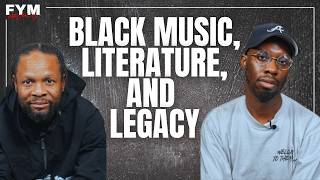
In this FYM Show episode, hosts Yo and Worldwide Ty discuss the significance of Black Music Month, reflecting on how Black music has shaped popular culture and serves as a passage for Black and brown communities. They examine a student essay that connects F. Scott Fitzgerald’s The Great Gatsby to contemporary experiences of race and class, highlighting the essay’s powerful question, “What does it cost to enter a world that wasn’t made for you?” Ty shares his involvement with the nonprofit Put Me In, which supports children of incarcerated parents, and describes how a 16‑year‑old student, Rodney, earned a week‑long internship to accompany Ty on his Cannes Lions trip to France. The conversation expands to Ty’s music‑industry career, his unexpected investment in SpaceX through R&B work, and his plans for future projects—including a Kids‑Overseas cultural immersion program and a comic‑book adaptation of The Great Gatsby. They also preview upcoming events such as a Bad Bunny concert in London, Ty’s appearance on an Essence Festival panel about rap lyrics, and the broader impact of Black music on charts, radio, and cultural memory. The episode blends personal anecdotes, philanthropic action, and cultural commentary while maintaining an informal, enthusiastic tone.
Chapters
And we're back with another episode of the FYM Show with Ty and Yo. That's my man Ty. I'm Yo. And Ty, it's June, it's summer. It's Black Music Month, people outside, people looking beautiful. Um, why is it your favorite season?
Favorite season? I don't think that humans should experience too much cold weather. Um, I think it's harsh. Um, and then, you know, I like the body to— you know, our body temperature, you know, when you say you healthy, your body temperature is like 97.9, you know what I'm saying? Now you don't want to be in 97.9 degree weather outside every day, but, you know, man, the sun, man, it's kind of like— it's not like every other season isn't beneficial to how this world operates, man, but it's just something special.
It sparks something in people, you know, it's exciting. It's an exciting time. You gotta— you got a trip coming up, right?
Yeah, man. So we're going to, um, Cannes Lions for our annual trip to the—
okay, okay—
advertisement festival.
Yes, sir.
Trying to find some money, you know, some brand dollars, get some brands to invest into what we're doing. And we invest into what the brands is doing as well, which is That is just as equally important. So yeah, so I'm gonna be in France for work and then— okay, I'm gonna take a couple days, go golf while I'm over there because it's south of France.
Have you gone to France before or will this be your first time?
Kind of nice.
Okay, okay.
Yes, yeah, I golfed last year when I was there. Last year I actually took a few of the, um, a few of the staff with us. They was trying to struggle to figure out, you know, how to— how to— sounds like a great time, but we had some fun.
Oh, the real sticks.
This is your birthday?
Okay, I ain't mad at you. I ain't mad at you. Now, Ty, you sent me an essay, um, that's associated with your trip. Can you kind of give me, uh, or give the people a bit of background on what you sent me, how it came into your, uh, possession?
Well, first, I would love you.
You don't want to introduce it first? You want me to, uh Yeah, just when you, when you give your opinion on it, he doesn't give me any background per Ty usual, right? He gonna just send it to y'all and be like, here, read this. What Ty does not know is I really like F. Scott Fitzgerald. I really like The Great Gatsby. So the essay is about a student who is comparing their experience in school to a passage in the story of The Gatsby., and it was an incredibly well-written piece. It was very short, but it had a lot of like heart and this, this student's observation of their surroundings and how they are just so aware that their background pits them outside of some of the students that they go to school with. And just like that realization of feeling within some place, but also on the outside. Was, was like really at the heart of the story. And comparing that to a lot of the characters in Gatsby, where wealth has a lot of power and can just create a lot of problems for people. And just understanding— if you've never seen The Great Gatsby, you should go watch it. It is— it actually turned 100 years old last year. So it's a great American tale, but it's about a man who pretty much transformed their life in hopes of getting back what they lost in the past. So I think this student did an incredible observation of Gatsby, and yet I was really moved by it.
Yeah, so it's great to hear your perspective as a writer, right? You know, I like to call myself a reader more than I call myself a writer, but so in October of last year, I started donating to this organization called Put Me In. So Sometimes you'll see me wearing this hat that said Put Me In, and it's an organization that creates resources and tools for kids whose parents are incarcerated. So, uh, one of the community engagement young, um, young, young women named Daniela, um, she sent me this like, hey Ty, would love for you to check this out so you can kind of see where your money is going, right? Like, this is what's happening, this is what it's producing. And so I read it, and as you were, yo, I was, I was pretty moved by it. Um, I think the first paragraph really got me when the kid is basically at a private school, and he's a Black kid. He had a private school. He on, he's on, he's on scholarship. The private school, like, 60 grand a year, cost like 60 grand a year. And so, so, so all of his peers, they come from money, right? Either they come from money, right? And so, so they're talking about their summer vacations, which is my favorite season of the year, and they're talking about, we're going to Morocco, we're going to Italy, we're going to Paris. And this kid is writing this article from the standpoint of like, I'm not going to none of those places. Like, like, I'm included.
He's like, I'm gonna work, I gotta work for my summer, right? Because he's thinking about his summer budget, he's thinking about his school tuition. They worried, they thinking about, you know, traveling and having fun, and he's worried about like how he's gonna be able to pay for school and, you know, pay for his living, right?
Right, so this young man moved me, and I was like, man, I want him to have a cool summer trip too, like that he can go back to school and talk about with his friends. Um, and so, you know, I was moved to hit the community person back. I said, hey, would this— would this young man would like to be an internship, like a week-long intern on our company trip? We're going to Cannes Lions he can hang out, he can ask a bunch of questions, you know, it can be— he can have a cool summer trip story as well. So, uh, she hit me back, was like, wow, let me connect you with the mom. So I end up doing a Zoom call with the mom and, uh, the kid, he's 16 years old, he just turned— so he just turned 16 in March, right? Um, and so long story short, he's coming to Cannes with me like my full entire trip. So my trip is longer than everybody else trip because every year I've been to France for the last past 2-3 years, I'll go get down on the Sunday, work, work, work, work, work, then I'll just leave and come back to the US and work, work, work, work, work, right? But this year, uh, even before the Lord showed me this email, you know, I was like, I'm gonna spend more time in France, like It's— the weather is great. I'm gonna bring my golf clubs. I'm gonna take some days, I'm gonna go golf into these different parts of France. So I'm gonna work for 4 days and the other 4 or 5 days I'm gonna travel throughout France and golf. So I had already planned this trip, right? Um, and I was going to be by myself after I finished work because my, my girl would have to come back to the US to work. So I was going to be there just a little bit longer just by myself. So I was like, man, you know, I, I obviously I asked for his mother's blessing. His mom wanted to do a Zoom and walk through the details, but he literally is curious about finances, uh, real estate. Um, his name is Rodney, you know.
Oh wow.
He just started playing golf. Uh, he want to go to University of Miami. So, so we built out his whole itinerary. So June 19th You know, he lands in Miami for the day, kick it. Then on the 20th, he's gonna basically be with me all day because I gotta go to this 707 tournament that we sponsoring. Then after the 707 tournament, we go to the airport, and then we go to the airport, we fly to Nice. And then from there, he's just journeying along, basically learning about advertisement, learning about brands, learning about finances, being creative— I mean, being curious. It's super safe in France. In the area that we're going to be in for him to like walk around and explore and kind of like, you know, like he's 16 years old, so this is kind of like transformation— can be— this can be a transformational trip for him at his age if he takes full advantage of it. And, um, and then he's gonna just move around with me after I finish work. We're gonna go— I booked this really incredible golf club, golf resort for like 2 days, like 35 minutes north of Cairns that has like this incredible golf course. So I'm gonna play— we're gonna play golf there for 2 days, then we're gonna leave and go to Saint-Tropez and play golf there a little bit. And then we come back to, um, we come back to the US. And so, you know, for me, it makes me very warm inside because I didn't start traveling on a plane until I was 20, you know what I'm saying? Right before my 21st birthday, the first time I've been on a plane. Now I drove around, you know, different places, but I didn't get out of the country for the first time until 2000, the, um, 2005, which that was to Canada, which was still me driving, you know, flying to Buffalo and we drove in. And then, uh, my first time officially out of the country, out of the country, uh, was to London in like 2009, you know what I'm saying? So like, so like for me Um, I, I, I got exposed to that stuff. I didn't have a passport until, until 2008, 2009, right? And to be able to take this opportunity to bless another young man, uh, who, who his father is incarcerated, um, I don't know why his father's incarcerated, but he still talks to his father. His father knows about the trip, uh And yeah, man, I'm just super excited for him. Uh, this is something completely new for me because, you know, I don't really got— I don't got no kids that I got to be responsible for in that way. So moving around with like a 16-year-old that's a minor that you got to be making sure you're accountable for certain— a lot of his actions that his mom is trusting you, um, for that. So, so it's pretty— so I'm pretty excited, not gonna lie, like, you know what I'm saying? I don't know if because he's just, he's young and like can be, you know, exposed to a lot of things, or the fact that he played.
Man, Ty, this is incredible. This is incredible. Um, dang. Okay, I got, I got two points I want to make. I got, I got a quote from his essay that I want to ask you, and then I got a statement I want to make. So one of the quotes is, what does it cost to enter a world that wasn't made for you? And once you're in, are you ever really there? Well, I want to ask you that, Ty. Like, how, how did that make you feel? Or do you have like an answer to that question?
It made me feel— this article, reading this article for a very, very long time gave me this clear sense of like my life, you know what I'm saying? Like, you're like, when you, when you are— and we're not even just talking about being Black, that's another layer, right? We're talking about you, your skin color, then you dive down to how you articulate, then you dive down to, you know, how you dress, then you dive down to what your income is. Like, all of those different things on top of you being Black in America, you know what I'm saying? I didn't go to a private school, I went to a public school, right? So honestly, I didn't even know white people was in the music business until I started working in the music business, you know what I'm saying? Like, I didn't— I didn't— like, I was so blind to a lot of things that, um, my world was like not introduced to. When I say white people, I'm talking about with Black music. Not the whole music business. I thought white people dealt with white people music and Black people dealt with Black people music. That's how ignorant I was to be growing up in Atlanta, seeing nothing but Black people all around doing, doing Black people stuff. Like, I didn't, I didn't know what that was until I started getting more educated about it, right? So when, when you start talking about— we talk about this with Shawnee Prisons, right? You know, You, you're trying to put on for people who really don't care for you. They really, they're really not thinking about you every day. And so when I read this kid's article, man, I was just so moved. One, to learn— like, I feel like I can learn from him, you know, uh, ask him questions to be able to, like, you know, speak from that perspective. And then, um, I've had this, and I'm— and this is the first time that it's connected to me, and I'm gonna work on this for our— I'm gonna add this as a part of my operational side. But I've always wanted to do this summer program called, um, uh, Kids Overseas. So it was called, you know, KOD— I mean, KOS. So it was Kids Overseas where you would put together a program and you would take a bunch of kids to like places they'd never been before, where the first like, uh, week of the program they will be, let's say, in Miami or in Atlanta, and they will be learning about the history of the South of France. Then after a week of learning about this, like learning about the dialect, the language, all of these different things, then another week they will go to that place to be able to explore it, apply for it, all of those different things. And this is a concept that I had a decade ago that now, as I'm talking now, something that I want to revisit. And this kid is going to be— Rodney is going to be like a case study and a pilot for it, where you're moving around. They spend a whole week first learning about the places that they're going to go, and then they go spend 5 days in that actual place. Being able to, um, know the culture, know the language, all of those different aspects of things.
Incredible, man. Listen, I'd be remiss if I did not mention that a 100-year-old book inspired an essay that has created the experience for this kid that would not have happened if he didn't write that book, right? He didn't write an essay or he didn't read that book, right? So something I never told Ty About 9 months ago, you know, I be in Oakland, right? So my partner out in Oakland is an illustrator. He had just finished a comic book and he was like, yo, I got all of these agents I've pitched my stories to. I got all these publishers. I got my book sold. I think you should write a comic. He was like, you should write about F. Scott Fitzgerald because Gatsby was turning 100 years old and it's in the public domain. So he was like, we could do a Gatsby comic. I ain't never really wrote a comic before, right? So I write, I send it to him, he doesn't say anything, he doesn't respond, right? So I thought he was like, oh yeah, y'all gonna be sensitive, I'm not gonna say nothing. I thought, I thought it was trash, right? So I just go about my life because look, I'm not gonna ask. All right, you don't say nothing, I ain't gonna ask. 3 months later, he texted me, he was like, all right, I got about 4 pages drawn. I said, "A drawing of what?" He was like, "The comic." I was like, "What you talking about?" He was like, "Bro, the one you wrote." I said, "The one you didn't say nothing about?" He was like, "Yeah." All right. So it takes us about 6 months to get a draft, and then he sends it out to about 7 or 8 agents. And we get one hit us back, and it's a 20-year-old young lady. And she was like, "I want to meet y'all." So it took about another 4 months, but we ended up getting, uh, signed to the agency for the comic book. So it's been out trying to be sold probably for like the last like month or so. So the process was slow, but it's pretty much a story retelling the life of F. Scott Fitzgerald in comic book form. And the reason why she, she picked this up, because she was like, this is something that you could use in educational spaces because they're still teaching Gatsby today. So like, I feel like I understand how literature is powerful in that way where you can take a story and it can potentially impact your life in such a big way. So when I read the essay, I was like, bruh, this is the type of people that they want this kind of book to be in front of. People who are still learning Gatsby, have taken in process in their life. But something that he said in the book, in his essay, that was not accurate was that he said he felt like F. Scott Fitzgerald would not have understood where he's coming from, 'cause he's Black. Fitzgerald was not Black, right? But Fitzgerald was considered the poor boy at a rich school where he went to school at. So as the poorest boy in school, he also probably felt a lot like the young man in this essay. Like they probably have a lot more in common because it's like, sometimes your skin color does make you feel like a separate, but also class systems will also make you feel like you're not being seen. It's basically where people who have money don't have the same sense of like, invisibility. So I don't know, man, I just felt like it really spoke to me because of the— all the work I've been doing with Fitzgerald for the last 9 months.
That's crazy. I didn't know none of that either.
I know you didn't know. That's what—
see, that's why I'd be like— that's why— that's probably why you was like, tell me, tell me more. You didn't want to give me your feedback first.
First off, it shook me. I was like, this time my walls like— all the things he sent me, the first thing is Great Gatsby. I said, yo, this nigga's tripping. I said, he don't even know. I said, I didn't even told him nothing because we ain't sold the comic yet. So like, I've been keeping it a little locked up because, you know, saying, you know, we got pictures. But I would love to show him the pitch deck. I would love to show Rodney the pitch deck and let him know like, yo, this is the type of stuff that we're working on. Would this be interesting to you? And if we are able to sell it, I would love to consult with him for the Gaspee section of the comic because I just really thought his observation of the story was like really refreshing.
Yeah, me reading, I was like, man, who is this?
Yeah, I was like, yo, I thought he was— you said 60, I think he's like 26. I thought it was like a grown adult in college. First of all, 60 grand tuition, I was like, this is an adult. I said, this is a grown-up. Summer job, boy, you got a summer career because 60 grand.
My children would have been at Forest Park. Their children would have been at Forest Park. Morrow, whatever. But it would have been those people.
So I didn't even have Ty's background. I just said, yo, this young man is going to a school with 60 racks as the tuition. He gotta be in college. So, and then it was well written. It was like, I was like, he knows, he knows how to work a sentence. It was very well done. It was like, so sophomore in high school.
Nah, I was impressed.
I mean, we didn't read Gatsby until AP Lit. For me. So like, I didn't, I didn't even— right, right, right. You reading Gatsby at 16, 10th grade? See, yo, this kid, this kid is crazy. But again, it's like I had already been living in that world and been thinking about these things, but even I didn't see the things that he saw. And that was really impressive to me. I said, ah nah, he, he got something. So I mean, I was geeked the fact that you sent it to me, and I was just like, man, Ty don't even know what I got going on. Oh, that was fire, right, right, right, right.
Yeah, man, this, um, so, you know, we, we're talking about Great Gatsby. Um, it is a, you know, we talked about summer because summer just officially started June 21st. So no, people be outside, they need to be dressed, need to be dressed accordingly, you know, don't get too out of control. Uh, but then, you know, we speaking about race and we're speaking about, um different things that we experience as Black and brown people. And we are in Black Music Month.
Yes sir.
You know, I know, I know, I know the Drake album came out more so in May, right? Um, but you know, we have a lot of great music, his history, great history of Black music. And I'm pretty sure some really dope songs that's out right now. Uh, one of our clients dropped some— dropped the record today of Cali Sway. So that record has been getting a lot of support, which, um, I'm not gonna say I was— no, I was surprised. You know, you just never know how much support music is gonna get because it's so subjective. 100%. Um, and you know, we're, we're, we're, we're a few, um, few days past Juneteenth, you know, celebration. And I'm pretty sure everybody in the different cities did their Juneteenth cookouts and all those different type of things. But, but yo, when you think about Black music, what, what, what's the first thing that comes to your mind?
Hit records. Hit records, Ty.
Hit records.
First off, I don't think there would be songs of the summer if it weren't for Black people. I don't know if that's a good take or not, but I don't believe we would have this conversation about songs of the summer every year if it wasn't for Black music.
Yeah, that's definitely Black Twitter.
It's a Black Twitter thing, right? But I just think that when I think about Black music, man, it's always about the hits. Like, we are hit makers. We don't want to— we won't just make underground shit. We make the top charting bangers. So I think, yeah, I think that like when I think about like radio, when I think about Billboard charts, when I think about anything that like tallies up the amount of people responding to a song. I don't think those infrastructures would even matter if it wasn't for Black music, because like we really not only just listen to music, like we, we care about the stats, we care about like the— I, it's like you can hear it, you know, we care about knowing you can hear a record like, oh no, that's, that's right, that's heat. So I, I don't know, I mean, what about you? Same question, what do you think?
When I think about Black music, I think about passage. Passage, right? Yeah, I think about passage. I think about music has been a passage for us, you know, to move through different parts of life that we wouldn't have been able to get exposed to, even when it was, um, racial tension. It's still racial tension to this day, but the height of it, right? Um, slavery, post-slavery, pre-slavery. And when I think about music, Black music, I think about the, the spirit of like Harriet Tubman and like taking and getting people to safe, safe passage through hardship, through, you know, the torture and the, and the, and the sacrificing of your body for your family, or the removal, right? And that's what I think about when I think about Black music, that it has been a pathway, it has been a vehicle for Black and brown people to be able to see the world, experience, you know, life in just a different way, um, find some level of honor in the middle of like racial tension or, or racial, um, persecution, um, and to be able to spread the, the, the news, to be able to spread the message, you know, because when you think about a passage, you know, and, and you in the pathway of, of where you're going to be actually going, you know, there's always something that's moving, right? So if there is a tunnel, you know, that tunnel can have just cars moving through it, you can have water moving through it, you can have livestock moving through that tunnel, you know what I'm saying? Uh, and I just think that that's what Black music has been for us, you know. And I'm— and we are a product of the passage, the being able to pass through music to make a better life for ourselves post-slavery. You know what I'm saying? There's people that's been able to do it, you know, um, you know, post-internet, you know, before the internet. And so I'm super, super just thankful for the pathway that music has carved out because I tell people all the time, I'm like, bro, I got, I got stock in SpaceX, um, at the, like, right at the IPO, right? I didn't have to wait for retail. I didn't have to wait till it was on retail. Like, I was able— I was afforded the opportunity to get SpaceX at about $135. I think it's already trading at like $165. Wow, right? So that's a, that's like, that's like a, you know, a $20, $20 bump. You know what I'm saying, uh, $30 bump, right, uh, per share. But I was able to get that from making R&B songs, bro.
Yeah, yeah.
All said and done, I wasn't— I wasn't privileged to be in the— this— I was making R&B songs, dog. Literally, there is no other way that I can justify that outside of blessings and the Lord and the spiritual and your belief system. But your work, what you decide— what I decide to use my free will for here on Earth is that making R&B music exposed me to space companies.
That's a bar. You got any— like, R&B, that's a Black music genre. Like historically, the history of rhythm and blues goes back to Black people. It's like, literally, it's our art form, right? And the fact that you were able to work with someone that operated in that same art form, right, and was actually making music was a callback historically to music that was coming back around speaks to the passage of time. Because it's interesting how like time moves, where obviously we're always moving forward, but art allows us to move backwards as well. So you're able to bring things from the past to, like, the art of sampling and bring it to the forefront of the present day and invent new cultures, invent new sounds, and invent, you know what I'm saying, new characteristics that didn't exist before, but it's still within the lineage and the history and the heritage. You know, I like to think that music is like artifacts. That should be in museums because they say so much about history. A song has history a part of it. It has, it comes from a city, it comes from a state, it comes from a state of mind, it comes from a person. Like there's so much like wrapped into a song. So I mean, Ty, I really loved your answer because we are operating within the passage when we listen to music or when you create art. So I mean, man, that's just, I was interested, or do you know why June is Black Music Month? Like what it is about June, I wonder.
I, I don't know what created June as Black History Month. I want to say it might be connected to, um, this, this, this proclamation of like, uh, being independent, just the United States of America. Okay, it's Independence Day, it's the first week of June, but I think all of that stuff got signed and officially done and they just celebrated in July. I don't know if that's the case, but you know, that's probably another conversation.
That's really interesting. So even it's even rooted in independence in terms of possibly why we celebrate in June. I mean, that's, that's incredible. And again, you know, that kind of goes back to Gatsby being again, it's a book from 100 years ago that even literature has a passage. I think all art forms and all crafts are artifacts of the past that we can bring into the present day and will have impact and influence on our lives.
Man, it's, it's, it's crazy to think about this, right? It's crazy to think about these different transitions with music where the story about Little Richard— and this is a lot of others, like a lot of other Black artists— Little Richard just cracked the code where when it was time for Black artists to sing the songs on radio, they will hire white artists to sing the song, right? But they couldn't do that for Little Richard because he had— he made it so unique that if y'all want to play this, y'all gonna have to play me, right?
Yeah.
The fact of the matter, that's how diabolical the thought process of slavery is, right? Is that I will listen to your music while I am spending time with my family I don't want you at the table next to me eating.
So nasty.
Like, like the type of human— type of humans that operated in that world where it's okay for me to hear it, sing it, dance to it, but I don't want you to even be near me. I don't want you to eat in the same restaurant as me. Is when I say like those type of people should definitely make sure that they don't get this— they like to the Lord before they die. Because boy, let me tell you, I can just imagine where they gonna be headed to when it comes down to it. Because human like treatment like that is— it's like, man, it's almost like wanting a person to design your house, right? But you feel like they so ugly— you just put a visual aspect— they're so ugly you don't want them to come to the house, right, to see it, to try to, to try to make sure the design— you're just like, no, I just like the design, just give me the design. I don't— you're so ugly, right? Not, not that you're not talented enough, not that you don't work hard. You just visually ugly. Your physical appearance to me, your physical appearance to me is just terrible. I don't want you at my house. You smell good, you're smart, you know what I'm saying? But to them, you're just ugly, and I'm gonna take your designs. I don't want your ugly butt coming up to my house.
It's crazy, man. I mean But you just said a word, Ty. You just said a word. I guess, have you felt more inclined to look at the history of music as you've gotten more success in music, thinking about like the roots of where you came from?
Um, I— the more and more success that I experienced within the music industry, I really more so try to reach back to like people trying to figure it out. Yeah, not more so the history of music, but like reaching back to like pull somebody up, help educate somebody, and invest into an idea that somebody has, you know, um, that's trying to figure it out. And what I, what I, what I've been very conscious about is to not tell people what not to do within music if I did it and it worked out for me. What I, what I've experienced, somebody will come on the other side of it and be like, oh, get out of music, music is terrible. But they got rich from music, you know what I'm saying? Like, this is how you made a living, how you change your family life, but you telling me not to do it because now that you're on the other side?
Yeah, yeah, yeah.
Oh, that was a terrible thing, right? So what I do is I tell people, man, make sure you have a plan. And if that plan works, make sure you figure out how to diversify. You know, you still can put money back into it. Um, but I don't tell people— oh, don't do— I don't tell people not to do the thing that I'm very well doing. I find if we build it independently, I'm gonna be like, this is hard. Now if you want to do it, I can give you all the information, but this is hard. So we clear, this ain't no walk in the park. Trying to do these things independently outside of the infrastructural money that you could probably get way easier than sometimes, you know, trying to use your own money if you got some, some motion going, you know.
No, I got you, I got you. I mean, shoot, man, you got anything else you want to add? I don't want to keep you all day because this is— I feel like this has been a lot for people to digest, but it's all good stuff.
Oh yeah, nah, that's it, man. That's it, you know. Enjoy your summer.
You too.
Summer is here. Uh, summer is here.
Best of luck.
There's a lot of concerts, man. A lot of concerts.
Concerts is booming. Concerts is all the way back. We not even— this is like a show a day at this point, which is—
I got invited to— I am— I got invited to go see Bad Bunny in London July 4th, and I am going to not go there. I'm going to go golf at one of these islands. And then on the 4th, I go down to New Orleans for the Essence Festival, and I'm going to be speaking on this panel about how rap lyrics are being used to persecute people for crimes.
Oh. On July 5th, you and— okay, okay, okay.
New Orleans, in, in all this, baby.
I might, I might come down and see you, Ty. I might, I might have to show up for that. I need a ticket.
Uh, I don't think so. If you down, you know how you just walk in on me.
All right, well, I'll see you on the field. That's it. Hey, if it's that easy, I will be— I, I'll come, I'll come fuck with you.
Yeah, it's gonna be good.
All right, well then, y'all enjoy y'all's summer. Um, best of luck to Rodney. I can't wait to hear your stories, Ty, about, about, you know, helping and chaperoning a young man. I can't wait. Um, Rodney, I just got— as someone that has traveled with Ty, don't miss your flight. Wake up. He gonna be moving in the morning. Just— that's just my advice to you. That's the man that gets up to go.
All right, it's game, baby. It's game for executives.
Yeah. Nah, I'm thinking about content series.
I'm thinking about this content series that I'm gonna build, that I'm gonna build, that I tell you, that I tell you and B about when we get offline. I ain't gonna spill it, you know. Sometimes people like, people get over-inspired. They be over-inspired, right? By mistake.
Over-inspired. Yeah, niggas be over-inspired all the time. All right, y'all, that was another episode of FYM. Y'all enjoy y'all's summer. We'll see y'all next time. Peace.







