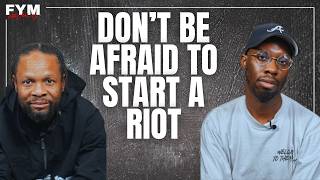
Yo and Worldwide Ty mark 34 years since the Rodney King beating and trace Black activism from the 1960s to Black Lives Matter. They examine how wealth among Black professionals affects community engagement, debate funding strategies for movements, and share cautionary tales about bridge-loan scams and financial due diligence.
Chapters
And we're back with another episode of the FIM Show with Ty and Yo. That's my man Ty, looking like he outside in Miami, you know what I mean? Let me hold a boat or something.
I hear your Jeezy playing in the background. That is not me, that is a boat that's driving by, and they typically play ignorant rap music or EDM music. There's no R&B. I rarely hear R&B.
You don't buy a boat to play R&B, Ty.
I guess not.
Buy a boat to feel like Jeezy. Motivation. Thug motivation is a boat. Nah, man, you got a boat, you want to play some Jeezy.
Yeah, I guess.
Oh man, how you feeling, Ty?
I'm feeling good, man. You know, it's, it's, uh, we're in the second quarter of the year.
Yes, sir, man.
I, I haven't had to travel all really pretty much all month. You know, we had a lot of growth first quarter, and now we know it's April 29th, man. You want to know what's significant about April 29th?
Tell me, Ty.
I was doing this research just to figure out like just topics that we could talk about, but they acquitted the police that beat up Rodney King on April 29th, 1992, 34 years ago.
And it got me the anniversary.
Wow, this is the anniversary today. And it got me thinking, it's like, hmm, 34 years later What are we willing to fight for?
Oh, what are we willing to fight for? That is a good question, Ty. Now I'm gonna assume you don't really remember those rights because you, you learn about it.
I was 8 years old. You learned about it over time, but like, maybe my mom, you know, remembered it, you know what I'm saying? It ain't like social media around, so like you know, right? The general news probably captured it, but it wasn't like as heightened as if something like that was to happen now with everybody has phones, you know what I'm saying?
Yeah, it'd be everywhere. But it was just even— but I do feel like that, that was a major event where the news coverage around it was pretty massive. Yeah, around it was pretty crazy.
Yeah, yeah, yeah, 1000%. Every news, every news broadcaster, every radio talk show, everybody talked about it. So it was amplified in a real, real big way. Even once you learn about it after the fact and you start doing research, you see how many news clippings from different news broadcasters that you're able to like capture, you know what I'm saying?
Mm-hmm. I mean, how does it— how does it make you feel today though, looking back on it? Do you think we've grown out of the need to, to protest in that way, or do you feel like we're not as um, I don't know, like, prepared? Because I feel like it happened so fast. When I think about the Watts riots, I think about how instantaneous it happened as a response. It was like no, no break in between the, the beating of Rodney King and the way that the people, the culture responded.
Yeah, so I might get counseled by what I'm about to say on this one though, but all right, Ty. Black people making too much money now. Black people making too much money to care about the same things that Black people cared about in 1992 or 1990 or 1981 or 1979. Like, they, they don't, they don't care the same way, you know what I'm saying? Why would I, why would I care about you know, what's going on in my local neighborhood when, you know, I'm making, I'm making $300,000 a year. I guarantee you the medium salary of the, of the Black people that was marching in the '60s and the '70s wasn't what the medium salary was in some of the Black households, you know what I'm saying, today. Of today. It's just not really interesting. And this— and the truth of the matter is we, we got— we might not think we have a lot of resources. We could— the reason why it looks so— the disparity looks so kind of crazy at times is because we got a lot of resources and then we separated from the community. But in the '60s, the '50s and '60s, they kept so close that it felt like they had more resources than they did. You know, it was bartering labor, they was teaching each other how to read. We get a lot of resources and then we, we disperse. And some of it is valid because, you know, some of these young men will try to take you out, you know what I'm saying, or try to take from you or steal from you, and it does threaten your livelihood. But 34 years later our progression in society of the United States of America through arts, through entrepreneurship, through exposure to education, through inventions, through social media, through dot-com boom. Yeah, we, we are disconnected from fighting for anything.
Um, I won't say fighting for anything because this is— we're still in the era of the Black Lives Matter movement. Which was huge in terms of like being able to gather community online, able to show up, protest, and really fight for what you believe in as a community, communally, in a way that I feel like we weren't able to kind of gather in the same way. Like you had to be amongst each other, like you had to have that connection personally. Now you can build that connection externally and then bring it in internally. But I do want to ask you, Ty, do you think money creates isolation from your people?
Um, it can depending on the person. Let's go back to Black Lives Matter. Okay, let's do it. Do we have that research on the woman that started Black Lives Matter? That— I want to make sure that I'm accurate. There was somebody that started Black Lives Matter that was, that, that was messing up the money.
No, I definitely did hear that there was some, uh, contingencies on the paper and like how money was being, um, expounded through the movement. Now I don't— I couldn't tell you off the top of my head what that looked like, like what, what happened there. Hold on, let's see. Vanessa, Vanessa, you got, you gotta, uh, you got a note on that for us?
It was Patrice What's the name? Um, Patrice Corso. Or Patrice, is it? Is it Patrice? P-A-T-R-I-C-E. Patrice.
Patrice Colors.
Colors. Yeah, so she was a co-founder. Faced scrutiny over personal real estate purchases separate from the organization, questioned about financial transparency. She denied wrongdoing but later stepped down from the leadership. So like, allegedly, I don't know what she did with the money, right? Okay, but you want to know— but you want to know what I do know?
What you know, Ty?
There wasn't no mismanagement of funds for the Million Man March. There was no mismanagement of funds for the— for when they was marching to Selma and they was marching down to Alabama. The leaders that was in that, they weren't mismanaging the funds. Yeah, they probably still had shortcomings. But we bring up Black Lives Matter and then it gets— the, the mission gets distracted by somebody.
I see what you mean though.
I see what you mean though, you know what I'm saying? Somebody's like— somebody being conscious, let's just say that that was your money, it didn't come from it. How do you go about making sure that it was so separate from your personal, your personal dealings, you know what I'm saying?
Right, right, right, right, right. I mean, because obviously you don't start that company, you don't start that movement with $30 million. No, right? You don't start with that much paper. But then when that money does come, you're supposed to spend it on the community, you're supposed to spend it on the movement. That is not your personal earnings, right? Um, so that does create— because I mean, as soon as I said it, that's the first thing that came to mind for you.
Yeah, guess what? You knew who you was following. Back in the day. Think about it.
Yeah, to a degree, to a degree. Yes, sir.
It wasn't to no degree because it wasn't no internet. The person that was leading it in the '50s and the '60s, they done did work around the community. You, you, you know what's—
what it is.
Like, like Rosa Parks was on the bus. Like, it wasn't— you couldn't fabricate that, you see what I'm saying? Like, nah, nah, but You don't know what the background of the person that started Black Lives Matter, how many years did they put into this type of, you know, movement, this type of work. Was there 20 years in and then just so happened this was their lunching part? We don't know what that— that's what social media does. Social media crowns people with power and leverage who hasn't really been tested with the things that is going to happen for them if they are a part of a successful movement, you know what I'm saying?
My only pushback on that, Ty, is that having the platform and being amongst your community is not quite the same, right? You could be doing things in your neighborhood, you could be doing things in your community on a smaller scale, right, that I wouldn't know about if you're doing it in Miami. But once you have a platform online, we can all pay attention to what you're doing online on the internet. So I do see what you're saying, it's just that I think it depends on—
raise money back then. You couldn't raise money.
Well, we didn't have no Cash App, we had no GoFundMe, we had no Kickstarter. So you get no way you could raise money to that degree. So I mean, I, I do, I do think it's interesting what you're saying about we too rich in the country right now to utilize revolutionary tactics if it came down to it, because you spent all this time trying to get up right trying to make money, trying to do better for your family, would you throw it all away if it meant bettering your people?
And that's, that's a very valid question, you know what I'm saying? The truth of the matter is, is about the, the thought process of understanding that, you know what, I think that when we are building out certain things, when we're moving around with certain things in our thoughts and our actions, it really do come down to, hey, are we really dedicated to the cause? And, and, and, and it has been the norm is it's okay as long as you take care of your family. Yeah.
Uh, yeah, shoot. I— Ty, you remember back in the day you didn't want to be a sellout? Like, that was a bad thing. If you were considered a sellout, that was something that was like a stain on your name. Yeah, that nigga sold out. Now it's like, hey, he got that bag. It don't matter what he did, he got that bag. And as long as you got the bag, whatever you had to do to get the bag, someone can argue that it was acceptable. Doesn't matter how egregious, doesn't matter how unlawful, doesn't matter if you did dirt, dirt, dirt, dirt, dirt, dirt. It's like, dang, but that bag— why do you think that mindset changed? Why do you think we went from kind of finding selling out dishonorable to as long as you got that bag, someone will defend your actions.
I think that with the internet is a part of it. I don't think that the internet, like, accountability was a thing. Like, internet is accountability. In the streets, if you're the leader in the streets, somebody's going to challenge you. Somebody's going to challenge you like, oh, you, you say you did this, but Show me. But on the internet, it ain't, it ain't really the same case. So you can build up a huge following off of just fraudulent, like, scamming. People don't even really know because you can scam so many people online. You can only scam so many people in the hood before they're like, yo, he, he, he can't move around here, she can't move around here. And it, and it stabilizes you and then you know who the scammers are. Yeah, the problem now that you don't know who the scammers are.
Oh man, they, they get real good in 2026 in terms of just being like, I don't gotta just scam in Atlanta, I can scam everywhere. I can scam in Antarctica, I can scam in New Zealand. I can, I can, I can convince people of things in ways that they couldn't do it before. Because I can do it through social media. People can do, you know what I'm saying? Like, it's kind of interesting because at this point it's like, how do you build trust in your community to be a leader and then keep that trust when you do have profit come in and people are starting to support you? Like, you got to be almost like super diligent and super about your community today more than ever because you can get that platform way faster. You can get that money way faster, but also the downfall can go way quicker if you're not honest about it.
True story, there's so many scammers, bro. And it was, uh, one of my business partners reached out to me about somebody that wanted a bridge. This happened like 3 times over the last 2 months. Somebody wanted a bridge loan because they got a, they got a deal going through, right? And I would be like, I don't know about this one, man. This feels like scam, right? And each and every one of the times it was a scam. Um, but the most recent time, one of the other individuals that was asked about, you know, getting a bridge loan or something like that, they went and did a UCC search on the person and found multiple lawsuits pending. Oh, you know what I'm saying? Like, but you wouldn't think about it because it's like people just look at what's in front of them, they don't look at what's behind them, you know what I'm saying? That's why I'm always like, yeah man, check them records, check them Google, ask around about it, you know what I'm saying? If a person— nobody is flawless, right? There's gonna be somebody along your journey that you may you didn't, you know, that you offended, or you didn't pay them what they wanted to be paid, or you was late paying them, whatever the case might be. Nobody is a perfect operator within business and life, but there are some tremendous, tremendous scammers, and I think it devalues our power to fight for rights, to fight for certain things because you got them in politicians that scammers, you got these leaders of these organizations that's scamming because they're all trying to live a life that they really truly didn't work hard for, you know what I'm saying? Like they using the causes. Now listen, if I started an organization and the, the, the, the community wanted to donate $30 million, bro, first of all I'm bringing in an outside— I'm bringing in outside, um, outside, uh, uh, uh, accounting services that I'm gonna vet out to make sure that they ain't no scammers, right? And then I'm gonna document every single thing. I'm gonna create checks and balances so that I won't get tempted. We still humans, you know what I'm saying? Yeah, I'm gonna document those things. But a lot of the time there is no checks and balances with these things. People are really trying to solve problems. Like, like, for instance, uh, they talked about, uh, Elon, Elon Musk, how he can solve hunger with like 0.5% of his money, whatever his net worth was, right? And he responded like, give me a, a executed, the well-thought-out plan, right, on how you're gonna do this step by step, and I'll— I'll send you the money on Bitcoin today. I don't even think the person— I don't even think they responded, you know what I'm saying? Like, dang, yeah, because it's like, it's so many scammers, nobody's really gonna take the time. Like, I will say that if I was in the headspace and I was like, you know what, I would have solved world hunger. How much money do I need to solve world hunger? I'm not gonna do it just to make money. I'm gonna actually try to solve the problem. Yeah, let's put together operations, or at least solve the problem for 10 years, you know what I'm saying? Figure out what the problem is, why it keeps reoccurring. But that's just me, because I'm like— I like to think that I'm honest in my approach on the things I want to do, but I'm not. Yeah, I just— I'm not in the headspace to try to solve world hunger. But if a billionaire came to me and said, hey, I saw this show, I saw the podcast, we're trying to figure out how to solve world hunger, first thing I'm gonna do is that I'm gonna hire the, the most high-level security and, and secret arms people to move around with me. Because it's a, it's a reason why they want the hunger to stay.
Yeah, yeah, yeah.
Your first thing is concerned, like, oh Yeah, I'm gonna say these countries, I need, I need to know that this is a level of protection, and I need to know which governments I need to pay off so that we can actually go and do this work.
But see, see, Ty, you thinking about this logically though, even though this sounds impossible, right? In the world, hunger sounds like some impossible shit because it hasn't happened yet, right? But let's say you start thinking about it rationally, you will still have to commit to the rationale when the money comes in. Right? You can't let the money come in, all of a sudden you start getting irrational. Oh, you know, I can go get that Porsche. There ain't nobody, nobody, ain't nobody gonna really think about it, right? Like, we in the world hunger, they're not gonna be mad if I give me a little Porsche, right?
They're trying to get that new Porsche too, you know what I'm saying?
That Porsche 2027. So the thing is, I, I think that is the problem though, is that you can have revolutionary a revolutionary mindset and mentality. But it's kind of easy to do that when you broke. When you ain't got all the money in the world, it's kind of easy to think about how you can fix problems because you haven't been able to solve it yet, right? So you can think about it, you can imagine how you would do it. And then let's say the problem solver comes along and gives you the money. Now it's like, who are you as a person? Are you going to commit to what you was going to do?
Was you doing that personal work? Now you don't fumble up on this bag. Have you been doing that personal work? Dang, because it's easy to vet somebody out when one or two people give you $30 million. It's hard to vet somebody out when you raise $30 million from 50 million— from, from 50,000 people donating. Yeah, you know what I'm saying? You can't—
yeah, if you got that many people donating, they believe in somebody. They believe in somebody.
They believe in the cause. Yeah, I believe in the cause. There's somebody ain't even there no more. Black Lives Matter was a cause that people believed in. They seen the paintings and the graffiti on the floors and stuff in the streets. They believed in a call, but it was nobody. It didn't, it didn't form into a coalition that would hold these corporations accountable. That everybody said, oh, we're gonna do this fund, that fund. Man, a lot of that money ain't get deployed into the Black community.
Yeah, you remember the Black squares? The Black squares during, uh, COVID? Yeah, it was like, what, what, what happened to that type of, we care about what's going on in the Black community, we care about how police brutality is harming others, we care enough to stay consistent about providing assistance versus the performance of providing assistance, because that is a part of it too, right? You can perform like you care, right? You can get all of the benefits of looking like you care, but like the consistency and being committed, that's a whole nother— it's like a job. You got to be committed at a level that's 40 hours plus. And like, bro, we all, we all just human beings at the end of the day. So you do have your family, you still have your wants, your needs, but like once you commit yourself to a cause you gotta be about the cause. So I see what you're saying, man, because like, you know, you start talking about Rosa Parks, start talking about Malcolm X, Martin Luther King, people that were really down for the cause, spent their life fighting for the cause.
They—
I mean, dang, there's a James Baldwin quote, and I'm gonna butcher it, but I remember reading his book of interviews, and he was just like, I didn't do all this to get a new Cadillac, right? Like, I didn't do all this getting a Cadillac. But in 2026, niggas want a caddy, you know what I'm saying?
Like, listen, man, like, I remember, I remember when we did our first interview and I was just telling people what was going on in our experiences with the labels. And like, I was just talking, man. I'm like, hey man, this is what I— this is what's going on, man. I don't really rock with it, you know what I'm saying? And then for me to turn around the next week and I'm with the major label, like, yeah baby. It's like, what changed in 3 months? What changed in 3 weeks?
If you would have did that, first off, that interview would have died. That whole thing would have fell apart immediately because people would be like, he's a hypocrite, he done sold us this idea about how to be independent, now he popping bottles in the major label office.
Well, now today I can articulate what would have probably happened. Today I can say there's some artists that want to be independent and we have the infrastructure for that. Then there's some artists that want to be with a major label and we have advice for that. You know what I'm saying? We have advice for that. We have, you know, support for that. I wouldn't have been able to articulate that in 2017. I would've looked crazy because I didn't have the experience or the language to even be able to articulate it so that people didn't look at me crazy.
But Ty, you were so committed though. I think your commitment to independence kind of allows you to get the experience you need to now articulate today. If you wasn't committed, you would have never learned what you learned to be able to talk about it today. Oh, you would have just like threw it away, but like, oh shit, I saw that over there. I think commitment is a really interesting concept in this conversation because you— whatever calls you about, you have to be committed long enough. You can always adjust your mindset. You can always get more information.
You got to understand, I'm just now getting to the place where I'm open to taking other people's money to do business. And I'm not saying it's right or wrong, I'm just saying that that's how boutique of a mindset that I'm having. I'm like, man, if I got the money, I'm gonna put my money up. I'm gonna put my money up. But then I started to realize that you just have more power, power for your purchase, you know, with financial partners. You know, I've always had partners, but to take the money, you know, I, I've heard people like, yeah, I raised $30 million, $40 million, $100 million. And I'm like, man, I could not imagine myself taking that kind of money from, from people, bro. Like that, I would have to really know exactly what, what I'm doing. Like, we gotta have an asset that's already— that's already working. Yeah, I wouldn't— I would be like, man, what we finna do with $100,000 of other people money?
But I mean, man, I remember, uh, I don't know if you remember Dom Kennedy. When Dom Kennedy was coming out, his whole movement was like OPM, other people's money. Wow. And I didn't really understand it. Like, I always thought you supposed to get other people's money. You didn't want to spend your money, you supposed to spend other people's money. But Ty, since knowing you, I've always kind of been a little confused. It's like, well, usually you gotta pay that money back 9 times out of 10, right? If you take an advance, you gotta pay that money back. Is it better to take the advance, or is it better to bring your own money to the table and cut you a better situation? Because I feel like advances end up getting real complicated because this is like that— having— depending on how large the advance is too, it's like if you ain't never raised $250,000 and you get a $250,000 advance. It sounds great, but yo, that advance could mess up your whole career because it can get you stuck in the red. You never pay that advance back, you never able to get out that hole, and your whole career trajectory can go down because you took more money than you needed or because you knew what to do with it.
It's just— I look at everything now as a strategy, right?
Okay.
One thing that I did used to tell people, even when early stages on the, on the, on the developing of a business. I'm like, hey man, my lifestyle, what I was willing to compromise and like take less than, I don't know if you in that same position. So I can't tell you to do what we do or do what we did, because if you got 3 kids and somebody come up to you and you like, yo, I want to sign your artist for a million and you gonna get 10, 20% off that million, ah, I'm not in a position to tell you that you shouldn't do that. I'm not gonna shame you or say that you stupid or you dumb. I'm like, no, that's your current situation. And if you got a strategy on how you can take that $100,000, $200,000 and really position yourself in a better— in a better— in a better light, man, listen, man, sometimes it's better to take the money at the time that you get it if you have a strategy. That's where it all boils down to. Like, yeah, how many people taking money without strategies is really what kind of what it boils down to. Yeah, there are some negotiation aspects of it, but negotiation is a form of a strategy. You negotiate properly, you negotiate long-term, you negotiate short-term. That's a strategy that you have. But the problem is we do a lot of stuff without having strategy.
Dang, that's a good point. Um, and do you also think just in general, like, when you're having a cause, that you need to have a strategy just in case that cause actually gets funded? And you actually can't do the thing that you said you're gonna do. Sometimes I think we have dreams, but we don't really have a strategy if that dream come true because it seems so far off, right?
You know what my strategy always is when it comes to other people's money? I'm like, whoa, whoa, whoa, whoa, whoa, I'm gonna do a case study with my own money first and I'll come back to you. In my case, that it might be a $10,000 case study, $100,000 case study, but I'm gonna go do a case study first because What I don't want to do is end up with too much money and I don't know what to do with it because I don't even have no real way of going out and, you know, putting it back. And then a lot of people don't know how to give people money back. See, I done made a science. I done created a science. I will give you your money back. I don't really play them kind of games. I wire back.
Yeah, but do you feel like a case study makes you comfortable though? You're like, okay, now I can comfortably kind of see what the marketplace looks like. I can see how this could work out.
It don't make me 100% comfortable, but it gives me confidence to know that I have a proof of concept, right? Like, we're building this fitness studio right now under our family office, and I'm, and I'm doing it at 100% ourselves. Like, we're not taking no outside money. Right. And, but this first location is gonna be a very, very, it's gonna be a case study. Mm-hmm. So if, if any, if once that is successful, I can say this is what this look like. Oh, as a one-off.
Yeah.
Maybe, maybe after we get to the fourth one, we should probably raise $15 million to go and, and, and launch 10 more across the country, maybe. But I'm gonna do— maybe I'm gonna do these mini case studies until further notice, you know what I'm saying?
Ty, I guess you've always been strategic though when it comes to the businesses you partnered with.
Not always. That was, that was another thing that was picked up over time, like, you know.
Um, but, but what's, what's— I guess of all the things you've learned when you're building your strategies, what is like a key part of your formula that you always lean on when it's time to be strategic?
Build a plan that you can execute yourself first.
Mm-hmm.
Because if you can execute the plan yourself, it's easier to get help. Because people tend, not all the time, but people tend to want to help the people that don't need their help.
Yeah. Yeah.
So if you got a simple strategy that you can execute yourself, run with that strategy and run with that until somebody come and say, you know what, I like what you're doing. Maybe if you add this, you add that, maybe you— maybe we can get some, some things cooking. But if that person go left on you, if they delay, you got your strategy that you know how to execute. You have the skill set, the confidence, the talent to execute that scratch.
Dang, that's good advice. That's good advice. That's good advice. Um, I mean, yeah, Ty, you kind of, you kind of right on the money, man. Do you think that if people were more strategic, then we would be able to kind of stay close-knit as a community?
Um, I don't know if strategic means that we will be more close-knit as a community. I think that, I think that it would be a good, it would be a good first step because if the strategy is, hey, let's pull together our resources, you know, not let the one person that got the most resources, you know do whatever they want to do. It has to be a community effort, you know, for them to like bow to the community, you know, and really having a sense of like serve— like serving, you know, like Christ serving the community, and the community serves you. And nobody is better than or less than. Everybody is equal. No matter how much money you got, no matter how pretty you are, no matter how fly you are, but we come together as a community, and that can be a strategy. But, uh, I think, I think that will be a first step to kind of keep everybody together if that was the overall thought process and strategy.
You know, it's interesting, right now I'm reading Exodus in the Bible, and, uh, I think it's— hearing you talk reminds me how, like, so you got Moses and his brother, and God is speaking to them, and they're doing what God says to help the enslaved, uh, and I think that, that part of it, the Israelites, is like really interesting that I'm relying on Moses to be honest with us about what God's saying to him so that way it can help the whole. But like, if I get mad at God talking to Moses and not talking to me, then that don't help the whole. It's like, you know, sometimes it is one person that's getting the message and they're, they're going to be the ones to help everybody get out of, you know, bondage. They're going to be the one to help us get out the wilderness. But, you know, you got to trust that Moses is upright, you know what I'm saying? He's got to be a righteous man too, or, you know, you don't want him to take his blessing and then take advantage of us. That won't help us neither. So it's almost like you got to kind of know, um, you gotta trust someone that you know who's gonna do what's best for the community, and then from there just hope that they stay upright.
I absolutely agree. And that is just the— you don't, you don't, you don't know trust until you have time.
Oh, hold on now. That's a bar. You don't know trust unless you have time. Dang, Ty, you know what's crazy? Most people feel like they don't got a lot of time, so they don't really build a lot of trust, you know? You know, I mean, I feel like the way this year's flying by, it just feels like, dang, time is just flying.
Um, time always fly.
I don't know, different now.
You can't buy it.
Um, nah, you can't buy it. You surely cannot buy it.
It's fleeting. It's forever fleeting because you can't control it. You know, everything feels like it goes by fast if you can't control it.
That's what happens.
People don't know how to manage money. They don't know how to control it. So that money go bye-bye fast. But when you learn how to really manage— we learn how to manage time. You still can't control it, but you can manage it. Time slow down.
Yeah. So you don't feel like time been flying?
I do feel like time fly at moments, but I feel like I have a certain management of the time that it, it feels like it flies by after the fact, not when it's happening. Like, I've been in slow motion for 2 weeks, but when I look up and it's October, I'm like, man, it feel like the year went by fast. But in the moment, I'm like slow motion with it.
Um, all right, I'm gonna make one more point. There was a point in time I think we were having, you know, the FIM conversations, and I was like, Ty has leadership skills, right? Real leadership skills. That if Ty wanted to be the leader of a movement, he could. Now, would you actually want to do that, Ty? Would you want to lead a movement and kind of be trusted to push a certain agenda forward for the betterment of your people?
If the Lord put it on my heart, I won't just volunteer.
I feel that. I feel that.
Put on my heart by the Lord, I don't mind signing up for the cause, you know what I'm saying?
Yeah, I think that's a great answer. That's a great answer. Well, I'll be looking forward to see if the Lord does his, you know, if he put, if he put it on your heart, what that would look like. I, I do think you are very capable of such a position in the world, so, you know, I'll just wait and see.
Me too.
All right, y'all, well, any, any final thoughts, Ty, on today's episode of FIM?
Don't be afraid to start a riot for the things that you believe in.
Don't be afraid to start a riot. That's the name of my next album that I'm working on after this, after this podcast. I'm gonna start working on the album now. Um, that's Ty. I'm Yo. This is the FYM Show. Please leave us a comment about how your year is going, how you feel about the second quarter, and how you feel about the episode, you know. And you know, if you're gonna start a riot, let us know. Uh, send us some videos. We do got camera phones now. They didn't have them back then. You got a cause and you riding, send us a video. All right, peace.
Peace.







