Her Reactive Dog Was One Mistake Away From Being Put Down (Real Life Case Study)
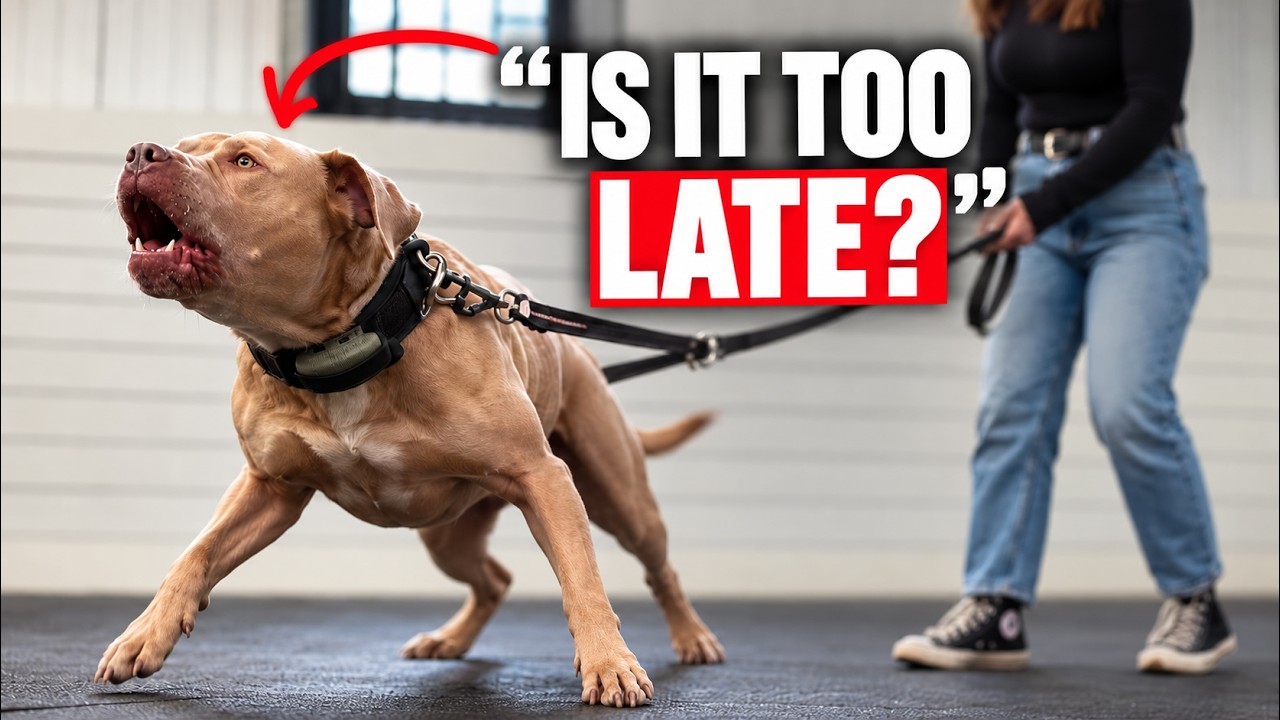
The video follows a five‑day intensive boot‑camp designed to rescue Juno, a nearly two‑year‑old reactive dog, from a trajectory that could have led to euthanasia. Owner Katie describes Juno’s severe fear‑based aggression toward people—lunging, snapping, and even grabbing a passerby’s trouser leg—making walks stressful and limiting family outings. Trainers (Speaker A, Mark, Harrison, Sam, and others) implement a structured program that builds a rock‑solid recall, establishes clear positive and punishment markers, introduces controlled e‑collar use, and leverages play‑based resocialisation (play triangles) to change Juno’s emotional response to humans. Throughout the week, Juno progresses from on‑lead reactivity to off‑lead freedom, calmly sitting in a café, and enjoying a pub outing. A one‑month follow‑up shows lasting change: Juno now accompanies Katie everywhere, interacts positively with strangers and other dogs, and even passes a vet’s assessment of anxiety. Katie reflects on the cost of the boot‑camp, emphasizing the value of in‑person, hands‑on training, community support, and the necessity of continued practice at home. The video serves as a case study illustrating the methodology, owner mindset, and long‑term outcomes of intensive dog behaviour boot‑camps.
Chapters
This is Juno. He's not even 2 years old, but his owner Katie was genuinely worried that if his behavior continued the way it was, that one day he would end up biting someone, and that would ultimately cost him his life. On lead, especially with Katie, when people are approaching or even trying to say hi to Katie, sometimes even just passing by her on the street can trigger lunging, snapping, biting at the air. And on one occasion, Juno actually grabbed the trouser leg of someone passing by. And the more Juno repeats these behaviors, the more in his mind they become effective, because the way he sees it, he made the big scary thing move away. The result: walks have become incredibly stressful. Katie's elderly parents can no longer walk Juno through fear that he's gonna pull them over one day, and finding dog-friendly walks to take Juno on have become near impossible. And at home, he's barking constantly No. At anyone or anything that moves past the house. So that's what this week's boot camp is going to be all about for Juno. First, we're going to start working on building a rock-solid recall and a clear communication system for him with Katie. Then gradually, we'll put those skills to the test. We'll start reintroducing people into the picture, first in a controlled environment and then outside in the real world. And by Friday, we're aiming for something that feels currently a long way away for Katie. We'll have Juno off lead, getting the freedom that he deserves, and then finally we'll end with the ultimate test. Katie will be settled in the pub with Juno by her feet while she enjoys a meal. Let's see what we can do with Juno in 5 days. Tell me a little bit about Juno, like, before you got here.
It came across like he was very protective. So if he was on lead and anyone was near, said hello, said good morning, it would be the barking, the lunging, the nip in the air trying to get to them. It was obviously stressful for him, stressful for me. I thought at some point this dog's gonna have to be put down because he's gonna bite someone, and obviously I didn't want that to happen. And he's still quite young, so I want a, I want a life for him.
Was there like a specific thing that happened that prompted you to book on the course?
He got hold of someone's trouser. Luckily they were baggy trousers, but if they weren't baggy trousers, he would have bit then. So that's when I was like, okay, I need to, I need to keep doing something more because I've done online courses, people have told me over a video call what to do, but it's, it's much different than doing it in practice and actually learning from someone who does it consistently. He used to be bad with dogs, so we did a dog walker so we could socialize him. So then he was fine with dogs, and the minute he became fine with dogs, it's like he's got a hate on something. So then instead of dogs, it became humans. He became a lot better off lead. It's the lead walks that are the most stressful. And at home, if someone barks and they're on our street, they can't be on our street. So, uh, he barks until they move, which they will because they're walking away, and then he'll stop barking. It's— it was a lot.
What are your, like, main goals for Juno this week?
I just want him to be stress-free. I don't want him to be triggered to the point where he feels like the only way he can get that out is by barking or lunging or feeling like he has to become aggressive to get that fear away from him. Yeah, um, and I want him to live a happy, free life. He's only 2— well, he turns 2 in October, so he's got so much ahead of him. I want him to enjoy that.
He's a cute boy, that boy.
I know, he's gorgeous, isn't he? I want him to trust me, I want me to be able to trust him, and I just want him to have a stress-free living.
What bit of this week are you most excited for?
Honestly, the brunch. I want to walk into a room full of people and know that he's not going to be triggered, or even if he is, he's going to know what to do to, to calm himself down and just sit in a cafe or somewhere normal and not feel stressed about him and he not be stressed.
Have you ever done that with him before?
Once. Once, and it was— we were outside and we were in like a barriered cafe, so we just brought the barrier around us and then he lied on the floor and then he was fine then, but only because he had a pup cup. But otherwise never. We've never really taken him out anywhere public and he's not really enjoyed the human side of life as well as just a dog. He's very, he's very boxed at the moment.
Yeah.
Which is unfair.
They do a great brunch at the Garden Centre.
I'm also excited about the food, I'll be honest. Yeah, to eat happily and knowing that Juno's happy and not stressed as well would be great.
Amazing. I'm excited for you guys.
I am so excited.
So this morning is Monday morning.
We are going to get the dogs out into here to do a short redirect exercise. So that's going to be predominantly working on Teaching dogs pressure and release on the new equipment that they'll be working on and strengthening their marker. So a lot of people came here with really good markers today. Juno didn't eat this morning, so we never want to test a marker if the dog's not taking the food that we're giving them. Hey guys, sorry to interrupt. I do have a little confession here. I have a really nasty habit of misgendering dogs. I don't do it on purpose. I want you to know that I am genuinely trying, but I'm not going to get it right every time. And you'll probably find that if you come to a boot camp. Feel free to pull me up on it. I'm always doing my best, but I'll be honest, a lot of the time I get it wrong. Also, if you want to learn what a marker is and how to charge it, click the link below and join our free online course, which will show you all of that. Right, enough from me. Back to dogs. So hopefully when we get Juno in here, she'll have marinated into the environment a little bit. We'll be able to give her food and she'll be able to work on her marker. And then after a session in here with me and Harrison, dogs will go outside into the field with Sam, and we're going to start working on getting them a rock-solid recall so we can get all the dogs that arrived here this morning off lead safely as quickly as we can.
Mark.
Yes.
There we go. Lovely. Good stuff. You got a bit excited there as well, Mark.
Yes. Oh, that was a big handful. There you go.
That's a big bit.
You can have that much.
Nice. So just walk over there and then just walk towards the stairs for me.
The stairs?
Yeah, just come towards the stairs, Mark.
Yes.
Nice, good work.
In the clips coming up, you're going to see us starting to build a rock-solid recall with Juno. The reason that we start working on recall straight away is because we want to get dogs off lead safely and reliably as quickly as we possibly can. We don't believe that off-lead freedom should be a nice Brucey bonus at the end of a training program. It should be one of the foundational pieces that you use For every single dog. The reason why it's going to be so important for Juno is because it's going to give her the ability to explore, make choice, use her body, use her nose in the way that she was meant to. Being at the end of a 6-foot-long line cannot compare to the freedom that a dog gets when they are truly off lead. The reason that we use an e-collar for this training process is because you can get a dog's recall to 99.9% amazing, but at some point in every dog's life, there will be something in the environment that is more rewarding for your dog to continue going towards versus coming back to you. And that's why we use e-collars, because it gives us that tactile communication with our dogs At distance where we are able to say, hey, no, you have to come back to me. At the end of the day, recall is safety. When you call your dog to come back, they must come back to you in order for you to be able to keep them safe. Coming up in the next clip is a talk all about stopping behaviors. So yesterday we also worked really hard to strengthen the dog's yes marker. So everyone has a way to tell their dog That was correct. Come to me, get paid. Now we're going to start working on charging a punishment marker so we're able to clearly communicate to all the dogs what it is that is not allowed anymore. There are hundreds of videos on the internet that you can find about how to teach your dog to do stuff. It is very rare, probably impossible, that you will ever find anything on the internet that will teach your dog to stop doing things. If they are, they're probably not effective. When we talk about stopping behavior, what we're really talking about is punishment. But people hate that word because they think punishment equals retribution. They think it's yeeting the dog on a slip collar or smacking them over the head or blasting them into next year on an e-collar. And it's not that. Punishment by definition is reducing the likelihood, intensity, or frequency of behavior. It's not about ruling over your dog's life with an iron fist and saying, do what I say or else, and creating fear. It's about having a conversation with your dog where they are able to understand that thing isn't worth it, I won't do it anymore, and giving them agency to know Those 5, 6 things in life are off the table. I'll just pick something else. So they can go and be free. They can live out in the world because you can trust them to make choice without constantly micromanaging them. I want them to know, can't do that, pick something else that I do like. The way we teach punishment is very specific, and it relies heavily on the social system. You guys were all really good today. And remember how we kept hammering home about the word always coming first? When we're doing this punishment routine, eventually you want to be able to rely solely on your word. All good, nice timing, nice waffle. Be mindful of hands and just slow it down. So he tries to be like, oh, Mum, I sorry, and rush into you, and then he's starting to dictate your pace because instead of using your lead to keep him back You're going like this. You go at the pace you're going, and you use your lead. Put this hand here. Okay, make up with him. All right, head straight back for me. Sure, uh, relax your lead a little bit. All right, hang out around there. Do one where you walk over there, and then as you come here, walk backwards past the thing so he's on this side. Yes. The thing is, like I said, when you have a relationship that good with your dog, they really care about disappointing you, and you can leverage that. Good boy, good boy. So this week with Juno, in conjunction to obviously giving Katie a nice clear communication system with Juno where she's able to give her feedback about when she got it right and when she got it wrong, we're really going to focus on play and resocialization. She's become incredibly fearful of people, and that's where her type of reactivity stems from. But she really enjoys play, so we can utilize that to help us introduce people back into Juno's life in a way that she finds fun. So we'll probably use something like a play triangle with a few of our trainers to get Juno moving with us, get us engaged with us in a way that she actually enjoys, and help her see that people aren't such a bad thing. Hopefully by the end of the week she'll have made multiple new friends and go home with a bit more confidence about people. Play is something that is super important, and it's quite often a piece of the puzzle that people really sleep on because they don't see the value in it. For Juno specifically, play is going to be detrimental. Now we've been able to effectively take behavior off of the table, we want to be able to start changing his emotion there, making him feel more positive about people being in his space. Juno's super into play. He feels really good about doing it. So we're going to use something called a play triangle where we start to introduce new or unfamiliar people into a game with Juno so that he can learn that, hey, this person being here or coming into that person's space eventually is not a bad thing. It's actually really fun. These people are great. Maybe I was actually wrong about those people. Maybe I didn't need to keep them away. Maybe they're not that big scary thing. Maybe they're just here to have a good time with me.
See, he's just like zoned in on the toy now. Like, he's enjoying playing with his toy. He's having fun. And like, this is the thing now, he's having fun with Sam. Do you know what I mean? Like, oh, we can all play. This is all fun. Yeah, exactly. Sounds friendly. Sounds fun. Hello, yo. Hello. Come on in. Should we have a break? With like new people as well, it's good to let him have some like early wins with new people. Hello!
Yeah, I reckon you probably want to get bigger toys as well. Is it?
Oh, almost lost it there, didn't he? Almost lost it. Hey, front, front, front! That's a happy boy. That's a happy tail. Yeah, like the early wins just brings in like fun for him. Like, oh yeah, I won it. You know, like if you've got someone who's constantly just taking the toy off him, he's going to be like, yeah, kind of, you're ruining the game a little bit, you know. See how he chose to go to Sam there though? Like, Sam gave him the opportunity to like go back to you or move away.
So see how he's getting a bit bored now? I would give you an end of play cue. Enough? Because now he's like opting to like do something else.
So it's not the main thing that's on his mind?
You want to end it when he's like— probably like a minute ago when he was like proper tugging. Um, hey, you're fun, buddy. It's good though.
The next clips you're gonna see are Juno calmly settled in a pub and also going into a tight space, sitting down and having brunch with Katie in a cafe. There's a number of things that we did here to be able to get Juno to this point where he was able to be successful. Number one, and probably the most important, is that we have a clear communication system with Juno now. Katie is able to tell him in a way he can understand and learn from what is correct and what is incorrect. We've also worked on making sure that Juno's needs are being properly met. We've been able to get him off lead safely, and we've also been able to build play with him, so he's getting that fulfillment to drain the tank of those genetic needs that he has to have a bit of conflict and that little bit of a tussle and a fight. We've also worked really hard with Juno in terms of resocialization with people, so he's more comfortable with people coming into his space and starting to understand that people being around actually isn't such a bad thing. And that's what you're going to see in the clips that come up next. We'll start by any interaction from the dog that I'm doing it with, or the dog that Harrison's doing it with, we throw food Behind them. So they looked at me, it was good, but they got to have space, go behind them, collect the food. As they get quite good at that and they come closer, they could take food from my hand, and then you would, as the owner, would use your positive marker to draw the dog back to you. Take food from you. And then maybe we do a couple more behind, and then I take some from hand. The thing where people go wrong is You have a dog that is food motivated, bit people spicy. You go, oh, I'll just give you some chicken or some cheese to give to them, and when they come over, come over and take it. They don't yet know I can just move away. When they get there, they're like, yeah, I'll go over because I want the pâté. But then once they're there, the food's gone out of my hand. What's left? Just my hand. Now they have conflict and they're like, ah, fuck, I actually don't want to be here. And then they use aggression. So we want to pay, throw, pay, throw, or pay and ping pong back to mum. Always have them on a lead so that you can stop them if you see them getting a bit frosty. You can say, good boy, yes, come to me and get paid. And then we go again. And if the dog then chooses, I don't want to interact with that person anymore, Fine, don't have to. Juno's like, you got the food? So this is where I would use high value with people. I would give your person the high value food and you just their regular food, so they start to see more value in the new person, also that they can move away. Right, when you're ready, you can tell him your release cue. Okay. So he didn't have to come close. Just showing interest in me is enough. A bit closer. Too close.
It's because I've told him not to eat stuff off the floor before.
Oh, okay. So if I say get it, he would get it. Okay, get it. He's too good, this boy. Get it. So he comes into my space and out of my space. He sees me as a good thing but then starts to be like, oh, I can pay attention and then move away. Get it. But I'm not gonna, just because he came a little bit closer, go Like that and reach into his space. Get it. I would wait for him to come closer to me. Nice. Get it. Good boy. And payment from Mum. Get it. And then can start to like leave it a little bit longer that he can be in my space and be there and not be like, this is weird. But I also give him the choice to not come to me. Not be like, what's this, what's this, what's this? Like, he's like, still, I don't want to approach you. Fine, get it. Harrison, you swap with me and do some with Juno, and I'm gonna move around to Frank. What we've been up to today?
Today we've done some off-lead walks, and Juno's actually decided to go off and do his own thing, which is nice because he was a bit hesitant after a bit of e-collar training. But now he's confident walking off, and I know that I can call him back if I need to.
And I've got the super mega zooms.
Yeah, we've got the mega zooms.
And he just got rushed by an off-lead dog.
And, uh, he approached you on lead and took food from you, which is crazy cuz normally he'd bark and go crazy and try to murder you. And he's approached Kayleigh off lead, the gal behind the camera. Um, so yeah, it's been a fantastic day. This morning he's happy, he's took it all in, slept on it, and now he's loving life.
He's rested on it, eh? What are you looking forward to next?
Taking him, just taking him out. I'm honestly, I'm so excited to walk him out of the front door and not be 2-hand on the lead ready to scream at him and vent rather than actually manage it correctly and, and do what you've taught us all.
Are Nanny and Grandad going to take him out when you get home?
Yes, but I need to train them.
Yeah,
they usually do the off-lead, um, so I think Granddad especially is super excited to learn how to do it and just watch him just be free and enjoy himself, but also know that we're the safe place that he can always come back to.
Yeah, he's done amazing this week. It's so mad to see like how far he's come.
Day one he was, you know, when Harrison approached him and he was— I thought, God, this is like, this is just not gonna work. Not because I didn't have faith in you guys, I just thought he was too far gone because I, you know, I would punish him in a way that would never last. So it just—I would just be managing it rather than actually changing it and getting rid of the behavior completely.
Yeah. And so to now remove it, yeah, not so bad actually. Yeah, and now he seems to have love and treats and joy
and zoomies,
and he's got all his joy back.
He has, and he's sniffing and loving life. Do
you know? You want to see? Say something to the camera.
Say thank you.
How do you feel about this week? Easy, good boy. You can't eat it. No.
Can you say thank you?
Good boy. Oh, there we go.
Everyone's friends. Are you about to go home?
I am, yeah.
You going to leave him here though?
No, I am actually taking a well-behaved dog home with Yeah,
good lad
that loves humans.
I know, he's a good boy. How did you find the week?
It's been a fantastic week. I was— I wasn't ever skeptical, I just— of your ability. I was skeptical of his ability to change and to get those behaviors out of him because he's, he's just been so hard to deal with that I just thought this is just what it's going to be like forever. At one point I thought, you know, he's He's just gonna bite someone and I'm just gonna have to have him put down, and I just thought that's what it was gonna be.
This guy.
I know, look at him. Because I always knew he was so loving towards me and to people he knew, like he was the softest little thing. Like he takes treats out of my mouth, like he's just so soft.
Yeah, I bet you do.
But yeah, it's been fantastic. I've thoroughly enjoyed it. Even just getting to know you guys and seeing the passion that you have for what you're doing is incredible. And it shows in everything you do with the dogs, so I genuinely cannot thank you enough.
Thanks for being here. What are you looking forward to doing with Juno the most when you get home?
Normal stuff. Holidays, cafes, going to the park.
Wait, don't cry!
Yeah, I'm so emotional. Yeah, just, um, going for a walk and being like knowing that I trust him and he trusts me and just being like happy with my dog. That's genuinely all, all I'm excited about.
Going and getting a
Yeah, go and get a Rioja at Stones Bar in Minard. Big up Stones, they might give me a discount code now.
If you had to pick a favourite bit of the week, what was your favourite bit?
Probably when you approached him on lead this morning and he came to you and then took food from you and then willingly came back to you, because on lead normally that would be his trigger point.
Yeah. He wouldn't want anyone to come, even come near him, let alone approach someone else. So to nicely
approach you and then take food from you and then still want to come back to you, that was probably— that was when I was like, ah shit, it's worked. So that was
really great. Good lad. All right, if you were talking to someone that was thinking about booking on a boot camp, but they were like apprehensive about it, or they thought maybe it's not going to work, maybe it's not for me, what would you tell them?
Just to trust the process. Because, you know, it's— on Monday and Tuesday, like you pre-warned us anyway, it did feel slow. I was kind of like, why are we just saying Y-E-S over and over and over again? But then it started to make sense when you put it into real-world situations. So I tell them to trust the process and to put their trust into you guys because it works. And I've got one happy dog.
Do you know?
Have you got any parting words?
Juno, thanks for this week. Well done, you're a good boy. Get out in the world, go be dog again. Thank you. You're welcome.
One of the most common questions we get when people are thinking about joining a boot camp is, do the results actually last? So we caught up with Katie and Juno 1 month after completing their boot camp to see what life looks like now, what they've been up to, and how they've been maintaining their results Hi,
how are you?
I'm good, how are you?
Yeah, good, thank you. Can you tell me what life has been like since you've left our boot camp with Juno?
It's almost too, too like different to put into words. Um, he comes everywhere with us now. Uh, there's not like a cafe or a restaurant, especially if they're dog friendly, that we just don't take him with us. Um, he comes, he's never in the home, like house alone anymore. He's always with us and going out on adventures with us. We take him down to the beach. He actually approaches people when he's off lead on the beach to say hello, like lick their hand and then just run back and expect a treat because he's been nice to another human being. Aww. Um, he plays with all the other dogs. It's, I don't know, like you can just see how much happier he is as well. And he knows that if he's being called back, it's almost like he knows that whatever we tell him to do, it's because we're trying to keep him safe at that moment in time. So his trust in us has changed like tenfold because it's almost like he's learned They're telling me to do that for a reason. It's just crazy different. He's like a different dog. I've had people around the house. My friend who he bit previously came over, um, and he just like greeted her, said hello, and then just went back doing his own thing, as if like he's just so— he's just chilled out more. He's still the excitable dog that he was, but he's just so much more chilled now, and I have so much more trust in him that we're doing more stuff than we ever did before, because I know that I can correct it if he does anything bad.
Wow, that's amazing. That's so nice that you can just take him wherever you want now as well, like you've not got to think about, oh, I've got to leave him at home, or if you want to go to a cafe or a pub or whatever, you haven't got to think about like, oh, I've got to leave him.
Pretty much every cafe we get a pup cup, so he's like, if we go somewhere, then I know I'm getting some whipped cream. So he loves it.
You mentioned about, um, I think in the group chat you said something about like the vets.
So I took him to the vet on Friday, and they, on his notes in the vets, it's basically said like anxious dog, sometimes muzzle dependent on his behaviour, like won't sit for anything, like won't come into the room. And he, we got there and I said like this way, and he just came straight into the the room with me. I took some treats in. I said, like, focus on me and look at me while she did the check. She put a steroid shot in him. She did, like, his heart rate and stuff. She did everything she was able to, and he was just looking at me waiting for that yes, um, to be fed. And she was— she— the vet literally said, like, I've never seen a transformation like it. How did you do it? And I said, I went to this boot camp for 5 days. She's like, there's no way that's done in 5 days. Like, he's a completely different dog. Like, I'm deleting all these previous notes because he's absolutely fine. And if he's with you, he's looking at you and he's trusting you. Like, I don't understand how this has happened. I was like, I don't know, but don't start asking me more questions because I will cry again. But yeah, it's, uh, I just said he's just completely changed, and she genuinely couldn't believe it. She was like, there's no way that's happened in 5 days. I was like, I learned everything I needed to learn in those 5 days, and I've carried it on since getting home. So it's, it's not really been 5 days, but it was in 5 days. It's been the months after, is also keeping up with everything that I was taught.
Tell me a little bit about his, his birthday party.
I planned, uh, I planned it anyway, but luckily I got into the boot camp before his actual party, um, and And we went to like an indoor soft play for dogs, and we had 3 dogs and like 5 different humans, um, and he just played. He had a lovely time. He was so happy to just be there. He opened a gift from one of the other humans and opened it from the person's hand. He greeted everyone that came in. He jumped up and gave him a lick and said hello.
Like, it's a big step for him as well, isn't it, with like multiple other people around him?
Yeah, and it was in like, I mean, it was a big room, but it was an enclosed room, and he had, he could run somewhere, but he was still in, you know, 4 walls. And he was just chilled about it. He was just playing in the little soft play and taking treats from the table that they'd set up and ate his birthday cake and shared the cake with other dogs. It honestly was just so freaking adorable. He loved it. We went to the pub afterward to meet up with some other people and he just laid under the table, let us all eat our food, just laid there with his little glittery bow tie on and, and had a nap after his little birthday party. And he, he can chill out a lot quicker. When I say down, it's because he needs to just chill out, or when I say easy, like he needs to calm it down, or enough has really worked. So the game that we used to, that we do when we play and say enough. Like, the minute I say enough, he just stops whatever it is he's doing and just checks in with me to be like, yeah, okay, I've stopped. But he just, I can't explain, he's like a different dog, but he's the same dog. It's like he's just as goofy and excited and has high energy like he did beforehand, but now it's like controllable and he knows that he can control it himself as well. So instead of getting overexcited and trying to bite or getting nervous and trying to bite, he just, he looks to me now for some sort of guidance instead of just reacting By himself, which is really, really nice.
Final question, seeing that the results have stuck with Juno, what would you say to somebody who was on the fence about booking onto boot camp in terms of, is it going to stick? How's it going to go from leaving on the Friday?
So the one thing I would say, and the one thing I was a bit skeptical about, was obviously the cost of it. Um, because you, you can do like a Teams meeting with a trainer for like £100 for like an hour, and obviously this cost is, is much higher than that. By the time you spent £1,500 on different Teams meetings and stuff or whatever, it None of it sticks because you don't get to learn it in person, you don't get to see it exampled on other dogs. I just think if you, if you're skeptical about money, just forget that because, you know, you have finance options as well, as Kelly mentioned previously. I just think once you've paid that, as long as you consistently carry on with everything you've learned, you're just not losing anything. It's an investment. Like, the dog is much happier and chilled out, and he can now enjoy his life for the rest of his life. Because I always say, like, and it makes me like proper emotional when I think about it, but they're just aww. small part of our lives, but we're a whole part of their lives. So we want to try and give them the best life possible. And I think, you know, the cost of doing the boot camp is allowing you to give your dog the best possible life. And as long as you listen to what you're taught and you don't think you're better than the trainers, or you think that you can go home and it'll just go back to normal because you've had 5 days away— like, the 5 days are incredible, but you have to carry it on when you get home. And I just think if you've got a dog where you're not 100% sure, or they're not enjoying their lives, or you're feeling down because you can't give them everything that you want, just bite the bullet and do it because it will genuinely just change, change the dog's life and your life. And if anyone is considering doing it, I just think if you want to see the long-term results, then just bite the bullet and do it because it pays off. But saying that, you have to be just as committed to it as you are for your dog to get better.
You went and saw Justine, didn't you?
We had 2 nights away and it was so nice. Justine stroked Juno, I fed Frank treats, Justine did the same for Juno. Like, we practiced everything that we were practicing at boot camp but on each other's dogs. Um, and it was, it was crazy. It was so great, and we had a lovely time, and the dogs are so happy, and Justine and I were obviously happy because we got some wine at the end of the day. Not only has it changed Juno's life, it's also allowed to meet some great people and some great friends with similar circumstances along the way. And one thing I was majorly skeptical about was, obviously with your dog, you think your dog is the worst dog, so you always think like, no one's going to understand. People are going to think I've abandoned this dog or not done, not done enough for this dog, or people are going to think this is my fault. But everyone's going through the same thing, so there's, there's no judgment, and it's like a, it's like a clean space to kind of vent out and learn and take everything in. And, and you know that no one's going like, that's a bad dog, Mum, or that's a bad dog, because everyone's just dealing with it at the same time, you know.
If you're watching this and you're seeing your own dog in some of the behaviours we've been talking about, then I want you to know that you're not alone, and you and your dog don't have to keep living like this. Living with a reactive dog can be exhausting. It can affect your routine, it affects your confidence, it can affect where you go, and most importantly, it can affect whether you even enjoy taking your dog out for a walk anymore. Maybe you're getting up at 5 in the morning. Maybe every walk feels like you're constantly on edge, just waiting for the next thing to happen. And over time, your work world gets smaller. You start avoiding places, avoiding certain situations, and planning your entire day around your dog's behavior. At our boot camps, we work with dogs and their owners to navigate those situations, overcome challenges, and start working towards a calmer life together. We run our 5-day boot camps at our centers in Sussex, Yorkshire, Perth, Australia, and We know that every dog is different, and we want to understand your individual situation before we tell you what might be possible. And that's why the first step is simply having a conversation with us. So if you want to find out if we can help you with your dog, you can book a free consultation call with our team. Just know that you don't have to spend the rest of your dog's life avoiding the world. You'll find the link to book your free consultation in the description below.
More from Jacob



She Thought Her Reactive Dog Was The Problem… Then THIS Changed Everything (Extreme Case Study)

She Couldn't Trust Her Reactive Dog Off-leash… Then This Happened (Labradoodle case study)

I Wish Someone Told Me THIS When I Had a Reactive German Shepherd (Extreme Case Study)
