16: Yuriy Timen, Ex-Growth Grammarly, Advisor Airtable, Canva etc.
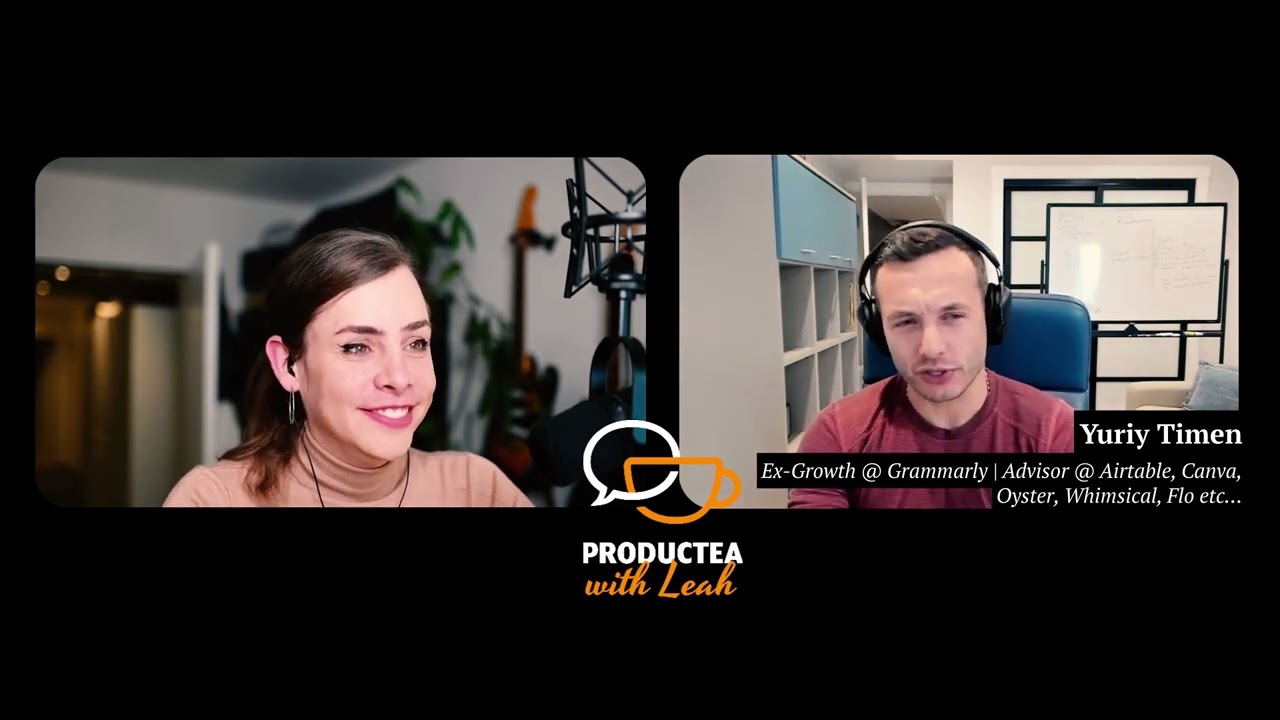
In this podcast episode, Lea interviews growth advisor Yuriy Timen, former growth leader at Grammarly and advisor to companies like Airtable and Canva. Yuriy explains his evolution from operator to "growth engine builder," emphasizing a holistic, product‑and‑marketing‑agnostic approach to scaling subscription businesses. He outlines how he helps early‑stage firms define clear funding milestones, prioritize the single metric that blocks the next round, and implement a portfolio‑style growth engine using the analogy of a watch’s gears. The conversation covers practical tactics such as establishing self‑serve (PLG) motions in traditionally sales‑led companies, the importance of data infrastructure, and the pitfalls of chasing reach without substance. Yuriy shares networking strategies that led to his Canva advisory role, discusses common misconceptions about his background (nationality, marketing‑only label, confidence), and reflects on imposter syndrome. The dialogue also touches on the current AI/ML hype, noting that true differentiation will come from execution rather than merely adding "AI" to a product. Finally, Yuriy highlights trends he’s betting on—generative AI and its potential to unlock massive TAM—and offers contact details for future engagements.
Chapters
Welcome to the Performance Zone with Yuriy and Lea, where the product tea is full of business and not a lot of tea leaf reading. The legend, the man, the first name that I actually cannot— I cannot even spell it. I can say it, but I cannot spell it. Yuriy, it is so nice to talk to you today. How are you doing?
Better now.
There you go. Introduce yourself to the fools that do not know you.
Oh gosh, okay. I guess the man, the man, the legend is here. I mean, I don't know how serious this introduction is supposed to be, but I dabble in growth with, you know, mostly subscription businesses. Spent a big portion of my career as an operator, helping Grammarly go from, kind of an unheard-of glorified spell checker to something quite a bit more. And then the last 2.5 years, coming up on 3 years, I've been kind of a growth nomad or a serial advisor, as I've been accused of in the past, but essentially, you know, partnering with companies that are a bit earlier stage than Grammarly. Helping them get their, you know, shit together, their growth stack together from team to strategy to data to vision. And yeah, it's been fun, very different from building, you know, but still exhilarating in other ways.
Yeah, that's amazing. Thank you for this introduction. I'm going to introduce you now back to the audience. I think there's a couple of interesting points that you might not have known. I don't know whether that's true, but Um, the first time I heard about you, uh, was on Lenny's podcast when you were talking about, um, yeah, also Grammarly. And Grammarly has a very special place in my heart. So I'm a dyslexic, and any tool that helps me to mask that I'm absolutely incompetent, uh, when it comes to writing stuff, reading it back, and being actually quality-oriented. Has been an absolute godsend for me. And I'm not just saying that. That's one of the things. And on the other side, I think you made a very interesting case when you were talking about Grammarly. Now, you know the LTV numbers. I always had my hypothesis on how high they actually were. So like the lifetime value per customer. But I think Grammarly is a very good example of a product that is exceptionally well positioned In a relatively B2C market because everybody's using this individually. There's not a lot of cross-collaboration happening or whatever, but I think it's an exceptional product. And I really liked how actionable and specific you were also in Lenny's podcast. And that's one of the key differences in why I'm talking now to you because I don't just invite all the Peters and all the Susannes in the world. No offense to Peter and Suzanne if you're—
Some Yuriys as well, right? Sprinkling some Yuriys in the mix.
No, no, no, no, no. Like, I think this is one of your talents that you were actually specific about the numbers, right? And I think this is something that I really appreciate. When people talk about the reality in this business, they rarely say the numbers. And I try to do it wherever I can, you know, skirting on the side of like, oh, maybe should not have said that. But, you know, that's what it is. The other thing about you is, is that when people go to LinkedIn, And they go over your CV. If you scroll through all the positions, you actually, uh, your browser is crashing because it's just like your memory's gonna run out because LinkedIn is bad and your CV's really long. So, um, yeah, you're listing a lot of companies there. So, so, so that's, uh, that's the other side of it. But I really appreciate you for this. And, um, I think this actionable advice is exactly what we need in the industry because we need to show how it is and not just how it's supposed to be or whatever.
No. No, I, yeah, I appreciate that. I pride myself on being specific and focusing on actionability. And, you know, as you know, I'm not, I don't write a lot about what I do. Most of what I do stays behind closed doors with the companies that I work with. It's just a function of how I choose to spend my time and what I find to be most energizing. But it's opportunities like these, which I don't do often, just like you don't invite every Peter and Susan to your podcast.
I'm so sorry for all the Peters.
Yeah, sorry, all the Peters and Susans out there, right? I also don't come on to speak to all the Leias in the world. I only do a handful of these. But for me, this is my opportunity to actually create more value, I guess, right? Because there are only so many companies that I can work with at any given point in time or even more broadly. So this is an opportunity to share the knowledge more broadly. And I find this to be much more natural and energizing than, for instance, running a Substack.
Okay.
Personally.
Is that because of the medium itself? Like, do you enjoy more like the fleeting nature of podcasts?
I think it's, first of all, it's enjoying the unpredictability. There is a little bit of that unpredictability in having a conversation, even though if we have like a rough agenda, a rough outline, right? There's an opportunity to create some unexpected magic, which, you know, does not happen, I think, in written form, unless you use ChatGPT to write your posts for you, then maybe you'll get some of that. unexpected magic in there. Um, and, and I get writer's block a lot, you know. Me alone, me alone with a blank page, um, is, is a, is a, is a pretty lonely experience.
Well, Yuriy, you know, we all had to get through this. I think, uh, for me, it's definitely had to deal with, um, with imposter syndrome, uh, also to some degree, because you're always thinking like, ah, this stuff is not complex enough, you know, and it's not valuable enough. And, and I think, um, one of the interesting effects that it had for me because I'm also on a lot of podcasts and I talk a lot about the same metrics. So for instance, let's say you try to explain to someone the difference between B2C and B2B customers, right? So like from an LTV standpoint, we always go with some like, everybody has their own kind of ranges, you know, like Lea's range is always like, okay, if you get between 0.1% and 1%, you're safe in the B2C segment. It's kind of good. Yeah, like it's kind of okay. B2B, you're going to go up to the 5%. If you keep repeating this story—
Sorry, are you referring to conversion rate from like free to paid or what is this?
Yeah, yeah, yeah, exactly. I mean, and also depending on how you define whether a customer has been activated or not. But the point is you just retell these stories dozens of times until they sound so basic to you, but everybody hears them for the first time that listens that you think like, I cannot write about this. This is too kind of basic. I will be judged by my peers. What will Yuriy think? What will Elena think? What will all these other people think? And this is a weird effect where people are kind of— we know consciously that we are writing or we're producing content for those kind of, not behind, I don't want to say behind us, but like those that need our advice, you know, like the companies that want to do PLG and companies that want to have Growth Advisor. But at the same time, we apply the QA from, oh, but what if someone on my level is reading it, right? And that's been something that I've been definitely dealing with. And it took me a long time to get over this. Once, if you're maybe once you're as old as me, Yuriy, then you're getting over your insecurities as well and you start a Substack.
The wisdom, the wisdom. But yeah, I mean, look, I think I hear you. Also, I have to say that it never ceases to amaze me how supportive our peer network is.
Yeah.
Because like none of those fears that you just alluded to, none of them ever pan out. It's always the opposite. It's always just support on top of support on top of support. And even if like, and people will have divergent takes from yours, but it's always delivered How should I put it? Non, non, in a non accusatory way.
Non friendship ending. Yes.
Yeah, yeah, yeah, yeah.
Yeah, no, that's very true. So that's a good point. So let's go to the to to a very serious question that I ask every guest that I have on the podcast. Once people get to know you, what do they get wrong about you? What is the thing that annoys you? Maybe once people get to know Yuri, what do they get wrong about you?
I think, well, I think there's a good amount that people get wrong. Well, I guess the first thing is up until recently, when people would look at my name, they would assume that I was Russian because that sort of like whole region was just Russia, right? And today— Just kidding.
Eastern of Germany is Russia. Yeah, yeah.
Yeah, yeah. I mean, like Yuriy, like everybody's like, oh, Yuriy, Yuriy Gagarin, right? Like the astronaut. But well, today it happens to a lesser extent, right? Now people don't assume that you're Russian because they know that there is another place out there called Ukraine and maybe a couple more places in the vicinity. The other thing is, you know, you talked about imposter syndrome earlier. Isn't it interesting how people always assume? I feel like they always attribute a lot more confidence to others than they allow to feel themselves. They'll assume that I only have imposter syndrome, but look at Yuriy. Look at how confidently he's projecting himself on you know on the Producty pod. He must have either never felt it or he has conquered it. Nothing could be further from the truth, right? I was sitting here right before we went live and I was like, you know, fidgeting and I'm like, you know, like, like, can I do this? Like, so people probably think I'm more confident than I really am. And I think the other thing is like more professionally speaking, one, One misconception that I've had to battle is especially early in my advising journey, I kept getting bucketed purely in the marketing bucket based on like my title progression at Grammarly and the fact that I don't come from a traditional product background. And so people would think of me as like, if you need help with growth marketing or user acquisition, This is the guy. So I spent not like intentionally, but the last like 2 and a half years doing a lot of like growth product work with clients to sort of course correct that perception.
I can totally relate that relate to that because my CV was a total dumpster fire. I can absolutely relate to that. I think people just assume, like, so they try to judge you, of course, based on this, right? At some point, if you have the bigger reach, that doesn't happen so much anymore because now they know you for your name and your name becomes more important than actually the CV. Um, I—
With one caveat, with one caveat, reach without underlying substance is the worst.
Yeah, yeah, no, no, of course. Yeah.
Right? Like you see that on all social platforms, but let's stick with LinkedIn. You see people with like, because listen, listen, the reach is gameable at the end of the day. It is gameable to some extent. And so you do see, you know, I do sometimes still encounter folks with impressive reach. And then, you know, you look at the, like what underpins that foundation. And it's not always there. So I think, you know, people like you, people like Lenny, people like Elena, there is a strong foundation that underpins that reach. And so this is, I guess, you know, a slight pushback, actually not slight, just a pushback on saying that, you know, reach completely trumps, you know, your CV. I think they have to go hand in hand.
I meant brand, right? So like in brand trust. And I think the one thing that you do not want to have is you do not want to go viral on LinkedIn on a topic that you do not care about. I am very, very aware of this because once you do, you know, like one of these crazy topics where you have like 20,000 engagements and then there's like 5,000 people following you because what's happening is—
I don't know about those, but I do your part.
No, but I can tell you that, like, no, that never happened to me. Like, I never went viral in that sense. Like, the most that I had was probably reach for one post for about 300,000 impressions and stuff, which is a lot, right? So like, just, you know, like writing a little bit of stuff. But the problem is, this is the same motion that happens in products if you start to acquisition users that you do not want to have in your product. Because what happens is now you have suddenly people that are not here for what you actually want to do. And now you cannot talk to them because they came to you because of this other garbage that you wrote.
I have a great example of that.
Go ahead.
I have a great example of that. Grammarly's Facebook page. Grammarly's Facebook page was a phenomenon. It had— today, I don't know how actively or what its strategic purpose is. But back in the day, it was gargantuan. 10 million followers in like 2015 or something, okay? Massive, massive. It was bigger than almost any other product. I think it may have been bigger than any other product company we can point to. It was all writing puns and like grammar jokes, okay? The followers were basically diametrically different from the customer base. They were like Midwestern middle school teachers, right? Who like just, they were really into this type of content and they didn't even know that Grammarly was a product company. That's our fault. It's entirely our fault because Right? You wanted to be careful not to like be promoting your product on social. Yeah, yeah, yeah. But like we did it to such an extreme that people just thought that this was just a fun page that existed and had no idea that there was a product behind this brand. So that's just like, that's like a classic, classic example. So none of those followers are monetizable in any way or acquirable in any way. In fact, when they learn what Grammarly does, they go, What? Like, you're basically, you know, helping students cheat. Um, I just thought that was really
funny. No, that's absolutely true. And I think in the end, it comes down to your positioning. You do not want to gain followers with a positioning that you don't want to have. And, um, yeah, maybe this is good for the next question as well. It's like, how do you position yourself? So I know that you position yourself also in growth, and you said that you're now also— or that you recently tried to also really focus down on the growth product-ish side where you were more focusing on the entire funnel of the customer. But where would you say you position yourself right now? Like if you had to really niche down to the ideal client, who would that be? How could you describe those?
Yeah. So let me tell you how I position myself and from there, you know, sort of like who is the ideal client? So I position myself as a growth engine builder. I help you build growth engines that deliver across all time horizons. We take a portfolio approach and we ensure that your growth engine will deliver in the short term, lay the foundation for the medium term, and for the long-term returns. When I say growth engine, I'm very selective with my words. I didn't say growth team. I didn't say growth function. I said growth engine. I like luxury timepieces, so I like to use a watch mechanism analogy, right? When you look at a watch mechanism, you see a lot of little gears. The gears are of different sizes. They interlock in a perfect way. And everything needs to be in place perfectly for the mechanism to function. If one gear is out of place or it wasn't cut perfectly, the entire mechanism, the entire movement will not function. When I think about a growth engine, each little gear may represent the right talent in place with the right vision, with the right strategy, with the right data infrastructure, with the right roadmap, with the right culture. I am your time master, right? I will help you set all of those gears in place.
Yeah.
I'm not limited to marketing levers. I'm not limited to product levers. Unlike most other growth advisors, I've operated in both growth product and growth marketing. So we can— we're gonna set a strategy that encompasses both.
Yeah.
So that's roughly how I position myself. Now, the companies that are where I have the strongest product-market fit are usually companies that are looking to benefit from that type of holistic growth approach. If a company's trying to pigeonhole me into, hey, we just need help with growth marketing, Growth product is well taken care of, or we just need help with growth product. Growth marketing is well taken care of. I can still add value, but you're not gonna get that sort of like immense synergy that you would get if you open up both of those kind of sides of the house for me.
I went even more extreme. So I agree, and I went even more extreme. I do not take anything that is in one of the 2 silos. There's this interesting problem that we have with growth that you kind of have to attach it in the organization, either under marketing or product, or the worst is if you do it in both, but you're not really understanding what they do anyways, right? So like the growth marketing teams, they're kind of like stuck to acquisition and they don't understand like what they should do with the rest of the team. But this is, I do not even bother anymore. with this view where it's just like, oh, help us a little bit on the product side. That does not happen anymore. And I had to do exactly the same thing that you also had to do. But on the other side, I had to educate myself on marketing much more to understand the holistic change that is necessary in a company on marketing, sales, which has been the most recent addition because I feel like that's where the money is in the future. Sales, marketing, and product, because I'm coming also originally from product. I focused a lot on retention and so forth. So— Right. I can 100% underline what you just said. I see the exact same thing happening. And yeah, without C-level buy-in, it's not going to happen. And if you have a very limited influence, it's not going to generate a lot of revenue. And then we're not worth our money.
Yep. Touché.
Well, it's not touché. That was agreed. Agrégé. That was now—
I'm French.
I can make these jokes. Okay. You had, like, if you look back on the advisory roles that you had, and you had a couple of interesting ones, can you maybe outline maybe one or two ones aside from Grammarly where you were not advising, but you're working operatively? What are some interesting ones that would be maybe worth it to elaborate on?
I feel like it's, I don't know, it's a pretty broad question maybe by design, but, you know, a lot of the engagements will have something interesting about them. So maybe let's focus on some of the more unusual ones. So one that comes to mind is Airtable. Mm-hmm. Airtable, is a type of client that I would typically not take on. Why? At the time that I engaged with Airtable, Airtable was largely very sales-led, kind of like traditional enterprise, long sales cycles, et cetera. That's not my sweet spot.
Mm-hmm.
Right? I need kind of like whether it's a healthy PLG motion, whether it's a self-serve component, more kind of high velocity, high volume funnel, right? That's where I'm kind of at my best. Airtable was anything but that. However, they believed that they were ready to seriously explore and potentially spin up a self-serve motion. So I came in into an organization that was very much sales-led. Most revenue was sales attributed and tasked with helping them explore and potentially stand up a self-serve motion. That was a really cool experience. And frankly, it opened up, it broadened my horizons because I'm like, because it's like, oh, because here's the type of company that I would typically say no to because there are people who are better positioned to take on a client like that, right? Maybe it's Guillaume or Elena. And so that became a new wrinkle in my offering, right? That if you are a sales-led B2B SaaS business who's looking to develop a self-serve motion, that's something that I would take a stab at. So that's an interesting one that comes to mind. Another one is Canva. Canva was one of my first, actually was my first client. So talk about winning the lottery, right? Landing Canva as your first client that basically like set me up from a brand standpoint, right? So that was massive. And the way I was, and maybe I don't know if your audience would be interested in this, but I can share how that later, again, if you want to, how that came about. And maybe there are some takeaways for folks who are thinking of also exploring—
Of course, go for it.
Not full-time work.
Go for it, go for it.
Okay, so Canva was unique in that, okay, let's talk about how I landed Canva. Canva was a company that it's a lesson in look for opportunities in unobvious places. Many of us, you know, probably even still are getting a lot of inbound requests for, you know, like recruiting requests, right? A lot of inbound recruiting stuff. And most of us, if we're either, we think of it in binary terms. I'm either interested in exploring a role So maybe I'll say yes or I'm not. So I'll decline or ignore, right? Canva reached out to me years ago and I was quite happy at Grammarly. There was no way I would entertain making a move.
Mm-hmm.
But because I liked what they were doing and I was interested in sort of following the brand, I took the call and tried to establish a relationship. So I established a relationship with the founding team. They knew that I was not hireable at the moment. I was not poachable, but I was very forthcoming and generous with ideas, insights, wins, and things like that, right? And so I built rapport with the founding team and we started maintaining a cadence, right? Maybe it was once a quarter that we would touch base. I would point them to different resources, again, share learnings and wins, et cetera. I never thought of it in transactional terms. I wasn't trying to capitalize on this relationship commercially, right? But it allowed me to build trust and some credibility with the folks there. So when I was finally ready to, you know, take a, you know, have a try at advising and I let my network know about it, Canva jumped on it. And so to me, just a lesson in be really intentional, intentional but non-transactional in your networking, right? And don't worry about oversharing. I mean, okay, I should say it with a caveat. Obviously don't share anything proprietary or confidential, but don't worry about oversharing what's worked, what hasn't worked. Yeah. It'll always— like, don't pay— don't, don't paywall your knowledge is what I would say.
Yeah, 100%.
Yeah,
like,
it'll come back to you tenfold down the line.
In the weirdest, in the weirdest unimaginable ways possible. I, I acquired one of my best, um, contracts over this particular podcast. And now you can guess who that was, but it doesn't matter. It's just that when you never know, right? So I always also think like, bring your best. And the way that you described yourself is kind of like a PLG self-serve motion. You gave them the trial.
Yep.
And when they were ready to buy, because they were not ready before, they kind of subscribed. And yeah, it's very true. You're doing it in your way. And yeah. This is the true PLG way. This is the way. And that's the episode. Thank you. No,
exactly.
That's what it is. No, I cannot underline this more. That's exactly what it is.
You know what else I think doesn't get enough recognition is that every time you talk about your craft, right, it's an opportunity to connect more dots. It's an opportunity to, you know, have like have multiple ideas merge, morph, etc. And so you're actually getting stronger. You're getting more refined as a professional. So it may seem like you're just giving away knowledge and you're not getting anything in return, but you are because you're gaining more confidence in. Communicating your craft or around your craft, right? And sometimes in real time, like even in a setting like this, right? There may be a breakthrough in the way I formulate something, you respond to it, I capitalize on it, et cetera. And then you come away and maybe you have a new way of looking at things, right? Or a new way articulating things. So never, never pass up an opportunity to You know, talk about your shit.
Yeah, that's, that's so true. And even if it is to people that are seemingly very, very unlikely. Yeah. I think one of the things that happens to me occasionally, and it's funny when I say this, because everybody goes like, yeah, this happens to me too. You're in a conversation, and you're kind of trying to argue. And as an advisor, you try also to make a lot of, you know, like, you try to really bring in value, right? So like, that they see that this is worth it, right? Like, of course, course, right? We're there for the clients and they pay money for it. You do notice in the moment where you're weak on a topic when it happens. And this is usually where you're just like, you go off the call and you're like, this did not feel right. There is, I do have a gap there. There is something wrong either, or, you know, you're just like, I spoke too fast. I didn't listen close enough. I didn't understand their problem well enough. Or like, there's Something all wrong going there, or I'm not good enough on this particular topic. And I think that in itself also has a lot of value. So yeah, I 100% agree. Talk about your shit and do it often. That's what it is.
No. Yep. Definitely been there before.
Yeah. Well, not anymore, right? Because now we're wise and perfect.
Oh yeah. Yeah. Now, now I make, now I'm infallible.
Okay. Except from Monday to Sunday, but the other days we are. Okay. So in regards to maybe the trendiest topic that we have right now in the industry. It's about machine learning and AI. And for some reason, LinkedIn is starting to act like AI and machine learning did not exist before ChatGPT. It's like, so I'm leading the product in a machine learning company. I know Grammarly has been extremely AI-driven. What is your take in general on— is there something different about companies that build AI and machine learning-based products in the way that they're being advised or like how they position themselves in the market? Do you have any thoughts on this?
I mean, it's so messy right now. It's hard to, but right now it's like, you know, everybody is trying to just slap on AI. You know, everyone's trying to buy, you know, their domain name.ai. and trying to weave it into their narrative. And so we have to wait for this all to shake out. There are very few true AI companies out there.
Yeah.
Right? There are companies that have AI hypotheses around where they may be able to take their company, but those are just hypotheses right now. And it's unclear if they'll be able to create really differentiated value. But there are other companies who've been doing AI way before it was cool. And, you know, now they're like, oh, okay, so now this is trendy. Okay. So, yeah, so I don't know. I think that what I believe, and I'm probably not, I don't even trust myself with this assessment because I'm not, a futurist. And there are other people who I think better understand where the world is heading. I don't consider myself, I think I wouldn't give myself that much credit to be like, I know where things are heading, right? It's like, what's that analogy? Skate to where the puck is heading or something, right? Like, I think there's like an ice skating analogy, right?
Yeah.
That you should be skating to where, not where the puck is, but where the puck is heading or something. Right? I think those are the people who kind of can more or less predict the future. But I think what's happening right now with AI is basically it's gonna level up humanity, not just product development. Think of it as like, I don't know, what ended up happening when a smartphone appeared in every pocket, right? Or virtually every pocket. I think there's still a lot of people who don't have smartphones, but— people with smartphones are in the billions at this point, right? Think about that revolution. Think about the revolution of like internet connection becoming truly global. There are smaller, I think, technological revolutions that are more recent, right? Which is, I don't know, web development. Everyone, anyone can build a website now, right? Mm-hmm. I built mine on Wix, or my assistant built it on Wix. So it's like, You know, I think this is gonna be, 'cause like I think AI, generative AI is gonna become a complete commodity, a virtually zero-cost commodity in the next 10 years. Everyone is gonna be able to tap into generative AI capabilities virtually cost-free. So that's not gonna be a differentiation vector in and of itself. Okay? So companies need to look beyond that, right? There are companies today that are honestly just a nice little friendly interface on top of ChatGPT. That's all it is.
Yeah.
And they're gonna be raising a shit ton of money possibly. And it's really just arbitrage what they're doing right now, right? It's kind of like being first to market. And you can do that. Maybe you never have to build a differentiating technology. If you just lean into go-to-market motions.
Yeah, it needs to happen.
And get to moat in your market. Like maybe you never really need to build differentiating, truly differentiated capabilities.
But anyway. Yeah, I guess you need to kill it on the execution in any way because your product itself is not defendable, of course. And do you know these graphs that are speaking about how long it took to get product market fit and stuff? You know, like ChatGPT was released and then boom, 2 days, product market fit, that kind of stuff.
Okay. Uh, yeah, I mean, sure.
This is, these, no, no, I have a problem with these, right? So like they really annoy the shit out of me. They really do. Because one of the problems is, is that if I look at my, uh, on my gig that I am right now, so we're building a machine learning end-to-end model in-house, 100%. There's no outside technology whatsoever. But again, if you would look at, because usually what a reporter does is they go into when was the founding date? When was this company having their seed round or whatever? Boom. This is how long it took them to find kind of product market fit.
Well, how do they define, how do they infer product market fit? By the funding round?
You're probably Series A. That's what all they do, right? So like, that's like either Series A or like this humongously stupid announcement of like, oh my God, we just, we expanded so much. We are
landing on a different planet. And this is the kind of stuff. It's so tricky. Yeah.
But that's, that's not the problem. This kind of endpoint is fuzzy, right? But like you can say, okay, roughly. So let's agree that it is a Series A that is kind of like, okay, you found product market fit unless you scale too early and you tricked all the investors. But let's just say you found it. The problem is just because the company gets funded or founded at a certain point does not mean it starts. There has been 4 years before of our model that we have created in a university, you know, like it's also in the head of the founder and so forth. So these are the things where the market is just getting stretched a little bit. And then you're looking into these claims online and then you go in there as an advisor and the story is always different than it is actually portrayed. I worked at Microsoft and I worked at Small PDF, both huge in terms of traffic, you know, like on the stuff that they manage. And it's just different. It's just different than people say. Yeah. But that's fine, you know, this is what it is, I guess.
Yeah, I mean, you may have inadvertently unlocked another topic for us, but it's basically that—
Go for it.
The broader notion of when you're outside looking in and then you actually, you know, how different it is to actually being on the inside. Like for me, one of the things is like, this is one of the most common things I encounter. People observe companies from the outside and assume that those companies have their shit together. And they are trying to study the shit. So they will look at like, I don't know, pick a company, but I don't wanna pick on anyone.
I know where this goes. I know exactly where this goes.
Yeah, but someone may be like, somebody like, hey, We view ourselves as an X for Y, right? Like we really look up to this company. We're different and we're not gonna compete with them directly, but we really look up to them. Look at all their success. So now they're gonna work, try to find causality behind it because they are assuming their mental model tells them that this success means that it's a direct result of having their shit together.
Yeah.
So now I'm gonna go and look for evidence of how they have their shit together. Right? I'll oftentimes get asked, you know, how does— again, I'm not going to name any companies because I feel like by naming them, I'm basically revealing that they don't have their shit together, but no one has their shit together, right? But you'll be like, hey, you work with so-and-so. How do they approach multi-touch attribution across, you know, above the line and below the line channels? Because obviously they have their shit together. And I'd be like, how do I say this? How do I tell you this?
They kind of stumbled into it or like, yeah, that was, I don't know, some lucky event.
Yeah, yeah, yeah, yeah, yeah. It's so much, so much of success, honestly. And I'm probably gonna, this probably is not gonna aid my positioning, but so much success is frankly circumstantial.
Yeah. And it's also, it's, I think it's a, it's also a position of luck. And I think we, you and me, we talked about this some other day about having, being at the right time at the right logo was a huge indicator. And it still is, you know, like to generate trust, but this will be over at some point where, you know, I was at Microsoft when they launched this. And then you're like, if you're high enough, then you can kind of get some of the, I don't understand why it's happening this way, because I know for sure, I cannot name companies now, that if certain founders would have wanted that, I would have been in a successful exit and otherwise they don't. And that's the thing. Sometimes it's just a binary decision and none of this would have changed anything of the stuff that I did in the years before that. And this is the thing where people just get it wrong. As you said, they look out from the outside to the inside and then they try to find something Oh, Yuriy was there. That means he was a part of the success. Yeah, maybe. Yeah. We were just better at not dying. Maybe that's the only reason. Like, everything was fucking burning all the time.
I just flew under the radar. And no, it's, you know, I think humans are pattern matching machines. And we gravitate towards patterns. And so, you know, without patterns, it's like, how do you cut through the noise? How do you cut through the noise? It's like hiring. We went through this with hiring where we used to look for, because we have nothing better to look for. We didn't have an alternative. So it's like we looked for tops. I'm not going to say which company, but we looked at like making sure that people graduated from a top Top 20 university.
Yeah, we're talking about Google, right? Okay, no, sorry. Yes.
Right, right, right. A top 20 university, making sure that they had tenures of at least 3 years. I mean, tenures, I would agree a little more with. Schools is bullshit. Like, I'm on the record saying, like, screw it. Stop paying attention to universities that people graduated from. It's just, I mean, the infamous Google study that showed no correlation, right?
Yeah, they stopped at some point with hiring that.
Yeah. But anyways, but yeah, 10 years is a little bit more, there is a little bit more credence to, I think, longer tenures. There is something to be said about longer tenures, even though just because someone has short tenures doesn't mean that it's a commitment problem. You know, a bunch of things could go different than planned. But I do think there's something to be said about longer tenures is you're able to— the kind of value that you're able to deliver in year 3 somewhere, all else being held equal, it's going to be greater than you could deliver in year 2 and certainly greater than you could deliver in year 1. Yeah. No. Like as you, because it compounds.
Yeah. And you can influence a lot more, right? Yuriy, after in year 3 is, even if I would clone you, just because it's you and you've been there, you can do much more because people also trust you also internally. Yeah. You know, not much to add to that. I think that's a fair point. And the interesting thing is, if you assume that in product, we have accepted the notion that we do not understand a single customer. Why do you think you understand an entire company of it? You know, like, this is the kind of thing that just drives me crazy. I mean, I enjoy case studies as much as everyone else. And some of them are better and some of them are worse. And I usually only trust people who are doing this professionally, you know, actual investors and actual VC funds because their business depends on it. So they're also incentivized to get it right. So speaking about that, If so, let's say, I don't know, you have a specific— everybody has a notion about their companies, like, I don't know, Canva, whatever. And then you get an advisory gig there. And the thing that you have to deliver is usually something that contributes towards the next funding round. And if we talk about what kind of traction do you usually talk about, or like, what is for you being measured in terms of like, what is the success of Yuriy? Is it always like revenue or what kind of traction? Yeah. What traction are you looking for in the companies that you're advising?
So look, a lot of my companies are, at least in some ways, looking towards the next funding round. Some of them are closer to it, some of them are further away, but they have to think in terms of deliverables and milestones to get there. The first thing I like to do is, sure, I'll come in and I'll have my own sense of different funding milestones. But they will be more kind of like aggregated across like companies I know and folks I've spoken with. I first say, I first make sure that this company has a very clear sense of what its board is expecting, what its existing investors are expecting, and if they're already talking to other investors, what are they hearing? What are they, like if they're already like having exploratory conversations for the next funding round, what are they hearing? And then I'll take that and I'll triangulate it with what I know. And from there, we'll marry those together and we'll come up with clear targets. Like is it, you know, do we need to improve our week 2 retention? Do we need to improve our LTV to CAC? Do we need to improve our activation rate because too many of our signups never experience the value in the product, right? And usually, usually it's gonna, especially if you've already raised one funding round, like if you haven't, like if you're purely bootstrapped, you just raised like a pre-seed, you may have code red in a lot of these places. Yeah. But given that you have a little bit of traction and you're probably looking to your Series A or in some cases maybe towards your Series B, you're probably only gonna have like one metric that's gonna obviously stick out as the one that stands between you today and the successful next funding round. And my value, Yuriy's value is in helping you meet the target for that metric. It doesn't matter what it is. It doesn't matter if it's activation or top of funnel user acquisition or unit economics. Like, I have a playbook for each.
Yeah. And the interesting bit is that for most companies, it's less metrics than you might think. It's not a complex construct. As you said, usually the businesses know what they want to optimize. They even have a game plan.
Yep.
We're moving downmarket, we're moving upmarket, we want to expand, we want to increase LTV, we want to optimize acquisition, whatever it is, they usually already have a game plan. And I think that was my biggest mistake that I made early in advising. I did not listen long enough. And I did not ask the questions that you just said, because I figured, oh shit, I need to go in there and perform from minute number one. Because I'm gonna cost so much money per minute. And this is a big mistake that anyone can do. Like you're just not listening to your customers in that sense. And I think advisors oftentimes do this because they feel like, you know, like, oh, I cost so much money. Cannot wait. I cannot waste a single second. But hey, if the CEO wants to talk about their beagle and how it plays in the garden, I'm gonna happily do that for 10 minutes. That's fine.
It's worth it to them then. Then it's worth it to them.
Well, it's also worth it for me then, you know? But it's like, but yeah.
Yeah, yeah, yeah. Yeah,
go ahead.
No, I was gonna say, I try to, I try to take the, that pressure off by, um, um, being like in, in the discovery conversations, first of all, in asking for a 6-month commitment. Um, and I, uh, it's not a hard commitment. It's actually very easy to terminate an engagement with me if something is not going well. But I still stress this sort of like nominal 6-month commitment. And I talk about it from like, look, to get the most value out of working together, you gotta get to the point where my value starts compounding. And that takes at least a quarter, ideally 2 quarters. Are you gonna, does that mean you have to wait 3 months to see value? No, you'll see value sooner. But the value you see in week 1, it's gonna be great, but it's not gonna compare to the value you see in week 10, for instance, right? As my institutional knowledge, you know. So I try to be upfront. So whenever whoever is signing an engagement with me, ideally, at least I've done my best to communicate that I'm not some kind of silver bullet that's just going to come in, right? And be like, change this, this, this, you change it. And then like all your curves inflect. Yeah. It takes time.
I think that's interesting because if I remember correct, you said at the start of the talk that you prefer companies that have already figured a couple of things out, right? So like data setup and so forth. And interestingly, If they don't have it figured out, I would say if you have to start on the very, very ground, right? So there's not even the infrastructure for it. It may even take a year. And this is becoming an actually a long-term thing. And this is usually the case for sub-$100 million ARR sales-led companies because they survive for a long time without data. They have all their data in Salesforce. Of course, I get it. But that's not what I mean. Um, so that seems, it seems quite interesting to me. It takes longer than people think for sure. No.
Yeah,
that's a good point. Um, we're getting slowly to the end and I wanted to get 2 questions in for sure from you. And I said, um, sure, you said that you're not a futurist. I think that's what you called it. Yeah. But still, are there any trends that you are betting on from your side, either for Yuriy, the, um, The advisor or like for the industry as a whole that you're passionate about, that you think like, yeah, this is going to happen?
Yes. So generative AI, but I'm working with a couple of— I'm working with some projects that are truly viscerally generative AI related. So I'm not saying, when I'm saying I'm excited about this trend, I'm not just like any other tech junkie who's like, ooh, it's the cool new thing. Look how awesome, you know, Lensa, you know, AI avatars are. Like I'm legitimately working with companies that for whom this has been, like, they've been doing this since before it was cool.
Yeah.
And the current trends are simply accelerating their ability to execute on their vision. So I'm very excited about that. And I'm betting very big on that. Some of these companies, projects that I'm involved in can completely transform the company to the On the same level, at least from an analogy standpoint, like the iPhone transformed Apple, for instance, right? Like complete TAM explosion.
Will we know in one year whether it happened or not for these companies, Yuriy?
You'll know this year.
Okay, good. So I will invite you back in season 3 where you will be featured.
Invite me back in the summer.
Okay, fair enough. Good. Season 3 is about AI and machine learning. You heard it here first. And Yuriy is one of the first guests, only if that happens. And I'm not guaranteeing anything. I cannot be held liable and all this other crap.
So if the producers extend us into season 3.
The producers? I'm everything. I'm the producers. All right. So final question then to you. If you could go back 10 years in time, is there any company that you would have liked to join outside of anything that made a success on the stock market? But like just from a pure interest perspective, where would you have liked to be a fly on the wall?
Honestly, I would have still joined Grammarly and I would have asked for double the equity. Yeah, fair enough. I would join Grammarly. I would take all of my compensation and equity. I would live in my parents' garage and just for like 2 to 3 years. That's what I would do again. No, honestly. Yeah, it may be cool to be a fly. I've had the opportunity to be a fly on the wall at a lot of companies. I mean, advisorship in some ways is being a fly on the wall. It's just like once in a while the fly is actually expected to, To speak up, but I I know this this may be a boring answer, but Grammarly for me was so much more than a positive career outcome. It was lifelong friendships. It was it helped me develop my personal values. It helped me translate them into professional values. It helped me. Like I would not trade that for anything. And to this day, you know, I encounter so many other companies, so many other cultures, and there is nothing like Grammarly. There are multiple ways to succeed. You don't have to, you know, it's not, you don't have to have a uniform culture, but I don't think there is any other company. I mean, sure, like some historic companies, like I'd love to be at Google in the early days and Apple in the early days, But if that meant not having the Grammarly experience, then absolutely not. I wouldn't trade that experience for any other
one. It is so interesting because everyone I asked this, they had this one company that kind of defined them. It was never like, you know, oh, everything was a bit distributed or whatever. It was this and that. And also for me, I think it was the same. There's this one company that you kind of grow up with and they just go into hypergrowth for Not necessarily, but like, there's just something special about it. And yeah, for me it was the same. So I can also, I wasn't at Grammarly, by the way, like, but it was the same experience for me. Like with one particular company, it just goes through the, through the entire roof and the numbers go crazy.
Yeah.
And suddenly you manage dozens of millions and that's just crazy. It's just crazy.
Yeah. Yeah.
But it also shows that we don't have any more reference for scale. It's just that, yeah, we just play around with a lot of stuff.
It's Monopoly money.
Oh, yeah, it is. Yeah. Okay. Well, Yuriy, thank you so much for joining me. How is your preference of people getting in touch with you? Do you want them to get in touch with you? How can they do if they want to?
Yeah, so I have a website that has a contact form. So you can check out yuriytimen.com. I have a cool bookshelf there as well, which is probably one of my most prized aspects of the website. Can confirm.
It's cool. It's really cool.
You can always— thank you. You can always follow along what I'm reading, and you can even submit a book recommendation that I'll take very seriously. You can read more about my work there as well. LinkedIn. I'm pretty much off of any other social media, so LinkedIn is my go-to. Hopefully you have a new enough machine where it won't crash when you're on my LinkedIn scrolling through my LinkedIn profile, right? You think I'm joking? Yeah. And yeah, so you can find me on there as well.
That's great. And I put it into the show notes along with everything else that is mattering. And thank you so much for joining me today. It was a great conversation.
Of course. Of course. Thanks for having me. This was fun.
More from Yuriy


An experimental culture is the best moat you can have | Yuriy Timen (Grammarly, Canva, Airtable)

How to grow a subscription business | Yuriy Timen (Grammarly, Canva, Airtable)