Brain Chips are Coming: 18 Year Old Tech Founder - Zach Yadegari
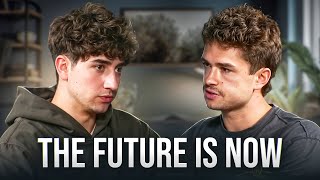
Blake Anderson interviews 18-year-old Cal AI CEO Zach Yadegari about building a $30 million-a-year app and the AI boom. They discuss how cheap LLM APIs let small teams outcompete funded startups, near-term opportunities in personal assistants, and speculation on brain-computer interfaces. The conversation spans job displacement, education reform, and building high-leverage products.
Chapters
Welcome to the first episode of the Blake Anderson Podcast. My primary objective is to have interesting conversations with interesting people. The first episode is with Zach Yadegari. Zach is my 18-year-old co-founder and CEO of Cal AI, an app that does over $30 million a year in revenue. This conversation is all over from AI apps to brain chips to simulation theory. I hope you enjoy. Thank you for joining me on my first ever podcast as a host. It's great to have you.
Thanks for having me on.
We can get right into it. Zach, what are AI apps?
AI apps could be any kind of software, a website, a mobile app that integrates AI technology into the main feature set in some kind of way.
How would you describe this to the average person that is pretty unfamiliar with AI or artificial intelligence and also pretty unfamiliar with software as a whole? What's new about AI apps versus the apps that they were using on their phone 5 years ago?
It's a good question. Software, I'm sure most people by now would know what that means. You interact with software every day in your phone, turning on the light switch, Everything uses software. Now, what AI allows people to do that it didn't allow previous technology is almost a human-like touch to many different scenarios. For example, in the past in software, there's this term called an if statement, and that was probably the closest thing that anyone could just code up and it mimics decision-making. It's a binary thing. You could go in one of two directions. If this, then that. If the color I detect is red, then turn on the light. If it's not red, then turn off the light. Versus now with AI, you can tell the AI to turn on and off the light based on the time of day, the mood it's feeling, for example, factors that can't be easily measured.
So essentially variables that are not as easy to quantify into, you know, some sort of binary set and then maybe build branches off of that. You can take AI, which can understand context being language, images, whatever it may be, and produce a human-like analysis to it. Definitely. So what have you done with AI for people that are listening that are unfamiliar with you? How did you get into it and how did you identify opportunity?
Started coding when I was 7 years old. I was obsessed with building video games, built those for a few years, put my first app on the App Store when I was 12. No AI involved. Back then it was very difficult. You would have to make a custom model if you wanted to put out any technology that used AI. Fast forward a few years and I built an unblocked gaming website, grew to 5 million users, sold that. Still no AI, but it taught me a lot about distribution. Fast forward, got into the app game, built a few couple, a few small projects, and then teamed up with yours truly on Cal AI, an app where you can simply take a picture of your food and artificial intelligence will tell the user the calories and the macros.
Um, you know, this is obviously a special podcast to do for the, for first episode, being that you and I have been partners for over a year. Um, when we first started working together, you were 16 years old. You had had some experience in software, but it's not like you were professional by any means. And I think that's a testament to how much opportunity there is in the AI app space, but also how much opportunity there is in the economy as a whole right now. In that when things move more quickly and you have these massive advancements in technology, the only differentiating factor, or one of the primary ones at the very least, is how much you can stay at the forefront, how, how much you can stay up to speed on the new technologies and their new applications. And so for AI here, it's like there have been application studios were building mobile and web applications for years, even decades prior. And yet people like yourself and myself can come into the industry with relatively no expertise, um, in the more traditional sense, but we can rise to the top pretty quickly, um, by applying the new technology, uh, and, and, and becoming relative experts in, in the new field.
I had ideas for all kinds of things in the past that simply weren't possible to build. But now since all these APIs are publicly available, anyone for very cheap cost, just a few cents for thousands of AI calls can do anything. I mean, when we started Cal AI, there was a YC-backed company that 2 or 3 years before raised millions of dollars, but they went nowhere. And in the matter of probably the first month after launch, we generated more revenue in a month than they probably did that year.
So I want to get back to AI apps in just a moment, but I think this thread is super interesting. You can be a YC-backed company, you can raise millions of dollars, you can say that you have the best-in-class engineering and then get outcompeted by a bootstrap team a few years later. Because of the underlying changes in the publicly available technology, right? Here being the advancement of LLMs. You don't need to build super sophisticated in-house models if you just expect that the models in a few years that everyone has access to are going to get the job done.
Yeah.
Now, following this, what do you think are some opportunities right now some maybe problems that aren't fully solved yet, but are going to become easier and easier to solve over the course of the next few years.
I think that you can look at almost any industry, any product right now that doesn't use AI and find ways that AI would be useful. For example, a calendar. It's a simple calendar. We've used these for hundreds, thousands of years. And recently there are now companies like Motion who help you organize your calendar scheduled around your work week. Same with note-taking. Everyone's been note-taking pen and paper, maybe voice recordings for years. And now with AI, you have voice note-taking apps where you simply record a voice and then the AI will transcribe it.
I think those are two really interesting examples because they're both products where AI has been applied to democratize essentially a personal assistant, right? It's like two of the main functions of personal assistants are manage calendars and manage documents or notes. And these are two instances in which, okay, not everyone can afford a personal assistant, but this is pretty much commoditized intelligence. It's very easy to reduce this down into tasks that LLMs can complete on their own. So that's a really interesting thread. Then there's essentially what we've done, which is take a consumer action that they already engage in and make it more efficient, right? Through using LLMs, we can allow people to just take a picture instead of having to manually scan the barcode or type out the information. Are there any of these other sort of meta improvements that you think people should focus on when they're thinking about how the future of AI technology is going to progress?
The framework that I like to look at is anything that's monotonous can be and will be replaced. And right now in software, it's super easy to do that. Going forward, it will also be in the real world with hardware.
Mm-hmm. What, what are some hardware applications that you're excited for?
It's a great question. There's definitely a ton. I'm very excited for the future of glasses. I think that there will be like the Meta Ray-Bans just came out, have been playing around with them the last week instead of AirPods, just experimenting, seeing if, if I see the vision for it. And I do. I mean, right now it's just audio, but when they actually will overlay graphics, I think that's going to be awesome.
Where does the opportunity within AI glasses lie?
I think that this is something you say all the time, a local LLM where you could just ask it questions.
Sure, totally agree. I would add to that, I think there's a lot of opportunity for AI hardware in the form of a local LLM that you can ask questions. Maybe it's a watch, you know, a lot of people are, uh, building on the pendant thesis. Maybe it's like a computing puck. I think glasses are so interesting because it seems pretty obvious to me that they are going to be the next primary form factor, um, after the phone. Whereas some of these other things, it's like the Apple Watch, for example, like that isn't a phone replacement. Glasses could be a phone replacement if done right. So when I think about that, I'm— the vast majority of people won't be able to compete with Meta, with Google, with, with Snapchat even. I don't know if they're going to be a real player. Apple. Um, but I think there's going to be an insane new software wave.
Definitely.
Because they're all like, they're not going to try to do everything in-house, you know, they're going to have app stores. And we're going to have this insane— like, as those floodgates start to open, man, it's going to be like the Wild West all over again. Honestly, I think that like the, the original Apple App Store, that was kind of the Wild West, but it was a little bit rudimentary. You know, it was like people were still figuring out the use cases. It took a number of years. The AI wave was like a mini Wild West. but now when we have glasses, we're going to understand a lot of the, the, the, the consumer software use cases, but there will be no major incumbents. Few guys will port over, but for the most part, completely unexplored territory.
Yeah, exactly. I mean, just like you said it with the App Store, that was Wild West. And I think it almost became saturated where most ideas were built. There were very few totally original innovative ideas that people actually enjoyed using, maybe come 2022, completely new, maybe a few. So, uh, not even many social apps, but during which period? I think since the App Store came out and then 2022. I think by 2022 it was like a plateau of how many new novel apps came out.
100%. You look at like the, the majority of the most popular apps in the App Store, they're like all built before 2016.
Yeah.
And now we have this new— it like, it went somewhat parabolic, you know? It's like if we have a graph of the number of new apps that are being released, that, that, uh, gain significant traction. It's like initially it was a ton and then it drops. And then in 2022, 2023. Yeah.
With AI, big spike. I mean, cause every idea, almost every idea, I think every single player idea could just be reinvented. Or innovated on.
Absolutely. And what's super cool to me and exciting to see is that there were a lot of theses when, when the single-player app wave came out that like social would quickly follow suit. I think that's pretty clearly not been the case up to this point. But I think that as we evolve the, the AI UX patterns, there will be more opportunity to figure out like, oh, this is how we integrate AI into social. And oh, this is how we design, you know, completely novel messaging experiences, whatever it may be. And especially when you have the glasses, when that unlocks, it's like everything is fair game.
Yeah. I've seen some companies experimenting with fake social profiles that are AI.
Oh, like Sims or?
Yeah. And I'm just thinking, is that— do you think that's something people would actually want? Is, for example, an AI version of George Washington responding on people's comments?
I— as in that being a new social platform paradigm as a whole, maybe immersed within Instagram right now? Yeah, I don't— I have a hard time. I mean, so many of the comments that we see already are bots.
Yeah.
What is it? It's got to be nearly 50% of interactions on the internet are probably bot-oriented.
Dead internet theory.
Yeah. Um, I feel as though it has to take it and it has to be a new platform for that to be integrated effectively.
Maybe that's true. However, I do think that We're the generation that has grown up on these technologies, and when we die, it seems weird to me that we're going to have all of these social media accounts, Instagram accounts of dead people that had millions of followers, whatever it was, and they just stopped posting for hundreds of years. What's going to happen? I mean, what if an AI could perfectly replicate their personality and continue?
Well, it's a great argument. To be made that people talk about, like the simulation, right? Simulation theory. Are we in one? Who knows? Um, but in terms of in our base reality, what are we going to simulate first? Reality or the experience of reality in social media? I think that social media is significantly easier to simulate a fake reality in than, than our base reality. And so whether or not— I would assume that it has to be a new player. Like, I think that the current social platforms want to keep their identities tied to the real world with added bot engagement in order to— to the extent to which it increases retention. They see that if they have bots liking your stories every once in a while and you think that they're real, then you're going to keep coming back. But then you still need to be grounded to the fact that you see your friends on the platform.
Yeah.
But, you know, there certainly could be players that build where it's like everyone's in on it, everyone understands it's an AI platform, and you're— it's almost like you're playing a video game, but it feels like social media.
Then when I think about the future and where we're trending towards and always have been, I feel like we're always working on building a utopia around us. And I think that with Brainship and the direction we're heading, The virtual world is increasingly becoming— it is the escape. I mean, people escape on hours of content. They just scroll TikTok mindlessly.
It is the Matrix. It is literally the Matrix.
When we get to the point of brain chips and we could just simulate an entire utopia around us, and then one step further, what if we can just artificially induce the brain chemicals that just make us in pure bliss and we're just floating in a pod in pure bliss?
This is why I'm bearish on virtual reality personally. I'm very bullish on augmented reality, very bullish on brain chips. Virtual reality, I just don't get it. I'm like, wait, so you're saying that I get to kind of see and experience a simulated reality, but I don't get any of the stimulus, like any of the real stimulus? I can maybe see, maybe eventually smell, and I can hear, but I can't feel. And I think that augmented augmented reality will enable us to kind of transform the physical world that we exist in. And to your point, brain chips will enable us to enter into a completely new spiritual dimension, um, which is, you know, it's sort of like the Black Mirror-esque, like, are we currently, um, experiencing that?
What do you think about AI in the next few years, how do you think it will actually work out with job displacement and the gap between the builders and people that have all their jobs replaced? Is the gap of rich and poor going to widen?
Yeah, so I— with these things, I feel that the possibility set expands ad infinitum, right? Infinitely. To the point where it's so hard to predict, uh, 20 years out.
Yeah.
Because there are so many premises that are— that in order to make those conclusions, we're just like not— we don't have any ability to accurately predict it. Now, from like a theoretical, sort of like philosophical perspective, where I stand is, um, yeah, power laws will continue to scale. The vast majority of people will become increasingly displaced by AI, their skills will become irrelevant. I think that this is kind of in line with the average individual is a pretty low performer to begin with.
Totally.
And if you're able to be completely replaced by AI, at least based on where it's heading, then you probably weren't creating that. You were kind of plug and play to begin with. Totally. And to add on to that, I think that this is a good thing though. I think that it will force society— it'll force us to ask questions like what we— how we should spend such excess human capital, because we'll just have so much more human time on our hands. It would be a shame if that's like everyone just becomes like a factory worker sort of robot, or we're like, actually, the cost to feed these people is less than, you know, and we're like, all right, fuck into the factories. You're less expensive than robots at this point. I, I don't know. That would be a shame. I think that my techno-optimist sort of conclusion is that people get to spend more time engaging in the beauties of the world. I'm engaging in art, spending time with friends and family, time outside. Um, and in terms of creating meaning with their life, they dedicate themselves to the, um, pursuit of excellence and they treat their life like a job, right? They, they, they, they take their health very seriously. They take the time that they spend with loved ones seriously. They, they create, um, they vibe code, right? Like AI tools are going to enable every human to become an increasingly high leverage creator. And even if they're not creating all that much economic value, you know, may— maybe they're able to create more beauty and happiness in the world.
Yeah, I've thought a lot about the idea of universal basic income that some people have been suggesting could be the direction we head toward. And I used to always think it sounds ridiculous we would ever pay people to do absolutely nothing. But now I'm thinking, I mean, people who get paid minimum wage, how much value are they actually adding? Maybe it's basically the same thing. It's not like people that are getting paid minimum wage are doing much more than what the people on UBIs would get when robots are replacing their job.
Yeah, the— I think that UBI becomes like pretty obviously necessary in my eyes when the average individual is not able, like, when their— the highest leverage extent of their work is just completely commoditized and worthless. Um, the concern that I have with it is that it can enable people to default into an insane state of consumption. Yeah. And sloth.
Yeah.
And ideally that's a problem that we can solve and we can figure out how to kind of reinvigorate, um, their souls in the sense of like still desiring to experience life. And, you know, to some extent, like, we already see this. People that after work they get home and they just lock in on Instagram Reels for the next few hours.
Crazy. It's people's— it's their actual default mode. They'll be on a line for like 2 minutes. They instantly pull out their phone, scroll until they get to the front of the line.
And in a world where we have such incredible access, such incredible abundance, it's very easy to default to consumption. And I think that— I don't know if this is like a, you know, As entrepreneurs, we often view efficiency and we're like, what's the efficient state? What's the optimal state? Okay, now how much opportunity, generally economic opportunity, is there in solving this? The question of how much people consume versus create, I don't know how you capture value on that. I don't know how you build a business around it, but anybody who can help push more people in the direction of creation rather than consumption I think we'll be doing the world a major service as we enter into this post-AI era.
I think a lot of this consumption behavior stems from schooling. I don't think we're taught to actually live life. We're not taught how to best experience the wonders of the earth. You kind of have to seek that on your own. And the internet has definitely opened many people's eyes to the possibilities, but I think there should be a big— or if we get to this point where people need to learn how to be more creative and pursue other means than just purely a job, then I think the entire system of the K through 12 grades should be changed, reformed. Yeah.
Well, there are many threads and many factors that you have to balance when you design education systems. It's like, to what degree do you prioritize creating Albert Einsteins versus creating, you know, who's like a quintessential purist entrepreneur like Rockefeller versus creating people who can work in the factories, people who can work in the office. But I certainly would agree that the internet, social media, for all of its faults and all of the hate that it gets, it certainly does a good job enabling people to follow the path that, that they feel most drawn to. Um, and I think you and I's generation is kind of the first to grow up, um, consuming relatively high-quality content around entrepreneurship and technology and philosophy and psychology, where we're not taught very in-depth in school, but we could find that on social media by virtue of the algorithms recognizing our interests. And enabling our progression in those domains.
Yeah, totally. I think AI will just totally change the education system. There's a school using it right now.
Alpha School.
Yeah. Alpha School.
Yeah.
And their results are pretty crazy.
It's so sick.
They have like, I don't know if it's the record, but their average SAT, ACT scores are like crazy high.
There's certainly like a component of selection bias there where it's like smart kids going in the first place. But no doubt that AI is just more efficient learning. I mean, for any relatively high intelligence, highly intelligent individual in K through 12, what, like, what percent of your time were you just sitting there daydreaming, completely disengaged in the course material? Like 80+ percent?
Yeah, I mean, it really is like no joke, no exaggeration. And the question is, is that a bad thing? Because boredom, I've heard, is very good for you, especially for creativity.
You know, I think so. I think that intentional boredom is— for example, I don't find that I'm all that creative if I'm sitting in a subway that's rocking and super loud and, you know, people are breathing on you and it's smelly. I don't find that to be a creativity-inducing environment. One step lower, or maybe one step less bad, sitting in a classroom where the teacher is constantly vying for your attention, getting mad at you for daydreaming, and kids are kind of making noise. I don't find that that is all that productive for my creativity. It's not terrible. It's not zero, but it's definitely not one on a scale of zero to one. Going on a walk in nature, meditating, playing a light sport, you know, socializing with intelligent friends. I think that those are more creativity-inducing tasks or activities, I should say.
Maybe the case. I do think— I don't know exactly what it did, but the extent that I was bored in my very early years of elementary school, I believe they did have a big impact on me.
What did you daydream about?
Various things. But as a kid, I was always the kind of person who— I had all of these different kinds of pens in my desk and I learned how to make pen shooters where I would use the different springs and parts of a pen to like create—
okay, I did that as well.
Yeah, and so I was just always tinkering with random household and classroom materials. And I mean, it's hard to know exactly thoughts, but probably on that front.
I played, um, a ton of Minecraft and RuneScape.
Yeah, a lot of Minecraft and Fortnite thoughts.
I would in both of these games, I would have factions, guilds, uh, like towns, which were all essentially small businesses. Yeah, I would daydream about my businesses. We had employees, we had times that people would have to get on, we had shops that we set up, we were running gambling rings, like you name it. And I would always, every day, just daydream about the moment that I either got home or finished sports, whatever, and got to hop on that computer and get to work. I fucking loved that. It was, man. And I think it's, um, to have those experiences as a kid, to have those things that just like energize you and fuel you up. I think that everybody has them as a kid. Yeah. And I think that so many people lose it as they get older.
Yeah.
And it turns to no longer playing sports. But it's, you know, it's watching sports on TV, which, you know, we've spoken about recently. It's no longer, you know, building these little businesses in video games, but 9 to 5. It's their night. But, you know, even if they're not excited about that, maybe they're getting excited about like going home and watching fucking Wolf of Wall Street because that's how they get their little like fake dopamine fix. And I think this comes back to what we were saying about creation versus consumption. It's like, I wonder to what degree it's solvable, you know, to what degree.
I think by nature you need more consumers than producers. Otherwise, I mean, if you produce something and no one uses it, do you consider yourself a producer?
Well, okay. Let's play with this. Kind of coming back to AI apps, um, we see the new vibe coding trend. Yeah, it's essentially how we've done the majority of our coding since AI has come out, right? We're both like somewhat technical, but we're primarily like, we're good enough to be able to leverage AI, especially in the early days. Like, we were able to do it without cursor. We were, we were able to do it copy and pasting from ChatGPT, writing some code, splitting it between the two. As we increasingly abstract that away, um, people can create not just for the masses to be consumed, but for their own consumption. So for example, you can create your own sort of Zach CRM that has, uh, the specific sort of task list structure that you want, um, that has the sort of goal setting reminders that you want pretty easily. And you can interface with this application and you can tell it to change, um, how often it reminds you and all these different things that previously were difficult or had to be very static within applications. Now you could create that for yourself. So if we're moving towards this world, I actually think that we're moving towards a world in which more and more people can create, and it doesn't have to be that creation is centered or isolated to the few with capital and the few with connections and the skills, but that everybody can become a creator.
That's true. I think a lot of it— I think motivations would need to shift. A lot of people, I mean, even now, it's suddenly becoming more popular to vibe code just because it's easier. I think a lot of it is the friction point. And you have to be more motivated than the amount of effort it's going to take. And so the effort will consistently continue to decrease. But the effort is always low of just consuming. How do we motivate people to want to consume? And is that even something we should do? Like if someone just wants to live their life on TikTok, is that objectively a bad thing?
You mean how do we motivate people to want to create?
Yeah.
Um, I think that goes to what you said about excess human capital and how to best spend it, which is, you know, to some extent, like, I view— I view going on a walk in nature, it's creativity-inducing and increases my capacity for creation, but I view that as more of an act of creation than I do it an act of consumption. What it really is is it's an act of experience, right? I'm experiencing this, this moment in nature, but it's one of one, you know? And so like it feels like I'm kind of like creating this experience in my life rather than consuming this experience in my life. Although it has elements of both.
It's definitely interesting.
I think so. Sorry, real quick, finish this analogy. So with regards to the excess human capital, it's like we've both read Man's Search for Meaning, right? He posits that there are a few ways to create meaning in your life. There's creation, there's experience, and there's living with virtue through suffering. Whatever. I think people often take the experience and they relate that more to consumption. I don't view it as such. I think that there's a distinct difference. And like I had said, I think that the, the act of experience is more akin to the act of creation. And in this world where we have this excess human capital, I think that people can use it to create things for themselves, but also to, to experience beauty, um, not in a mind-numbing consumption sense, but in a sort of personalized world sense, the same way that going on a walk um, is, is beautiful experience versus scrolling on TikTok, it's like mind-numbing consumption. I think that we'll have more opportunity, um, to cultivate those sort of beautiful experiences in people's lives if they so choose.
Yes, I think the problem is if they so choose, because just like it will be easier and easier to do that, have the more beautiful experiences, because You won't need the responsibilities of 9-to-5s potentially. At the same time, TikTok or whatever the TikTok is at the time will be so far advanced. I think we will get to the point where you could just inject chemicals in your brain that give you this like bliss that drugs do without actually the harmful effects. And at that point, do you get addicted? You just never want to be off it. Then you're not living. I think it would be horrible if humans got to that point, but I feel like capitalism like someone could capitalize on that.
I think philosophers throughout history have kind of answered this question for us, which is that the optimal life is not one of, um, of pure hedonism and pure pleasure. Yeah, in that we are built and we're hardwired to, to overcome challenges and that we, we create meaning through that. Um, you know, similar to in biology, there's the concept of the— there is no biological free lunch. You don't get to feel amazing or experience some amazing, um, uh, release of chemicals, uh, neurotransmitters, whatever it may be, without paying the price later.
Is that true?
To some extent, yes. So the classic example here being, you want your dopamine from cocaine, or do you want it from an ice bath?
Got it. When I think there is a win-win scenario, what about like having a kid?
So sort of positive sum scenarios, um, like certainly, but the point there being with a kid is like, that's a lot of work.
Sure. Yeah. Okay.
There you, you rarely get pleasure without any amount of work or sacrifice. For me, for example, I'll say, well, what about working out? I love working out. Working out requires significant energy expenditure. Yeah, there you don't get the upside without having to pay either. In the— maybe it's the, um, for cocaine, you do the— you do it right now, you get the dopamine, and it lowers your baseline dopamine in the future. For working out, it increases your baseline in the future, but you pay with physical energy expenditure. For children, you pay with physical energy expenditure, you pay with resources, you pay with this sort of emotional attachment that you create.
Okay. What if you stop before actually having the kid?
Okay, so you have sex without having a child. You know, there— this gets somewhat philosophical, but many would say you pay in— you're decreasing your ability to soul bond and pair bond in the future. When you have sex with a lot of women without really developing that, um, deeper relationship, that what you're doing is you're kind of just numbing your brain. And that maybe it's fine, but that, that might impact the depth of the relationships that you're able to experience in the future. And so that's on like the relationship front. But then also like you still have to— it still requires energy, it still requires effort to be able to court a girl, you know.
That's true.
So coming back to your point of the why don't we just inject chemical— well, I— not that your point was why don't we do it, but that we could theoretically in the future, the Black Mirror-esque, let me just turn up the bliss mode.
Um, was that an episode? A bliss mode on a device?
Yeah, there was a recent episode where you can kind of control the different experiences.
That's actually super interesting because I was talking to Will Ahmed from Whoop, and he was telling me how Whoop, what it does well is it helps you measure what's going on in your body so that you can improve it, whereas other forms of technology could actually just solve the problem instead of be a measurement tool. So there are devices that can cure—
to pro—
not cure depression, but like temporarily fix depression by hooking up to your brain.
So Here's another example where people that are generally less motivated, more Type B people, my understanding is that they have higher baseline levels of serotonin, which is like, that's awesome, right? They feel more pleasurable on a minute-to-minute basis. And then the cost is that they generally have less drive. I think my little brother is kind of like this. I love Teddy. He's an amazing kid. Coolest guy to hang out with, super smart. He doesn't feel that like go, go, go. Um, he's a pretty chill guy, like he likes simple things. The trade-off is that if he continues like that, I don't think that he's going to be as successful as me, but that's okay, right? That he, he has a perfectly happy life and is going to create a ton of meaning and have a great time. And so I feel like with any of these sort of futuristic devices of like, oh, I'm just gonna change this thing you always pay in some sense.
Yeah, maybe you're right.
And I think that that's what life is. It's like there are always trade-offs, and I don't think necessarily that there's any calculating your way into what the optimal balance is, you know. It's not like, oh well, it's actually 0.23 serotonin today and 0.7 dopamine. But following your gut and following your soul, right? We're complex organisms and we've built up these sort of You know, our genes are encoding into us the action that we as individuals are supposed to follow, our life paths, our destinies, right?
I don't think they're— I agree with you. I don't think there is a clear answer. I don't think we will ever have it answered until we die. And therefore, I think that also acts as a problem because different people Because it leaves it up to the person to figure out what is the most important thing to focus on, and different people that have different belief systems will try to push those on others. And that, I think that's what leads to most conflict in this world. But also I think it will lead to people pushing maybe different technologies that we should or should not be pushing on others.
Okay, I'm pulling out— oh man, I left it in my— I left it in my hotel room. I was about to pull out a book that I'm currently reading, Ego and Archetype. Um, it speaks about union psychology, uh, and it's super interesting because you say the issue is that it leaves up to the individual to determine how to live their life and try to figure out what's best for them. This is the classic Nietzsche pronunciation that God is dead, right? We live in a post, post-monothiest religious culture where we do not all have this unifying Judeo-Christian-Islamic God that we all follow. I'm sure those religions all have differences, but they have the general same core set of beliefs. We don't have that anymore. And so previously, uh, we all figured out how to orient our lives based on looking to religious texts and, and, and what we're— what we're taught by the church, uh, that manifests itself not just through the, the Bible, the Quran, the Torah, the, the, the words themselves, but through the collective unconscious and the collective conscious as well. And that's a major problem now because we have these like sort of secular godlike structures where it's increasingly easy to identify your entire sense of self from maybe your political ideology, be it right wing, left wing. And there are two interesting points here on a technological front. One, which is your algorithm can kind of become somewhat of your god in that it teaches you the different sort of virtues and things that you should strive for in life. And people have very different algorithms, as we know. So people worship these sort of like somewhat individualized, somewhat sort of attractor basins where like you get fed into similar pipelines. And then two, is artificial intelligence. Um, and this is the concept of AI alignment, right? It's like, how do we ensure that AI is funneling people in the correct direction towards the aspirations that we deem valuable and virtuous in Western culture?
Some people are starting to believe in this idea of a Church of AI or AI God. and it's, it's an interesting thing I've increasingly started to hear. What are your thoughts on this idea?
It is, um, it's fascinating. When I was a student in Walter Isaacson's class, he told us that Elon and Sam, in the early days of OpenAI, um, so we're referring to Sam Altman, uh, the CEO of OpenAI and one of the founders. And Elon Musk, who was originally one of the co-founders of OpenAI, but then was forced out. Or I think he actually left by his own accord.
I think he left.
Yeah. Following a dispute. Now, Sam and Elon often went back and forth with regards to whether or not there should be one centralized, unifying AI. That kind of ruled them all, or if it should be collective. Sam generally believed more so in one almighty AI, kind of like the Church of AI, as you're referring to, and Elon in a almost decentralized sort of conglomeration of different specialized AIs.
Is this in reference to different companies' AI models or different models that do different things?
I don't want to put words in Isaacson's mouth. Um, but my— based on how I remember it, it was like a theoretical optimal structure, but that's kind of both additionally how they orient themselves as individuals. And this was around the time that OpenAI started to transition its efforts to closed source.
Yeah.
Um, now in line with the AI god, I think that there's a passage in Isaacson's book where Elon is speaking to either Larry Page or Sergey Brin, founders of Google. And Elon's like, dude, we need to prioritize the human race above all else. And they go, well, why? Artificial intelligence is going to be the more intelligent life form. It's only natural in the course of the history of the universe that the more intelligent life forms prevail. And so I don't understand why we need to prioritize the preservation of the human race. We should prioritize the acceleration of the AI race at all costs. It's not word for word. That was how I interpreted it. People should do their own research, but it's hard to say. I generally am a believer in humans. I want— I I love humanity. I want to see humans to continue to succeed. Ideally, we can foster healthy relationships with AI as well. I think getting to the point of treating them like gods at this point in time is probably not something that we should universally adopt. But who am I to say?
Um, these are very interesting points. I have noticed that We've started to talk very, very philosophically when we started with just the conversation of software. And I think something maybe interesting is Maslow's hierarchy of needs. I don't think I was always— I always thought very deeply about things, but maybe not this deep and to this extent until very recently, because I think I was always on this like treadmill or I was on the journey. I was, I was still searching for how to make it to the top and there's so much left to go. But at this point, I do feel like now I am worried about these existential thoughts. And just, I think something to the viewers that they might appreciate is you do not have to think about this stuff to build a successful AI app.
It's true. I don't think that you need to have a fully developed worldview as a whole, nor do I think that you need to debate these sort of existential topics. That said, I think that developing a general holistic understanding of the universe is valuable beyond just its utility. Though I do think that there is real utility. I think that if you can think clearly from a high level, understand the fabric of the cosmos, um, I think both from a sense of physics, a sense of psychology, a sense of philosophy, um, it's gonna increase your ability to put the more micro things into perspective. If you can see the tides of the ocean, you're going to be more easily— if you understand the general tides of the ocean, you'll be able to more effectively orient your sails so that you can reach the correct destination.
Totally.
And I think in addition to Maslow's hierarchy of needs, like, you're probably thinking like, wow, you know, I start to have this material success and then I start to question the existential. Well, you know, there's also like, I think it's Kierkegaard's stages of development where I think it's very natural as you get older to question these things more and more. And you're probably speedrunning some of it as well because you being 18 years old, running a company, making $35 million a year, you are, you just kind of like speedrun the game that most people play as you get to that kind of further, further stages of maturation.
That's interesting. I always think about kind of future-proofing things and building things that, one, it's easy for consumers, but then secondly, I think, I think there is good UX to anything that we still talk about today that was built thousands of years ago, including ideas, had some sort of good UX to it, like Maslow's hierarchy of needs.
UX being user experience. User experience.
That's like the most common consumer apt term. And, and this is kind of random, but Maslow's Hierarchy of Needs— if it was named like Jared's Hierarchy of Needs, would it be used today? I don't know. I think Maslow, since it's not a name that's used today, maybe something where it's— people aren't giving too much credit to this one guy. I think of it as just like—
it's certainly something to be said about sticking power there. That's funny.
Just a thought.
Um, how much time do we have left? We got a few minutes. Do you know if we're gonna have extra time or no? Um, we could probably do like an extra 15 minutes. Oh, sick. When you think about the future of your life, um, you know, we talk a lot about macro decisions, right? Like, what are the correct macro decisions I think one example is like going into the right career path. Um, this applies to everybody. Uh, if you go to school and study gender studies for fucking 4 years and then you go do a PhD in it another 4 years, it's probably the wrong macro decision. Um, and like, no, I won't accept like the, what about the exceptions? No exceptions here. How do you think about making the correct macro decisions in your life? What are the frameworks that you use?
It's a good question. I used to think that the best way to make macro decisions was first define a purpose and then orient everything around trying to achieve that purpose. But after doing a lot of deep thinking over the last few months, I have come to the thought that I don't think there is any clear— not just purpose. Purpose is fluid. But I think that there's no clear optimal thing, optimal goal to chase.
Well, I think that that is what you just said. It's purpose is fluid. Exactly. It's like there's no— it changes over time.
Totally. And therefore, I think that— so I used to think, okay, let me find this one thing and orient everything. But now how I think about things is, what do I want to have done by the time I'm maybe 80 and on a deathbed? And when I think about the different things, it's build a product that billions of people use. And there's a reason behind everything. The reason behind this isn't just, oh, like, it's not all— sure, I want to make money, but that's not— this isn't about money. Making money is a separate goal. This is more about I love seeing people use something I built. I also would I'd like to know I had a net positive effect on society as a whole. And then there are other ones like, I want to create a song that hits the Spotify top charts. That's more of a thing that I think could be fun because I love listening to music. I listen to it a decent percentage of the day. I always have it on. So would love to have that done. And then there's a bunch of other things like giving a keynote speech like Steve Jobs. That's more rooted to childhood, how I was always really inspired by that. So I want to recreate it. Having a documentary created, that's probably more ego. But all of these things I want to do. I think I've thought recently, okay, which ones, what makes the most sense to order it and then moving in that direction. So right now I'm very focused on the entrepreneurial path of building businesses, getting to the billion users and giving that keynote. And then maybe after an acquisition, I would spend a year focused on music, and then after that focus on the next and the next.
I feel like, I think a lot of people optimize across like individual dimensions. Um, you know, a lot of people are like, my objective is just fucking work, or my objective is athletics, or my objective is family. Um, I'm sure this isn't groundbreaking news to many people, but I don't think that's the right approach. I think that, like you said, to clearly define your purpose and then orient everything, like backtrack, how do I achieve this? I think that humans are inherently like way too complex and fluid to optimize like that. And I've certainly done that as well, been like, okay, this is what I'm going to do, and then this, and then this. Rather, I like the concept of like Build your fundamental values. What do you stand for? Define them clearly. Is it strength? Is it, uh, family? Is it nature? Define the, the multiple— could be 3, it could be 5, it could be 8— that you really care about. Maybe not 8, that might be a few too many, but define the things that you really, really care about. Um, and then follow your gut. You don't have to say like, this is the end state for all of them. I think it's good to have goals like you stated, um, but also follow your creativities, or I should say follow your curiosities. Yeah, follow what interests you at any given moment. Have some sort of structure, but do the things that are most exciting. And I think that the world continues to move in this direction where, you know, success, not just financial but holistically, becomes less about really specializing and diving into one field, more about how do you become the sort of person that is able to be a high performer across the board. Follow the things that put you into flow state. And I've noticed that when I follow that sort of framework— I think we both experience this— when we follow this framework, life is better, you feel better, you make more progress across, across every domain.
I totally agree. And I think to dumb down everything you just said, it's like follow interestingness while staying away and being wary of shiny object syndrome. Absolutely.
Yeah, very true. Follow your deep curiosities, ignore everything else.
Yeah, and that's like following your gut. I actually— yeah, that is how I do want to live my life, and I think it's very hard to do before you have a lot of success because not all forms of curiosities are easily monetizable.
Yeah, dude, I would even say like before you have any success— once I feel like you have any amount of success, everything becomes much more clear. The main optimization is like whatever it takes, get that first fucking win. Like get it, finish it.
Yeah.
Um, and then And then you're able to, to, to kind of understand what works and what doesn't, because then you get the real positive feedback. Up until that point, before your first success, everything is negative feedback. Everything's like, didn't work, didn't work, didn't work, didn't work. And then one thing works, and you kind of see behind the curtains a little bit, and then you figure out like, okay, these are the general things that do work. This is what I have a propensity for. Now you have connections with other people that have figured out how to make shit work, whereas before everything's like a black box. 100%. All you see like entrepreneurs online, you have no idea who's lying, who's not.
Yeah.
Yeah.
Once you do have a little bit of success and you start integrating yourself into the space, it is super interesting because first of all, 90% of what people put out is just completely inaccurate and also representations of their lifestyles. So many things, so many, too many misconceptions and So I think podcasts like this one will actually be very, very good, actually going deep on what a real business model is, and it's not just extremely high level.
We've gone really deep on the business model today. This has not been high level at all. This has all been in the trenches. Now, well, yeah, I mean, to people listening, who knows, actually, like, fuck it, maybe this will just be the podcast. Um, Zach and I have a lot of content online. You can like find all the, all the in-the-weed shit. I don't know if there's all that— like, dude, we started off going to the AI apps. I'm like, holy shit, I've heard you say this 20 times, I've said this 20 times. And then we both just kind of seem to simultaneously agree, like, fuck that, let's go high, let's talk about AR, let's talk about simulation theories. That's funny. To your point though, I think that honestly, in terms of the like getting the insider knowledge, the key takeaway is like I do think podcasts as a whole are good. If this one doesn't end up being in the trenches, go listen to like Brett Malinowski or My First Million, whatever. That's—
sorry to cut you off, but I actually think that's why I get way more value. I think most people get way more value out of mid-tier successful entrepreneurs on podcasts than very— because like billionaires, they're like talking—
there's nothing to learn from them, bro. There's nothing.
But people that are just starting to have success, they're the ones that are like actually in the trenches, and all they know, all they think about is their company. They're not diverging into like, what's the next stage of my life, dude?
I think you and I have also probably both experienced it, like the further that you move from the trenches, the like the less you're able to easily recall and relate and provide value to people that are in it. You know, it's like billionaires who built their first successful business 25 years ago. They just like, they don't know what it's like nowadays to be trying to try to get your first win. They have no idea.
Yeah, I was always— I've thought about this and I'm very curious your take and then I could give mine. But if you put someone like all of the billionaires, Elon Musk, Jeff Bezos, Mark Zuckerberg, and their goal was to build an AI consumer app that uses GPT or something. Who do you think all of them would come out successful?
Zach would fucking kill it. Zach, number one, top, easy.
I would agree with that.
Um, you know, it's hard to say. On one front, you could be like, they just don't understand the times, blah blah blah blah blah. On the other front, you can be like, these guys are such killer operators that if you told them that this was their sole focus, I have a hard time believing that they couldn't get it done. Like, sure, they might not understand the virality as much, but to get to that level, the degree to which you have to be able to learn systems— I would say to get to that level, continue playing there and continue to push it, right? These guys aren't just looking into it. Yeah, that's the side I lean toward as well, that they would be able to Yeah, I think it'd be very easy to be like, nah man, we got something that they don't.
I mean, I think like, I think their intuition isn't there. Like, they won't have the intuition for a viral TikTok, but they're not going to come up—
yeah, they're not going to create the viral TikTok, but they're like, they'll just study the space.
Yeah, they'll figure out, they'll replicate, they'll make something work, make a deal, whatever it is.
But I think it is, um, the playbooks now are just so different, you know. I was talking to, um our friends who founded Moonshot, and they were saying, they were like, or we were all saying, we were like, you know, it's funny because nowadays, in the past, you look at all these previously successful, or the, the biggest founders of the past generation, the Jensen Huangs, the Elon Musks, the Mark Zuckerbergs, their time horizons on most of their projects were pretty long. Even though, like, the examples that we use of, like, you can do stepping stone— look at Sam Altman, look at Elon Musk— build something that makes money and then use that to parlay into bigger plays. Um, this playbook was not nearly as accessible for them. Yeah, the difficulty to build a successful venture, it— like, you couldn't— the technology didn't exist to spin it up in 3 months as an individual, um, you know, 30 years ago. Right, possible but extremely difficult. You didn't have distribution solved, you didn't have engineering, like all, all these software service providers, you didn't have Figma, you know, it's like, um, so I, I saw Gary Tan had a tweet the other day, CEO of Y Combinator. L Y Combinator. I don't actually hate them. I just like making fun. Gary Tan had a tweet. He was like, you simply cannot apply frameworks of the past, um, what had traditionally worked for decades in an era where everything is being turned upside down. The technology is unlike that which has ever been encountered. The rate of progress is just like— it's there. There aren't comparables. There, there isn't precedent. It's a new— it's a new day and age that we play in. Yeah, we got 5 minutes, by the way. Um, okay, I want to see if there's something fun to wrap this up with. Okay, let's, let's, let's get, um, let's get tangible. We can do— this will be some good clips too. Okay, we started it off low, specific. We ended up going really high, bouncing in between. Um, I want to end this off with really practical— I want to end this off with really practical, actionable advice for people that are listening. What do you think the greatest sources of opportunity are in the mobile app industry and adjacent? This could be building apps. This could be content agencies. This could be design agencies, engineering agencies where you prioritize building out development pipelines unlike any other, and you can build single-player apps for $5,000 in pretty high quality, right? Um, if you were to get started today and your goal was to make $100,000 in cash as quickly as possible, starting with $5,000. How would you do it?
I would go the app strategy, 100%, no doubt. I would look on the App Store. I would look through all of the top charts, health and fitness category, entertainment category, lifestyle. Find apps that are ranking the highest, or find new apps that are up-and-coming, ones that Ideally don't use AI or ones that are just built poorly. They clearly have virality to them. It's clearly a use case people want, but it's executed on very poorly. I'd come in, I would figure out a hook, a viral hook, which it maybe would use AI, maybe not. And so I would create, I would innovate on that idea. It's already validated. I would create a hook within it. So maybe this is a new feature, for example, that will be used in all of the promotional material on TikTok. This could be, for example, if I'm making some kind of learning app, an IQ test could be a hook and then plugging that into a bunch of videos that maybe I would start creating them myself initially. And then after validating the idea some more, getting more feedback, I would use that capital to push out to influencers in the niche that I'm building?
Good answer. This is our playbook. You know, we're experts at this. I would add a new one here. If you were to ask me this question, I would say there's tons of opportunity there. But what I would do if I had to do it as quickly as possible, um, My previous answer for this, I think, was content agency. Um, do UGC, influencer marketing, whatever. It's starting to become saturated. They're actually a lot on the market. Even though there's still a lot of demand, it's becoming saturated. Um, I think that would actually be the fastest right now regardless, given our personal brand. But assuming that we don't have the personal brand, what I would do is I would spin up a development agency. I would get a few really cracked devs. I would give them equity. What we would do is we would develop a number of different templates. We, we would have onboarding templates. We'd be really good at paywall strategy, and we would be able to design the viral AI features as quickly as possible. We would then go partner with 10, even 20 influencers that have solid distribution. We would give them each 60% of the product. Maybe less, but enough to properly incentivize them to feel like it's their thing. But we would retain general control of the company. We give them 60% of the profits. We take 40. We spit up these apps, we make them good, but we don't have to make them perfect. We're doing 20. I think that pretty reasonably you could get 20 different influencers, all with a million plus followers across platforms. Within a month and you could spin up these 20 apps if you have the proper templates within maybe 4 months less. If you have yourself and a team of a couple of other engineers, I think this seems like pretty much a zero-risk strategy. The big thing that you have to do is you have to social engineer your way into the sufficient, uh, credibility to get these influencers to partner with you. If you haven't already had success, right? This is for someone with $5,000 and no credibility. That's the only hard part. You solve that, it's game over.
I completely agree, and that's what I was going to bring up. I think the reputation without a personal brand, that's the biggest challenge.
Zach, thank you very much for joining.
Thanks for having me on.
Everybody that listened, I hope you guys enjoyed. We were obviously all over the place, but I don't view this as like a this needs to be a super dialed in, like, maybe we'll see, maybe we'll go like really deep into business breakdown, super structured if that's what you guys want. But what I love is having conversations like the one I just had with Zach Yadegari, where we explore some of the technical weeds, some of the operational specifics of how to build a successful business. Us obviously talking about AI apps, maybe that's what I'll do with future guests. Maybe we'll, we'll go deeper into the philosophy. Whatever you guys liked hearing about, just like leave a comment, uh, if this is on YouTube, Instagram, whatever. Um, so yep, thanks for joining, brother.
Thanks for having me.
More from Zach


Zach is 18 & made $50m from an app. Here's the brutal breakdown of how he did it (and you can too)