Meet The 17-Year-Old Making $1M/Month With AI
In this interview, host Speaker B talks with 17‑year‑old entrepreneur Zach Yadegari about his journey from building a school‑time unblocked‑games site called Totally Science to creating the AI‑powered nutrition app Cal AI, which now generates over $1 million in monthly revenue. Zach explains how he taught himself coding through YouTube and Unity, leveraged rapid product development and influencer‑marketing systems to achieve explosive K‑factor growth, and sold Totally Science for roughly $100 k after two years. He details Cal AI’s technical pipeline that combines multiple AI models to estimate calories, proteins, carbs and fat with about 90 % accuracy, and describes the influencer outreach process, CPM/RPM calculations, and the network effects that enable scaling. Zach also shares his philosophy that speed and distribution are the primary competitive advantages, his decision to stay bootstrapped and only raise capital when necessary, and his plans to launch a B2B SaaS platform called Viral Tech that packages his influencer‑marketing tools for other founders. The conversation touches on his personal sacrifices, ambition to reach Elon Musk’s level, his rule of maintaining personal control, and his reflections on failure, validation, and the role of free will in his life.
Chapters
I'm going to make $1 million in high school. That's what I said at 13 years old.
This guy is Zach Yadegari. He makes $1 million a month at just 17 years old. And last month I had him at our studio and asked him to teach me everything he knows about building viral apps. In less than 100 days, you grew your app to $300,000 a month in revenue. How did you do that?
We have a few systems in place with influencer marketing. I think—
How have you been able to balance school but also building out really successful businesses?
I would find the classes where I didn't need to pay attention. I would program during them after getting my homework done, stay up late coding.
What have you figured out about building businesses and making money that others haven't?
Distribution 100% is where the advantage lies.
What are your ambitions?
To be up there with Elon Musk.
I have a secret to tell you. This show has been blowing up lately and it's only going to get bigger. So if you want to be along for the journey, hit the subscribe button down below. and I'll promise you that we'll keep bringing on better and better guests every time to bring their insights to you. Thank you very much and enjoy the episode. We're gonna delve really deep into the company you're building today, which is the one we're here to talk about, Cal AI. That company's generating, I think now over a million dollars in, in monthly revenue. But before we do, I think early context is, is really important here. Um, one of the companies you started before that, uh, in 2022 was this company called Totally Science. So, Tell me more about that business. Give me the full context and picture. What was going on behind the scenes and, and how did that business end up, uh, getting acquired for, for 6 figures? Cool.
So to paint the picture, this was right after quarantine. People were returning to schools. Schools gave Chromebooks out to every student to reduce contact. Students obviously abused this. They started playing games during class. However, I noticed that students would have multiple tabs open. They would have like 5 tabs, a different game on each tab, because all of these unblocked games would be on these obscure websites and scattered all across the internet. So I saw the opportunity to aggregate all of these games into one site. I called it Totally Science. I built that in about a week after identifying the opportunity, shared it to a few friends in my school. It very quickly spread. To everyone, that made me realize, wow, this has something in the app space we call K-factor growth. So basically just word of mouth, it spreads. After one person sees it, they will share it to one or more people, which essentially leads to very quick growth. So then I posted a video on TikTok, which got 100,000 views. The next video got 1 million views. and very quickly it started spreading all across the country to different schools. One or two people per school would pick it up, then it would quickly spread throughout the rest of the school.
When you were building these apps, you were building them at a very young age. I know when I first started to learn how to code, I was like, at that age I was learning how to clo— code like some sort of Flappy Bird game or something very basic and simplistic. How did you learn how to code these more complicated like websites and, and games and, and build those out at such a young age?
YouTube. That's the answer. I just binge watched YouTube videos all day.
And what were some of the processes that you would do? Is it just watching the videos and then you'd take notes and start practicing or like walk me through that process.
So I really got started in Unity, which is programmed in C#, or you program on the game platform Unity with C#. And there were a few channels in particular I would watch, one of which was Brackeys. Which had game tutorials, and I would just watch his videos all day. It was entertaining to me to watch him code and similar channels. I didn't even follow along with the videos, but just purely consuming so much content every day, I eventually started picking things up and learned to implement the same type of game mechanics myself.
And it started out with a lot of word of mouth. Why'd you call it Totally Science? That seems like an interesting name to start the company.
Yeah, so Totally Science was the name to bypass the school blocking filters. If I named it something like Games Hub, that would've been picked up and blocked immediately. So doing this, it was categorized as educational. Schools didn't detect it. We also added a button on the keyboard. If you hit the tilde key, it would automatically redirect you from our website to Google Classroom. So if teachers were walking by, you could quickly switch tabs. And these small things really helped it stay unblocked in the classroom.
How did it feel when, I guess, you coded out this website, you're sitting in class, maybe there's like 20 people in the classroom, and then you might see somebody else who was a classmate on your site. How did that feel?
And so that's really when I realized the magic moment of why I love to do what I do. Seeing someone else use something and enjoy what I made. It's such a rewarding feeling and it inspires me to work harder every day. I will go back though to the question about the games that were made, and I'll say most of the games on Totally Science were not my own games. We actually took all of these games from other sites and had these weird methods to scrape the games, scrape the data, throw them on our site, which the legality of it all is questionable. But I was a pretty young kid and it all worked out.
Okay, so you're growing out this, uh, website. You eventually get to 5 million users pretty quickly. Um, how did it eventually get acquired?
Yeah, so after 2 years, I had so many new ideas of what we could improve upon, what we could build, how we could take this site to the next level. Cool Math Games. That was the website that had been popularized a decade before ours. That was the go-to unblocked games website. Everyone knew about it. I wanted to beat them. I had gotten in contact with the CEO and spoke to him. I knew what numbers they were doing, and I didn't think it was too far off that in a few years we would be able to beat them. So that was my mission. That was my goal. And In order to pursue this, or at around the same time I was pursuing this, I was also getting more closely into the startup world. So I started networking with different founders. There was this Y Combinator co-founder matching platform that I would be reaching out to people on, and I hopped on this call with this one guy. He was telling me he built this chat app. It was kind of like Telegram. It had a few million users and was making him a few thousand dollars a month. I was like, wow, that's really cool. It sounds just like Totally Science's story. He told me he founded it in high school too. Wow, that's just like my story. And then he told me his age. This guy was 25, and that's all he had done. He didn't go to college because he pursued the stream. However, the website or his app had stagnated. It did not go anywhere. And that scared me. I did not want to be like this guy, not going to college and being a one-hit wonder, this kid who had so much potential in high school who didn't go anywhere. So I decided to burn the boats. I didn't want to fall into the same pit. I let go of that dream to beat Cool Math Games, and I decided to look for the next product to build. That led me to reading a bunch of TechCrunch articles and I saw Nikita Beer's app Gas, which was just a rebrand of a previous app he built, TBH. I thought this was crazy. For those who don't know, he built the same app twice, essentially sold both of them for millions of dollars. And this just made crazy news, the fact that the same exact app just built it twice. And so I was inspired by that. I wanted to get into the consumer app space. I did more research. I started reaching out to people on X, and I got started building my first apps.
You want to be coolmathgames. Why did you have such this ambition and drive to take on like a company of that size at such a young age? What are you running towards?
It really did feel like I was just up against this behemoth of a company. When I was first getting started. However, actually connecting with the CEO on a phone call made me realize I'm not so different than that company. At the end of the day, they are just people and people can be beat. Before that, it seemed like they were this, this being that was this big company, no face attached to it. But now seeing something tangible, I realized how achievable the vision was.
I will say when I've sat down through the podcast with either CEOs or executives or even founders of massive companies, I used to glamorize it a lot more, the brand and what they've built. And then I sit down with them and then I realize, yeah, you're right, they're just people. And I think if you put in enough time, work and research, basically anyone could figure that out. What was the acquisition process like? How did, how did that go and how did you negotiate a 6-figure deal that young.
When I decided to abandon ship, sell and move on to the next thing, I listed the website on Flippa.com and waited a few months. I got a few offers, weren't ones I liked. Finally, I got a good offer, or at least something closer to what I was looking for. It was probably, probably just under $100,000. And then I sent him something. I was doing some quick negotiations on text, to be honest. I just wanted to sell quickly because I was so discouraged by the person I spoke to on the phone. So didn't even do as much negotiating as I probably should have. But I'm happy with what happened. I sent him a text saying like, okay, if we just add $10K to this, we close right now. After the sale, I sold off some of the extra domains that we had. It landed at just about $100,000.
What do you think that tells you about the importance of speed in, in business deals and business negotiations?
I really like speed in business. That's honestly the core value that I always hold in mind for everything I'm doing. I think moving quickly— I mean, if I hadn't moved fast, I wouldn't have accomplished anything that I've done today. People like to wait for things. People around me wanted to get into coding. They always ask me, how did you start? I just tell them, YouTube. You could go watch YouTube right now and learn. They tell me, well, okay, I'll wait till I take a class in college on how to code. And I think the fact that you don't have a fire under you that is forcing you to move and move quickly, that you're not moving with speed. You will never make it. Everything that we do, like Totally Science, the first version we got up in a week. There were other sites that came after us. Maybe they had the same idea before, but we're spending a month to build it. I don't know. All I know is we were one of the first websites that got up everything today in the consumer space. It is a very competitive landscape, and if you don't move with speed, someone will beat you.
I will say I have never met a founder that has been successful that doesn't operate with speed. Like even, even 10, 20 years later, like for example, with Mark Cuban after he sold broadcast.com to Yahoo, even today he still responds to emails super quickly. I remember I sent him an email a year ago asking him to come on the show. Within 30 to 40 minutes he just replies, yes, let's do it. I was like, okay, that's how you operate. Instead of taking a ton of time to make decisions and, and figure out like, oh, okay, should I really do this? Eliminate the mental bandwidth and just take action is one of the things I've learned. I want to transition here a little bit to the business you're running today. What is that app and how does it work?
Cal AI is an app where you take a picture of your food and it will estimate the calories, proteins, carbs, and fat content of the meal.
How did you come up with the idea for the app?
So I was always pretty skinny growing up, and I started getting into working out a couple of years ago. I wanted to build muscle, which requires gaining weight. And so I was tracking my calories with MyFitnessPal to bulk. After 3 days, I quit typing in every meal I ate into this app. Weighing my food on a scale was not something I was willing to do. and I knew there had to be an easier solution. The idea was there for CalAI at least a year before it was possible, but then finally with AI models becoming so advanced, they were finally to the point where CalAI was an idea that was feasible.
How have you been able to make that image scanning recognition that accurate? To the, to the point that you have so far?
There has been a lot of trial and error, a lot of experimentation, and we've landed on a system that utilizes multiple different models. I can't go too deep because there are definitely competitors listening to this right now. However, the pipeline that we go down will essentially gather as much context of the food before passing into a final model to make their estimate. And from our testing, we yield about 90% accuracy if the image is taken at a natural angle. And that beats the FDA's approved margin of error for nutrition labels.
The app that you have, you now do $1 million a month. In less than 100 days, you grew your app to $300,000 a month in revenue. How did you do that?
We take a pretty novel approach to influencer marketing. We've been the fastest growing app in the health and fitness section of the App Store. Going from zero to the ninth rated in 6 months. It's really just the way that we work with influencers and how we have scaled those systems. Many people are able to achieve rapid growth in the short term with influencers, but then they can't figure out how to make it sustainable and scalable.
Have you been able to make it sustainable and scalable?
We have a few systems in place with influencer marketing. I think there are many nuances that go into it. However, to take it from the top, it really starts out being very scrappy. It's a numbers game. You have to do a lot of outreach in the beginning. You reply to 100 influencers. Maybe if you get lucky, one will reply to you. After you do it long enough, you'll start building up your initial base of influencers, and this will compound. There's a network effect. As you're working with more influencers, you have credibility so that when you reach out to other influencers, they're more likely to respond. The influencers you have will refer, will refer more influencers. So you will be able to build up a big base. But part of the way that this scales is by keeping them on retainer with deal structures that ensure profitability. You essentially need to calculate what the average amount of views they get on a video and then negotiate a CPM from those videos, which you need to predict. The CPM is the cost per thousand views. So you need to predict the cost per thousand views that you will pay them, assuming that they hit their average view count in a video. And then taking that number into account, you need to ensure that your RPM, the revenue you generate from those same 1,000 views, exceeds the CPM. This is pretty difficult because it's hard to measure the impact of an individual influencer post. There is no way to track where people are coming from or if they have come from an influencer post when you have multiple going on because you can't have links within the video. Live for people to click. So that is actually something, a problem we will be tackling and helping people with, which we could get into more later in this.
And how do you go about finding these influencers that are success— actually helpful and successful to the growth and scaling of the app?
For some apps, it's easier than others. For Cal AI, it wasn't too hard to find. Health and fitness influencers would work well for a health and fitness app. For other apps, for example, a fashion app, finding influencers that will work well, it may be trickier. There are fashion influencers, but not as many as there are health and fitness influencers. So you have to be a little creative and you could find that creators that do get ready with me content probably will convert pretty well also. So it's a lot of testing. Sometimes it's more obvious than others.
And you have 3 co-founders at Cal AI. It's not just yourself. Um, who are the co-founders and, and how did you meet them?
It is Blake Anderson, Henry Langmach, and Jake Castillo. Blake has founded Numax and RizGPT before Cal AI. While I was getting started in my app journey, I had reached out to a bunch of different app founders. He was one of them. We hopped on a call, and then a few months after that, we founded Cal AI together. Before meeting Blake, Henry Langmak, he and I met at a coding camp when we were 10 years old. We stayed in touch. He moved away, and then we decided one summer, okay, you know what? Let's work on something together. He's a much better programmer than I am. And I was always better at the business side. So we decided if we team up, we could probably make something happen here. We built Grind Clock together first. This was last summer. Grind Clock was an app where someone like David Goggins can wake you up. Any motivational speaker you could select and they will wake you up by screaming at you, whatever. We built that. It did okay. 20K downloads in the first 14 days. and then we built a few other apps following that. Then eventually we teamed up also on Call AI. So that's Blake and Henry, how we all got started together.
Did that app make money or it's mainly just the downloads?
So it did. We were making, and we still are making about $2,000 in monthly recurring revenue. It, we had just not figured out influencer systems. Or had not known how to scale them to the point that we know today. But I think the idea still has a lot of potential.
Given that you know how to scale them today, is that something that you'd like to revisit?
We actually are revisiting it. Okay. We're going to be launching an app called Locked In in the next month. That app will be a motivation app in whole, so not just a motivational alarm clock, but also motivational content that you could watch.
You're in school now, you're a high school student. You have a nearly perfect GPA, which is something I could not have done in high school while also building out a business. How have you been able to balance school but also continue building out really successful businesses?
So senior year, which is this year, is really when things have started picking up with business outside of school. And this is the first year I'm prioritizing business, but prior years I had been prioritizing school. Totally Science was something where I was balancing better. I would find the classes where I didn't need to pay attention. I would program during them. Then I would, after getting my homework done, stay up late coding. This year I've dropped a lot of classes that are debatably important for life and for getting into college, and I prioritize the company over getting a good grade on a test.
Do you want to go to college?
It's a hard question. I've thought about it a lot. I've asked a lot of people, and my thought right now is I'm going to take a gap year. If I get super depressed because my social life sucks, then I'll probably go to college. If things work out, if I'm able to find other young entrepreneurs or even older people that I could still relate to, then I think I'll stick it out and won't go to college.
I will say, I think if you have something that you're passionate about, whether that be a passion project, a business, whatever it might be, I think a gap year is something more people should consider taking. But not a lot of people do because of the external pressures, whether that be parents, friends put on you as a high school student. But I definitely think it's something more people should explore. You actually haven't raised any capital for the business you're running today, and most of the businesses that you've ran. Why so? I feel like there's this misconception that to build a business to the scale that you have, you have to raise like millions of dollars, go out to Silicon Valley, get term sheets, but you've built this all off the backs of yourself. Why so?
100%. I think people definitely do feel that way, that they need capital in order to run a business successfully. And I think that takes away a lot of urgency. If it's no longer your money that you're dealing with, then failure doesn't seem as disastrous. This is pretty much exclusively advice for consumer. I think you only need to raise capital if only at a certain scale you will be able to profitably run the company. So that's something like Instagram where only until you have millions of users can you serve ads that generate enough revenue to sustain everything. For something like Cal AI, if it's not working immediately, it's probably never going to work. And so you only need $1,000 to figure out if the idea is feasible.
I will say, even when I started my company in, in February of this year, like you said, only needed the $1,000 for like lawyer fees and to create up the LLC. And then after that, I tried to hop on some sales calls with some founders to see if I could sell what I was actually building. and signed a client within, uh, within a week. And it was like a small retainer at that time, much more than what we do now, but it was like $2,500. And then I just used that money to then actually deliver the service and made a profit from that. So I think, yes, it's very different cuz it's more agency focused. And I think with agencies you can get paid upfront, whereas in other types of businesses you kind of have to build out the product first and then see if it works. Um, but I do think you're right. I think there are much easier ways to validate ideas than, than going straight into raising capital.
Definitely. A lot of people also, they'll spend a year building something before validating, before launching. That's also something I strongly advise against, and many other people say the same thing, because that could just be a year completely wasted. This goes back to speed. You need to quickly get something out. Once you get something out, then validate it. It doesn't need to be good by any means. The first prototype for Kali AI we developed in 3 weeks, launched it, got feedback.
This is a book I think every founder should read. It's called The Million Dollar Weekend by Noah Kagan. The reason why is he basically teaches you how to validate ideas and get money and get revenue for your business within 48 hours. So he did a video with someone who wanted to build a golf agency. The person wanted to help other basically rich people who played golf plan their entire trip and get paid for that. But he wanted to see like, hey, does this actually work? Do people want to pay for this? So he just hopped on calls with his friends. He said, hey, could you pay me $500? I'll build this out later on, but this is just upfront payment. And if you like it, we'll build this out. He collected a few thousand dollars in, in 2 days and was able to end up building out that part of the company. But there's very easy ways to validate ideas that I just think not a lot of people really think about early on. Going back to Callie, I, for a second, how did it feel when you reached a million in monthly revenue at 17?
So this was a couple weeks ago. It's interesting. I heard my friend say this recently and I really resonated. My friend Alex Slater, he said he actually just reached maybe $50K in monthly recurring revenue on his consumer app. And what he said was that he felt like he was always destined for this, that this was always coming. He had the vision so strongly. So when he hit it, although it's an amazing milestone, it doesn't feel that crazy because in his mind he hit it months ago. We set out to hit $50,000 in monthly recurring revenue by the end of the summer. So we completely exceeded our goals. My expectations and hitting a million. It's almost surreal. It feels like this whole thing is a video game. Part of it is that we've reinvested everything back into the company, so I haven't seen any cash myself yet. And because of this, it's like, okay, it's just numbers on a screen. I'm clicking some buttons. It's like Minecraft Skyblock or any of these other simulators where there's economies built in. So we'll see what happens.
I will say how you phrase it is pretty, pretty accurate. I remember when we first hit like $10,000 in revenue, probably a month or two months into the business. That was like the goal I had to do like 3 months in and we did it like a month early. I remember looking at like our Stripe dashboard and like ogled at the number for like 3 seconds and I was just like, okay, now how do we get to like $20,000 and how do we get to like $50,000 a month or whatever the number is? And I think you fantasize a lot about it in your mind about how can you actually build this into fruition. Then when it comes true, then you're just like, okay, well, what's the next milestone down the road? And then you just stop thinking about what's currently there. One of the things I've noticed from really successful founders and entrepreneurs and even people in general is that the larger the mission or the goal, the larger the sacrifice is as well. What's the most difficult thing you've had to go through as a founder, and, and what have you had to sacrifice?
I've definitely sacrificed a lot of family time and time with my friends. The entire summer I spent it in San Francisco with my co-founder Henry, being a 17-year-old living with my parents. This is the last year where I will live with my family altogether so close. And then I move out. I go wherever I'm going, potentially California, and I will only see them less. So I am always working, locked in my room. Last night, my friends all went out to do something. I did not partake. And these sacrifices are definitely necessary to keep the business moving as fast as possible. And it is something I've thought about. What am I optimizing for? Should I be optimizing to have the most balanced life, a good business, a good family, good friendships, or should I optimize for just going all in on one, which I think is potentially necessary if I want to excel to the levels that my ambitions drive me to.
What are your ambitions?
To be up there with Elon Musk.
I really enjoy working with and being around founders and people who have, like, incredibly high goals, one of which is this guy named, uh, Brad Adcock, who He runs a company called Figure now. And they've, I think they're like a multi-billion dollar company now. But they're basically, if you've ever seen Tesla's autonomous robot, I don't know if you got to see the demo, he's building something similar to compete with Elon. And he previously built another company that he scaled and sold. I think people like that who are able to go against, like for example, when you were in high school, it was going against cool math games and now it's going to try to reach the level of Elon Musk or whoever it might be, I think there has to be some level of a combination of delusion, but also high ambition and high work ethic. Because otherwise, I think without those three components, I don't think it's really possible to build something to that scale.
Yeah, I agree.
What do you think are some of the things that you've tried to scale with Cal AI, or, or just things in the business that you tried that didn't work, and what did you learn from them?
So recently I launched an app called Screenshop. The idea is like you're scrolling on Instagram, you wanna know something your friend bought or that an influencer is wearing. So you screenshot that, you upload it to the app, and then it will tell you where to buy it. Launching this app and then running a few influencer promos for it, quickly realized that the intent to pay was not as high as the intent for previous apps I'd built. And so because of this, the influencer promos were not profitable. And I think the biggest learning is just how important it is to assess the immediate intent of solving a problem, to pay a few dollars for a problem that you might have in a week. Which is, okay, in a week from now you might find clothing that you might want to know where to buy, but not something that you immediately want to know where to buy. That is a framework that I think could be used for future ideas to help validate them more quickly without shipping them and realizing.
I know a lot of VCs that now try to refrain from investing in consumer because they think it's just so difficult to actually build a company that can scale and there's like a whole graveyard of companies now that try to start in consumer and, and failed. And it's, it's technically much easier, I think, to start a B2B company than try to get mass adoption and scale for a consumer company. What have you figured out about marketing and building businesses and, and making money that others haven't, or other consumer founders might not have?
Distribution, 100%, is where the advantage lies. Within everything that I'm doing within my companies. Everyone always says that the bottleneck for their company usually just is distribution when it's a consumer company. Finding developers that could build a good product is pretty easy at this point if you're willing to pay their costs. However, distributing the app is difficult. I've said recently on Twitter that I've never met a head of growth for a company that's actually helping lead growth to any point that is helpful. Otherwise they would go found their own companies. But the way that we do things with influencer marketing, it's just allowed us to scale in 6 months what people usually can't do in 3 years when launching apps. Taking all of these learnings, we will actually be soon launching a platform which will be called Viral Tech. And it will bring all of the internal tools that we've built out for influencer marketing into one platform, which will allow people to achieve similar levels of growth.
Talk to me a little bit more about that B2B SaaS platform that you're building, Viral Tech. Why build this type of platform instead of continuing focusing on just building apps of your own?
It's kind of the notion of don't sell or don't go chasing the gold in instead sell the shovels during a gold rush. There will be more and more people realizing how to work with influencers pretty soon. So we may as well just, instead of keeping it secret or continuing to reveal all of the secrets and then help people basically achieve that success to the maximum scale and then be the company behind it fueling everyone and allowing everyone to be as successful as possible.
Who do you want to help the most?
I think many early stage startups who want to get off the ground, indie hackers, and potentially late stage companies as well who want to run influencer marketing or find new marketing channels, at least profitably. A lot of big companies, they do influencer marketing. However, they mainly go for mass, just mass exposure. Online brand awareness campaigns, which are very hard to measure and usually aren't profitable in the end for these brands. But if they used similar tactics to the ways that we've been doing for Cal AI and then just increase the scale, they should find profitability at the micro level and be able to achieve massive results with the budgets that they have.
I have a couple of closing questions that I end every interview with. First off, what's your greatest failure and what did you learn from it?
My greatest failure. That's a good question. At this point, I don't think I've had any great failures, and that scares me because I know something is coming. I know I have to hit rock bottom at some point. And right now I am currently building momentum, essentially 10x-ing what I've done the previous year every year. And I don't know how long this will last. At some point, I do expect to completely bust. But for now, things are moving in a good and promising direction.
By the way, do they— Do the kids at school know about what you're building and how successful it is?
Most do not. Some have recently started to pick up a sense because some of my tweets which have gone viral, some students from school have found out about them, but no one really knows the full extent.
Why do you keep it quiet?
I try to be humble. I try to stay grounded. It's definitely something hard when you go to networking events and everyone's saying, wow, this kid genius, everyone wants to talk to you. But I don't really feel that way, like I am some genius. I just think I'm working really hard. I think I could be working a lot harder. And part of it is not to boast intentionally. Another part is that I just don't think it's what I want to speak about yet. Like, at a certain point, the success will be something I want everyone to know about. But at the stage it's currently in, I don't think it's something that I want to necessarily establish as like my one thing or my legacy.
I've been in meeting rooms and conferences where maybe somebody would bump into me or somebody knew about the podcast and what we've built and then would start telling other people in the conference room or networking event or whatever it might be. And then people come up to me and they're like, oh my God, you've built this cool thing, you've interviewed so many cool people. And you're right, it's like very similar. I try not to talk about it too much. And then I also realize I don't really like to talk about it a lot. And I think I found out that I personally get a lot more joy being like one of the dumber people in a room and just being able to ask a ton of questions and just understand how people have done things that I haven't yet. Than trying to tell everybody everything that I've been able to do. It's just not, not as fun. Charlie Munger has a cool quote. I forget exactly how he words it, but I think he says something along the lines of, it's a lot more fun to learn about the things that you don't know than tell everyone about the things that you do. And I think that really applies with, with some of the really smart people I've met.
Yeah, I like that quote.
Couple last ones. What's the worst piece of advice you've ever received?
So many things like people saying, if you don't go to college, you won't be successful. I know so many people who didn't go to college, they're unsuccessful. And there's so many people who did go to college and they are successful. You have to go to college. There are like people in my family, friends, relatives, whatever. And any advice in general that is that definitive, but specifically for this college situation, I don't think is good advice. It's horrible advice in my opinion. Most things are nuanced. Most things, it's really depending on someone's circumstance. So I despise when people give black and white pieces of advice.
What's one rule you live by that most people don't?
It's a good one. I don't know if I would say this is a rule. This could be some disorder that I have. However, I suppose I try to stray away from the norm so much sometimes. I also do not want my life to be scripted or controlled. Like, I so badly want to ensure that I have free will that I will intentionally do things that go out of my way to just ensure to myself that I have free will. For example, on the way here, getting off of the train, there were a few doors I could go through, and the nearest one is where most people go through. They just go through in the nearest. I intentionally went to the farthest door thinking, like, okay, my life was scripted. I would go through the nearest door. So let me just make sure and re-instill in my mind that I have complete control and go to the farthest door. And that's what I did. And I make these decisions all day, like, Okay, if my life was scripted, I would probably walk this way. So let me walk this other way. I don't know if this is good. It could be something terrible, but it kind of just enforces my control over myself. I guess actually going into control over myself, I don't drink or do any drugs. I know a lot of people in high school do, and my friends all do. They encourage me to. But I stay away from that stuff. I don't think it's bad to do, like to drink a little bit. I don't think that's going to be really harmful, but I always stay away from that because I don't want to lose control of myself. So the biggest thing is just having control.
Yeah, I personally don't like anything that can change how I think or, or who I am as a person. I think substances can do that, but What you mentioned around taking the farthest door just because you could, it's a really interesting way to think about life and something that now I'm going to start thinking about too. Um, last question: if I slid you over a phone and you could call, I guess, your 12, 13-year-old self, would you call? And if so, what would you say?
Maybe I wouldn't call because I would be too worried about the path it would set me on that could potentially alter where I am today. I think I'm on the right path, and so I don't know if I could have gotten here any other way. I recorded a video when I was about 13 years old. It said, 'I'm going to make a million dollars in high school.' That's what I said at 13 years old. And I don't know if this was some manifestation exercise, but it happened. Now, I mean, I'm making that number every single month, through my company.
So did people think you were crazy when you made that video?
I didn't tell anyone I posted it. I think it got probably like 20 views at the time, so no one really saw it or commented on it. However, now, now it has a few thousand from people I've shared it to, but it's just pretty crazy still that it did happen. I don't know if this is destiny, or if I just got lucky. That's the kind of thing that makes me fear that my life is being controlled, that I don't have free will. I don't know, 99.99% of people that make a video like that probably aren't going to achieve it, but the fact that I did really makes me question, like, okay, do I have free will, or was this all destined to happen? Is everything I do destined to happen? Is it all a part of a script? And Maybe that's what instills these thoughts in my head.
I think that's a really great way to end it. Well, first off, thanks, Zach, for taking the time to join the show. We'll have a link to CalAI in the episode description down below. And if your new platform's live by the time this episode goes live, we'll have that there as well. But thanks for joining. I enjoyed the convo.
Thank you. This was fun.
Psst, I have a secret to tell you. This show has been blowing up lately and it's only going to get bigger. So if you want to be along for the journey, hit the subscribe button down below. And I'll promise you that we'll keep bringing on better and better guests every time to bring their insights to you. Thank you very much and enjoy the episode.
More from Zach


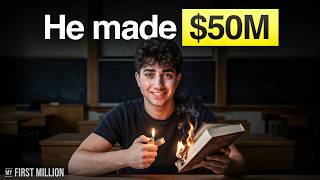
Zach is 18 & made $50m from an app. Here's the brutal breakdown of how he did it (and you can too)