What is genius?
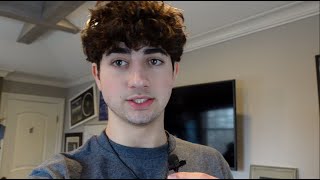
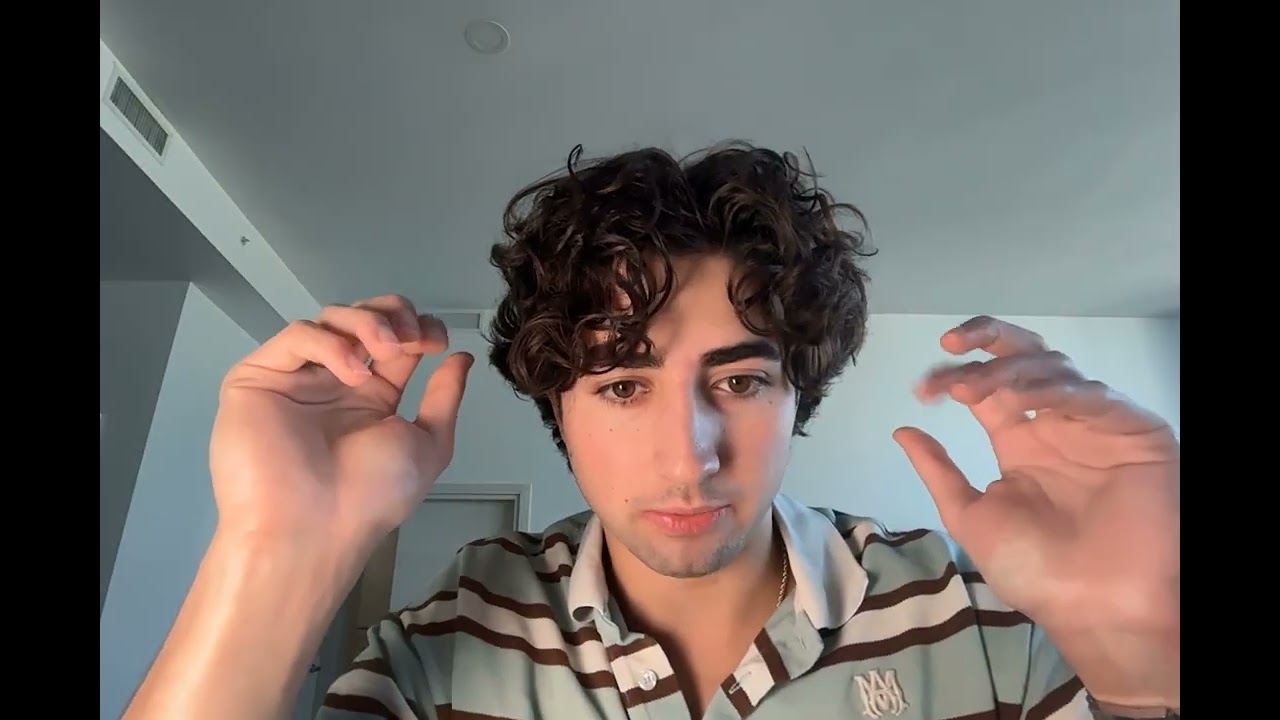
Zach Yadegari records a vlog while prepping for a Georgia Tech interview, celebrating Cal AI hitting $100,000 in revenue in 24 hours. He argues genius isn't high IQ but relentless work and contrarian thinking, citing Edison and Hamilton as examples.
Chapters
Yo, what's up guys? It's Thursday afternoon, 12:06. I don't know if you can see my phone. PM on a Thursday, and I'm actually about to go to Georgia Tech, to Georgia, to see Georgia Tech for a scholarship interview. I don't know if I would want to go to Georgia Tech. I don't really care about the scholarship. The reason, the whole reason I'm going is just to tour it, see the vibe there. As I've spoken about recently in my other videos, I'm really just going to college for social life. So trying to find where to optimize. It's not just about fun. I'm not like a super big party guy. I usually don't drink. And if I ever drink, which is very rare, it's like barely anything. I've never been drunk, drunk in my life. So I am looking for somewhere where I could be around the highest quality people that are on my wavelength. That are also fun. But yeah, just wanted to talk. Not sure exactly what I wanted to talk about. Just decided to pick up the camera and record because a lot of you guys have seemed to like my last videos and found them inspiring, which is my whole goal with this, is to show you guys that it's very possible to do what I'm doing. You could do it yourself. We just hit a massive day. On Kali. Let me show you guys. We just did, we just did $100,000 in the last 24 hours. Let me pull this up right now. Let me pull this up. It's absolutely crazy. So right now you'll see it says $99.95K, but let me refresh because that's outdated by like an hour. And In the last 24 hours, we had $101,000. Is the last 24 hours. That is absolutely insane. It's, it's nuts. When we launched Call AI, it was about 9 months ago, and the goal was to be making $100K a month. By January. Now it's February and we just did that in a day. That is insane. I think I've grown a ton as an entrepreneur, as a person since then. I've changed a lot. I've learned so much, so many valuable lessons even outside of entrepreneurship. I think being on this extreme or so level of entrepreneurship it has taught me many things which have impacted my actual life. Mom, what are you doing? I'm going to help you pack. Let me help. Okay, well, I'm recording a video. Can I watch? No, you cannot watch. Okay, so as I was saying, I'm not sure what I was saying, but some things that are top of mind right now are paid ads for Call AI. I've personally been managing the ad buying. And I have a few strategies in mind. We're starting to try out new things like web funnels, and it's all very exciting to be experimenting with. Another thing top of mind is that a big problem that we have, probably the biggest, is the narrative around Call AI. If you look up Call AI, there's so many people online that will tell you it's a scam. It doesn't work. It's fake. Well, I guess not fake, just that it's a scam. But I think this comes down to a lack of education overall. So we never say Calla is 100% accurate. We never say it's exact. We say it's about 90% accurate and that it greatly depends on the photo you take, the angle you take it, and what is shown in the image. For example, if I took a picture of this bag, it's going to take a guess. Maybe there was a bagel or something in here. But it's not going to know if you open it up and you take a picture of the bagel. It's going to be better, but it's still not going to be as good as if you took a picture of an open bagel so it could see exactly what was inside it. And even then, it's not going to know the exact portion sizes of how much cream cheese you put on the bagel, for example. But it will do a rough guess and then you can— well, a rough estimate based on the picture. And then you could go in and edit. So even though it's not 100% accurate, it's 90% on average, which is good enough to lose weight. And it also makes it a lot easier to track because if you're someone that is trying to be the next Mr. Olympia and you need to track with 0.1 decimal accuracy, then you can use the CalliEye scan as a starting base. And then adjust the measurements as needed, which in my opinion is a lot faster than typing everything in, taking a picture to populate the ingredients instead of typing it. And so the goal is to educate people on this topic. I'm going to start making videos myself, ideally every day on the TikTok, but hopefully I'll be able to hire someone that can do it full time. I think there's a lot of cool things they could do. YouTube experiments, like YouTube long-form videos doing different experiments, tracking calories with Cal AI, comparing it to nutritionists, and then short-form TikTok-style videos doing similar things and just explaining things like in the way I just did. Well, this camera is actually kind of hard to carry. I have to start going to the gym more. I've actually been lacking on that front and it's not good. It's definitely not good. I have to get into it. It's so easy to justify not going because, yeah, I could still be productive and not go. I always have important work to do, but health is something I think adjacent to working on my business. I want to build myself at the same time I'm building my company. So I need to be doing that. There's something interesting I learned about the game of chess. I say this because I have a chess set right here. Something interesting I learned. Okay, it's very bright, so hard to see, and this is a glass chess set. But what I learned is that chess masters, the skill of chess doesn't actually translate as much as you would think. In other strategy games. Chess masters usually just end up memorizing all of the different positions, the different common positions, endgames, how to start the game openings. And if you change what each piece does, or you change the starting pieces you get. It was something along those lines. So because they memorize it, the skill and strategy that goes into winning chess games doesn't translate as well to other board games. For example, I love learning, and I honestly really don't enjoy reading. There are so many books I want to read because I've had the thought recently that if I was next to Steve Jobs while he was founding Apple, next to Elon Musk while he was growing SpaceX and Tesla, next to Bill Gates, next to all of these great people, Alexander Hamilton when he was helping with the Constitution, I would take away all of these lessons that I could directly apply. To build something myself. And I say this because I built Cal AI. I firsthand saw everything that went into it, and therefore I know I could do it again. I know I could build another app and also scale it up tremendously. Theoretically, I'm sure that the books are missing many details, but if I could read every book out there about these people, I would pick up a ton of the lessons that I would have picked up if I was with them and alongside them. So I've wanted to read more. I like listening to audiobooks because I can read them a lot faster. They're also easier to consume, but it's hard for me to make reading an active activity. I usually only do it when I'm doing something like driving. So sometimes I'll intentionally go out of my way to go on a drive for some particular reason. Where the real purpose of the activity is to read, even though that's not what I'm doing. At the same time, what I said about reading these books is that something I've learned recently is that almost all information people post online or talk about publicly, even on podcasts, is either wrong or only half the picture. It's very calculated what they want to share with the public. And the actual alpha, the actual sauce and secrets that they use to grow their company came from are more secretive and they're not going to share that publicly. The book I'm reading right now is the biography of Alexander Hamilton, and it is great. It's super, super interesting to learn about the past and what his life to learn about the past and what his life was. He's an extremely inspiring figure, and he's said a lot of things that I think are very interesting. Actually, I was listening to a Thomas Edison podcast about Thomas Edison yesterday on the How to Take Over the World podcast, and I recommend it. It's very good. I've been listening to it recently, and it talks about his view on genius. And his view on genius was that no one man is a genius and no one man creates an original idea. He believes ideas come from and are almost extracted out of the environment and that genius is almost stumbled into and you catch it, you catch genius. If you are always working, then you will catch more acts of genius. Than someone who's working less than you. So this actually would support how Elon Musk operates. He says at least that he works about 120 hours a week. So if he's working that much, he must be catching more genius than the average person working, the average founder working. Even something else interesting about Thomas Edison that I learned is that he really brute-forced his way to inventions. He didn't go to school, so he did not know the scientific method. So instead of starting with logic and reasoning before jumping into a task and creating a whole plan, he would just jump in. One example is that he was trying to find a material for, I believe it was a transmitter of one of the first telephones, and it was a race between him and Alexander Graham Bell. Alexander Graham Bell, he took the more scientific approach. He thought about it very carefully, and based on previous knowledge and some theories backed by what could be potential clues, he experimented with new materials to improve the transmitter. Thomas Edison, on the other hand, just brute-forced his way. He tried any material he found Apparently he tried frog guts, pig, and a bunch of metals as well. At the end, Thomas Edison's was far, far more successful than Alexander Graham Bell in terms of how far it could transmit the voice without it getting distorted and lost. And I think these are good lessons to take away. I've actually thought about this whole notion of intelligence recently, and I wonder— I've wondered how much it actually matters for success. Will I be able to create something that can change the world as much as I want to change the world and aspire to change the world if I am not— if I don't have as high of an IQ as someone like Elon Musk. Also, on this note of IQs, if you look up any inventor or anyone who was one of the richest people in the past, like Steve Jobs, for example, it will say his IQ is somewhere between 140 and 160. If you look up Albert Einstein, they estimate his is 160. And all of these people, they didn't actually take an IQ test and publicize it. This is, this is an estimation, but I've thought a lot about this. An estimation based on what? I think it's just an estimation based on their success. So If Steve Jobs didn't create the iPhone, no one would have thought he had an IQ as high as he did. But because he created an iPhone and changed the world, people assume he must have had this enormous IQ. Ah, I mean, Elon Musk, for example, he's still alive today, but even him, he didn't publicize his IQ anywhere, and people estimate that his is enormously high as well. But that's just based on the fact that he's a trillionaire sending rockets to space. So is this something where as a society we will— we— maybe this means that as a society we attribute success and innovation only or mainly to having a high IQ. And so if you have done something extraordinary, you must have a high IQ. But I don't actually think that's the case. I think it comes down to many other things. And to be honest, it's not like I knew him personally. But from my— from what I've heard about Steve Jobs, it seems like He doesn't come off as the person that was the genius mathematician that's in my math class that would have gotten a 1600 on their SAT the first try because of their high IQ. No, but he does seem like someone who thinks like no one else does. A true contrarian, someone who isn't afraid to go against the norm. The type of guy who experiences so many cultures, living as a monk to change his whole perspective on life. And I think that's the kind of founder, the kind of person that I want to be. And I really do believe that's what it takes. And as I'm pacing around my room right now, talking to a camera, looking like a lunatic, I think that was honestly the epiphany I needed. I just was kind of rambling for a little bit, but I've thought about it a lot and now it is becoming more clear to me than it was before recording this. I truly believe in myself. I always have. Obviously I've had doubts in my abilities sometimes, everyone does, but I always come back to believing in myself, and I always— I know I can accomplish anything. I don't know why you guys stuck around for my rant. I hope you guys got some value from this, but I'll probably make a video a month at least. We'll see how people are receptive to this style. I'm honestly just documenting. Even if no one watches this, I don't care that much. Ideally, someone will piece together all of this content in a few decades and make some very cool documentary. Alright guys, see ya.
More from Zach


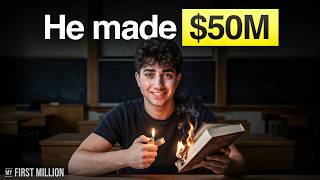
Zach is 18 & made $50m from an app. Here's the brutal breakdown of how he did it (and you can too)