She’s among the top 100 women who changed the world (Ft. Chiara Corazza)
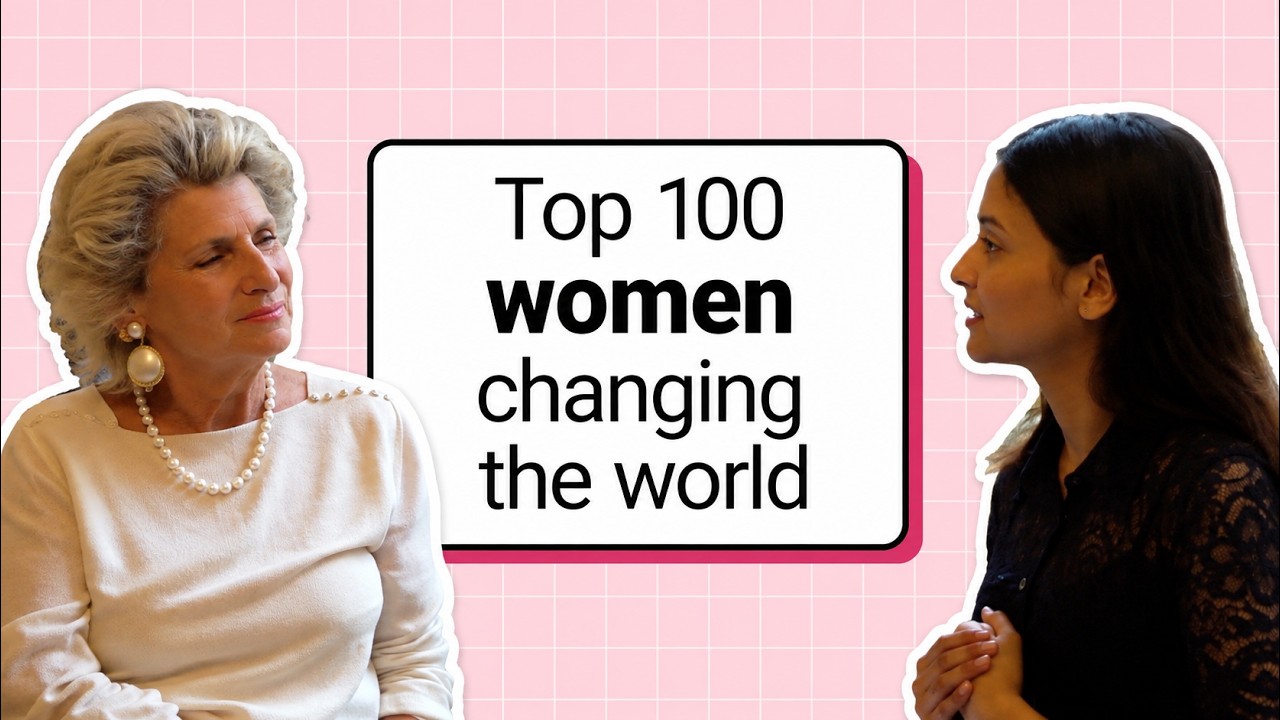
In this Odd Quest podcast episode, host Speaker A interviews Chiara Corazza, a former journalist turned policy influencer who contributes to the Women’s Forum, G7, and G20. The conversation centers on the systemic barriers that limit women’s participation in STEM, tech entrepreneurship, AI, and cybersecurity, and how these gaps threaten societal resilience and economic growth. Chiara highlights stark statistics—only 22% of AI professionals and 11% of cybersecurity experts are women, and women occupy just 3% of CEO roles in the world’s top 500 firms. She argues that increasing female representation is not a matter of equity alone but a strategic necessity for security, innovation, and GDP growth. The discussion moves to concrete policy levers: France’s Copé‑Zimmermann quota law and the newer Rixan law, which mandate gender‑balanced boards and executive committees, showing measurable gains (women’s board representation rising from 11% in 2011 to over 46%). Chiara stresses the need for inclusive leadership that blends technical STEM expertise with broader managerial skills, and she calls on governments, businesses, educators, and families to nurture girls from early childhood through lifelong reskilling. The episode concludes with a rallying call for citizens to vote, support legislation, and personally commit to advancing gender parity, underscoring that numbers, laws, and heart are all essential for lasting change.
Chapters
Welcome to the Odd Quest podcast. Today I have a very special guest with me. This is the place, as we know, to to get success mantras of tech entrepreneurs, investors, and this time policymakers as well. So I'm extremely thrilled to to sit with you, Kiara. You've done so much for for women, for the society. This episode is for anybody who's interested in how policymakers and political figures can actually make a difference in the contribution of. Women entrepreneurs in tech, and my guest here today is here to help us with just that. So welcome to the show, Kiara. I'm extremely honored to sit with you.
Good morning. Me too. I'm so happy, and I just would like to add that I'm not finished my work. I still have plenty of energy to continue to have a positive impact and continue to do things not only for gender but really for the whole humanity. You started as a journalist.
How did you become a journalist in your career? And today you're the voice of Women's Forum, you contribute to G7, G20. How did this happen?
It happened because since I was really a child, I wanted to change the world in a better way. And at my time, I really thought that with my capacity to write, to make editorials, we could as a journalist influence things and make a difference. And then I had the opportunity to come to France by marriage, and I did an outstanding career where each time I had in mind to give back to the community for all what I'd received and how I could have a positive impact. And really, it was by chance I always relied on women when I wanted to carry on projects. I will tell you more then.
Interesting. So like we are speaking about women, right? We are talking— this is a broad topic and our focus today is tech entrepreneurship. You know, I remember that last time when I spoke with you, you told me there are several factors. It starts from the time— and you just handed me some of your notes— it starts with women getting into STEM, right? And then eventually you have VCs impacting How many women actually get access to funds? And there are so many factors, so I want to know your take on what factors impact.
First, we have to know that we are really living in a disrupted world. 85% of the jobs are being invented or reinvented. And what we know, that those new jobs, we don't know what they look like, but what we know is they're linked with STEM education. And the fact that it was not the time of the KAIST 15, 20 years ago. Now everything goes so fast, and if you're not there where you can really bring a contribution to this change, you're out of the system. And I take an example, AI. We're not talking only about ChatGPT, we're talking about AI. AI, it's an important issue. Each way we're living, acting, thinking, consuming will be related with AI. AI will drive our daily basis, our common life, not only big data companies, finance, everyone's life. And the issue is that you have only 22% of women active in AI. That means that these very well, wonderful, intention-wise engineers will just scale up what they know. They will just put in the algorithm the data that they know. And at the end, the risk is very high because in fact we will of course scale up stereotypes, bias, and the risk is that we just create a world that doesn't correspond to the need of each of us, but just of a very small part of those who decided what the AI will be able to do. And the second risk It's not only the AI that should be, of course, inclusive, and everything should be done to make this AI inclusive. It's also when you have this AI, those who will be giving the orders to the AI, what they need, what they search, will be extremely important for the results. And again, they are mainly men. And we cannot, in this polycrisis, in this so difficult period that we have, not having more women involved. Again, not to promote women, but because the society needs the talent of each of us. I always say, when you are in a war, and we are in a war, and not just in a—
Intuitive.
Yeah, in a really true sense of the word. When you are at war, the general, what he does, he takes all the talents, he takes all the resources, all the expertise because he wants to win the war.
Right.
And we're not using women's talents enough because of the fact that they are not in numbers in STEM education. Because for many reasons, maybe traditional reasons, maybe educational reasons, maybe again barriers and stereotypes, women are not enough active STEM, in all the fields of STEM. And this is not changing fast enough. We still have only 20% of engineers women. And by the way, what we did in G20, we really put the STEM education as the enabler, right, the catalyzer of leadership, women leadership.
It is indeed.
It is, it is, because this world needs that.
Yes.
And you see, it's the same for men. We need more men also involved in And you see, I was just saying in the G7, now I was just finishing my G7 virtual meeting with my colleagues, and I was saying, even if we talk about security, peace, defense, conflicts, women should not only be at the table negotiation as diplomats, of course. Women should not be involved to protect, to help, and to prevent crisis, but should also be able to prevent in terms of cybersecurity.
Indeed.
You know that, for instance, 2 years ago when the Games were in Tokyo, there were 5 million cyberattacks. 5 million, it's a lot.
That's colossal.
Here in France, in the next Games, by the way, for the first time in more than 100 years, Games will be completely equal. You will have the same number of athletes women and same number of athletes men. But guess what? There will be 5 billion potential cyberattacks, and women are only 11% in cybersecurity. That means that for our security, for our states, for our personal security, for the business security, there are only 11% of women active there. And that's a danger again. And coming back to the conflict, peace, and security, I really think that also to fight against fake news, disinformation, that brings to press not reliability, not reliable press, that means that you don't have a real press freedom.
Right.
But what is the reason? Because you don't have enough women, again, to fight against this fake news. this disinformation that is also at the source of many conflicts. Then you see the role of STEM is not just how many women will be in mathematics, right? Of course it's important. How many women will be, you know, in astrophysics? That's important. But it's also in key issues like conflicts, like security, like, of course, AI. Again, I repeat, this is so essential.
It is.
And I think that we don't find the miracle way to attract and retain more girls and women. They have to have the same opportunities that girls— that boys, exactly the same, since they are 5 years old, from schools to the boardrooms.
Indeed.
Lifelong story, all the time. And all their life, they should be skilled, reskilled, upskilled, cross-skilled. If I am at my age, I want to learn to code, I have to. It's no reason that I'm not. Able to learn to code and bring my contribution to society. It should be all around, and this is in all countries.
Continuous process. Yeah, I think what you've touched base upon is extremely important because, you know, out there when you try to understand this issue, you see people talk about the current state of affairs. Very few actually try to dissect the situation and see, okay, what is the root cause behind it? And I think again, when people think of gender diversity equality, they kind of feel allergic to these terms. But the moment you make them understand this is not just about us as women, it's about, as you mentioned, in the global interest of the country, of the security, etc. So—
If you want to build a bridge, you take the best engineer. Talent has no gender. You need talents everywhere. Again, if they are not in numbers, Women cannot express that. They cannot bring the contribution. Look, in France, you have only 3 women in the CAC 40, you know, the index of the Bourse. Those 3 women are, one, active in Orange Telecommunications.
Right.
The second one in everything that's urban management, utilities. Veolia. And the third in energy, Engie. 3 wonderful women. What they have in common? STEM education.
Yeah.
The 3 of them come from Polytechnique. They have the capacity because technically they know what to do. Our former Prime Minister, Élisabeth Borne, that I had when I was administrator, board member in RATP, you know, the transport. Transport, and Elizabeth Warner was the president of RTP. Again, polytechnician, she comes from Polytechnique. And I remembered her expertise when companies such as Cisco, Xerox came and was coming to explain, you know, we will make some economy in energy, you will save some, I don't know what. And she had immediately the competence to react without having notes, without having people telling her, and that makes a difference.
It does.
You see, it makes you reliable, credible, legitimate where you are. Then competence is what everybody, man and woman, needs. And that's why I'm really very involved in how to invent a new system of inclusive leadership in which you don't only have leaders capable— and it's not easy, true leaders, it's not easy to be— Capable to associate the best talents to bring where the vision wants to go, for purpose, for good, for something useful for the society.
Right.
Not only this, it would be also, of course, zero gender gap, as much men as women. I just remind that actually in the world in 2024, we only have 6% of women CEOs of the 500 first companies in the world. 66%. And again, it's linked, it's always linked with STEM because many companies need technical, digital, or engineers' competencies.
That is very true, even for the C-suite positions. I mean, that's what they look for. I mean, that's the thing, you know, when you look at companies, they say, okay, we have 50/50 policy, but then you see that women are not in leadership positions. They are mostly positions that don't have much influence.
In support positions, very often in support positions, very often that's a very important support position, but they're not those who take the strategic decisions. Because again, if you want to make a decision on something that's very technical, you need the competence. You cannot— if you're an expert in human resources, you cannot say if this bridge is good in this part of the world, or if there is an earthquake coming, because you're not an expert in geology, in geological structure off the ground, etc. Then I was coming back to the leadership, inclusive leadership. For me, inclusive leadership, it's this, it's open-mindedness, it's tolerance. It's very rare to have people able to listen and then to take a decision. This is inclusive leadership, to listen to people before taking the decision. And it's also, of course, international open-mindedness, open-minded in terms of religion, open-minded in terms of tolerance of everything what's going on, you know. Really integrate the different points of views before taking decisions. But it's also the capacity to have at the time financial, management, marketing, let's say business typical competence, but also the part of competence coming from STEM education. A mix of the two that will make an inclusive leadership leader. And that will favor also the arriving of new talent of younger generation that will mix these two, and that will be of course much more also gender favorable for women who will be easily accepted in this kind of inclusive leadership.
In these kind of positions. So to me, the key takeaway is for the governments and for the countries in general to start with the root cause, which is get more and more girls into STEM so that eventually they can build on, as you mentioned, the Governments, businesses, and civil society—
mothers, fathers, teachers— they all should be conscious of the importance of that because you cannot leave the government alone.
I totally agree. It's like, and that's why on this podcast as well, I want to have all kinds of stakeholders. You know, just can't hear one side of the story. How important do you think are laws? Because they say we don't want to have any kind of laws imposed on us. We know talent has no gender, so we would just see whosoever is capable.
It's based on experience. It's based on success stories, what works and what doesn't work. Unfortunately, we would all dream that the world could be changed without laws. It's impossible. If you want to respect human rights, you need laws. And even with laws, it's difficult. If you want to respect human dignity, you have to punish those who don't respect it, even if you don't like it. And that needs laws. And in gender equality, All the countries who don't have a legal frame, you don't have more than 26% of women in the boards.
Interesting.
No one.
Yes, I know you mentioned that earlier.
I mentioned that because I really count, check, verify, because at the end of the day, I was not a quota woman, and when I was on the board, it was before quotas existed. But now I see it works, it accelerates things. Look in France.
Yes.
In France, we were 11% in 2011. Now we are more than 46,3% in the boards.
That's amazing.
Thanks to a law. Yeah. Copé-Zimmermann law. And even better, look, I think that this is a law that everybody envies. It's the Rixan law. And I've been very active to implement it with Marie-Pierre Rixan, who is a wonderful member of the Congress who really fought to get it. By the way, it has been voted unanimously, even if we were during the COVID and maybe during the COVID people could say we have other priorities. Despite this, it was voted unanimously. And why the board in bias this law? Because this law goes deeper on. It's not only the board. The board is very important because the strategy of the groups.
Right.
But it's also very important that the executive committees That means the operational one, who on a daily basis bring the purposes, the vision, the ambitions of the companies and the performance, of course. And in this, you have no country with a law apart France. And this law—
Yeah.
It's very simple. It should just oblige the companies to prepare a pipeline of talents in order to have the number of women required to be 30% From now to 27, and 40% 39. It's absolutely reachable, possible, because you have the talents. But you have to be prepared. You cannot just decree, I will take somebody. And what is very important is that you not only promote a person because you need a number, because you need a woman, because in a number, because in the executive board You cannot take the risk not to have people who are completely needed to the company. Then you have to pay the right position, those who really make the job, they make the job on a daily basis. Then this is extremely interesting to see this law, and it works. Even after 3 years, 3 years, we are now 9% more. We are almost 27% more.
That's quite an exponential growth.
Exponential.
Right behind you we have Christine Lagarde. And I was watching one of her interviews at the European Parliament, and she was speaking about how not having enough women in the European Union can impact GDP. For example, by 2050, she predicted like the GDP per capita would increase by 9.6%, which is almost €3.1 trillion, which is significant. That would be the impact to the European economy. And she said that—
And worldwide, it's at least 20%.
Look at this.
28 trillion.
And she mentioned the same thing, like if we do not have laws, if we do not have targets, it's gonna take way more longer to get to that goal.
So, um, first let me say all my admiration, affection for Christina Gardiner. She is a great, great lady and she did so much for women all over the world. She did much not for only women, she did so much for the economy, for the society. And she has an enormous heart, of course competence, but she's really somebody that, I mean, unique. She's incredibly wonderful. And I wanted to say that this is my message. I don't know when the podcast will come, but this is my message. If we women want laws that are fair for us and for the society and for the economy, Not only have to go to vote. Look the European Parliament. We have to go to vote. If we don't, if we let the others get the place, then we cannot say okay we don't agree what has been done. Let's put the place, but put in place the person who represent us, our values, what we want to be done, and we will ask them then to do what is needed. And when I talk about going to vote, it's of course the European Parliament, but it's in each country. This year there was 5.2 billion people invited to go to vote. We have the chance to vote. Many countries don't have. Look, Afghanistan.
Yes, exactly.
We have the chance to vote.
We have.
Let's go and choose who wants to be there to represent our rights. Our willingness to change things.
That's so insightful, Kiana.
You know, the important things— numbers are important because if you don't have numbers, you cannot progress. But what is important is that you put your heart in what you do. That means that when you really want to help a company, if you really want to help a startup, you will find the money. Because if you really want to To change things, if you put all your determination and all your heart, you would succeed. Especially young people like you with passion, energy, and the willingness to achieve something.
That's a million-dollar advice. I think like for everything that you need, you're just one step away from it.
Never give back. If you want something, never give back. Trust in yourself. Go ahead. Never get back.
Wonderful, Kiara. You are a true, true, true inspiration for everybody out there. I'm so honored to to have this conversation with you in in Paris, and keep doing, keep inspiring us. Like let me just tell you, you are a big inspiration for women out there. Not just women, men, countries, governments. Thanks a lot for for.
Thank you. And now act, engage yourself, and go.
Indeed.
There you go.
More from Abhilasha


The Best Business Leverage Isn’t Financial #business #entrepreneurship #leverage

If you love it enough, you can make it work #foundermindset #WaltDisney #startupadvice