Adam Markel on The Daily Grind Podcast - Episode #102
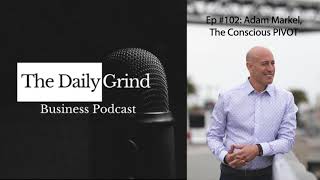
Adam Markel left an 18-year law career and spent two and a half years reinventing himself. He talks about his book Pivot, why pain forced the change, and his approach to marketing built on what he calls 'more love' instead of the usual hustle.
Chapters
Make it onto the podium. And that's the exact same thing with us with entrepreneurs, with business executives. We've got to be able to recover quickly.
Good morning everybody. Colin Morgan here. And we are back with another episode of the Daily Grind where I speak to amazing people, dive into how they got to where they are, share with you the obstacles that they had to overcome to hopefully get you up off your ass and start living the life you've always wanted to live. This show is for grinders, people who are motivated to change, dedicated to taking action, and driven to being great.
Foreign.
Today's episode is brought to you by Bulletproof Coffee. Just like the food you put into your body, the quality of your coffee matters. Bulletproof coffee gives you the mental edge and energy you need to thrive. Crappy coffee can SAP your energy, hurt your performance and give you that gut rot. This is not what Bulletproof Coffee does, so get started with it today. Go to dailygrindpodcast.com on the right hand column you're going to click the link for Bulletproof Coffee and you're going to see what all of that hype, talk and excitement is all about again. Daily grindpodcast.com the right hand column. Click the link for Bulletproof Coffee and get it started today. If you're a coach, consultant or service provider and you've been struggling to figure out how to get a consistent flow of clients to your business, then here's something that may be of interest to you. My good friend and someone I recently had on the show Exodus Justin is giving away a free training in which he'll be walking you through exactly what you'll need to do to attract anywhere from 5, 10, 15, even 20 new high paying clients per month to your business with consistency and predictability. So here's what I want you to do. I want you to daily grindpodcast.com in the right hand column you're gonna see a banner ad which says coaches and consultants. It's gonna have Exodus name. There's a. You're going to click on that link and sign up for the webinar. If there's one thing I've learned is that when an expert like Extus comes along and offers free training, you take advantage of that training. So go ahead, sign up and we'll see you all there. With us to share his story in the Daily Grind today is Adam Markell. Adam Markel is a transformational teacher who inspires, empowers and guides people to live authentically, purposefully and powerfully from their hearts. He's Trained thousands of people from Singapore, Europe, Canada, Malaysia, Vietnam, Australia, and all across the United States. Adam uniquely bridges the worlds of business, psychology, and spirituality to facilitate massive and lasting personal and professional transformation. Today, Adam shares some amazing information and insight. So grab a pen, grab a piece of paper, and. And enjoy today's episode. Adam Markel, welcome to the Daily Grind. How are you today, brother?
It's good to be here. It's good to be alive. Thank you for having me.
It is good to be alive. And say, Adam, for those out there who are being first introduced to you, if you wouldn't mind just expanding on your intro a little bit and share a little bit more about who you are and what you do.
Oh, man. Okay, so who am I? All right. No, I. Seriously, I love that question. It tees it up perfectly for me. First and foremost, I am a human, good human, blessed human being. Married to my college sweetheart, so somebody I met, gosh, it's a lot of years ago. We're married 28 and a half years at this point, and we have four amazing kids. Most important thing is that they're healthy. And then next to their health is the fact that they're doing great things in the world, they're contributing, and that makes me feel great. So I'm a dad. I'm a husband. I'm an entrepreneur. Been blessed to be an author, following my dad's. My own dad's footsteps, although he writes fiction and I write nonfiction. And the books that have come out, like Pivot, the art and science of reinventing your career in life, have really been well received. So that's been a blessing. It's enabled me to speak about the topic of transition, career and life transition. I've spoken all over the world on that topic. I've done a lot of training and speaking as well. People know me from that arena because I ran a large company in the personal development and business development space for a lot of years as well. So, yeah, that's a little bit about me. I love life. I mean, that's the most important thing, I think, to take away about my bio is that I'm a lover of life.
I love it. And you're doing some amazing things. And one thing I always like to dive into, Adam, is like, how did you get started in this? How did you find the idea of, say, your book Pivot? And what led you to doing what you're doing now?
What led me to do what I'm doing now is probably. I mean, the catalyst was pain. It's not. Not sexy. But it's true, I was a lawyer. So I spent 18 years in the practice of law and from about the seventh or eighth year on, you know, that kind of thing about the seven year itch. I guess instead of getting the seven year itch in my marriage, thankfully I got it in my, I got it in my business, I got it in my job. I really, really was not in love with my work anymore. I woke up in the morning like we all do, put my feet on the floor, it was dark out, you know, got up early, getting ready to head off to, to do another, another 12, 13, 14 hour day, which was pretty typical for me at the time. And I just had no energy, had no enthusiasm. In fact, I felt the opposite. I felt dread, I felt such a sense of almost impending doom and make it really dramatic. But. And that went on day after day, week after week, month after month, year after year, honestly, year after year, until the pain got so great I couldn't stand it anymore. And I came home from work one day, one night, and I had missed the kids going to bed. I routinely tried to get home for dinner and get home to read him a bedtime story, and more often than not I missed those things. And I walked in and I looked at my wife and I said to her, I go, if I keep doing what I'm doing, you're going to be a widow. At which point we both took a deep breath. And she didn't remind me of all my responsibilities because I wasn't saying, hey, I want to quit my job tomorrow. And we had plenty of things to take care of, houses, cars, all the usual responsibilities people know that, you know, have when they have kids and stuff like that. She didn't remind me of that. She knew I knew that. We took a deep breath, said, we'll figure it out. And two and a half years later, I elegantly closed my law practices down and other business ventures and was doing something that my heart was calling out to me. So instead of having a, you know, the proverbial midlife crisis, I ended up with a midlife calling, which was really, really something I didn't predict.
So, yeah, really interesting story. And I kind of, you know, I can sympathize. I know a lot of people out there say in a similar position, they're listening now and they're kind of, they may have job, but they're sort of dreading it. And I like how you were able to kind of go home and realize like, I need something, something needs to change in my life and not Just quit. But let's put together like almost a plan in order for us to transition out of what we're doing. And I'm sure like two years later now you're kind of an entrepreneur, so to speak. Like, things are probably a bunch different. Like the paychecks aren't coming in early, the job security is not there. As you know, as an entrepreneur, like, what were some of the behaviors that you had during that time which helped you in that transition?
Yeah, you know, Colin, I want to just go back and fill in a couple of blanks too. So real quick, the, the. There's no question that a plan was required. And so ultimately that two and a half year period where I was reinventing myself. So the book I wrote was all about the reinvention process. And it very much is a process. It's not about to me anyway. It's not about quitting, quitting your job or moving to Fiji or doing, doing the thing that, that often is, is, you know, sort of seen in the, in the newspaper or on TV and stuff. This romantic idea that you've got to, you've got to, you know, burn the ships and, and jump ship and do all these dramatic things to make a change in your life. And what I discovered is that small changes can produce massive transformation over time. Small little changes, changes that don't have to trigger all of your fears. I mean, it's good when you fears get triggered. When my fears got triggered, it was great because I got to deal with them, I got to face them, which is really a profound work in and of itself. A spiritual practice in and of itself. But yeah, I, over two and a half years used a process to change, to create a plan B while I was still working my plan A. And then, yes, at the end of that period of time when I closed down my more familiar channels for creating money, for example, I had new challenges, new things to deal with. And now it's, gosh, almost 10 years later. And I've taught this process to people or use the book as a teaching tool for folks to learn this all around the world. And that's been remarkable. And I run into a lot of people who are entrepreneurs. So my next move, just so we're clear, is two and a half years later, I was training and traveling around the world teaching this subject matter and getting paid quite well to stand on stage. And I know a lot of, of people are want. Among the things they want to pivot into is public speaking, which is something that we also work with folks on and I was doing that. I was training them and teaching and doing that kind of thing. And then I ended up in the. In the role of a job. I had ended up getting a job for the kind of the first time since I was in my early 20s. And that was to be the CEO of a company that was in that. That personal development space. And I did that for six years. And then thinking, oh, you know, like, pivots are gone again. You know, like, I'm not. I'm not thinking about any major pivot coming anytime soon. I'm sort of working really hard and all that kind of thing, but I'm working for a paycheck and. And thinking that this is pretty stable and pretty secure, and all. All of a sudden, I sit down with my partners at the time, and we don't see eye to eye on the vision for the company going forward. So I end up leaving. I exit this company, and I'm like, you know, right back in the soup, Right back in the mix of, you know, what the pivot process was all about, including what you described. Pure entrepreneurship. Waking up every day with this clean slate and this creative palette and no guarantees, no guarantees of money, no guarantees that things will work out the way you plan. And more often than not, it's basically every day you get punched in the gut or in the head, and you have to. You have to really master the craft, the craft of being an entrepreneur as well as the craft of pivoting, because that is the. That's the one constant for me, the great constant in the universe is that everything is changing. So that's an oxymoron of sorts that you know that the universe, the constant is change. But for me, the constant within that process is that to be able to embrace change and utilize change, and the creative opportunities that it creates for you are the greatest. It's the greatest opportunity for fulfillment and for wealth creation that I've ever discovered. And so that's kind of leads me to today, where just like a lot of people, I'm an entrepreneur and run a business, and I have teams and I've outsourced solutions for things and whatnot, but there's still no guarantee. There's never a day you wake up and there's a guarantee other than that waking in that moment when we wake up, what we know is that we're guaranteed that today we have a purpose. That purpose is to live, to live fully, to enjoy our lives and to be of value to other people. And that's the only truth to me that I know is universal truth. That's why we got today. And not everybody gets today, as you know, not everybody wakes up every day.
Yeah, absolutely. You know what? I love that concept. And you had mentioned challenges. And I think it's super important for listeners to understand, like, you listen to Adam or you listen to other people on the podcast, and we hear about everyone's successes, but I also think it's really important to hear about people's, you know, some of your failures and obstacles because, you know, they've been exactly where you are before. So for you, in terms of challenges or obstacles, like, what's been the biggest one for you as an entrepreneur?
Well, I would say everybody's going to nod up and down when I say this one. Marketing. I mean, I've been studying marketing for so many years, man. And it's just. It's great because it's changing all the time, right? So the landscape of digital marketing in particular is so disruptive just trying to keep up with the changes to the algorithms on Facebook. I mean, everything is changing. And that's why I say the pivot, the tools of pivoting is so important to me because I'm pivoting all the time. I pivot in my mindset. I pivot from a place, from a standpoint of self awareness. I pivot so that I'm taking better care of myself, so that I'm more resilient. Because all the changes that we're talking about, so marketing being one of them. I mean, I could get pretty, pretty upset about things not working out at times with a Facebook ad or with some other thing that we're investing our teams or myself investing our heart, soul into writing really great copy. And then people don't respond to it, or they don't. Or they don't take the action that we want them to take. I mean, and it can get really depressing even, because you don't know exactly what. You don't know about what's not working at times. So we've learned to be. To be not only okay in those moments, okay with ourselves, okay as a team, to come back. Not just to come back to the drawing board, to, you know, do it again and again and again. Which is part of the. Which is part of it, by the way. Tenacity and the. That ability to come back to testing, come back to a place of knowing that you. The more you test, the more you discover what doesn't work, the more you know what does work. I want to repeat that. When we know what doesn't work. When I know what doesn't work, I know what does work. I know it sounds counterintuitive in a way, but when we examine the things that we know don't work, it tells us, it informs us very much what might work, what could work, what does work often. So it takes humility to be in a place like that. So that's a practice for us to be more self aware, to be okay with that process of testing and finding out and often finding out what doesn't work. And we've also got to be really resilient. So part of what we do as a team ourselves, when we're feeling that depression or we're feeling that sort of the energy being sucked out, the getting kicked in the gut kind of feeling, is that we go back to rituals, rituals that help us to be more resilient, that help us to recover and to bounce back. And there's even some really incredible studies. Harvard Business Review produced a study not so long ago about looking at business executives and entrepreneurs and comparing them to high performance athletes. And what they found is that those athletes recovered more quickly. Meaning the highest performing athletes in the world, the ones that win the gold medals and win the biggest championships, recover faster than the ones that come in second, third or, you know, don't even make it onto the podium. And that's the exact same thing with us with entrepreneurs, with business executives, we've got to be able to recover quickly. And those rituals for recovery are part of the key.
I love it because I think it's super important because I think a lot of business owners, you probably see it like they're reluctant to change. They're either stuck and they love their idea or their business model and they're not open to looking outside the box. And being curious is kind of what you're saying. And for you, like I'm sure a part of it, when you're talking, when you talked about marketing, right, like things are changing. It's 2018. It seems like there's a new marketing, there's a new way to market your business every single day. A part of being open to change for you, I mean, correct me if I'm wrong, is probably through self educating yourself, wouldn't you say?
Oh my goodness, I read all the time. If I could devour books 10 times faster, I would just don't have, I've got to take, I think I've got to get one of those speed reading courses or something like that. But. But in any event, yeah, it's just what you said it's curiosity. It's that curiosity. And curiosity is very much more child, it's child energy. Yeah. And I don't mean childish energy, obviously. I mean this, this looking at the lens, looking at the world through a lens of, of a child's eyes, which is curious, which is not knowing, which is not ego based. It's, it's this beginner's mind in Zen, this apprentice mind in Zen. And I think that's, that's what keeps me enthusiastic in part. It keeps me feeling like, yeah, we're gonna figure it out, we're all gonna figure it out. But we've got to be curious about that and not beating ourselves up about what's again, what's not working. And that's a big piece of it. That really is.
Yeah, absolutely. Love it. Now, Adam, one quick question before we go to a short break here is I always like to ask for you. I mean, you have done a whole bunch of different things. Now you're doing what you're doing, you're super successful. You really love what you do. I'm wondering if you could go back in time and you can choose the age, but go back in time and offer your young self one piece of advice or a piece of guidance, what that would be for you.
Love that question. I would go back to my younger self. I don't know what age it would be. Maybe I'd be 17 or something like that. I mean, I don't think we know very much when we're those at that teenage point in our lives. I know some people were pretty purpose driven at the time. They knew they were going to be a doctor, a lawyer or astronaut or whatever. They knew they were going to be an Internet marketer right before there was an Internet. There are those some people who've had it dialed in long ago. I don't know too many of those folks. I would go back to that point time and just whisper in my ear a couple of things. One would be that I want you to move forward in your life with an open heart and, and, and, and be fearless not to not have fear, but to be able to open your heart and be heart driven in spite of fear because everything's going to be all right. And that is, that's advice. I think we, well, I'll stick to myself. I would have loved to have had from my older self when I was younger.
Yeah, you know what, I think a lot of people can take that advice with them. And now everyone, we're just going to take a lightning quick break Hear from our sponsors and we'll be back with the overtime round. Today's short break is sponsored by Plan to Profit. Whether you have an idea and you're looking to take that idea and see if it makes sense, or even how to start with that idea, or maybe you're in business and are looking to grow and scale your company to the next level, or maybe you're someone that's just unhappy in your current situation and you're looking to transition out and you need help. Contact us at Plan to profit. Visit plan, the number 2 profit CA. Go to the contact page where you'll have a chance to book a free 15 minute consultation with us again. That is Planthenumber 2 Profit Cat. Adam, we're back. You ready for overtime?
Oh, bring it on, man.
Love it. Adam, what motivates you to keep grinding? Like, what gets you out of bed every day and just fires you up to do what you do?
Oh, that's easy. We get to impact people's lives in a really positive way. And that may sound, I don't know, like we're tooting a horn or something, but it's really not the case. We just get the feedback from folks that have either been through some process with us, whether it's reading the book or it's the public speaking thing, or it's the pivot program we have online. And they tell us routinely how it's made a difference and where it's changed things for them and how the change has been lasting. We hear from people all the time. So I know this entrepreneur's road and even the road of people who are in a job that may be listening to this right now, to be fulfilled is not an everyday. It doesn't feel fulfilling every day. And we've got to create that fulfillment for ourselves. So to me, I define purpose as our ability to express our true presence. So that's what, when I think of purpose and what purpose means and being fulfilled, it means that I'm going to show up as my true self and my divine self and the presence that I am in what I do. So I love, I love people. I love to tell people how much I love them. I love to express my heart. Sometimes my heart is, is really when I'm expressing my heart, sometimes I'm, I'm. I'm pretty tough with people. I can get in their face because I'm, I come from a place of, of love. And accountability is a part of love. Being able to tell people, speak your truth in a way that helps them to See them, to see something they might be, you know, a bit unaware of is an indication of love. I always think of great friends as the people who will tell you the things that no one else will tell you. They're not interested in whether you like them. They're interested in helping in some way. And good friends, well, they enable you. They'll tell you what you want. They will tell you what you want to hear and what will make you feel better. And that's good. There's nothing wrong with that, except that great friends are rare. I really wake up in the morning and I put my feet on the floor every day with a specific ritual. And that as I wake up, that's the first part. Duh, right? But I go. I don't take it for granted. It's not a duh to me when I wake up, because I go, right now, I'm taking a breath and I'm waking up, and there are people everywhere who are taking their last breath. So this breath I'm taking is special. It's sacred, and it's a gift, and I'm grateful for it. And then when I'm done recognizing that takes a few seconds, I realize I'm awake. I'm grateful. In the next moment, I declare out loud, I love my life. And I say it a couple of times, I love my life. I love my life. I love my life. And I put my feet on the floor and I realize I've got an assignment today. And that assignment is to help people to love their lives, to help them to open their hearts, to help them to be able to pivot in the moment and pivot ongoingly into the things that they. That are going to bring them greater fulfillment and greater joy and greater purpose and greater prosperity as well.
I love all of that. Now, I know you're a big reader because you mention it, you wish you could read more. But what's like, a favorite book that you're reading now or what's your favorite book, you know, that you've ever read?
Oh, my God. I don't know that I have a favorite book of all time. I have a lot of favorite books. But I'll say this. There's a book that I've been rereading lately, and it's the Greatest Salesman in the World. It's a little book that a lot of people know about and a lot of people don't know about. It's Og Mandino, M A N D I N O. The Greatest Salesman in the World. And it is a book that is transcendent in its wisdom application. It's a book from the early 70s and sold millions and millions of copies. I love, love, love that book. I love the book the Go Giver by Bob Berg. I love the book by my buddy Steve Farber, Greater Than Yourself, an incredible leadership book on leadership and business. I'm partial to our book. I love what people have said about our book, which is cool. And frankly, when I was pivoting in the last few years, again, you know, more of a. Of a. Of a pronounced pivot, I went back to even sounds crazy. But we have an audible version of our book, and it was tough for me to listen to my own voice. I mean, I'll just admit it, it was tough because I never liked my voice. And so it took four days to. To record that book in a studio. And when I was in that pivot, I said, listen, I've got to go back to the principles that I teach other people, because if they don't work for me right now, right in the moment where I was so comfortable and feeling like I'm sort of riding on the top of a wave, and then the wave, you know, kind of falls out and I'm coming over the falls and get crushed. If it doesn't work for me now, how am I going to ever stand up and talk to people about how this thing, how this thing can help? So it was a huge benefit to me to just go back to our basic principles as well.
Love that. Now, I know you had said earlier in the podcast about sort of rituals and habits. What's a daily ritual or habit that you do that is, say, attributes to your success or getting things done.
So outside of the habit, the ritual that I described earlier, that three parts, wake up, be in gratitude, put your feet on the floor and say, I love my life. I go into stillness early in the morning, so I don't pick up the cell phone. In fact, I'm lucky because my wife, she has her cell phone next to the bed, and she's the mom. She's the mom. So she. It's. It's ready to go if somebody texts her in the middle of the night or calls her one of our kids or stuff. So. And it's got the alarm on it. So my cell phone stays downstairs. And I typically don't even touch my cell phone for the first half hour of the morning. And instead what I do is I stay in stillness. I create stillness instead of, you know, the busyness that we're all so familiar with, which is you know, busy is a dirty word for me. Instead of trying to force things to happen or be forcing my mind to work in a particular way early on, what I do is I prefer to go with the flow. I want to allow for things to show up. So that creative process, whether it's to solve a marketing challenge that we've been having on our, how we've been marketing a product or service or something, or it's some other challenge that's shown up for us. I allow that stillness to be a place for creative exploration and for the things that the universe wants me to be focused on. They flow into my awareness when I'm in stillness. So I sit quietly for five minutes, I think about what it is that I'm going to do for the day in general terms, what my general intentions and goals are. And then I allow the universe to guide me to think about more specific things. And those things that come up to me during my meditation, that come up to me during that period of stillness, become the things that I focus on before 10 o'. Clock. So those are the things I call the critical inch. And I got that term from, from a. I think it was from a Richard Carlson book many, many years ago. I think it was the, the Don't Worry series. And he talked about the critical inch. And now I use the critical inch as a way to think about what are the three things. So again, this comes through my stillness practice or meditation. What are the three things that I'm going to do before 10am Each day? So each day it's something different. Those are the most important things. It could be that in my meditation, what came up was that I'm supposed to speak to the lawyer about that contract, or I'm supposed to talk to my accountant, or we're supposed to follow up. I've got a very important joint venture partner that I haven't been able to get a hold of and I'm going to do all those things. The most uncomfortable or the most critical things. I'm going to do those things before 10am and that's a productivity hack that I use in the morning. That's a ritual.
I love that. What a great piece of advice and a great thing that a lot of people can kind of grab a pen, grab a piece of paper, rewind and write that down. Because I think that that's going to help a lot of people. Now I know you said earlier that marketing has been your biggest obstacle, but for you, what's been your most successful form of marketing?
Ah, well, it's what we call More love marketing and what that is. So our company is called More Love Media and More Love marketing for us is the philosophy and the paradigm. So we are not interested in the old paradigm of marketing. I used to do, gosh, millions and millions of dollars in marketing a year promoting and filling thousands and thousands of people into rooms, into business development, personal development workshops and the like. And we did a ton of marketing. And to me, much of the marketing I see around this old paradigm, which is sort of you're wanting to market to certain people who are interested in something and then of course, sell them or promote something to them. And what's the problem with that for us is that it leaves a lot of people behind. So moral of marketing is, is a philosophy and a paradigm where we leave nobody behind. So when it comes to our social media marketing, when it comes to the development of our communities on social media, when it comes to our email campaigns and all of our email copy, it's designed to include everyone, to enroll everyone. So our speaker training is called the heart of enrollment, for example, and that's all about 100% enrollment, which means that we're never looking to close sales. Too many people still speak in terms of that old paradigm of, you know, closing sales and closing percentages. And we're not looking to close anything. What we're looking to do is open. We want to open relationships, and we want to open relationships that have no end date. We don't even talk about lifetime value of a client, which is again, you know, industry or, you know, very common terminology because there is no lifetime. The lifetime is, is unlimited. We want to stay in relationship with people and not. Not think of them in terms of a dollar amount per year or some other metric. As to that, it's not like we don't measure. We measure client. We measure the, the acquisition expenditures that we use to acquire new clients. We, we measure those things as well. But we're constantly looking at never leaving anybody behind. So whether a person buys something or doesn't buy, we want them to, through our company and their interactions with our company, that they're always in relationship with us, that we're going to serve them, we're going to continue to provide them with value, and that's whether they buy or don't buy. So we're looking always to just open relationships. That's the key distinction in how we've gained a lot of success in our marketing.
Love it now. Adam, we've heard a lot from you today. You shared a ton of Great content. We covered a lot of topics. I always say, say my audience listens back. They remember nothing, but they can go home with one thing or one thought. What do you want that one thing or one thought to be?
I want them to remember that their lives are worth loving. And so this transcends business and it transcends the money part and a lot of other things that we can get dizzied up by. So I imagine your listeners that are consuming this content are going to be of varying ages and varying experiences and ethnicities and political views and all the rest of it. So transcending all of that stuff, which is a lot of noise in a lot of ways, I want them to know how truthful this statement is, that they are worth that each of them is a divine being. And the most important thing that they can give to themselves is their own unconditional love. And if they remember nothing else but that, that they can practice giving themselves unconditional love. Starting potentially with those words in the morning. I love my life. It's just a small way to remind each of us that I get to remind myself that I love myself unconditionally. That would be the thing I'd love for them to remember.
I love that. What a great piece. Now, Adam, what's the best way for our audience to connect with you and learn more about what you have going on?
Oh, way cool. Well, a few things. So if there are people listening that would love to find out where they are in the process of their own pivot, and we're all pivoting. So everybody is always reinventing something. And we've got a great community of folks that are doing just that. And it's tremendous support that they provide to each other. They can go to startmypivot.com startmypivot.com will give them access to a free guide. So there's nothing for sale. It's just a kickstart guide with six questions and some resources to help them to really get into momentum in terms of that curiosity and to discover where it is that they might be unaware. Unaware not just of things to do with themselves, but things to do with their business that they could gain gain some greater insights to be able to then take some new actions or learn learning, learn some new things and take some new actions to make their business that much more successful. So startmypivot.com is a great resource for them. They can go to AdamMarkel.com podcast if they want to check out our podcast. And lastly, our Facebook community is called Startmypivot community on Facebook and they can get there. The shortcut to that community is Pivot fd and those those three resources will help them to really not only sink in deep to our content and the resources, but also the community that can really provide them with a lot of support as well.
I love that that is startmypivot.com also check out Adam Markell's podcast. I will leave all these links. Best ways to connect with him, visit his Facebook group. He's doing some absolutely amazing things. And as you can see from this interview, everyone, success is driven by passion, hunger and today, curiosity and love. Everyone has to overcome obstacles. Everyone has a story. Start building yours. Today we today had the chance to speak with the amazing Adam Markell. Adam, thank you so much for taking time out of your schedule and coming on the show with us today.
Thank you so much, Colin, you're a superstar.
It was a blast. And if you like today's episode episode, everyone just be sure to hit that subscribe button. Leave us a comment Share it with your friends. Until next time, Colin Morgan signing off. And always remember to keep on grinding.
Sam.
More from Adam


Mastering Strategic Communications To Navigate High-Stakes Environments With Chris King


Mastering Self-Leadership Through The Conscious Habit Framework With Amy Woodall




Optimize Your Performance And Vitality Through Advanced Metabolic Health Testing With Mauro Stara

Cultivating Audacity: The Audacious Path To Success With Anne Marie Anderson
