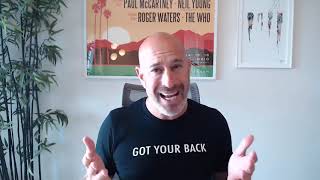
Adam Markel (keynote speaker and author) delivers a short keynote-style message urging leaders to create a "got your back" culture to build resilience during widespread disruption. He recounts a formative lifeguard experience where his team adopted the mantra “No one goes down on our watch,” which produced seven summers with no fatalities, and argues organizations should adopt the same visceral, mutual-support mindset so employees can move from surviving to seizing creative opportunities. He also highlights virtual training as a cost-effective, high-retention way to teach these cultural behaviors and offers to discuss implementing such programs.
Chapters
Hi, I'm Adam Markell, keynote speaker and best selling author. In fact, I wrote this book a couple of years ago, and man, oh, man, are we in pivot times right now. In fact, this is the most prolific time of change and disruption that I've experienced in my life. And there are a myriad of ways that we can approach what's happening for ourselves as well as leaders of teams and within our organizations. And what we feel more than anything else over time, we've learned this, is that there are creative opportunities, that there are blessings in disguise in the midst of all this chaos and change, and that we're going to see those things in the future. So why can't we actually adopt the kind of principles and move into the opportunity phase while this is happening? Because that may well be the distinguishing feature between a company that is merely trying to survive, kind of like white knuckling this whole thing, and a company that is able to thrive. And one of the principles that I wanted to share with you today, it's a pivot principle. It's something that I learned when I was 19 years old working as a lifeguard at the beach. And this was a very busy ocean beach. We had thousands and thousands of people on that beach every day and hundreds of thousands on the weekends. And we lost somebody. My first summer on the beach, we lost someone. Somebody drowned. It was a devastating event, and it was something that we had to recover from very quickly. We had to get back up in the stand, we had to get back on guard, as it were. And it was not easy, but we did it. And we had to learn our lessons so that it didn't happen again. And in fact, what we learned that summer is something I don't want to share with you right now. I've got it written on my shirt. Our lifeguard crew had to deal with that devastating loss and get back up on the stand and perform. And for seven summers after that, thousands of rescues and hundreds of thousands of patrons later, we never lost anyone again. Because we developed a mantra as our lifeguard crew, our team, our organization on the beach had a mantra. And that mantra was that no one goes down on our watch. No one goes down in our water ever again. We had each other's backs. We had each other's backs, and that was the only way that we could do it. We were 20 lifeguards, and there were thousands of people on any given day in the water. And yet for seven summers, we had an impeccable record because we were present to the life and death context. That existed, and we were no longer willing to be satisfied with anything other than that perfect record. And right now, in the midst of this chaos, in the midst of this great change, we need to allow the same context to be created within our own organizations. Meaning that people within those organizations must know, like they know their own name, that you've got their back, that the company and its leadership has got their back. Because that's how they'll be able to not just endure, not just survive this ordeal, but. But they'll be able to see the creative opportunities and seize those opportunities. They'll be able to develop the kind of mindset that allows them to see through this haze and this maze of chaos and find what we're all looking for, which is how it is that we use what we're learning to improve ourselves and to improve our world. So one of the things that I share with audiences, in fact, often we blow this whistle at the beginning of a keynote talk, and then at the end of that talk, we. We give everybody. They don't know it, but it's usually under their chairs. We give them one of these whistles that says, got your back Right on it. Because we want them to go back to their teams. We want them to have a visceral experience and understanding of how important it is that we look to our right and we look to our left, and we look in front, we look in back, and we know that people have got us, that they are taking care of us, and that we are able to take care of others. Right now, that is the most tangible thing that you can do. When your teams are home, they are working virtually, and they're not used to that. Some maybe are, some aren't. But right now they're worried. They're anxious about health issues, about their job security, about finances, about what's going to happen in the world mentally, emotionally, physically, and even spiritually. They're under great strain. And right now, the most important thing that you can do for them is to help them to develop resilience. And as a culture, as an organization, the kind of resilience that comes out of an organization that's willing to own this, to live and breathe this mantra for each other. That's an organization that's going to stand for something that people will stand behind and people will put faith in. So right now, more than anything else, I just wanted to share this one concept with you. It comes out of our pivot teaching. It comes out of the teaching that we do with organizations about how to create resilient individuals, resilient teams, resilient and holistic organizations. And we want to share that with you. And of course, we can't be on a live stage right now. We'll get back to that soon enough. But for years, years and years, we've been using a virtual platform to teach, to teach, to lead and to train. And I would love to discuss that opportunity with you because those opportunities exist now, and they're going to be very cost effective ways for you to reach out to your teams to share important things about how they can become more resilient, how you can apply this on a cultural level so that it's not just lip service, but it's something that people within your teams know that you actually mean. And so the virtual training opportunity is really a profound one. And it's one that research has shown that people can learn and retain almost 80% more information when they learn virtually. Because we're able to space out information, we're able to chunk it down, we're able to sequence it in ways that people will actually be more likely to remember what they've learned, which means that most importantly, they can bring it back to their workplace. When we're back in the workplace, they can bring it back to their teams and apply it. And so I would love to have that conversation with you on how it is that you can create a got your back culture and be more resilient.