Day 2 of the 5 Day I Love MY Life Challenge with Adam Markel
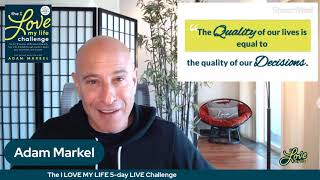
Day 2 of the "I Love My Life" challenge (Adam Markel) is a live coaching session focused on examining belief systems—especially beliefs about love and self-worth that form in early childhood—and replacing limiting beliefs with empowering "I am" statements. Markel reviews three developmental stages (precognitive 0–7, cognitive 7–14, physical 14–21), invites participants to journal limiting beliefs and counter them on a T-chart, models use of a physical "I am" card box, and encourages community sharing via the challenge Facebook group and ilovemylifechallenge.com. The tone is motivational, reflective, and action-oriented.
Chapters
Hey, everybody. Good morning, good evening, good afternoon. It's day two of the I Love my life challenge and I'm so blessed. I feel really honored, really good to be here. Do you love your life? Did you wake up today? I want you to go ahead right now and put it in the chat right at this moment. Put in the comments. If you woke up today, I want you to write it down. I want you to state it. I know it's obvious. I know it sounds. It's weird even on some level to be honoring something so basic like that. But it's also a gift. It's also something that wasn't guaranteed when I went to sleep last night. I didn't get a guarantee. There was no contract that said that I'd get to wake up again this morning. And I don't think anybody gets one of those. I've yet to meet anybody that's got that contract. I was a lawyer for 18 years and I'm always looking for the legal agreement that we get to wake up another day. And obviously we know that's not the case. So if you woke up, I want you to just go ahead right now. I'm going to look in the comments really quick to see it, but I want you to state it right now out loud. I woke up. I see. Deanna, you woke up. Rachel Sanders, Good to see you there. Love. Awesome. Yes. I woke up today and blessed the gift of another day of life. Well, today is day two. Due day two of the I Love my life challenge. I see more comments coming in. Say I woke up. Yes, I got my I love my life hoodie on right now. I woke up as well. And waking up. Waking up. We're all going to wake up together. Day two of the I Love my Life challenge. So good to be here with all of you. Be beautiful. Oh, Guy Stickney. Miss you, buddy. Miss you, guy. Big hug, big hug from Randy and I to you, to your family. Everybody out there, welcome. And happy new day, as we like to say, was Happy New Year, right? We had Happy New Year. Now we have Happy new day. Way cool. So day one. Yesterday was day one and we had a lot of insights. We got some really wonderful things. I was tracking all the comments that were in Facebook. I'm taking a look. I'm grateful that I woke up today. I'm grateful. If you click on, there's a little button that allows this company, this technology called Streamyard to actually show us your name. If you don't click on that thing that allows Streamyard to show Us your name, then we can't get to see exactly who it is. But I see Randy. Randy Gitlin Markel. Good morning. Up and ready for the day? Absolutely. So let's talk about day one for just a moment. What are some of the insights from yesterday that, that impacted you? Things that you start to think about? Did you do the exercise, for example, if you did the exercise and you created that t chart, started to look at the areas in your life that you are actively blessing, actively intending to give love and attention to. I'm sure there were some ahas there, but for me it was, it was twofold. Not just the things that I was looking at that I was giving love to, that I was consciously saying I love you, like to my children or to my wife or to my finances. But, but other areas as well, like my body. Like I have had a little bit of a sore knee and I was giving love to my knee and I was sending love and I was, I was sending blessings to my knee. I was intending that my knee would feel better. And you know what? This morning my knee feels better. And I'm not pretending that there's, you know, something going on here that, that's bigger than, than what we're talking about. But I believe in miracles. And I don't, you know, this is just a, we're going to talk about beliefs today, and beliefs are so important. And I don't mind saying this. I mean, I don't, you know, even, you know, I care less how it sounds. I believe in miracles and I think a lot of people do not. Not everybody's willing to say out loud that they, that they believe in miracles or they expect miracles. They, they, they look to be a miracle even. But I believe in them. And if you believe in them, I don't mind hearing from you either. Go ahead and put it in the comments if you believe in miracles. But go ahead and write down what were some of the things that came up for you yesterday when you started to examine the areas of your life that you are actively blessing and where you are examining some of the areas of your life, perhaps, that you are withholding blessing from, you're withholding your love from. I love that huna philosophy from Hawaii. That we bless that which we want and that anything that we're not willing to bless, anything that we negate, we can never have ourselves. And frankly, it goes deeper than that because some of us have situations in our lives that are causing us challenge. I mean, if you're right now in a situation in Your life, you don't have to say what it is. If you don't feel like it, you don't have to say it at all. But if there's some area of your life that you're being challenged by right now, I just want you to go ahead and put that in the comments because I think it's really important that we as a community are honest to begin with, and of course, that we're willing to share things, because as we said yesterday, we're coming together as one. And so if you're having challenges, you could be rest assured there are lots and lots of other people who are also having challenges. And what I'd suggest is that to some extent, the challenges that we have in our lives are the result of our lack of actively loving those areas of our lives, even people. It's funny enough that sometimes people can be troublesome. They can be seemingly troublesome to ourselves for a while. But if you quietly. I know this is going to sound far out, but if you quietly send your love to them, send a blessing to them, send an intention. If you don't want to call it a blessing, you don't want to call it love, just send an intention that's kind. An intention that things will be resolved, an intention that you will feel good when you think of them or when they think of you. I realize that we're getting into some area that might even border on faith, and I'm okay with that. Because today, one of the things that we're going to talk about is our belief systems. And part of that, I have to say, is that the quality of our lives, the quality of our lives is very much equal to the quality of our decisions. Like the decisions we've made so far are what got us this far. The good, the bad, the ugly. And so many of our decisions, the things that we decide in our lives, are based on our belief systems. So in just a little while, we're going to talk about what those beliefs are. And if we want to make a shift or a change or we want to reframe those beliefs because we think it'll be in our interest to do that. I'm going to give you an exercise for how to do that, a way that I do it in a way that. That we've even shared with our kids for how to do it. And in the meantime, I want to start with something even more basic and more fundamental. And I think the reason we're all here this week together and the reason why I put together this workbook called The I Love My Life Challenge workbook. Because the most important belief that we have is our belief about love. The most important belief that we have is our belief about our own value, our. Our worth, our deservingness, meaning whether we feel we actually are deserving of love, of unconditional love. And you go, well, man, that's super deep. You know, like, can we condense 30 years of couch therapy into, like, I don't know, 10 minutes? Well, I'm going to try because this is one of the things that I found some years ago that really, really helped me, first of all, to understand that there are actually three stages of our early development. Three stages. In fact, I've never. I don't know if I've ever shared this. It's not that profound a thing to share, so I'll just say it. But. But when I was in college, I don't know why, but I decided to take a child psychology class. And I gotta tell you that probably among the decisions. Remember I said, the quality of our lives equal the quality of our decisions. Well, the decision that I made to attend this child psychology class was really profound one, because I love children and I was interested in child psychology, but I was also trying to fulfill a requirement. And it was a good class to fulfill that requirement. I probably thought it was pretty easy or was going to be pretty easy as well. But I met my beautiful wife. I met the love of my life in child psychology. And I'll state for the record, she asked me out because I was shy. And there's more to the story, but she asked me out. So I'll just say that this is where it all began for me in terms of just being curious about psychology and in particular, how it is that we develop. There are three stages, precognitive, cognitive and physical. And so you think about what precognitive is. It's before we're thinking, before our mind is developed. And that's usually from the time that we are born until about eight years old. Seven. Eight years old. Then we go into that. That place where we begin to learn how to use our minds and that our minds are something that can be formed and that will create things. And we learn how to think and we learn how to study. And this coordinates quite well with us going to school and being socialized and all that kind of thing. And then, of course, we get to a place for you about seven years later where we're in puberty. So, you know, 0 to 7, 7 to 14, and then 14 to 21, we are developing physically. These are the three simple stages. But here's the thing that I want you to get. When we learn what love means, we are very, very young. Most. Most of the research shows that, that. That understanding, that definition of what love means occurs between the time we're born and the time we're about seven or eight years old. And I'll say that defining love is probably the most important thing that any of us can do in our. In our lives. And not just to define it, but to have a definition that actually makes sense where we are at the present. When we're young and we see our parents and we see other people around us, we form a definition of love, but it's based on something that. That is. That is outside of our control. It's being formed at a time when we're not fully formed ourselves. And our ability to understand things is really not formed yet either. So for me, when I grew up, I grew up in a very loving home, but there was a lot of fighting between my mom and my dad. They ultimately got divorced after about 25 years. But when I was really young, there were some pretty vicious arguments, yelling and screaming, and even the threat. The threat of violence. And I know some of you have grown up in homes where there was physical violence and verbal abuse. And that threat of violence, that yelling and that screaming in many ways formed, for me, the definition of love. We all do that at that early age. We create a definition of love that's based on what we've experienced when we're quite young. And most of us. And I know this is going to sound strange maybe, but most of us have experienced some childhood trauma, Whether it was our parents fighting and divorcing, whether it was some form of abuse, whether it was someone that died. There's so many things that occur in our early lives that we. We can't really make heads or tails of. We're not formed cognitively to be able to understand, to evaluate, to be critical in our thinking. So we simply form these understandings. We make meaning out of those situations and even those traumas, and they form our definition. And so for me, growing up as an early. As a young adult, I. I thought that in many ways, yelling, screaming, kind of this verbal abuse, even this sort of threat, you know, of everything coming apart at the seams, that somehow or another, that's what love was, that that's what it meant. And obviously, just to hear me say that, you can tell that's just not an accurate way to define love. And it's not how I would want to define love as an adult, but yet it's what was true for me at the time. There's this old movie. I don't know, I'm probably dating myself when I say this, but there's this old movie called Love Story. And there's a line, you know, a funny line, well, not a funny line, a serious line in the movie that says, love means never having to say you're sorry. Love means never having to say you're sorry. That's a definition of love. My question to you is, how do you define love? What does love mean to you? What does it mean to you? Maybe you've never asked yourself that question. Maybe no one's ever asked you that question before. I can tell you, if you've never explored this, one of the things that I'd ask you to do is to think about that, to sit with that. If you've got some definitions right now, feel free to go ahead and put it in the comments. I'll just take a quick look here. What does love mean to you? Go ahead and put it in the comments. What does it mean? And if you want a clue as to what love means to you. Some. For some people, it means safety and security. And that means that in their relationships, they have to feel safe. They have to make others feel safe in order to feel loved. For some people, love is tied to abuse of some kind. And so what ends up happening is they attract that abuse or they even dole out that abuse because love is connected, it's tied to that insecurity. What does love actually mean? You have to go back, you have to think about and put yourself back in that situation when you were 4 years old, 5 years old, 6 years old, 7 years old. Maybe it's abandonment or rejection. It's. It's very, very interesting when you go back and explore what was going on in your life very young, at a very young age, and what was happening and how it might be that you've given that incident, that situation, a meaning that also defines how you see love, how you define it for yourself, and also how you define it for others. So that's the question for you to think about, to be curious about, to sit with today. What does love mean to you? In many ways, the definition of love is visible in how you treat others and how others treat you. That's a clue. If you're looking for a clue for how you actually define love for yourself and for others, look at how you treat others and how they treat you. And on top of that, what it is that you tolerate, that's a clue as well. What are you tolerating in the way other people treat you? That's a clue about how you define love. But the great news, and this is great news, that where we are now, we are developed. We are cognitively developed, fully developed. And that means that we have freedom of choice. We get to choose what we believe. Remember I said earlier, the quality of our life is equal to the quality of our decisions. And our decisions are made based on what we believe. We get to choose those things. That's our greatest freedom. No matter where you are in the world, no matter what's going on around you, no one, no one can ever disenfranchise you from your thinking, from your beliefs and your ultimate meaning, the meaning that you make. We're a meaning making machines. And no one can change that for you, but you can change it for yourself. So what I mean is you get to choose now where you are in your life now. What do you want love to mean? Do you want it to be tied to rejection or abuse or security? Being needy all the time? Some people tie their love, their definition of love, to approval, to feeling worthy. So they're constantly trying to prove their worthiness and their deservingness to others to feel loved because that was the environment that they were growing up in. They learned, they made these meanings when they were so young and they'd never re examined them. You get to re examine those things now. I love this quote. Remember, you can have anything you want as long as you are willing to give up the belief, the false belief, even that you can't have it. We've got to examine those things, examine what we believe. So to give you an exercise right now, you can go ahead and put your answers to these, these statements into the, into the comments. And then again, this will be something that will be part of your life work for the rest of the day. So I want you to identify the reasons that you believe you can't have what you want right now. And I know there are lots of things that we all want in our lives. And, and I want you to just for a moment take a deep breath and think about why you can't have what you want. You don't need to think too hard about this. In fact, what my experience tells me that those first answers, those immediate responses are the most true. So go ahead and write those down. If you want to keep them to yourself, you want to put them in a journal, that's fine. But I want you to keep writing down what that obstacle is. What's that barrier? What's that reason that you can't have what you want? Just go ahead and write it down. If you don't want to put it in the comments, that's fine. If you're willing to put it in the comments. Again, thank you so much for being truthful, for being vulnerable. But the goal is that you write these down for yourself. Take out your journal, write them down. Put down those reasons why you can't have what you want, number one. Reason number one. What's reason number one? Go ahead. I want to look and see in the comments if anybody's got those in there. Why can't you have what you want? You know, do you think you're too old? Are you too young? Do you not have enough money? You don't have investors? Why can't you have what you want? Do you not feel like you live in the right place? You're not smart enough? You don't have enough education? What is it that you believe is the reason? Are there people in your life that are in the way? Do you have too many responsibilities? Did Covid take you out? Is your business bust? Why can't you have what you want? Put your reasons down. Because those reasons are your limiting beliefs. It doesn't mean that the reasons aren't valid, doesn't mean they're irrational. We can examine those things, but for now, just assume these are rational beliefs. The reasons make sense. That's what's insidious. That's what's so tough about those kind of reasons. Maybe you think that your health is at a stage where you can't help yourself, or that you've got to live with something. You've got to live with an illness or live with an ache or a pain. Who says that's true? You say it's true. I say it's true. That's what makes it true. Those beliefs that we have in many ways are limiting us. They are limiting all of us. They are limiting our opportunities, our possibilities. So what do we do about it? I'm going to give you an exercise that I've been doing for years. And it's one that, that I think will help you in the moment and will help you long term. So it's very simple. I'm a fan of these things called T charts. I don't know why. They're simple. That's what I like about them. I like things that are simple, things that are usable. Step one on the left hand side of The T chart. All I want you to do is write down that list, what's that list of your current limiting beliefs. And by limiting beliefs, I just mean what you believe, the things that you believe, the reasons that you can have something, something that you want, something that you feel you might even need. What are those reasons? Write them down. On the left hand side. On the right hand side, I want you to replace that belief. Replace that belief. And one of my favorite ways to replace a belief is with an I am statement. So what are your I am statements? For me, I grew up in an. In an irascible house. Very loving, very demonstrative, but also unstable at times. So peace is really important to me. And I believe that I am peaceful. Do I act peacefully all the time? Is my mind peaceful all the time? Is my body? Are my actions always peaceful? No. But I want to believe that I can be peaceful. And I know that I have become so much more peaceful since I started to replace those old ways of thinking and believing with things that are true, things that I want to be true. And in fact, I want to show you something that someone gave to me years and years ago. And actually just recently, very recently, gave this to our youngest daughter. So the box that you're seeing right here in front of you is a box that says I am. And inside this beautiful wooden box, inside of it it says, as you can see, I am. I am. And inside this beautiful box of I ams there words that are written on, on little wooden cards. They can be on paper, they could be on anything. But these I am statements. I am sweet. I am loving. I am life. I'm just picking these out randomly. I am. What does that say? It says I am healing. I know it's tough with the camera. I'll just read them out loud. I am energy. I am compassionate. I am tranquil. I am unconditional in my love. I am restoring. I am statements are so powerful. They are for me, a 10 second reset. It doesn't even take 10 seconds to just. When you are feeling yourself disempowered, when your mind is playing tricks on you, when it's telling you the old story, the old belief system, you get to replace those beliefs. And you can do it very simply. In fact, you might even choose to do this. And this is such a cool project to create a little box that says I am and put your I am statements right in that box. I know that one of our kids this morning pulled this one out. It says I am tranquil. I am tranquil. Peaceful, at ease. How do you want to feel? What do you want to believe? Later in the week, I'm going to share with you my code of conduct, a process that I use in the morning to create the day that I want to experience. We'll do that in just a couple of days. But right now, what we have to do is just recognize where we start, where we are. What are our beliefs about our body, what are our beliefs about our mind, what are our beliefs about our lovability? What are our beliefs about our prosperity, about our ability to manifest abundance of every kind, including money, success in business, any other area, relationships? What do we believe at the root that has given us exactly the results that we have so far? Because that's really the determining factor. If you look at your life right now, everything you've got is something that's the result of your decisions thus far. It's the result of your belief systems thus far. In fact, it can feel tough to realize that at times that we've created so much of what we've got. And if there's stuff that you still want, then we've got to go back to the drawing board. And this is the drawing board. A list of those things that are your limiting beliefs. A list of those things that are your replacement beliefs. And one of the greatest forms of replacement belief is simply an I am statement. You speak them out loud, you speak them into existence, the way the world began. Speak them into existence for yourself. I had the wonderful experience just recently of having my godson send me something that he wanted me to see, which was a report, a project. He's in college, it's not a report anymore, but he wrote something for his professor explaining the meaning of a song that really meant a lot to him. And it was so beautiful in his explaining this concept to his professor that I got to learn something not only about this song and about the person, the artist that created the song, but I got to learn so much about my godson and about what's important to him. And one of the things that he writes in here is that if we don't love our lives, if we're not willing to love, our lives will never be truly happy. If we're looking at other people and loving their lives more than we love our own lives, we will never be truly happy. How often is that we are looking at someone and thinking that they've got it so much better than us. Wanting to be them on some level is not easy to admit. And yet many of us would probably trade with Any number of other people that we think have it really good. We love their lives, right? We love their Instagram page, their Facebook pictures, and all that other crap. We love it. We love them more than we love ourselves. That erodes so much of the foundation of our own life. And so JB shared this with me, shared this song by J. Cole. And there's this wonderful line in this song. The song is called love yours, which is kind of really, really cool in many ways. And. And it's a tough song. I will say this, because it. It tackles some pretty harsh things. And he does it in a. In a. In a really wonderful way. Love yours with a Z. He says this, this a line in that song. No such thing is a life that's better than yours. There's no such thing as a life that's better than yours. I've been repeating that line for weeks now. No such thing as a life that's better than yours. Think about that. How could there ever be any such thing as a life that's better than yours? You know, Ram Dass said that the universe. There's no. There's no one in the universe, no one in the universe who's more deserving of love and caring than you are. No one. No one's life is better than yours. There's no way it could be. We've got to love our life. That's the only life you've got. But it's the life you ought to love. That's the place we have to put our energy. Love your life, not someone else's. It's a challenge with social media and so many areas, but we've been comparing ourselves long before the existence of Facebook. We. We know that we. That's what they call keeping up with the Joneses, right? Looking into someone else's yard and seeing the grass is greener. Let's call BS on that. Start to love our yard, our lives, our body without conditions. Redefine what love means. Love can be unconditional if you decide that's how it's going to be. I truly believe that. When we learn that, we learn that for ourselves, that becomes our offering to the world. The way we judge ourselves is how we judge others. The way we love ourselves is how we love others. You know, there's an interesting line, right? It's a statement that's attributed to Jesus in the Bible, the Golden Rule. Treat others as you would treat yourself. Well, that's the problem, isn't it? We love others the way we love ourselves. Sometimes we treat others the way we treat ourselves, withholding our love, making our love conditional. And we wonder why we have so many challenges in our world. So here's your simple life work as we wrap up for today. Obviously, these are really big concepts and I'm glad that you all were willing to dive in the way you have. Be vulnerable, truthful. I see that somebody wrote truth. Yeah. Mahalo. Yes. Here's our work today. Our work. Not my work, not your work, but our work collectively. If you feel inclined to put in the Facebook group the I Love My Life challenge. Facebook group, your declaration, your statement. Maybe it's your I am statement today, your replacement belief today, your blessing, your intention. Maybe you just want to declare I love my life. I am willing to love my life. There's an I am statement for you. Share an ILML moment. I saw a number of people were sharing pictures from what they were doing and their, their pets and their friends and their kids and all those beautiful things yesterday. Thank you, Kate, for posting that picture of your beautiful dog. Share your ILMO moment today. If you get that moment and you say, you know what, dang it, I love my life right now. I love this moment in my life. Remember it. Share it with us if you would. And think about what love means to you. What has it meant to you? How did you learn the definition? What did you learn about love when you were growing up really young, before you were even eight years old, Think about that, write it down, sit with it, define it, how it's been defined, and then think about maybe how would you redefine it as a knowing adult, which is where you are right now, you get to decide to change that definition if you want. And of course, use the replacement beliefs exercise that we've been going over. And then we'll talk about those insights again tomorrow. Again, those of you that have already purchased the I Love My life challenge workbook 28 days right here. So when we're done with the five day challenge, we're just going to keep going 28 days. These five days are not even included. We take these topics on a little bit differently in the workbook. And I love the workbook. It's meant to be written and that's the best part of it, with diagrams and all kinds of things. For you to actually take your Sharpie like the way I do. I just destroy books with pens and Sharpies and I dog ear them and, and this workbook is meant for that. It's meant to be rolled up and put in your, your satchel and, and taken Places and used. That's it. It's not meant to sit on a shelf. It's a workbook. If you've not yet gotten yours, you can go to the ilovemylifechallenge.com site ilovemylifechallenge.Com and of course if you've not yet claimed your bonuses from pre ordering the book, please go to the site ilovemylifechallenge.com and claim your bonuses. The laptop sticker and everything else. Just go ahead, claim it. And of course this Friday we're all going to be together. I hope all you got to do is go to ilovemylifechallenge.com to sign up for our kickoff event, meaning our, our the celebration of the workbook. We're going to, I'm going to be speaking for a little bit, going to have some other people there that are going to be doing that. We're going to be doing some hands on exercises and we're going to celebrate the launch of not only this book, but of this movement and we'd love to have you there with us. So if you go to the site, you'll see exactly how it is that you can join us, how you can get an I love my life T shirt. Soon there will be these hoodies available on the site as well, but the T shirt is a gift at one of those, one of the registration levels. So please check that out for yourself as well. Lastly, three ways that we simple steps that we get to wake up each day. First, that we wake up. Right, that's the first thing. So how many of you woke up today? Go ahead, just type it in the comments if you woke up. If you're still in the process of waking up, that's perfect. I'm still waking myself up. So that's good. We're all waking up. We're all here. What a blessing, what a gift, what a treat that is to be here. All of us waking up, waking up our consciousness waking up ourselves physically, mentally, emotionally and even spiritually, whatever that means for you individually. For me individually. We get to wake ourselves up, raise our consciousness. That's first. And in that moment where we, we get to put our feet on the floor, we get to feel the blessing of that moment, the gratitude for what we've been given. A brand new day. Remember we said happy new day. Happy new day everybody. Happy new day. What are you grateful for right now? What are you grateful for in that waking moment? And lastly, not least at all, this declaration. And I'll quickly say that to me, these words, these four simple words have changed my life in ways that I never in a million years could have imagined. I was in a really dark place that day that I shared with you yesterday about feeling that day when I woke up, put my feet on the floor and felt that dread, felt that anxiety, I remember ending up in the hospital later. That day was a Saturday. We're on our way to our son's baseball game. And I ended up in the emergency room because my heart was beating so hard, I felt it was gonna pop out of my chest. I was sweating. My fingers, my tips of my fingers were tingling. And I thought I was dying. I thought I was having a heart attack. And it turned out to be something quite different. It was a gift. It was a wake up call, an anxiety attack, wake up call, a panic attack, wake up call. And I. I thank that moment. I thank. I'm thankful for that day every day now when I say these words, because when I put my feet on the floor now, I don't feel that anxiety or that dread. I simply say, I love my life. And I mean it. And just like my godson JB says, you gotta love your life, baby. You gotta love your life. That's our job. Love our life. Be a model for others. How to love their lives. It's a wonderful place to be. Doesn't mean everything goes our way. It doesn't mean shit doesn't happen. Doesn't mean that we're not upset or angry. Our emotions are there for a reason. We're gonna honor our emotions. But we can still love it all, can't we? Can we love it all? I mean, what else is there to do on this ride except love it? I love all of you. We're really happy that we get to have this time with you. Our company is so committed to these things. That's the name of the company, More Love Media. We want to bring about more love. That's our movement. We're so happy that you've joined us. If you know anybody that you think could really benefit from this message from being a part of this community, please invite them to join this group. The I Love My Life Challenge Facebook group. Share the replay. Feel free to do that. We're going to send out the replay later as well. All right, You've got your life work. I'm going to send you all off with a lot of love, a lot of kisses, a lot of hugs. I hope you love your life today, and I hope we get to hear all about those I love my life. Moments. Go ahead and share them when you can in the Facebook group. And we'll see you tomorrow, everybody. Ciao. Okay. I love my life. Go ahead, put it in the comments. I love my life. I l ML baby. Here we go. Happy New Day. Okay, everybody, ciao. Bye for now.
More from Adam


Mastering Strategic Communications To Navigate High-Stakes Environments With Chris King


Mastering Self-Leadership Through The Conscious Habit Framework With Amy Woodall




Optimize Your Performance And Vitality Through Advanced Metabolic Health Testing With Mauro Stara

Cultivating Audacity: The Audacious Path To Success With Anne Marie Anderson
