Day 4 of the 5-Day I Love MY Life Challenge with Adam Markel
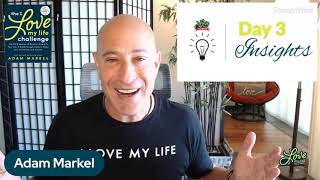
Adam Markel leads Day 4 of the "I Love My Life" 5-day challenge, centering this session on resilience while revisiting gratitude from prior days. He mixes personal anecdotes (teaching, marriage, lifeguarding rescue) with participant stories to present a three-part resilience framework—Reframe, Reset, Regenerate—plus short practical tools (I Am statements, a 10-second reset, and rituals for recovery). He invites viewers to declare "I love my life," take a brief resilience self-assessment (resiliencerank.com), and engage with follow-up events and resources.
Chapters
Foreign. Welcome to day three. Actually, we are at day four. We are at day four, believe it or not, but we're going to talk about yesterday a little bit. Day 3 insights Today is day four of the I Love My Life challenge. And as I'm sitting here, I'm feeling grateful. Just like yesterday. We talked a lot about gratitude and the importance of gratitude. And I'm feeling grateful as I'm sitting here right now and also feeling a bit somber. I woke up this morning and had some of those mixed emotions. And as you can imagine, waking up, keeping to the ritual, the I love my life ritual, putting my feet on the floor, feeling that gratitude that we've been speaking about, being just grateful for the day, grateful for a new day, happy new day, feeling grateful for the breath, being alive and breathing in this moment and also feeling a sense that this, that there's so many challenges that are going on in our world, challenges that we anticipate the kind of struggles that have been going on for years and years and years, generations, centuries even. And then waking up and feeling it even more profoundly this morning. Obviously, there's been a tremendous amount of drama and chaos in the world, and I'm not going to get into that. I'm not going to talk about politics. That's not the purpose of this platform. It's not the purpose for our time here together. But it all relates. I mean, there's just no overlooking the fact that everything is interrelated, that everything is relevant. I remember long, long ago when I had a lot more hair on my head and I was just getting out of school, getting out of college and not knowing what to do was before I went back to law school and started on that path after Randy and I got married and started having kids and I became much more focused early on. I started out as a teacher. I was a middle school English teacher, actually seventh and eighth grade. And I was just a kid, myself and my beautiful bride, we were just engaged and getting ready to get married. And she was a teacher. She knew she wanted to be a teacher from the time that she was, I think, in high school or earlier than that. And she studied to be a teacher, was an education major at University of Massachusetts at Amherst, which is where we actually met. I wasn't thinking so much about being a teacher, but it was something that just sort of fell in my lap. It was an opportunity to be an influence, to have an impact on young people's lives. And I was still very young myself, and I didn't know anything. But one of the things that I remember saying even back then, that I think has held up over time and even has held up as we've raised four children, is to see the world, to be able to see the world and see the connection points, to see the interconnections between ourselves and everything that's happening around us. If you have ever felt that way yourself, that you, you could, you could sense your part in the greater picture of things. You could sense that there's not randomness but synchrony, synchronicity between all the things that are happening. I, I didn't use those words when I was teaching kids back then. I, I just basically said that life is about connecting the dots. And that's not always easy to do, to connect the dots between things, but that that's a part of the mystery, it's a part of the riddle, the paradox, if you will. The joy, even, is to find those interconnections, those connection points, so that the world doesn't seem random, because it's not. And so, yes, things are happening in our world, in the United States in particular right now, that are quite chaotic and, and, and disheartening in many ways, upsetting. And yet we're meeting here this week to talk about loving, about love, about love for ourselves and love for others, love for humanity. So this morning, as I was thinking about what my highest intention was for today, to show up and to be a voice, what was I going to be a voice for? What, What. What do I know is true? True with a capital T, Every, every minute of every day. And I wrote it down in the form of an I Am statement. Remember two days ago we talked about using those I Am statements. And I'll talk a little bit about it shortly. But I'll just say that my I Am statement for today was, I am a voice of peace and love. I am a voice of peace. I am a voice of love. I am peace. I am love. This is how we each, I believe, have to conduct ourselves. We have to take personal responsibility for the kind of energy that we bring into the world, the kind of energy that we're sharing with other people. That's our truest authority, that's our great freedom and our great power is individually and then collectively to be sharing that energy of peace and of love with other people. Because things like the things that we've been witnessing don't readily happen when that's what we're doing, when that's what the multitude of us are doing, that we're focused on being our best not just for ourselves. This is not a selfish practice. It's the, it's quite the opposite, that when we actually learn how to love ourselves, we become an instrument of love. We become a reflection of love. We become the energy of love. You know, this is not a conversation just for Sundays. It's not just for temples and for churches and for places of worship. It's for every moment of every day. It's a way of living and being or it's not. That's an individual question for all of us to ask. So even as we watch these things, I, I counsel myself this morning to stay out of judgment, stay away from judgment on either, in, in either direction. Of course. So let's, let's get back to yesterday just for a moment. Right. The day three insights. I've just got a couple here that I want to read because they're, they're really beautiful. So, Catherine Cavadas, we love you, Catherine. First of all, everybody say hello. If you haven't yet done so, please go ahead and put a comment, just put a comment in to say hello. Say where you're signing in from what part of the world you're in right now if you haven't yet declared it. If you've not yet declared I love my life, I want you to go ahead right now and put that declaration out into the universe. Why not? Why not? What have you got to lose? Absolutely nothing. What did he have to gain? My view. Absolutely everything. So I love my life. Go ahead. I'm just going to look and check for those comments right now. I see they're coming in. Beautiful. I love my life. I love my life. I love my life. So lovely. Katherine Cavadas. Dear Catherine, she's in Australia. Her and her beautiful family, her kids and her husband. This is what Kathryn wrote yesterday. Gratitude. Practice was nutritional gratitude and the choice of three little ones. Wanting pancakes, ice cream and waffles. Choosing and loving salad, grilled chicken, eggs, sunny side up. Thank you. Yes. Beautiful code of conduct. Modeled Randy and Adam sharing. Taking on the challenge to adopt these codes that Adam so generously shared for 28 days and seeing what people, situations, places show up for. I, we us. Thank you for your generous sharing. I love my life. Catherine and her family. Beautiful. Tracy Burns. I love my life. Day three. I woke up. I'm breathing. I'm grateful. I love my life because I have two teenage boys who make me laugh every day and they laugh at my dumb stuff, too. Yes. What could possibly be better as a parent? And first of all, to embarrass our kids. I love that. And for them to laugh at our stuff and, and to be able to learn by our example that we have to laugh at our own stuff. Man. Good job, Traci. Rachel Sanders. I had my I Love my life moment last night. I was thinking about how we rescued a tiny, sickly kitchen. Kitchen. Funny. A tiny, sickly kitten during the pandemic. He was one and a half pounds. We loved him and used all our parenting skills to turn him into an enormous, loving cat. I can only imagine how big this cat is. He still has his moments. He is only 9 months old and now 11 pounds. Just picture that 11 pound cat he was cuddling with me, which only recently started happening and I heard that voice say, I love my life. Awesome. Rachel Sanders, thank you so much. That's so beautiful. Again, as we go through this week, please feel free to post those insights into the I Love My Life Challenge Facebook group or any of the other Facebook groups that you are currently part of that are are taking in this content and share it with other people. Because it's one of those things that we can share. It's something that we can make a gift to all of us. So let's talk about this. Let's talk about today. And today more than ever before. We've got to be resilient. If anything, seeing what's going on in our world right now, we know that resilience is so vital, that loving your life is the result of resilience. And resilience is the result of loving your life. Your life. I want to just quickly share something that came up for me yesterday when we were talking about how it is that we, that we, we show up as the best of ourselves by loving ourselves. This has not always been the easiest concept, not for me and not even in, in, in my marriage. I, I think back on the first few years that Randy and I were married. When our kids were really little. I used to sneak away on Saturdays, sometimes on Sundays for a couple of hours. I usually make the excuse, you know, I'm going out to go shopping. You know, I'm going to do the shopping today, which we have young kids around and, you know, any way I could help was, was welcome, of course, you would imagine. But whenever I would come home, Randy would sort of look at me funny or even sort of not speak to me for a little while because I'd been gone for like two hours. Like, what could I possibly be doing in the supermarket or running some errands for two hours? But the truth of the matter was that I wasn't being honest. I wasn't being truthful because I wasn't just going in the supermarket. I was also going to the YMCA to swim. I was going to the YMCA to swim to take care of myself. And it's really interesting because at a certain point I remember we love that movie, Jerry Maguire. And there's a great scene in that movie where Jerry walks in, he starts apologizing, he starts talking and, and his, his, you know, the, the, the, the scene unfolds where his girlfriend stops him, Renee Zellweger. And she says, stop, you had me at a low. And he says, you complete me. You know that wonderful scene, you complete me. And Randy and I at a certain point just call BS on that whole scene. We just were like, there's no way that that's what relationships must be about, that one person completes another. What total bullshit. There's no way that you can complete me or that I can complete you. That's our own responsibility. Just like we said earlier today, we have to own our responsibility for who we are in the world, for the energy that we bring to the world, to everybody around us. So the fact of the matter is I was taking care of me and at that stage in our marriage. And I won't speak for Randy, I'll just say from, from all the times that we've spoken about this, we've led relationship retreats and, and workshops and things. Randy has said that that was a moment where she had to ask herself the question, am I going to love my husband more because he's showing up as his best, or am I going to resent him for taking care of himself? And ultimately we both came to the understanding that we had to take care of ourselves, that that's what helped us to show up as the most sexy, the best, most interesting versions of ourselves, was not that we were depriving ourselves, that we were being martyrs or trying to be selfless, but ultimately making ourselves miserable by neglecting our fundamental needs. I have a fundamental need to swim, to be in the water, to just take care of my body. And Randy's had her own fundamental needs to do certain things. And we've supported each other. And we find at this point that that's one of the most important things in any long standing relationship, any resilient relationship, is that we actually are willing to love ourselves first. We actually have an acronym for it called Fly F L Y First love yourself in any relationship. You're not going to complete me. That's not the equation. You don't have to lean on somebody else in that way. We have to stand up, take care of ourselves and come together in that place where we can be our best for each other and for everybody else, including for our. For our friends, for our family, for our kids. So today is going to be about resilience. This is resilience day. And since I started out with sort of a story about my love of the water and of swimming, I'm going to keep that going because resilience has been on my mind. I'm sort of known as a resilience guy in many ways these days. And it's because I've made resilience one of the most important things in my life. And I'm going to share the story of where this all started, how it all started right here on a beach, on a very crowded beach. Three whistles rang out, and I knew what that meant. Three whistles on the beach meant someone was missing. I ran down to the main stand and the captain of our beach shouted the order. They lost someone@field3. It's a search and rescue go. 10 of us ran down the beach to join the search team. It was a weird scene. There was a crowd of people pointing to where they last saw the missing swimmer. We dove into the ocean and we swam out past the breaker. We formed a straight line that was perpendicular to the shore, and we started our search pattern. We dove down about 10ft into the cold, dark Atlantic Ocean. We swam into the current and we came straight up for air. And when everyone's head popped up, we repeated that process again and again and again and again. We were exhausted, but we didn't come in. After more than an hour, I heard that whistle again. It was an awful feeling. We weren't done. We hadn't found him. We got out of the water and our captain led us in a moment of silence. And when we opened our eyes, he. He looked at each of us and he said, no one goes down in our water again. No one goes down on our watch again. And then he said something that I will never forget. You either make the save or you die trying to. Just. Just a little intense, huh? But we had to continue to do our work that day. We had to get back up in the lifeguard stand and do our job that day. And so our captain gave us some advice. He told us that we had to ground ourselves, that we had to learn something from the experience and that we had to be able to look out for each other and for everybody that was in our water that day. In other words, we had to pause, ask and choose. That was what resilience looked like for me and for the rest of our lifeguard crew at Jones Beach. My question for you right now is what does resilience mean to you? I want you to go ahead and put it in the comments. How do you define resilience these days? For yourself as an individual, for yourself as an entrepreneur, if you are one, as someone working a job, someone who maybe owns a business? What does resilience look like for you? As a friend, as a parent, as a spouse, as partner, as a son, as a daughter? What does resilience look like? Go ahead and put your definitions for resilience in the comments. We could see what some of those definitions are right now. I'm going to check those out. To keep saying yes to life. Yes, exactly what does resilience look like? How do you define it? Because for us right now, resilience is really about how do we leverage, how do we leverage adversity? We're seeing adversity to keep moving forward, not feeling defeated. I see. Yes. Learning versus retreat. Treating, saying yes to life. Yes, exactly what does resilience look like right now? Because for us, it's all about how do you utilize adversity. We've got a lot of adversity facing us. We see it more and more every day. Adversity is not going away anytime soon. Isn't that true? So it's not about getting used to it. It's not about how do we endure it, how do we survive it. I think too many people are in survival mode. We've got to learn how to actually utilize adversity and leverage it for our long term growth, our long term success. And the studies are clear about this. McKinsey studied companies coming out of the 2008 financial crisis, the Great Recession. What they found was simple, that the most resilient companies recovered the quickest. Here's the thing, this is not about bouncing back, it's about bouncing forward. And Those companies that McKinsey studied not only recovered, but they moved ahead, ahead of their competition. They were more creative, they were more flexible, they were more able to find novel solutions and ideas. In other words, they were innovative, they had useful ideas, they were improvisational, they were able to get out of their own way. That's what resilience looks like in the context of business and also of life. I shared with you. My journey has been a rocky one. Like most of us, I've had my dark, dark nights. Nights that I Couldn't sleep. Nights that I had to take Ambien to get to sleep. I remember coming home once after a particularly difficult day. That was a series of difficult days, months, even years. I'd say I walk in the house after not seeing my kids for dinner, missing them go to bed, missing them go to sleep that particular night, not being able to read them a bedtime story. I meant walking in the door and walking up to my beautiful bride and. And looking her in the eyes and saying, if I keep doing what I'm doing, you're going to be a widow. Yes. Silence. How do you. How do you develop resilience out of events like that? That's what we're talking about. And we've studied this now for a number of years. Research of our own, as well as the data and research of a lot of other really smart people, people that have studied this for dozens and dozens of years. And what we found is that there's three particular themes to resilient individuals and resilience. Resilient companies, resilient organizations as well, they have the capacity to do these three things. It's simple. Reframe, reset, regenerate. That's what we're talking about here. So let's talk about what it means to reframe something. To take an event that's happening in your life, or maybe even as we're seeing in the world around us right now, to look at that event and to pause. Just the way we had to pause that day on the beach before we got back up in the stand, we had to ground ourselves. I like to refer to this now as getting to neutral, removing the judgment, being able to see a situation through the lens, through a lens that does not imply something is right or wrong or true or false or fair or unfair, but simply to be able to be with what that is for a moment, even. That's the pause, the grounding to ask, what can we learn right now? We had to ask that question on the beach that day. What is there to learn from what just happened, from this tragedy? We had to ask that question so that we can then choose to move forward. So many of us, consciously or unconsciously, choose to stay where we are, to stay stuck. And many, many people choose to look backwards. We look backwards to find meaning, to extract meaning. That is the only thing we need to ever do when we look backwards is to find out what we've got to learn. My grandmother used to call those moments where we find little things that mean a lot in our lives. She called them Little gems. These are the little distinctions in life. That's the purpose of looking backwards, but nothing else. So we've got to be able to choose to move forward. And that collectively represents what we call a reframe. A reframe. Think about something going on in your life right now that could use a reframe. Do you know what that is? We all have those things. If you're willing to go ahead and share that with us, to release it, to just put it out there, go ahead and put it in the comments. If there's something in your life right now, a situation, whether it's something in your personal life, in your financial life, maybe it's how you're viewing what's going on in the world right now, how can you reframe that situation? How can you pause, ask, and choose to see the creative opportunity? Because ultimately, that's what this is about, asking the question, what is the creative opportunity? Randy My wife has been asking me that question for years. And she waits. It's like she lies in wait for me to be in one of my stuff states where I'm caught up in something. I'm angry, I'm leaning on something from the past, I'm in my default mode. And she will ask me that question routinely. What's the creative opportunity? Husband Adam what is it? So for you right now? What's that situation that you want to maybe look at differently? Find the creative opportunity in something that's causing you pain or is scary, causing you to be fearful? What is, what is the opportunity right now in that situation? The only way out is through. This is the way we dig in, we reframe. But of course, we know we have our plans. We make great plans in our lives. And the universe has its own plan. Isn't that true? I mean, we've lived long enough. We. We know that this is just the way the world is. We've got our plans. And then there's a whole different reality, isn't there? We all experience it. But what do we do when we find ourselves lost? What do we do when we find ourselves, that we've made a wrong turn, that we're in the weeds from? Back in my days as a waiter, we used to say that we're in the weeds, right? I've got more going on than they could possibly work with. What do you do when you found yourself in that situation? I think about when I'm in the car and I make a mistake. You know, back in the day when, when I first started driving, there was no gps. There was no such thing. You had to follow it by instinct or using a map. Okay, but today, what happens when you make a mistake? This little voice comes on and says, recalculate. It says redirect. We stay stuck when we make mistakes. We lick our wounds. And we look in the past and we look for people to blame, don't we? We complain, we freaking complain. Instead of simply saying that wisdom, that statement that comes out of our GPS every time, redirect, recalcul. That's the process of resetting. That in the middle of the day when you find yourself lost, or at the beginning of the day. I used to have trouble at the beginning of the day. Maybe it's the end of the day before you go to bed, wherever it might be that you find yourself lost, confused, that you've made a mistake, that you're looking in the rear view mirror, you're looking backwards, you're resenting or condemning something. You need a reset. And we Talked about this two days ago. What is your 10 second reset? I shared mine with you this morning. My 10 second reset. I am a voice of peace. I am a voice of love. I wanted to remember that this morning, especially when I saw things that were bothering me and I got angry. I'm from New York. I can't help it. I was 18 years in a litigation practice. I get angry. We all do. What's your reset? The I am statement takes less than 10 seconds. It takes less than 10 seconds to say I love my life, doesn't it? In the midst of chaos, confusion, any of those feelings and you feel lost, you can reset. So first we have to reframe. When we want to be resilient. We're regular reframers, serial reframers. We know how to reset, recalculate. When we're lost in the moment, even for a second, how do we get ourselves back on track? Resilient people reset. And lastly, resilience is about recharging ourselves. This is not about endurance. Our research, Harvard Business Review research, article after article, researcher after researcher has said, this is not about winning the Night Owl Award. This is about how it is that we actually recover. In fact, one of the studies I thought was really great was one where they looked at the best athletes in the world, the most successful professional and Olympians, and they compared those really successful athletes to business people, to people that were managing and operating organizations. They found that the most successful in both of those camps had one thing in common. Anybody want to guess? If you've got it, go Ahead, what is the one thing they had in common? I'm just going to go ahead and put this up front and center so you can see it. That one thing, as you can see, were their rituals. But what kind of rituals? The rituals they had for recovery. That's the key to resilience, being able to recover. You have to exert yourself, but you also have to be able to recover. Look, I showed you that picture at the beginning. We were on the beach. We had 100,000 patrons on a Saturday or a Sunday in July or August. We were 20 lifeguards in our crew. How on earth could we have taken care of all of those people and kept them safe? I will tell you as a footnote to that story. We never lost anybody again. I worked at that field for seven more summers before our kids started to grow and I just couldn't do it anymore. But seven summers later, no one went down in our water again. Not on our watch. How do we do that? How could you have an impeccable record? None of us were superhuman in any way. But we worked together. And we didn't just work as a team. We took care of ourselves. We didn't work eight straight hours. We worked up in the lifeguard stand for an hour, and then we relaxed for an hour. We read a book, we worked out, we ran, we swam, we slept, we ate, we looked at girls, whatever. But we took care of ourselves for an hour. And then we got back up in the stand, recharged, ready to see what was there to be seen. How is it right now that you are taking better care of yourself? Where is your. Where are the recovery zones in your day? You know, sometimes this is called the Pomodoro technique. You can look that up. We can put a link in the chat for that. We used to. I refer to what we did, the up an hour, down an hour at the beach as a toggle. You toggle back and forth between exerting yourself and relaxing yourself, meaning you could exert yourself physically. And then in your recovery, you could be working on things that are more cerebral, more intellectual. You've got to be able to walk during the day. You've got to be able to take care of yourself. We're going to talk about this a lot tomorrow. The kind of specific rituals for recovery that we all have to create. So when it comes to resilience, we're talking about three basic things, and these are the three things I want you to take away from this conversation. We've got to have the ability to reframe whatever is happening in our life, we've got to be able to find that creative opportunity. That's the thread that we're looking for every time. We have to have a. The capacity and the systems actually set up to help us to reset when we find ourselves lost and we've got to regenerate. In other words, we have to recover ourselves, part of this book, Ourselves. So, so vital and so important. You know, often I think when people think about resilience, they think about Rocky, right? They think about. It's. It's such a physical thing that we've got to be able to take the punch and get back up, right? We love Rocky 1976, I think, the first Rocky movie. And Sly Stallone, man, he gets knocked down, gets back up, I don't know, a hundred times in that movie, right? He's just like endlessly getting punched in the face and still gets back up. And he wins our hearts, of course, but he loses the fight. And as you can see in this picture, as my Jersey friends would say, you don't look too good. That's a lot of us. We're all banged up, we're exhausted in so many ways, mentally, physically, emotionally, even spiritually. Resilience is not just the physical. It is, in fact, mental. It is emotional. And yes, it is also spiritual. In other words, it is holistic resilience. It's not just about how you get back up from a punch. This is not about bouncing back, it's about bouncing forward. And to me, in the midst of a pandemic, this is really the vaccine that we require. And it's for now and it's. It's for all time. Because this is not the last quote, issue, challenge pandemic even, that we will face in our lives. What do we do? We survive. No, that's not our calling. That's not what's in our DNA. We're here for much more. Now, one of the things that we want to give to all of you today is a. Not just as a way to bring the point home, but as a way for you to find out yourself how resilient you actually are. It's a very simple URL to remember, but we're going to put it in the chat as well. Resiliencerank.com this will take you three minutes. Three minutes is all it will take. It's entirely yours as a gift from us. To find out how do you rank yourself in terms of your own mental, emotional, physical and spiritual resilience? Three minutes. If you're truthful with your answers. You're going to get some something I think that will really serve you, really help you going forward and we absolutely want to know how you're doing. So tomorrow at the beginning and at the end, we're going to make some time for Q and A for some questions. If you've got any questions, please put them in the comments now. We'll collect them from from this session at the moment and and be able to utilize them tomorrow or anytime during the day today. If you've got a question that comes up about any of the things that we've been doing this week, please go ahead and post that. Post that in one of the comments and we'll be able to pick those comments up and address them tomorrow. We also have our book event, our book launch event, the I Love My Life Challenge book launch event. If you've not yet gone ahead and gotten yourself a ticket to that, please go ahead and do that. We'd love to see you. Of course, anybody that's purchased the book is going to have a ticket as well. So if you've not yet claimed your bonuses, please do that. So today we want you to again post your ilml, your I love my life declaration. Post the intention, post the blessing. Post the moment that you share that you experience today a love for yourself. Again, not a love for for something else other than out something outside of you, but post your reflections on love for your life. What does that look like for you? If you're identifying a creative opportunity that exists now even in the midst of the challenges that you're facing? We would love to know what that creative opportunity is. What's that big insight for you right now after you look at that situation and you reframe it, what is that creative opportunity? Try out your 10 second reset again. I shared my I am statement. What's your I am statement for today? You can put that in the comments as well. What's your I am statement? I am resilient. I have a shirt that says I am resilient. I love putting those IMs on shirts because again, it's all about energy. Everything in the universe is made up of energy. This is just about how it is that you through your energy attract what it is that you want most. You want more, more of the good stuff you've got to go after. Doesn't happen just by default. At least not in my experience. And of course, the last of your life work today, if you're willing to do it, take the resilience assessment by going to resiliencerank.com resiliencerank.com and as I said yesterday, if you've got questions about your plan for 2021, you want to explore that plan and Perhaps even spend 20 or 30 minutes discussing it with me. If we've never worked together before, I'd be happy to have that conversation with you. All you have to do is email teamdammarkel team adammarkel.com to be able to set up a time for us to do that. Lastly, again, claim your bonuses if you've not yet claimed your bonuses for the the pre order and and for the ordering of the I Love My Life challenge workbook. And Again, tomorrow at 4:00pm Pacific, we're going to have our friends and family kickoff event. It's going to be an hour. I, I believe, I think that either one or more of of of our kids, my kids, Randy's kids, are going to be speaking, which is going to be fun. Always love to see what's going to going to show up in that moment and, and what a blessing that that truly is. We'd love to have you there. I'm going to answer questions. We've got a few other fun things, activities that are planned. We'd love to have you join us and be part of that event as well. So right now, more than anything, I just want to remind everybody that we got to wake up again just like we did yesterday. And hopefully that you realize in this moment even that you've woken up, maybe woken up just a little bit more because of the time that we got to spend together. But that we got to wake up, that we got to feel that gratitude. That gratitude is what produces the things inside of us that we most benefit from. The good stuff all comes, all is all rooted in love. It's all rooted in gratitude. So when you wake up again tomorrow or even in this moment, just declare these words out loud and feel them, see how they feel. You know, maybe it's not the thing for you. I'm not prescribing anything for anybody. I just tell you this transformed my whole way of being and every other area of my life has been benefited by this one simple thing. Four words, man. That's it. I love my life. So as we close this out today, please go ahead, put it in the comments and declare it out loud. Maybe it's the first time today you're doing it. I love my life. I love my life. In the midst of everything going on in the world right now, I love my life. That's how you honor you honor your life. It's sacred. It's holy. Let's do that. Let's show up for the world today. That way, let's leave our judgments and our angers and our resentments where they belong. In the trash. I love you all. We're so happy that you're part of this. Please, if anybody, you know could really benefit from this content, be a part of this movement, this community. Share a link Share this Facebook group. Do whatever you're called to do to just move this forward. Be this in the world. I love my life. I can't wait to see you all again tomorrow. I. I'll say ciao. Tomorrow is ritual day. We'll see you for ritual day tomorrow. Have a great rest of your day. Ciao, everybody. Bye. Bye.
More from Adam


Mastering Strategic Communications To Navigate High-Stakes Environments With Chris King


Mastering Self-Leadership Through The Conscious Habit Framework With Amy Woodall




Optimize Your Performance And Vitality Through Advanced Metabolic Health Testing With Mauro Stara

Cultivating Audacity: The Audacious Path To Success With Anne Marie Anderson
