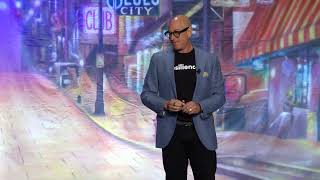
Adam Markel defines resilience as the ability to leverage uncertainty and adversity as catalysts for growth. He reports a study of organizations after the global financial crisis and concludes that resilient organizations do not merely 'bounce back' but 'bounce forward'—emerging stronger and continuing to outperform amid ongoing uncertainty and accelerating change.
Chapters
What we found is that not only do we all define it a little bit differently based on our own personal experience, which makes sense, but that there's a common thread, if you will, a through line, and that is that resilience is how we leverage. What's that word? Leverage. How do we leverage uncertainty? How do we leverage adversity as a catalyst for one thing that we all need personally and in regard to our businesses, and that is to grow. It is all for growth. We studied organizations coming out of the last great Recession, the global financial crisis. We found that there was one thing that was common in all the organizations that have continued to outperform, to outperform in the midst of chaos, in the midst of uncertainty. Look, let's get it straight. Uncertainty is the new certainty. Does that make sense? The unknowns are only going to continue. The velocity of change is only going to continue to increase. What we found is that organizations that are able to be resilient are not the ones that bounce back. Are not the ones that bounce back, but are the ones that bounce back stronger. In other words, they're the ones that bounce forward. Sat.







