From Fit 2 Fat 2 Fit: Transforming An Industry With Empathy with Drew Manning
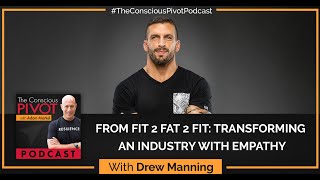
Drew Manning gained 75 pounds in six months eating a standard American diet, then lost it all. He repeated the experiment in 2020 to understand what his fitness clients actually experience. Manning talks about leading with empathy, the Hawaiian concept of imua resilience, and why self-forgiveness matters more than willpower.
Questions this video answers
2011
75 pounds
Six months
August 27 through December 27, 2020
Complete Keto
Chapters
Welcome to the Conscious Pivot Podcast with international speaker, business mentor, best selling author of Pivot, and your host, Adam Markell. The Conscious Pivot shares the stories and wisdom of people who have successfully reinvented some area of their business and personal life. You'll gain powerful insights into how you can fully embrace new opportunities, increase your performance, and master the art and science of innovation and resilience. So please join Adam as he guides you on your Conscious Pivot.
Hey everybody. Welcome back to another episode of the Conscious Pivot Podcast. I'm your host, Adam Markel, and I am. I just feel super happy today. Blessed to be alive and well right in the middle of everything that's going on in our world. I can imagine how you all feel. I know how I feel. Just sort of a little dazed from Times Now, a little Dazed and Confused, actually, which was a great, great kind of old stoner movie. This is a different brand of Dazed and Confused than in that movie. Certain and really different than I've ever experienced before. And that's sort of been going on for a while now. And the interesting part about this is that there really isn't light at the end of a tunnel, if you look at it that way. And I'm a resilience guy and a Pivot guy, and so to me, I'm not so much looking for light at the end of the tunnel. Anyway, to me, there's an opportunity to leverage right now in this moment. So was with that thought in mind that we booked a great guest for me to speak to, for you guys to learn from and to connect with. His name is Drew Manning. I'm going to read a little bit about him and then we're going to dive right in. So Drew is a New York Times best selling author of the book Fit to fat to fit and is best known for his fit to fat 2fit experiment that went viral online. He's been featured on shows like Dr. Oz, Good Morning America, the View, and many more. His experiment has become a hit TV show called Fit 2 Fat 2 Fit, airing on AE in Lifetime. And his book, his new book, Complete Keto is available now. Great to have you on the show today, Drew. I'm really excited to get to know you and to have this conversation.
Yeah, thanks Adam. Really appreciate you having me on and excited to do this podcast with you.
Way cool. So what's not a part of the bio that I just read? What's one thing that you'd love for people to know about you that's not written there?
Yeah, first and Foremost, I'm a father of two amazing daughters, and that's my main purpose in this life. Yes, I have a business. It's. It's successful. It does really well. But first and foremost, I'm a dad, and I love being a dad, and that's my main purpose in this life. So I probably would throw that in there as well.
Yeah, you and I are simpatico. In fact, before we even turned on the video today, I just said, you know, nothing. Nothing is better for me at my life than a daddy of three. Three daughters, and you got two. And being a, you know, being a dad is great. Being a daddy to. To girls who become young women. And that's in store for you. I'm a little, you know, further down that path, to see them grow up and see them become young women that are doing amazing things and just. Yeah. Are just a blessing to the world. So I wish that for you, brother. I know that's what's in store. So, Drew, let's just dive right in, man. Fit to fat, to fit. Everybody just heard that. Is going, what? Cleaning out their ears? Going, what the heck are you talking about? So maybe create a little context on when this thing got started. I know that you're actually involved in this now, again, meaning going into the belly of this beast. So why don't you just sort of lay it out for us before you take us to the present?
Yeah. So back in 2011, I had this crazy idea as a personal trainer and someone who had been in shape my entire life, just like most personal trainers are. You know, the six pack, the muscles. It's like, yep, personal trainer, right. And I had a tough time. Well, I grew up in a family of 11 brothers and sisters. First of all, we all played sports, so football and wrestling were the sports that I played. So for me, being active was something that came naturally. And a byproduct of that was never being overweight, never struggling with emotional eating, and naturally became a personal trainer, because that was part of my life. And there was an instant disconnect between me, someone who had never been overweight a day in my life, and then my clients who had been overweight pretty much the majority of their life. And I couldn't understand why it was just so hard for them to follow the meal plan, do the workouts. And it seems so simple in my mind. I'm like, you guys, why do you keep struggling? You just do it, and then it gets easier and you see the results. I had one client who was my brother in law at the time. Tell me, Drew, you don't understand how hard it is for me or for people like me, because for you, it's always been easy. When he said that, I took that to heart. I was like, you know what? You're right. I don't understand why it's so hard thinking of ideas. And then, boom, this light bulb moment, this thought entered my mind, and it was, what if you got fat on purpose, documented that journey and put it online? Would that give you better understanding? And, man, I almost felt called, like it was a calling in my life to do that experiment to give me that understanding. So to make a long story short, I let myself go for six months. I stopped exercising for the first time in my life. I ate a lot of the SAD diet, the standard American diet, lots of processed foods, put on 75 pounds of pure fat in six months. It was one of the hardest, most humbling things I've ever been through. That's where the book eventually came from, which became a New York time bestseller, which you mentioned. And I learned so many valuable experiences during that first experiment, where, luckily, I did get back to fit, which is why it's called Fit to Fat to Fit, but within a whole new perspective and a whole new understanding on the mental and emotional side of transformation, but also a ton of empathy. Because before I was the judgmental person, I was more of the judgmental trainer that couldn't understand why people couldn't just do the work and no excuses and, you know, just do it. For me, seeing the emotional side of transformation for the first time, I could now empathize with my clients and understand the connection to food and the emotional eating and food addiction that I could have never probably experienced had I not gone through that. So that was the first experiment. We can pause there if you want to ask some questions. I want to.
I want to just dig into that a little bit, and then we'll move, move, you know, kind of current moment. I just got to say, to me, that's just fascinating that you. That you would want to experience that and have that kind of empathy, develop that kind of empathy. And I could see it's a smart. It's a smart move. And obviously, at the time you did it, I'm sure you weren't thinking, hey, this will be a great book. It'll become a bestseller. You know, all that kind of. Well, you didn't think that way, right?
I mean, yeah, yeah, that's a good assumption. I had no. No marketing strategy, no idea a book deal would come or TV show would come. I had no idea any of that would happen. I just kind of went with it. And a lot of luck, to be honest with you.
Yeah. And you know what? I certainly. I'm not going to quibble about the word luck. I just say, you know, you put yourself into proximity of those good things happening because you went for something that was for really good reasons, to develop that empathy, to create that greater understanding. Because how can you understand what it's like to be somebody that struggles with weight in any way, shape or form if you've never struggled with weight? I mean, I would think that from a lot of people, their perspective is, yeah, you don't know what it's like to be me. So to just say, well, okay, I'm going to call BS on that because I'm going to go go and figure, you know, have that experience and gain that understanding so that I can come back with some. Something more that I can do to serve and help people. So what it. So I really want to get a sense of what kind of weight gain did you experience? What kind of weight gain were you able to create in that timeframe? And what was the timeframe? And also, you know, then unpack some of the things that you learned that ultimately enabled you to write the book and empathize it at a much more authentic level.
Yeah. So the journey was six months of gaining weight. Right. No exercise for six months. Ate a standard American diet, put on 75 pounds during those six months. And just to give people some context here, you know, most of us, I'm assuming, have seen Super Size Me by Morgan Spurlock. He focused a lot on McDonald's. Right. Fast food. I think most Americans know fast food is unhealthy. I focus on a lot of the foods that we grew up with in the 70s and 80s and 90s of these processed sugary cereals, chips, cookies and crackers, Hot Pockets and Mac and cheese and top ramen and soda and juices. All these foods that sometimes we think are healthy or healthier, to be honest with you, it's based off the food pyramid. We won't go down that rabbit hole. But what I'm saying is a lot of these highly processed foods that are convenient, they take, they taste freaking amazing. I mean, I'll be honest with you. Cinnamon Toast Crunch is like. It's like crack cocaine. It's so good.
It is though, right? It is true.
And they're super affordable. Like, these foods are cheaper than real whole food. And we have it totally backwards in our society. So that's the food. I focused on a couple experiences.
Short term, they're cheaper. Long term, they're cheaper. We'll talk about what long term looks like.
Yeah, but that's why a lot of people gravitate towards these foods versus broccoli and lean meats and lots of vegetables. It's kind of set up backwards. But anyways, a couple experiences that really shifted my perception were a couple of things more so on the mental and emotional side. Physically, I knew I was going to get fat. I knew I was going to get the man boobs and the big gut. That was expected.
But.
My identity, my whole life was based on my body. Like, my body image was my self image. So in my mind, I was Drew the fit guy. Like, that was part of my identity. Right. Once I lost that and became overweight, I'll be totally honest with you, I freaked out. I didn't know who I was anymore without the six pack. I wanted to go up to strangers in public when I was overweight and explain to them, like, hey, I'm not really overweight. This is just an experiment, just so you know. Here's my before picture. I just felt the need to tell you this so you don't judge me because I was so uncomfortable with my own skin. And what that taught me was that eventually, after going through that hard part, is that we are all more than our bodies and we have more to offer this world than just our bodies. And so for me, that helped me not put so much emphasis or be obsessed about my body image as my self image and being able to separate that. The second thing was when I transitioned, after six months of eating Cinnamon Toast Crunch and Mountain Dew and all these delicious foods to then the next day going cold turkey to eating real whole food again, I felt like crap for two weeks. It was awful. I felt miserable. And here I was, a trainer proponent of eating healthy food, thinking, hey, this food's going to make me feel good. I felt miserable. And if I could compare it to something, it's probably not going to do it justice. But if you were addicted to drugs and you try and cold turkey, get off that drug, your body goes through these withdrawal symptoms that are awful. That's what I felt like going through these withdrawal symptoms where my body almost fought back against me and pushed me towards the high that it got from these processed foods for the past six months. And that's where it clicked for me, because my clients would tell me all the time, they would struggle to stay consistent with their meal plans and eating, and I couldn't understand why they couldn't just willpower their way through it. Because for me, my whole life has been easy. And then for me to make that transition and to feel the headaches, the grumpiness, the moodiness, the hunger pains, and just feeling miserable, even though I was eating broccoli and spinach and all these healthy foods that were taught to eat, my body still pushed back for about two weeks and the cravings were super intense. That's where I finally could develop some empathy for people that struggle with emotional eating and people that struggle with food addiction, because the emotional connection to food is way more powerful than we can ever imagine. And for me, it took me going through that experiment to finally realize, man, just how wrong I was in my approach. So those were some experiences that really shaped my perception shifted how I could help people in the future.
So did you get back to original weight? When you came out the other side going, you went fit to fat to fit again. What did fit again? What was the difference between fit again and fit originally?
From a physical perspective, you couldn't tell a whole lot. I did get back to my original body fat percentage and physique, if you will, and everything looked good on the outside, but up here is where the big shift was. So it took me six months to get back to fit, but it was not easy. If you go back and look at my old videos, it was a freaking struggle. It was hard mentally, it was hard physically. I've never been. I kind of compare it to being on top of this mountain my whole life, where all the fit Instagram models have always been in shape. They're up here on top, and then everyone that's trying to get there is at the bottom of the mountain. And that climb up from the top looks so easy. You're like, yeah, yeah, it looks so easy. You guys just do this, just do that, no excuses, keep pushing yourself then. For me to come down off my mountain and start at the bottom was a very humbling experience. And it taught me a whole new perspective and so much more empathy for those that try and make that struggle up the mountain. Because I saw things through a different lens finally.
Yeah. What do you think? I mean, do you have a sense of what the most humbling part of it was for you? You may have touched on it already.
It was the transition with the food. The second thing was with my daughter. She was two years old at the time, and she, you know, two year olds have a ton of energy and she wanted me to chase her around the house like she Used to play this game where she's like, chase me, chase me. And she could play for hours. And here I was, huffing and puffing, came home from a long day of work, exhausted physically, mentally, and tried to keep up with my daughter. For after about two minutes, I was out of breath, and I was just exhausted. And so I sat on the couch and said, hey, Daddy needs a break. And she wanted me to keep playing. So she was trying to pull me off the couch, like, daddy, Daddy, please come play with me. And I told her. I was like, hey, I can't play with you right now. Daddy needs a break, and I can't play with you. And she didn't understand why. But then she just. These puppy dog tears just coming down from her eyes. Just, please, please. And, like, she wanted me to play with her so bad. And it hit me in that moment how many millions of parents out there can't play with their kids or their own grandkids, not because of their weight so much, but because of their health and how bad that must suck, because that broke my heart to see my little girl want her dad to play with her. And I couldn't because of the health condition I was in. And I was doing this to myself on purpose. Imagine the struggle for people that can't do that because of their health, because they've been that way for decades now, and they just can't make that change. It broke my heart, and it developed some empathy for those that struggle. And how much of transformation is mental and emotional. That wasn't about me being fat or overweight. It was me not taking care of my health, to be the best dad I could be.
Yeah. You know, just from a context standpoint, you and I are having this conversation right in the middle of a pandemic. I mean, still hard to imagine. And yet. And yet this is the reality. There are a lot of people who have already succumb to this virus, and by the look of it, we'll lose more. There will be greater loss. Obviously, the virus is the thing that we're just still not fully understanding. And greater understanding, I think, is being had each and every day. Just like we're moving toward the potential for there to be something that. That is like a vaccine for it, et cetera. But one of the things that I've heard when I ask you about that, I actually, I'm really, you know, I lean into this positioning that we are more susceptible. So Covid has wreaked havoc in the United States, in North America, but in particular in the United States more than it has elsewhere in the world. That's just a fact. You know, it's not a. It's not debatable. I'm not assigning blame, you know, politically speaking, to why that is the case, but that's a fact. And at least in part, you could make the argument that we've succumbed to that because our diet in the United States, like you called it the sad. Sad Standard American Diet. I mean, I'm sure you don't use the word, the acronym S.A.D. for no reason. So I'd love to get your thoughts on. And again, I'm not putting you on the spot to be some sort of an expert on this virus just to say, to what extent do you think there is genuinely a connection between how people respond to this virus, whether they recover quickly or ultimately die from it, and their diet and the way they've taken care of themselves from just a pure perspective of what they put in their mouth each and every day?
Yeah, there's a correlation there for sure. And I would love for our society to be more aware of just how much food, lifestyle, lack of exercise affects us in so many other ways. Like, wearing a mask is cool. I'm all for trying to stay safe during this time, but what if there was an emphasis on taking care of our health first and foremost? The problem is our society is a society of convenience. We want the path of least resistance. Okay, I don't want to do the work. Just give me a pill. And that's what we've been programmed to think. And that's what makes the wheels turn and money talks. And so it's hard because you can't come out on the news and say, hey, guys, you guys are eating your vegetables. You guys start working out 60 minutes a day, and on top of that, wear your mask. But what if we mandated everyone eat real food and exercise every single day and take care of their health, which affects their immune system? No one wants to hear that, because they just want, okay, where's the vaccine? Where's the pill? So, man, yeah, I would love if there was more emphasis on that. And my hope is that through my platform and other people's platforms, we can awaken people to the importance of taking ownership of your own health rather than placing blame. But I don't want to make light of anything. I'm not a politician, I'm not a scientist. But I do know that things like eating real food, exercising every single day, getting some sunlight, getting out in nature, meditating, those kinds of things do have an Effect, whether the science community wants to admit it or not, I think it does play a role, but it's, it's a hard pill to swallow. People want the smaller, easier pill.
That's a good way to put it. Right. They want the bite sized pill. So you're involved in the same experiment. So that was 2011 that you had that. And so now we are nine years later and you're back into fit to fat to fit again. Where are you right now in that experiment and what have you started to notice? I see you're wearing a Coca Cola shirt.
Yeah, I would never look at it.
I don't believe you're in the getting fat part right now.
Right? Yeah. I would never wear this, but I ran out of clothes that fit me, so I just went to Walmart or Target and got these cheap T shirts that can fit me. Now let me first talk about why I'm doing it again, because I'm sure people are wondering, why would I ever do this again a second time? The first time I learned so many valuable experiences and that time it was more so about me experiencing what it's like to be overweight for the first time. Now I kind of know what to expect. I know what I've learned. This time around, I'm on a mission to disrupt the fitness industry, to bring some real change, because let's be honest, 2020 is a year of radical change. And whether you like it or not, things are changing. And I want to disrupt the fitness industry by leading with empathy first. We've tried macros, we've tried diets, we've tried restricting calories, we've tried all the workouts, we tried all the supplements, all that stuff does and can work. What's not working is up here. And I feel like if people or no one cares how much you know until they know how much you care first. And that's something that I live by. And that's kind of what fit to fat to fit is all about. And I feel like if we can bring some empathy to the fitness industry, people are going to be more willing to what the influencers, the leaders, the doctors, the trainers, the coaches have to say because they want to feel understood first. And so my focus is more so on the mental, emotional side, helping people overcome trauma and challenges that are connected to emotional eating, that are connected to food addiction. Because we are trying to look for the simple pill, like, hey, what diet should I do to lose the most amount of weight with the least amount of effort? Like, what's the easiest way to do it, what pill should I take? Vs hey, let's go back, face this trauma, let it go, release it, and then from there, be free of these addictions that have been holding us back. Because we can't figure out why we keep sabotaging, why we keep going back to our old patterns and our old thinking and our old programming. For me, it's a different approach. Yes, calories, macros, workouts matter, but my approach is all about focus on the mental, emotional side first. And so this time around, doing it a Second time in 2020 is a vehicle to bring empathy to the fitness industry. The second reason I'm doing it is because I'm turning 40. Back when I was 31 in 2011, different metabolism, different hormones, and we all know or people have told us, like, hey, when you get older, it's harder to lose the weight, it's harder to maintain. Your hormones change, your metabolism changes. It's way harder. And so I'm like, okay, I hear that. Let's put that to the test. Let's do that together. I'll let myself go for four months, August 27th through December 27th. And then come January of 2021, let's do this journey together. I will do it as a 40 year old and to give that demographic, that age group some hope and say, hey, I'm here with you. I will hold your hand. You, me, all of us will do it together as a team, as a community. But this time around, it's about shifting our perception of what success looks like. So instead of focusing on, okay, I want to get skinny, I want to get the six pack, I want to get the muscles, in hopes that that will make me happy, in hopes that that will solve all my problems. And then I'll love myself, then people will love me, people will respect me. It's about learning to let go of what success looks like in the fitness industry and shift your perception of what success looks like and realize that's about letting go of the results and it's about falling in love with the process because you are worth it, because you are now operating out of a place of self love versus self hate or hating yourself to skinny, like some people say, letting go of that and realize that it's all about the climb. Like Miley Cyrus said, it's not about getting to the top and saying, okay, once I have this body, once I have this car, once I have this much money, then I can be happy, then I can relax, and then I'll love myself. And then until then, I'LL just hate myself. And if I don't get those results, then it's not worth it and I'm a failure. It's time to break that old programming. And that's what fit to fat to 40, which is my second journey is all about. So I'm sorry, that was a long response.
No, brother, that, you know, I think you just nailed it in so many ways. So do you feel like, and this is kind of a tossed, you know, like an underhand pitch here, so acknowledging that right out of the gate, do you think that the fitness industry has contributed to this sort of self loathing behavior that you're speaking to right now?
100%. It's the whole diet culture of you're not of worth, you're not of value in our society unless you look a certain way. Because I see it all the time in the fitness industry. People are judged, people are shamed all the time because they don't look a certain way. Even me, even when I was at 8% body fat. Oh, bro, you have skinny calves. You're, you're not even 8% body fat. Like there's all this hate out there because it's all about body image. And we think our body image is way more important than any other thing in this world. And so that's why people are shamed and shame themselves because at some point in time they bought into this myth that someone made fun of me because I'm a little bit overweight, or someone made fun of me because I look weird or look different. And then it's hard to break the old pattern, the old programming, if it stems from childhood, for example, to let go of that. And so that's why a shift in perception is probably the only thing that can help people. It's not about getting the body. It's not about like Nutty Professor. We've all seen that movie. It temporarily can work to feel great, but I promise you, it doesn't solve all your problems. I know people with 5% body fat that still hate themselves, that still are self conscious, that still aren't fulfilled in life. Same thing with rich people. It doesn't guarantee success. So if you can learn to be fulfilled now, even though you're not where you want to be, even though life isn't perfect, even though your body isn't what you want it to be, then when and if you get the body, you will still be fulfilled. It's not going to change magically. One day you get there and be like, oh man, finally I did it. And I had to hate myself to get here. I really don't feel like that's how it works in people's minds, for the most part. So that's kind of what.
Because you're not enjoying the process, for one thing. I mean, life.
Exactly.
You can call it a journey and call it a lot of things.
Yeah. You put up with the process for long enough if you get these results, and then you'll continue doing the process if those results come. If they don't come, you'll put in two months worth of effort, three months worth of effort, and be like, I'm not getting the results, so why even bother to do this?
Yeah, that makes sense.
Yeah.
We talk about resilience in this community a lot, and I'd love to get your beat on what resilience looks like. How would you define it? Or what or where? Has it even been a thing that you've been able to define through an experience you've had in the past?
Yeah, for sure. So many experiences. And this is everything I'm talking about. Carries over into other areas of her life. Mentally, emotionally, physically, financially, every other area of her life. If you're an entrepreneur, you're listening to this. This also applies to your journey as an entrepreneur. Resiliency for me. So like I told you before this, I'm part Hawaiian on my dad's side, and there's a word in Hawaiian called imua, I m U A imua. And I have it tattooed on my forearm here. It means progressing forward or keep moving forward in life. And to me, that is resiliency. Because there's times where we get beat up, we get shamed, we hate who we are, we hate our situation, and it can either make you or break you. Right? And I've had experiences in my life where I get to choose, okay, do I want to stay here at rock bottom and have the victim mindset of blaming people for my problems? Hey, why am I here? How did I get here? Blame God, blame your parents, blame religion, blame whatever it is that happened to you. Or resiliency for me is saying, okay, all this stuff happened to me for a reason. So life happens for me instead of to me. And that's the difference between a victim mindset and a resilient mindset where you say, okay, all this stuff, all this bad stuff, I can either look at it as happening to me and question God, why did he let this happen to me? Or this happened for me. And this is to be learned as a lesson, to be resilient, to keep moving Forward and learn from it, grow from it, and then from there you pay it forward by helping other people's help, by helping other people with what you've learned to pick yourself up from that rock bottom moment.
Right, exactly. Everything happens for a reason. Always kind of left me a little, little lacking, empty. I don't know, just feeling, um, like that's, that did, that didn't, it didn't help me initially in the moment to think things happen for a reason until I started to really think about what that reason could be. And more often than not, that reason is about how you serve or how you help other people. That's the sort of the, not quite the irony of it, but just something that you don't necessarily expect. It's counterintuitive. The things that you're, you're able to work through become, becomes something that not only strengthens you, but also helps you to strengthen others. And so then it elevates it to an even higher level of importance in your life. You said I M E U A. Is that what you said?
I am UA I M U A.
And could you say a little more about that or you know, where, where that, that concept comes from? And in Hawaiian culture.
Yeah. So if you go anywhere in Hawaii, you'll see a statue of King Kamehameha, who was the king of the Hawaiian Islands. He's the one who united the kingdom of Hawaii, all the islands and made them into one kingdom. Right. And a lot of his statues have the word imua, which is, like I said, progressing forward. And the symbol for that is the tip of an arrow, the tip of a spear, of that point, and it's continually moving forward. So you'll see that a lot in tattoo designs and things like that in the Hawaiian culture. And, and yeah, it's, it's a very powerful word used in the Hawaiian culture and that's why I have it tattooed on my arm. But for me, I went through a divorce. I left my religion back five, six years ago now. And those two things, after those two things happened, I was at my rock bottom moment in life because those were two big things that molded my identity at that time. And like, who am I without these things? I don't know who I am. So it forced me to go on a self discovery process. The thing that pulled me out of that rock bottom moment instead of blaming everyone and having that victim mindset was being a dad. So this is why I mentioned being a father first and foremost, because I knew that my daughters were worth it to show up the best version of myself. And I owed it to them to not pass on that trauma, that hurt, that pain, the hate to them. Because what you don't heal in yourself, you pass on to the next generation, in my opinion. So for me, it was about breaking that cycle, letting go of all that hurt, all that pain, so that my daughters didn't have to experience that same thing. Because when we go through trauma, if you don't heal it, you're going to bleed on those who didn't even cut you. And this is what I'm trying to awaken our society to, is just that, break the cycle. Learn how to heal yourself so that you don't pass on that trauma to the next generation, which is how racism and hate and division keeps happening in our society. It's because a lot of this stuff is taught.
Yes, exactly. You know, in past episodes, I've mentioned this author's name and his book, and I want to do it again just because it's irrelevant again and again and again. But. And it's a book that a lot of people haven't heard of. So I'll even ask you, Drew, if you've heard of the book the Presence Process.
I have not, but it sounds right up my alley.
Yeah, it does. It is right up your alley. So Michael. Michael Brown is the author of South Africa and just one of these books that. Yeah, it's. It's a gem. It's.
It's.
It's really wonderful. And, and I. You know, in. In Hawaiian culture, there's also the Ho Oponopono prayer. This is for forgiveness. Right. So to what extent is forgiveness a part of the equation when it comes to how it is you are able to move forward?
Yeah, it's a huge part of the process, for sure, because I think it starts with self forgiveness, forgiving yourself, which is the hardest thing to do in my opinion, because the culture that I was raised in and my perception of it was the guilt, the shame to kind of control you from doing bad things. Like, hey, if you shame yourself and beat yourself up, you'll never go back in sin. Right. But we're human. We make mistakes, we mess up. And learning how to deal with that, it starts with self forgiveness first and foremost, which is really hard for people to do. They can forgive other people, I think, easier. But what happens when you don't forgive is you are the one that ends up suffering. You're the one that's stuck in that victim mindset of blaming other people and still continuing to be hurt until you learn how to let that go until you release it. And I'm a big fan of finding whatever tool works for you, whether it's religion, whether it's prayer, whether it's meditation, whether it's plant medicine, whether it's breath work, whatever it is, to help you learn to release that pain and the blaming and to be able to forgive fully. Whatever tool works for you, seek after that. Because if you don't, like I said, you still just try and live with it. And as men, we do a good job of suppressing these things. We will suppress it, pretend it doesn't exist and just act as if everything's okay. We just man up and handle it right. That's what we're taught. But I promise you, it eventually catches up to you at some point in your life. And unless you learn how to let go of it, release it, it'll manifest itself in different ways. So for some people, that's why they get addicted to food. Other people, how they become alcoholics or drug addicts or abusive, is because it manifests itself in different forms unless you truly learn how to release it. So that's kind of what my hope is. Give people that hope so that they can be released and free from it. It's scary to go through that process. It's scary to be vulnerable and to step into the arena like Brene Brown talks about.
So true. Yeah. And I'm just thinking back to a time we were in Maui some years ago, and we were. We were being introduced to some things from. From some local people that. That shared some fascinating history as well as some rituals. And one of the rituals I still remember, and I don't know if you're familiar with this one, is that children, often Hawaiian children, are given a cup like a coconut shell that's empty and all sort of day long when they maybe do something that isn't good or they have been reprimanded in school or something, something happens and they make a mistake. They sort of put something in like a rock inside this coconut shell. And then ultimately they come home at night. Part of the ritual is to empty out the coconut shell so that the next day they get to start with a clean, you know, shell that has nothing in it. And, you know, that's a. That's something. I think it's really powerful when we're modeling for other people how it is that, as you said, you're able to release things and let go of them. When it comes to weight, it's not just physical weight as you've been Bringing up. It's mental baggage, it's emotional weight. It's emotional baggage that we carry around and wonder why it is that we can be exhausted. And it's ironic because the exhaustion that a lot of people feel, mentally, emotionally, physically, even, even spiritually or in other ways is. Is the result of all the baggage that they're. That we carry around. And so it's ironic that if you're. If you're exhausted from carrying this load, it's not really. It's not a wonder that you wouldn't have the energy to work out at 6 o' clock at night after carrying all that baggage all day long. All the worry, the anxiety about the uncertainty that's part of our daily lives. So I just want to ask you one or two other things with regard to uncertainty. How do you feel about uncertainty? How do you deal with it? How do you leverage it? Do you think it's possible to actually make use of uncertainty? What's your beat on that?
Yeah. So I've come from two different ends of the table here, where I used to be so certain about everything, thinking that was what made me happy. Like, I knew where we were from, I knew why we were here, I knew where we were going, I was certain of all this. And then all of a sudden, boom, that table came out from under me and I'm like, I'm uncertain about everything. And at first, that's freaking scary. So since then, I've been able to make peace with not knowing. And that's how I move forward in life, is being uncertain about it, but being courageous enough to make those steps, to go on that adventure to figure things out instead of staying stuck in fear of like, well, I'm uncertain, so I better not even try this because I don't even know. And this is like the journey of an entrepreneur, too. I think what stops a lot of people is the how they have an idea. This would be so cool. How do I do that? I don't know. Well, I'm not. I don't. If I don't know how, I'm not even going to try. Instead of being courageous, like I said, to go on that adventure of being uncertain, like, I don't know how I'm going to do this, but the how will come. If you believe in your mission, you believe in your dream, you believe in your goal, whatever that is, so much that you are willing to learn how, the how will come to you eventually if you're willing to put in the time to make that goal, whatever it is happen. So for me, there is resiliency in being courageous enough to be uncertain about what's going to happen, but still moving forward. Imua, like I talked about, keep moving forward even though you're not certain what's going to happen. And that's the beauty of life, in my opinion now, is this journey of being uncertain about what the future holds, but not letting that paralyze me with fear, but having that courage to keep moving forward despite that fear. The fear is never going to go away. It'll still be there, but it's the. It's the resiliency and the courage to keep moving forward despite not knowing.
Yeah, that makes such sense to me. Drew, what's one ritual I want you to share one key ritual for you in your day. I'm going to share in just a minute one of mine. But when it comes to building that resiliency, that imua, that ability to progress forward, what's one thing that you do just about, if not every single day?
Yeah. And this is something I've talked about on my fit to fat to 40 journey, is continuing to meditate. I can't exercise right now, which is my therapy usually. So continuing to meditate helps me in those moments, because what meditation does is it kind of helps me become the observer of my thoughts. So what happens in life, in my opinion, is we become so reactive to situations in life that trigger us, and our emotions rise, and we attach ourselves to those emotions, and then we, boom, move forward, which is why road rage, or just like getting upset at your kids and losing. Losing your patience with them because they spilled something. Those reactiveness, that's what causes a lot of damage and hurt in our lives. And so for me, meditation is one of those things I still have as part of my routine, because it helps me become the observer of my thoughts. And when I'm the observer of my thoughts, I don't have to attach myself to the emotions of fear, worry, all those things that can happen when you're uncertain. I can just almost take a step back and observe it like a movie. All right, here's what's happening. Here's these emotions that are starting to come up. I know exactly why these emotions are coming up. And now in the moment, I can thoughtfully respond to the situation and keep moving forward with resiliency, despite not knowing what the future holds. Meditation is one of those things that can do that and carries over into other areas of your life as an entrepreneur, as trying to become healthier and more fit. Meditation can help you in so many different ways. So that's something that's still part of my routine.
Beautiful. Beautiful. So, first of all, Drew, thank you so much for everything you shared with us today. And I know a lot of people are going to be very curious to find out exactly what the fit to fat to 40 journey now looks like for you while you're going through it. And then, of course, as you're moving to that next level of understanding and empathy and a lot of other things that just people can organically experience it right alongside you, especially as they're wanting to create greater fitness, moving into the new year. So this is really powerful. And love the conversation. Really appreciate your contribution to the community. I will say, for me, now is always a good time. Now is always the perfect moment for me to remind myself about how it is that I ritually and rigorously pursue the best that I'm capable of. And that always looks the same way for me, meaning it's always the way I begin the day that is the signpost for how that day will be and what will happen or not happen. That's something I got from my grandmother long ago. She would just remind me to leave the house on the right foot. What does it look like to start your day on the right foot, in other words? And that, to me, is waking. And there's something beautiful about just the metaphor of waking. Obviously, waking up is key. We know that the alternative is not an alternative at all. And knowing that how we begin the day is vital. I like to just keep it really simple, something that anybody can do wherever they are in the moment. In fact, listening to you speak earlier about how it is that we ultimately have to create greater love for ourselves, that everything we do is a reflection either of the love that we are giving ourselves or the love that we are withholding from ourselves. And so you did a wonderful job of leading us into that conversation. One of those things about love, about loving yourself and loving others, is that it has to ultimately be without condition. Because the conditions are the really painful bits. When we believe we're worthy and deserving of love, when we have one body type and maybe we're not as deserving of love when we're not looking that way, or when our finances or our business or something isn't going well, or other people are doing better than us, and we're comparing ourselves to those other people. So many conditions that we can place on. On love. So to me, the process, this very, very simple waking process, to me is all about conditionless love. Conditionless love for yourself. Of course. And conditionless love for the world. Because, again, I think that the love that we. That we are willing to give ourselves is exactly the gift that we offer to the world. So can you love yourself right now? Is the question. Can you love yourself? Can you love your yourself in the midst of radical change, as you said earlier, Radical, radical change that's happening. So I gave a TED talk a couple of years ago about this. It's four simple words. So we wake up, feel grateful in the moment for waking, whatever that even looks like. It's a new day. It's sunny, it's cloudy. I'm fat, I'm skinny. I'm happy, I'm sad. I mean, like, where am I at emotionally, physically, mentally? All good in that moment, as long as you can appreciate where you're at in that moment. And so wake up and be in a state of appreciation. And then as you're starting to begin to. And for me, starting is always the feet on the floor. Get my feet on the floor, And I take 10 seconds to say something out loud. It doesn't even take 10 seconds. But it's four simple words. I love my life. I love my life. And if you want to add sort of a statement, a parenthetical or comma after that, and add these words, as I do lately, it's no matter what. I love my life no matter what. That's conditionless. That's conditions. Conditionless love. Not easy word to say. Conditionless love. And that's love for everything. It's love for our environment, love for. For our brothers and sisters, love for the sky, love for God, love for your business, love for your life, Everything that is your life. Because there's just no question that that's ultimately what will create that day. Create that experience of living for that day is, at least from my experience, it's how you start the day. So, Drew, I've just so enjoyed the fact that we got to connect today.
And likewise, thank you.
Your journey is something that we're going to share more about in the Show Notes. So, folks that want to find out more about Drew's current Fit to Fat to Fit or Fit to fat to 40 journey, just go to the Show Notes and check that out. There's links in there to be able to connect with Drew. So support what he's up to. Even if you're on that same path or want to be on that path, there'll be ways for you to do that as well. And of course, he's got a great book out right now. Called Complete Keto. It's available. You can get that as well. And just once again, Drew, thanks so much for being a part of this.
Thank you for having me on. It was really a pleasure. Thank you, Adam.
Yeah, a blast. Ciao everybody.
Thanks for listening. Listening everyone. We hope you now have the tools and greater insights to navigate your own pivot. Help us inspire others by sharing this episode and leaving your comments over@adammarkel.com podcasts for more tips, strategies and support as you consciously pivot into a new business and lifestyle you love. Join our Pivot community on facebook@pivotfb.com.
Sam.
More from Adam


Mastering Strategic Communications To Navigate High-Stakes Environments With Chris King


Mastering Self-Leadership Through The Conscious Habit Framework With Amy Woodall




Optimize Your Performance And Vitality Through Advanced Metabolic Health Testing With Mauro Stara

Cultivating Audacity: The Audacious Path To Success With Anne Marie Anderson
