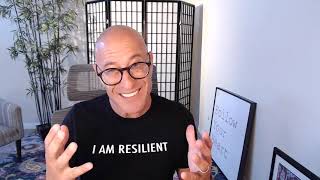
Adam Markel examines Simone Biles stepping back from the Olympics as an example of resilient leadership. Real resilience comes from ritualized recovery, not pushing through. Biles' pause let her teammates win gold and silver, then she returned to take bronze.
Questions this video answers
Adam Markel
Pause, Ask, Choose
resiliencerank.com
Bronze (the same event she won bronze in five years earlier in Rio)
Chapters
Hi, it's Adam and I'm a resilience guy. I've spent my entire career focused on what it takes to be at your best, even in the most adverse conditions, the most uncertain times like the ones we're living in, including writing two best selling books on that topic, one called Pivot, the other one called Change Proof. And I want to share with you right now something I think is really important that we take notice of. I've been watching the Olympics, as many of you probably have been as well, and the story of Simone Biles stepping back, taking a moment for herself to reset, to breathe, to recover, I think is really profound. Obviously, she's been met with a whole host of both praise and criticism as well for her decision to do that. A lot of people thought that she was a quitter or called her a quitter. And other people said it was so courageous of her to simply recognize and acknowledge that she was feeling the way she was feeling, that she was burnt out, in essence, that mentally exhausted and unable to be at her best. And so she did something really courageous, which was to actually own that, to admit it, to let the world know. I don't think she ever would have imagined that on the biggest world stage for athletes that, that she would be in a position where that would, would become operative for her. But she owned it. She decided that instead of trying to fake it or muscle her way through it, which is what we're often taught, so often it is that we just have to keep grinding it out and gritting it out. And ultimately that would have been damaging, potentially damaging to her physically, might have been damaging to the team, certainly would have been damaging to her psychically, meaning that her mental resilience was waning, that she was feeling that the pressure was too great for her to perform at the level that she's capable of. So she did something very sort of radical and counterintuitive, very different than what you see from many, many athletes and many business leaders. And that is that she admitted that she needed to take a break, that she needed to step back. See, so many people define resilience as our capacity to sort of muscle our way through bad situations, to bounce back from, from setbacks, to be sort of like Rocky in all the Rocky Balboa movies, where you just get hit and get back up. You constantly are able to get back up. Every time you get hit, you keep moving forward. And what we found in our research and is something that's been studied now for dozens of years, is that resilience is not born out of that capacity to bounce back. It's actually born out of our capacity to recover, to ritualize our recovery enables us to move forward, enables us not just to bounce back, but to bounce forward. And that is exactly what Simone Biles has shown us. Because not only did she take that moment to reset herself, she took herself out of the competition. And what ended up resulting from that was that one of her teammates won the gold medal in the all around. Another teammate that wasn't going to be able to compete at many events actually was able to win a silver medal. And most recently, just in the last couple of days, Simone Biles decided that she had done what she needed to do for herself, that she had created this recovery zone for herself. So that with that ability to recharge, she was able to actually get back in the competition. So because she afforded herself that recovery, that time to reset, to regenerate herself, she was actually able to re enter the competition at the highest level and win a bronze medal, a bronze medal in the same event that she won a bronze medal at five years earlier in Rio. And she cleared all that space for other people, for other members of her team to also step up and be their best. Quite a lesson in leadership. Quite a lesson in resilience and resilient leadership. Each of us individually know what it feels like in the last year plus to have to feel exhausted, to feel like we are in a constant sort of cocktail of cortisol, that there's perpetual fight or flight experiences and feelings that either we or members of our team are dealing with on a day to day and moment to moment basis. And so often it is that we just try to keep those things to ourselves because we are afraid to be vulnerable in that way. We don't believe that we have permission to do what Simone Biles did, which was to simply own where we are, be transparent about our capacity at a particular moment in time and let people know that for our own mental well being, our own mental resilience, as well as our physical, emotional, even spiritual resilience, sometimes we have to take time to reset, to recover, to regenerate, to be able to come back stronger, more productive, more capable of serving our company, serving our teams, serving our families. Simone Biles modeled this for all of us, not just for the other Olympic athletes who are under tremendous strain and pressure, just like she is and was, but she's modeled it for the world, for us as individuals, as family, as leaders. Something truly remarkable occurred in these Olympics and Simone Biles was one of those People, I think, really brought this home in a way that is new, that the conversation is not something that we've seen before. And so I invite you to have this conversation with members of your team. Not just to say, hey, you know, how you doing? Because we do that. We ask people how we're doing and how they're doing, but to dive below the surface to find out are they hiding, are they hiding? Where it is that they are lacking in resilience right now, mentally, emotionally, physically, spiritually, to care enough to ask those follow up questions, to ask those uncomfortable questions, and to also be vulnerable and transparent yourself, honest, in other words, with your team members about where you are. Because so often it is that when we are honest ourselves and transparent with our teams, we, we give them permission, consciously, unconsciously, they have permission to do the same, to be transparent with us, to be real with us. And that's how it is that we are able to look out for one another, to create got your back environments, got your back resilience and resilient cultures versus watch your back environments and cultures. So I invite you to have this conversation with your teams. I also invite you to take action. Our resilience rank assessment, to find out where you're at, it's divided up into those four realms that we all experience each day. The mental, the emotional, the physical, and yes, even the spiritual. You can go to resiliencerank.com resiliencerank.com and in three minutes you can get a free assessment and see where it is that, that you may be in need of some reset time, some recovery time, and we can certainly help you in that area. We are going to send you some free resources just as part of what our company is committed to doing is no strings attached. So those resources will show you how it is that you can ritualize your recovery. It is so important right now that just like Simone Biles showed us that we can pause, that we can assess in that pause where we are at. We can ask, ask questions, find out where it is that we can improve or help ourselves or help others, where it is that we can see the creative opportunity. And then we can choose to choose these rituals to recover more readily, more quickly, come back even stronger, to be able to bounce forward. In other words. So pause, ask, choose is the model that we share in much of our work. I look forward to sharing it with all of you sometime very, very soon. I invite the conversation both here with us and internally, wherever you are, with your families, with your teams, and I look forward to getting your feedback as well.