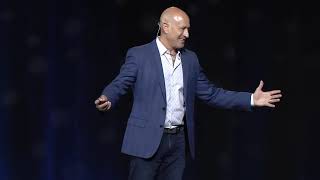
Adam Markel on building accountability through feedback. He shares a four-part script: "For me / What worked / What didn't work / What could be done differently." He uses the story of his son Max arriving late to show how this approach works without blame, turning feedback into a tool for team growth.
Chapters
Take a look at the event that you've been at this week. How beautifully and impeccably created, curated for you. They've obsessed about every detail. Look at these beautiful screens. Look at this incredible room, Just the placement of the tables. If you knew what went into, just how to set this room up for your enjoyment right there, people on the staff going, oh, yeah, I know exactly what that was like. Every detail, carefully thought out. Impeccability. Nobody wondering, whose job is it? Because on the baseball field, everybody's got one job. Everybody's committed to one thing. What is that? What's that one thing? Winning. They want to win a game. That's what all of us want to do. That's what this team here is doing. Igor micro set this room up, created this event for you because that's how they're winning a game. And nobody's wondering about whose job is it. Whose job is it. It's everybody's job. You lead from any position, you lead from any seat. That. That's what's incredible. When you get buy in, you allow people to be seen and to be heard so that they are empowered to lead from any position on the field. I love ups. I love it because their culture is so interesting. They're very structured. They have rules for everything. Where they put their keys, how they put their keys in the ignition, how they open and close the door, the clothing that they wear, all of that is routine. And yet they empower their drivers just to do what it takes to deliver a package. So when Hurricane Andrew decimated Florida, what were UPS drivers doing? They were delivering packages to people in their cars. In their cars. Because those people didn't have a home they could go to or get into. They were empowered to do that, to do whatever it took. Here's another scene from the genre of sports. Whether you're a sports fan or not, I think these analogies really work well, especially in life and in business. This is a typical scene on the pitcher's mound. What's happening on the mound? Call it out. What's happening? Look at their body language right then they're ready to make a change. Let me ask you, is the conversation that's happening up there on the mountain that just happens to be my team? No, just. Just have to say that that's where I grew up. Is the conversation going something like this, hey, buddy, you stink. I can't believe you call yourself a professional. We're sending you back to the minor leagues. In fact, you're going to play little league baseball now. Is that what's going on? What's that conversation really about now? Hey, how you doing? How's your arm? What happened with that last batter? What are we thinking about going forward? Do we need to bring the relief in? How you feeling? You see, that conversation that's happening on the mound is an accountability conversation. And it's different than the ones that many of us grew up with, many of us are familiar with even in our own organizations, because more often than not. What does accountability feel like to people? Call it out an attack. What else starts with a J? What's the word that starts with a J? We all. What's that word? Judgment. Yes, judgment. No one wants to be judged. No one wants to judge others. This is not a conversation about judgment. It's going to sound a little strange in a business context, but this conversation, this accountability conversation is rooted in love. Love, support. They just want to win what? A game. They want to win a. They want to win a game. That's what they're there to do. That's the goal of the team. It's rooted in love. I want to share something really tangible with you that you can take back to your teams and even back to your families. Because feedback is. Again, when we hear the word feedback often, it brings us to the. To the thought that we're talking about criticism. Nobody really wants to be given feedback. How many of you love it if somebody comes up and he says, hey, I'd like to give you a little feedback? Does that feel good? Anybody to that looking for that? Not usually, because it feels like judgment, it feels like criticism. It feels like you're about to get it. And this is a different way to look at feedback and to practice it. So you could take a picture of the screen. But I'm going to give you a little context. So I want you to imagine, as I can imagine, because this actually happened in my life, that one of your kids. So we'll call your kid Max, because I just happen to have a son named Max. And I want you to imagine that Max comes home late one night. He's borrowed the car. He's supposed to be home at 11 o'. Clock. You hear the door close. He comes into the house. It's 11:10. Max is a teenager. He's 17 years old. What do you do about it? For most of us, I think what we do is just say 10 minutes after 11. Close enough. Good enough. Because who wants to go have a conversation with a teenager about being 10 minutes late to anything? Most people don't. I Walked into Max's room and I said, max, here's what I want to tell you. What worked for me was you're home. You're home. The car is safe. You're safe. I gave him a good smell. I sniffed them. I said, I don't smell anything funny on you. That's good. I love you. You're safe. Did you have fun at the party? Yeah, awesome. That works for me. What didn't work for me doesn't work for me. Is that the time you were supposed to be home was what? 11 o'? Clock? What time did you walk in the door? 11:10. That didn't work for me. Because what happens, it's 11:10 today. What time is it next week? What time is it next week? 11:26. Five minutes before midnight and on and on. And people allow these things to go on, and I've allowed them to go on at times in my life. And then you've got boundary issues. You don't know what to do at that point. Well, this is what we did with Max, and we didn't just do this with Max, but we've used this in our company for years and years and years. What didn't work for me was at your home 10 minutes late. What could be done differently is the question. And that's a question that either I can answer or the other person can answer. I asked Max, Max, what could be done differently? And he had a whole host of answers, and they were all really good ones. Leaving early, being more cognizant of the time. All those things were solutions. Because what could also be done differently is you simply don't have access to the car. Or if I can't count on you, if your word doesn't mean anything, if your integrity doesn't mean something, how can I trust you with something like an automobile? We never had to have that conversation because he got the point. What's beautiful about this, and I want you to get the essence of it, it comes from the military. We just made some changes to it. To use in this context, is that, first of all, it's not judgment, it's perception. That's why the words for me are underscored. It's what worked for me. Not a statement of the truth of anything. It's just my perception. Everybody get that? Yes, Perception, not judgment. It gives a collaborative. There's a collaboration that's happening. When you think about what could be done differently, we're in solution mode. We're collaborating on the solution. We're not judging by saying this is what could be done better. It's not about better or worse. It's simply about what could be done that's different. Get a different result. So this feedback loop is something that we use when, when we're working with contractors. Sometimes they deliver a product late, sometimes someone's late to pay something, and you've got to have that difficult conversation about money. Maybe somebody on your team's missed a deadline, didn't show up to a meeting, or is perpetually late to meetings. These are difficult things within the team structure. Remember, our goal is for everybody to grow together, to get on the same page. That's what high performance requires. You can't have high performance without accountability. You can't have accountability without feedback.