Revolutionizing The Sport Of Swimming With Michael Andrew
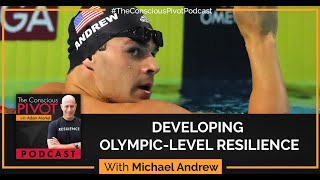
Episode of the Conscious Pivot podcast (host Adam Markel) featuring Michael Andrew and his father/coach Peter Andrew. They describe an unconventional, science-aligned swim training approach focused on race-specific high-intensity repeats with fixed short rests to drive neural adaptation and prevent deep fatigue, contrasted with traditional high-mileage programs and tapering. The conversation emphasizes recovery rituals, maintaining love/purpose for sport, family/team support, and how these principles map to business leadership, resilience, and performance rituals.
Chapters
Foreign.
Hey, everybody. Welcome back to another episode of the Conscious Pivot podcast. I'm your host, Adam Markel, and I am sitting here in our little treehouse home. And Martha's been very, very happy for the conversation I get to have in just a couple of moments and get to share with all of you as well. Before I get started, I just want to acknowledge how grateful I am to. To be here, to be in this moment, to be alive and breathing. I know it's been a difficult year for so many people, and for a lot of people, there's been tremendous opportunity as well. But gratitude to me is a grounding thing. No matter how good my life is going or even sometimes how crappy things might be going, gratitude is always just right there in a moment, in a breath, even. And I've got my I love my life T shirt on for those of you watching on YouTube as well. It's, it's, it's a way to remind me of what's really, really important. I'm so happy that the. The gentleman that I'm going to introduce you to in just a moment. Some, some of you may already know him or know them, but. But some of you. It'll be a first, first introduction. We are, to use an old word, simpatico, like, just have something really fundamental in common, and that is that we love the aqua, we love the H2O, the water. It's life itself, and some of us spend a lot of time in it. And this is just a wonderful opportunity to speak to somebody who is not just spending time in the water, but is using the water really as a platform for so many things in life, for creating new ways of thinking, new ways of being, new ways of training, new ways of developing resilience, which is something we're going to talk about today. So I've got a soon to be Olympic U.S. national team member, Michael Andrew, and his dad Peter with me. Peter, Michael, it's great to have you with us today.
Thank you so much for having us. Yeah. I'm glad we're finally able to make this work. It's been exciting.
Yeah.
Yeah.
It's kind of a funny little thing that we. We met the way we did, right? We met in the pool. I wish I could say I was training for something like the Olympic trials.
You know, I mean, that's one. Like, the pool is such a common denominator for so many relationships. It's been really cool. Even just looking back, like, as you mentioned that in your speaking, it's like the amount of awesome relationships and conversations we've had that have all started from the pool. It's countless.
Yeah. So the long story short is that I've been swimming in this one beautiful pool in Encinitas. I think it's Encinitas, California, and I should know. It's where I live. But I was swimming a couple lanes over from where you were training, and. And I just sort of was noticing that there was, I don't know, a lot of activity.
Yeah, we move a lot of water.
There was.
There was a bit of water moving.
I was like. Almost like there was a propeller or somebody had put a.
Put a.
You know, like a mercury engine in the water or something. And I popped my head up a couple of times and noticed this. Just what was. I guess, you kind of rocketing across the surface of the water and. And initially I thought, oh, my God, that's. That's just unusually fast. You know, like, having been a college swimmer, I hadn't seen anybody kind of move in at that level, at eye level, since the days when I was training myself. And then I saw this other guy standing, walking alongside the pool, and I said, oh, got it.
That's.
That's the coach. I get it. Right. Um, And. And eventually I just noticed that you were training in a very different way. And then I got out of the pool, kind of. I think it was at the end of my. My own little short workout and walked over to introduce myself, because I was just blown away by what I thought was a very different approach to training than I grew up with, which my. The short. The short version was you. You swim so many yards, thousands and thousands of yards, twice a day, and that's how you train to be a great swimmer. So, Michael, Peter, what were you guys up to? What have you been up to? That's different.
I'll just touch on it briefly, and I can let dad speak more to the nuts and bolts of it. But the way we train is, like you said, very unconventional, untraditional. We follow what the science supports. And up to now, throughout my short career, the results have followed. And the idea behind it is just being as specific to racing as possible. So when you say, you know, we're sprinting, we're going fast all the time, that's in a nutshell, what we're doing. Everything we do is tailored towards racing or training. Training like we want to race and being very repetitive with our movements so that when it comes time to race, there's no thinking involved. It's just instinct.
Yeah. I think, you know, like the way.
You trained was the science of the day because there was no science. Right. And, and actually Dr. Carlisle is an Australian scientist that in the 40s. That's his training methodology. They came up with that. And before he died, he put out a paper saying, and he's really well connected to the scientists that we work with. And he put out a paper saying, well, the way Michael Andrews training, he's really sorry but he didn't have the science that we have now. But unfortunately the dogma's been set and people believe what they're doing is the way that honestly the science is evolving and it will keep evolving. Right. And we've just been blessed that I happen to sit in a lecture and listen to this Australian speaking about training specifically and how the brain codes movement and how we need to be absolutely specific to be able to, you know, and it's, and it's kind of done across all sports. Swimming never picked it up.
Yeah.
And so I think one thing that's.
What'S so incredible too about the way we train is it's simple. Like, it's so simple. But people want to confuse things. Much like making a decision to love your life regardless of circumstances, it's like, it's so simple. But people, it's so easy for us to confuse that opportunity that we have to choose to do what just makes sense. It's, it's something that is commonsensical.
But we want to, we want to.
Throw in these weird drills, we want to throw in these long garbage yardage. And it takes away from that experience, takes away from the purity of just swimming fast so that you can race fast versus. So yeah, it's very interesting.
Isn't it interesting how people are almost addicted to making things complicated, more difficult.
Yeah. Like we love throwing things in our life.
That makes it more, more a nuisance.
Than anything I know people ask.
Addicted to struggle, right?
Yeah, we really are.
That's the general program.
It's so short. It's like gluttons for pain.
Yeah.
People, people always want more. It's got to be more difficult. It's got to be something. And it's. Yeah, no, it's really not that difficult.
No, it's a simple formula.
Yeah. And I want to get into the simplicity of the formula in just a second too. But so for those who've not maybe been swimmers or had people in their family who are swimmers, let's just walk people through what it looks like for like a 6 year old from, from 6 to 16 back in the day. Or I shouldn't even say back in the day, because the truth be told, this is still. The old paradigm is still what's running USA Swimming and swimming all globally, really? Right?
Yeah, no, it is 100%.
So like the traditional program is you've got athletes swimming 5,000 to 7,000 yards a session, just grueling the body. You create this massive amount of fatigue throughout a season. And in theory, they have these what they call taper, you know, like they're big tapers meets.
And the goal is to essentially start.
From this point, break the body down to here. And then if you have this big taper, you can in theory get back above that level. But the way we train, it's weekly breakdown, but there's a growth period. So you break down, you recover, you break down, you recover, you break down, recover. Throughout a season, there's this continual stair step of growth so you can get faster. Like, I mean, I remember starting the season in January and people are like, how are you breaking national records right now? Like, we're all grinding.
It's like, right, you're. You're all capable of this. Your body is capable of it if you just train specifically to the way you do it.
Because we know that the growth formula is stress plus rest equals growth, not stress plus stress, but stress that just digs you into a deep hole. And so there's got to be recovery. And I think actually in all sports, right, recovery is probably the most important training part because without it, you don't.
Get better even like just a simple breakdown of a set of hours. And the sets are constantly the same. So regardless of what stroke or event you are training for, the principles are the exact same. So you'll take the event, you break it down into quarters. So say I'm training for a hundred freestyle and I'm. So my best time is 60 seconds. So I want to beat 60 seconds. So that's like my barrier. Each 25, then would be 15 seconds. That adds up to a minute. We'll do 3020 fives on 15 seconds. With 15 seconds rest, no more, no less. And it's really important because that rest period is what creates this conditioning in the body, allows for the heart rate to stay maximally effort like you don't want it to drop because that's when lactate acid and it pools and fatigue. So the 30, 25, this repetitiveness, this specificity of back and forth codes, these movements in the mind so that when you come to race, it just happens instinctually. And you do the same for Every stroke, every distance. You know, two hundreds are fifties. And so it's a really easy plug and play formula that it's almost impossible to screw up.
That's exactly it. You're basically programming yourself to. So come race day, don't think about anything because you're already trained to do it, and just go and do it.
It's muscle memory.
It's total muscle memory. Yeah, yeah. And it's, you know. I know, Doc, you'd always use like a soldier, right? They train you a few steps here.
A few steps there. It's exact.
Just say, hey, here's your gun. Go and do mass carnage.
You know, when I think where there's. Where there's a parallel with our training is what people don't understand is it takes time to get to where you're making the repeats that I'm making. So, like I'm holding very fast times for very long intervals, like for long repetitions. But as much with, like making the decision to live a certain way or create a new habit is there's an adaptation period. So it takes time to get your body to that level. And I think people often look for this quick, easy, like, take a pill, go and swim fast type of thing. And it's nothing. Nothing works like that. You know, there's got to be this day in, day out, build off of each other kind of repetition because it's that compound effect that grows and actually produces the results.
And we know even from science, Jacob, muscle fibers, like fast, medium, slow, twitch. And there's an adaptation to become faster, twitch and then more oxidative, so you don't even create as much lactate. So you actually change your body makeup to as much as possible.
Right.
But that's only over time, and it's only over short training, short rest. And so I think he's probably maximally adapted. And so, yeah, it's a beautiful space to be.
Now you can see again, for folks that are watching this on YouTube, you'll see there's a slide that's kind of hanging out right over my shoulder and it's. It says the following. So I'll read it out. For those of you just listening, it's. It's far easier to prevent fatigue in the first place than to recover from it later. The person who's responsible for this quote is actually a sled dog musher. Like, she's an Iditarod competitor by the name of Blair Braverman. And this was a New York Times article that came out a couple of months ago. And I think in part, we're really talking about that. Right. Is that you're not necessarily trying to fatigue yourself to the point where you have broken yourself down. Because the model that I grew up on as a swimmer was break you down pretty much 90% of the season was all about breaking you down.
Exactly.
Create this sort of taper period, which tapering means just you're easing up on the gas pedal or taking your foot entirely off the gas pedal. And. And then you would somehow perform well. And so, yeah, everything kind of came down to that last meet or those last couple of meets.
So dangerous.
And it puts a lot of pressure on it. I think that's the hardest thing too, is dealing with the psychological side of man. If I don't do this right now, this whole season is a wash. I couldn't think of anything worse. But it is, it makes so much sense, like being able to prevent fatigue. And I think it goes even farther than that. Not just preventing fatigue, but preventing deep root fatigue. So for us, we do create fatigue, but it's a, it's a. It's a neural failure. Like when we train, we're creating these neural pathways. So it's, it's much more. We create fatigue in the brain so that we can learn from that activity. And the brain can say, okay, like, I want to grab onto this or I want to throw this away. Like, I understand what's actually going to.
Help me, what's going to make me.
Faster, what's the velocity, the technique. All those small things go into the level of fatigue that you're producing and then you learn from there.
Yeah, it's kind of like a bodybuilder. I remember that Mike mentzer in the 60s or 70s, he came with that. You fail once, but you just fail. So it's just an overreaching fatigue. And then you let that muscle grow back and it remembers where it got hurt and it grows back a little bigger. But if you carry on failing it, you create such a deep inroad. And that's the same thing if we do with swimming is it's a neural failure where the brain doesn't fire to the muscle. There's a small breakdown and we stop it there. And that way you can recover really quickly. So that when we come back to the pool, he's a recovered athlete, not coming back on fatigue. You know, we want to always be stair stepping up. So your fatigue is. I mean, it's necessary, but not. It's the deep fatigue. I mean, if you can. I mean, there's got to Be stress. But we want to just overreach so we can grow. Yeah, yeah.
I mean, there's a cost of being exhausted. There's a cost of exhaustion. I saw it when I was in college because there were guys who were. And I started late for a swimmer. I was starting in high school, which was unthinkable. Like these kids were swimming in AAU meets and training since they were 6, 7 years old. But by the time they got to college, many of them were burned out. Didn't want, didn't want to get in the water. And a lot of them had serious shoulder injuries, physical injuries, shoulder injuries, knee injuries, things of that sort. The burnout. The burnout and the, the, the breakdown, if you will, was. So what was, was. It was a, it took place over a protracted period of time. It wasn't a singular event. Like I'm, I'm, you know, overwhelmed in this moment. They were, they were overwhelming the system.
Ongoing physically.
It's actually, it's actually dangerous. Right, because if you think of swimming, we want to like the movements need to be like an adaption where the shoulder, especially the shoulder, because it's all shoulder driven, right? So you want them arm to work up and down this way because that's a natural movement. Once you get tired and they overwork you, you start to roll the shoulder.
You create bad habits.
And then that's why they have shoulder, because now they're not swimming properly because they're too tired to do it properly to raise. So then you stretch the shoulder and that's the end of your career. And so it's so silly to be a fatigue.
Well, I think like even looking at.
The slide and what's the cost of.
Being depleted is like, I think the major costs, you know, injuries and things like that aside, you, you lose the love of a sport. Like, you lose that desire to even be involved in it because of that experience. And that's the biggest cost. And the problem is there's so many programs that have this ongoing cycle or universities of athletes coming in, leaving just depressed, hating their sport. And it really, it kind of sets the tone for those that are incoming freshmen or people getting into the sport where it's like, I've seen what this has done to them. I don't want any of that. And overall, like, it takes a toll on the sport as a whole. And it's really unfortunate because, you know, you see it in. Swimming is like. Swimming is such a beautiful thing. It's like the water is such a therapeutic place. It should be A place where you go to really enjoy this opportunity and race, and then you can have performance, you have results. You know, you have that. It's like being able to go from the summer league type of mindset to the elite levels. Like, how do you do that without taking away that initial love for the sport? And I often, you know, I feel like the biggest way to combat that is asking yourself the why question. The big why do I do this in the first place? You know, having purpose beyond performance. And that's where a lot of that issue lies, too. And being depleted, it's like you just.
Start to hate what you're doing, Right.
You've lost connection with the deeper why the love, if you will. You know, there's a great. There's a great part of the movie Jerry Maguire. Did you guys ever see that movie?
Yeah, of course. Show me the money.
Yeah, right.
Everybody remembers that. There's a scene in that movie, you know, where. Where Cuba Gooding, who's the guy who says, show me the money? Jerry. He's like, But. But Jerry has to give him this advice where he says to him, look, as his agent, right, you know, you've lost your love.
Yeah.
Seems like it feels like you're in it for the money. Like, all you want is the. You know, what he called the kwan, right? And he wanted to get his contract, his due, but. But where was his love for. For the sport anymore? And then, of course, it's a great ending, Hollywood ending.
Beautiful.
Yeah. It comes back to that love. And then he performs, and then he gets his contract and all that. And that's also, interestingly enough for me, anyway, that. Where this I love my life message originated. Because there's a scene in that movie where Jerry's mentor, this guy named Dickie Fox, you remember, that older. Older guy, is kind of in this, you know, seersucker suit that probably wasn't in fashion, you know, 20 years earlier or whatever. And he looks right into the camera and he says, you know, I failed as much as I've succeeded, but I love my life and I love my wife, and I wish you my kind of success. And, you know, that was a time in my life when I was practicing law and would wake up in the morning, put my feet on the floor, and feel anxiousness and even dread, and ended up one day, you know, in the hospital thinking I was having a heart attack that turned out to just be. Just be a panic attack. Right. You know, so. But when I got back to the love, when I started my day putting My feet on the floor and saying, I love my life. It didn't mean. And it doesn't mean my life is perfect or that everything's going to go my way. It just means I'm going to put love into as many things as I can, starting in the moment I say it with myself and all that. So maintaining love is a part of the formula for what you do. Right. So how do you, after swimming, God knows, miles and miles, too many miles to count. And you've been swimming since you were a kid, and now you're on the precipice of both Olympic trials and the Olympics that are coming up this summer in Japan. How is it that you still love. Love the sport? How do you still love what you do?
That's big. So this last season's been really, I think, pivotal for me in finding that love for the sport. It's always been there. But I think what I've realized more than anything is it's not like, if I can understand that it's not going to last. Like, it's all perishable, like, what we're performing for. I may break a world record, I may win a gold medal, but there's going to be so many people to come break world records. They'll break my world records. They'll take my medals. They'll do, you know, I mean, they won't take my medals, but they'll, you know, like, there's going to be so many victors and things. Like, at the end of the day when I'm dying, nobody's gonna remember. Like, no one's gonna care. And so I think if I can understand that, if I can be so present in this moment, to enjoy every aspect of this, like, pursuit of excellence and pursuit of Olympic gold and the stardom that does come with it, I can enjoy it and understand that whether we achieve it or not, I'm still being excellent. And there's very few people in the world getting to do what I do. I think you started this with the. Started the podcast with the act of gratitude. It's like understanding that I am in a position that nobody else is in and I don't want to. That's grace wasted. If I throw myself, you know, under the bus by. By being so afraid or by losing that love of the sport.
So it's a lot of.
It's just a constant daily reminder of where I'm at and the fact that it's just an opportunity to find joy. You know, like, sport is here for us. It's not like, we're here for sport.
You know, one of the things I love about, about both of you, actually, because I know each of you speak and share your thoughts with, with, with organizations and people that are looking for more than just motivation and more than just inspiration, but are looking for genuine insight. And maybe not even, you know, so frequently are athletes tapped initially for their insights. And what I love about you being, I don't know, you're 22, right? To just turn 22, the level of insight that, that, that you exude at that age, at that tender age. And I have a son your, your age, myself. You know, it's, it's atypical, to say the least. So I want to, I want to ask you a question really, about this. We're talking about your training methodology. That's again, not this breakdown. Break things down, break people down, break your muscles down, only, only to put so much pressure on. At some point, maybe they, they actually perform. But rather as what you said, Peter, stress and rest, stress plus rest ultimately leads to greater performance. Or as I show the quote that's up on the screen, you know, the real enemy of high performance is not stress. It's a lack of recovery from stress. So I want to use this as a sort of a. Your training as a meth, as a metaphor. And I want you to think, Michael, in terms of, you know, what's going on in the world around us and maybe even in terms of the business audience. So, like, imagine you're speaking to an audience of business leaders here, and they're not swimmers, and they're not going to necessarily get what it means to do 25 yards in eight seconds, you know, that kind of thing. Right? But what they do get is that in business, there's constant pressure as being an entrepreneur, business owner, it's constant pressure to perform. And often the cultures of business is really about that old paradigm, right? How do we get the most. Squeeze the most out of our people? Exhaust them if necessary, because if they're exhausted, then they're working hard and we're getting what we pay them for. And that's a paradigm. And I want to use your training methodology as a metaphor for something different. What would you say to an audience of those folks?
Man, I have to take some time to think about that, man.
You know, I think it's, it's interesting how, and this is something I've seen even through social media, and this is a little bit of a tangent that I'll circle back, but it's like I used to see these Posts where it's like this billionaire, how did, like, their five steps to success or whatever. And it used to always be that typical model of grind sleep. Six hours. Like, sleep as little as possible. When you're awake, all you're doing is grinding, reading, working, emails, calls, whatever. And now I start to see this kind of new age. And really, I mean, a healthier perspective is like, you look at other billionaires and whatever in the world is there. It's like I sleep 10 hours a day. I start with meditation or prayer in the morning, a healthy meal, I exercise, and then I go work. So there's this shift in perspective. I think that's very similar with the parallel that you have in our swimming culture. Where we come from is you've got the traditional mindset, and then you've got USRPT and the science and the data that supports a healthier approach to success. And I think that's kind of like just where my mind's going now. Outside of that, I think if you look at it as a business like mine, so I'm trying to find the words in terms of parallel.
One of our main sponsors, and we just hung out with him the other day, and he doesn't even have social media, and he cuts himself off, and he. And only a very few people can reach him. And, man, is he successful. It's ridiculous. And it's like, how do you do that? But it's because he. He's so.
Well, and I think there's an intentionality there. So with our buddy Dan, you know, managing, working with billions of dollars, like, just crazy, like, things that I'm looking at, I'm like, oh, man, like, signing a $60,000 deal sounds epic. And you're here managing billions. It's like he's got an intentionality. So when you look at usrpt, for us, everything is intentional. Every stroke has a purpose. So for those that are listening, with a business and like, with daily tasks and work and the pressure that comes with that, it's about allotting your time to be intentional towards an end goal, you know, so everything we do, we're training for something that's coming up in the future. And each day, we're basically edging away at that major task. So right now being Olympic trials a week from now, you know, we've spent this last six months so focused on this that we didn't have to cram it in one week. We've been intentional over time, and now we can sit back knowing we're confident and prepared and the results have already showed their self and we're not even at the day yet. It's like we're so ahead of the game because we've been deliberate and diligent and disciplined because, you know, we had a higher goal and something we were focusing on.
Yeah.
And you weren't depleting yourself or wearing yourself.
No. And that's the thing is like we had a life outside of the swimming. Like it wasn't just, you know, I hate when people say, oh, you eat, sleep, swim. I could not think of anything worse than living my life like that and then ending my career, looking back and thinking, man, what did I do? Oh, I ate food, I swam and I slept. Like that's crazy. So, you know, I surf, I hang out with friends, I go out, I swim, I work hard, I rest hard, I eat. But I'm doing so many things outside of it. Like we're creating an academy. Like there's a lot of things occupying our time but, but at the same time they, they revolve around my love, which is swim. You know, so it's not like I'm purely defined by swim, but everything I choose to do has something that complements my dreams, my desires and my, my love. And I think that's a much healthier approach than just kind of grinding it out because you ultimately, you know, you deplete yourself.
Yeah. And it's interesting too because this, this would seem, as you said at the beginning, so simple that everybody could grasp this concept. It's so basic and yet it's still counterintuitive on some level, still runs against the grain. I put up on the screen just this old. And it is at this point, 20 year old study Harvard Business Review reported on where they were comparing the highest performing athletes in the world with the highest performing achieving business people. They found that they all had one thing in common. There was one commonality, you know, in the Venn diagram between these two groups and that one thing was that they had rituals, that each group had rituals for their recovery. For their recovery. So you're right, it's like a billionaire is somebody who isn't so busy that they can't have find a moment to think like people. How often do you meet somebody, go, I don't even have time to think.
Yeah, too busy to think.
Well, it's because they're so scattered. They spend a moment here, a moment there, like it's this adhd. Now this is like self. What's self diagnosed? Like we feel like we probably have ADHD in Our thinking. And that's why swimming is so good for me, because of the repetition and the way we train.
But it is.
You see that in the rituals, or we call them routines, really. I use routines. You know, when you create a routine, you don't have to think as much about it because it's something you're so used to doing that it flows and it builds upon each other. And as. As you do a routine for so long, you then start to add things and you grow and you get stronger. And it's much like you create a rhythm in the work you do. And it's the same with a stroke, is like, I'm much faster in my hundred breaststroke when I hit that rhythm and find that rhythm and can build on that rhythm throughout the race, versus trying to force one stroke, force another tempo, change the thing here. Cause that's when it all falls apart.
And what we do recognize too, is no matter what stress, like fatigue builds upon each other.
Right?
So it's toward an awake. If he's fatigued, we know, cut it off, just walk away.
And a lot of people can't do that.
They feel like they've got to work through.
And we realized, like, if you. If you work through, you're gonna.
You're gonna train slower. So you're training yourself to be slower. So we just pack it up and walk away and recap and restart. Yeah, and restart the next day. And.
And it's. So what you just said, Peter, is, I think, so brilliant in. In a few different ways. One is the fact that people don't walk away. They muscle. They muscle through it. They grind, as you say, grind, grind, grind. And that's what's rewarded, right? They reward the Night Owl Award. Or as you say, people on social media are talking about, you know, you only need three hours of sleep and you should start your side hustle at 7pm and keep going till 2am it's like, it's.
No, that's not sustainable.
It's not sustainable.
And then the idea of walking away and knowing you can reset, you're gonna restart the next day is possible. And I think that just is a product of faith. It's hard.
It's hard in itself because sometimes I feel like, oh, you know, I know that other people are working like we walking away. And I feel like we. But the reality is, the more you. I mean, I see the results too, of like, where we are. I mean, Peter, do you ever question.
Yourself as a coach? I know this is one of those kind of funny moments because you're dad and a coach, right? And that's.
Yeah, all the time. I think I do all the time. Because I, you know, when I'm out with other coaches, like all the big name coaches, I realize, honestly, nobody really knows anything. I don't think any of us know anything. You know, it's like they just. Everyone's watching each other and don't say that.
You can't let that out.
And it's just. It's just. It's crazy. But, yeah, I question all the time, like Michael said to me the other day, and, you know, I think the magic between us, too, is he trusts.
And he trusts me.
And then he asked me, like, dad, because we're doing a lot less now. You know, this is probably the most that we have. We've cut everything back, but we are still. He's got a small amount of stress, but he's not stressing. He's just staying fast.
Yeah.
So much.
And I believe it's the right way, but I don't really know. But we'll see. We'll see. And I do see the speed. And so I think when we get to trials, I think he'll break the American record in his very first swim in the heat. So you'll be able to watch back and say, yep, that happened. Yeah, I see it. And so. I know, but it's actually. It doesn't even matter what I know.
It's.
What does he believe? So if he believes in me and. And I know you, but I think.
And that's good to have is. Because you have to have some of that nervous, like, is it gonna work?
That's part of.
That's.
That's part of the high of performing. You know, it's like you don't really remember the race, but you remember how you feel. And I remember how I feel going into some of the biggest races of my life. And I, like, I'm starting to get those jitters. Like, you know, the more I talk about it, my toes and fingers start to tingle, and that's me getting ready to perform. It's my body knowing, okay, like, it's. It's time to turn on and go.
Yeah, exactly. Yeah.
And that's the beautiful part of, like.
On our journey to we learn stuff. Like, I thought, okay, to become a better two.
I am.
It's got to be endurance, right? And then we trained endurance, and it was just a little slower, and then his speed was off. And I was reading that book. I think it's called the Compound Effect, or I Mean, I listened to all these books, and the big thing that came to me over and over was, do not work your weaknesses. Always work your strengths.
And it's like, oh, my goodness, this.
Isn'T even a sport. This is business. So what are his strengths? They are speed. Let's go back. We train his speed. We did that and bam, it was like, okay, so, yes, we got to work strengths.
Forget your weight, too, in that instance was we realized we had added on so much yardage that I needed to recover from it. You know, this was the first kind of time doing this amount of endurance, trying to focus on getting stronger for that back end. But I wasn't going to see the results of that work until I recovered, you know, and then a few weeks later, we recover, swim at Indy, you know, break American or break U.S. open record, fastest times in the world. And so that's like, kind of what, what set us up for that.
Yeah, it, you know, your, your. The faith and trust that you were talking about earlier, both of you, Peter, but I was listening to what you were saying, is that you, you have faith in the process, but you don't have a crystal ball. So everybody. Right. Faith without the crystal ball, which is really what faith is about anyhow. Right. If you had a crystal ball, you would never have any faith.
Right, But.
And then you trust the process.
Yeah, I believe in the process. What we're doing. I believe because I believe in science. I mean, although science is so paid for by big.
It depends where the science.
Yeah.
So trying to find the right source.
It. But yeah, I mean, like, when Michael.
Asks me, it's like, sure, I believe.
But it's like, you know what to trust.
Right. To trust. When Michael says, you know what, or to trust what you're seeing, which is like you said, some days you got to go, no, it's time to, you know, fold the tent. Go have a night where you're not thinking about it or doing it. Yeah.
Great.
Example is we have overspeed training today. And Michael said, sure, dad. My shoulder just feels a little weird.
And so it's like, okay, we want.
Not weird in a bad way.
Just like.
Yeah, well, you got to trust your. There's trusting instincts, there's trusting your body, there's trusting each other.
Right.
More than necessary.
I mean, the, the thing about developing this level of, of bounce forward ability, we like to think of it as bounce forward ability, not bounce back. Who wants to bounce, you know, back? It's, you know, that, that's, that's again, that's Old paradigm. Right. You know, we're going to bounce back from the. From the pandemic. We had to bounce forward from the pandemic and for anything else. And I. We use the word for that. We. We say it's resilience. That's what resilience is. And your. Your body is just more and more resilient all the time based on your training method. But it's not just purely physical. Right. It's. It's mental, it's emotional, it's even spiritual.
Yeah.
So much spiritual. Again, that's what I've noticed has been the biggest thing for me is realizing that, you know, my. And we believe that God's given us a gift. You know, this is our opportunity. This is not an obligation, but an opportunity. And in this season, there's so much freedom, especially with racing is like, I know that I can't control the outcome. Like, I can do my best to be prepared for it, but now I'm ready to stand there in faith and let the training do the talking. Yeah, but it is like, you're right. Like, there's a mental, emotional, physical, the spiritual and everything plays a huge role. And I actually. It's funny, I feel like physical probably plays the smallest role out of the four because it's so easy to become physically fit. You know, everyone can sleep well, everyone can drink water, everyone can train hard and do, like, follow the science. But what's gonna separate the great from the excellent from the legends is those that are mentally fit, spiritually fit, emotionally healthy. Because you see athletes that aren't, they just collapse under that pressure or they collapse afterwards, realizing that all they found value in was their performance or their sport. Like, they couldn't have a life outside of it. It's like there's so many.
Yeah, there's enough studies on emotion, right? How it spikes that DHEA hormone, that the oxytocin locks you down, you fatigue before you even start your race.
And.
And that, I think, is a big key for Michael. He loves the big lights and all that excitement. He channels that energy into. I mean, into energy. So that emotion becomes energy. And it's pretty radical because I see at trials, I think it's one of the slowest meets because people, they get out there and there's thousands of people shooting flyer and flames and they just.
Just.
I think that's what attracted me to want to really speak to you guys and get you on the show today and talk more about or really have people be able to hear. Hear you, because I was just so taken by how grounded as a person you both are. But, you know, Peter, look, you're about my age, and I thought, well, you know, that's. That's to be expected. Right. With age, you know, age doesn't bring everything that you want.
Right.
But one thing it does bring for a lot of people is a bit of wisdom, a bit of perspective at a minimum. Right. And to be so young and to be as grounded as you are, I think that's what's. That's what's atypical for me. And yeah, to put kind of say it's. There's an emotional component, there's an emotional stability or an EQ element, you know, I think is super important because you can be a leader in a lot of ways, Michael. Obviously leader in the pool, win. Win lots of medals. Everybody, you know, everybody wants to see you do that, routes for you to do that. And yet there's. There's other leadership as well. There's this kind of thought leadership that is profound. Because sport needs to evolve. The methods that we use to train people in sport, I believe, need to evolve. And because it's a metaphor for the way that we want performance in other areas of our lives, including in business. I think there's a nice. There's a nice bridge. Yeah.
You know, I think a massive thing in our. That's in our favor, too, is. And I see it in our organization as they very against. And it's a horrible thing to say, but they are very against family. And I think the family is so powerful if we work together like we have. And look at, like a Tiger woods, you know, when he had his dad, how incredible he was. And I mean, you know, there's so many instances like the Williams girls having their dad, you know, train them. And so I just think there's so much power in family, and if we do it right and we really manage.
I think I get where organizations are fearful of families because some parents are absurd, you know, like, you know, get your helicopter parents. But I think if you can have a healthy dynamic where the parents understand what it's like to coach, like a father loves type of instance, and to support and to build up not to.
I mean, that's been a journey too, right? We've learned, like, okay, okay, now it's time for Michael to be outside the nest.
And.
But we still, you know, so it's still all mesh, but how do we do this so that we do it right? And it's been a journey.
We've learned.
I mean, I'VE learned, too. Like he said, love the highs are.
Only as high because of the lows.
That goes back to my talk. Right. The mountain stuff grows in the valley when it's hard. Not on the mountaintop, you. Hopefully on the mountaintop, you've experienced the growth in the valley.
Otherwise you can't get through it.
There's a volcano and everything dies.
Indeed. Hey, look, just recently. We're going to wrap up here in a second, but I was thinking, as you guys were speaking, that Phil Mickelson, he's 50 plus years old, he just won the PGA Championship. And it wasn't because he was physically superior to his competitors. Right. He could never be physically superior to a guy who's 30 years old. That's not going to happen. Right. But emotionally, mentally, even spiritually, he was in a different place. And when he was interviewed afterward. And of course, he's tremendously humble guy. I just love listening to him speak. His brother, who I think is his caddy and a performance coach that he uses out of Australia, and of course, his wife, you know, he was. That's where he placed the credit was in family, you know, in the family that you were just describing.
What's the biggest thing we always get is Michael in interviews, he always says we.
Yeah.
And they hate it. Like, who's we?
It's.
I.
It's like so interesting that you say that. That they hate that. Isn't that interesting?
And that's the fear is like, I don't think people hate it. It's that they don't understand it.
They don't understand it.
You know, a lot of people aren't as. I'm very fortunate. I often take it for granted how lucky I am that, you know, my family's still together. My parents have been so invested in my career. They pushed me, encouraged me to do this. Like, this wasn't just me, like, at.
The end of the day.
And Phil understands that as well. It's like it takes a village. But the issue is a lot of people have a broken village. And so, you know, there is a lot of really amazing blessings that I've been given. And, you know, even in the hard days, as we've been able to communicate with our village and change people. And, you know, it's like, I've worked with agents, I've worked with companies that weren't great. I've worked with people that weren't good for our team and for the direction we were having. They didn't have the same vision. And so, you know, as our Village aligns and has that same vision for success and for purpose beyond just the medals. Nothing can get in our way. Nothing will stop us from succeeding.
Indeed. Yeah. I can't help myself. You guys are just inspiring so many things to come up. You know, the picture I've got up right now is a guy who took over as the. The performance director for British Cycling in 1998, at a time when British Cycling in 1998 had not won a gold medal, not one gold medal in the Olympics since 1908. So, you know, I think the technical term for a team like that is they sucked, right? So had never won the Tour de France, ever. And the thing about Dave Brailsford, that I think folks who have never heard of him, you can, you know, look him up and listen to him speak. He's got a pretty cool British accent. It's kind of tough to understand him at times. But his. His whole thing was not looking at all the ways that you could try to create perfection out of something that was clearly imperfect. And I think a lot of people beat themselves up because they are not perfect and because they've made a lot of mistakes, as you were alluding to, and don't know where to begin. And what Dave Brailsford, coming into that really very difficult role, did that was so counter to what was expected was he just looked at all the ways they could make a tiny, tiny, tiny little impression. Improvement. Almost imperceptibly small improvement. Even to the point where I think he painted, if the story is correct, he painted the inside of the box trucks that carried the cycles to the races. He painted them white on the inside.
I've listened to all of that because we followed this whole. The whole thing. Because one of Michael's sponsors was Dotsy Bausch. You know, she won the silver in the velodrome. And so we kind of, in that, cycling the world, it was a radical story because they just.
So for all of us, I think finding the tiniest changes, like he painted the trucks white simply because he wanted to be able to see with the naked eye if the trucks were dirty, that the dust would get into the gears of the bikes, right? He was teaching these guys 20 years ago how to wash their hands properly. How prophetic was that, right? So that they would get sick one time fewer in the year and change their pillows. He changed, you know, a myriad of millions of little tiny things that. That by themselves wouldn't have won a medal, but in the aggregate, by clumping them together, you know, by 2004, I think they won two medals. By 2008, they were the most medaled team at the Olympics. One, I don't know. Five, six, seven. Tour de France is so, you know, it's just really important, as you said, that we, we don't beat ourselves up, that we've even made mistakes, but rather that we use them as a catalyst for growth. Yeah.
Yeah. That's huge.
Yeah. So I so appreciate you guys being here and, and the fact that, that you're, you're off on an epic journey, the both of you.
I mean, all of us are, we all have a journey and a story to be told. And I think that's what so cool is. You know, everybody's got a gifting, they've got something. You know, some are fortunate to find it early on, some find it later in life, but we do all have these, these crazy stories to be told.
Yeah.
And we're excited to know what else is cool.
And it's just, I mean, it feels like we've been here for so long, but it's just beginning, right?
Yeah.
And so it's super exciting. I can't wait down. You know, I have this thing of. Because when you make your first team, like on your event, then you parade around the whole pool and you wave at all the people. And it's like I said to Tina last night, should I wear dark glasses? And she said, no, if you cry, people should see that emotion.
I honestly, I think dad's getting way more nervous than I am.
But it's good nerves and I'll be awesome with it. Oftentimes I'll watch a race, I don't even see anything.
Glad he's not racing.
Exactly. You know, it's just, it's a blessing on so many levels to be able to be with you guys at this moment, actually in the, in the place that you're at and to be on your growth edge. You know, we, in our business, we train people to speak and deliver high stakes talks, like on a TED stage or, you know, elsewhere where nerves are normal. Like you're going to get out and speak in front of a group of, I don't know, 12,000 people. You're going to have a few nerves. Right. But, but as an old mentor once said to me, when I was just getting ready to go into court and speak in front of a judge for the first time, and I was really, really nervous in that environment, he said, just, you know, check yourself for a pulse, because if you've got a pulse, you know, you're alive. That's a good. That's what you want. And when you. When you know that you're nervous or that you've got that energy about something, it can only mean that you're alive and that it's important to you. And I always swam my best when my. When it was the highest stakes, when my parents were there and I felt the sickest to my stomach before, like, it was like, I don't want them there. What if I fail? What if I screw up? What if I miss the wall, like, you know, flipping or something, you know? But it was that intensity of focus that brought out the best in me. Michael, I know you're. Regardless of what the results are, you just have a ridiculously big future as a person with tremendous insight and of course, with 120 national records to your name already, I know there's a lot more ahead of you as well. So, guys, so happy to have you join us today.
Really appreciate it.
Way cool. And for everybody, as you're. You're winding up or down your day, remember some of the things that we talked about today. And if you know somebody that could really use hearing that message about maybe not depleting themselves and finding those, creating those routines or what we like to call rituals for recovery, mentally, emotionally, physically, and spiritually even, then share this episode with them. Leave your comments and let us know. And of course, you're going to want to follow Michael Andrew and his journey and lots to be looking at there as well. All right, ciao, everybody.
Have a good one.
Thank you.
More from Adam


Mastering Strategic Communications To Navigate High-Stakes Environments With Chris King


Mastering Self-Leadership Through The Conscious Habit Framework With Amy Woodall




Optimize Your Performance And Vitality Through Advanced Metabolic Health Testing With Mauro Stara

Cultivating Audacity: The Audacious Path To Success With Anne Marie Anderson
