The Grit And Resilience Of A Recovering Swimmer With Cameron Black
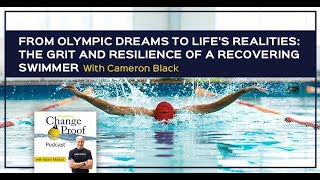
Transcript of a Change Proof podcast episode (host Adam Markel) featuring Cameron Black, a former competitive swimmer and current wellness director. The conversation covers Cameron’s athletic highlights (near-Olympic attempts, injuries, broken starting block), the long-standing personal disappointment from narrowly missing Olympic qualification, and how he’s applied lessons from high-performance sport to resilience, identity, recovery, and daily rituals. The episode also connects these themes to practical resilience strategies (pause → process → release, baked-in recovery) and audience takeaways about forgiveness and purpose.
Chapters
Life happens, and not always the way we expect it to. Every single day, we face change, stress, and uncertainty. What if you could learn to thrive no matter what life throws your way? Resilience expert Adam Barkel and his inspiring guest explore breakthrough strategies to fully embrace change and build the resilience required to become change.
Proof. Hey, everybody, it's Adam. And welcome back to another episode of the Change Proof podcast. I'm so excited today for my guest. He's. He's a new friend. His name is Cameron Black. He. He is going to blow your mind. I he. The level of his just honesty and transparency and, and, and his story. His story just, frankly, is amazing. He's a Scotsman living in America who is still, in his own words, finding his path. He's a recovering swimmer who has a. An epic tale about the Olympics that you will hear and great memories and also unfulfilled dreams. He is currently working as a wellness director and strategic advisor for a brokerage firm in Springfield, Missouri. That's where I got to meet him at a recent keynote that I was asked to deliver there. And he's just a heck of a guy. I mean, some of you guys will absolutely just love. I know it. It's going to be great feedback. And all I ask you to do right now is just relax, sit back, and listen to this episode of my conversation with Cameron Black. All right, Cameron, so I. I've been. I've been looking forward to this conversation, actually, since the very last time that you and I were together and we said we were going to do this, and we're doing it. So I'm super excited for what's to come. But I want to start by asking you a question I ask all of my guests, which is what is one thing, one singular thing that's not part of your. Your bio, your professional credentials, the bio, the intro, you know, that I've just read out loud for everybody. But what's one thing that you want people to know about you?
You know, the biggest thing for me, and it's evolved over the time, is I am a massive soccer fan. Massive soccer fan. Manchester United, greatest club in the world as far as I'm concerned. And it's funny, I watch every game. I never miss. And I talked to my dad about it, and I always say, you know, we did this and we did that. He's like, cameron, you don't play for them. You realize that, right? But the reality is I love that team. And it's. It's a real passion of mine.
Yeah. You know, I'm not even surprised to hear you say that because you're. Well, two things I know about you, that you're, you are very passionate that there's a. And you're not quiet. I wouldn't call you quiet. So it's not so much the still waters run deep, but you're, you're, you're not also, you're not, you know, super, super gregarious or whatever it is. So the passion part I detected in our first meeting, but you also were very passionate about sports early on in your life. In fact, you've been, you've been an athlete at, at very, very, at a very high level, I would say in the sport that you were in, I could say that you, you, you were a semi pro or if not a professional, but there, there is no professional swimming. And I was a swimmer in high school and I didn't swim at the level that you swam at, but I was very passionate about it. And in fact I would say most people, most young boys and girls and men and women in that sport in swimming and the related things like water polo or diving, what have you, since there really isn't any money that you're after, it's like there's no professional status that you can look at being a part of a team and getting paid, you know, the dream is of course to make the Olympics. And you, you, you started out with that dream to be an Olympic swimmer, didn't you?
I did. That was from the very earliest age I can remember. That's what I wanted to do. I'd watched it on tv. I'd seen, you know, the Olympics, some British swimmers mounting the podium, which wasn't, you know, wasn't that common. If you were British and got a gold medal, that was, that was impressive. And just from the earliest time I remember walking, headphones on, just dreaming of the day, visualizing it, that I would be in that final, racing and winning that gold medal. It was definitely something that burned deep inside for sure. About what age was that right from the get go? You know, I came from an athletic family so I learned to swim very early. But I started at club when I was 8 and immediately just loved it. Never loved the training from the time I was eight to the time I retired. But I love to compete. I love to be under the lights. I love that walkout music. I just loved everything about competing. It was just amazing.
Yeah, yeah. It's so funny, I'm thinking to myself, what were the things that I love most about, about swimming? And yeah, the the rush at the end of a. At the end of a. An event, hopefully that one that you finish first. But regardless, there's. There's a certain adrenaline, and it's not even adrenaline. It's just like there's a. So I would describe it for me as a peace is a piece that I could ex. That I would feel when that race was. Was done. Because it's one of those sports where there really isn't a lot of modulation. Well, no, I'm going to correct myself. There's modulation within the event, but when the event is finished, if you've. If you've swum or swam the way you're supposed to, you really don't have very much left in the tank. I mean, you kind of have left it all in the water. Was that what it was like for you, too?
You know, I think you're describing it very well, and I've thought about this a lot over the years. There's nothing better in life than from the second your fingertips touch that time pad and your eye looks up to the scoreboard and you see the time. That was when I was at my happiest. That was. You know, when you've swam a race, you've personal best. Boom. That's amazing. But then there's a downside to that, too. And I look back on my career, didn't celebrate those enough. It was immediately, what's next? What's the next event? What can I get into? Is that going to qualify me for this? And so in hindsight, and I try to encourage my kids to celebrate any victory. You don't have to be crazy with it, but you work hard for those moments, and the team works hard, your coach, your parents. And looking back, I wish I'd maybe just celebrated that little bit more.
Yeah, that's fascinating. I mean, I want to be able to expand the lens here, the aperture of that, a little bit later into where that plays out in our lives outside of the pool. So our lives outside of a sporting thing, whatever the fill in the blank is on the sport or the passion that we have for things when we're quite young and apply it to more like being a parent or being a member of a team or being in business or an entrepreneur on your own, whatever it might be, you know, being in sales, all that kind of thing. So want to come back to that? We'll do that. So here you are. You're. You start out early in life with this great passion, and it leads you pretty far. You know, you got further than I Did. I swam in high school, I swam in college. But you went, you went beyond that. And could you tell us, I mean, I'm not asking you to. I know you're a humble guy, but I want you to do a little, just sort of give us a little few of the highlight reel moments for you as a swimmer.
Yeah. You know, pretty quickly I was wedding state or our equivalent in Scotland and that was great. I made my first Scottish schools team when I was probably 15 and I ran home from school to tell my parents. I mean, you couldn't have been a happier kid in the world than me when I got my first cap there. And from there it progressed each year I was kind of a slow burner. I probably worked hard and wanted it more than most, but wasn't quite good enough, to be honest. But eventually kind of wore everyone down and started winning. Made my first senior Scottish cap, 96. And then from there I was really close a lot, Adam, I would say really close to qualifying for a lot of major things and never quite getting over the line. I competed at the European Short Course Championships, I competed at the Commonwealth Games. I swam in World Cups in Australia and Berlin and various places. But the big one was the Olympics. Right. That was the holy grail, right. In my mind. I had two pretty poor experiences, one of which I've shared with folks and one that I haven't. In 96. I wasn't going to make the Olympic team in 96. I was still relatively young back then, but I was looking a final and my block broke. Believe it or not. I used to do the track start, you know, where you pull and put a lot of force on the block and it broke and I kind of pancaked into the water and finished and got out and kind of punched the block when I went to the other end. And so that was 96. And that was again, wasn't going to be close to the Olympic team, but probably would have made the final, which would have been really cool. You know, at that age you progress another four years and you know, I was looking to make the team, go into Australia. I was on the pre Olympic Games camp with the British team. We spent six weeks out there in January training, getting ready. Not too long after I came back and swimming really, really well. I was lifting weights and I tore my pectoral muscle. And even at that time, and that was early in the year, I knew that this was going to be a tough, tough ass to make the Olympic team, but rehabbed it as best I could, even though they said, there's no chance you can get this back in shape and swim again. Before trials, I was like, no, no, this is going to happen, right? This is my life's dream here. So rehabbed as quickly and as best I could. And long story short, I was one of the favorites. And you never know at Olympic trials, people can come out the woodwork. But I was, in my particular event, ranked third in Europe at one point and top 10 in the world. So I had a chance. I got down there to Sheffield, to the Olympic trials. The day before my event, I was warming up, dove off the block, and I retort my pick. And you talk about the highs and the lows. I didn't know who to talk to, what to say. My dad had driven down my coach. I went back to the hotel room after telling everyone, yeah, yeah, good, warm up. I'm good, I'm good. Went to bed that night, obviously couldn't sleep, right. Went down in the middle of the night to my coach's room and he opened his door kind of bleary eyed, and I said, hey, coach, I'm done. It's over. And we both cried and we kind of just pugged and that was. That was kind of the end of it. Now I swam after that. I took a year, went back to college, finished my degree and I swam and I swam pretty well after that, but never hit the heights again that I wanted to. By that time I was 25 and getting married and life gets in the way and it's a regret, Adam. I mean, I'm not saying anything my wife doesn't know or my family doesn't know. I. I feel like there was more in the tank. I feel I should have done better. I don't know that I was ever built to do better, but in my mind, I felt like I deserved and wanted to do better. Sometimes life gets annoying.
So it's. I want to unpack that just a little bit more because. And for context, for people that are listening to some of you who are watching it on YouTube, I'll just say this. Cameron and I, we met at an event that I was invited to come speak. In fact, Cameron was the person who found me. Is that. Is that correct, Cameron? You.
No, absolutely. Yeah. Yeah. I was excited to have you come speak to our event. Yeah.
So he's like surfing the Internet and he finds some videos of me giving my talk on resilience to some audiences or whatever. And I was asked to come to speak for, for the company that Cameron works for. We're Going to find out more about his work and what this company does. But they're in the insurance space and the business advisory space called Olis Acres, Arnie. They're based in Springfield, Missouri, a well regarded firm that's been around, gosh, since before the prior century. So forget this 1885 century. It's the century change before that that they've been around 1885. So pretty, pretty amazing organization, incredible history and legacy, etc. So was an honor to come and speak and before, you know. So it's the morning of. I could save, I could talk about a few other things, but I'll go right to the morning of and we're getting ready for me to get on stage and all that and we're doing early morning tech check and getting set up. And in my tech check or what we, you know, like to call the, the mic check or whatever, I'm going through some of my presentation just a little bit here and there. And, and at that moment, Cameron sort of, you know, has a, has a moment. I don't want to describe that moment for you, Karen, but what happened when you heard me doing my warmups that morning?
Well, I don't do a lot of public speaking like you. And so when I'm going to be on the stage in front of 300 folks, I got to get myself mentally prepared for this. And I'm watching some of the slides, as you say, go by and one of the slides certainly hit on a topic and a story that I wanted to tell that morning that I'd rehearsed and I was ready to roll. And then the lesson I learned, Adam, is if you're going to invite a keynote and you're also going to go on stage, be the first guy on stage. Right. That's kind of, that's kind of the thing. And so that's right.
The lesson is to steal the thunder of the guy that you brought in.
Absolutely. But I had to figure out very quickly that obviously the audience isn't there to hear a similar story twice. And I had to do something different. So I, you know, ran, ran an idea by Adam and he was gracious enough to kind of give me a couple of pointers and kind of steer me in the right direction. And this is where this, this swimming story kind of poured out, I guess would be a good way of saying did.
I mean, it was. So you were going to speak after I was done and you had, you know, some time with the audience before, before the end of this wellness day, which was wonderful. That the, your firm brought together and has for I think, 16 consecutive years now brought together a group of, of clients and people from the community to talk about wellness, to talk about, you know, before it was f. Talk about it, and now that it is more fashionable to talk about it, you know, we keep, or you guys keep diving into that subject matter at it at a greater and greater depth. And so again, I was, I felt incredibly blessed that I was tapped for that assignment. And when it was done, you were going to kind of say some things to wrap it up. And what you had said to me was, hey, listen, I was going to mention this thing about Rocky and the whole kind of concept around Rocky, you know, Rocky Balboa and all that. But now that I know that you're going to say something about Rocky, it's like, I, I probably shouldn't do that, right? And I'm like, yeah, maybe, maybe that's not necessarily what, what makes sense. I said, so what would you do if you weren't going to do that? Like, what might you share or talk about? And Cameron and I had just been talking about, like, we geeked out on the swimming stuff because I, like I said I was a swimmer. I got started late in the game. But, but, but swimming is, is just one of those things that, what you find is that people are just madly in love with it until they become madly in hate of it or something. Because I, I met a lot of, a lot of swimmers along the way that had been swimming. You know, their, their parents tossed them in the water when they three, four years old and they were in AAU or, or some other, you know, sort of organized swing thing since they were so, so young and, and by the time they got to high school or college even, you know, they were sort of burnt out on it. Unless, unless they were bitten by the bug. And if they had the Olympic bug, well, then there was just a whole other thing that was happening. So to meet somebody that, because I had met a few people, just a couple that had been bitten by that bug, and not just bitten, but had the skills, you know, physically and mentally, emotionally, all of it just, they had their heart set on it, you know, to meet somebody like that in you. You and I just were geeking out on that stuff. So I said, well, why not tell something of your story around that disappointment? Not because it's a, you know, like that it's, it's necessary to, to sort of share a story that you're still dealing with or share something that you're still bleeding from. But it's really about resilience, which is the topic that we're. That was the topic of the day. What. What is it? What does resilience look like? And our. Our premise about resilience is that, among other things, that it's. It's not about bouncing back, it's about bouncing forward. It's about how you leverage these kinds of adversities in your life to build strength that would otherwise not. Not be there, wouldn't be there in that particular way. So maybe you say something about that and then. And then Cameron proceeded to get up on stage after I was done, and he literally just captivated the entire audience with a story that was incredibly personal and still evolving and still, you know, and still not entirely resolved, which was breathtaking to see. And that's what I said to you afterward, because when I did my book signing afterward, people were coming up to me and they were so, you know, just happy with how the day had gone and very complimentary and all that. And. And they said, you know, what a number of people had said to me. And, you know, I really needed to hear what Cameron shared. Like, I've had. I've had these things in my life that have happened, and I don't talk about the much, you know, people know, you know, people are closest to me, know about that disappointment or that broken block or that torn pack or that opportunity that I, you know, didn't pan out or whatever. But what people don't know is that I. I still think about it, and I still think about it, you know, sometimes, you know, on a daily basis of some of. Some of the comments I got. So what you had shared really was so powerful for them. So, Cameron, you've had a few weeks to process since then. Anything come up for you in having for the first time, publicly shared the story of that great disappointment?
It's a great question, and Obviously I've had 25 years at this point, to process, but I think it was cathartic in a way, quite frankly, to offload that in a public setting like that. I'm a big believer that not enough of us are vulnerable in public. And although it was not what was intended that day, I don't mind standing up and being that person, because I know other people have far worse problems in their life than I'll ever have in my. In Touchwood. And so this last couple of weeks, I've had some great compliments just similar to what you gave me, and I appreciate that very much. But it's given me a Chance to almost. I'm not going to say put closure on it, Adam. I don't know that I'll ever get there. Maybe I will someday. But put some perspective around it and say that that was a wonderful time in my life. Even with all the stuff that didn't go right, there was a lot of stuff that did go right over the years, and I thoroughly enjoyed the experience and I would do it all over again in a heartbeat if I could. But now is the time to move on and really bring some of the skills and the tools that I had from that time and put those into my work and more importantly, put those into my family. Because both my kids are athletes. They're good athletes, and I want them to have wonderful experiences, but maybe not share some of the pain that I have. And if they do, because as an athlete, you do get injured, those things happen. Maybe help them bounce forward, as you say, quicker than their dad was able to do.
Well, I mean, I would love to talk about some of the, the skills that you. That you use going forward. And I, I'll just say, and this is more of an opinion out having research to base this on or back this up, but I don't, I don't know that this is about closure. Necessary. I think people that's, you know, that's again, one of these phrases that we hear that maybe, maybe we think that's what you're supposed to have is closure, as in, you know, I don't think about that anymore. And you know, when I do think about it, it's just all good. It's just all perfect. You know, I. All that. I, I don't, I don't know that I buy that because there's a lot of things in life and we, we could start with probably the most, the most important, which is that when we lose people, I mean, I don't know that there's anything that's. That's more heartbreaking than when someone you love dies. Right. I mean, you could have the death of a dream, like the dream to be in the Olympics or whatever, but still not the same as the death of some person or something, you know, some absolutely thing that you love. Right. But so I don't know that there's ever closure there. As an example, you know, you could be 95 old and you're still going to look back, and if you, if someone that you cared about in your life passed away, you know, you probably still think about them daily or, or weekly or monthly. Right. So. So I don't think there's anything wrong about that, wrong with that. You know, from a resiliency standpoint, that, that dream of being of, of winning medals or being at the Olympics and competing was like a baby. You know, you gave birth to that baby when, when you were very, very young and you nurtured it, nurtured it, nurtured it as far as, as, as you could. So, you know, to me, that loss is something, you know, that's profound and it'll probably be with you. It's just a question of, I think, perspective, and that's the word you used. And I think that's the thing that we can, we can pinpoint that is a resiliency trait among, among others, that capacity to look at things with a certain kind of a, of a perspective. And, and for me, when I look back on the greatest disappointments in my life, which, by the way, you know, would be long, it would be down further on the list for me. But at a certain point, I quit swimming. I stopped swimming in my junior year of college, even though I, I really loved it and, and the reasons for that don't matter. But I, you know, I am disappointed that I didn't, you know, get to break a few of the number time records that I, that I had set for myself as well. But I'm sanguine about it now because when I think about swimming, I think about like the smell of the chlorine that would stay with you for hours. Right. I think about how hungry. I've never had a better appetite in the, in the best possible way. Right after morning practice, you'd swim for an hour and a half or two hours and we would go to the, to the commissary, you know, the food area, you know, at college, whatever. And I mean, the amount of food, the volume of food that I could consume with like no trouble at all, it was breathtaking.
And never gained weight.
And never gained weight. Never gained an ounce. In fact, it was struggling to keep my weight on. And last thing was just the shower to me, the hot water in the shower after practice. And I got this from high school because I swam in an old, I went to an old New York City high school that didn't have heat in the pool. And it's, the pool was cold every morning. It was cold during the winter and especially on Mondays when they even heat the school on the weekend, right. So we swam. And of course, you know, people don't realize you can sweat in the pool, right?
Sure.
Yeah. You literally get a sweat going, you know, if you're swimming hard enough, you get a sweat, like getting out of that cold pool and standing at that shower before I had to go to class and I was even willing to be late to class just so I could let the hot water beat on me for 20 minutes, right till my back was right. I mean, these are, these are, these are beautiful memories of a time that, you know, sure is over. Like it's over, it's past, but, but they're beautiful memories. So the perspective thing I think is key. I would love to know what are some of the skills that helped you to be really, really successful in that, in that sports arena and, and how do you apply them or how are you applying them even going forward in your business and personal life?
Yeah, again, it's, it's a great question. I was not built like a typical sprinter. I'm six foot tall. I'm, I'm pretty slight quite frankly. And particularly against sprinters today that are, you know, man mountain. The biggest attribute I had was, was my brain, I think, and I'm not that smart a guy. But I lied to myself constantly in my mind that I was going to be Olympic champion. I was going to be Olympic champion, I was going to beat this guy, I was going to beat that guy, this was going to do. I just constantly reinforced that story in my head to where I probably outperformed my capability if you look at, you know, what I was blessed with bodily wise. So I'd say that was my biggest thing. I was a terrible trainer. I don't care what coach you'd ask. I was, and this is no head on 12 year old girls, but I was worse than 12 year old girls when I was training and I was kind of bringing up the rear. It wasn't through lack of effort, I just wasn't very good in training. But I could flip that switch for whatever reason when it came to competing. And that's what kind of drove me. So, you know, I didn't miss practices ever. I was always there unless I was sick and which I did get sick a lot. And looking back, I think it was that level of stress, you know, where I wanted something so bad and I was always on the edge of, you know, when you're an athlete, you're working so hard, you're, you're close to peak fitness or close to being in the hospital, it seems like, you know, as far as your health. But that mental fortitude I think was probably my biggest, biggest gift and I think it's probably been my biggest issue since I Stopped swimming?
Yes. I was gonna say what does that look like? But you're already answering that question, so.
Yeah, I just think that a. There's a regret. Right. And when you visualize stuff so much and become good at perpetuating the positive, you're also really good at perpetuating the negative. Or certainly in my case. Right. And so I've had to work really, really hard to make stuff matter that mattered so much. That was the be all and end all. My identity was that I was a swimmer. And that's terrible. And I've tried really hard to make sure my kids don't have that same issue. Because when that leaves you or you don't meet the goals, then what are you or who are you? I was kind of left on an island and have been for a long, long, long, long time. And look, I've got a wonderful family, I've got a great job, and I'm actually relatively good at it, but it doesn't equate. And I'm not trying to say family's not as important or job's not important in the big scheme of things. Family number one, without doubt, job number two. And then my amateur swimming days are, you know, distant. But when you create something in your mind that's so strong and so powerful, it's hard to ever get that exact same intensity again, at least for me. I don't know if that answers the question or not, but that's the way I feel about does.
I mean, and it starts with what you said a, you know, a minute ago, which is that I lied to myself and that you, that was a sort of a bit of a superpower for you, was that you, you lied, just lied to yourself. As in you said you reinforce the story that you could beat these guys, whoever those guys were, and ultimately even make it as far as, you know, you can make it in that sport. Not because you were 6 foot 5 with a 70, you know, with a 7 foot wingspan like you, whatever, Michael Phelps or whoever, but, but that you just could, you could wear everyone else down, which was the words you spoke, you know, 10 minutes ago, that you could wear everyone else down. And, and I think, and then obviously, and you said that, that you were, you physically were at times sick, not healthy because of the stress that you were putting on, on your body. I think what's important from my standpoint, listening to you share these things, that's relative, that's sort of universally applicable to me, to everybody, is this, this idea that we, first of all, that we tell Ourselves stories, those stories are not inherently true that they might not be false either. Just because it's a story doesn't mean that it's false. But the, the same thing could be said of just how true it is. And so the story is sort of an op, is the area where, let's say, our control enters the picture. We have a choice about the stories that we create and what we make them mean. So that's really important. The concept of sort of grinding your way to success is not a new concept. It's, it's probably, you know, in the playbook of success. It's probably the first chapter for most people. And, you know, you, you're living and working in Springfield, Missouri. It's, it's, it's a particularly Midwest mindset. I find this concept about grinding, you know, it's probably born out of the farming culture and out of, you know, what, what it meant to be a farmer or is, means to be a family farmer. You know, that you just, you just setting yourself up for, for like what, whatever is required of you, of course, you just grind your way through it. And I'm, you know, I, I, I am a tenacious person when I get my sights on something, when I sink my teeth into something, I, I'm, you know, pretty, pretty, pretty well locked into it, like, you know, like a snapping turtle or whatever. But, but what I found is that when, when I am, when I am not taking the proper or, or have, when I don't have the right perspective on, on ultimately what will help me to go the distance, to go the longer, the longer distance, whenever I've lost that perspective, lost sight of that. I've gotten sick, I've gotten injured. I've, I've, I've tried too hard. I've blown, I've blown relationships or blown opportunities because I was, I was, if you could, you know, relate to this too, too focused, too singularly focused. And I think that that can be the case for a lot of people that, that we, in the resilience research that we've done, I think provides some level of answer to this, because what resilience is more about than I thought it was is, is more about the recovery end and less about the endurance end. And, and I had this conversation with a, with a swimmer that actually did go to the Olympics.
Thanks for that. Yeah.
Mike. So sorry. Michael Andrew. Now, Michael Andrew was on our podcast a while ago. I happened to swim in a facility nearby, local YMCA where he was also training. And I met, I met his dad first and and, and the reason I met his dad was I was watching him in the pool and just, like, in awe of what felt like a dolphin. Like, I just looked at him in the water and I'm like, where's, where's the, you know, where's the motor? Or actually, the first thing I thought was, is he wearing fins? Because you and I know when you wear fins in the water, you, you know, you, you're like on the top of the water and you're just like, you. Do you have, like, an engine on? You know, sure. On you. And he didn't have fins on. He just had these massively long feet, you know. But I'm watching him train, and I said to his dad, I said, this is not like any training I've ever seen, because I saw him in there, like, week after week after week before I even, like, said anything to his dad. But I'm standing on the pool deck talking to his father, and I said, so, So I got to just understand, you know, what is it that you're doing? He always says, my son is training for the Olympics, and this is our particular. And I coach him. And I go, oh, amazing. He goes, yeah. And he's my son. And I'm like, okay. This is first of all something you don't see very often anyway, because those guys that are training for the Olympics are a part of Olympic team, and they have an Olympics, you know, they have Olympic coaches, you know, they're college coaches and all that kind of thing, whatever. So. So he says to me, the reason I'm coaching him, I've been coaching him his whole life. But the reason is that the other people in the sport think we're out of our minds and they won't sanction that this type of training that we are doing. I said, well, tell me a little bit, you know, more about it. And he was describing exactly what. When I wrote the book Change Proof and I started to share more of the research and even philosophically, what resilience is really about, he was describing that to a T. Because when I swam the goal in swimming, and I was just like, you wasn't the greatest workout guy, but I could perform, you know, on meat day, getting up on the blocks, I could perform, but I wasn't, I wasn't one of those guys that would grind in the pool. It's like something inside of me knew. I, I just, if I ground, if I was grinding myself down in the pool, somehow or another, I, I, I was not going to be able to perform on the Day of the meet, et cetera. But the way swimmers work is, that's what they do. They grind and grind and grind. Two hours in the morning, two hours after school. You know, during, during the key parts of the season, they're swimming three to four hours a day, five to 10,000 yards or meters, you know, if you're in Europe a day. And, and then of course, when you get to the, the season, the part of this end of the season and you're swimming, swimming meets throughout that whole process, you get end of the season for a couple of weeks, they, they, they do what's called tapering and they taper you down and stop. You know, like you swim much less yardage and, and you're not in the pool as long and you spend more time stretching and, and doing, working on your flips, your turns and your starts and all that kind of thing, you know what I mean? For two weeks or three weeks at the end, that's what they do. So that people could, then when they're ready to swim their best times, that they're sort of like they're going to be shot out of a cannon kind of thing. And I thought, wow, this guy Michael Andrew is doing it differently because his whole thing was that he's going to maintain his recovery rituals. He's going to constantly be keeping his body from getting to that side where injury can occur, where you break it, you break yourself down so much through stress, the physical, the mental and emotional stress of it, all of it, that you, you break down and then, then you give yourself this short period to recover so that you can have this one great race or these series of great swims. Right. And that's the philosophy that you were also wrapped up in, isn't that true?
Well, it is. It's kind of funny that you mention all that. And I, I know a little bit about Michael Andrew because my brother loves to swim, still in his 40s, and he shared some of this stuff back in the day that you're describing. There wasn't a swimmer in the world that would have done that because tradition was you go and you as hard and as far as you can go. Every coach that I ever had at the very last year of my career, I did what very similar to what Michael Andrews did now because I was a 50 guy primarily, but even 50 was quite frankly, too far for me. I was good for 40 and then died the last 10 because I was an out and out sprinter.
Right, so was I, by the way. 50 and 100. That was, that's it.
Yeah. But what, what Michael Andrew has done is kind of what the track guys were doing 20 years ago. So I'm a huge advocate for that style of training. I think that's the way to do it. But yeah, I was in, in the same kind of mixing bowl as every other swimmer that the coaches did what. What they thought was right at the time and things move on, of course, and we learn and that wasn't good for my body. That wasn't good for my body at all. I was a huge taperer because I dropped time like no other between in season and the end of season. Partly because I think my body just needed the rest. It couldn't handle it, you know, and then again because I told myself such great stories. I've got taper for swimmers is like this holy grail, right. Like great things are just going to happen because we're tapering and touch wood. It did quite a few times for me, but it doesn't work for everybody either. And I think Michael Andrew is setting this new pattern that many swimmers will start to follow.
And if you injure yourself before you get the opportunity to get the benefits of a taper.
Yeah.
And then it's. The whole thing is shot anyway. Right. So look, this is not a podcast necessarily for swimming. So people, hang on for a second here, even if you're fascinated by this whole thing, because it's about life, that we're really going to come back to this moment where looking at ourselves in our personal lives and, and, and in our professional lives, which are not separate things. It is a blend of the both. Right. That we're. Some of us are parents, some of us are not. Some of us are in relationship moment and some of us don't have partners at the moment. Some of us are working for ourselves and others are working in someone in some other business or organization in various roles and capacities. But we're trying to achieve whatever the Olympic medal, gold medal status is in all of those things. I mean, that's the way I see it. That's what we're all after. Everybody is doing that. The question is, are we working that old methodology, the methodology that would be grind, grind, grind, grind, grind, you know, swim till you basically your arms are going to fall off so that at some point you're going to be able to reap some reward from all of that grinding. That's philosophically where I find a lot of people are. Or are you going to apply this? What I think is, is, is a new way of thinking. It's A new mindset and it's research based as well. And that, that I wrote about and change proof that Michael, Andrew and I spoke about in, in that podcast that we're talking about now, which is that you focus on recovery the whole way through. Meaning that recovery is, is baked into the effort always so that you're not really grinding, you're simply moving from one optimal moment to the next, if possible. When possible, you are moving from one optimal mindset and, and or way of, of handling situations in the moment from one optimal situation to the next. Because you have baked recovery in between those stressful moments. That's the part that I think people just don't get that you're, you're, you're not wasting your time or doing something that is lazy or selfish. Because throughout the day you have moments when you sit quietly to catch your breath or sit to, to reset yourself or take time to close your eyes, to put your legs up a wall, to take a, you know, a few moments of, of what is almost. Well, it, it's non sleep. Deep rest is how it's referred to those legs up the wall process or that you make time to drink water or eat something healthy. These things people think are going to take away somehow from optimal performance. And quite the opposite seems to be true. My question for you, so back to the position of where does a, a mishap or a, a time in life when things didn't go as, as you'd like or a disappointment that still is in your memory bank and still something you chew on? What do you do in, in the, in this conversation around resilience? What do you do with something like that? And, and my answer to that is simply that you, you take a moment to pause because you and I didn't really talk about this, but it's in the book. I, I talk about pausing, asking and choosing. But really I think in this moment it's pausing, it's processing and it's releasing. So let's say there's that moment when you, you think, well, you know what if this had happened differently? Where would my life be if somehow or another that that block didn't break or whatever it might be? We in those moments, and I have mine and you have, everybody has theirs, and you have to pause for the moment to recognize that that's where you are. It's come up again so that you can process it in some way in the moment. Processing it is really just asking yourself a few questions about it. One of the questions, and this is a longer discussion But I'll just do one of the questions I ask myself. Is this useful? So in this moment, is it useful for me to be sitting in the energy or reliving some of the feelings at the moment that I, you know, of disappointment or, or, or whatever they might be? Right? That. So it's to pause and process that in the moment, not to pause and then, and then repress it or, or to subconsciously be repressing it because it's, it's something that you just can't allow yourself to even think about. You pause to process so that you can then release. And the releasing, I think, is, is, is also just a lot easier than many people might, would imagine. And, and I'm gonna, I'm gonna put it to you, Cameron, that when, when you feel that, that come up, as it does from time to time, sit with it for a second. You know what? This has come up. I know I'm about to get ready to go do something. I'm not saying if you've got a meeting, an appointment, you're going to put somebody off for five minutes, but, but if you can make five minutes at some point near to that time, you sit down, these are five minutes from me that I'm, I'm just going to sit with this now and literally going to process what I'm feeling about this and ask myself some questions like, is this useful? Or what. What. What have I learned? What. What. What is. What is the creative opportunity? In, in the fact that this is coming up again, that I'm thinking about this, what is the creative opportunity? Like, is there something that's going to motivate me or enable me to help other people the way you did when you got on that stage and shared that story? The creative opportunity that day, Cameron, was that you shared a story that helped other people. And, and that was just, you know, that was like a gift. And then you can release it in the moment to say, you know what, you know, I'm okay to let this go for now. I'm not. I'm. This, this will, will come up again if it, if it comes up again in the future, it'll come up again in the future at some point, and that's okay. But in this moment, I'm, I'm all right to release this and move on with my day or move on with the next thing I care to do. Does that, does that feel like something that could be useful as a tool?
You know, I think it really does. I will say that I've got the pause part Diet, I'm pretty good at that. But I then replay would be my word for it. And I replay the event over and over again and it can't get out and I need a distraction. That's, that's when I have to, you know, listen to something on the radio or have to go get myself busy doing something else. But I think in thinking about, and I have thought about it a lot in the last couple of weeks, obviously it's in the past it happened. I can't change the fact that it happened. Right. It will come up again, I've got no doubt about that. But to your point, I loved being up on stage there and sharing that story because I did feel it had an impact for people. And you can take a pride in that, that maybe you're helping somebody that needed it at that point. And that's what I need to continue to find out. And I don't have the answer for you today, but I need to continue to find these outlets that I can forgive myself, relieve myself, however you want to phrase that, but also use that for the good of, of our community and my friends and whoever else could benefit from, from that. Forgiveness. I'm going to use the word again.
I mean, yeah, it's, it's a one, it's a, it's a, I think it's a tool people don't use nearly enough. And I think often it's really because we, we feel like forgiveness is, is something that, that, that is, you know, that has to be earned. And, and so there's this quid pro quo that's assigned to it. And, and, and I'm not saying that there isn't, there aren't situations where that might not be the case. But when it comes to ourselves, I, I feel like that is a self perpetuating hardship, that it's, it's like it's suffering that is optional.
Yeah, that's a great point.
We create for ourselves.
I think empathy is not easy, but I think most good human beings, and I'd like to think most people in the world are good. I know people have their opinions on that, can find empathy for somebody else, and I certainly can. If somebody told me the story that I told, I would congratulate them on what an amazing success. And I would say, God, look at the career, look at the family, look at all this good stuff. But that's the logical brain speaking. And I sometimes think the heart dictates right to the head, at least in my case. I'll just talk for myself here. And so Some of my very close friends, my brother in particular my wife, we've talked this through, but everybody's problems are their own. And like I said earlier, my problem is so minuscule. It's a nothing in the big world, but it's my problem. Right? It affects me and my life, and it has. So it's sometimes difficult to forgive and to process on your own for someone else. I could help you. You got a problem, Adam. Let me talk you through it. I'll help you. But for me, it's a little difficult to tell myself that. Release.
Yeah, I've never said this. I don't think I've ever said this publicly. A part of the reason why I speak and why moving out of practicing law, which was my prior profession, why I, I moved out of that, was that the, the. The forgiveness that's, that, that is, that I've given myself that the gift of, of my own forgiveness as well as the fulfillment that is beyond. You know, there's no description standing on the, on the medal stand, whether it was for the Olympic gold medal or it was at an AAU meet or a high school or college thing or whatever it might be, you know, is, Is a thrill. And that thrill, it lasts a few, a few seconds. You know, I've spoken with a number of very high performing former professional and amateur athletes, and I was also an athlete, so I remember what that's like. Those moments are fleeting, but the opportunity that, that, that comes in sharing your life experiences with other people and seeing how it, how it provides something of value to them, the fulfillment that you get from something like that, for me anyway, has been far more lasting. And, and it has no shelf life. It's not based on whether I could still swim a certain time or do something physically as well as I did in the past. It's actually something that has this, this really wonderful, almost no, no expiry date. And I say that to you, Cameron, because in the work that you do or the work that anybody who's listening to this right now does, there is that opportunity for all of us, whether, you know, I'm not saying you have to become a public speaker. Maybe you do want to speak. Maybe you want to speak just locally in community things or to do something that's more outwardly, you know, in that vein at work or something, but it's more along the lines of how is it that you. That you are able to share your own life lessons and experiences and even those things that you don't have closure, quote, unquote, on with other people that provide. It provides this. This everlasting opportunity of that I would call fulfillment. That. That is. It's just as sweet as standing in that. To me, it's just as sweet as the feeling of being in front of that shower, you know, after a long workout. Or that peace that came when I looked up at the clock and saw that I had broken my best time as. As you described. You know, there is so much of that from just the. The way that we can reach out, connect with other people. So to that. To that, I would say I so appreciate you not only standing on that stage that day, having a lot of courage to do that for the very first time, to share that publicly, but also to get on a. On today and also share, you know, what people don't often share on a podcast. Like, a lot of times, everything is clean. You know, like, it's. Everything has been worked out and, you know, by the time you're speaking about it publicly, it's all resolved. And you can tell everybody, here's the three steps to, you know, it all. Just being, you know, nice. Nice and neat and tidy and what have you. And your situation is still evolving. And you have perspective, but you don't have all. All the perspective that you are. That you're going to have and that you're looking for. And I think that's just amazing. It's. It's not just brave, it's inspiring. Cameron, I thank you for that.
Well, I truly appreciate you this, this last month and getting to know you and have an opportunity to, you know, to be in the same vicinity and have these type of conversations. It's been helpful. I'll be very honest with you. It's been helpful. It's given me. Not that I needed more time to think about this type of stuff, Adam, but it certainly helped me think about it in a different way. And reading the book, I'm going to use the word perspective again. It kind of starts to put stuff in perspective. And I'll get there. I'll figure this out. But love this opportunity, and hopefully your audience got a benefit out of this, too, so.
So, Cameron, you. You got change proof, because that book was one that, that I know we. That was the whole point of my coming to speak at olis, but I'm not sure. Did I leave you with a copy of Pivot? Did we have one of these?
I did. We got those, too. Yeah.
All right, cool. And the reason I, I point that out is just because there's a. There's a wonderful place in pivot, I'm just going to grab the, the exact chapter which is chapter four, Entering the Pivot phone booth. This is about identity. So you spoke earlier about identity and how, you know, your identity was the thing that was changed when, when, you know, when that part of your life ended. And I think that's the case for a lot of folks. And for me, the pivot phone booth was my going in like, like, you know, Clark Kent, so to speak, and coming out like Superman. I went into that pivot phone booth back when I wrote that book in 20, started in 2015. I went into that pivot phone booth as a lawyer. I went in with an identity of, hi, I'm. That's who I am. I'm this right guy who's an attorney, who's a professional and blah. And all this stuff that, you know, goes along with that. And I left. I came out of that phone booth realizing that I was mostly an educator. That every. The common thread in my life through having been a middle school English teacher for a couple of years right out of college, and, and in everything I was doing, including 18 as a lawyer, was that I was a counselor first, that I was a. I was educating, I was counseling, I was advising and mentoring and things of that sort. And that's what I do to this day. I do it from stage. I do it with a different, in a different sort of, you know, context. But that's the thread. And so that's, to me, with the advice that I, if it's advice anyway, I don't know. But in that book, that concept of how you, you, you take a look and a good look at what your identity is and how it is that you, you see yourself and through your own eyes, through your lens, as well as sometimes we see ourselves through the lenses of other people. Like, how is my wife look at me? How's my husband? How does my kids, how do my parents look at me, how does my brother or sister look at me? You know, how do my boss look at me or whatever. And, and so often our identity isn't even always our own, but it's really a sort of a weird reflection of how we see other people looking at us.
That's a great point.
Which is its own psychobabble. Right? But it, but it makes, it does make sense. So, yeah, I, I just. Again, Cameron, can't thank you enough. I want to end our conversation today by asking you, is there one thing that you do on a daily basis, sort of a ritual, if you will, will routine that helps you to be a bit more resilient. Is there something you've been doing or working on now?
You know, and this is going to sound very simplistic, but the first thing I do in the morning is workout every single morning. Sometimes it's really intense, sometimes it's just, it's jumping on a bike for 15 minutes just to do something. I think for me, it does a couple of things. It gets me into a routine. It's something that I do every single day. And it gets my, my brain going. It gets, gets me ready for the day. And if I know if I do that, then I'm on track for a good day. And so I try to have a good day every day. I can.
Awesome. That's beautiful. Well, you know what, there'll be so many things in the show notes I know that people are going to want to check out. Folks. Here, here's the thing I want to say, if there's somebody that you know that would really benefit, maybe even need to hear some of what was discussed here today, and I'm sure we, most of us know somebody like that, please share this episode with that person, with that individual. You know, it's super helpful as well. And I know this is again a request I'm making, it's self serving on some level too, to say please rate the podcast, you know, whether it's on Spotify or whatever medium it is that you're using to consume your podcast. If you give us a five star rating, algorithmically speaking, it means that this show is going to show up in more people's feeds and people will see it and that's what we want. And I, I of course have my own interest in, in that agenda, of course. But I appreciate your support and I'm asking for that. So thank you for doing it. And lastly, if you've got a comment that you want to leave a question for Cameron or for myself, you can Simply go to AdamMarkel.com podcast, leave a question comment there and one or both of us will respond to that personally. And I so appreciate that you take the time to do that and I will say for now, ciao. I hope everybody has a beautiful rest of your day, that you feel a little bit more resilient having heard what Cameron has shared with us and that you take that moment today to forgive yourself. I mean that to me is what comes through in some respects as a through line here that you, you pause that you process that you in that moment to release. Maybe just as simple as saying, hey, you know What I forgive myself this moment. You know, you might need to forgive yourself again tomorrow and the day after that. And that's okay, right? Just take care of. I, I firmly believe that if we could just get this moment right, if that's the only thing we can do is get this moment right, then we are doing more than all right. Okay, ciao everybody. Yeah, that certainly didn't disappoint me. I, I hope you feel the same way. I hope you feel that was one of the, one of the more interesting conversations that you've heard on the Change Proof podcast. You know, we're talking about business, but we're really just talking about life. And, and when I met Cameron, as I said I was the I, I was asked to deliver a keynote presentation Resilience keynote for the company Olus Acres Arnie. It's based in Springfield, Missouri. They are, they are a, one of the most highly respected regarded firms in the business advisory and insurance space in the state of Missouri. They've been around since 1885 and, and they are, they are a purpose driven organization and Cameron is just a great, a great person to head up their, their wellness strategy for the organization internally and how it relates and intersects with their business and clientele. Today the conversation took some really wonderful turns into highly personal dream. The disappointment dream. Disappointments, maybe it could be called. Cameron shared with us his journey from a passion to someday make the Olympics to almost making the Olympics and getting very, very close but, but coming up just a little bit short and, and, and the lingering disappointment around that even more than 20 years later as well as a number of other areas of his life that, that he is still highly motivated by working on as he said, he is still finding his path. And I, I loved where our conversation led because it talked, we talked about things that I think are very relevant in pretty much every person's life, which is how we deal with our disappointments, how we deal with our lack of forgiveness of ourselves for the mistakes that we've made along our path and the stress that those things can cause us. So yes we did. We spoke about resiliency. We spoke about it in the context of swimming at a very, very high level. I, I was a pretty high level swimmer in high school and in college, but not at the level that the Cameron was. We swam same events actually, funny enough, which were these short sprint events, the 50 and the hundred and that's you could say 50 yards, 50 meters, 100 yards, 100 meters. They are slightly different lengths and mostly they are in, in different Contexts. So yards is typically how we swim in high school and college in the United States, and we don't get into meters until we're in the Olympic training arena. And if you swim in Europe, which I did get to swim when I was in Great Britain studying first semester there, they swim in meters. So it's, you know, it's a grueling sport, and for many, many, many people that have done it or have seen is just practice, practice, practice, grind, grind, grind. You grind your body and you grind your mind in the pursuit of just a few good events, a few good swims at the end of the season. So you're working for more than six months for perhaps just one swim, for one event, going the way you want, the way you plan. It's a lot of pressure. And most people, they, they have exhausted themselves, worn them out even to the point of injury before they ever get that, that, that moment. And Cameron is no exception to that. He blew out his, his pectoral muscle. He. He tore it. And I won't say more about that. He says a bit, you know, obviously in the podcast about that, that. And so, you know, I'll best leave it to his description of what that was like. But he had other mishaps occur as well, like a broken block standing on the block, ready to dive in to start a race. And, and as he makes the dive, the bro. The block breaks. That is something that just does not happen frequently. So, so there was really something quite, quite eerie about that, but it's really just about how, how we lead ourselves often down this path of, of exhausting ourselves in, in pursuit of our goals. And grinding is something that we think, you know, sort of gives us a badge of courage, badge of honor, or that it, it will ensure our success. And often what, what our research on resiliency today shows us is that grinding just burns us out. And grinding without the proper amount of recovery, the commensurate recovery to go along with that, grinding to go along with the stress that is created in these situations will only inevitably lead to our exhaustion, our depletion, and ultimately, if unchecked, our burnout, which doesn't get us what we're after, it doesn't help us to succeed in the short term or the long term. And I think we're really more speaking in these terms about what, what it means to succeed over time, to have longevity, to be able to do something at higher and higher levels of capacity over time is, Is a sort of a rare thing. And the secret sauce, if you will, is to adopt this new paradigm of resiliency that, that I am known for having written about and, and speak on these days. So this podcast was just personally very enjoyable for me to get to know Cameron better. To have somebody that was willing to be so transparent about, about where his life has been and where it is currently and the work that he's still doing in that arena allowed me to be even in some respects in, in, you know, sort of wearing my own mentoring hat as well as, as a podcast host. So I hope you appreciate it as well. Again, if you have share it with a friend, someone who might need to hear this conversation today. Also, if you have not yet determined your own resiliency in the moment, like right now, what's a snapshot of how resilient you feel and how resilient you are in those four zones of resilience? Mental, emotional, physical, spiritual. You can Simply go to resiliencerank.com resiliencerank.com and get your own resiliency score, which again is, is not, it's not something that's set in stone. It's. It's a snapshot at this moment. So you can get your own resiliency score every week if you like, by, by doing that, going to resiliencerank.com it's entirely free. It takes just three minutes and you will get tools, strategies as well as the actual numbers. The actual, almost like a credit score if you will, but. But it's a score of your resiliency credit and your resiliency bank account, something that I talk about in the book as well. So how resilient are you? Find out. Takes just three minutes, which is the beauty of it. I again want to thank you as well for being a part of this community, for sharing the podcast with other people, for giving us when you're able and when you feel called to it, that five star rating, which only helps us to have the podcast be delivered and seen by more and more people. So thank you for that. Thank you for your support and for your comments. As always, I wish you the absolute most resilient day of your life today and every day. And I want to say thank you again. Ciao for now.
Thanks for listening everyone. We hope you now have even more tools and greater insights to build resilience and become change proof. Help us inspire others by sharing this episode and leaving your comments over@adammarkelle.com podcast for more resilience tips and strategies, including support for building change proof teams, visit AdamMarkel.com BecomeChangeproof.
More from Adam


Mastering Strategic Communications To Navigate High-Stakes Environments With Chris King


Mastering Self-Leadership Through The Conscious Habit Framework With Amy Woodall




Optimize Your Performance And Vitality Through Advanced Metabolic Health Testing With Mauro Stara

Cultivating Audacity: The Audacious Path To Success With Anne Marie Anderson
