Candid Conversation with Adrienne Barker
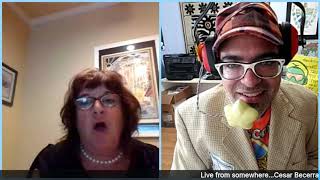
This content was created by Adrienne Barker, MAS. This content was uploaded by Adrienne Barker, MAS. This is a YouTube interview-style conversation titled "Candid Conversation with Adrienne Barker," recorded April 14, 2020. The excerpt is a casual, diarized back-and-forth between Adrienne Barker, MAS and guest/host Cesar Becerra (with occasional mentions of producers and others). They discuss Adrienne's Candid Conversations series, anecdotes about her parents and their museum/gallery and promotional-business history, show production and set design, Burning Man, traveling, and practical changes around greetings and social interaction during the COVID-19 pandemic. The tone is informal and personal, mixing storytelling, reminiscence, and practical advice.
Chapters
Can't hear you, Caesar. Caesar, Bob, Bob, can you help us?
Oh, oh, I'm sorry, I, I didn't re— I'm sorry, I'm just so, uh, I forgot the, uh— How are you, Adrian? How's it going?
Oh my God, you look like you're wearing a really cool hat.
Oh, I didn't— I guess, I guess I forgot my, uh, yeah, let me get all— let me get all gussied up here. How you doing? How's it going?
Not good, not good.
Well, I'm always, uh, oh, did you say not good?
You're not good. Not good. I, I cut my hair with dog scissors. Um, oh no, I shouldn't be touching them. I should be arrested. It's all weird and I can't— I don't know, I look really weird. And if I showed you the back of me, you'd feel bad for me.
Yeah, but wait, wait, you didn't get the— you didn't get— well, wardrobe and makeup handles all that for you. I mean, I got you. You don't have a makeup department and all that?
They're busy with Kelly Ripa and, um, you know, the other guy, all the Savannah and Guthrie.
And that's great. Let me talk to my producer. Hey, Bob, let me talk to my producer. Bob, can we, can we lend her a— oh, what? Oh, he said with the corona we can't really send out people. We're kind of quarantined here. I'm so sorry. Well, I'm sorry you're having a bad hair day, but other than that, how are you doing? Oh, there he is! Was that a donut?
I'm getting rounder, which is my favorite shape.
Nothing beats a bad hair day than a good donut. Uh, it kind of levels it out. So how are you doing? What can I do for you? It's good to be here live from Miami.
My God, Cesar, you've been around the world! I'm tracking you down.
What have you been doing?
Tell me about you.
Well, I'm, uh, you know, I got this, I got this new show and I'm just kind of, uh I'm kind of tickled pink. You know, we're, we're still, we're still dealing with a lot of little details that, uh, I'm— I don't know if you want to hear about them, but you know, they're just kind of little trivial stuff. Well, well, well, for one thing, it's a little, little tricky to travel now, but I— they are working. They said they're working on my, um, on my plane. See, on my— but, uh, I'm not very happy. The logo, I want the— I want the Caesar part a lot, a lot bigger. And also I want it on the tail. Anyway, Bob said he's working on that. It's part of my contract. But anyway, so I'm a little bummed I can't really do like live on-the-spot interviews from like Yugoslavia and London and all that. So for now, I'm just hunkering down here. Kind of a rudimentary set, although they're working on that. There's a different budget. This is what we're looking at. We have a little model here. I want to kind of have like a FDR fireside chat type look, but more modern, you know, instead of the red bricks.
I love that art, the white—
well, it's not art, it's actually a window, but we don't have enough budget for the windows. They've actually crossed that out. Uh, but, but I'm not, I'm not going to, you know, uh, take no for the bamboo, uh, light pink floor. I think it's gotta, gotta be there. But, uh, but We're having a great time. We're interviewing people. We're keeping it live. I, at least I got my, my extra starch for my, my nice jackets here. So yeah, it's all good. It's all good. How are you doing? How's your, how's your show going?
Everyone that I've been interviewing has been fantastic.
Wonderful.
So I'm showing off your friends, which is what you're doing. You're showing off your friends.
Absolutely. Absolutely.
Your show just cracked me up when you, when you showed the picture of the guy with a jacket and you said it was like too small because it didn't cover him. That was funny.
Well, I just— we did some, we did some research, and, uh, actually I'll show your viewers what we're talking about. But we had an R&D department do a little bit of, uh, some kind of, uh, uh, what do you call it, role reversal engineering, reverse engineering And we did, we did, we put this on, we scanned it, and we did kind of like a run-through it. And, and, and the study, the forensics came back, that jacket cannot possibly come together. We also noticed that they're, they're kind of trying to, uh, be a little bit prejudicial, as if the only people that can wear this are people that have skinny jeans or skinny pants. So that's not fair, but But anyways, a product called Plain Air, Plain Air, and it's supposed to, you know, you know, scientifically proven to eliminate 99.9% of harmful bacteria. What about that 0.1, 0.01? That's the stuff that'll get you. But anyway, I don't want to get all negative here. But yeah, we're, we know we like to inform and educate our public as you do. I know you've been talking. How many people you've been talking to so far?
I have talked to 16 people so far. You make 17. And coming up this week, I've got some amazing conversations. Yeah, all good. Hey, wait, show me your bottle of sanitizer.
Oh, um, oh, it's, uh, it's in the green room right now. It's not—
oh, it's not right now.
I have a whole thing, you know, they gotta calm me down with some sedatives. I get a little nervous. In the morning, but I do sanitize every day. And even my entire— even my getup needs to be sanitized, every part of it. So it's a process to get going in the morning. But, you know, I come from the Howard Cosell School of Broadcasting, and we have an adage. You know how they say, you know, people— guys with big feet— oh, big feet. Big shoes. The mic, it's all about the mic baffle here. You know, the bigger the mic baffle, the more potent the broadcasting. So yeah, but yeah, you remember Howard Coors. This is Howard Coors, ladies and gentlemen, coming to you live from the arena. He never said what arena, it's just the arena. We were supposed to know anyway, but Yeah, it's good, it's good. Now, how do you get your guests kind of comfortable and lucid and ready to go? Are they just naturals?
Wow, that's a killer crazy really cool smart question. Probably the host is just really good at making sure that people feel comfortable because I just do it right.
I don't know.
I have a face for radio and right now I'm like I honestly though, I am looking scary, and I think people are going to enjoy watching the show because a month from now my face will be like this, and then I'll take up more. Right now we're cut in the middle. Pretty soon I'll be like 3/4 and everyone else will be a quarter.
Well, I'm the believer of, uh, of kind of like getting really up close to, uh, to the camera.
I got new glasses though.
Look at these. Yeah. Oh yeah, you got the good glasses going on. I'm glad I'm not wearing them. I also feel like on my hard-hitter interviews, as you know, my show's pretty serious. Anytime there's kind of a trivial thing and you want to make a big point, let's say we're talking about the moon and someone calls in and says, ah, the moon is 256,000 miles away from the Earth. If they're wrong, it's always good to say, actually, It's $253,000. That extra— oh yeah, that, that's a good— good to add some extra. Yeah, that— yeah, push it up. That's right. Actually, yeah.
Wait, what if it goes my nose?
Okay, so that's a good, uh, device. And, uh, but as you know, only for, you know, just to really emphasize certain things. Other than that, we have a great, great team here that's fanned out around the country, and they send me copious amounts of notes if I get anything wrong. Of course, the computer I'm on is on the fritz, so I don't know if all my facts today were correct. But anyway, we have to roll with it with what we got here. But right now I'm in a regular kind of like a raw studio. But again, soon enough, I'm really excited. The show will be, uh, as gore— I think I'm really looking forward to the new set. So any, any moment now. So tell— paint me a picture, uh, how did you begin your show? Or how did you think, I'm gonna do this now with the corona going on, everybody's at home, might as well do something?
Okay, so I think to myself, I have this great friend named Caesar. My dad met Caesar's friend Heather. So Caesar is a friend of a friend of a friend of a father's friend's sister's mother. And I was like, okay, now how do I tell people about Caesar? I could say Caesar wrote Robert Is Here, a really cool book.
Thank you.
About a great— and then I could tell people that Caesar, uh, drove the United States in a really fun car and all together, all 50 states, before the internet really took place. And, um, doesn't have a lot to prove it, but I know he did because I see pictures. I can also say to people that I know, I say, oh my God, my friend Caesar, he is like— he lived on the Appalachian Trail for 1 year and 26 days.
23 days. Yeah, 1 year and 23 days. That's right. No, it's good, it's good.
And then sometimes I say, hey, have you ever been down to the Everglades? And they're like, oh yeah, I have. And I'm like, oh, because the Everglades By the way, there's a man named Caesar, but the Sarah and Caesar loves the Everglades, that he does, um, he educates the Everglades. I also— there's times where I say, oh my God, I have a friend Caesar and he plays Mr. Flagler to like a T, so much that Mr. Flagler came back and hit Caesar during one of his presentations and said, stop being me, right?
Well, his lawyers, his lawyers got in the way. Flagler never really did anything. He always had people to do things for him. But anyhow, you're right. Wow, I'm flattered. Yeah, all those good things. All those good things.
And then I'm like, how do I get them? They're like, I want to meet Caesar. I want to meet Caesar. Let me meet Caesar. Oh, how can I meet Caesar? And I'm thinking, well, I could do a Candid Conversation hashtag show off your friends, and then I could have Caesar on it. And then everyone could see who my friends are. And like-minded cool people hang with like-minded cool people, just FYI. My friends like my friends and your friends will like your friends.
I'm rolling up my sleeves. I'm ready for some candid conversation. What would you like to know? What's our first hard-hitting question there, or candid question, if you have any curiosities?
First, I have to say thank you for actually— serious, on a serious tone right now— thank you for taking— thank you for videotaping my mom and dad. I never actually wanted— my parents would be like— my mom, you know, my mom, she'd be like, Adrienne, I'm not gonna live forever. And I'd be like, uh, Mom, stop talking about it. So I never actually would give my parents a chance to talk about their, their, like, age and their death because it always made me look at— I'm right now, I'm even— I just— the thought of it was always so bad. So Knowing though, a couple years ago that there was an opportunity to have you come in and document is pretty amazing to have that, and there's some amazing video and there's a lot that my parents— and they, they need to live on. It's so important for me, and that is, that is really is important to talk about the museum and to talk about all the good things that they've done and to make sure that we, we sit, you know, no matter what, even though at one point I will be 25% of Barker Animation and Barker Museum. It will always be what I've always said when people come into the gallery: this is my parents' gallery, this is my parents' museum. I, I didn't— you know, I'm actually taking a class though, by the way. I'm taking a tangible things class from Harvard. Excuse me, from Harvard University. I'm taking a class on tangible things so that I will be able to better understand the museum and And one of the things that I was last yesterday was a chair, and there's a YouTube video. I'll play it. It's really cool. I'll put on my post. It's like a chair is not just a chair. A chair could be a statue. A chair could be a document. A chair can be sustainable, you know. So they were like, how you look at something. So I want to make my parents' museum the best that it can be, and it's not Toy Museum. It's— I don't like that word toy. I think it's really pieces of history. And Caesar, you went up there. Can you tell and share about the museum for a minute, if you don't mind, and how amazing it is?
Well, first of all, before I get to that, uh, Herb and Gloria Barker were just two amazing, amazing people who, uh, not only started a business— and when I mean start a business, you have to understand This is going way back. This is going so far back that when there was an order to fulfill of any kind, they were into a lot of business, but they would go so far back that your father had to sometimes pull off the side of the road after getting an order from, let's say, a diner for salt shakers, and he had to call your mother up and your mother then would jot down all the details, go run to the library and grab a Thomas Guide, which is a manufacturing guide at the time, and look up, call if there was a number, and pay exorbitant rates for long distance, or write them a letter and then wait, and then wait, and then wait sometimes 2, 3 days to get a letter back. And then, or if they can get within an hour or next day, she'd call back Herb, or Herb would call back the next morning. She'd give him the quote. Herb would go drive back to the diner and say, okay, listen, we can do this for this, this, that money. Now, if they said yes, this is perfect, Herb then would go get to the next phone, call her, she would say, go put in the order. Then they'd wait, and they'd wait, and there was no Amazon Prime shipping for the next day. And sometimes they had to wait till they got the order shipped to the home office in Connecticut, which was back then a little tiny room in an apartment initially, and then go drive it back out there. And then the process of collecting the money, which sometimes was in pieces, and so you'd have to wait and wait. And so, you know, whatever business they were— and they were in a lot of different businesses, from promotional products to animation art later, to a lot of other things, frankly, a limousine business in the middle of the whole journey. So they did it the long and hard way, a lot of hard work. But also they did it in kind of the true sense of your father's like, and your mother's like, two of the most savvy marketeers.
Yes.
Musketeer marketeers, you know. And they could just sell up anything. They could just really, you know. And your father in particular was just great at what we call schmoozing. He's a very good schmoozer. And anywhere he went, he would drop both business cards and pens and what have you, whether it be a restaurant or— and, you know, it's a testament to that fact. Many moons ago, when I started this project with you a long time ago, when you asked me to start this project on your parents' lives, I know that your husband found a golf ball in the back of a ditch in a golf course area, and it ended up having a Broward Sheriff's Office logo. And that was a ball that your father actually had that, you know, that contract to make. So, you know, it's global in reach, you know, these primarily the promotional products, you know, it doesn't matter, the ubiquitous pen or pencil or golf ball, it has a way— and studies have shown that it's the best money you can spend over advertising and other things. It has a long, long life and it has a lot of eyeballs. But anyway, we're going on a tangent. But yeah, and your father would have been great at hosting a show like this, believe it or not.
I tried to get him. I remember my dad, though. My dad was— he was in and out of the hospital often for his ileostomy. But I remember that he would have— it was so important to him. He would be in the dire pains, horrifying pain, and he'd be like, Gloria, get the pens for me.
I need to have pens.
And the pens would say, doctors are special people, nurses are special people. And he would always have them so they could come in and they would do that. And then when I was younger, I would fly with my parents and they would have flight attendants are special people, pilots are special people. Doctor, dentist. I mean, like, my dad wanted to make sure people felt great. When he, when he realized that lip balm is something that the nurses and doctors would love to have, he would have the lip balm. He was— honestly, nobody's replaced my father. He is, it was, and will always be the original marketer. So when he sat down with a salt shaker, he probably sat down with them and came up with some kind of, you know, you're the salt of the earth, and would have come up with some kind of cliché and a little funny saying and put it on.
Absolutely.
Really a brilliant man, lovable and likable, stubborn as all— as he got older, Dad was so stubborn. It was really pretty impressive because I was like, wow, I'm, I'm like a flip-flop. I'm a politician, I flip-flop, you know. If you could, if you could show me something that I'm wrong, I'm okay with that. Like, I'll be wrong. My dad didn't matter, right? So stubborn. And he loved his wife more than anything in the world. And I say that often because, you know, we see a lot of stories right now with the pandemic, and you hear these stories of one spouse losing another one, and, and, you know, and how they can— how they can honor that spouse is to say how that spouse has treated them. And, and, you know, and to come in life and have your spouse treat you beautifully— Alan, you know, he thinks that I'm like size 1 because he's Shallow Hal. I married Shallow Hal. You You know, he's gonna wake up one day and be like, what the hell? But like my dad, every— and my dad would say, my mom could not have anything to do with it. My mom, maybe she didn't even buy the sandwich. And my dad would be like, I wanna thank Gloria for this delicious sandwich that she took the time to buy. And my mom would be like, I didn't even think of the sandwich. So my dad just is a wonderful man. And he knew enough that his wife should be by his side for almost 70 years. And I was always jealous of the fried chicken, by the way.
Yeah.
What was that called? Oh my God, it just escaped me.
That was the Golden—
Skillet.
Skillet, that's right.
I wanted to work there so bad.
One of the things that's important to know is that I think your father and your mother, but mainly your father, but your mother as well, I think they were walking around. You know how we take for granted that we have something today called Wi-Fi that can just kind of go anywhere, right? I think they had their own personal router of a scanning device, and they were always open. My theory about your parents is that they, they were kind of addicted to business in general. You know, they had one or two that they really— but they were always open to any business or an opportunity. And so they're always very big on opportunities. And sometimes they didn't even know they were getting into a business. For example, I think organically while your father traveled so much and then on the weekend, he told me that, you know, even though he had a late night on Friday, early in the morning your mother would get up on Saturday as early as 4 or 5, pack the cooler, get everything ready so that time he woke up at 8, they're ready to hit the road and then they go hit the road. And for their off time, you know, as they were young and hungry and just starting out, they would go tag sale and yard sale and down the highways and byways of Connecticut and other places. And they would purchase things that didn't cost very much. But they also, unbeknownst to them until years later, trip upon another business they would get into, which is basically the celebration of anything that came from a character. Or a story through a character. We call it sometimes animation, but more of a character building a story. And when the dust settled, your father and mother kind of vacuum cleaned all the good stuff when it was at good prices, way before the eBay. And although they did buy a fair share of stuff on eBay, and I know eBay had an early version of what we call the Buy It Now button. I think your father and your mother sometimes kept pressing the buy it all button.
Oh my God, that's funny.
I think they would love sometimes a buy it all button. Like, they would search for, you know, Superman memorabilia, the whole page. I think sometimes they'd want the buy it all button. But anyway, but they just had a knack for seeing the potential of a business plan. And, you know, that's good and bad. Sometimes things worked out, sometimes, you know, it was a little bit of a stretch. But that's the thing, you know, that's, you know, your father, I think, was kind of a Willy Loman type, always into business and had that faith that things would work out. And your mom had an incredible amount of knack to figure out if it was working out, if it wasn't, and, and making it work. Um, although she was really the people person behind HR on, on many levels, and I've talked to copious amounts of folks that, uh, you know, she was kind of like the, the true glue and heart there. Although your father, of course, had a big heart as well. So just fascinating. Gloria and Herb, amazing. And, uh, I mean, I think they would have been fine during this, uh, this, uh, pandemic because they, you know, they basically held court in their quarters, so they wouldn't have been, uh, hurting much in terms of, you know, needing to move around. But, um, but anyway, we love them and miss them.
I want to ask—
they're looking over us.
I want to add something. As much as you said about my parents and work, they had a fascination for people. And so my parents— and growing up, it was a little bit— I always felt like kind of put off a little bit because like if you were in a restaurant, they would always, you know, talk to the servers. They wanted to know other people's jobs and roles. And then I remember when I turned 16, I was quite, you know, cute at that age, and then the servers would put their attention to me and then everything was fine. No, go ahead and talk to them, Mom and Dad. Find out everything you can. But like literally a lot of the staff that were hired was— were hired because my parents would meet and say, oh my God, like, would you like to come into the family business? Shannon, for instance, worked for the Southington Library, and Shannon has stayed over— I don't even know how many years. Well, so probably over maybe 25, 30 years. I remember my parents having me hire Morgan. Morgan, who is now like— has like over a million so followers. She was on Bad Girls of Miami, really sexy woman. But when I hired Morgan, she was working at the grocery store. My mom and dad are like, you got to go down there, you got to talk to her, she's 17, we're let's get her in the business. And I went over and I met her. She's a beautiful girl. I loved her. And, uh, I still love following her. But my parents— and you've seen that too, actually. I think of Dimitri and my parents. Remember the story with Dimitri, that they saw Dimitri with his sister and at the Gulfstream, and they realized that Dimitri was making a choice whether to buy his sister a meal or a cake. And my parents said, well, we'll buy the meal. And they went over and they have this relationship. So I always want to remember my parents too, that they just have— so they would have loved this show because they love people. So that's kind of— maybe I get that from them. I want to learn more about my friends. And so, and when you go back, and I know it's hard to watch other people's interviews, but each one of the people that I've interviewed so far really are pretty amazing and are teaching something in that, um, candid conversation. Like, if I had more time, I'd be able to really pull it out and create some fancy art But everyone is saying something that's amazing. Abby Sweeney, Abby, 25-year-old Abby is a coach. My daughter comes out and it's Candid, so I don't care. Alana comes out and she starts talking a little bit and she's upset about something and somehow Abby picks up on it and gives Alana 3 sentences that has gone on to change Alana's friend's life.
Like, it's unbelievable.
So that's why I'm doing the Candid Conversations. I want to show you off. I wanna show everyone off, but I wanna hear more. So you came here and I wasn't feeling good. I had a scratchy throat.
Yeah, at the beginning of this, just so you know, everybody, I left Miami on a road trip heading to a very good friend's wedding in St. Augustine. And I had told you about a month ahead that I would be doing so. And I was chugging up the coast We definitely weren't in a— nobody was social distancing, not fully, fully, a little bit. That had just come into the lexicon, maybe 2 or 3, 4 days of serious social, but not, not everybody. It was the 17th or 15th, 15th of March. But as I was literally going up the coast Things were changing every day, every day. And so you had a little scratchy throat and I almost canceled out just, just almost because I was going to stay over. And I said, well, look, let me camp out. I found a beautiful little campground in Daytona, but I still wanted to see you. And we did see, but we kept our distance. But that was weird. I was different. I was— you were the first person that I knew that I really had that awkward, like, wow, this is weird. I have to not hug my friend Adrian and not hug your daughter and your husband and all that and, and just kind of stay apart. That was a real— and of course, that very second day, uh, as I was heading out, the wedding gets canceled. So everything was— it's almost like that moment where What's that cliché moment in a movie where someone's running across the rope bridge and the back of the rope bridge starts to crumble, but they're still running? It felt like a normal world that we knew was literally disintegrating just one step behind. You went to Savannah though. Huh?
I remember thinking you went to Savannah and I'm like, okay, you're going to Savannah.
Well, what had happened is right about the time the wedding gets canceled, I was— I had talked about a week before with a wonderful lady named Bea Brickell, who is the great-great-granddaughter of Mary and William Brickell, the founders of Miami. And we had talked on the phone and she had invited me to her home in D.C., but she also has a home in Beaufort, South Carolina. When the wedding fell through and I was already up in the St. Augustine area, I figured, well, it's only 3.5, 4, 5 more hours to her house. I called her up. He said, do you mind if I come over now? She goes, you know what, we should do this right now. You're right. Come on up. And so I headed up. I did another 2 days, one to Savannah and then one to Beaufort. And, and so I met the great-great-granddaughter of the founders, one of the founders of Miami. Julia Tuttle was one, and Mary Brickell, in my opinion, and William Brickell was another. And so we had 2 days of incredible yapping and talking and showing old photos and showing me artifacts from her great-great-grandparents a day. And so, yeah, so it kind of got extended. But every time I was rolling anywhere, almost every day, something was changing from the day before to the next day. Something, another little piece of that rope bridge was falling behind us all. And now when we look back, well, there's no rope bridge. It's kind of like we're in a whole new It's like we can't get back. You know, when a rope bridge crumbles, you can't go back.
Wow, that is a great analogy. Oh my gosh, new territory. You, uh, and then, and then, so a couple things before we end this. So first of all, tell— I like— I think what's always fascinated about me about you is that you do Burning Man. And Burning— I never even heard of Burning Man because obviously I don't think I hang around with people that go to Burning Man too much. So you were the first, and then I was hearing more about it actually once you start Googling it and then it starts popping up. But you— well, Miss Burning— so what's the story? First, I'll tell everyone about Burning Man.
Okay, so Burning Man is a beautiful, beautiful event every year that takes place in just the most beautiful concert hall you can imagine. They cap it off at just 4 people. You're supposed to be very quiet. And there's a piano and there's this beautiful concerto that comes in. They play the piece. You can't— you got to be careful. You can't get up and gyrate or move or clap. It's a very controlled environment. In fact, they like to have all the walls black, no color at all, just very somber. And, you know, and then later they burn the piano.
Really? Yeah.
No, I'm kidding. Burning Man, Burning Man is a tricky one to explain, but one of the things I like to tell people, if you want to understand what Burning Man is, I ask them 2 questions. Number 1, whoo, I like that, 2 questions. Number 1, or you go, number 1, would you like to go to another planet? Would you like to visit another planet? Most people say, Yeah, I'd like to visit another planet. That's as close as you can come to describing Burning Man. And then the other thing I like to tell them— what's the second one? I just had a brain freeze here. Um, wow, I was on a roll there and I forgot.
Older, getting older.
Anyway, but basically it's like visiting another planet, and, uh, but it's an art festival music, art people, and there's no spectators. Okay? Everybody is a participant. Okay? We like to say that, you know, everybody is on whether they're just wearing something funny or weird or, or acting out some, or working on a piece of art or bringing something to share with people. But basically, it was started about 30, 31 years ago. On Baker Beach, California, with the burning of a small wooden type of sculptural effigy man. And a guy named Larry Harvey originally started it with a couple of friends, but mainly Larry Harvey. He hauled it off to this beach, lit it on fire, and about 13 people kind of sauntered over and said, hmm, that's pretty cool. And he decided to do it again the next year. And then next year, about 30 or 35 people, you know, got wind of it. A little bit more people. And they all— my numbers could be off, but basically they said, that's cool. That's pretty cool. And the man kind of got more ornate, maybe a little taller. And in the following year, something like 300 people showed up or even 3,000. I forget the— but anyway, a lot of people showed up. And that's when the cops said, whoa, whoa, whoa, what are you doing? Right before they lit it. You can't, you can't be, you don't have a permit. You see all this melee of people, and then somebody in the crowd from the Seattle-based Cacophony Society said, you know, why don't you take this out to the desert? You know, nobody gives a crap about doing stuff out there back then. And so they hauled this thing back out of the desert and burned it in the desert. That was many moons ago, and now it's grown to about 70,000-75,000 people come around from around the world, not just the United States, around the world to sit in the desert, again, very quietly, somberly, while someone walks up to a piano. You can't talk. You can't— and then they burn the piano. No, I'm kidding. They have a big party. It's a crazy, beautiful scene. So that's Burning Man, and I've been a part of it. And there's also regional burns, like here in Miami. The Love Burn in upstate New York. We have Portal Burn. So we have all these burns. There's Australia, there's Burning Seed. I got to go to Australia's Burning Seed, a regional event. So now there's events around the world. And Burning Man, unfortunately, just 2 days ago announced that they, due to coronavirus, are going to be canceling the event. Or not can't— well, they say can't, not really canceling, but taking it to a different level online. Although, you know, I don't know how you can get away with not defining that.
Isn't it at the end of August?
It's end of August, but they decided that the combination of both the time that the artists and the camps need to really prepare for it and get a super green light, uh, that would be a very risky moment. And they already, you know, felt that It's already been kind of stalled in terms of not knowing, but they announced just today around 9:30 in the morning that they're going to move the festival, 70,000 people, to Daytona, to your apartment complex. So just get ready. Yeah, let your neighbors know that we're coming over, we're going to party in your place.
Wouldn't that be amazing? I would love that. And then, and then when you think back, you can also I also think back on Australia when you were there before Australia, and then the fires were right after you left, right? It was not too far after you were gone.
Adrian, like I said, and I just came up with this morning, I did not— I haven't been using this— rope bridge falling apart behind us, everything, you know. And maybe that's a— maybe that's a little bit of an adage that you can take in your life. You know, there are moments where people have told me and I've read that, you know, the past is the past. You got to move forward, you know, and, you know, I'm a historian. I love the past, but the past now is being hyper compact. You know, I was in Australia and months, a couple of weeks, months later, actually, while I was in Australia, there were a couple of fires here and there. And by the time I got back a couple of months later, the whole place is just, you know, you couldn't go there. You couldn't do some of the things. That I attempted to do research-wise, or go to— I researched the brickles over in Australia, or, you know, go to Burning Man. Yes, it's crazy. It's really interesting. And it's going to be really interesting to see the effects of what all this has to our new normal. You know, our new normal is going to be real. Everything from shaking hands in the regular foreseeable future, not maybe— maybe not the future future, but the regular foreseeable future, who's going to be shaking hands right and left? I would like to say like that's just the tip of the iceberg, but go ahead.
I'd like to say, first of all, 80% of people don't know how to shake hands anyways. So I did enjoy showing people how to shake hands. It's crazy because so many people really don't understand it. So you get so many of this. Second of all, I wrote the— I was thinking last night that, okay, so what are you going to do when you can't shake a hand, but you still have to outclass the competition. You still have to be on top of your game. And so the other day I wrote you, and actually I'm going to write a blog about this. You got to stand up. Too many people are not standing up. If you're sitting down and someone's approaching you or someone walks over to introduce you, stand up, say hello. I cannot believe how many people don't stand up. Now, if you can't stand up because of, you know, you're just unable to or you're squished behind a corner, you know, that's okay. But if you have the opportunity to stand up, stand up. Now, I would also think that if you— we have antimicrobial pens. It is kind of nice to give someone something with your information on it because I say, hi, I'm Adrienne Barker. Normally I would hand a business card, so maybe now doing antimicrobial business cards or giving a gift of something that— and you could say, oh, by the way, this is antimicrobial. So because now you're exchanging something and you're having a conversation outside of what you are. Always ask what someone— how you spell someone's name too. Oh, hi Caesar, it's nice to meet you. We can't shake hands, but how do you spell your name?
That's a good different segue. Or how do you pronounce your name, or etc., like that.
How do you spell your name? Like, if you say I'm Caesar Becerra, I'm gonna be like— I would ask, how do you— Caesar and then Becerra. And then that's a nice thing to do. So I gotta think of all the ways now because people were not shaking hands very well anyways. I will say I saw an interview the other day with the president, and he was— it was about 1999, and he was talking about that he didn't like shaking hands. And a lot of people don't necessarily like it. And he, at that day— actually, he really hasn't changed his personality from over the years. Not to get political, but just as a human being, I give him credit. He's, he's been the same way forever. And so during this interview, he's like saying, hey, It's kind of grimy. You know, he didn't use the word grimy, but you know, we're shaking hands. He goes, you know, I come out of a meeting and some guy just sneezes on his hand and then puts out his hand and I'm supposed to shake it. He's like, so I can understand that. We say often with shaking hands that, you know, you want to do it and then run to the bathroom and wash your hands. But now is the time you got to figure out a way. Most people, as I said, 80% really do not shake their hands nicely anyways. I don't think that I will be doing a lot of this and this and this and this. I think it's really now looking someone in the eye when you meet them, holding them, you know, getting their attention. So like this.
Yeah.
Hi. Oh, it's nice to meet you, Caesar. How do you spell your name for me? Now don't do it that way.
Well, you bring up a good point. It'd be fascinating. A couple of things I want to I want to throw across your, your brain pan here, or ideas. Um, it would be interesting to, uh, A, ask, uh, uh, Shannon and your brothers and your sister and folks at— and Max at Barker Specialty— how much— I'm assuming through the roof— the little, uh, hand sanitizer giveaway things must be.
Okay, so I'll ask Halo. I work for Halo.
Oh good, right. Oh, there we go. We'll ask Halo.
How about products.guru? I work for Halo.
That's right, Halo. How— how— that must— that must be gonna go through the roof in the future, you know, orders right now with the beautiful company Halo, which I absolutely love.
Um, amazing company. But, um, and it's okay because sometimes people in a family business leave the family business due to just whatever may happen, come up. That's not— it's not unusual. And And it's a good thing. Halo's the third largest in the United States, so they're amazing. But so right now, Halo's doing something that nobody really would understand is that they are so on top of it that daily we get reports. Right now, very little sanitizers are out there. So I'm taking orders.
Right, right.
They'll come in about 4 to 6 weeks. Masks, the masks are the issue. I got a couple of funny little masks here. They're like, poor Alan, he's gotta wear these little cute ones. But even with masks, we have to know how to sell them, who to sell them to, only work with vetted suppliers. And the key is, if you work with me, you know that it may not be the fastest. There's a lot of things that have to take place. This is all happening very rapidly, but we are providing a service, 'cause right now you're not allowed to leave your house where you are without a mask. And so we don't sell them individually, but for companies that wanna, And they're not— pretty soon there'll be masks with imprints all over them. And that's coming right now.
That's gonna be huge. And just imagine, you know, you have gone to trade show. When the trade show market gets back up and going, you remember when you walk back past the trade show, not everybody, you know, some of you are looking for the snacks and the food. And sometimes you see like little, you know, antimicrobial, you know, what do you call it? Products. Yeah, products. And you'd be like, oh, in the past you'd be like, oh, I don't want that, I want the chocolate. But now people will be like, whoa, they got— I'm gonna grab— you'll probably see people glomming on that. But here's a great thing for Halo to think about. Again, it's just, you know, I got a pretty big popular show and we did a kind of a study on what people want. And you're right, it's going to be hard to kind of like You know, shake hands, and I think it would be rude if you shook hands and then pirouetted and took off to the bathroom to go wash them. So, so our viewers came up with something genius. Again, it took about a good month of R&D, but we came up with a beautiful tiny— like, you know, on the submarine they have these very tiny sinks, very tiny sinks, or on cruise ships. And if you can wear that over and in front of you or off to the side, You can shake that. You can almost preempt the handshaking by putting on the water, shake the hand, and immediately as you're talking to— and just shake their hands. So tell me about, uh, the studies of last summer. Did you ship that product out? And then, no, it won't be awkward. It won't be like, you know, it won't be tearing off to, you know, you won't be like, oh, hold on, I'm gonna go. No, you'll have the sink right then and there. There's a beautiful marriage between the sink and the, um, The pesticide companies noticed that there's a lot of backpack-holding reservoirs of water. We can put the gel or the water into that and it would just be, you know, seamless. Oh my God. Seamless.
Oh my God. And listen to this one. If you have an everything bagel like this, you can have everything but the kitchen sink. But now you'd say everything and the kitchen sink. I actually was saying yesterday, why can't we have a sanitizer item? Why can't we have a sanitizer that you put on your hands and it lasts like all day? Like all day, this one sanitizer. It's like an invisible thing that's like on and boom, boom, you're gonna do your whole body in a second.
Well, you can, you can do that too. You can also do that too with one of those big beautiful, uh, bubbles, those 6-foot bubbles that, that get Uh, plastic bubbles that get inflated and you just walk around all day with the bubble. I love that. You don't, you don't have to worry about anything, even sitting down on surfaces. You just stay in your bubble all day.
Okay, so now let's talk about one thing before we go. Okay, some of the good things about a pandemic, being part of a pandemic. Um, I found out yesterday that when I eat tuna fish and then go on to this stream that nobody could smell my tuna breath, so that's a good thing. Give me one.
There you go. Tuna breath issues coming way down, way down. In fact, in fact, we had before this a sharp curve of tuna fish breath problems, and now we're flattening the curve. And actually, it doesn't always get talked about, but we're actually bringing the curve back down. So yeah, you're right. We've almost eradicated that pandemic and that's a good thing for sure.
Oh, but Caesar, serious, on a serious, serious note.
Yeah.
On a serious note and then I'll let you go. Brush your teeth before you use the mask because if you use the mask and your own breath is horrible, you're gonna be smelling it and you're just gonna be mad at one person, yourself. So for everyone that wears a mask, brush your teeth. That's, that's a trick for yourself. That's a gift to you.
There you go.
I know, I know.
There you go. That's good.
Is your mom telling you you have to go now?
No, no, no, it's my father who called to tell me that my godmother was on the phone, but I'm live here. I'll call her immediately after.
Oh, what's for dinner today?
Um, well, we had a beautiful Frittata for breakfast.
Oh man.
Which I like to say is an overpriced omelet, basically. Although I'm sure I'll get callers on the show what a frittata is. But basically, we had some eggs this morning. I don't know what we're having for dinner tonight yet. Really? But I'm in very good hands. I got my parents here. A swimming pool, my daily show. Of course, corporate got me the swimming pool. Again, as you know, jet. I also have been changing and morphing one aspect of my life that I've been wanting to get going, and that is a little art studio that I have set up in the backyard shack here. I've been wanting to, for many, many moons, to get back to doing art, and it's going to be called Art on History. It's going to be art pieces that have a little flair, color of street and modern art, a document that's a historic document of some sort, um, and sort of marrying the two. So I look forward to telling you guys a little bit more about that. Maybe we'll do another show in the future about— oh my God, this is coming out of that.
Uh, check out Debbie, Debbie Reaney. Check out my show with Debbie R-E-A-N-Y. I think I got it right. She is a recycled artist. She walked us through her home with all the art, and it was amazing.
Nice, nice, nice. I also think I should go into production with this, uh, wonderful headphone and microphone. Uh, you know, I'm producing these. They're a little bit on the expensive side, closing in on $70, $80, but I'll ship that to you anywhere in the world. I don't want you to think it's something I got out of the dollar store and, and put together with a fly swatter or anything like that. There have been all these rumors that I did it for $2. But anyway, so if you need to clarify a better audio on your feeds today, let me know. We're selling that show special, Halo show special for $65 while supplies last. I can keep up with the demand. But yeah, doing a lot of good things and just kind of figuring out. But everything is loosey-goosey for the future. No one— I don't know. Where I'm going to pivot to. I was in the tour business, tour industry, and that's of course, you know, kind of gone. You know, nobody's wanting and itching even after this to jump back in a bus or in a group tour. So I've been working with a company called, let's see, Built Story, and they have an app that will allow you to go on your own personal tour without having to get into group type things. And so it's kind of like your own personal, not fully epically conceptually new, but just a little easier twist to how to go from point A to point B. But I'm telling you, I'm missing my main peeps, Roberto, my boss, big boss man at Expeditions South Florida, and others that I'm just missing that that journey, you know, being in front of people. I had just gotten on Airbnb Adventures, you know, but I'm still gonna be doing some work with Pink Parrot Productions. We hope to be doing some online work, maybe some future workshops for now that everybody's on the Zoom thing. So, you know, but it's definitely impacted, it's definitely impacted. It's going to be— I don't know, I don't know what's going to happen. So, but that, that also gives you a good moment to recharge and re-look at some things like my art. So, uh, let's see what— let's see what we do.
Yeah, I would say, first of all, I have to tell you that I could feel my dad, and I could feel him wanting to say something to you. He's a little disappointed in you. He thought that he taught you to always want to know what your next meal is.
And I—
because my dad, he'd wake up at— before dinner, before he'd go to bed, he'd say, what's for breakfast? At breakfast he'd say, what's for lunch? At lunch, what's for dinner? If he's going somewhere, if he's away, he would want to know like the whole week. But my dad just— I can hear him, he's like, Caesar, Caesar, what happened with you? You need to find out. When Adrian asks you what you're having, you should know. You should know.
So just, just FYI, tomorrow or the next day when I get on the show, I'll I'll be in a habit of asking ahead of time, what's going to be for dinner? Yes.
Now I'm the cook here, so I feel bad for my family because I suck. World's worst cook. But you know what? It's funny. I work from home, and so I find— I found Alana. I just have to tell a little bit with Alana. So I'm a little embarrassed by this too. So Alana, the other day at like 11:30 at night, because she's got really wacky hours now, but that's cool. She's 14. She's like, Mom, Mom, come into my bedroom, come into my bedroom. So I walk in her bedroom, okay? She arranged her room like, like how it should have been. So now of course the first thought is, oh my God, this looks amazing. The second thought is, I suck. I— why did I even do her room the way I did it? Because it didn't make sense. And I noticed that with her, that now that she has time, she'll do certain things, and the way she puts things together she actually— that could be a career for her. So I think that this kind of showed us where she is. Um, I'm used to not— I'm not used to not going out. I'm afraid that I could get used to not going out because that's kind of scary to me. But, um, I try not to watch TV. I'm taking the class from Harvard, which is good. I think it is important. I, I do my own marketing. And then I also, um, I actually think that I will, um, about Upwork, U-P-W-O-R-K. So So I've gotten a couple of jobs from them. I'm on another one in the industry, which is great. So opportunities are still here along with selling promotional products and then thinking ahead. So I don't actually— I'm, I'm, I'm doing my own thing, which is okay. So it's not as much for like you where you're really out. For me, I just get like, you know, we all get stir crazy, but the neighborhood is beautiful. So I love taking walks. Our pool is closed. So last night I took a walk with Alan at 10:30 and everything looked so pretty to me. It was unbelievable. And, and I think, I think he just annoyed him because I'm like, but it looks so beautiful, like the clubhouse, it's all lit up in the pool. And I'm like, we'll get back there and I will enjoy it more. So I think now my heart goes out to everyone that's lost a family member. And so many people on my news feed. And Chris Cuomo, who I fell in love with on CNN, I really like— I'm hoping— I haven't even heard— like, I feel like he's my friend now. Where's Chris Cuomo? I haven't heard from in 2 days. But like, I, I really feel that, um, that things will be okay. But it's hard to say that when you know that people have gone through and are suffering so hard. So I don't want to say that because, well, our doctors and nurses, though, they're heroes.
We haven't, we haven't come up with a perfect phrase for the recalibration of our future lives if this thing has not only impacted your industry but maybe impacted your mind. I had a former boss who, Dr. Hyler Bracey, who was the CEO of a company called the Atlanta Consulting Group. He would consult, he was a CEO to consulting CEOs. I mean, he, but one of the things he always said is that the biggest thing, the measurement that's been finitely measured in what it takes to not live your dream is about 7 to 8 or 9 inches. And that's, that's the space between this ear and this ear. Your brain will talk you out of things, you know, if you have a dream. But, you know, this, I think this process, as painful as it is, as scary inside, I think it would be fascinating to know years from now how many people said, you know, the coronavirus thing really impacted my life. Without it, I wouldn't have started this dream that I always put off on the back burner. And so, we have a phrase in the business world and it's kind of a negative phrase and I thought if you've heard of it, I think it's planned obsolescence, meaning an object is planned to kind of have a shelf life of enough time for the company to build another number 4, number 5 version of something, and then you have to switch. But I think your daughter was experiencing a type of moment where eventually the epic time in your life could impact what you thought was a pipe dream of her really rolling up the sleeves and doing something epic like organizing and cleaning your room. And for me, it was that way. I mean, I just finished up many, many days of really attacking things that I put on the back burner in my room. All of it made for, you know, grabbing the, the different pieces of art that I've always wanted to marry, documents that I've been collecting for years and art. Now I've got them in one area and I'm ready to kind of— so that is something I can assure you, with our kind of busy lives and, and, and, and our regular scheduled programming, does not get impacted, you know, on my— and my open slate of opportunities that I would not have been open to has to be now consciously open. For example, I'm considering being an art teacher for summer camp in North Miami at a camp program. I'm considering even going back to one of my former jobs at Nature's Classroom. Because if the trade show and convention market don't get up and running, or all those trade shows and conventions that normally were in the spring aren't going to book till next spring, then the fall is going to be pretty empty for the tour season down here. So I've got to be kind of open to that, although I have the luxury, to be honest, to not feel the huge pinch because I live life way below a certain level of, you know, under the radar of a lot of pangs and pressures and responsibilities. I will admit to that. But now with the show, my new problem is how do I, you know, bury the money quick enough? Because they're just, you know, the offerings are just— I mean, I've hired 3 accountants. I don't even know where to, you know, Anyway, that's another story, uh, you know, but I'm thinking that I would take my, my Learjet over to, to, um, to, uh, Switzerland and hide the money that way, you know.
No, Caesar, you need to watch Breaking Bad, and then you watch Ozark with Jason Bateman, and then you know how to make meth. Well, no, forget the Breaking Bad. You want to watch Ozark so you can learn how to launder money.
And then there you go.
I love the show, girls.
And now I have the time to dedicate to learning how to launder money.
That's right. Yeah, we'll probably watch right now.
I'd say— I think we're gonna see a slew of white-collar crimes be more undetectable because all these people have more time to look at Breaking Bad and, and do, you know, learn the proper way to carefully launder money.
Okay, so now you're saying things that really could be true. Actually, a lot of people are very upset with what's happening right now, so it's scary. Um, so I— you know what, it's, it's— you gotta learn to— have you noticed the days go by faster for some weird reason? Because I've noticed that days are going by really fast. Like, I just washed my sheets last Saturday and it feels like last Saturday. Like, it just feels like a day.
Yeah. Yeah, no, you're right. It's— everything's just evaporating. But one of the things I've noticed in white-collar crimes is there's always a digital paper trail. So if I— that's why I'm— that's why all my sponsors know I'm paid in cash. So when the Learjet's done, I put the cash in the jet, fly it over to Switzerland, and then deposit it in cash So I only have a little deposit slip. There's no wire— the wire transfer is where they get you.
It's true, that's true, that's true. This kind of conversation is making me scared because, you know, we've been—
we've encrypted this and there's actually a, a, a, a new program that makes the entire conversation seems like we're not being said that we were just being comedic, but you don't know the difference. So we fall under the radar. In a court of law, we'll just say to the judge, the court, obviously we were joking.
Obviously Caesar was joking. I've done nothing. My mouth has been— I am like innocent. Halo. Yeah.
So when they try to pin me on any charges. Hey, listen, you think I'd be stupid enough to go on international TV, tell them what I was gonna do, and then do it?
Come on, come on, come on.
It's always good to go be upfront about things, you know.
Well, Caesar—
well, Adrian, this has been, uh, a beautiful time. I definitely want to check in with you once a week and see what's going on. Oh, look at that. That's Mickey and, uh, Pluto.
Mickey and Pluto that were in a box somewhere that turns out to be called the Mad Dog 1931, very expensive, limited, for number 437 out of 1,000. Someone— I gotta— it's thrown in a box with no care for my clap.
Look at the foreshadowing there. Mickey and Walt himself, you know, Walt has always been known to be way ahead of his time. You can see that obviously Mickey is washing the coronavirus off Pluto's body there very, very diligently.
I'm gonna use this for my museum history paper that I have to write about. So anyway, so I'm gonna go back to school. You're gonna go to call your auntie or grandma or whoever it was.
Well, I gotta add some autographs to, uh, to digitally sign around the world.
Uh, you know, I love you, by the way.
I love you, honey. All right, very good. I love it. And, uh, remember, my show is every morning around 10 AM called And We're Back with Cesar Becerra. Now, your show, Adrienne, because I'm going to be posting on my site, tell the viewers how they can link up to your show other than going to Adrienne Barker and sending you a friend and a following request.
Whoa, so I am learning about people. But this— what we need you to do is you have you or your friends hashtag show off your friends. And just like you're doing now, you're showing me off. Show off Heather. Maybe Heather. We'd like Heather to come on. Heather Moxie.
Calling Heather. Absolutely. Is this mic on? Heather? Heather? Paging Heather.
No, you know what, that's really what it's about, is I never mind talking to anyone but getting to, um, showing off my friends. I am working on— you know how you have a— we— I belong to all these networking groups and everyone's like, let's do a one-on-one. So the brave ones are coming on and doing a live one-on-one with me. Brave. But most people I know— and I'll send it to you, I'm going to download it. It's an hour, 63 minutes and 27 seconds, so it's going to take a little while. I'll send it to you. YouTube, and I love you, and be safe.
Got it. All right, we're out. Take care. Bye-bye.
You're so awesome. And then I just stop it, right?










