Celebrity Author Guest Elke Scholz, author of Anxiety Warrior, shares tips on dealing with anxiety.
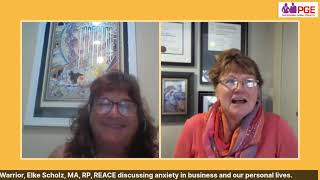
In this live interview, host Adrienne Barker, MAS, welcomes registered psychotherapist and author Elke Scholz (author of Anxiety Warrior) to discuss practical ways to understand and manage anxiety. Scholz explains why professional psychotherapy training matters, differentiates everyday stress from clinical anxiety using a 0‑to‑10 intensity scale, and emphasizes the importance of daily "brain vacations"—short, intentional breaks such as yoga, walks, or watching a cooking show. She introduces tactile grounding tools, notably the "butterfly tap" and an imagined energetic shield, describing how visualizing a protective bubble can calm a highly sensitive nervous system. The conversation moves to core belief work, urging listeners to question "should" and "must" statements that fuel anxiety. Both guests stress the power of kindness, love, and social connection as antidotes to fear, especially in the context of the COVID‑19 pandemic, where teen anxiety rates have risen dramatically. Scholz outlines the structure of her book Anxiety Warrior: the first part builds awareness of anxiety types and origins, while the remainder offers hundreds of concrete strategies, with a second volume adding real‑world stories. Practical resources—including the website anxietywarrior.ca, ebook, and audio formats—are highlighted. Throughout, personal anecdotes from both host and guest illustrate how anxiety manifests in work, parenting, and daily life, and they provide actionable advice for individuals, parents, and professionals seeking to reduce anxiety and improve mental wellbeing.
Chapters
with that, it goes live on Facebook and LinkedIn, and then boom. Hi everyone, we have here today, and I'm very, very excited to introduce you to registered psychotherapist, and that's important to understand, remember that word right there, Elkie Schultz. And the reason why I say that, Elkie, is that there's so many people out there that, you know, anxiety, you could put it in Google and it'll come up with everyone, but sometimes you really need to make sure. So let's start that right away. First of all, welcome in being here, very excited. But what's the difference if I just talk to somebody that says, oh, I can help you with anxiety and mindset, or actually talking to a psychotherapist?
So, well, I'm trained. So everything I've learned, and that's something, that's a great question, because everything I've learned isn't from my family. And when I'm coaching people, when people coming are coming into my practice, A lot of people feel, feel bad of all ages, whether they're 10 years old, 14, 15, 16 years old, or 55 years old. And I just say, you know, just be gentle on yourself. So, something that I've learned, and I also have anxiety myself. So, I started this journey with my clients and we started taking notes together. And I'm very practical. So, one of the things that's really important to me is that these strategies that we we present work. And part of the thing too is what's important to me is that you understand it. So education, and the more we understand, the more we're aware, then we can make changes.
So anxiety, so even for myself, so I just got an email from one of my clients and right away I feel like, oh my gosh, but I don't even know if that's really anxiety or just like a little bit of stress to my day. Well, how do you know when a little bit of stress during a day actually is anxiety? Like, what does that look like?
Well, that, you know what, again, a great question. In a lot of my talks, we talk about, you know, is it stress, is it anxiety? And the thing is, the stress can cause anxiety, or perhaps the stress has the same symptoms as anxiety. It really, I don't even think it really matters that much. And one of the things I talk about is a 0 to 10. So 0 means no disturbance, being calm. We know what that is, you know, laying on a beach, perhaps having our bodies, our feet in salt water. The other is 10, I can't put a thought together. So where that comes from, that stress, or we want to call it anxiety, it really doesn't matter. It's just that we have that high level of, I want to say, discombobulation. And we know what that is. And like I said, it comes in very many different symptoms. So it's really, again, and like you mentioned, a small bit of anxiety or stress isn't a bad thing. And it's just when it stops us from thriving, when it stops us from living, that's when we really need to look at it. That's when we've got to manage it and we got to know our strategies.
Thank you. Thank you for saying they're great questions, because reality is there was no prep needed. You know, I got the original email, but I don't, you know, we don't talk beforehand. This is literally everyone's a fly on the wall as we're first meeting to discuss this and, you know, kind of getting to know each other. I, you know, I don't think that I actually am someone that carries anxiety with me, though I can feel certain days where I feel really stressed and I'm ready to push it out. There have been some days where I'm like, I need a brain break. Like, I definitely feel that way. So we're leaving to go to Cocoa Beach and I'm like playing grace with myself. Like, okay, Adrienne, it's just so much going on with so many different people and so many responsibilities to, you know, different groups that I belong to. And, and I love doing it all, but I recognize, okay, I feel a little overwhelmed right now. I'll take a little brain drain for 2 days, try not to do any work so I could come back better. I'm assuming that's a, that's a good thing to do, but what if someone doesn't have that opportunity to take and go away and do something else? What are some of the things that they should be doing, and when do they know when to seek help?
Well, again, there's a lot of questions there. So the first, first one, what's really important is how to take these, and it's interesting that you use brain drain, I use brain vacation. How do we take that? I think it's important to take it every every single day. And it doesn't have to be for a whole day. It can be for 5 minutes. It can be for an hour. Like yoga can give you a brain vacation. Perhaps a walk in the woods. Perhaps it's watching a cooking show. Whatever gets you out of that thinking stress, whatever that mode is, to take a little bit of a holiday. And we need to do that every single day. Again, what I like what you said is you're doing it with intention. So knowing that we're taking these brain vacations with intention. Sometimes, we do them and it's not intentional and that may not be such a good thing. Again, if we get two words out of today, awareness and practice. And that's how I talk about in my book. If you get only two words out of the book, is being aware of yourself, what you're going through, how to bring your number down to that zero and take that brain vacation or that little break. And also recognizing what are your limits, right? So, you know, if you're a 4 or 5, that may feel uncomfortable. However, that also could be that slippery slope to going up to that 10. It's just understanding what that is. And again, Seeking help, and one of the things is if it's stopping you. If it's stopping you from your dreams. If it's stopping you from that job interview. If it's stopping you from going to the school that you want to go to or dating that person that you dream of. If it's stopping you from doing any of those things, that's when you want to get some help. One of the things that we talk about in the book is these different levels. So, there's lots of things we can do to manage it. Lots of skills we can gain. If we're stuck, that's when we reach out.
You know, it's interesting. I think so. For myself, I feel like, I feel like if I, if I'm not doing something that is— so I wake up in the morning, I work from home, so I wake up in the morning, get everything together, get ready for the day. And then I feel like if— and I work for myself, so I have clients, I'm a freelancer— but I feel like if I'm not continuously working towards making sure the clients are happy, and then I'm a commission salesperson for someone else, making sure that I've got commissions coming in and making the sales, that I'm not being what I should be doing, which I don't even know what that should be doing looks like. But I know, so a lot of us put pressure, I realize that, I recognize that, I put pressure on myself. I'm not gonna sit down and, well actually yesterday I wasn't feeling well, so I did take an hour, and during that hour I'm like, well if I'm gonna sit here, I better listen to something. So I threw on a podcast, 'cause I'm like, I feel like I don't want to waste time. I know I'm putting pressure on myself, but I can't seem to stop it. And then at night, in order for me to go to sleep, I like listening to news and everyone's like, well, stop listening to the news, Adrienne, that's causing you anxiety. But I'm like, but if I don't know what's happening, that's going to make me anxious too. Like, I don't know where to find that happy medium.
Well, and again, it's a— I think it's about balance. One of the things that we've got to be careful about is the word should, the word must. And a lot of times, those thoughts come from core beliefs or belief systems. And we have them socially and culturally. One of them could be, I need to work hard. Or I need to be a good daughter. So, I've got to have Thanksgiving dinner. We may not want to do any of those things, however, we feel we should. So, when we have that in our mind, so when you have that thought in your mind, that's a good time to step back and go, where is that coming from? Where did I learn that? Because we weren't born that way. So, we gotta scale it back and go, where did I learn that? And belief system is not a good thing or a bad thing, it just is. However, what happens is when we've learned this very early on, our brain considers it a truism, thinks it is 100% true and it's not. So, when we can come back and say, "Wow, I need to do this. I need to do this. I have to, I have to, I should, I should, I should." And it's really important to step back and go, "Where did I learn this? Where is this coming from?" and unpack that and perhaps rearrange some things. Because I think, I believe our lives are abundant and things do come our way. And yeah, we don't have to beat ourselves up.
I really appreciate that. I mean, I recognize that my parents, they used to say, never say you're busy. And I feel like I'm always, I'm, I literally, I am consistently trying to do my best even though they both passed. You know, I believe they're looking down at me and I'm like, everything I do, I have to do it right. What about the stress that other people, you know, that people can be just so, so not nice and so unkind that they can really, I don't know if people realize, and is this wrong to say that Some people can cause other people stress. Is that like a horrible thing to say?
No. And again, it's a great point. I love this. One of the things is that people or actions can trigger us. And I'm emphasizing the word trigger us. So, we need to own that. So, let's say you and I, we could be in a situation. One of us would react a certain way. Another one may not react at all. So, it's really up to us. So, that situation did not make us stressed, did not make us feel badly. It's our trigger. So, we have to kind of recognize how we get triggered, what bothers us, things like that, and just own that. And we can talk a little bit deeper about that. And then, when you said about people being unkind or stressed, what I've noticed, and I'm highly sensitive, so I find that I want to protect myself, so I put around an energetic shield when I go out, when I wake up, and especially going out. And these days, as I was saying earlier, people are very stressed. So I just put out lots of love, and I know that it's not intentional. I really, I believe that probably 99.9% people, maybe 95%, I don't know, but that people are well-intentioned. They don't wake up in the morning saying they're going to hurt Adrienne or Elka. I don't believe that for a moment. And I think that people are very stressed. They're maxed out. They're tired. They're fearful right now. Lots of fear, which is so unfortunate. And so the opposite of that is love. And if or when we can be in that love space and keep putting that out, And you know what? I find people just love a smile. You walk in a store and have the biggest— and I do psych myself up for that. And I think about happy things and I think, you know, people love a smile. So I just walk in and I smile, smile at everybody. And it's amazing. They can be maybe cranky pants. And when they see a smile, they smile too. And even if they're having a rough day and they're kind of testy or a little bit miserable, You know, maybe it's just acknowledging, you know, I guess things are rough, or just saying, you know, hope you're having a good day, or hoping things go better for you. And usually people soften, and I'd like to go in that space because I certainly don't want to keep perpetuating the fear, the stress. And I think if we can keep being kind, and that's such a big thing right now, I think that that's one of the things I've been talking about is How can we be kind? Because people are on, you know, we have like both sides of the spectrum. It doesn't matter what country we're in. Lots of fear on both sides. Doesn't matter what you believe or don't believe. And can we just be kind? And can we accept each other and continue again to be kind? I'm going to keep saying it.
I love that. Oh, excuse me. I have to go buy my I have to go buy my energetic shield. I just need to know where I go. Amazon?
Well, we can do it right here, right now.
Okay.
Okay. So, so what I do is, and this is called a butterfly tap, and I'm just doing it because we can see each other on the screen. You can see my hands, but you can do this on your lap. You can even wiggle your toes back and forth. It doesn't matter how you do it, but what we're doing is we're stimulating our brains. One side to the other, and there's no right or wrong or speed or, or tension or thumping or whatever. So what you want to do is think of what will energetically protect you, and this shield or protector has magical qualities, and it can be anything. There's no right or wrong in it. And so what it does is it protects our inner shield And yeah, so think about something right now. Take a moment.
I love this.
Mm-hmm.
You're so—
mine, I've created a few shields. So I've been doing this. I've done this a long time. This is not just a therapy technique. People in Tai Chi do it. People do it in all different kinds of modalities, EMDR, tapping, all kinds of things. And so mine is a bubble, and it has special qualities. It's one that I carry with me all the time. And if you can imagine, at arm's length, this bubble goes all around me. And again, there's no judgment. It keeps away energy that I don't want because I am sensitive. And even if there's lots of excitement, it can be too much for me. So, I find I need to keep my inside calm. And so, this bubble, I can still see it, however, it stays at arm's length. And it does work. I've got lots of stories of how it works. And is it perfect? No. However, instead of it being like this big hornet coming at you, It's like we have these no-see-ums, these teeny weeny little bugs that get through screens. It can still be annoying, however, not so much, right? And that's, that's the idea of the shield. And then you can always do an extra one around your heart if you're going into a difficult situation. So you can just tap. And as you practice the tapping, it just makes the neural pathway stronger. Quicker. And as you practice more and more, eventually you can just breathe and there it is.
So, wow, works like a charm.
Works like a charm.
Mine is a bubble of toxicity. And I have to say, yesterday I got 2 emails, they were so toxic. And I was just like, ah, I feel bad that you even have to write that. Like, that's so— like, I just thought to myself, I know I've done nothing wrong. Actually, I know this sounds crazy, but I know, uh, Alka, that, that, that I could be a very much a goody two-shoes. I can't help it. Like, you know, my daughter's like, you're such a goody two-shoes. I like to do things right. And that not everyone wants to be around someone like me. Not everyone wants me on their board. Not everyone wants me on their committee. You know, like I get that, you know, I like to do things right. And so when I, when I just read things or have someone say something to me that I know is just like so inappropriate, I was so proud of myself. Usually I would feel that feeling because I do believe you could feel anxiety and it starts for me, it's red and it goes from my feet to the top of my head and it's a big red hot flush and my heart starts racing and I've been working so hard because, you know, I actually got very sick over a lot of anxiety at work. It was awful and so I've had to make sure that I don't allow that to happen again because I'm finally off blood pressure medicine so I'm like doing like something right so it's really careful. So I read it. I said, "Okay, feel it, Adrienne." And then just I said, "You know what? You're going to put it in a separate file so you don't have to see it or read it anymore and you're busy. I'm busy so like I'm not going to even think about it." And that really did help. So but I'm going to try the tapping too. I think that we all need to do this. It really is important. And also, by the way, being kind. I noticed that as we're coming back together in real life, which I'm in Florida, so we're doing a lot of that because we really don't have, like, we're just a different kind of state right now. But, you know, as we're coming back to real life, that people are, they're almost like, you know how like not nice comments on Facebook and LinkedIn, they're kind of like saying it in real life. So I'm like, whoa. I had someone the other day say to me, and it wasn't, it wasn't very nice. It was like, you know, well, Adrienne, you have so much energy. And it was like, but insulting kind of. And I was like, oh my gosh. But I was like, you know what, smile, Adrienne, it's just like a comment. I'm not going to go— I'm going to scroll right through the word. I like literally thought to myself, it's like a Facebook comment. And I heard it. Maybe she meant it for someone else. I don't know who was at the table, but she was looking right at me. But I'm going to dismiss it. I want to— do you have your book in front of you, by the way?
Yes, I do. And I'd like to say a little bit about that. When people— say things. So, here's an interesting thing to remember and this is a strategy that really helps me and my clients is when you're happy and grounded, you're going to smile and say nice things. When you're in pain, stressed, or fearful, that's when these mindless, unskillful comments come out. So, just knowing that When I do hear that from somebody else, I sure sometimes I do react. I'm not, I say I'm not the Dalai Lama yet. But what I do notice is I notice their pain. And I think about this is pain talking. This is not a happy grounded person talking. So, if maybe listeners can remember that. Yeah, I actually have my books here and thank you for asking. So Anxiety— whoops, let me see the camera's— because you got to—
Anxiety Warrior.
Yeah, so that one, I'm very proud. And the first 29 pages are all about awareness. So what kind of anxiety, what it looks like, where does it come from? And then the rest of the book is all strategies and literally there's hundreds of strategies in here. After each chapter, there are strategies, lots and lots. So, you can pick and choose. And the idea is that we've got to be aware of our own bodies. And you and I will have different strategies that work at different times. And so, it's really important. It's a little bit of a discovery process. So, one of the other words that I use is practice. So, when I say awareness, be aware of who you are, what you need, The other thing is just practice. So, you know, find out what strategy works for you and when it works. So sometimes that's a hit and miss thing, and don't be discouraged. And sometimes, you know, even our shield, we can do our shield and it may not work right away. So just take a little break and wait a couple minutes and then try it again. It will work. Just know that these strategies do work. And there is a volume 2. I'll just hold that one up.
Congratulations.
And it has— what's different about the volume 2 is there are a few more practitioners in there. However, some stories— what I realized that people were really interested in stories and how people overcame their difficulties in life. So there are some really great stories in there. And again, strategies of what people, real people use, not just me and my clients.
So anxiety, so, so people, I know I get confused. I won't say people, I get, it's easy to get confused with anxiety and depression.
Hmm. Well, they actually both go together. So a lot of times if you have anxiety, you probably will also suffer from depression or vice versa. If you have depression, you probably have anxiety. They, they, they go together. Not always. However, if people are noticing that they're stressed or really sad because they're anxious a lot, it's, it's natural. And vice versa.
So I wanted to— a lot— my daughter's not home yet, but so I, I am the mother of a daughter, 15, who went to start high school last year in the midst of the pandemic. And it was pretty much a very, very tough for all of us. I mean, it was tough for the school. It was tough for, for the family. It was tough for all of us. Her, and she was diagnosed. I didn't pull it out. She was diagnosed with something that would normally take about 6 weeks, 6 months. So it was an anxiety that, uh, that they felt that was just like the timeframe. And funny enough, I feel like she's kind of either coming out of it or understanding it more. So with my daughter, so she's in high school, just everything that you can imagine, right? With the COVID with being behind, with, you know, making new friends as a freshman in school, all of that, with a new boyfriend, with having difficulties in school. Really, it was, it was very tough. And luckily we, we made a switch over the summer, and she is going to— we're so lucky to have this in Florida— the Pace School for Girls, which is really a school that is part of the school system and also part of the juvenile, uh, system. So Alana never got in trouble doing anything. She just has suffered and did self-harm.
And so—
and I'm sharing that, I'm just being open— like, it's been like last March was like really, really hard, and she was trying to go through everything. Now she has as much therapy as she needs. I mean, if she's in class and she's like, I need therapy, she can go and find a counselor. She's like A's and B's now. And I noticed the last couple weeks she's just been really happy and bouncing. And we talked about it last night. I said, Alana, you know, but you have to be careful because if you say to your child, well, every single kid is dealing with, you know, being anxious going to school during COVID she's like, oh, see, you're telling me I'm like everyone else and I'm not. So I have to be careful saying, you know, Yes, a lot. Like, it's, it's so hard. And then she's trying to find help. So going through some of the— and there's some great open counseling sessions and that kind of thing. But I do think what has helped Alana is not only the school, but being able to do some of, you know, she's not doing this, but she'll, she'll do some things in her head that allows her to take a second. And for some reason, she was— she didn't see our relationship as beautiful as it is. I find, you know, I would send her like photos of how— because she She definitely had a great childhood. All my children had like a great childhood. She's not coming from a home where, you know, we were not— we weren't a broken home. Two parents loved the kids and did everything. Everything surrounded the child. And at 15, everything still does. Like, we just went to see a Neil Diamond tribute for 2 hours on Friday. That was like the first time we left her alone in like over like a year and a half. Like, so like this girl, you know, she's, you know, she's pretty much protected. And if she wants something, we, you know, she's spoiled too. And I'm glad to see the anxiety is kind of waning, but I want to address the other kids that don't have maybe the special help and, and what that really looks like this day and age when we do have COVID. Like, does that play a part? What, where does the news play a part? And also, you're in Canada, um, we're in the United States, and last year, last few years, last 4 years have been tough. And now that she's a political kid, but you know, she's watching us watch the news, she's watching our reaction to you know, the candidates and what was taking place reality-wise. And then I don't know if I was feeding some stress into her because it was definitely a very stressful 4 years for me being in the United States. So I don't know if you could wrap that all up, but just trying to figure out how do we help our kids? How do we help our teens?
Well, and one of the things, even before 2020, the stats are really pretty high in anxiety in teenagers. So I think we're looking at 2 out of every 15.
Wow.
So 1 out of 7. It's a lot. It's a lot. And it's a bit higher with girls. And yeah, that's just our teens. That's prior to 2020. So what I've said is whatever we were dealing with prior, we've got this extra sack of potatoes on our shoulders that we're carrying. So if our resilience is down or We just were already at that tipping point. We're certainly going to start tripping and falling over because of all this other stress. And of course, we're seeing it up here too. I'm seeing a lot more younger children and actually pretty harsh as well. So a lot of suicide ideation and suicide. So, which is, you know, my colleagues and I, we're We call the pandemic as the fear and the depression that's coming out of the fear, and it's really quite something. So, I think one of the things, one of the main things is to stay present and to really stay connected. So, we need to stay connected with each other. We need to be together. We're meant to be tribe dwellers. We're meant to be in families and groups. That is so important. We need to do that. We're meant to be together, that is our health. And really to look at love. I know that as corny as that may sound, it is the opposite of fear. So what comes with love is kindness and looking at, you know, when we're staying present is what is bringing love and joy into our lives. Is it watching a bumblebee? You know, taking out nectar out of a flower. Is it foraging in the woods? Is it playing with your pet or your children? Is it calling a neighbor? It's really looking into those things that bring us to that space of calm and love and kindness. That is going to do more for our mental health, for physical health, for all that. That's really, really important. And yeah, we need to really focus on that, right?
We're going to wrap that up. You're right. You're right. I'm really glad too that there's, there are some Netflix and some of the other, you know, writers and producers have really done a great job of putting together movies that really can help. Like, so I was watching a movie, I don't remember what it's called, with, with some amazing actors and the young girl had schizophrenia. And it was my daughter. We both were like, really, we kind of learned a lot from it because it was so real. And they kind of showed, you know, what that really looks like. Of course, I get nervous that Alana will next, you know, be like, I have schizophrenia tomorrow. And I'm like, no. So I tried to say to her, like, this is not, like, it's not something you want. Because sometimes, you know, you can watch something and then I've seen that with my daughter. She'll, she'll learn something and then kind of think that maybe she has it. So I don't know.
Yeah, and so the thing too is have the conversations. Talk about it. Talk about what does stress and anxiety look like. How do you manage it? Because these are life skills. And the skills that we can teach our children are skills that we can use. And that again, certainly in the book, you can learn them. They're easy. I have a great editor. He's very methodical, so very easy to follow instructions. And, you know, so how do we do that is present that as parents. And I think too, as a parent, the calmer we are, the more that we look after ourselves, we're also modeling to our children. If we're getting all worked up and getting fear-based and operating in that, our children are definitely going to pick that up. If we can be grounded, and the thing is, Adrian, is to look at, you know, the gifts that we have in our life. I mean, we woke up this morning. That already is miraculous in itself. We're, we're, you know, we're walking, we've got this, we're together. Like you said, you've got this family and your children. Is look at what's in front of you. And I live on a beautiful property and I've got a great dog, I've got wonderful friends and partner and And so I think about that. I focus on that. And, you know, we have 50,000 to 70,000 thoughts a day. So we can spend, you know, 10,000 perhaps on the news or what's going on to keep ourselves in current events. However, we can choose what we want to focus on with the other 40,000 to 60,000 thoughts.
I love that. I love that. I just want to say I was at a meeting and they were teaching teachers, so, so interesting. And the woman said, you can't feel fear and gratitude at the same time. And oh my gosh, that is so true. When I feel that feeling of fear, which is the same kind of red feeling that goes through my body, I can feel it. I'll just start going what I'm grateful for. So that is really great advice because that's exactly what you just said. So I love that. So that's fantastic. So everyone get the book. Can you show the book one more time? Sure.
And it's available as, as an ebook. Oh, and also as an audio. So just go to your favorite bookseller, it'll be there. We do have a website called anxietywarrior.ca. So that makes it really super easy. Lots of free resources on that website. And yeah, so we created that because it was easy to remember. So anxietywarrior.ca. Has all the links for the books, it has lots of free resources, you don't have to sign up because I figure if you got anxiety or stress, you just want it right away.
Oh my God, I love it. So you put that in your marketing plan too. That is brilliant. Brilliant.
My passion. It's my passion. And if I can share it, if I can help somebody in their moments, then, then that's made my day and given value to my life.
And really a tie-in with Professional Global Etiquette where we teach corporate etiquette because really one of the things is when you walk into a room, if you're walking into the room and I see it all the time at a networking event and you're high anxiety and you are stressed and you're coming in with all kinds of excuses of what's going on in your life, A, it is a little bit of a turn-off to try to meet new people, and it's probably not what you really want to represent. So this is really an important book for not just personally, but I think that business-wise, because if you're making phone calls, if you're making sales, whatever you're doing in your business, if you have all of that anxiety, that just— we all see it. You see it with different people. You really want to put them aside and say, wait, let's— I'm going to try that though. Let's get your energy shield up because that is good. Well, I hope everyone stays healthy and well, and I'll have all the links up. Elka, thank you so much. I'm sorry I pronounced your name wrong. Did I Did I spell it correctly? Is it?
Yes, it's perfect. So thank you so much.
I appreciate it.
Really excited to be here.
So thank you so much for your time and we'll push this out. I think everyone needs to buy the book and I think we will do really well if we have a less nervous and anxious society. It really would make such a difference. Oh, by the way, is there a country that really does that? Like Newfoundland or any of the countries that actually— have they studied any countries that have lesser anxiety?
Not that, that I'm aware of.
There—
I'm sure there's probably some. I know some different authors and anthropologists that do study that, and, um, it's mostly tribes, believe it or not.
Oh, I'm interested in that. Okay, we'll have to talk, have another conversation about that. I find that— happy to do that.
Happy to come back and do that.
Thank you so much. Have a great rest of the day and week. Happy October.
Yes, thank you.
Oh, thank you. That was fantastic. I will stop the stream. Thank you so










