Celebrity Guest Author Edgar Scott, 418: I Am A Teapot speaks with Adrienne Barker, MAS.
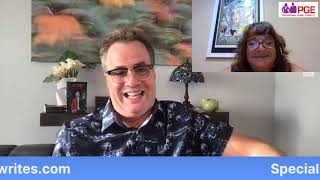
Author Edgar Scott discusses his dystopian novel 418: I Am a Teapot, where an immersive internet turns people into programmable laborers. The title references the HTTP 418 error code, and Scott's DevOps background shaped the world-building. He also shares plans for a screenplay adaptation and a game teaching players about misinformation and digital consent.
Chapters
Oh, we are live! Oh, so this is so exciting. So we're live and, uh, I don't have any fancy music. There's nothing fancy. This is just Edgar and I having lamb chop lollipops because I have this in my mind. I want lamb chop lollipops. We met at this amazing event at the Ritz-Carlton, of course, and we are sitting down and we are talking about who is Mr. Edgar Scott. So everyone say hello to Edgar Scott, author of 418: I Am a Teapot.
I do have the book.
Okay, whoa, right there, the COVID is amazing. So who is the photographer artist of this cover?
Ah yeah, it's, um, it's an artist. It's not actually a photograph, um, and the artist is Rafael Zucco. And he is the Vice President of User Design for, I think it is MDLive. And he's, so he's a corporate artist, web designer. And I gave him my book as a beta copy. I printed it out. It was pretty nasty. He got it before any of the editors read it.
Wow.
That's what he saw when he read the book. As my character on the immersive internet. So the question I usually ask people is, which side is real life and which side is the internet?
Oh, I want to answer though. You're asking me? Sure, sure. I'm going to say the real life is the suit.
We would all like it to be the suit. The real life is the orange jumpsuit. And it's too bad, but yeah, we— so, you know, the immersive internet is what I've written about. I've been an IT guy for years. That's where I met Rafa. I was a DevOps manager, and those are the guys who deal with your website when it's going down in the middle of the night and you call that guy and he has to figure it out what's going on. And so Where was I going with this?
So, did you say the word dead apps?
DevOps, development and operations. It's a new area of computer work where you are kind of a developer, but you don't spend your days writing code. You're kind of administering the network, you're troubleshooting the database, you're making sure that things don't blow up. It's, it's, it's Good work, but it's highly stressful work and a lot of it happens in the middle of the night, which is kind of why I wanted to become a writer too.
Why is that though? Why, why, why is that? Why in the middle of the night? Like, why do women have babies in the middle of the night too?
Yeah, that, that I— the second, the second question I can't answer. The first one has usually has to do with, uh, code pushes and we have evening load spikes. And then if there is nastiness coming from somewhere, it usually comes in the middle of the night because they figure that you're not paying attention.
Interesting.
You're talking hackers and like whatever that may be, denial of service, somebody trying to access the site, whatever. You know, usually it's just denial of service. They just want to knock you off the internet. And so you would have to just make sure that doesn't happen. That people aren't getting in. So you want to configure your load balancers to take whatever that piece of traffic is and throw it away. So when I decided to write the book, my dear friend Rafa knew me very well and went, "Oh, I gotta read it." And it's like, "Okay, well, sure." And then he designed that cover and went, "Yeah, I can really see that this is what we project into the internet." what we all wish it was, but sometimes it's a little more than a guy, you know, in his bedclothes on his laptop at home trying to troubleshoot the issue on the cloud where all the servers are. It's not often as glamorous as you might think. And that's also where I got the title from. 418 is an internet response code like 404, which is resource not found, right? And so 418 was originally a joke, and it was what a teapot was supposed to respond to if you asked it to make coffee. So for the computer guys out there, we're all saying, wow, you know, so much of the internet is so many things, like you think you're connecting to a computer, you may not be. You're connecting to a service, you're connecting to another service that is handling the data back, you're sending things off to another location. So it's totally possible that you might, not really know what you're connecting to. And somebody developed that as a joke. Well, here's the thing. Your web browser ignores the 418 error code, so we can pass it back to you. And as our web logs are just streaming, we can see 418 just happened. And now we can pull that line out and go, what did you ask it?
So wait, so explain the teapot again so I can understand that.
That was the original response code. So when you, when you, when you ask for a web page that isn't there, the correct response is 404 page not found or resource not found. But the correct response for a web server is 418, I am a teapot. You can't ask me to brew coffee.
Oh, oh, I can absorb that. That's really interesting.
And what it means is that you made a mistake asking it to brew coffee because it's a teapot. You didn't understand what you're connecting to. Do you see why 418 is such an important title or interesting title? We don't always understand what we've connected to. We might not always understand the internet. You know, it looks very nice, but what is it really doing? And so I've written this dystopia and there's a lot of really dark images in it because it's about a world where we have developed technology and we can have the immersive internet. Because, you know, I got my glasses here. And they— well, these ones just help me see you. But, you know, some of the glasses might give me coupons as I walk through the mall and things like that. We get our virtual reality headsets. Well, we take all of that and we just put it in your head. And, you know, we're working on technology like that, or people are. I myself am not. And, you know, we're working on technology to allow the human brain to interface with AI. There's a company called Neuralink that does that. I didn't know about them until very recently. And they— so I just saw this as where the internet would go. Well, that's great. And it sounds like a lot of fun because you could taste going to Paris. You could feel going to the South Pole. You could go to Mars for all I know, because you're just on the internet. It's not like you're actually going to die. So you could— I do this often. You could go parachuting. You could go skin diving and take your mask off. It's all fine. But if you were on the immersive internet, would you ever want to come off?
Oh, oh.
No, you wouldn't. But there's a good thing. You've got a little program to help you interface with the rest of the world if you're on the immersive internet. You have to have a concierge. So it's effectively a search engine and it has the same problems that search engines have here. It gives you information that it thinks that you want. And so it's trying to tell you what you want. So often in my book, I do little things like, hey, would you like to go to a popular— would you like to go watch a popular show? And it's only gonna tell my character about the popular shows, right? Because we don't know what to ask the search engine. We don't ask great questions. Okay, but here's— now I'm getting a little off topic. So that's one thing. So if you got this concierge, that means you got memory on the chip. If we got memory on the chip, we can make you do job tasks that we wouldn't want to do otherwise.
Oh wait, so immersively, right?
You don't know you're doing it. Your body just does it. So we can have you picking up the garbage. We can have you be a waiter. You don't know. And so you're online, you don't know what you do, you're not actually trained to do it. What do we pay you? Almost nothing. We pay you in virtual dollars that you can use online but you can't use anywhere else. So what I've, what I've developed is a whole class, a whole working class that really doesn't get paid.
Uh-oh, this is like Fortnite on steroids for adults. Yeah, kind of feels like that.
And so what, 418, the character, he, he has a name and he has a manager, and his manager makes sure that his physical body is looked after. He has a place to sleep, he goes to, to work, you know, he is fed, he is clothed.
He's a father? He's a husband? Oh, I thought the—
He's an owner. Oh, oh, and he directs him to do these things. Well, 418 is unaware of this at first, and throughout the novel he becomes aware of this, and he seeks to get out of this because he realizes that there's nothing real in his life. And he even goes so far as to have a wife online and he's never met her in real life. Well, and now how many people have dated somebody they met on the internet? I have. Okay, you know, we do these things. We're not always sure when we reach out to people on the internet that they look like they say they do. And sure enough, he does get to meet his wife in real life and she doesn't look like what he thought.
I just started the book. Wait, wait, wait.
So, oh, then I'll shut up.
Prince is not—
Yeah, so I'll just be quiet about that. So it's his story about trying to find out what's real in his life, trying to get meaning in his life. And so my character 418, who it is revealed that his name is George, he calls himself, he gives himself his own name online. It's not like our world where we name our children. Our children name themselves. So everybody's name rhymes online because that's what children would do, except for his. His doesn't. He's an exception.
Except George of the Jungle. Maybe that's like his.
Well, he's— I made him George Wojciech. But yeah, he's totally not rhyming. No, no, no. And, but he has kids who have rhyming names and he's never met them either. And I don't get into the the technical details of that, but we'll just leave it be because I thought, look, that makes the book very long. It's his story towards rehumanization. He has to find a way off the immersive internet. Well, let me take a little detour back to the real world. You've got this entire working class that is effectively not paid. That means that entire neighborhoods have collapsed because there's nobody doing those jobs anymore, collecting a paycheck, going to the corner store, going to the grocery store, paying So what's happened is people have been pushed into this working class because they can't afford to pay their bills. And it's not a very friendly world because if you become bankrupt, you can be forced to join the staff class as a worker to pay your debts, and you will spend the rest of your life online. And so George is trying to get out. 418 is trying to get out. His manager and I always refer to it that way, Brian, Brian, who wants everyone to call him King and nobody will call him King except for 418, but nobody calls him King, but he'd love it. He's trying to avoid being pushed into that working class. So the two of them must work together. And that's the story. It's a story of rehumanization in the face of technology that's gone the wrong way. But you can see that if you change the— say I'm an economist by training. If you change the production function of the entire country and make it no longer— and you have programmable labor, which is what you have, then you would have people being cheaper than machinery. And you would start driving the economy based on people instead of— based on labor instead of capital. And that would cause innovation to stop.
Wow. Okay. So this is so interesting. And the book you're writing is, um, is quite visual. I don't like— it can be me too, but like when I was reading it, I actually could picture the car that the little boy is in on his way to school. Excellent job. You know what I want to ask? I want to ask you a couple of questions. First of all, everyone get the book. It's very cool. And actually, I actually think that covers like a poster. I also see it as a movie poster. Who do you see playing the part? Who's, who's your actor that you would like to have to play?
You know, people ask me that, and I think I'm gonna leave it to whatever director comes up with that because they're all gonna have their own visions. Um, I always thought that Irfan Khan would make a great Brian, but he's passed away, so he's not gonna make such a good Brian now. Um, so I, you know, let's I can't really say who it would be anymore. That picture of the man on the COVID is a composite, so there's no one in particular.
Oh, I love that. Like, just all the faces together. But actually, I want to— okay, so the book is available. It is. The writing is great. And coming from me, I'm not a sci-fi girl, so like, I enjoy reading it. I look forward to— don't give any spoilers— I look forward to finishing it. But I really want to ask you a couple of questions outside the book. Like, so you're writing a book like this and you, you start to share it and you share it with your family. I want to hear, like, was everyone positive? Did you have a lot of naysayers and how did you handle that?
Um, well, I will have to say this. My wife was the most important person in this who told me to do this and that I could do this. Um, I had just come out of a job situation. Where I was working for a company that I got a new boss who was just out of college, and he was shooting his mouth off about how old I was. And so I left that company because I needed to. Well, I mean, he was going to fire me in a couple of weeks. I knew it. So I left that company, and then my wife said, why don't you write that book? And so I did. When I I didn't send it to too many people in my family because, well, they live a long way away. And I felt like if I couldn't print it and hand it to you, I didn't give it to you because I didn't understand maybe all the nuances of the writing industry at the time, that it's OK for me to give you an advanced reader's copy, a PDF, and you can read it. You're not going to go away with it. I didn't know these things. So I had to learn a lot of that stuff. The people who read it, I got strange comments like, that's really weird. It's like, I don't know what to do with that.
Weird, good, weird, bad, like, right? Like weird what?
So that would be my question. And eventually they said, no, it's weird good. You know, it really is. But I, you know, I was like, ah. So what I found is that it's It's, it's different. I don't think there are a lot of books like that right now. It's a piece of literature, which is the toughest thing to sell because people want something that is going to be fast, consumable. You don't have to think necessarily too much. This one's going to make you think. Um, and it's just the way that I wrote it. That's the way that I— it's my education. It's the way I was brought up in a house with tons and tons of books. Um, I, I just see it that way. Um, and so Yeah, I didn't get a lot of encouragement is what I have to say.
I guess that's kind of the thing I wanted to know. So did you publish yourself? Is it self-published? You found a publisher?
No, I— this is an independent, um, and that's a little tricky because it's not like it used to be. Um, back, back in the day, self-publishing was vanity publishing. Okay, this is not that. I own all the rights to this thing, and I had to pay somebody for all of the typesetting, and I had to pay editors to read it and proofread it and things like that. All of that had to happen. I— you don't need to necessarily go through a publishing house to get it done. You can go and get it done If you order it on Barnes Noble, you will get a physical copy because there are print-on-demand houses and they're hooked up to them and they will print it for you and send it to you. I don't have to have a publisher for that. What a publisher does is a lot of promotion. So I have a promotional team, right? So it's not a clear answer. Did I self-publish it? Yes, I own the promotional company or I own the publishing company. Is really what I am. And I might do that again. Here's the thing. When you're very new writing, and one of the particular problems I had is that I finished this, and after I started, you know, figuring out what to do with it, COVID happened. Trying to pitch to a literary agent in the time of COVID is not good because you really need to meet these people.
Why? Why? No, explain to me why. Because I feel like the listeners here, I want to make sure that, you know, when you, when you have a friend, you have a child that expresses an interest, and I have a beautiful niece that has expressed an interest. I've read her books and want to encourage them. The reality is you can be an author of a fantastic book, but why do I have to meet? Why do you have to meet in real life? Or you say, yeah, in real life, because they're not gonna—
because what an agent does is they represent you and sell you to a publisher. And so if they haven't met you, they're not going to put a lot of effort into it. And there's a lot of people writing books. So they know who the existing authors are. I was an IT guy approaching my 50th birthday. I'm 50. How about that? And, you know, yeah. And so that's not a really good sell for them. I'm just a guy. And for them to invest the time to read the actual book and go, holy, holy moly, this, this has real merit to it. This has, you know, worth. They're just not going to do it because they've got other things to do. They need to make money. So they want to just sell and get out. So it's, it's, and, and if you haven't met them personally, they don't have the time. And, and it's unfortunate. However, I have— I'm close to finishing another book, and I can look at that, or I can decide if I want to keep all of the, the rights to myself and do it again this way. Um, and so there's advantages to it. You don't have to do it the other way. I have just completed doing the first draft of a screenplay.
Oh wow. Oh, I want to hear about that. So wait, so, so, so you say you're gonna write a book, you sit down, and is it like what we picture Stephen King doing? You're, you're literally just writing at your computer, taking a little break, writing at your computer for— how long did it take you to write?
I think there's a lot more walking around in circles too, because I certainly did a lot of that. Yes, and, and I would recommend keeping spreadsheets, which is how I do it, of all the characters, all the places, all the chapters, what's supposed to be in each one, and trying to keep each chapter to be individual so that you don't have to think entire book at once because that won't fit in your head. So yes, it is like that. I want to encourage you or, you know, is it your niece or your daughter?
My niece. Okay.
Your niece who wants to write a novel to absolutely do it. There is no reason that you should be stopped. There are— if you can't go through the front door, there are new side doors and windows that you can absolutely go into and get this done, and it can still be quite popular. And actually, you could end up further ahead because when you go through the traditional publishing houses, your payout is different. So it's— you might not want to go that way, but they do things that you don't have to do. Now, I wrote a blog post a while ago about giving yourself the gift of writing horribly. And one of the most interesting people I ever met was a man. I grew up in Toronto, and there was a man in Toronto. He was actually a US citizen, and he used to sell his own books on the street corner. And he would stand there with his books, and the vending laws there meant that you had to talk to him first. And if you did, he would, he would offer to sell you his book. And, uh, I have his, uh, anthology of bad poetry, and it's terrible. He didn't write most of it. He didn't write any of it. He just collected it. And he would write just awful stories. But, you know, the value of it was that he showed me at that point in time— he told me— I would just drive down to Detroit, you know, get a printer to print up a few hundred copies of my book and drive back, and then I stand here on the street corners. There's no reason you should ever be stopped. Here's the thing with giving yourself the gift of writing badly. You don't know when the piece of brilliance is going to come to you. And if you're always trying to be brilliant, you're probably going to stop yourself from writing well. And sometimes the piece of brilliance comes out in the worst writing when you turned off your filter and you just wrote thinking you were going to throw it in the garbage can. and then you come back the next day and you go, hmm, that's really interesting. I wish I could tell you exactly where it is in my novel. There is one part of the book that is totally like that because I had one day where I really couldn't get anything, and the next day I woke up and I went, I don't care, I'm writing this badly. And it's still in the book just the way that I wrote it, almost. And people read it and go, that's great, now I understand. It's like, Good, because I didn't. And we— so write badly. And here's the thing, you don't have to publish it right away. You get an editor. So you've created the story. It's effectively— it's a piece of, it's a piece of granite that you've pulled out of your head. And editing is the fine chisel and the tooling that you choose to use to make it into a very interesting, well-written, readable story. Because when we write, —just as a great example, we use all sorts of little weasel words. I use "just" way too much when I write. "So." And you know what? Those don't appear in the novel because that's the way I might think. That's not the way you want to read it. And so give yourself the freedom to be terrible and you'll never have writer's block as well. Wow, this is beautiful advice.
What was that? I, I spoke, sorry. What was that?
Just don't publish it. Don't hit the publish button because it might actually be terrible.
I, you know what, I, I actually— I'm gonna say this— I actually can understand, um, why Transmedia has taken you on as a client. You're incredibly likable, and congratulations because they are a fantastic PR firm. I mean, to me, one of the best. So, so congratulations to have such a great PR firm behind you.
That's a great team.
Yeah, it really is a great day. But you're so likable, I could see why they would say, hey, this guy Edgar, he's going somewhere, yet with or without his glasses.
My reading glasses.
Yeah, I love it. I— what I want to ask you, so, so you mentioned about the screen, because screenwriting, because as I said, when I'm reading it, I'm actually visualizing it. I mean, like, I really kind of saw it all. So, so, so I see this as— actually, you see this as a movie, or you see it as a net series?
I, I'm hoping it gets, uh, sold as a movie. I think that's the way—
everyone cross every part of your body.
Yeah. Um, and so the screenplay isn't gonna follow the book one-to-one because it can't. They're different, they're different presentations. Um, there's many, many storylines in the book I think you've already noticed, you wouldn't want to see them all on a screen. So it has to be something that's more exciting, more visual, more motion-oriented. And so I've tried to write the screenplay like that. Again, I give myself the gift of writing badly, so I've done a bad job on the first draft. Now I gotta edit the first draft to make it better. But you, you would move things around in the screenplay that you wouldn't have done in the book. In the book, I need to introduce the world to you. This is one of my, my comments when people say, well, it starts slowly. Yeah, it's a dystopia. It's written in the near future. I need to— it's— I need to introduce the world to you so that you understand what kind of world we're in, right? And that is a little bit Well, it's a lot of writing. So I mean, I tried to keep it from being tedious and I hope I did, but yeah, it speeds up because I no longer have to explain this is a totally automated world where technology has stalled and I don't have to tell you anymore.
You would— I didn't think it was really slow at all. So I actually kind of also saw this as a game. That's kind of why I probably brought up the Fortnite on steroids. I don't know why, but I could actually see this being put together and watching kids actually go into the 418 or become 418 themselves. So just an FYI, if you do that, I'd like to be a little character.
That's fascinating. I hadn't thought of that. Um, okay. Well, you know, it's a story about rehumanization, um, because when we dehumanize people, we take away their pronouns from them, they become its. We turn them into, I mean, we've all seen that, the person with the staff shirt on so that we don't have to know their name. Oh, I never thought of that.
Wow. Yeah, you're right.
Oh yeah. And so now, and somehow the internet, because it gives you this sense of anonymity, actually dehumanizes you a little bit because you're not sure who you're really talking to. Do. If that person is what they look like, who they say they are, you know, it can be a little misleading. As a computer guy, I spent my life dealing with people who were trying to sell things, and I'd have to figure out if what they were telling me was really the truth. We might, you know, if you're new to the internet, you might get tricked a lot. So I thought that it was very important. You could try to make a game with all those odd pitfalls of stepping into, you know, believing somebody that is, that isn't. I don't know. It would be interesting. It'd be fascinating. I'd love to see what somebody would have to say. One of my favorite things is when I had book reviews going on on Instagram is people would send me mockups of themselves as 418. Oh wow, and I love that. Um, and, and I'd like to start making a collection of people who've done that, you know. Um, typically, um, you know, I'd see something like a cyborg type thing, but I— hey, there's no limits on it. Remember, it's the internet. He could make himself look like whatever he wants. He could, you know, he could wear a purple suit, he could wear— like, it's all customizable online the way that he sees himself.
Um, that's awesome. That's really a fun contest too. But the thing is, for our— so misinformation is really scary. And I was on Clubhouse the other night, which is the audio app, and a young, young girl was, was saying something so outrageous that I nicely wrote to her to tell her that she was wrong. And she nicely wrote back, and, and actually she ended up apologizing to me. Her sister told her. Really? Um, and then she kept saying on— when she was on Clubhouse, she kept saying nobody's talking about this. That's right, nobody's talking about it because it's not real. So it was like— I'm like, that's why nobody's talking about it. But my point is right now is that if you had the, the younger generation actually understanding this while playing a game and realizing that the whole As an adult, we have to find out who's credible and who's not, because so many people— and I didn't really think about it myself until Clubhouse came out, and all of a sudden there's this new audio app and people are coming on and they're saying— there was a man that was saying he was telling everyone how wonderful he was and he had himself, that he was the man to, uh, buy and sell automobiles. Do you know that he was so bad that someone had created a website that said his name and his poor reviews, and then he had over, like, I don't know, more than 100 negative reviews that people went on to this website that was in his name to say how— what a, what a schmuck the guy was. And there he is on Clubhouse with this like profile that makes him look so great. And I was like, oh my gosh. And that's kind of when it hit me, like, this is serious. We have to cut through the clutter. So a game to kind of— and I don't know if it would even be a game, it would really be— what would it be called? Like, what would it— what would be the real name for a game that would be I would imagine it'd be an adventure.
I mean, it's a voyage. So, you know, it's a voyage from, you know, from being, you know, maybe literally and figuratively enslaved to, you know, freedom of some sort, of his sort. Yeah. So I would imagine that that it would be a game where it would be— I don't know if it's a race, but there's only a few paths to it. I mean, there's— it's not quite snakes and ladders. We don't want it that simple. But there's ways that you can just get— you're just off into the middle of nowhere. And, you know, when we look at our lives, we get into all sorts of situations that cost us years of our lives. We might end up taking a job that we're not happy with, but it's paying the bills. And we might continue to do that job for more years than you might understand and you might not want to think about. And then, you know, worse things, we might, you know, take a spouse or something that we don't like. Oh my goodness. But, you know, we— yeah. So I wrote the book simply to I can't solve anyone's problems. I wrote the book to simply ask people to think about these things because I don't have the solution for many of these things because there is no real solution and it's going to be personal for everyone. But you have to start asking yourself the questions, what am I giving up? What am I really getting? Because the way I wanted to introduce the book is at the beginning of the book, I want you to like the idea of being online. I mean, it's awfully fun right now. I know I go through the hospital because I have to move the book along, but the way that I usually talk about it is, hey, and I did it with you, just think you could go scuba diving with no snorkel. You could go to the moon and be fine. Race car driving, spin out, it's okay, you're safe. It's all in there for you. And so a screenplay would have lots of that up front, and so it's gonna be a fun movie. And, but, you know, I then have to show you that just because you're getting that, what did you give up? And in my character's case, he realizes that he's— he didn't even give it up. He never had a chance to have a full and effective life that he wanted to have. And so now he must set about—
Balance. So balance is still always the key.
Balance is the key. The world is in balance. It's almost trite to say that, but I believe it to be true. But we have to sometimes step back and go, what are we getting? What do we have? What is that? And that's what the book is meant to be. It's a warning. It's a wake-up call, but it's not a warning that if you don't do anything, bad stuff could happen. It is a warning that if you took some of these technologies that are being developed and applied them with certain rules, you could use the idea of putting people online as a way for them to serve out their prison sentences. That's in the book.
Holy crap. You know what, for me, it would be— I don't have one tattoo. Or even want to have a tattoo. I, I'm scared of like motorcycles. I don't know, my parents seem to put like a lot of fear, like driving fast, a lot of things. Like I would never jump out of a plane, a parachute, like all the things that I wouldn't do online. I would, I would. And then to experience that, and wouldn't that be amazing to experience and look at my arm and to see a, a tattoo? Yeah, which would scare the crap out of me, but like to see And then you can take it away.
Oh my God.
So wait, so, so you're 50 years old. You're so old, by the way. Oh, I'm 59. I'm 59. I could say that. 1962, I was born. The IT world.
Yeah, it's kind of old, but it isn't. It really isn't old.
But, but so, all right. So now you've got the book.
When did the book get published? The 23rd of March.
Oh, congratulations! So you're a new author, you're going and you're making the, the rounds, which by the way, tell me, who would you really like to, uh, what show would you really like to be on?
Oh, um, geez, I don't know. I don't want to plug anyone's show, but, um, you know, I grew up and I grew up my, my I was born in Houston, Texas. My father moved to Toronto when I was an infant. He was a medical doctor. And so I, he took me with him. So I grew up in Canada, not really fully appreciating that the fact that I was born in the United States meant I was a citizen here. And so I've listened to the Canadian Broadcasting Corporation corporation a lot, and I would love to be on somebody's show like Tom Power or Writers and Company. You know, they have people like Margaret Atwood on the show, right? Margaret Atwood wrote a dystopia in 1985, and really that's the last major dystopia that I can think of, The Handmaid's Tale. And, you know, It would please me so much to do that, even though I live in Florida. I'm not moving from Florida. I love living here. I enjoy being an American writer. I certainly don't disappreciate the Canadian influence on me, and I love them too. I have the best of both worlds. That's what I'd love to do. Uh, but I don't, you know, I don't— they're, they're, you know, that's a long way away. I gotta cross a border.
There's still COVID going on. Oh, Adrian, Adrian's— Adrian, my same name as myself, the president of Transmedia. Make it happen, please. I'm looking right at you, Adrian. Adrian to Adrian, let's make it happen. Hey, I'm in, uh, I'm in beautiful Daytona Beach.
Okay, I love that. That's where I did my first ever body surfing about 10 years ago. I had a day where the water water was just the right way. And that is wicked fun. For some reason, it doesn't quite work the same way down here in the Fort Lauderdale area. I'm in Boca Raton.
Oh yeah, that's beautiful. I love FIU, so I love, love, love any, any community that has a lovely college, university, school, so you can see the kids. That makes me happy. So I love that. Good for you. Beautiful here.
You know what, and, and, you know, the people make fun of Florida Well, maybe rightly so, I don't know. There's a lot of very bright artists here. I mean, Transmedia is a great group of people. I'm very fortunate to have met Bill Hoffman through them, and he's a producer, and I see that he's upping his game again, and I'm excited about that. You know, we're opening, you know, movie production studios over on Sunrise Boulevard. Oh wow, just happening. Um, and, and that's great. That's going to be a lot of fun too. So things are certainly happening in Florida.
How long have you been in Florida?
Oh, since 2007. Oh wow, my parents had an art gallery.
Did you ever go to the Promenade at Coconut Creek?
Um, I have been there, but I don't remember the art gallery. But you know, there's a lot of places.
Yeah, there's a lot Yeah, that was marker animation. It was animation art, which was really fun. Okay. Yeah.
Now this is why I love being a writer and I'm not so keen on being an IT guy. IT guy, it takes all your time. You've— there's, there's this term in the IT world called technical debt. And that means that you've gotta always be learning to stay on top of things, cuz there's always new technology and you're always running to keep up there. And, and so yeah, it does start to— I mean, it's fun and I love technology, And it's great when it brings us new things, but man, it's, it can be a lot of work sometimes.
I never heard that term, but I absolutely love that term, technical debt. And I can see that for social media. I think many people that are doing social media, it's a consistent struggle to keep up, to know exactly what's going on. I'm so glad to meet you. Oh, well, I appreciate the opportunity. You're so likable. Honestly, your personality comes right out and, and well, this is not Zoom, but on a virtual video.
I'm glad, I'm glad. Well, you, you've— you're, you're in my, you're in my loft. Um, I, I guess I have a loft. Um, and that is my mother-in-law's painting behind me, which is really a photo that she blurred, and it's really cool. Oh, it's beautiful. Shout out to your mother-in-law. Yeah, yeah. So, so my, my wife's mother, not my mother. Well, she is my mother. She's It's confusing, you know, and when I want to confuse her, I ask her those questions. She's got an answer for it. So, you know, I'm glad to have you in my home. It's lovely to have you here, and I've enjoyed talking. You've done one of the things that I love, which is you let me talk for far longer than I should have. I'd love to know what you think of the book. Thank you.
So far I am loving it.
I got a few questions that I'll ask you only at the end. Oh, I'm not going to ask you now because—
why? Tell me. Okay, just so I understand this. So I, I did— I said I normally it's no prep needed, I'm just hopping on, but I knew for some reason I'm like, I don't know, I'm a teapot, not sure really what we're even going to discuss. And of course I have to like shut the song up because I was a camp counselor, so I am a teapot. Oh, please.
I apologize. I would not have done that to you. We would have printed one book just for you with a different title.
But so you read your book too. So there's, so I saw one video where you had chapter 1 and then I was like, there's chapter 13. And I'm like, is there 2 to 12 or did you just skip or are you skipping around or what's your story of reading the chapters?
Yeah. Um, I was just trying to read things that were insightful at the time. Uh, that was pre-published. Publication. So the book hadn't actually come out, and so I just wanted to read things to get you interested. Um, I would tell you that chapter 10 might go to the front of the screenplay, so whenever you get there, you'll, you'll read it and go, yeah, I see why you might do that. Um, and, and so, um, yeah, that's what that was about. Um, I didn't want to necessarily read through the whole book And I haven't turned it into an audiobook yet because I think I need two narrators. Because as you've probably read enough to notice that there are two different narrators in the book, and I changed the type font in case you're not paying attention so that you, you can see who is doing the thinking, whether it's Brian or George.
That would be cool to have the two narrators. So, all right, so one more question before I let you go. All right, so when people order the books, I always get confused. So your website, which I have under here, edgarscottwrites.com, Is— wait, did that— did the creator of the design— the designer of the COVID did he also do your website?
No, no. Okay. Um, so I hired a different group for that and they did a lovely job. So it's really my blog now. Um, and so I think I'm gonna post— I have a blog coming out very, very soon which has to do with Elon Musk. Oh, and, uh, he has just unveiled a huge— the Tesla Bot. Well, the Tesla Bot is an android-like robot that can lift 150 pounds, and he says that all men— essentially, in the future, manual labor will become a choice. Well, you know what? That sounds an awful lot like my novel. And he's about to bring about automatons to do those kind of chores. Now he phrases it as things like picking up groceries and stuff like that. Okay, but you know, why not have them pick up the garbage and, you know, do things like that? Well, and at the same time, we have companies like Neuralink which are developing brain interfaces. If you merge those two technologies, you have the staff class in 418.
Wow, this is interesting. I look forward to seeing the blog. So I'll help you out. Wait, can we sign up on your website? You sign up, but where do I get the book? Do you get the book off your website or off of Amazon?
And what if people want it signed? So Amazon, the Apple Store, the Google Play Store, all of those can sell you an ebook. I believe that I've got the prices set at $4.18. Get the real book, get the book with a printed book with the COVID Printed book is $12.99, and you can order it from Barnes Noble or Amazon or many of those other sites that have a printed option. And now remember, it's print on demand. It might take you a few days to get it, but you will get it.
I just think the COVID is so cool.
I'm in love with the COVID And the printed book comes with a bonus. I will show you. This page is my handwriting. Oh, so yes, if you want it— what does it say? I am a teapot. Oh, I just— when we talk about being a teapot, if you were programmable, you might as well just be a teapot. And in many ways, we're already programmed. So even the author of the book is a teapot, or has been.
Wow, you need a couple of memes like with your face and then like those words right there, because That's pretty awesome. And wait, now it makes me wonder what the original— like, what was that song about? I'm a Teapot? Like, did they—
oh, that's completely different. Different. But I love how you—
wow, I'm kind of blown away because I never really thought— but that really kind of empowers you a little bit to just be like, yo, I'm not a teapot. Like, do it yourself, I guess.
Yeah, my characters have to do everything that every— anybody has to do in order to be successful in life. They have to decide they want something new. They have to believe that they can get it. They have to make a plan to do so. They have to take action and they have to figure out if what they're doing is getting them what they want. And if you do that with any aspect of your life, you might be amazed at what you can actually achieve. I think you've already done this because you decided that you wanted to have a podcast. You've gone about finding the technology, you reach out and find people to interview, you do it, and then you look back and see, Did I get what I thought I was going to get? And where do I want to go from here? And so I think you're already following this sort of generic success formula. My characters have to do this in order to solve their problems. I don't want to give it to the— destroy the book. I don't think I have. You'll tell me if I gave out too much later, and please do if I did. And yeah, it's one more question.
How Thank you for the podcast. I actually started it during COVID because I wanted to show off my friends. So it was really a show off my friends, and I interviewed about 50 of my friends. And then actually I got the ability to interview Mr. Madden, and he seemed to like me, which I was like, okay, that's cool. And then next thing you know, Transmedia was sending me, uh, sending me lovely, um, celebrities to interview. Um, I have been called the HSN of podcasts Not even sure if that's great, but thank you, Captain Joe Sacchetti, Army Ranger, amazing man. And I also have had, uh, it's been fun. And actually, I take a lot of, a lot of the conversations that I have. I'm also the chapter chair for SCORE, which I love, SCORE Volusia Flagler. And some of the people I'm interviewing are fantastic to be a workshop, and they're coming in and doing workshops for me, which is really nice. I don't make any money on my podcast. This is all just fun because I get to learn and I like to look at myself. Um, but what I want to ask you, okay, so how do people communicate with you? Because at the end of the day, it's really fun to, to connect with a writer and then be able to write to them. So are you on LinkedIn? So give us your like social media so I know.
Oh, I am on LinkedIn. I'm Edgar— I, I use the, the handle edgarscottwrites.com or Edgar Scott Writes on my Instagram. I'm @eScottWrites on Twitter because my handle is one character too long. And my website does allow you to send me an email, so you can do that and I will get it. That's how I usually like to do that. If you send it to me, I'll read it. If it seems like you're legitimate and you're not trying to sell me 'Oceanfront property in Arizona,' then I'll respond. Oh, that's so weird.
I never think of that. But just someone who reads a book and wants to ask— that to me is the coolest thing, is being able to read a book and connect with the author. That is like a gift.
So my Instagram is where I do that, and I put up a lot of stuff that I do. Like, my wife and I, we just went to Las Vegas. We're very tired of being here, and I don't mean to upset anyone. We— I'm vaccinated. So I thought it was a totally appropriate thing to do, but I follow all the procedures that they asked me to. And, you know, we had a lovely time. And, you know, so that kind of stuff gets in there into my social media, into my stories. So you'll see that, you know, I, you know, there's all sorts of fun stuff to do. And, you I think the good part of social media is sharing that kind of fun thing. The bad part is when it becomes malicious and I'll just leave it there. So I try not to do that. I have a couple of rules for social media. I totally encourage everybody to do this. I don't retweet things that I'm not involved in. So if I wasn't doing it, I won't I won't forward it out unless there's some really good reason for me to do it. I don't say anything negative. If I went someplace and I had a bad experience with a restaurant, I'm not gonna say that. That's bad. If I read a book and it's bad, I look, some books, maybe it's just me, because not everybody's gonna like my book either. So, you know, we keep those comments to a minimum. We just say positive things. We share the good things. And I wish we'd all do that. I love—
you see my logo up there, PGE? That's Professional Global Etiquette. I'm a graduate of the Protocol School of Washington. So thank you. We all agree etiquette online is very important. Did I get it right? You got it all beautifully right. And one of the things I love to do when I go out to eat, and I do go out to eat, I'm vaccinated too. Um, but I, I just suck as a cook. I don't even really enjoy it. So anyways, so, but I always ask the server for their name, and I always take the time to write something lovely for them. And I'll do it on Facebook if they, if they say, and I'll show it to them. And, you know, just say, look, because I want them to know that they're appreciated. And I also know, by the way, when you take a minute to do that on Google, Facebook, Yelp, they get a little credit. Someone's looking. They have a boss that's looking at them going, oh my God, that's so Yay for you, Sally J. So I, and I absolutely agree. I have a blog post I wrote about bad reviews really could hurt and harm a business. And we all have different taste buds. Many things can go wrong and you, that's why you talk to the manager or go the next day and have a conversation. Don't put it online because it's not fair to business, but I'm all about business. Hence I love SCORE because I want businesses to succeed and I want authors to succeed. Succeed. And so that's important to me.
Well, one of my, one of my first reviews that I really didn't like, and I shouldn't go too much into this, but you know, I'll give you the example. Somebody somewhere, and I don't— I think it's been lost to time. As soon as my book hit one of these platforms where you could review, said, oh, this is a— that's a weird title. I don't like it very much, so I don't think I'll read that book and gave me a very low review. And it's like, you didn't even read the book.
Right? Exactly.
So, you know, what's that supposed to— yeah. So I think that's how you don't do the internet. But a lot of people think somehow that that's how you should. So, you know, we want to promote, we want to be positive. The internet is a great place for positive promotion. If only we would use it that way.
Exactly. Exactly. I actually had a— if you Google my name and contact tracer, you'll see this whole story. I was a contact tracer and there was a situation where there wasn't any account, whatever. There was a big story. But so a lot of people were writing and they were kind of negative to me. And you know what I did? I gave them my phone number and I said, call me. And I had like 3 people call me. And when I explained to them what the story really was about, because people read a headline They didn't understand that as a contact tracer, I was put in a hotel, I was being paid, I was waking up every morning, getting ready to go to work, excited to go to work, but never given the job to do. And so literally, and it wasn't just me, if it was just me, maybe, you know, but there was a variety of other employees that were getting paid by the state of Florida and by this like, uh, you know, employment agency to sit in a hotel. And they all thought, well, you, you know, I should return the money or I'm like, I got up every day, I got dressed, I was that with my family. And because I wanted to do this job so badly. But when I realized that there was something that seemed off and I contacted the reporter who said, oh yeah, this is a story. And there was a variety of local representatives that had found out what was going on. But the minute I gave my phone number and those that were brave enough, because most people will talk online, but they're not brave enough. The minute they, they called me and I shared, they're like, oh my God, we're so sorry. They went back and changed it. So I always say, I mean, I'm not worried about my number. It's a phone number, whatever. I could turn my phone off. I don't have that worry, like, oh my God. By the way, that's my thing. I don't have any boundaries either. You can call me anytime, whatever. I don't— you know what, if I want to answer, I answer. I don't— I really, I wonder if that's age, because I love the younger generation who have boundaries, and they're so strong with that. And I'm like, ooh, so cool. But I'm like zero boundaries, like, just call me.
You know, I, I, I did so much of my work career was done in the dead of night. I, I just, I, I, I do, you know, my, my phone does have a do not disturb. So yeah, sorry, we're in charge of our own phone.
Isn't that part of it? We're in charge of our own social media, what we do.
You know, that phone, we, it didn't always have a do not disturb. You had to turn it off.
Yes, now it does. And sometimes it reads you, I swear. Sometimes it just like knows Adrian went to bed early, let's not disturb her.
It's, it's, it's amazing what kind of, you know, stuff is being collected about you. That's a subject for a whole different story. And I'm going to talk about it a little bit because, you know, the concierge Samuel, he starts suggesting the things that 418 has always done because he knows something. About them.
Oh, that gives me chills, right?
Yeah, yeah. And our search engines do that too. I know, but, you know, yeah, it's, it's a little scary how that goes. Um, my— one of my favorite things for my search engines is occasionally just give it all sorts of nonsense. Like, I don't have a dog, so start, you know, asking about dog medicine or something, you know, dog, dog healthcare, or because I have a cat.
Oh, and then all of a sudden you'll start seeing the posts on Facebook.
You'll start seeing all of that come into your ads and it's like, really? Oh man. So I try to turn all that stuff off because I don't want someone to suggest too much to me what I should do. It's, you know, but then again, I still love the ability to go out in a search engine and go, yeah, I got this interview with Adrienne Barker What do I need to know here? Yeah. Online presence. Well, you did it to me. So, um, you know, um, it's, it's, it's okay. You know, we, we, we, we, in this case, we know what we're giving up and what we're getting. Exactly.
Exactly. I definitely honor those that don't have any information though. I'm like, wow. So it's almost like really cool to me too. Like, so if like my mother-in-law, her last name, I cannot— the only person I could find with her last name is her brother, like my uncle. Other than that, I cannot find— and I'm like, whoa, that is so cool, you know. But I worked hard to get my name all over the web.
Yeah, it's good and it's bad, um, because yeah, it, it identifies you, but you know, you're also— so it's so obscure that nobody would ever I never find you. But yeah, um, uh, you're awesome. Uh, well, thank you.
This has been a nice hour. I love it. You've been really enjoyable. I know about that. Thank you. Um, oh, I didn't know. I'm just noticing because it says it. But so what I'm gonna do, by the way, my lighting has changed.
The sun's gone down in South Florida. Oh yeah, me too, in Volusia.
So, um, so this is gonna go— I'm gonna download it It's live on, on my Facebook, on LinkedIn, and then I'm going to download it to the YouTube channel and I'll send you a copy of that. So you have that with all your information, how to get in touch with you and how to fall in love with you because you're awesome. So can't just be your wife loving you. We have to have many people out here that are your fans that love you.
Well, I appreciate that. I'm just trying to write a good story. That's really all I wanted. And that's You know, I get such satisfaction when somebody tells me that. I recently got a post from a friend of mine who lives in New Brunswick, and it was so heartwarming to see that, you know, they said, this is the best system administrator— well, that was one of the jobs I used to have— that I ever knew, and he's written one of the best books I've ever read. So it's like, thank you, because it's been— I haven't worked there in 10 years. You bought my book, you got it in Canada, you read it, and I love to hear about it. And I just wanted to write a good book because in this world, we have to decide what it is that we have done with our lives. And if at the end of all that time, you can't sit back and say, I've done something of note, or I've contributed something, then I think that you missed the point. And it's unfortunate because you don't get to hit the rewind button. So I tried to write a book that would be interesting. That's why it is more literary rather than, uh, sort of genre fiction. Um, and I'm glad if you read it and I'd love it if you liked it. And even if you don't like it, all I really want to hear is that it made you think.
I love that. I will send you— when I'm finished, I will send you a note. And, uh, and very nice to talk to you because I know in 5 years nobody's gonna be able to have time to talk to you because you are going to be doing some big things and you'll be on, um, my favorite— no, actually, I can't even— I don't even know who I— I like everyone, so I can't even say I have a favorite. Anyways, uh, I don't even know who I would say I want you to interview, but I feel like I'm gonna see you on the big screen. I'll be like, oh, Edgar, yay! So up and on the PlayStation app for games, because you're going to be able to be found and you're going to have an iPhone game that's going to be amazing. And you're going to have the first channel that's going to actually be all about your, um, your, your life online. So I love that.
Well, I'll probably write more about that. Um, I think that it burns you out if you just keep writing dystopias. But I mean, there's, there's things that are burning a hole in my pocket, like disinformation. Um, have we entered the disinformation world? Should we just believe that everything is incorrect first and then prove it, as opposed to believing it to be true and then disprove it?
Holy crap. Oh my God.
Yeah, find the disinformation era if you went online and you should just automatically look at any article and go, that's not true until I can prove it.
Well, then you got to teach people how to prove it, which I find that's the hardest too, is that people don't— I love that. I love that. I tried to do that after The Social Network. I, you know, they actually had a lot of great information and to have events and watch parties, and I added it to my website. I wanted to have this big event on talking, like a community event. Let's talk about disinformation. And, uh, yeah, nobody bit. So that's because I'm not popular. Yeah.
The reason they don't bite is because they think you want to talk about a micro piece of disinformation, a specific topic. We're talking about it in general. In general. It affects so many things from things like, you know, well, I told you I give my search engine disinformation about the dog I don't have. And so, you know, I mean, disinformation about how to cut my grass. I mean, like, it's a There's all sorts of incorrect stuff out there.
Oh, how about all the recipes, by the way? Like, I told you, I'm a really horrible cook, so I'll like watch these recipes and then I'm like, I have to like really kind of sit down to myself, say, really, does that really make sense, Adrian? I'm like, no, because they'll show like a pretty girl and she's making something and that's kind of cool, puts it in the oven, takes it out. And so I realized that that's all fake too. So I can't—
I think you've hit on the other problem is who are you listening to? Because the pretty girl didn't actually come up with the recipe. And so if you want to talk about it and what could possibly the internet turn into, well, why not listen to a guy who worked for the internet for 25 years? But I have, you know, like I have a personal trainer and I know he gets results because he looks a certain way. And I have a woman who stretches me and she's very good at that because she's done training for that. So I'm getting my information from people that I know actually could do that, but I might not listen to them when it comes to, you know, what to do with my cat because they're not vets.
So you are so right.
Oh, I— who are you listening to? You know, ask yourself that when you run into something.
Who's telling you? Wow. And you know what, also the other thing is you would be great as a podcast host yourself. So I would think about doing that. You can have some great conversations and kind of build up your, your, your audience being your own host. Perfect.
And if I can't find a guest, I can spend the time talking to myself. You can, exactly.
That's what they do. I love it. I love it.
All right, well, anybody would really want to watch that.
Actually, yes, you really are very interesting. Interesting. I really enjoyed this conversation. So thank you so much for your time. I really appreciate it. And I will talk to you soon. We'll stay in touch.
And you know, let's, let's, let's all work together and get over all of these things. And, um, you know, I can't get out of South Florida without going past Daytona Beach. Oh, I love that.
Don't say that. I'll be really excited. And nowadays you say I can't go past, uh, Florida without going to Buc-ee's because we have a Buc-ee's right here in Daytona Beach with 130 whatever gas pumps and, uh, brisket out the bunions. So you can— okay, all right. So thank you so much. Have a great rest of the night, and thank you. This is fantastic. Bye, Edgar. Bye-bye. And I'm gonna stop streaming right now. Thank you. This










