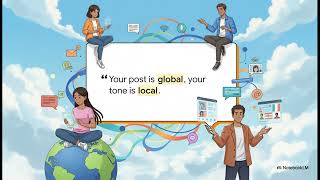
In this presentation Adrienne Barker, MAS, explains how the shift to hybrid, globally‑distributed work has rewritten traditional etiquette rules. She argues that professionals must move beyond memorising country‑specific customs to reading an “invisible cultural map” that reflects audience values and adapting in real time. Barker introduces a practical framework of three modern cultural shifts that determine how respect, communication speed, and online persona are perceived: (1) the Respect Gap – because non‑verbal cues are lost in virtual settings, respect must be explicitly narrated; (2) the Speed versus Space Dilemma – different cultures interpret instant replies or thoughtful pauses differently, so mirroring the counterpart’s communication rhythm is essential; (3) the LinkedIn Layer – professional social‑media tone must be locally calibrated even though the audience is global. She illustrates each shift with concrete examples (US vs Japan directness, Germany vs Brazil agenda expectations, Singapore emojis, Paris formal greetings) and then shows how a leader of a global team can set inclusive standards (e.g., brief connection time at meetings, concise messaging, assuming good intent). Finally, Barker ties cultural competence to career outcomes, stating that mastering these shifts builds trust, credibility, referrals, and promotion potential, making reputation a decisive human asset in a digital world.
Chapters
You ever send an email or a message that you thought was perfectly clear, totally professional, only to find out it landed completely wrong with someone from another culture? Yeah, it happens. Well, that exact challenge is what we're gonna break down right now. The new rules of cross-cultural etiquette in this wild hybrid age. So let's just start with a quick gut check. Picture your last big video call. Camera on. Is that a sign of respect? Or is it actually— Kinda rude. You probably have an answer in your head right now. But guess what? Your colleague halfway across the world? They could feel the exact opposite. And what about your emails? Are you trying to be warm and build a connection, you know, make it conversational? Or do you just get straight to the point? Crisp, direct, save everyone some time. These aren't just little style choices anymore. These are critical professional decisions. And this, this is why it all matters so much right now. Because whether your camera's on or your email is friendly or it's direct, those choices have a global ripple effect. Your office could be your kitchen table, but your professional impact? That has to land, and land well, everywhere. So what is going on here? Well, a really helpful way to think about this new world is to imagine there's an invisible cultural map. All those old lines of etiquette we thought we knew? They've been completely redrawn for our hybrid world. And this makes it super clear. For instance, in the US, getting straight to business is seen as efficient. Awesome. But if you do that with a partner in Japan, skipping the formal greetings might actually feel pretty disrespectful. Or think about Germany, where your teammate is expecting a clear, structured agenda, while your client in Brazil really wants to connect and build a relationship before you even get to that agenda. Same meeting, totally different expectations. So this means that the new cross-cultural etiquette isn't about memorizing a million different rules for every country. No way. It's about getting good at reading that invisible map, understanding your audience's values, and being able to adapt on the fly. Okay, so how do we actually do that? It's one thing to say it, another to do it. Let's get practical. We're going to break down 3 modern cultural shifts you absolutely have to master to navigate this new world like a pro. It all comes down to this framework of 3 key shifts. First, we've got the respect gap. Second, the speed versus space dilemma. And third, something I like to call the LinkedIn layer. Let's dig into each one. Alright, first up, the respect gap. See, in a hybrid world, we lose so much of our nonverbal language. You know, the head nod, the eye contact, the little things that show we're listening. Respect has become harder to see, so you have to say it. You literally have to narrate your respect. Simple things like, "Hey, I really appreciate you making time for this," can make a world of difference. Next, let's talk about the speed versus space dilemma. And oh man, this is where so much friction happens. In some cultures, an instant reply shows you're engaged, but in others, taking a thoughtful pause before you answer shows you're actually respecting the question. The secret here? Don't just stick to your own rhythm—try to mirror the communication pace of the person you're talking to. And finally, there's the LinkedIn layer. Yep, even our professional social media has unwritten cultural rules. That really personal, inspiring story that gets tons of love in one part of the world might come across as way too informal or even unprofessional in another. So just remember this mantra: your post is global, but your tone has to be local. Okay, so that's the theory. But let's see how these ideas actually work when the rubber meets the road. Time to put these principles into practice. So, imagine you're leading a global team. You've got folks in New York, Paris, and Singapore. And you're noticing—things. Your teammate in Paris always starts with a very formal "Bonjour." Your colleague in Singapore communicates in quick bullet points and emojis. And the New York team? They've already sent you 3 emails before you've even finished your first coffee. So, what do you do? So, what's the right move here? Look, it's not about making a million different rules for everyone. And it's definitely not about forcing everyone into one rigid box. The real solution is to blend that flexibility with strong leadership. You need to set a clear team standard that works for everyone. So, you, as the leader, set a standard that honors every style. You could say something like, "Okay, team, moving forward, let's start every meeting with just 2 minutes to connect." Let's try to keep our messages concise, and most importantly, let's always, always assume good intent. This works because professionalism, that's universal, even when formality isn't. Now, let's bring this all home and talk about why getting this right is so much more than just being polite. This is about giving yourself a real, tangible edge in your career. Because here's the bottom line: modern etiquette isn't about getting everything perfect or following some old, dusty rulebook. It's all about perception. It's about how other people see you, how they feel when they work with you, and ultimately whether or not they trust you. And look, when you nail this, the payoff is huge. Master this kind of cultural awareness and what happens? People trust you more. You become more promotable. You get more referrals. You're building the kind of professional credibility that can cross any border. So if there's one thing to take away from all this, let it be this. The world might be hybrid now, but your reputation is still 100% human. So think about that for a second. In this new digital global world, how is your human reputation really showing up?