Expert Health and Wellness Coach Rina Hatton, www.Nexus-Wellness.com
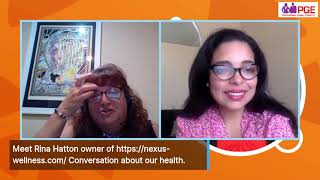
In this live YouTube interview, host Speaker A chats with Rina (Rina) Hatton, a health and lifestyle coach who grew up in a Hispanic family with a pharmacist mother who emphasized balanced meals and regular exercise. Rina explains how her cultural background shaped her approach to nutrition, describing creative twists on traditional dishes (e.g., broccoli slaw, salsa‑flavored vegetables) and discussing staple foods like rice and beans. She offers practical food advice, comparing potato varieties (red vs. russet vs. cassava), recommending preparation methods (roasting, steaming, minimal oil), and giving restaurant‑ordering tips (lean proteins, greens, avoiding heavy sauces). Rina outlines her coaching philosophy: a holistic “mind‑body‑spirit” model that begins with a comprehensive wellness vision questionnaire covering mental health, physical limitations, and spiritual/emotional connections. She emphasizes sustainable, individualized plans over fad diets, integrates energy work (Reiki), and tailors macronutrient ratios to sensitivities (gluten, dairy, animal protein). She shares client demographics (ages 38‑70) and success stories, such as helping her physician husband lose 20 lb and switch to grilled steak. The conversation also covers industry topics: the growing number of health coaches, the need for proper certification to obtain insurance reimbursement (mention of National Board of Health and Wellness), and the challenges of false‑claim marketing. Rina discusses how she helps clients navigate food sensitivities, choose organic produce, and understand seafood sourcing (wild‑caught vs. farm‑raised). Business‑related insights include her education (ASU health‑solution and human‑behavior degree), the role of SCORE mentorship (business‑plan development, pricing, and strategic planning with mentor Sheila Slick), upcoming local workshops (January in Ormond/Daytona covering nutrition fundamentals, vision‑boarding, and mission statements), and plans to write a book by May. She provides contact information (hattonrina@gmail.com) and mentions future website pricing updates. The interview ends with a brief promotion of SCORE’s Fast‑Track program and gratitude from both participants.
Chapters
be live right now, who knows, because the live is an interesting, oh, we're counting down, we are now live, good. Hi everyone. I'm not fancy with any fancy intro, so Rena knows this is no prep needed. Rena and I are actually meeting for the first time on Zoom, though I have seen Rena's beautiful face when she did the Big John Show with her SCORE mentor Sheila Slick, so that was fun. There was a lot of great pictures and I heard the whole interview, that was fantastic. You did a great job. So without further ado, Let me introduce Rena Hatton. And today we're talking about healthcare. So share with us, share with us. So, I mean, what did you do growing up? Like, how did you get into healthcare?
So my mother is a pharmacist and she always encouraged us to work out and eat healthy, even though we're Hispanic. But she forced us to make sure that we ate a well-balanced diet. And part of it was make sure we had the broccoli, the green beans, even though we're Latinos and Hispanic, you know, the rice and beans and, you know, but she makes sure we always ate healthy. And especially she used to make these beautiful smoothies all the time, you know. So when I married my husband, he was a, he's a Southern Mississippi boy. And I would be like, no, we need melon juice. And he'll be like, we don't drink that, Mina. And I'm like, no, we need melon juice. So that's the way my journey started with healthy lifestyle. My mom always bought us weights and bench presses and things to exercise all the time. So it was kind of the 3 of us doing exercise always, my 2 brothers and I. So it was kind of fun to do that.
Wait, so explain this. So you're saying the culture, this is so interesting. So while you're eating healthy and bringing healthy food to school, What does it look like for everyone else in your community?
They were like, what happened to the beans and the rice? Don't you guys eat that? And I'm like, yeah, we do, but mom picks broccoli today, so we have to eat them, you know? So she will make it differently because her broccoli was sautéed with onions and tomatoes and cilantro, you know? So I make it at home here sometimes, and they're like, what is that? That is not Yaki broccoli? No, no, no, this is Latino style, I will say, you know, and I fix it at home most of the time and they get surprised because I make even coleslaw, broccoli slaw salad, and my family loves it, you know, my friends love them, and I get very creative because that's the way I was raised with my mom, you know, making those kind of twists of eating healthy, you know, in different ways, you know.
I find this so fascinating because I, first of all, I never really gave it thought. And B, yes, you're right, when you think of someone from the, with an Hispanic background, that would be. But I never thought like rice and beans every single day. Are you saying that, that, that could be a staple every day? Wow. And nobody gets tired of rice and beans?
No, it's kind of like your french fries in American food, you know.
You're right, that's a good analogy.
Big potato, you know. Actually, the staple is rice and beans, and usually poor families will eat that, and that was— it's very nutritious, don't get me wrong, because it has the protein and the rice and the carbs, so that creates a very healthy way. But my mom always wanted to improve our health, so—
And she brought it up to you so you understood. I actually have a question for you, like cassava, right? That is— is that healthier than a regular baked potato or a regular potato?
It's almost the same thing. The only difference is now you have to ask— I'll ask you this question. Which potato is it? The red potato or the brown potato, russet potato? So the red potato is the same equivalent as a cassava. That's the difference of potato.
You know, I really, I really appreciate learning, A, and B, I recognize that I'm the worst. Like, I— so someone did bring up to me, Mary Ann had told me about the purple yams, the purple potatoes that you could get at Perrins Produce. We have Perrins here, and that is absolutely delicious, and that is really chock-full. But if she didn't mention to me, I'm 59 years old and I'm finally like learning about purple potatoes, like, that's crazy. So you just, let's just keep with the subject of potato, how there could be so many healthy potatoes and knowing what to eat, does taste get in the way? And is it okay if I'm eating a purple yam that I put actually like real, like Amish butter, which I'm addicted to now, Amish butter, like how do you make sure you're eating healthy and then not destroying it with all the other things that can go into it on top of it?
For me, I would roast, if you like your Irish butter, I'll make sure that your protein is lean and, you know, and make sure that you're not eating more carbs, you make sure you have like a healthy green, like a nice green bean or broccoli or asparagus, or a beautiful eggplant, you can add it to that. And you still can put your little bit of butter on it, and make sure everything else the way you prepare is completely different from, in a healthier way, in the sense don't fry it or overcook it with lots of oil, Just make sure you prepare it like roasted or baked or steamed, you know, a nice vegetable steamed, even grilled is delicious. Make sure you don't add too much oil when you're grilling your vegetables, you know?
So a lot of it seems like it's common sense, but I love the fact, so the reality is there's a ton of health coaches out there, right? There's just, I mean, you type in Google health coach and there's so many, but I love the fact that You really, you didn't just wake up one day and say, today I think I'm gonna just take a couple classes and I'm gonna become a health coach and put up my sign and go. You really, you're living this. So your mom taught you when you were younger, and then what happened? So now you get through high school, I wanna hear a little bit more about your, like how you started your business.
So I got married very young, and my husband is a physician, so we travel a lot in the world, United States, because he was doing his clinicals and things like that. So I waited for a very long time to get my degree. And then I, for a very long time, I struggled what I wanted to be when I grew up. And all of a sudden I hit 40 and I was like, I know what I want to grow up. I thought at first I was going to be a health psychologist and I'm like, no, that's not for me. So I switched to Arizona State University as a healthy lifestyle coach. Yeah. So I have a 4-year degree in health solution and human behavior. So we focus on the mind, the body, In the Spirit, and we focus on wellness and how we provide the— provide a wellness and intuitive way to find the healthier way of people eating, you know, and besides eating, you know, their physical activities, and there's some holistic ways of doing things, you know, and so that way we can find the root of the problem and find a smart way to eat better.
I love it. Were you— did you go to ASU online? I will tell you, I lived in Tucson, and ASU in downtown Tucson, it's, it's so fabulous. And I miss Tucson so much, and part of it is just having that beautiful campus and the wonderful students that just like were in your community. I absolutely love that. So fantastic. So did your husband reap the— like, where was he in his health and his health because he's, he's, you know, I know there's a lot on doctors and the beginning stages and the intern and doing the clinicals. So was he already eating healthy or did you help him by making sure that you were serving healthy food to help him to stay focused and energized?
That was a battle because he's so used to eating fried food and I'll be like, no, honey, how about we try not eating fried food? Bread everything out, you know. And I remember used to eating all that Southern food. It's delicious, don't get me wrong, but it's like I would get so many tummyaches and I couldn't understand it was because it was not my style of eating. So when I realized that it was part of it, I really cut it out at home. So he really, every time he would go, "Mom, Mina doesn't cook for me for Southern." And I'm like, "Honey, you can cook it for yourself, honey. We're very modern here." I love—
did he feel the energy though? Was he starting to feel better?
He lost about 20 pounds with me and then he kept it off, but, um, but now he prefers a grilled steak instead of a country-style steak with rice and gravy. So it's kind of nice to know that.
Wow, I love that, that you not only influence your husband, but now you are ready to influence all of us, which I think is so important. I was saying yesterday, I was interviewed for Consumer News Television, and I was saying that, you know, I have the COVID-20, maybe it's a COVID-25, I don't know. But like the freshman in college, like it definitely, and what is it like, Rita? It's the craziest thing because every night I'll say like, I'm done, I'm not eating again, that's it. Tomorrow I'm waking up, it's gonna be a new day for me. And then I wake up and I'm back to my same old habit. So how, so let's take me for instance, I'll be the guinea pig here. I come to you, I'm overweight, I can feel the chunkiness in my face, my clothes aren't fitting. It does affect me where I'm not comfortable with myself, so going out and doing things makes it more uncomfortable. When I see photos of myself, it's so disappointing and depressing. What would you say to me and how would you help me? What would be some of the steps that you would take?
So the first step, first step, I'll make sure that we do a wellness vision. So we go into a series of questions and find the root of the problem because it comes from, we need to find when it started and how we gonna move on because I have to look at your mental health, where you are, and make sure that is nothing like it, that you might need more besides coaching. I need to make sure that is, I could deal with your mental health. And then we have to look at your physical, what if you have chronic disease, if you have any disability issues that makes you not improve your physical activities, you know. And then we have to look at your spirituality. Are you emotionally emotionally connected with your loved one? Are you emotionally connected with yourself? So all those 3 compartments, I take a look with questions and we have a really nice conversation like we're doing right now, a very friendly and nice conversation. And then somehow at the end of those questionnaire, you and I will become best friends, okay? I'm telling you right now. And then we were like, oh, Rena, there it is. There's the problem. You find it, you find your answer why it's keeping you from having a healthier lifestyle. And it's like, and then we work together, we meet once, once a week, and then I provide whatever you need. If you need to provide, if I need to provide for you, let's say a fitness plan, I'll prepare it for you and I'll make sure it's according to your fitness ability and whatever is going on in that time. And then we'll do some energy work, which is the a spiritual part of the work that we do together. That way we can get balanced and align the whole body instead of focusing, oh, let's go work out, let's push it, push it. No, I don't believe in that model. I believe in a well-balanced lifestyle, not just focusing one little area. Oh, this is what it is. We're going to tackle exercise. Have you heard the intermittent diet and the keto diet? Everybody's, yeah, yeah. Is that sustainable? Not really. It's not really sustainable. Sustainable. So we'll find ways that is sustainable, that way you can reach your goal.
I love this. I really, I have to say a couple things. One is that I think that's brilliant, like exactly how you sit down, because I actually do have, I have a sponge kidney disease, which is kind of rare, but I'm not like, I can't, I gotta be careful with oxalates and too much protein. So that makes it difficult for me. Second, I really enjoy eating out, so I— and I do not really enjoy cooking, though I do it. I made a really killer chili yesterday that I thought was very healthy, and, you know, made sure to me that all the ingredients were fresh. But I also really like and enjoy— going out is not just going out about the meal, it's like just being served and the whole thing. So what do you suggest when someone says, well, I really don't love the kitchen, Is there a way to work with going out to eat and how to make that a healthy lifestyle?
Yeah, I do always make sure that I mention to my clients that when you're serving, if you're going to a restaurant, look the most healthiest possible thing on the plate. For example, if you're going to have a grilled steak or grilled chicken or grilled fish, you know, I would suggest for you to make sure you have a green salad first and then some kind of green vegetables and avoid that butter, that heavy butter, that sour cream and the baked potato or the French fries. I will order actually some kind of rice for yourself because that way rice normally is not so much fat on it and not so much, you know, because come on, when you eat a baked potato, what happens? You're loaded, but bacon, sour cream, and butter, there it is, you know. So the whole healthy eating is down to the toilet. So to avoid that, I always ask, oh, maybe you'll have a sweet potato, you know, make sure you tell the person, don't give me cinnamon or butter. You know?
So unfair, Rita. But honestly, you kind of brought up the toilet and really there is this balance between eating right and then not feeling well afterwards. And I think you get to the point. So at 59, I'm finally also saying, oh my gosh, I love that. You know what, my stomach is not feeling good, or I'm not doing really well anymore, or I feel like— it's funny, I remember my mom almost becoming lactose intolerant in her late 50s, and I noticed that the same thing for me now. So do we keep an eye out for our bodies changing? And I'm gonna ask one more question on top of that just while we're doing this. Your body's changing, and what about our blood type? Does that play into anything?
I'm curious about that too. Does play, and also plays what cycle of life you're in. So for example, I'm going through menopause, so I'm now sensitive to gluten, you know? So it's like I can't have gluten, but that's the new fad. But the thing is, I did get tested and I am sensitive to gluten. I do not have celiac, so you have to eat according to that. So when I have a salad, I make sure I say, please can I have olive oil and vinegar? I cannot have no kind of salad dressings because you don't know how it was prepared. You know, some salad dressing has gluten. So like with you with dairy, now we have to focus on your GI, how is working your GI and why is that, you know? So most of the time when you have a sensitivity, we try to find substitution how to eat better.
So Rita, let's, let's, let's place the blame. Let's have a fun game. Let's place the blame on our government. Let's just say, why is it that we can have— why is our country allowed to have the food dyes and, and some of the things that are being put into the food and GMOs while— so we have that whole problem with with the food and how it is actually what's inside of it and the processed food and all of that. But yet we don't also offer insurance for preventative healthcare, right? So that if I was going to see you and all of a sudden, next thing you know, I lose weight, I'm no longer on blood pressure medicine, which I'm not anymore, by the way, no longer on blood pressure medicine. I now I'm no longer diabetic. Like, so, but yet that's not covered by insurance, or is it? Are there any insurances that are now saying, you know what, we'll get you a health coach and we'll pay for it because we want to be preventative?
Yeah, actually there are a few insurance, they're starting to pay, um, health coaches. Ah, but you have to have some, uh, some certifications. Like, I, I will be sitting on the board of the National Board of Health and Wellness, uh, in next year, into 20 2022. So that would be give me credential for me to be able to get insurance. And there are, I think, 2 or 3 companies that are providing health coaches payment on it. That way my clients could come and see me, you know.
So yes, I think that's so important. And then what do you think that we should be doing? Should we be fighting more to try to change rulings regarding our food?
I think so, I think we should start fighting for that because all these chemicals is not healthy, you know, and we get to this runt, you know, I have a, recently I had a client who came for energy healing for me, just energy healing, and then I'm like, you know what, it's not about your energy, your energy is fine, it's about your input intake, and I asked her to give me a journal or meal, on the daily meal, what she eats. And then I realized that she was having a Diet Coke. So for her, that was healthy. It was supposed to be Diet Coke. And I told her, you know what, why don't you go buy— this is free propaganda, even though I don't like drinking soda, but I'll put it out there. If you want to drink Diet Coke, don't drink diet. Go drink Pepsi, the real sugar one that is available now. If you have to have a soda, unhealthy, but the point is that we do need to fight. We need to fight and start providing healthier choices in our home, like exactly like my parents taught me, especially my mom. So, yes.
I love that. So actually, I think back on Michelle Obama, who did such a wonderful job making sure in the school systems getting rid of the crappy food and getting rid of the soda machines and really putting an eye on it. So it just shows you that there, you know, there are changes to be made, but also it's easier to be lazy. You know, I will tell you, you know, I got my vaccination and I'm looking to get my booster shot, but I've always understood when someone says, you know, I don't, I don't, I'm not, you know, I don't want to put a vaccination in. I, you know, I watch everything that I put in because that, that does make sense. To me as far as if, if I was such a clean person, I ate clean and I watched everything that went into my mouth, maybe then I would say the vaccine wouldn't be for me because I'm so clean. But I feel like I would be totally— what is it called— a hypocrite if I was to be like, I would— I, I mean, I, I put everything in my mouth. I really don't think twice. As a matter of fact, I take this, I do this, um drink which I love. It's Passion for Life liquid vitamins and minerals. I do an ounce a day. It's a drink. I shake it. I actually like the taste. I've been doing it for 4 months now and the last time I went to the doctor, she said, "Your blood pressure is fine." And then they had me go back and it was fine and I test it every day on my smartwatch and somehow it's either working for me— like that's the thing, you really wonder, but why would it all of a sudden my blood pressure be normal. And I'm thinking, could it be? This one has 135 minerals and vitamins. I'm not trying to push it. I don't, you know, get anything, but I, I absolutely love it. I think my parents— my parents both lived to 90. They would take that cup of all kinds of vitamins. So I, so I guess I'm trying to say regarding the vaccinations, and that, not to make this political, but I could understand if you really are eating clean and watching everything that you wouldn't want something in your body that you don't know. But for the average person Really, what do we know? I mean, you could read the labels, but we still don't know what's going in our system. What do you look at when you're doing something? Do you, like, do you look at the— you look at all the labels and everything? Like, how clean are you?
I could say I am 75% clean. Okay, I stay away. I go to the outskirts of the grocery. I don't go in the middle of the rows of the grocery. I try my best not to do that because that's where the healthy not option is. And then you have to learn what plants, what vegetables are organic, it's beneficial for you, and what plants are not organic. I know there's controversy about that, you know, and then you have to learn your seafood, you know, it's like what is a top feeder and what is a bottom feeder fish, you know, so it's like salmon, let's put salmon, salmon up there, okay? A farm-raised salmon is a bottom feeder. So when it's farmed, all the pesticides, all the yucky stuff is at the bottom of the ocean. So the salmon is going to get sick. Maybe sometimes they might carry lice, you know? So you don't want that kind of fish, you know? But then again, if you get a catfish, you want it to be farm-raised because its bottom is top feeder. So when they sprinkle that food, they will eat on top. So if it's in the wild-caught, then think about it, the cruise ship and the waste that sometimes you're not supposed to do in the ocean is throw out there, then you want the catfish that is farm-raised, not the salmon, you want it wild-caught because it's bottom feeder. So you see the difference? So you have to learn those kind of tricks. And this is where I come in and we educate you and I talk to you about the difference those kind of way, that way you become healthier, you know.
I love that, Rena. It really is important. I hope you like have a show. I want to hear more about your business. I want to bring up one other point that I noticed right now, that I— my daughter got me into TikTok and like the Reels now and the whole thing, but a lot of them are— a lot of them will show people cooking, but they're like the 2 ingredients or 3 ingredients, which I'm like, I love the 2-ingredient recipes. But they're usually not healthy. I mean, it's putting, you know, sweet condensed milk in with this, and then you got this thing. Or I, I had one, um, it was the— there was the angel food cake with lemon pie filling and how she made. I'm like, oh, that looks so amazing. But I don't see them doing a lot of healthy. There is— so you've got a lot of now being pushed out besides TV ads and all of that. Now we've got the push out regarding videos that show unhealthy food. So how do you— so what are your thoughts to make sure that we combat it? How are you like really pushing it out for healthy food? And then when someone's working with you, you gave us like kind of the overall, um, do you have products that are for sale too? And I just want to get a more juicier description of working with you and what that would look like and feel like. Are you tracking? Are they— are you— am I measuring every body part so that I could see if that goes down like a Weight Watchers? Like, what does your program look like?
Kind of like a meal plan. So I'll give you what is your macro, your proteins, you know, and I will label each thing, you know, what kind of vegetable you're going to eat and what kind of protein you're going to eat. Like, you, you're sensitive to, I would think, animal protein. That's what you said. So I will make sure that your proteins are more based plant-based instead of animal protein. That way you become— you have the energy and more focus and more clarity for yourself. And then Each person is different, so I cannot say, oh, you're just going to eat protein and this 30% of fiber. It all depends. Some people are not gluten sensitive, so then I could push a little pasta and things like that. I don't sell products. I focus to educate my clients how to balance the food, how to balance your food in the sense the whole plate. I usually tell them, You have to eat 80% of plant-based vegetables and fruits, you know, and then the rest of it is just a little bit of animal protein.
Got it. And then what about a little bit of fun?
And I'll teach you how to do beautiful chocolate, malt chocolate cake and things like that. I'll give you all that, you know, and you mix it with almond flour with regular flour if you're not gluten-free. Sensitive with chocolate. That way you have a little bit of protein, but you still have the fun, you know.
And yeah, what do you think about the before and after photos that a lot of—
sometimes I wonder how sustainable is that diet. Honestly, I do. I always wonder because I have a friend who did the diet, the FAB diet, and she lost a lot of weight, about 60 pounds, and then she gained it back. And she became— and she actually became during that time really sick. And it was the time of COVID so she even got COVID. So her immune really got destroyed. Me, it's not like I'm going to lose 60 pounds in 3 months. No, you're going to lose 60 pounds in about minimum 6 weeks, 6 months, up to a year.
Rita, I give you credit for getting into this field because it's not really an easy field to get into. And I'm really saying that out loud because you have so many people that, that, you know, read a couple YouTube videos and they say, I'm going to become a health coach, or they, you know, drink this water, it'll get you, you know, knock out your COVID or whatever it may be. Like, there's just so many people out there that especially during COVID were trying to push. I think the government was doing a fairly good job of really like shutting down anyone that was making false claims. It does seem that we stay on top of that with the, uh, with the FDA, I think it is, to like You can't have false claims. Have you— and then I've also seen other people saying, get on this diet, it'll cure you of cancer, it'll stop your diabetes. But they won't get any of that. You're not gonna get false promises with you.
Healthier weight and is sustainable for you and your lifestyle. In that particular, like, ah, we're gonna do this plan, you're gonna lose 30 pounds. Yeah, but I— how healthy are you going to be at, at the end of the road, you know? Because my focus is for you to be healthy. I'm asthmatic. I have a chronic disease, asthma, and I'm telling you, when you do those crazy diets, the first thing I get, I do, I have respiratory issues.
Wow. I had no idea that. I also noticed too that a lot of this, I love that it's a mindset. So, you know, because when you're younger, for me it was, I could, I could gain weight and lose weight really quickly. And then all of a sudden the age hits 59. It's like, It's not going away and it's getting worse and I'm hungry in the middle of the night. So I love it. So working with you, what else would like— so someone, can they reach you?
Tell—
I've got to put your website here. What do you have on your website and do you have different prices? Is it customized for the person you're working on?
So that's the old, um, way. Right now I have personal training and nutrition and, uh, and now Reiki. Because I do Reiki. So I'm about to invest on my website, so I'm going to start putting pricing and all that good stuff, you know. So I just graduated from school in June.
Yay!
So it's been really fun. So I kind of forgot about my website, but they could contact me in there. They should— there should be an email there, but if they cannot find me, they could find me at hattonrina@gmail.com. Yeah, Hatton is spelled H-A-T-T-O-N and then Rina, R-I-N-A, at gmail.com. And that way you can communicate with me anytime you want and we can talk about how we can have a healthier life, you know, healthier lifestyle.
I love it, Rena. And Rita, I just gotta take a few minutes now. Let's just talk about SCORE because I love it. You're a SCORE client. At what point did you realize, hey, I should connect with— so what happened after that?
People who were in my same like-minded space, you know, uh, because sometimes you'll hear, oh, if you do this, this is the way you start. But then I'm like, I'm not the typical health coach. I am actually a very educated health coach. And yes, there will be debates about that. So I found Sheila Slick, and Sheila has really taught me every little details, how to price certain things, how to do a business plan, because that was one of the things I was like, what is the business? And finally she goes, you know, you have a business plan already. I'm like, I do? And then I was like, it was kind of fun because at the same time she was teaching me the right way to do the business plan, even though she said I had one. But it was fun with her hanging I say hanging around because she really educated me a whole lot with SCORE. And she was like, you're on the right path. Now let's talk about it in a sense, if you lose this amount of money and how you're going to recuperate with things and how much it's going to charge and how much you're worth. So it was kind of fun to see that side of SCORE.
I love that. We're so blessed to have Sheila just come to us, and she's so incredible, and our webmaster now. And, you know, I totally appreciate it because Sheila's, Sheila's treasure of her time is so lovely that she is able to, you know, share her knowledge. And especially in this day and age where if you were to, you know, throw on Facebook, I need some help with my business plan, you'd get a lot of help. Of course, it cost you who knows how much money, and SCORE never wanted that to happen. SCORE really is zero— SCORE cares. And SCORE said, you know what, 55 years ago when SCORE started, about that, that SCORE said, let's make sure that we will offer this at no charge and have all the resources on our website, score.org, which is like an onion, peel it back. But I'm saying that because in this day and age, there's so many people pivoting during the great resignation that they call it, and going into health coaching, you know, and going into business. And they, you know, I mean, I've seen, I've seen someone, you know, in their 20s saying, I'll do a business plan for you for $1,000. And that's great. But that, we know that some of what SCORE offers, it's really the, that all that information, the education and experience combined. They're just not watching a YouTube video, getting a couple templates and telling you what to do. Our SCORE mentors are experienced. I just wanted to do a shout out because A, we're so blessed to have Sheila, and B, you're really a live example of how— So you would either— What would you have done if you didn't ask for help?
I downloaded that business template and I kept getting lost. And I'm like, what do you mean a loss profit and gross? And I was so confused even though I did personal training for years, you know? And I was like, I'm like, what is that? So finally, when Sheila taught me, it was like, oh, I had a rude awakening. I'm like, oh, I know what I did wrong. And the beauty part is that she aligns my business, what I really want to be, and her expertise. And that was the beauty of SCORE with her mentoring with SCORE. And because it was like, sometimes somebody offered me, oh, I'll pay, $1,000, you say, and then sometimes you get stuff that you're not, it's not exactly in your head what you really want in your business. I wanted to be a more people approach, more personal instead of just, look, if you do the keto diet, you're going to look, we can do that, but that's not healthy. Keto is for autoimmune issues and sometimes it's not for that. Score, that's what it brought me to more clear focus because it's hard to speak it out and put into words what you really— for your service to be. And she was able to tap on that and educate me and now put it on paper and make it into a service.
I love that. I'm going to whisper this so nobody else hears because I don't want anyone to hear this, but Sheila is our Mentor of the Month for November. She's killing it, we just love, love Sheila. All right, so it's so wonderful talking to you. I think that there's so much conversation. I wanna just make one more point. What I love about you, Rena, is that you are, you're selling what you know and your education and your brain. I actually kinda like the fact that you're not trying to also on top of it sell a whole line of food. So it's not like work with me and then, but I need you, before you work with me, I need you to pay and have all of these products here And you know, you can't— so you have to think about that when you're looking at a health coach. Do you want a health coach that maybe has— is also selling product behind it? Or someone like Sheila— I mean, someone like Rena who's really literally looking at your, your mind, body, and spirit, if I can say that correctly. Is that right? I think that's huge, Rena. I think that's really big in your marketing. But if someone is selling that, then they need to market that and be strong and proud of that too. There's nothing wrong with anything. I'm just saying what I like is the fact that you are mind, body, spirit, and you're not trying to sell me anything. I think that that for me would be a fantastic, you know, health coach to have. So how old is your youngest client for a health coach and how old is your oldest?
My youngest client is 38 and my oldest is 70 years old.
Oh, I love that. I've noticed women, by the way, looking so beautiful. Rose, we actually, we have one of our coaches, Rose, I won't tell your age, but my God, she looks like 25 years younger than her real age. So I— you really could see, look at even you, you can really see how beautiful, right? Because what we're eating on the inside comes out on the outside.
Absolutely. Yes.
So I'm so glad you're a client. I'm so glad you're a new friend of mine now. I'm so glad you did the Big John Show. I'm happy to have this out here. I will promote this show. And thank you so much, Rena, for your time. Okay, so someone— so we're gonna have all the information and the phone number to reach you on the bottom when I post this on YouTube. You're here. Do you have any other plans? Are you going to be writing a book? Are you doing a podcast? What are some of your marketing plans?
In January, I'm going to be doing in Ormond and Daytona area a lot of workshops. That way people start knowing me, who— what I actually do as a coach, you know. So we're going to do a mission statement. We're going to do a vision board. We're going to do Human Nutrition 101 from the basic and all the way to the expertise size. So those are my plans for January, and then hopefully by May I might write a book.
Oh, I love it. Excellent plans. And by the way, just one more little promotion. I just want to talk about the City of Ormond Beach with the Executive Development Director, Brian Rademacher. Did I say He is the— I think I got his name right, whatever. And so Brian and the City of Ormond Beach and SCORE were teaming together to bring the Fast Track program, which is a 10-week program. So we're just graduating the class we have now. And actually Saturday they will present their business plan and executive summary after 10 full weeks, 30 hours. So it's a big program. We're going to do it again in the spring. And we so far, we've already graduated one class. Last spring. So when people say, well, I could just do a business plan and get it together, but here's an example of 22 to 24 entrepreneurs that really took their time every week to go over each aspect. So it's not as easy. So I'm glad you had Sheila helping you. Business plan is moving and flowing. It's so important. SCORE is here to help you. And Rita, it's been so lovely to meet you. Thank you so much for your time today. I appreciate it.
Thank you for for, for the interview. I appreciate it too.
Oh my gosh, my pleasure, my pleasure. No prep needed. Reena and I just met right now. We did not discuss anything. So thank you all for watching, and I'm going to end it now. Thanks, Reena, you've been wonderful.










