Let's Meet Dr. Kristen Williamson
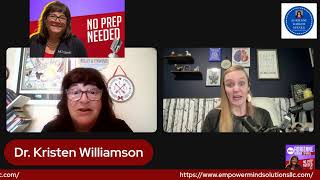
In this informal, conversational interview, host Adrienne Barker, MAS, talks with Dr. Kristen Williamson, a licensed professional counselor and neurodivergence advocate, about autism and related neurodivergent conditions. Dr. Williamson explains why a diagnosis can feel like releasing a held breath, outlines how Asperger’s was folded into the DSM‑5 autism spectrum, and discusses why women and people of color are often diagnosed later due to gender‑biased criteria. She shares personal experience of being diagnosed at 39, describes how masking exhausts neurodivergent brains, and details sensory‑based supports (vestibular, proprioceptive, pragmatic speech, occupational therapy) that helped her daughter Alana. The conversation moves to school accommodations (IEPs, 504 plans), teacher challenges, workplace accommodations, and the need for corporate training on neurodiversity. Dr. Williamson also explains neurobiological differences such as reduced synaptic pruning, and advocates for self‑advocacy, reducing shame, and using tools like ChatGPT for clarification. The interview ends with practical resources, her social‑media presence, and a call for broader acceptance and understanding of neurodivergent people.
Chapters
Okay, we are live with a dog barking in the background. So I can't say I don't know Dr. Williamson, but I'll tell you what a little bit I know. Very smart, absolutely beautiful in person, because we met at CreativeCon, which was amazing, and we were sitting together. And I— was I speaking and you took pictures of me?
Oh, you were? Yeah.
Okay. So you got the pic. Oh yeah. Cause I danced on stage and then—
yes, you did.
But anyway, so I am very interested in all that you have to say. And I know you were giving me some helpful tips, so you're not 100% no prep needed. Well, I actually didn't do any work in asking you questions, but what I do want to say is that I'm really excited to have you here. I was not doing that great. I'm going to tell the dog to stop it. And you introduce yourself to the audience of, I think I have like 2 or 3 people that watch me.
That's fantastic. I love the 2 or 3 people that watch you. My name is Dr. Kristen Williamson. You can just call me Kristen. I am a licensed professional counselor in the big old state of Texas. Although I work virtually most of the time, I'm licensed, lucky enough, in a couple of different states. And I work with clients who over time has migrated to mostly adults who are late diagnosed autism or ADHD, somewhere on the neurospicy spectrum. Or parents who are coming in because their kids have gotten diagnosed and they're saying, "You know what? I actually think that this might be me. I do a lot of these things." And so they come to me to kind of rewrite their narrative of how their life has been going and to say that there's not anything wrong with me. My brain is just different and it works on a different pathway and with all that I have been able to do as a therapist, I've started coming in and branching out and becoming a louder voice for the autism world and coming in and just doing a lot of advocacy.
Do you remember what I asked you? No. Okay. That's okay. I think I had asked you about how, how important is it to have a diagnosis?
You did ask me that, and you know, and I'm hopeful that my answer did not change to my answer today. And you know what, it's always evolving and ebbing and flowing. And I don't know that any adult needs a diagnosis, but I tell you what, having the diagnosis is almost like you get to let go of a breath you didn't realize you were holding, and it gives a little bit more of guidance and pathways to say, you know what, I was struggling in school, I do have sensory sensitivities, or I get overwhelmed really easily. That doesn't mean that I'm failing. It doesn't mean I'm failing as a mom, as a parent, as a human, or a worker at whatever place they work at.
They're just saying, you did say that. So you're, you know, you didn't, you didn't change. So what happened to the term Asperger's?
It got moved into the DSM-5, Statistical Manual 5. It's the manual that all clinicians use and psychiatrists and psychologists, and it's how it matches the criteria, gives the criteria for getting a diagnosis. And with Asperger's, we were learning that once people hit 18, they were no longer qualifying for autism services. And with Asperger's, because it is a variation of autism spectrum disorder, that they lumped it into one. So that way, the people who were getting assistance before— and this is to my knowledge of it— and so the people who were getting assistance before, especially once they turn 18, they still qualified for assistance.
Oh, so when you— you mean as an adult? Oh, interesting, interesting. I was, I was sharing, and, and I think a lot— my daughter is fine with me sharing this, I'm sure— is when she was younger, I heard a lot, you know, she has Asperger's. She didn't speak till she was about 6. I brought her— I'll never forget, she's so cute— I brought her into the doctor, and she sat there on the floor and there was a big box of toys, and Alana had no interest in looking in the box of toys, and she just sat there and listened. And the woman's like, well, why are you here? And I'm like, well, my daughter doesn't speak. And she's like, well, does she speak at home? And I'm like, oh yeah, 100%. And then she said, and she's how old? And I'm like, she's going to 6. And she's like, you need to wait another year or two, like it's still too early. But there were a few things that I recognized with Alana. Like I noticed that when, um, if people approached her too fast, like rushing up, hi Alana, here's a coloring book and I need you to— that would be it. And also what I realized, that she was always playing with the salt and the pepper, the sugar packets. I just naturally, which I think like every mother would do, I just, before we sat down, I just moved everything over to another table and took it away from her so that she didn't have that distraction, and then everything was fine. And You know, but like, what are some of the things that— at first I don't even know if that was the right thing to do. And, you know, what do parents do? Like, what, what is it? Well, how— tell— first of all, tell us what you're a doctor of, because I— we got to go start— go back from the beginning.
Fair enough. I have my doctorate in behavioral health management, and then I have a master's in— I have one master's in clinical psychology and one in counseling psychology. And it really— I only had to get both because Texas didn't tell me that I needed to have more classes in order to become a professional counselor. So I ended up getting both degrees in order to make sure that I had all my courses covered.
Oh, I love that.
It's not anything like, yay, I'm fancy, I've got two degrees.
No, no, no.
It's I needed both of them in order to have the course limit for—
actually, let's go backwards. So, so nowadays when you have a child, that there's a certain age where that child goes through testing, because I remember Alana was sticking pencils and poking, and I called my doctor and I'm like, her doctor, and I said, I don't think my daughter has empathy. And you know what he said to me? He said, get dressed and come in right now. And I was like, wow, he took it seriously. And he was a cool doctor. He would wear like the jeans and a regular t-shirt.
Awesome.
Never wore the white coat, always was comfortable. And then that's where he said, okay, let's have you start to fill out paperwork. And, uh, but it was hard because how she was at home was so different.
Very, very different.
Everyone else— okay, I'm gonna let you talk because I want to be quiet now. I want to listen.
No, I love it when you talk because it pings ideas for— I can say this. So with Autism Now, they are having assessments that you can get for as young as 18 months. Those are definitely, um, kiddos, I would say, that have maybe higher support needs. So instead of Asperger's, they've moved everything into autism spectrum disorder, but it used to be we would say low functioning or high functioning. That's not anything that's true because where I might be low functioning in certain areas, I am very high functioning in other areas. I should also preface this for anybody who's watching and/or listening that I have been diagnosed on the spectrum and ADHD. So I can come in with my personal experience along with the clinical experience of it. I did not get diagnosed until I was 39. Wow. Because females don't hit the criteria. The criteria was created for male cisgendered Caucasians of— oh, Caucasian cisgendered males of affluence. So think of it with women, if we're not meeting the criteria of 8-year-old white boys, we are not seen. People of color, if you are not— if you are meeting that criteria, is the bias coming in for something else? For women, and I'm actually writing a book on this, it's taking far too long to write this book. It is for late-diagnosed neurodivergent women, and to see that almost from coming out the womb, we've been taught smile, look pretty, don't cause a ruckus, you need to be quiet, you need to be okay to appease all of those around you. So the social normative behaviors we were taught because we can mask really, really, really well. And that means that where we might struggle at home, it doesn't show outside the house. Where we have the ADHD, that, oh, that the masking of we want to bounce off the wall, we want to talk, or we are in our head and daydreaming and not thinking about anything, but we have to suck it up and push it down. And then we come home and just melt down because we've been dealing with such sensory overwhelm and masking for so long throughout the day that a lot of kids will come home and just completely fall apart. And then parents will say, what do we do? You're falling apart at home, but teachers say you're doing fine. You're making A's or B's. How, how is this dichotomous thing happening? And then parents are consistently feeling like they're failing because they don't know how to help their kids. And thankfully, we have a lot more awareness now than we did 15 years ago, 20 years ago, 30 years ago.
So, so first of all, something you said made me think to myself, this question, I still want to go back and get the, like, talk about like, how is the diagnosis for an 18-month-old? But sometimes, like, I remember like thinking someone would say that they're an introvert, and by the time that they have the day, they come home and they're exhausted. It was all so that they were able to, aka, function, but then it would be exhausting. But could that have been that some people that maybe feel that they're introverted or, or, you know, um, socially awkward, which does happen to me, anxiety, all of that, like, it is it, right? I mean, like, there seems like— is that under the umbrella? So I—
it all really depends on who you ask. A lot of people come in and say, well, everybody is sort of neurodivergent. And yes, it is the idea that we have a spectrum, or do we— we have a spectrum with being on the spectrum, and it all depends on so many factors in life. With the, the anxiety, the social anxiety, is it— where are you feeling awkward at? The introverts, oh my gosh, I I hear more people consider themselves introverted extroverts in I can be drained in a group of people. My battery is just depleted or an Uber driver is having small talk conversation that just drains the battery. But when you're in a space where you like stuff like this, it's equally draining and exhilarating because it's something that I'm passionate and I love. And it's talking about all these fun things and meeting new people, but it's putting out energy, which you have to then watch yourself to see, okay, is this depleting? Is this— are we doing okay? Have we met our needs? And with the 18-month-old, it's because that is around the time in which our progress starts regressing, where you may have found that you can you were learning and learning words, you were speaking, you were doing all these things, but then it stops at a certain level, and then you start regressing. And that's where doctors come in and start assessing the behaviors.
So is it really— so what does that look like for the assessment? For, for me, it was a lot of papers to fill out, just like it felt like a big questionnaire that never ended. It was miles long. Is that— so is it, is it the testing of the child too, looking in the eyes, like, you know, yes, Oh my gosh, the looking in the eyes.
Are you walking on your toes? When you play with toys, do you line them up? Do you color coordinate the crayons? Do you organize cars in a row? Are you able to engage in imaginary play? Can you come in and connect with other people? If someone calls your name, do you meet their eyes? Do you look when someone calls your name? And for women, and I have I have now read probably just about 200 research papers just on women and autism, and so much is coming across that predominantly we are diagnosed first with anxiety or with depression. They don't immediately go into neurodivergence unless you come in very specifically with I, I can only attribute it to behaviors such as in the movie Rain Man. The, oh look, you're just a savant, you were this or this, or need to be in levels of group homes. Like something that's very much pinging, this is not normal for female behavior.
So, okay, so that's where the, the spectrum is just that it could be across— I mean, it is so long.
There are extremes on both sides. With me coming in, I have a doctorate, I'm able to hold a job, I'm able to come in and I'd say articulate fairly okay, but I also notice with my cadence of speech, I will talk and then stop and then talk and then stop and sometimes I have to figure out what my words are because it's like my brain is buffering trying to figure out the scripts that are almost pre- prepared in my head ahead of time. So with your kiddo, if someone came up to her and caught her off guard and said something, I wonder if she would then just completely fall apart because she didn't know what to say. Or for you, if you have those moments of someone says, oh, and it's something that you were absolutely not expecting, do you just immediately jump in and go with it? That's my ADHD brains. They can just go. But my autism brains come in with more cognitive rigidity, and they have a harder time having those connections and process quicker.
So the history of autism, so when did that diagnose, what was the term autism?
Oh, I'm so glad you asked this. I was looking into the history of it recently because April is Autism Awareness Month, which is, it's great to bring in the awareness and now we are bringing in the the acceptance on top of the awareness, which is where we're coming to. Anyway, that's it. So between the 1910s, 1940s, that is when they had it almost pinned as childhood schizophrenia because they had no idea what autism was. So they're like, okay, yeah, no, this is schizophrenic behavior. We understand what schizophrenia looks like. We didn't know that this is autism and I think his name was Hans Asperger in the 1940s, did a lot of— well, he did a lot of sciencing out brains, but he was not— he was a part of the— I believe he was part of the Nazi Party and so a lot of people don't necessarily like to associate Asperger Anymore, but we still say it, we understand what it means. And so he studied in the Germany side, he was studying children with autism-like behaviors, and I think that's where he really kind of coined the name. But also in America, they had, um, Dr. Leo Kanner came in and he was studying at Johns Hopkins, and he was really able to push it on our side. I think around the 1950s, they were— they blamed the moms. They called us refrigerator moms because we were really cold. And they're like, well, a mom's coldness is the reason why their kids are autistic, because they can't be warm and welcoming. And I'm like, well, doesn't that mean that they're probably on the spectrum themselves?
Well, as you saw my face, guys, I— if you're watching, listening, I'm like, my mouth is just dropped. I don't— I'm just like staring and just like amazed. Keep going because I, I'm like, wow, that's— wow, I never even knew that.
The refrigerated moms, the refrigerator, because we were cold, we were lacking the maternal warmth that causes the autism. Um, I— one of, one of my favorite humans to learn about, her name is Dr. Temple Grandin, I believe. Almost said Temperance Brennan from the show Bones, but that's not the right person. Dr. Temple Grandin, she was diagnosed, I believe, in the '50s, and she has been an advocate basically her entire life of what autism looks like and how it's— her brain thinks in pictures, it doesn't think in words. And so she's able to almost like 3D image everything in her brain. More than she can find words, she can find these images. And that makes her really good at what she does.
That is really interesting. So wait, let's go back and just explain neurodivergent.
Neurodivergent is— I want to say just that our brains are divergent. Our brains think different. Our brains work in different pathways. They are developmentally different. Oh, one of the coolest things I read was a research article that came out in, I think, 2014 that talks about our brain synapses. It— whenever we are born, we have a certain amount of synapses in our brains that kind of help us learn to process different things. And as we get older, growing into adolescence, our brain starts pruning them. Think of a rose and like pruning off the leaves so that way we can get to point A to Z way like straightforward. For a neurotypical brain, they prune upwards of 50% of these synapses. But for a neurodivergent brain, our brains, we tend to prune only about 16%. So think about that. A rose with only 1 or 2 leaves on it, you can get from the stem to the smelly good part way quicker. For our brains, we have rows and rows of leaves that we have to go up and down every one in order to process different things.
Oh, that's a good way to explain it. Oh, so, so, um, when they study the actual brain inside of our skull, does it look different?
It can in different areas. And this is where I wish we had the ability to measure our brains. I would get my brain measured in every capacity that I could because it's like, I want to look at my brain. This is awesome. I know more about this because, uh, Temple Grandin's book, she talks about A lot of people just wanted to measure her brain, and she was like, cool, I can understand that. Let's go see what my brain looks like. And they found that parts of her brain are more developed. I think like her amygdala is bigger or smaller or different areas where we process things, and other neurodivergent brains are too. And that's where some people can come in with the easier ability for speech and where some can't.
All right, I have a question that I've been dying to ask. Teachers, okay, so you're a teacher and you've got 24 kids in your room. They're all like, how? So they're all different. And so one of the things with my daughter— don't be mad at me, Alana, um, but I, I, I mainstreamed her because, because she was able to be mainstream. She was able to do the work. She worked harder than anyone else, but she did it. Uh, perfectionism was something that she had that was tougher for her. Like she had some different things, but I couldn't see having her out of the class. That didn't make sense. My son Rudy had speech for a few years, and it was always like taking out of the class and then bringing back in. And then like all of that just seemed like so messy and hard and you're learning. And now when I talked to my daughter, she said, yeah, like she, you know, just having to leave and then they're open to bullying and other kids. So how does a teacher really handle that? When I was the child that I liked to watch a video, and even nowadays I have a hard time with understanding. My daughter has dyscalculia, and I think that maybe I have a little bit of it too. I have a hard time with math, always had a hard time with that. Now, like the whole market and the stock, no matter how many times people try to explain to me like I'm a 5-year-old, it's still difficult for me to really understand And yet, you know, I was only a C student because I didn't learn the way I wanted to learn. Like, if you— if they went up and did skits and taught me things in a fun way, I will learn everything. And that is why, honestly, when I teach, I teach with a lot of humor because that's how I learn. And so I'm sure that some other people are like, my God, just can you be serious for 5 minutes, Adrienne? And I can, but I don't.
I don't want to. Also, life is too short for being serious all the time. And I will tell you my answer for the teachers. I don't have a good answer. These teachers, they don't get the amount of help that they need with the administration coming in and say a kiddo is having a meltdown and they need to teach these 30 other kids, but they have this one that might really be like overwhelmed with sensory or just their— my now 15-year-old, and thankfully he doesn't listen to these, so he doesn't know how much I talk to him, I talk about him. He was diagnosed at 8, and this poor kid couldn't sit next to the kids who were aggressive erasers of their papers because it would set his central nervous system on fire and he couldn't tune it out. And so then he would go into getting really frustrated because he didn't have the words to say, I'm getting overwhelmed. And so the teacher would just see his frustration and think, oh, what a tough kid. Now I have to teach with this tough kid.
Oh my gosh, I—
oh, I am really grateful that I was able to come into this pathway and I was like, he is diagnosed, yes, I have a pathway, I can do this, let's learn everything about it. Not every parent steps into that as easily, and the stigma is getting reduced and that shame is getting reduced, and that's why I want to come out here and scream as loud as I can that there's nothing wrong with us. We're just a little weird, but that's okay. Weird makes life more interesting. And I was able to talk with the teachers and say, if he's having a hard day, let me know. I will work on this at home. We will help work to find what is helpful and what is not. And I would sometimes get on a first-name basis with so many of his teachers. And I still— because he's in 9th grade, I go to every teacher and say, I am his mom. I need you to know that you are safe to email me to let me know. Because I've got you. And teachers don't have as much assistance. They don't have nearly the help. Elementary school kids, I mean, as an adult now, I don't always have the words of how I'm feeling. I cannot imagine underdeveloped brains.
And then teachers have to—
I don't want to say they have to raw dog it, but they're kind of raw dogging it out there.
I have to say, not to pat myself on the back, but let me just pat myself on the back a little bit, because I did get Alana a speech pathologist. And the speech pathologist, not that Alana had any kind of, you know, speech issues, that she didn't know how to communicate, hey, I want to be your friend, or do you want to play together? And she didn't recognize emotions. So they worked with her on the cards to understand. And so that was great. And then we moved towards, that was like kindergarten, then first grade, we moved towards, and actually I paid for this, or my parents, thanks, mom and dad, they pretty much paid for the occupational therapist that I brought in to the school. But the school said to me, if you're going to bring an occupational therapist in, that person has to be for the whole class and not just for your daughter. And I'm like, that's totally fine. Because Alana got occupational therapy after school too. But that was great too, because she, she realized that Alana, like she made some interesting changes I want to share with you. One of them was like lunch, right? You eat your lunch and then you go out to play. She said to the teachers, why don't you have them play first, get their energy out, and then eat. And then why don't you have your daughter— because Alana was strong— why don't we have her, you know, like carry in some heavy things so that she would be— so, you know, carry in the cooler with the food or carry something where she was getting like that, just being strong and being able to sit down. And that made a huge difference for all the kids. And also, they were— she noticed that Alana was having a difficult time when the students were coming in. And leaving. So she said, let's put Alana in a, you know, a smaller part of the area, put the headphones on, and that made a difference. And Alana was able to drown out all that noise. So there was a lot of things that for, for like someone like me that didn't know what was going on, didn't have a diagnosis, though weirdly enough she was seeing the neurologist because she did not have a soft spot. So I was 44 when she was born. Her bilirubin was very high, I remember it was like 17 for— she was on the lights and everything like that. But it was about almost 3 weeks she was at her bilirubin was stayed high. So they— and then the doctor didn't even tell me about the soft spot until I moved to Celebration. He's like, listen, I don't want to make you nervous, but you need to give this information to the doctor. She had a little smaller head. And so she had the neurologist, but the— it all ended up kind of working out together. But I, but I noticed those things along with myself just doing everything to remove situations from her. And then I heard like, well, you know, you're making it tough on her. What's going to happen when she gets older and blah, blah, blah, blah, blah. But I'm like, right now she's like 6, 7. Why would I— why do I want to go in a restaurant and then always have her want to pour sugar in her water? And like, so what little advice can we give to parents that are maybe dealing with this and that maybe haven't gone out to get that proper diagnosis, but know something is going on?
Well, the idea of not going out to get the proper diagnosis— and this kind of connects back to what we were talking about earlier— having a diagnosis as an adult doesn't really mean a whole lot. There's not medication to fix. But getting a diagnosis as a kid, if possible, can open up a whole bunch of different pathways, can get you on to IEPs, can get you on to 504s. Oh, I'm gonna get my words wrong.
That's okay. You're saying like, so like, Alana had an IEP.
Yeah, to get accommodations through the school. But a lot of schools, like, I found this out, the school wouldn't test my kiddo for autism, for anything, because he was making A's and B's. He was doing okay. He was not failing in elementary school. And not creating that much of a ruckus. So, um, I had to argue with insurance for probably 3 years, jumping back and forth with the doctor, trying to get all kinds of things. And we have fairly good insurance. And so for those who don't have insurance, I, I can only come in and say I understand how much it sucks because it's— you want to do every single thing you can for your kid And we just are getting hit in different areas, or we don't know. We don't know that's what ADHD looks like. That's what autism looks like. We just think, oh, they're kind of weird. They're kind of quirky. They're really shy. And it's— I love what you were able to do within the school. And oh, that just tings all my interest with it. So there is, with speech, there's something called pragmatic speech.
That's what she had.
Yes. Pragmatic speech is the Hi, hello, how are you? I'm good. Like knowing that time to talk and respond to one another. And oh, look, I've been talking about dinosaurs for so long, this person's eyes glazed over. That means they're not as interested as I am. Let me see, how are you? And then you just kind of work in that idea of let's talk back and forth to one another. And then the pragmatic speech, the going outside and the playing. I don't know if you have heard this. I learned this I don't even know how long ago. We have our typical 5 senses: taste, touch, hear, those 5. We have 2 extra ones: vestibular and proprioceptive. Vestibular is how we are able to calm down ourselves through motion. Think of it, kids, that kiddo who loved that tire swing who could spin and spin and spin and spin and spin and never get dizzy. Which now as an adult, I'm sitting here in my spinny chair. And I'm like, yes, I'm moving. It's a vestibular sense that helps to calm down our central nervous system. And the proprioceptive, it's carrying heavy things, putting weight on our joints, climbing the monkey bars. Yes, she was jumping on trampolines, carrying the heavy things in for lunch. It puts pressure on our joints, which helps us to regulate our emotions.
I'm really concerned now. So because like here in Florida with the Department of Education, and I know that there's a lack of like, you know, teachers, and, and I don't know what's happening with the whole dismantling of the Department of Ed, but I do— at one point in my life, I did go, I got trained by the Classroom Teacher— Class— CTA, Classroom Teachers Association. It was to go in and talk to the teachers about how they could teach and adding some diversified methods to their teaching. So maybe creating a skit, maybe, you know, maybe not just like plopping a video down. I had a hard time with videos too, as much as I loved like a good film. But if you were trying to do a video and teach me, and I noticed that I'm still the same way. Yeah, I really questioned myself. I could watch a video and I could like start to tune out, or I'd like, I have this thing Dr. Williams says, I'm not going to watch a movie twice. I don't like to watch it. And I'll be like, and then maybe I'll get sucked into watching. I'm like, geez, I don't really remember watching the first one. I thought I did. Was I? But sometimes I'm watching and the next thing I know I'm down a rabbit hole. Am I? And I'm like, what's going on?
My, my family will pick on me, my, uh, spouse in particular, because when we're watching something, I'm usually fiddling with something else. I have to fidget in order for for my brain to focus on what's on the TV, I need something to be activating my brain. That's the ADHD component is our brains need to have multiple things going on. I learned this through occupational therapy where they would give kiddos gum and the chewing gum helped them work into learning whatever they were doing for that day. And I'm like, what? Oh, our brains need to do multiple things. And there's nothing wrong with that. And so with teachers coming in and allowing kids to fidget, allowing kids to squirm, as long as it's not interfering within the classroom teaching, if it's not having other kids just paying attention to that one kiddo who's got this really cool spinner fidget, and it's like, okay, that's interfering. But also knowing that not everybody learns from videos, not everybody learns from standing up and teaching. I love doing virtual counseling and doing these podcasts virtually because I have a really hard time with eye contact. Here it's I can see you and know that we are not necessarily looking at each other in the eye. I can see your beautiful face on the screen, but it's not me saying, okay, it does not cause me physical pain for eye contact, but it's the— I'm— that social norms of, you know what, I need to look them in the eye. Have I looked them in the eye too long? I need to look away. Oh, look, their eyebrow hair is really long. That one's turning gray, like something that my brain just gets distracted And then I realize I'm not listening to anything they're saying because I'm focusing so hard on trying to make eye contact.
Yeah, it's so interesting to me. I almost think like the judgy people in the world, those that like are always judgmental, though I wonder if that's because they're judging themselves and they're a reflection. Because my mom always said what you say about other people is probably a reflection on yourself. But I, you know, if someone I'm talking to them and I see their eyes over here, over here, I just kind of assume, okay, you know, maybe a little— I mean, there's a million things. I don't figure I don't need to like know the diagnosis, but I'm not going I'm not going to make them feel bad, right? I'm not going to be like, oh, do you want to go somewhere? And unless I feel like, you know, that maybe they're hurrying and I'm taking— I'll, you know, I'll end so that they can go on because I just want to be— what was that noise? Was that on your end?
That's probably my fidget.
Does it make a noise? It—
oh my gosh, it makes a little—
no, it was like a— it was like a— like a— oh, that was weird. Okay, it was like a Maybe. Okay, but anyway, so that may have been us. I just, I just, I just questioned, like, now I'm 62. I mean, what would a diagnosis really do for me? It's not like I work for myself. I'm okay. Like, you know, maybe, I mean, maybe I could just say, like, I'm feeling more comfortable now to say, look at, I, I am having trouble understanding the stock market and understanding when it comes to money and finance. It is definitely not like I would not ever go out there and be like, uh, hey, I'm a financial wealth advisor. I don't think I could even go through and study and do any of that because it's very difficult for me. And listen, I'm being very honest, the 4 people that are listening right now. I'm really being honest. You know, I have more of a creative mind, but it's really a problem. And today I was in a chatter social and I was, you know, like, can you like explain it to me? Like, so I understood what was taking place right now. And, uh, and they all were very nice and everyone did explain, and I was like, okay, now I, I'm getting it. But yeah, and then even sometimes reading it, uh-huh, what would it do for me if I— well, do I need to call my doctor? I mean, I don't really understand that.
If you want to get a diagnosis, if you want to go down the pathway, there is not going to be an insurance that covers it. It's going to come out of pocket because they say you're an adult, you've made it this far in life, you're good. And so it's deciding if this is something you want to go down and No, it's going to come out of pocket, which comes at a level of privilege. And that's where I will fight to the death to say you don't need to be officially diagnosed because it's just going to cost us money at the end, especially if it's not doing anything that you can't come in and advocate for yourself to say, you know what, I'm learning about my brain. I am not as good with numbers as other people are. Can you break it down? Can I ask you some more questions? Can I ask for clarity? I think sometimes having the diagnosis or even coming in and understanding where your brain is at, it gives you that freedom to say, I don't really get it. I don't really get it. Can you explain it to me? And it, just like what you said earlier with the judgy people, we have this idea that people are going to be consistently judging us. And it, I don't know if you've gotten to this point in life, but I've gotten to the zero Fs to give. If someone's going to judge me, they're going to judge me. I still want to ask my question because I don't understand. I want to understand.
Yeah, that makes sense.
I think it helps to kind of come in and reduce the shame and just that, oh, I am wrong, I've done something wrong, I must be lazy because I'm not doing this at the same speed of other people. I've heard, yeah, people my whole life, the teachers would tell me that I'm lazy, or my family would tell me that I'm lazy, and why can't I do this, and why can't you do this, or why can't you make a decision. I will say this is something that communication is just incredibly, incredibly important to come in with your spouse. You may have a spouse who has a different brain pathway than you do. My spouse and I certainly do. He steps forward more in the ADHD. I step forward more with the autism. And so we have that mishmash. He's like you, he's that creative brain that can come in and do all these things. I thrive in structure and organization. And so we do not come in and meet, and I will be more literal and take things literally. And he's had to learn when I say something, he doesn't look for the underlying meanings because it's not there.
Oh my God, that's interesting, Dr. Williamson.
Oh well, and think of it, if someone says whatever it is, but if we're missing a tone that— oh, I think the best example I can come up with is, why'd you turn there? Why'd you park there?
Why? Why?
Like, my brain is coming in trying to understand why you're doing it his brain hears, what have I done wrong? Why are you coming in and interrogating me this way? And so we've had to do a lot of glorious communication. Going to be, I think, never-ending. Like, I don't think we ever get to a point where we are like, this is the best communication possible. No, no.
You know, I see this too. It's really interesting. I see this on chat, or someone will say something and someone will then turn around and say, well, you just said— and it's like completely weird. I had that happen to me. I was talking to someone. I said, Oh, did you read to the end of the article? Not like a horrible question, right? And she came back and she said, why are you questioning my comprehension? And I was like, oh, I literally am not questioning anything, but just asked that. But then I said, I'm not gonna argue because I don't like to argue. But what I do think and who I do believe should understand and have training are those that are leaders, managers, and HR. Because inevitably you're going to have someone that you're working with. And, you know, and maybe I shouldn't even say, well, this person is this way. But all it does for me is allows me to have more empathy and understanding. If I know that maybe I have a harder time communicating with someone, or maybe that, that, that, that is, I will change and adjust or try to understand without like pointing fingers. But it does help me to have an idea. That, okay. But I think, isn't that with everyone?
I mean, I just, then I say, oh my gosh, I want to say yes to that, just up and down.
Yes.
But it's why my husband and I started our company because we saw there is a lack of awareness of what autism, ADHD, neurodivergence looks like within companies. And imagine being the teacher. Now you have an adult who struggles to make it to meetings, and you feel like that's such a level of disrespect. But what you don't see is they have 17 alarms, and yet they're still missing it. And so it's, how do I work with this person? Or if you were one of those coworkers, I was one of these coworkers, where you would ask 17 questions after the meeting is done, and everyone else is rolling their eyes because they have inherently got it. But we're still sitting here asking the questions because we're not entirely sure what that is. And so it's coming in and teaching different companies and teaching people within the companies, okay, this is what it can look like. This is how we can work together. This is how you can have your employees thrive. This is how we might not want to say this or be straightforward. If you come in with an underlying subtext, they're not going to get it. They're not going to get it. And then you're both going to be upset.
So really a lot more openness and understanding. I knew with Alana, she, um, You know, she went, she ended up going and leaving high school and going to a school, girl, like a school specifically for girls. But one of the things was that they would say, Alana, you have 5 minutes to eat your lunch. And so Alana would, oh, she's still sitting. And I'm like, she doesn't understand what 5 minutes is. She doesn't really get that. Like, so come up with some ways, because if you tell, what if I tell Alana we're leaving in 5 minutes, that means absolutely nothing. What am I gonna do then, yell at her because you're not ready in 5 minutes? So I have to. Start with like a lot of 30 minutes, here's the clock, here's what we're looking at. Here's, you know, it's going to be when it hits this marker, then that's when you're going to go. Because telling time was very hard for her too. And so she really has come a long way. I mean, she got her permit, she's looking to get her license. She's very much straightforward. And, and like when she has a goal, she goes after it, like amazing. But I found it was just so difficult to explain to because they did it. Even understand dyscalculia, and I don't even know if they were looking to understand, how could she not know what 5 minutes is? So I think we all have to be more open.
It's not wild.
It's—
with dyscalculia, it's not one that is at the tip of our brains. You hear autism more than you hear that. You hear ADHD more than you hear that, but it's still learning what you need. I love where you're saying that, like, the 5-minute transitions. They now have these really cool timers that when you move it to 5 minutes, it shows in a different color. This is what 5 minutes looks like. This is what 10, 15, it goes, I think, all the way up to an hour. So you can see, you don't have to just come in and focus on it. And that's learning where your students are at, where your coworkers are at, where your employees are at, and what it looks like in the home. And it's coming in and understanding that not every brain works the same. And not come in and judge. I think you were spot on with the, we don't need to come in and judge where the other person is coming from. We can take the minute and come in with curiosity versus blame.
The other thing is Alana would then go, well, now you're going to go and go in the other room and you're going to be like in timeout or whatever it looks like. But Alana never minded that because that was a quiet room. That was a chance for her to be quiet and to not have to deal with all the crazy, like all of that. And so, so I'm like, well, that doesn't make sense. I really actually argued with the school a lot. I was like, I would— there was a lot of meetings. I'm like, I just didn't understand what they were doing and why and how they just didn't— if they— we never had a student like Alana. Well, you may tomorrow, so why not learn today, right? Like, it was, it was a crazy going back and forth. And then, and then it was just easier for them to say, oh no, she doesn't have it, she's fine. And I'm like, You know, and then they were questioning me too with the diagnosis. What happened was my son Sam, who was in China, and so he was, he was doing, he was maybe was like his 6th or 7th year in Shanghai, and he was teaching kids, and he said, Mom, have you ever heard of dyscalculia? When I read, I'm like, oh my God, this is Alana. Everything matched up. I need a doctor to tell me what I know. Like, who knows more, a doctor that's testing my daughter or myself. I think that that's something else too. We know— oh, hi, Iman. Thank you so much. We know that this is really important, like that I know more about my daughter. So yeah, they're going to be asking me questions anyway. So I never really did have her tested for the dyscalculia because there's not a doubt, like she just— sorry, Alana, don't get mad at me, but like counting money was very, very hard for Alana. Understand money was hard, distance, So it's interesting with her driving, we have to work harder for her to understand. But she did pass her test. She studies like crazy. She would get A's and B's, so they would be like, well, and I'm like, yeah, but you don't know like what an average of a lot of studying. And I remember she had this amazing book that she wrote. It was incredible. All the table of contents, everything. It was so good. And one day I went to look for it and she said, no, I deleted it all. And because— and she— that night we had a long talk about the perfectionism. She just felt like, you know, she was that kid. If she was doing something and all of a sudden she looked at it and she's like, that's not perfect, boom, it would go away. And we're all like, Alana, it was, it was beautiful. Like, what are you doing? I still regret that when she pressed the delete. And but isn't that awful?
And that's this— it's death by a thousand cuts. Like, growing up hearing like you're not perfect, you're not doing it right, not even hearing from the parents but just from getting that message from teachers, from bosses, from everybody that's like, okay, well if it's not perfect, it's not worthy of being seen. It's like, no, it's absolutely worthy of being seen. It's— my husband taught me this, the phrase good enough for government work and that has lived rent-free in my brain for many years. What does that mean?
Good enough?
It means we don't need to be perfect. The government, far from perfect. We— oh, enough to say we're doing okay.
That is interesting. I also don't get sarcasm. Like, like, like people that are really, really sarcastic, I'm like, I'm always confused. Like, is that real or not? Like, I, I don't seem to understand sarcasm as well as I think I should at 62. Like, oh, you're being sarcastic, but Often I'm confused with that.
I tell you what, if we continue to say should, which is such a shaming statement, it's the idea of setting it out there that, you know what, I'm behind, I'd suck. Yeah, right.
People, I love— thank you to everyone that says stop saying things like that. Stop putting yourself down, Adrienne. Stop looking at that way because that is—
I think it's like a race. You're like, I'm gonna step backwards. I'm going to let everyone else run first because they're the winners. I'm not doing as great. But I tell you what, I don't understand jokes. I miss them most of the time.
Oh, yeah. Oh, yeah.
I've just gotten used to coming in and saying, I don't get it.
Me too. I was talking to a client and he said something and I didn't understand. I didn't laugh. I didn't even know. And then I kind of did like a giggle because I wasn't sure. And then that whole night I was like, oh, thank you. I was like, oh my gosh. I'm like, is he mad at me? Because then all of a sudden his tone changed. I'm like, what do I tell him? I didn't understand it. Is that rude to say? And then as you're thinking, it's like he's already off the phone. I'm left like, what happened there? Or even the— even something as simple as talking about it. Like, my husband, like, just drop it. Like, you don't need to, like, repeat it 150 times. I'm like, I do. I need to, like, work it out of my head. I need to get— I need to figure it out so that I can reflect on it and then know what I did wrong.
Think of it this way. Your brain has the rose with multiple leaves on it. You were talking about it. You are needing to process through every leaf channel in order to get to the beautiful, smelly good part of understanding.
I do see what she's— um, I think it's Eamon, right? You know, from Dr. Eamon. Okay, beautiful. I kind of can't do something that's not perfect, and my level of perfection is hard for a lot of people. It's exhausting. We hear that a lot, the exhausting part of it. The— I have a question before I let you go. And then I want— before we go, I want you to explain, like, how people can reach you, because you have a lot of content out there that's really good, good content. What happens with someone who's taking, like, these DISC personality profiles? So now you have— you're in a company, they give you a personality profile, and you're filling it out. And now they're telling you something about your personality. But you're looking at it and you're like, oh, okay, but that's not really who I am. Or now you're being pigeonholed into that with an ex.
Yeah. I think it's doing a disservice to your employees. You are assessing them in ways that, okay, this is how they're reading the questions. But I can read a question that says, I don't like clothing. And/or a statement that says, "I don't like clothing." I'm sitting over here, "No, I like clothing. I like this and this." And I don't take into the account that, well, I have weeded out everything that's uncomfortable to where everything that I would wear is comfortable. Wearing blue jeans is awful. I won't do it. But they don't have the very specific and the semantics. We get hung up on the semantics, the verbiage of it. If the word is off, I will get stuck on it. And I won't answer nearly the same way as other people because I'm like, no, you said this when it should be this. And like you said, coming in and that coming in, like you will talk, talk it to death. It's the idea of we just want to be understood. And if we are not understood, we're going to continue talking about it because we want so desperately to be understood.
So this is really, have you, I would love it if you did a, like, you have a podcast, correct?
No, no, I have just been lucky enough to come on so many podcasts.
Oh, you do? You're so great. And you have your own, like, where you're talking and giving information, because I think that that is a great conversation. Because when I hear you're going to get another test— and funny, because like in my life, every chamber has given me a DISC test, and like, you know, leadership, like it's almost like, oh, you're in leadership class, you get a DISC profile. And I'm like, why is mine always different? Do I change during the decades? Or maybe we do change. Every 10 years, like, I don't know, or maybe we've learned something, or maybe I've learned how to get the answers I want to show them. But I wouldn't recommend it. I would say, I don't know if there's anything else that— whatever they need to find, isn't it something that they could just talk individually to learn more?
It's— but you are putting it out there that companies are willing to take the time to talk to people to understand. I think that is one of the beautiful things that companies can do in the future and learn from this and say, let me talk to everybody because everybody's different, everybody's unique, and they respond in different ways. Let's find where you soar. Let's find where you thrive. Let's find where you don't do so well and maybe not put you in that sector.
It's funny, I notice on Chatter and even in real life, I am a hand raiser. It allows me to raise my hand, you're gonna call on me and I'm gonna feel comfortable speaking. If I like get off mic and just start talking, I'm like, and then I start interrupting someone or someone else is talking, it's like so awkward for me. I can't, but so often I'll like raise my hand, I'll hear, oh, it's popcorn style, you don't need to raise your hand, Adrienne. I'm like, I actually do. And I'll say that, I go, I actually do. Like it makes me feel better. And I think that we should all honor that, right? You should honor the fact that I am a hand raiser and you're not. That doesn't mean I'm ruining the flow of your room. It just means that I, want to be seen and called on so I could feel comfortable and that it's my time to speak. Because maybe it takes me a little— maybe it's harder for me to speak too, right? Like, it's— it's sometimes it's not so easy. And also people that will say, oh, you're so outgoing, and I'm like, but that sounds so easy for me.
No, I—
can I share what happened? So I— this happened to me. I was with American Cancer Society in Tucson, and I'll let you go after this, I'm sorry. But all of a sudden I did it after hours, and next thing I know I was like in the corner and they're like, what's wrong? And I just, I felt so awkward. And from that day, I do not like after hours. I will go out to eat with you and I'll go, but if it's a group of people in like a bar setting, or I'm like, nope, it's not for me. I don't do well with it. And I will clam down and I won't speak and I get really nervous. So what is that?
Masking. Masking. It comes in the forms, and clearly you can, I can, you I could talk forever about this because I will nerd out to the day I die. Masking, I see it in camouflaging or masking or assimilation. It's the idea of, okay, I'm gonna go up on stage, let me put on the theater mask of a person who does well speaking on stage. And it's like you bring in all this energy to use at that time, but that is not sustainable amount of energy. And so it's whenever you're done, it's like you step into the mask of someone else. We go to these conferences, that CreativeCon, it was wearing the mask for me, it was wearing the mask of, I'm gonna learn this, I'm gonna do this, I'm gonna be up and bubbly and great. But it's not seeing at the end of the day, coming back and talking to my husband and my family and just completely melting onto the bed because no more energy is there. It's just bereft of everything because the battery has died because I've masked for so long.
So why did it just happen all of a sudden? Like, I— like, it was just like one day I'm like in a happy hour enjoying myself, and then the next I'm like I couldn't do it and I won't do it again.
Chances are you hit your limit. There is, there is a theory called Spoon Theory, which I'm not sure if you've heard about this.
Yes, I have.
Yes, the invisible illness. And every day we have the amount of spoons we can give. Well, every day if we've depleted, depleted those number of spoons, we will borrow from tomorrow and borrow from the next day until it's— we could be 100 today, 90, 80, 70, 60. And so these times you might have been 100% before and then slowly you were dropping down to where you hit that moment, you're like, I can no longer do this. I can no longer sustain this. This isn't good for me. And I'm just going to shut down. But it's something that you've learned about yourself. And now you can come in and you can say that I can do good from here to here. I cannot do further.
Yeah, thank you. If you— if you— that Friday night, Friday night, and I think Saturday night, I, you know, I stayed till about 7:30, 8:00. And then I was like, it was just done. I just— because I don't drink either. And so with everything flowing, I was just like, I'm not— I'm not feeling it. But yeah, it's nice to be at an age where I I think that that is the beauty of life and getting a little older is that I can say, you know what, you just go to the room, who cares? Like, you know what I mean? Do what's best for you.
That's just the glorious part about learning how you are and how your brain is. And like, no, some people, they get so jazzed. I wanna go to after hours, I wanna do this, I wanna do this. And other people are like, mm-mm, I wanna go upstairs and not wear pants and watch Gilmore Girls.
You know what I actually thought? I really was questioning like, Is it because of how I looked? Did I feel like I was chunky? So then I started going down that path, like, oh, maybe it's just because I'm not feeling comfortable in my own skin. So now I, you know, but I, I don't know if that was it. Nothing had changed in that, but that's how I just made it sound right in my own mind. Think about that.
Your brain immediately went to, what's wrong with me?
Oh yeah, you're right, you're right. Oh, I love you. I'm so glad that we connected. That I sat— I always think, you know, are there reasons why I just sat at that table sat down next to you. That was a great— that was just great. Yeah, that's a lot out of me. I, I really enjoyed dancing, getting up there and dancing a little bit, and then I think I fell down. And, you know, I like the actress and like doing that, like, that was a lot of fun. I really, really enjoyed that. I could, um— and now I always say I want to be the female Ramon Ray because I loved him. Oh yeah, amazing. Yeah, TM Hyman said you actually were a lot alike of him, and I'm like, yeah, I love that.
Like, that made me feel good, that energy.
Yes, yes, yes. And then it's okay if I'm tired at the end.
That's a good feeling because you know that the energy is for them, not going to be something that you have to be every moment of every day.
So true. Okay, so you have your website, we have that up there so people could see it.
I do.
On my website, how can people find you on socials?
On my socials? So honestly, on the website it has a link to every social that I'm on, and I try at least Monday through Friday to post some minute or two video on just what autism looks like, what ADHD looks like. I bring in cats way more often than I probably would benefit from. I don't know, cats are awesome, so they're in. And it's just, it's normalizing what life looks like.
I like that a lot. Thank you so much. Yeah, I have to tell Alana to do that. Thank you for your time. So this is going to turn into a podcast, so I'll have all this information. Is there anything that you would have wanted me to ask that, like, I missed, I didn't ask you, but that's important to tell the audience of 7 now. 7 of you are watching.
We're killing it. I— not a question so much as I love to make sure that the world knows that we all have value and worth. It is not on you to dim your light in order to make sure others shine. You are allowed to be there. You're allowed to take a space. And not enough people remember that, so I'm telling the world.
I love that. I love that. I used to work for Muscular Dystrophy Association, and they had a whole program that went, "Everyone's different, nobody's perfect," and I remember even at that time how important that was. Thank you. I would thank you first. Thank you for supporting, because that is so nice of Iman to come in and always support. She's so beautiful. I missed you Thursday morning, actually. So Thank you so much. I really— and we really— with Mary Lynn, I think you would do great in a segment. So you need to write out— you don't need to do anything, but it would be great if you could have us— like, as— I don't know if anyone's talking about this, but as an adult that thinks but not, not going to spend the money to diagnose myself, but I— it's a good feeling to know, you know what, it's okay to say it too. It's okay to say I don't get the stock market, and I'm, you know, yeah, it's absolutely okay. It really is. It's okay to use ChatGPT and say, explain it to me.
Yes, it is. It is a tool that helps put us on the same line as everybody else.
I love that.
Thank you so much for having me. I hope you appreciate it.
Oh my God, are you kidding me? I appreciate you. Thank you. It's all— you just gave so much information. Thank you for letting me share. And excuse me for a second, Alexa, stop. I tried this before, she wouldn't do it. Alexa, make me dinner.
Oh, I wish that wouldn't work.
I can't make you dinner. Okay, she's reminding me to take the garbage out. All right, have a great rest of the day. Thank you so much. Really, thank you. This was a great conversation. Thank you for watching, everyone. We'll see you next time. Alexa, stop.










