Let's meet Janneh K Wright
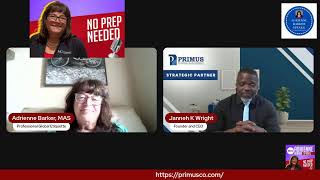
Jannae Wright runs Primus Business Management, a 23-year-old virtual firm that handles accounting, HR, and operations for small businesses and nonprofits. She recovered $200,000 for one nonprofit client by fixing data errors and streamlining processes, helping them grow from a $2 million to $5 million operation. Wright uses a framework called the 3 C's—compliance, culture, consistency—to guide clients through financial pressure and hiring challenges.
Chapters
I love it. I got two daughters, so yes.
Handsome man with gray, like gray in the beard. I love that. So we're live. Hi everyone, we're live. We're back again, this time with Janae. Did I say it right?
Perfect.
Yes.
K—
oh, I was right, so I guess I'm part of the Wright family now. And, uh, yeah, I said Bo. He's brave, he's bold, Handsome. And then a little touch of that gray, which years ago men would go into the store to make themselves a little gray to look distinguished. So is that real or out of a bottle?
Well, it's real because I actually went to the store to take it off, so I decided it was too much work, so I left it alone and let it grow naturally.
It's handsome. I would not touch that gray. Uh, for me— I have to, but we'll forget about that. Oh right, you have to introduce yourself because you know I don't know anything about you.
Sure. So, um, hello everyone, my name is Jannae Wright. I am the founder and CEO of a company called Primus Business Management. We are a consulting firm with over 23 years experience working with small business and nonprofits, and we specialize in their back office services, um, doing all their accounting, human resource management, and providing operational administrative support to them. And the goal is always about how do we give the CEOs back more time to focus on their company and not worry about all the, the business ethics stuff that needs to be done for every company.
I love that. Let's go first. First of all, to be honest with you, when I'm looking just like really quickly at your logo, I'm thinking you're financial wealth, but you're completely not.
Well, I mean, we do accounting and human res— we do accounting and financial management for businesses, but we also put into HR and everything else because we realize there's a really interesting connection between those three aspects of a business and things that people who really don't want to do all the time. So that's what we prefer to do. So we bring them together into one organization.
360. Yes, I love that. Okay, so I, I— so last like week or so I've been doing this, I have had about 300 episodes. I have been really enjoying going into the website. So may I go to your website?
Yes, please.
Okay, so I'm going to present it because I don't know, just like Going through it just gives me joy. And then I can answer any questions and we could talk about what you're doing. Uh, cause obviously I had no prep. Okay. So here, I like the logo, by the way. I like the logo. Wait, what does it stand for? Tell me about, tell me about the, tell me about the wording, the name, and where did it come from?
Sure. So Primus means first. And the goal that we created when we started this company was, you know, small businesses, uh, nonprofit business owners need help. And we want to be that first place that they go to, to get that help.
Okay. I love that. I didn't know that word. See, so I'm learning things too. I love that. All right. Look at this, transforming challenges into wins. What are some of the challenges that you see?
So from the accounting side, right now, with the idea that we might be heading to a recession and all the tariffs and everything else, there's a lot of financial pressure on businesses, right? They're not— some people are not making their budget. Some people are not bringing the revenue level they thought they were going to bring in, or expenses have gone really high. So on the accounting side and the management side, it's really about taking those, those challenges, figuring out strategies and game plans and looking towards the future. I mean, right now I'm talking to my clients about 2026, right? If we look at 2025, we know what's going to happen here. Let's start figuring out what we can do in 2026. On the HR side, right now it's hard to hire people, right? There's a, there's a lot of people who are looking for jobs, but looking for that perfect job. So they're jumping to different places. And unless you have the perfect game plan for bringing people into your organization, keeping them, retaining them, and making sure they're happy, you're gonna have a hard time keeping and holding on to staff. So for us, those are the kinds of challenges we are looking at for a lot of business owners right now. And the idea that we can help them get to a point where those challenges are manageable is what we're doing.
So, Jene, if we say history repeats itself, when in the past did we have such trouble with hiring and kind of like these employment issues? Can you recall when this was a challenge before?
I mean, it's cyclical. It happens every couple of years, right? It's years where there's a large population coming out of college, years where there's a large population retiring. Years where expenses have escalated at a rate that was way higher than salaries. These are all situations that can happen over and over again. And so regardless of the administration, regardless of the timing, anytime there's something in the economy, AI is gonna be another one of those situations that's gonna cause those headaches. But anytime there's a situation where there's a challenge in the economy and there's a change of, of a lot of people moving is going to cause issues when it comes to hiring. Um, specific times, I mean, you're thinking back to, um, the Wall Street crashes and the, the housing market issues. Those are all times where all these issues usually, um, happen.
It's interesting. So I have a 19-year-old daughter, so I've noticed like her age, like 19 to let's say 24, 25, and even some of my sons who are 42, 36, and 30, they've all finally embraced AI. But I really had to push them. I had to show them, you guys, stop being afraid. But I noticed my daughter and her generation are like, oh no, we'll never use AI and it's not authentic. And they don't seem to be understanding the importance of it. So people talk about this, the generation that we have now, like coming out of college, is more entitled. But I find the generation that we have now, they want— you're right, I guess you're really right. They want to do exactly what makes them happy, what they could do. Are they getting those jobs, or are they okay just being unemployed until they find the work?
I mean, from, from what I'm noticing it, you know, you don't like to generalize, right? So there are people within every generation that, you know, there's people in our generation that didn't want to work and they want to do anything, right? So there are people in generation who's going to be the same exact way where they're looking for the specific job, the specific situation, and they're, you know, they're staying home with parents more because honestly people can't afford to rent, they can't afford to buy houses, so they're staying home with parents, which means that the necessity of getting a job is not as burdensome for us when we left college because we need a job to get our house, we need to get our own apartment, we get our own things. So now that you stay home, you can stay on your parents' health insurance till like 25, 26. All these things are really— a lot of people are staying home a lot longer for those reasons. But the jobs are there for them, right? There's people out there who are looking to hire. I mean, the amount of, of job notices that's out there, it's a lot. But they, they're, they're gonna have to work, right? It's not, it's not a cookie cutter job. It's not gonna be easy. They're gonna work 9 to 5. They're gonna have to work. And it's, as a business owner looking for employees, I'm falling into the same rail where I can't find the right person and keep them because of, you know, I work in a consulting firm. Everybody knows it's a high-pressure situation, and some, it becomes a really hard thing to find people who are going to put in the kind of effort that needs to be put in.
Yeah, really, really interesting. David Meltzer, who I love, he said, if you, um, if, if you love what you do, then learn to love the things you don't love to do. I like that, right? It's not if you love what you do, then, you know, you never work a day in your life. He's like, no, you do work. You're working. Don't separate that. But you have to learn. But every time, ever since I heard that advice in February at CreativeCon, um, in Chicago. I'm like, gosh, that is really very, very true. All right, let's go, let's go look through everything because I, I'm just loving this. Okay, so wow, wow. So 72% of businesses claim that outsourcing accounting improves their ability to scale. That makes sense, actually. But can you explain why?
Well, one reason is economies of scale, right? You are reducing the cost to your organization while increasing the knowledge base in your organization, right? Outsourcing shouldn't just be, I'm finding something cheaper. It should be, I'm reducing costs, but I'm also getting a higher level of information or knowledge base, right? So like my firm, the cost to us is probably the same cost as you hiring one person, but you're getting a CFO, you're getting a controller, you're getting a junior accountant. So the amount of people that's working in your company, on your company, is a lot higher. So when people start to realize that, they start to realize that they're saving a lot of money and they're able to take that funds that they're saving and put it towards product or put it towards services to increase the benefit of the organization, hence helping it scale as quickly as possible.
I love that. I totally get it. But how does a company that's maybe, you know, new in business or their accountant that they've had maybe internally, they've had the person on their payroll or not, and now that person left, they just retired. And how do I vet a company like yours? Like, what does that look like? Can you give some vetting tips for businesses so that they know what to ask for and how to find the right company that they could trust?
Sure. The first— so the first part of that, I think, is, is having a connection with that person, right? When you're interviewing someone, it seems like interviewing somebody for, for a full-time position, you know, this is somebody who's going to be working with somebody you have to trust, somebody that you have to get along with. So the first part is really having that connection with the person and trusting that that person can do the job. After that is looking at their experience, right? Looking at who they've worked with, looking at their resume, asking them for information that proves that they can do this job and they have done it for not just company like yours, but company bigger than you, companies who have been where you are and, and companies that are going where you want to go, right? So think about those as well, right? The future, the future planning of the organization. Has this person— if I'm a $200,000 organization selling toys, Has this person worked with organizations that's $1 million and has a month of staff that I want to have, or even have the experience in that industry? And that's the second part. The third part is usually just about— it's usually about the knowledge base, right? As I said before, it's like, how much information can this person bring to you? How much information can they help you with? Are they going to be a strategic partner, or is it going to be somebody who's going to send you a bill? End of the month and really not understand your business as a whole.
Okay, then, um, then my next question would really be, what, what is the advantage? Like, can you share, like, the advantage of high— like, outsourcing it than having that person on your payroll?
Sure. The, the main advantage is usually, um, cost, right? So an outsourced organization may cost you $36,000 to $45,000 a year. Let's say it's the exact same as hiring somebody, $45,000 a year, right? For the outsourced organization, the cost stops there, right? It's $45,000 a year, it's flat. For a person internally, you also have to add on fringe benefits. Are you buying— are you getting this person health insurance? Um, do they— you have to also pay taxes to the government for this person. Are they— do they have time off? How much PTO time are you giving them a year? What What's going to happen when they're not in the office? Right. So these are all financial things you need to think about when you're hiring internal, because it's not just the salary amount you have to think about. You have to think about all the other ancillary costs that go along with this person, including getting them a computer, getting them an office, getting them a desk to work from. These are all things that add up into the cost of that person. With a consultant, it's like whatever that rate that you and that person, you and that person and that company decides, That's the flat rate. And you should make sure that you have those contracts together to make sure that that is that flat rate. This is not an employee to you. The person has all the credentials and all the rights to be a consultant, but it is one flat rate for your organization.
I love that. I love that. Also, less downtime. If I work for a company and then I leave, now you gotta find someone else. You've gotta go through, make sure, right? Like, so here you guys handle it. You do the onboarding and training of the new person and they come in. I like that. Thank you. Okay, so that makes sense. Okay. Um, and yeah, that makes— okay, you guys get on the website. Trusted partners. I love it. I love it. Let's see. Okay, so we've got strategic consulting. So you're helping them. So who's doing the strategic— how many on your team for the strategic consulting?
There's 3 on the team for 3 consultants, including myself. Um, we are— our job is really high-level future planning, future thinking for the organization. Looking at organization dynamics and growth. So that's our job. Those, those three right there. Adeola is really a great people manager. Her ability to help organizations really develop on the HR side, develop on the people processing side is phenomenal. She has really become like this CEO coach where she really helps CEOs through tough conversations with employees and her ability to just do that work is phenomenal. And Crystal is an operational mastermind, like understanding how to put things in place, understanding how to write SOPs, really, or just really looking at the organization as a whole and helping us figure out how to move faster, right, and streamline things. So, so the three of us are the ones who really do most of the top-line services.
Oh, I love it. What's going on here? Why is everyone so good-looking? I got a problem with this. I literally, I don't understand. I really don't understand. Okay, so we have, so we have Courtney. I love, I love this. Whoever had this idea, I think these are really fun. Oh, I'm loving this. And oh, I love that. Okay, specializing backend support and process improvement. That's really needed. Yes, processes are really— okay, so Sharice. My parents growing up, my mom always said to me, the most important important department in a business will always be accounting.
Absolutely.
Yeah, Patrice. Oh, so you really have an HR generalist. I'm going through each one. I love it. Uh, Cheeto?
Yes, Cheeto's internal account. Yeah, marketing.
Sunshine, marketing assistant. Oh, I love that. Okay, so they both get to learn. Who are they learning from?
So they work directly with me.
With you?
Yes.
Oh my God, Cheeto and Sunshine, I want you to like look at me right now. I'm gonna talk to you. You guys are very lucky. One of the best things in life is to have the ability to work with someone who is smart, like a brilliant mind that is willing to share it with you. So kudos to both of you. I hope you stay forever. Daisy, awesome. Uh, Daisy likes numbers.
Yes, yes, she does.
You really have to, right? Because, um, Danica, very nice. Oh, it's— oh, well, that's interesting. So she's an accountant but specializes in management accounting. I, I don't even know what that really means, management accounting.
So it's, it's— when you think of accounting, it's usually thought of like there's accountant that people use for taxes, then there's accountant that you use for growing a company. So you're thinking more along the line of futuristic growth, cash flow management, budgeting, So that's what she's really good at.
Wow. Good for you, Danica. David, HR assistant. So he gets to learn too. Okay. That's amazing. Okay. Faith, a business assistant. Oh, I love how everyone— you really— I got a good feeling about this because I like that you're describing what everyone is doing. So many people don't want to put it in writing. Mark, Mark is smart. He's going to— Boy, all of them are going to have an opportunity to really grow with the business, and I love that. Okay, and Jaylen, 8 years. Oh, she must have started when she was 12. She looks so young. I love it. And Jessica, uh, hi, I'm Jessica. Uh, oh, I love that. I like that Jessica put what she likes to do outside of work. That is really brilliant. All right, you got the— oh, so you pay for triple to BBB. That's interesting. Where are you located?
We are looking— so we are a completely virtual firm. So every one of those people live in different parts of the country, but the main home is New York State, New York City.
Nice, nice, nice, nice, nice. Okay, so would I go with the About? Okay. Oh, I think I already went through that. And the People, the Focus Area. Oh, here we go. Okay, so we've got Administration, Accounting, Business Strategy, and human resources. I love that it's all in one place. And then there's the services again, you guys. We went to people, and then here— oh, I— is this, um, is this more of like a nonprofit supporting the development of Guyana? Like, is— well, like, tell me a little bit more about this.
So I'm Guyanese. I was born in Guyana. Uh, I've been in this— I've been up here since I was 8 years old, but over the last maybe 10 years or so, I've been going back to Ghana more often. And the— where, where I was born is a small town. So I've been really using my, my skills and my knowledge really just to, to help grow and build out the business section that's already there. So I'm down there a lot more often. I'm doing a little bit more consulting work down there. I am hiring staff. I'm training down there as well.
I love that. All right. Can you share with us organizational behavior? That's an interesting term. And I just want to make sure everyone understands what that is.
Sure. So one of the things that we talk about as an organization is this thing that we consider, we call the 3 C's, right? So it's, it's the 3 C's is compliance, culture, and consistency, right? So when we talk about organizational behaviors, like how does your organization operate and how do we use that 3 C's to help it operate, right? So when we walk into organization for the first time, the first thing we're looking for is to make sure they're in no issues, right? So compliance-wise, we check all compliance issues, we make sure that's working very smoothly. The second one is culture. This is where the organizational behavior comes into play pretty hard. So the culture organization on the accounting side is how do things move around, right? How does paperwork get signed? How do— how does bills get paid? How does financial information flow? So who's talking to who, how things are working, so that behavior between each other and the team. On the HR side, while it does include that, it also includes the idea of like, you know, who are we working with? What is, what is the value of the organization? How do we express the value of the organization in the, in the parts of the organization, the hiring process, in the disciplinary process, in the promotional process? How do you create these, this, this uniform way of doing work that makes everybody feel comfortable and secure in their job and not have to think that somebody is looking out for somebody else, or you're not in the group, or you're not in the in-crowd, so you're not getting these promotions. How do you How do we create the kind of consistent workflows and culture in organization to ensure those kind of things don't happen? And the last part of our is the consistency part, and it's very straightforward. We do the same thing the same way over and over again. So that way everybody feels really confident of that. They know what their job is, they know what they're supposed to be doing. There's no ambiguity in any part of it because we've developed these systems in place to ensure that this organization is really moving really smoothly.
How long have you been in business?
23 years.
Wait, what?
23. I started, I started this company in 2002.
So did you have a business or did you start remotely?
No, I had a business.
I, I had like a brick, brick and mortar.
Well, we've never really been— we, we were brick and mortar for about— of those 23 years, we were brick and mortar for about 5 years. It started as a purely remote organization. I usually, in most cases, we would be in our clients' offices and move around that way, then have our own office. As we started to grow, I developed a brick and mortar because I felt like I wanted to do more training of my staff and have them with me. But then COVID hit and we went right back to virtual. And in this day and age, because, you know, because of COVID the level of technology has increased, right? The level of video conferencing has gotten such a great level that we realize we don't need to be brick and mortar. We can completely be virtual and still do a lot more work than we were doing before. Because one of the things I spoke to one of my clients about before is, you think about it, if me and you had a 12 o'clock meeting and my office is an hour away from you, that means I have to leave my office by, by 11 o'clock, come to you by 12, sit with you for an hour, then travel back to my office. So that's like 4 hours of time that I have to be either traveling or talking. Now I could jump on a call with you for 15-minute conversation because it's, it's much quicker and easier. And I could have, I could have 10 more conversations in a day than I could when I was going to people's offices because I had a brick-and-mortar.
Interesting. 20. But congratulations. So you've been the face of your own business for 23 years. So for the clients that have had, um, Janay for like, like 20 years ago, tell, call me and tell me about his beard.
Did it have any gray back No, I love that.
I think that that's a big deal because I know that if I was going to be vetting, that would be really high on the list, that 23 years. Oh my gosh. Do you have any plans for your 25th anniversary?
You know, no, I have— I haven't thought about it. I should do something.
Oh my gosh.
Yeah. 2 years from now. Yeah. I'm gonna have a— I should have a blowout for the 25th anniversary.
You should definitely do something. Like, no matter what you decide to do, you should definitely do something because that's huge. That's huge. All right. So I love, I love all of this. And then, oh, I want to just go to the blog. I love reading people's blogs. Oh guys, look, look, look, look, look, look. Like, I like that you don't have to put dates on your blog, by the way. You can remove them. I always think, you know, but I love this. I love that you're keeping it up. It's not like, you know, 2013. No, that's great. Solving Nonprofit Workforce. Okay. And you're using that, the 3 C's. Nonprofits can cut their costs, enhancing that. Oh, I like this a lot. Small, mighty, and structured. The power of organizational structure. Ah, this is great. Oh, oh wait, what's this one? Welcome back, office trailblazers.
Yes, we wrote this when people were first going back to the office. Oh, you want to make a statement about it? Because it was definitely— people were scared, people were nervous. So we wanted to make a statement about it and let's just put like, welcome back. A lot of people did go back to office those years.
I love that. I, I've always worked— not that I've always worked remotely, but about 15 years ago I went remote and I haven't worked. I haven't like looked back. I work for the family business, left, started my own business, and then, you know, I really have to say, oh no, I work for American Cancer Society for almost a year and that was going in the office. But I, I, it was weird to even say the word work because I loved every minute of it. So, um, I like stories, so I don't want to end without— can you give us a story? And hold on, let me think for a second. I want a story of— yeah, I think I'm gonna go with the old boring, but I like a story of a business that was struggling and had challenges, called you up, and you were able to turn it around.
Sure. So yes, um, I'm not gonna say the name of the company, but a few years ago I worked with the organization Part of it was they received a large donation or large government grant, right? So they're what, a billion-dollar company, and they received like, I think it was close to a $2 million grant from the government over like 2 or 3 years. They tried to do it themselves, they tried to manage the government grant themselves, and they started getting themselves into issues of not being able to draw down the funds, not being able to hire the staff in time, and just systems were just not in place properly. So we started with, you know, sending in Adeola as the HR person to really help them streamline their hiring process, right? There was, there was so much information in their job application. I think that by itself was causing people not to want to get hired by them, right? It was, it was a very long, like almost 2-page JD, and people were like, yeah, I don't want to do all this work for that money. So we started there. We started the thing. One of the first things Adeola was really good at going in a company and saying, so what's your value? What is it that you want to say when people talk about you? What do you want to do? And once she starts having those conversations, we kind of whittle that job description down to really understand what, what they actually needed for that position. So that, that part went very well. We started hiring up. I think they hired close to about 10 people within like a 3 or 4 month radius. We onboarded them. We were part of that. We designed that entire structure for them of onboarding, of making sure that was working well. Simultaneously, I was working with the accounting team on, you know, developing— again, it's always about systems, but once you have the right protocols in place, things move smoother. So we, we read through all of their funding sources, we read through all of their information, and we kind of really created policies to help the money move, right? So they started bringing in funds, we started really reviewing some of the things. One of the things that we noticed was they had, uh, so one of the ways they get paid is setting a very detailed list of information to the government. The government looks at this list and they'll pay you based on the list being correct. What the government doesn't do is say, hey, these 3 are wrong, so they just paid you the difference. So I started looking at the ones that are wrong. I started realizing it was like, oh, uh, Adriana has an N in their name instead of an E. Let's fix that. So I went through maybe about 4 or 5 booklets of that information and brought them back almost $200,000 worth of information, worth of funding because of little mistakes like that. The wrong numbers here, the address was off because the government was not telling them what was wrong and what's right to fix it. And nobody in the organization actually knew to go back and look at them and just redo the remittance. So the organization right now is really, you know, they're running very smoothly. They're bringing in more money. They've raised a lot more funds because of like the kind of, focusing on what you like to do and leaving, leaving the backend stuff to us, able to focus on those funds, focus on the business, focus on their services, and really was able to grow to a different level. I think right now they're close to $5 million, um, and they're helping so many people. It's, it's ridiculous.
Oh, I love that story. I'll share a story with you. I was having a little bit of a toothache, so I took like some thread from my husband's sewing kit and I put it around and then I tied it to the door and then I closed the door really quickly. My tooth fell off and I put toilet paper into my mouth. And who needs a dentist? No, we're trying to say to everyone, that's not true. I'm making that up. But you know, if you need help, don't try to think you could do it yourself. Don't hire your, your child that just took two accounting class. Oh, you, you, you got two accounting classes as a freshman. Come on to work with me and help me. No, you guys, this is why we need experts. Okay, I did not touch my tooth, nor would I, because I'm not an expert. I'm definitely not a dentist, and I definitely am not a doctor, though I played one on— no, I didn't play any, but I used to love Doogie Howser. But anyways, my point is, is that really, if you want to be successful, you have to make sure that you have partnerships and a collaboration. But with you, all of that's already built in, so it's like having your partnership and collaborators together under one roof so that you can get— so I love this idea. So all of you, just take this down, go ahead right now. I just went through the website with you. The website's perfect. Everything is good. Call, call, call. And look at, he's a nice guy and he's experienced and he's seasoned because he's got gray hair. That means that he has been around for a while. So I love that. Now, you seem so lovely. There's something about you. So we're— oh, so you're in New— where are you now, like this exact moment?
Home. I mean, my, my home office.
Where in New York though? Like city?
Valley Stream. So like on the outside, right on the outside of New York City. Valley Stream, New York.
Oh, is it closer to New Jersey or Connecticut?
Connecticut.
And, um, do you like Connecticut? Because I'm a Connecticut girl, born and raised, even though now I live in Daytona Beach. Yeah.
No, I love Connecticut. I go up there all the time. I have a lot of friends over there in Connecticut.
Oh, go— next time you are looking for something to do, go to barkermuseum.com. My parents have a toy museum, 80,000 curated toys. Also, by the way, all the grounds are beautiful. So barkermuseum.com, a lot of fun. And Barker Animation Art Gallery, if you go to Foxwoods, go down the elevator and our store is right there. Animation Art, you'll get a kick out of that. Good. I love that. Yeah, I'm not familiar with where you are, but it's good to know. Are you like Danbury side or more like the, um, Stratford or West?
Way, way closer to New York City. Like, literally, I am next door to Queens. I can walk to Queens.
What's the closest city in Connecticut though?
Is it, um, well, it's— so to get a connect, I have to go north to the Bronx. So it's like I am a little bit closer to Connecticut because it's like right across the river from us. But I'm not sure what city that is.
Okay, I'm just curious. I love that. All right, thank you so much. Is there any question I should have asked you that I did not?
No, I love this conversation. This was awesome.
Well, you guys, because we're talking about you, of course you love the conversation. I loved all your staff that is around you. I think that that is great. Looks like you've hired some great people. Tell them that they are on a podcast. But thank you so much for your time. I love this. This will be turned into a podcast in just a couple of weeks, and I am going to follow you. You're on LinkedIn? Oh, let me find your LinkedIn. You are? Okay. I'm going to follow you, and I look forward to just sharing all your information. The blogs that you're writing, are you putting them on LinkedIn too?
I do, yeah. I do different articles for LinkedIn. I do on my blog, but I'm starting to realize I'm going to do both of them.
Yes, you can. Let me tell you, you can. You do not get like with Google, you're they say you can't have it in two places, but LinkedIn, you could do that, or you could have part of the article and then bring it to your website if you want the benefits. That's what I would do. So, all right, good. So you'll see me. Thank you so much. Have a great Memorial Day weekend too. I'm sorry that it's cold up there. I feel bad because it's 85 degrees here and really, really sunny, but I don't want to tell you that because I don't want you to get mad at me.
Yeah, today is 40 degrees.
You have like a little— so like I was reading about that, that cold front. My, I have, uh, my son and his family are— they're married in Connecticut. So yeah, so I know you guys are cold. All right, have a great rest of the day and have a joy your weekend.
Thank you. Bye-bye. Bye-bye.










