Let's Meet Keeper Catran-Whitney
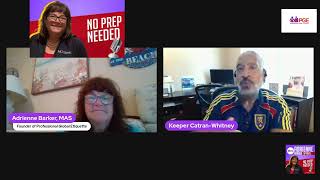
Keeper Catran-Whitney discusses her book Helplessness, which explores how brothers are traumatized when they discover their sisters were sexually abused by a parent. She grew up in South-Central Los Angeles and argues that existing support services ignore brothers entirely, leaving them to face shock, betrayal, and silence without help.
Chapters
But I bet you we will be thanking her because we'll have this opportunity to meet. Hi everyone! So I've just had 2 minutes with Keeper, that's all I know. I explained to him that we're gonna do a meet and greet live, it's no prep needed, and he's pretty brave, bold, brilliant, bald, and good looking. So we've got the 5 Bs today, really excited. So as always, I have to ask my guests to introduce themselves because there's no prep needed. So I didn't look you up. The only thing I did was say, wow, Keeper's got a really cool name and I look forward to hearing the history of it. So Keeper, take it away, share who you are.
Talk about being brave. You're bringing on someone who you have absolutely no background knowledge of. You have no idea what I'm going to say. That is being brave, especially for your audience. But no, no prep needed. I love the name. I, I just absolutely love it. So my name is Keeper. I am, well, Keeper Catherine Whitney. I am the author of the book Helplessness: The Emotional Health Challenges Brothers Experience Once We Learn Our Sisters Have Been Sexually, Sexually Abused by Our Parents. It is the first book of its kind. So for your audience, let's just stop right here. And say my topic is a very triggering topic for many people, and, uh, we want everyone to be safe emotionally, mentally, physically. Depending on where this conversation goes, because I have absolutely no idea, uh, uh, we want you to back away and come back and view it again on YouTube or where— or whatever other platforms she may have this on, but this is a very challenging topic for everyone. And so, as she said, there's no prep needed, so there is your prep. But by all means, please, please, please protect yourself. So as I said, I am the author. I am, um, I not only explore what happens to brothers, I actually answer the question based on my family's experience of brothers being left out of probably one of the most important conversations of their life when they learn about it. So can I ask you, let's just go again.
Hold on for one second, Keeper. Hold on for a second. Can you replug in your microphone? This conversation has to be had, but I get— I'm getting a little crinkly noise and I want to make sure that— so, so your microphone is okay and your everything, your audio?
Yeah, everything sounds great here.
Okay.
I just want to make sure. Okay, so keep going, please. So how do you want— how do you— how do you want me to go into this?
So I— okay, so let's— okay, this is a conversation you weren't ready for either, so— no, it's fine. So I'm a guardian ad litem. I, I, I was a SCORE mentor. I volunteered for business as a business mentor for years. I just switched to become a guardian ad litem and went through the training. So I think the conversation is absolutely so important, but selfishly, I want to understand it because in my training to be a guardian ad litem, we actually never talked about the siblings and what that looks like. So please continue. And if someone is uncomfortable, they can easily move on.
Right. So can you tell me what guardian ad litem is?
Yes. So are you in the United States?
Yes, I am.
Okay, so I'm in— where are you?
Los Angeles.
Oh wow, I'm on the other side. So I am in Daytona Beach, Florida. Oh, and yeah, in our county that we have, our guardian ad litems are volunteers. So we are— my goal is always to protect the children when a child is removed from the home and they have been due to usually abuse, sexual abuse, whatever that looks like. That they're removed from the home, I'm the guardian ad litem, can go in, we can ask questions, supervise, make sure that the foster parents are doing everything, see what, you know. But my goal is really the children. But I never thought actually— and so I've listened to a lot of interviews and shows and tried to make sure that when I'm in court and I'm hearing stories, I'm like this, like poker face, so that— so I— but of all the stories I've listened to, there were a few that talk about siblings but not many, and I think it's really important. So please, please, please take it away.
Okay, so let me just also say I am a speaker for RAINN, which is the Rape Abuse Incest National Network, the largest network of its kind. They're actually connected with the government in monitoring and keeping statistics. Stuff. So let me just go ahead and jump into this. In 1971, my family, we were very poor. I grew up in South Central LA. I went to 11 grade schools before I graduated high school. I lived in 21 different places before I moved out. I was homeless 3 times. I come from a family of 4 boys, 4 girls, my mother and stepfather. And so in 1971, it was once again one of those situations where we could not afford to put food on the table. So my mother and my uncle, who were amazing singers, decided to form a group. And as good as they were, they could not make enough money. This is around the time Michael Jackson and Jackson 5 were out doing their thing. They got ABC, Who Loves You, I Want You Back. I mean, they are everywhere. They are killing it. And so obviously, me and my brothers— I'm the second oldest of the 8— my sisters are singing around the house. And one day my mother looks at us and says, would you kids like to sing? Because as singers in a family, we could make more money. Like, yeah, of course, it's our chance to be like Michael Jackson and Jackson 5. So next thing you know, we are singing in after-hour nightclubs all over Los Angeles. It kept us off the street, so we sang. We rehearsed, we did our schoolwork, we went to sleep, and it was repeat over and over and over again. That was our life. One Saturday morning, we are singing, we are rehearsing for the show that night, and the phone rings. My mother walks over to the phone and says, "Hello? Who? Hold on a second." She turns to us 8 kids and says, Michael Jackson's on the phone. Yeah, that Michael Jackson, soon to be King of Pop. She says, okay, hold on a second. And she looks at my brother directly under me, child number 4, and says, he wants to talk to you. So my brother gets on the telephone. Now keep in mind, we can't even pay an $80 or $90 a month rent. And here is Michael Jackson, the hottest singer on the planet, calling our house. My brother says, hello, all excited. Uh-huh. Okay. Hangs up the phone and screams, Michael Jackson said he's heard of us. Says he heard I sing and dance just like him. Keep going. We will get there someday. Jump cut 6 years later to 1977. We are Everywhere. Billboard magazine, not once, not twice, but 3 times that year in their top 100 for singles and an album. We're doing TV shows, we're doing concerts. Also in 1977 is the year Motown completes an exhaustive 3-year search to replace Michael Jackson and Jackson 5, who they had lost to Epic Records 3 years earlier? You guessed it. It was us, my family. So as you said, keep going, we will get there someday. We were about to go from abject poverty to sky's the limit. They had created the TV show. I have the pilot episode in my office. They had created everything. They're like, you guys can do everything. We got boys groups, we got girls groups, we got— all of you sing lead, all of you dance. That's so much more than what they did. You guys just— in fact, there's too much talent in this one family. This is crazy. So the week we are to sign the largest new artist contract Motown offered any new artist, my family, we're going to sign this contract on Thursday or Friday. The previous Saturday, my sister, the third oldest directly underneath me, screams upstairs, "Boys, come downstairs, family meeting." This is it. It's about to happen. I like to say the bus was outside, the door was open, the engine was running, the seats were warm. All we had to do was step onto the bus and we were gone. Our life was about to change forever. Fame, fortune, you name it, right there. No more going into the streets looking for bottles to turn in to to get some cash to buy a pound of ground beef or a bag of rice. No more going days without eating. No more living amongst rats and roaches who were our playmates for all intents and purposes. Are you kidding me? All that was about to end. So we all come running downstairs. I'm the last of the 8 kids to come into the living room. And as I enter the living room, It's quiet. My three youngest sisters, the three youngest of us eight, and the two youngest are twins, are sitting on the couch cuddled in the corner, and they're not making a sound. What's going on? Now, anyone who knows my three sisters, or any of us, knows we're bubbly, we're effervescent, we are loud, we're energetic. We are just We want to have fun. That was us, all of us. But there are my 3 sisters, the youngest, sitting on the couch, not saying a word. Huh. My 2 youngest brothers are also sitting on the couch at the opposite end, but they're like me. They're not saying a word, but they're— what is going on? You guys realize what's about to happen? All this is about to end. We are about to be famous. So they're just as confused as I am. My oldest brother, my mother has 8 kids. She had all 8 of us by the time she was 24. She had all 8 of us in 8 and a half years. I like to tell her, you were on your back the entire time. Her response was, baby, I never had a headache. You think? Of course you never had a headache. But we're with our stepdad, and my oldest brother is standing at the far end of the couch, directly behind my 3 youngest sisters who are sitting there. And I locked eyes on him. What's, what's going on? Because how can you be quiet when you know what's about to happen? As I entered the room though, my oldest sister, number 3, child number 3, is pacing back and forth across the archway entering into the living room, and she is pissed. Which wasn't really all that odd considering she and my mom could be at loggerheads all the time. I'm thinking, okay, she's just doing what she does. All right, so we're waiting for my mother and my stepfather to come into the living room. My stepfather comes in and he sits in this brown recliner in the middle of the living room, brown recliner that clashes against this violently green carpet. It just didn't make any sense, but when you're poor, you take what you can get. But when he sits down, he immediately does this. What the hell? I look at my older brother and we have no idea what's going on. Now keep in mind, earlier that day, That morning, my sisters were going in and out of bedrooms, and they were like agitated bees buzzing, and you could hear the anger, the agitation, but you really couldn't make it out what they were saying or make out what they were saying. But they were having heated conversations. They'd leave the bedroom, a couple would go into the bathroom, and they'd slam the door. And one time my mother is in there talking, and you can just hear them You can just hear them, just the agitation. But I'm just thinking it's just the girls and mom doing what they do. But my stepfather, who's 6'6", 250 pounds, wears a huge Afro wig which puts his height over 7 feet tall, sits down and doesn't say a word. He just puts his face in his hands and bends over. My mother, who's just as bubbly as her 8 kids, effervescent, proud, loud, you name it, that is her, comes into the living room behind him, but her face is stoic. She's mad. She does not say a word to her children. I am so confused because in 5 days she walks to the center of the living room and turns around and faces her 8 children. Now there are earthquakes here in California all the time. We just had one 4 or 5 days ago. We had one on Tuesday. And earthquakes of that kind, material earthquakes, they break buildings, freeways crack and they fall, and houses rock back and forth, trees are uprooted. Those can be put back together. Little tape, little rebar, little wood, little hammer and nails, little concrete. Pop, pop, pop, pop, pop. Back together, get back on the road, walk back in your house. But my brothers and I are about to suffer 3 emotional earthquakes in a 10-minute span. 3 earthquakes. No brother could ever prepare for. We are about to hear the words no brother ever expects to hear. My mother stands and looks at her children with very little acknowledgement, but she's mad. She then looks at my oldest sister, who's still pacing back and forth across the archway and is looking daggers at her. Apparently what was going on that morning was my sisters had forced my mother into the position. We are telling the boys today what has been going on for years. My mother looks at the 7 of us who are sitting and my older brother who's standing and says, earthquake number 1, your stepfather has been molesting your sisters for years. What? What did you say? No, not us. We are viewed as the perfect family in our neighborhood. Everyone wants to be in our family. Everyone we know wants to emulate us. What are you saying? I am dropping. I am falling into a very dark abyss, the void. There is no slowing down the descent. In fact, it is speeding up, and I'm hearing things like liquor store, park, this system, that system. I'm like, no, PTSD is settling on me with unabashed abandon. I'm really slow on the uptake because I can't put together what is happening. This doesn't comprehend. It doesn't make any sense, not us. And then she says earthquake, or drops earthquake number 2. I mean, the house is rocking. There's a crack going through the middle of the living room. And then she says, I have known all along. No, no, you've known what all along? I have known all along. The year Michael Jackson called our house in 1971, I come to learn later, was the year all this started. My three youngest sisters, the two youngest, well 5 years old. The next one above them was 6, and the one pacing the entryway was 10 or 11. This has been going on for years, and me and my brothers have no idea. None. But it went a long way to explain some things for us, particularly recently. We would have conversations with our sisters because we're all a little older and we may say something and their response just did not match up with what we said or what we observed or what we may have commented on or what we may have seen on TV or blah, blah, blah. But it went a long way to explaining, I would learn later, particularly my older sister, why her reaction was as striking and as hard as it was, as unfeeling toward her brothers as it was. Like I said, my brothers and I had no idea. Then earthquake number 3 is dropped. Now, the first 2 are devastating. My brothers and I, there is no way we could prepare for this, but my sisters could. Prepared for the conversation, obviously, and unfortunately, because they had been experiencing it. In many ways, they had come to grips with what was going on, for better or for worse. They had viewed it as this is the way it's going to be, and it is sad to even think about that, or me even saying that about my little sister, because I'm a brother. And in most brothers in situation, what kicks in is our protective instincts. But we weren't even given the chance to say or do anything. We are, are hit with this information. And when you are a brother You're paralyzed. Most adults can't handle this. If a wife learns that her husband or her partner has been doing it to their children, she can barely handle it. How are children supposed to handle it? Like, I'm around 16 years old at the time, but it really made no difference how old I was. It was the news. That was all-encompassing, that was devastating. So earthquake number 3 is my oldest sister spun around and pointed at her 4 brothers and said, you can't talk about it. It didn't happen to you. It only happened to us girls. You can't talk about it ever. And like that, relationships between brothers and sisters that were so incredibly tight lay on the living room floor broken for decades. So you're a brother. What do you do when the people you are most close to, the people who could go the furthest in explaining to you what has just happened, just told you, we want nothing to do with you? We don't want to hear from you. Your feelings don't matter. Let's just put you on a shelf, tuck you in a corner, and close the door. Never talk about it. Now, as I said, this is a very challenging topic, but understand, Helplessness is book one of a three-book series that I'm writing. Hopefulness, I'm writing now, which is how you go from helplessness to hopefulness. And happiness is how you get to where I'm at with me and my sisters now, 40 years later, because that's how long it took to get back to them. When you're a brother and you're told you can't talk about it, where do you go? In 1977, women— and I say this in a very humble way, in a very sad way— could still go to a library, could go to a bookstore and find a book or a topic, sadly, because historically men have mistreated women around sexual abuse and abuse so much that women were writing about it, and you could find works on it. Every now and then in 1971, you could find a documentary on TV. There'd be a movie of the week or something around the topic. It might not hit at the center, but any woman could tell you, I know exactly what that woman is going through. I know exactly what that's about because that's me, that's my sister, that's my neighbor, that's my cousin, that's my friend at school. But brothers and men, nothing. No books, no magazines, no Ellen, uh, interviews, no Oprah interviews, no documentaries, nothing. So where do brothers go in 1971? There was nowhere to go. You could go to a 12-step program for just about anything in 1971, but for brothers, they did not exist. A one-step program, and that is still the case today in 2024. My book Helplessness explores what goes on in the minds of brothers, the emotional challenge we go through when we are locked out of the most important conversation. See, here's part of the challenge for us. We are told we can't talk about it, but we are expected to answer for our non-participation. It's a paradox. These two things cannot exist at the same time in the same space, and yet they do. Because we would hear from our sisters, how could you not see my tears? How could you not hear me weeping? How could you not know? Well, that's the power of it. When you are locked down by the predator and the predator's person who's empowering them, who happen to be the most powerful people in our world, in our universe, our parents, where do you go? You couldn't tell us because you were told if you told your brothers, I would hurt you, or I will hurt your brothers. And so my sisters are locked down. So I understood what my oldest sister was doing. It took me a long time, but she was protecting herself. She was protecting my 3 youngest sisters. And as I said, it took me a long time to understand, but to come to grips with it, because even though me and my brother didn't know about it, we were still victims. Because it was happening in our house. We just didn't know it, that we were being victimized. So what do you do? What do you— where do you go? Because you're dealing with so much shock and disbelief and guilt and shame and all these different things, anger and betrayal, and so many things are happening on a psychological and emotional front for brothers. As I said, unfortunately, my sisters were prepared for the conversation, not simply because they forced it to happen that day, but because they had been living it and reliving it and reliving it for at least 6 years. It took years for us to get through this. Because even as things played out, some of the molestation continued after. Like, what is, is going on here? Because initially it was just my two sisters that we were being told about, but we would learn later he would— he got to the twins, and our mother knew the youngest. So What do you do? Where do you go? My book is the first book of its kind, and I will say this about my book, and then I'm not going to— you know, there's a lot to this. There's a lot of ugly to this book, but we end up coming out on the other side. It ends up becoming a story of hope and triumph and survival and resilience. It ends up being one of those things that, as I like to say, I, I, my family's story was not going to be on the dunghill of so many millions of stories over the history of man where men have molested women and children and no one said anything about it. My story is from my brother's perspective because there are so many men as brothers who are silent today because they don't know what to do. And quite frankly, our sisters don't know how to help us. Our sisters don't know how to create an opening for us to have a conversation. And obviously we don't because we are told not to talk about it. But I will say this because I oftentimes sit with this, you know, Keeper, your sister's right. You boys can't talk about it. Didn't happen to you. But it did. We are collateral damage. And it's not until I say this part: 6 years before my sister's molestation, my older brother and I were sexually abused by our babysitter almost daily for 6 months when we were 6 and 7. That's 6 years before my sister's So I understand both sides of the coin. The abuse, sexual abuse side of the coin, flip it over, the collateral damage. I understand both. And it's not until I say that, that women then say, oh, you do get it. But I really shouldn't have to say that. Because trauma is trauma and we all take it in differently, and particularly when it involves our parents as children, we have different relationships with each of our parents as we do with each of our siblings. And so the impact is going to be unique to you. And what it did for me, I shut down. And let me just be clear, there are so many woulda, coulda, shoulda moments that I should have done something. But those words, "You can't talk about it, don't do anything," locked me down for 9 years before I actually did something. And what I did was what most people, and particularly men, uh, when this type of thing becomes too great for you to deal with, you lash out. So 9 years, 9 years after, I gave my stepfather 24 hours to live because I was going to kill him. I wanted closure for my sisters, not realizing that ultimately that would not have been closure for them. If I kill him, it would have been worse. But I'm an angry brother, and I'm trying to get back to my sisters, and I'm trying to be the brother that they have always wanted. And I'm trying to find my own self-esteem, trying to find my own self-worth, and I'm just drowning in all this 3 months before my marriage. And I realized I had to do something because my mother has brought him back into the house and I cannot leave him around them. But even in that instance, I know we don't have a lot of time and I know you probably have questions and thoughts and stuff, so, uh, there was a monumental failure on my part when it came to my wedding, because I was trying to create a relationship with my mother in some way. It's just, you know, we, we'd be going through this Stockholm Syndrome thing, you know, where the victim tries to cling to their predator or their abuser, but I saw my family so broken that I'm thinking, okay, let me, let me— and all this is in my book, everything and more. I am so incredibly vulnerable about what I could have and did not do. And in fact, one of the beauties of my book, one of the saving graces about my book, is 3 of my sisters contribute sections to the book. 2 of my brothers contribute. So you get a full family view. This is not People magazine article. This is not a Life magazine story. This is ugly. It's gritty, but it's real. And For me to have 3 of my sisters contribute to helplessness, and they are contributing to hopefulness, and they are going to contribute to happiness, speaks to how far you can go if you go through what you need to go through and go through those really hard conversations and, uh, looking deep within yourself and not being afraid to to speak up and approach people when they say to you, do not bring it up. Because even that not bringing it up is a cry for help. It's just, don't bring it up now. It took me a long time, 40 years, to figure out it's don't bring it up now. But me and my brothers, we did not talk about it amongst ourselves. For almost 50 years because we were so afraid to bring it up. So you get this full family view, and there is a lot of talk about mental health, and I think most conversations around mental health are the wrong conversation, which is why my book is The Emotional Health Challenges. I initially had it the mental health challenges, but that's not it. It's not the mental health challenge that's the problem, at least not in the beginning. It's the emotional health challenge. The mental health challenge as we view it and use it today in conversation, be it casually or legislatively or it's school or in law enforcement, it's singular. It says you're alone. It says you are isolated. Go over there, handle your problem. In fact, let me write you a prescription and deal with it on your own. That's not the genesis. It's not mental. The genesis is the emotional part that sends you to the mental place, because what you're dealing with initially is emotional trauma. And help emotionally requires a community. It requires shared experience. It is about feelings. And who wants to talk about someone's feelings that's not our own? So emotionally is what we deal with first. And when we cannot find the emotional help that we need, and that could just be a conversation with a friend, Let me talk. Let me express myself. And you talk about men doing that. A lot of our masculine toxic masculinity starts with our inability to talk, not only with ourselves but with each other. And we need to have these avenues created so we can do those and have those conversations. We need to have the tools created. We need to have the systems put in place, which is ultimately what I am looking to do, create systems and tools. Because if we can't get to the emotional challenge, it's the mental that comes next. No one wants to deal with the emotional because it's— how do you regulate emotions? You can't write a prescription for emotional, but I can give you something for a mental. Oh, people understand that. So I really understood it when I told my stepfather in the upstairs hallway, which is he and I, you have 24 hours to leave this house. Otherwise, if you're still here by this time tomorrow, I will have killed you. I understood it then that I had gone from an emotional challenge to a mental one, because at that time I was in my head. I was alone. I was angry by myself. I wasn't sharing it with anyone. So the question still ultimately comes back to, with at least reported some 44 million adults walking around in the United States who have suffered some form of sexual abuse— not just abuse, but sexual abuse— how do you create a conversation that allows brothers to come in? Because a lot of times we have a lot of celebrities now who are talking about their direct sexual abuse, which is amazing that we're even having those conversations to be sports. It could be athletes. It could be politicians. It could be teachers. It could be people of influence. Men are now beginning to have the conversations about the sexual abuse that they've experienced, but no one talks to the brothers. No one ever asked your brothers, are you okay? Do you need to talk? Is there anything you need? No one ever asked us. We're the only ones left out of the conversation, and the conversation can never come full circle unless you bring everyone into the circle. You can't only address the abuser and their— and people who empower them, and however that's going to shake out, and you just can't address the issues for the abused. There's someone else, there's another group that needs attention, that needs to be heard, that is hurting, and that's brothers. And so my job, what I do, and it is my singular focus from here on out, is to elevate the voices of brothers so we are brought into the conversation. Here in the United States, It is reported that every day, 160 unique children a day are sexually abused. So let's, let's just examine that for a second. Yesterday, 160 kids got up, had breakfast, went to school, played hopscotch, played foursquare, played handball, played with their Learned their arithmetic, English, and history, and they went home, did their homework, hung out with their parents, played with the dog, played with their brother or sister, and went to bed. And around 12 o'clock, like it was for my sisters, someone opened the door and walked in. It will happen again tonight. And it will happen again tomorrow, and then the morrow after that, and the morrow after that. So what do we do? We cannot shy away from these conversations, especially when it comes to children. We have to have some platform, some way of communicating with them, particularly brothers. When, as soon as we learn about it, we are in pain, fear, and anxiety and confusion because we feel that we've let our sisters down around something we knew nothing about, and then we start beating ourselves up. So, uh, as As the topic goes, there was no prep needed for this conversation, but possibly. But this is, you know, it's, it's, it's off the cuff, it's, it's real, and, uh, that's what I do.
So, okay, so I want to go back a little further into what you do. So the story itself, I, I feel like I want to get the book So I'm going to order the book. Amazon, your website, where?
Sure, you can go to Amazon, of course. Yes.
Okay, going to order the book.
It is not an easy read by any stretch.
It's very hard, but it's meant to be that way, as it should be, because what your sisters went through, reading about it is nothing for compared to what they've gone through in my mind. But, uh, but what I'm thinking is, if you don't mind, I'm actually thinking that I, I, what I'm going to do because you're right, I have the book Secrets, which is just short stories. But this is a good example is I'm going to take your book and I'd like to put it on my website just so that I could have a link to your Amazon. So that I'll do that just because I think that I want to promote it for you. So you've got the book. Let me see if I got this right. You've got Helplessness, which will go to Hopeless. I mean, wait. So it's hopefulness and then happiness.
Yes.
And right now, how many books are available?
Right now it's just Helplessness. Okay, so right now, right.
So to me, the big question for me that I want to ask you is, how can we help you? So right now, what is— what are your goals for— do you ever— are you running a nonprofit? Is it just the book?
Right now it's the book, but I've been approached, uh, about the possibility of creating a, a nonprofit, because ultimately that's what I would like to do. Um, because I think the conversation in the child sexual abuse space needs to be opened up, it needs to be expanded, and then you have to be able to create tools and systems that not only help brothers but bridge the gap of communication between brothers and sisters And in the larger conversation, how do you heal the family? You know, how do you not only heal the individual, but how do you heal the family? And it's not going to be the same for everyone. So right now we are doing a lot of interviews about the book, spreading the word that way, and then hopefully we can get into the conversation, how do you create the nonprofit?
Oh, so I have, um, I have a thought for you.
The—
not by the way, I was with SCORE for 8 years, so don't forget about SCORE, S-C-O-R-E. They're free business mentors, free certified business mentors, so they could really help you. You could have a free mentor to like kind of walk you through. I have a question for you. So just so what I find fascinating and not fascinating the story obviously, but what you've that, that I've never thought about it. So I was in Kissimmee. I was part on the board for the Children's Advocacy Centers. And those are— the advocacy center usually is like one location. So after the child suffers the abuse, they don't have to go to this doctor, that doctor. They go to one location and everyone interviews them. And it's more seamless than before when they had to talk to each doctor and talk to the police, all of that. Yeah, what if it's cumbersome, right? So, so that plus the guardian ad litem, and I want to explain the guardian ad litem. The idea of that is when the judge is making a decision if the child will be, uh, if the parent will have their rights terminated or if the child will be transitioned maybe home or whatever that looks like, the judge usually looks at the guardian ad litem because we are more of that neutral party. But what I'm thinking, guardian ad litem, let's get the book in their hands and see if this is a book that they want to share. So, because I'm thinking you have so many people, you know, I'm a volunteer, but you also have paid people, you also have paid attorneys that I think everyone could really benefit because you're opening their eyes to something. And then you have a story, and the fact that they could reach out to you, the fact that you're still here so that you can help them, I think could really make a big difference. And I could see you even doing workshops to the right people so that you are—
I'd love to get into workshops. We're starting to expand into speaking, and this particular topic crosses racial lines, religion, education, socioeconomics, wealth. It crosses every line. It crosses borders, it crosses waters, it is everywhere. And we're looking to, okay, how do we get you in front of more people? Because you have brought, you have opened up a conversation none of us have ever considered. And so we are looking to do that.
Can I be a volunteer on your team? I'd like to be able to help so that if there's, if there is, I'd like to volunteer even with your strategic— your, like, your, your business plan, in essence, or your strategic moving forward. I, I would love to, you know, help with some ideas and what I could think, because you're right, it's just asking that question. So they— so the brothers would come in this and they would be interviewed, right? Like, now, if that happens, what did you see? What did you know? How do you know it? What did you do? But they're really never asked how you feel? How are— I mean, I'm sure there's plenty of counselors that are doing that, but for those that may not think about it, there aren't.
There aren't. I have, I have spoken to so many family therapists and counselors, and I've said, okay, particularly even when I was looking for help, and they have told me, I can't help you. And my response is, how, how come? Well, if you were a woman, if you were a girl, I know how to help. Them. But because you're a brother, because you're a man, I don't know what to do for you. So there's not even any help in that area. And even when I put it this way, I said, oh, okay, look, let's say I'm driving with my family of 10 and we're in a car accident and I lose all 9 of them. I'm the only survivor and I'm in freefall trauma. I don't know what to do. Could you help me? Or, yeah, I could help you. Well, it's the same thing. I've just lost my family. I've just lost my sisters. I've just lost my parents. I've just lost my brothers, figuratively, but emotionally I've lost them. Can you not help me? Nope, I don't know what to do for a brother.
Well, and you're— and if I could just say this, you're also having one of the hardest emotions to have, which is that anger, which if you don't work on that, that's just going to eat you alive. That's poison.
And so it goes to mental, it goes to mental, and we're going to reach out. And of course, if I cannot handle this, it impacts every relationship with every woman that I know. You know, the trajectory of relationships are so damaged going forward. And you know this as well as I do, the chances of me repeating what was done to my sisters or me is very good. You know, I'm going to have problems in school, I'm going to have problems in relationships, I'm going to have problems at work, I'm going to have problems with just me because I'm in my head emotionally and I can't find the help that I need, right? And it's not even just the basic, what do you do first? Well, first thing you do, you have to have a conversation. You need to find someone who you can trust and have a conversation. And look, I don't need you to judge me, I just need to talk. Because what people don't understand, because we're brothers, like DNA, which is self-replicating, and oftentimes DNA replicates in ways we aren't aware of, they can't see, but it's doing what it's doing in our body. This is the same thing. The trauma is self-replicating. It becomes part of our DNA. It becomes a part of who we are, and it will manifest in ways we are not aware of. And that manifestation usually is, is shutting down. The manifestation, you know, for boys at school, you're suffering at school. You, uh, uh, uh, don't have, uh, healthy relationships. You don't have healthy relationships with women and sisters. And so we have got to figure out a way to help brothers with this. Otherwise, our chance of being, you know, we will be oftentimes positive within society, but we're hurting. We're in pain. And brothers are like sisters, and just like men are like women, we ultimately want the same thing. We all want to be seen, we all want to be heard, we all want to be understood. But ultimately, we want to bring the best version of ourselves in every moment of every day. And if we can't get the help that we need, just at the basic level, someone asking a brother, you know, I'm sorry, I didn't think to ask, are you okay? Because my sister who read the book— well, one of my sisters who read the book, and she's a contributor— she said, I had no idea. She read the book like 4 years ago— not 4 years ago, 4 or 4 months ago. I had no idea you boys were going through this. I thought you boys never brought it up because you didn't care. I didn't know it's because we told you you can't talk to us and you didn't know what to do. I thought it was that, and that's usually what men or brothers go through— women who control the narrative as well as they should around this conversation because of what men have done historically. But that's not the only conversation. And so she said, I had no idea she was in tears. And if I could just share one other quick story with you that kind of puts a fine point on it happens to everyone. My father-in-law who passed away 5 years ago, love him to death, white, Jewish, comes from a very different background. He grew up in New York. I grew up poor in LA. He found a way to create an amazing life for he and his family. I struggle all the time. My wife and I have been married 38 years. We have two amazing children. So we are so different in so many ways, so many ways. And of course, race is the one that you see right away. You find out he's Jewish, I'm not, blah blah blah blah blah. But we— it— our relationship just grew and grew and grew. About 2 years before he, uh, right, well, he read the book. I didn't know he was going to read it. And then one day he called me to his house. He said, I want to talk to you. I'm like, oh, okay, Dad, I'll be over in a few minutes. So I go over to the house, and then we walked in and said, hi Dad, how are you? Everything okay? He says, yeah, I want you to come here, have a seat here at the dining room table. I want to talk to you. Okay, so what's, what's going on? What I realized right away was my mother-in-law was not at the house. She was always at the house with him. They went everywhere together, but she was not at the house. So as I approached and began sitting down at the dining room table, I looked and right in front of him was my book. Okay. He says, I read your book. And I'm just waiting, you know, for the critique. He says, I want you to know— and this really caught me off guard, really knocked me backward— I want you to know I understand what you're going through. What? I want you to know I understand. He says, you cannot tell anyone this story until I pass away. At the time, he's 95 years old. He eventually passed away when he was 97. If you cannot tell anyone, I have only told this story to my wife. Okay, I sit back. He says, when I was a little boy, we lived in a duplex, downstairs, upstairs. We were amazing friends with the family upstairs. We did everything together. It was just amazing because back then that's just the way it was. We kept our doors open, people walked in and out of outdoors all the time. That's just who we were. It was just family. One day I went upstairs. My mother had sent me upstairs to get something. You could remember eggs, coffee, I don't know, sugar, something. And I went in. I didn't see anyone, but I heard a sound in the bedroom. So I walked through the living room went to the bedroom and I opened the door and the father was molesting my sister. I walked out and went back downstairs to our place and I didn't say a word to anybody. I didn't do anything. And so he started to cry. I'm like, it's okay, Dad, it's okay. He's like, no, no, no, there's, there's more. It happened again 3 months later, and I didn't do anything. I want you to know I understand. And in that moment, it occurred to me he has been carrying this pain for almost 70 years. He knows he's in bad health, but At 95, he wants to unburden himself. He's sitting across the table from his Black son-in-law. Grew up Baptist, he grew up Jewish, he grew up in Brooklyn, I grew up in LA. We come from different sides of the track in so many ways, but he's reaching out and he's telling me I want you to know. So the pain and the trauma for brothers can be so deep, can be so debilitating, and we hide it very well that this 95-year-old man is hurting. And he finally found someone he could say, listen to me, help me here. And all the help that he wanted was someone to listen, another man to listen. Not his wife, who he told, but he wanted another guy. And he wasn't asking for forgiveness, he wasn't asking for for anything other than, you have put this work in front of me. I thought I was the only one. It's like, oh my goodness. And in that moment, I knew how important this was, that it, as I said, crossed racial lines, it crossed religion, it crossed politics, it crossed socioeconomics, it crossed education. It crosses everything, but it's one of those conversations no one wants to have. And so my father-in-law was really, really special, really, really special guy. And, uh, our evolution of our relationship— he did not have any sons, but I'd like to think, uh, we had gotten to that place where we were like father and son, you know, and, you know, in, in the best way that we could be given our circumstances. And it really was cemented when he called, because he didn't have to call. He didn't have to say anything. He just read the book and kept it to himself. But he needed someone to hear him, put his mind at ease.
Okay, that story got me. Um, so everyone, please don't buy a book. Please buy 2 or 3 books. Buy yourself a book to read, and then I want you to buy— and I want you to, before you buy the book, go and see what you have in your community. Is there an advocacy center? Is there guardian ad litem? Do you know anyone that works with trauma for sexually abused children? Like get that information, then order the book and order one for each of their groups. Because let them read it so that they can then start to kind of this, this movement of making sure that we listen to the brothers, uh, when their sisters or their other brother— because it could be brothers too, right? So please don't just order a book. Take a second, you know, you can take my number. I'll, I'll do the research for you. Just tell me where you live and I will tell you the addresses and where to ship the book to, because that is— and we want to get it in your hands. I want in my hands, but I'm going to order a few so I can bring mine down to the Guardian Ad Litem. I'm going to ship a book to Joy Chuba with the Osceola Children's Advocacy Center, and I hope everyone else does that too. Keeper, I want to, um I, I, I— so you have a team. So tell, tell me, so that you have— someone had reached out or told you it was a meet and greet, and I— and who was that?
Uh, that would be Paula.
So Paula, Paula, Paula, thank you. Paula, my heart goes to you. Thank you, because something made you think this was a meet and greet, and I'm so glad you did. I'm so grateful, and I feel like all of this kind of aligned to exactly what we need to talk about. So Keeper, I have an idea, another idea for you. You have a marketing team?
Uh, well, we're starting. Um, okay.
I have a marketing idea for you. I have, uh, something I want to share with you. I think that'll be interesting and another platform for you. That's amazing. Um, your time today, the story that you shared. Yeah. Are there a million questions? Of course there are, But I'm going to read the book and then I want to answer the questions and then I want to talk with you again and I want to just keep in touch even though we're on different coasts. I want to keep in touch with you so that I can help you. So you're going to put Adrienne Barker volunteer on our team so that I can just— and I do have 40 years of experience. I have 8 years as a certified business mentor. So let me use some of my experience that I have to help.
I would love that. I would really love— yeah, yeah, uh, we, uh, we walk in the same circles, it sounds like, on many things. So, um, that would be fantastic.
So thank you, Paula, and your wife must be amazing. And just tell me, how many children you have?
Two. Two. And we just had our first grandchild, our grandson, 4 months ago. So freshly minted grandfather. Yes, it's great.
Oh, are they close to you? Are they in the same— like, like, are they, um, distance-wise close?
Uh, my son and daughter-in-law and grandson, they're 5 minutes away.
Yes, yes.
And our daughter, our daughter still lives at home. So yeah, everyone's right here. Yeah, they're just trying to figure out adulthood because adult Adulting today is very different than it was 30 years ago.
It really, really is very different. How old are they?
Well, let's see, my daughter's 30 and my son, he's 33.
Oh my gosh, I'm getting— actually, my 34-year-old is gonna have a baby at the same time my 20— my 30-year-old is getting married. So I'll go to the wedding and then come home and see the baby. And they do live close, they live like an hour away in the Orlando. I'm in Daytona Beach. I'm so excited that they're in Orlando, so I get to actually have an hour. But I will, I will travel an hour just to like, I'll do anything. It doesn't even matter. So I'm very, very excited.
As I told my wife, if they lived in New York, what's that, a 4-hour plane ride? That's a 5-hour plane ride. There's no distance that's too far.
You are such a beautiful human too, by the way. Uh, just your whole look, your whole face. One last question. Um, uh, so wait, so, so, so your mother probably has passed, right? No, she's still alive. How old is she? She's gotta be 97 too. 95.
No, my mother, like, keep in mind, she had all 8 of us by the time she was 24, so she's 16 years older than me. She's 73.
Wow, she's still young.
Sorry, not 73. 83. 83. 83.
She's still young.
Yeah, yeah, but, uh, I don't have any, uh, I don't have any conversation with her just because, you know, the book goes into a lot of that. Um, but my sisters, I have great relationships with 3 of them, and I never thought that that would have been possible, but that was because the willingness to go through the fire and take whatever swings and arrows I needed to take. I was willing to absorb and take those and have those conversations. And how I even got to the book is because of my second sister. You know, I was being driven to write another book and I called her and I said, um, I want to write a book, but there's this other book which ended up being Helpfulness that I want to write. And to make the story really, really short, when I told her, I was expecting her to just blow up. Absolutely not. But what she did was say, of course you should write a book. All you boys should write a book. It's not my story, it's not a girl's story, story, and every man needs to know what you're going through because you guys aren't the only one. And sisters need to know what their brothers are keeping hidden and the trauma that they are experiencing simply because they cannot talk. So she said, of course you should write this book. And it was the last thing I expected her to say. I expected her to say No way. Don't you ever bring that up. And even though it's my story, you know, and I knew I was gonna have to go through that, but the grace and the love and the tolerance and just the, uh, uh, the openness. And that's because time has a way of not only healing, but time also has a way of just bringing perspective. And her view of how— and she didn't even read the book. This is not even one who read the book. But having her own children and going through things that she went through, and time can just give us a long pause, but it is a needed pause to just not only reassess who we are, but also reassess those people that are important in your life. And those people that have actually come into your life for whatever reason and then been able to evaluate, oh, that's why they're here, that's why I have this relationship. It could be the length of relationship could be a week, could be a month, it could be a lifetime. And particularly with your family, uh, just because your brother and sister doesn't mean you have to love them. All that just means is that they're your brother and sister and you really had no choice in it. But whether or not it becomes a relationship of love, it becomes a relationship of healing and hope and triumph like it is for me and my family because, like I said, I didn't think our story needed to end in triumph— or rather, in tragedy. It was going to end in triumph through me telling the story and helping people. But those are choices. And my sisters made the choice that they wanted to create space for me and my brothers. And we gladly stepped in and absorbed it and have had conversations and it's spectacular.
And it's amazing. The story is amazing that your, your father-in-law really got— was touched and he— it's, it's— I mean, if that isn't enough proof of that, this book needed to be written and thank God you wrote it. So Keeper, before we go, can I just hear a little story about your name Keeper? Do you mind?
Not at all. Um, in, in the early 1990s, I was, uh, had a very successful career in the industry of direct selling, uh, network marketing companies like Amway, Mary Kay, Tupperware, and all that. I, I did very, very well. And this one particular company that I was with, absolutely loved, uh The head trainer for the company, I had no idea, but they just kept their eye on me. And so one day we were at a conference and he said, you know what, we're going to give you the nickname Keeper. I'm like, why? Because you just keep going. You do not stop. You are one of these people that completes the mission. And so from that moment on, that's all everyone has ever called me. They just call me that. And so I like it because it has a lot of multiple meanings for me, and, uh, I think it's pretty cool.
Wow, wow, thank you. I'm glad I asked that story. All right, so you and I are going to stay in touch.
Absolutely.
I'm going to share this So what happens is a live goes to a— I'll, I'll, um, syndicate it so that it goes on to the other platforms. And, uh, I do have a thought with you, but I'm going to end the stream so nobody can hear, and then I will share with you. So bear with me for a second.
I'm going to—
bye everyone. Thank you for joining us. I know it's tough. You're going to buy— you're going to first do the— see how many in your community would need it. And then you are going to be the one to buy, at least at the minimum, an extra book. For the organization in your community that helps children that have, uh, suffered some child abuse. So please, please. Okay, so, and you know what, it could be, um, Bikers Against, um, Child Abuse, BACA. So someone get a book for BACA for the president, or you may have one in your chapter, in your group. They're amazing. You know what they do, Keeper? I don't know if you're familiar with them, but they are incredible tough bikers And what they do, because the children have to go to court, if it's going to be— if they got to go to court and they have to share their story in the court, and often there's a lot— the children are scared, they're scared at night, and sometimes if there's not a restraining order, they're scared that the, that, you know, that the, the perpetrator is going to come back in the room, like all of that. And so these bikers are there to protect. They will often just say, hey, I'm going to be in your driveway all night long. If you need me, come out and get me. Like, they are such an amazing group of heroes too, and there's so many groups like that. So please find a local group, your guardian ad litem, and your advocacy centers, and buy a book for them. It's so important. So, Keeper, um, oh, let's— I'm gonna end the stream. Thank you, everyone.










