Live with Chris Pistorius
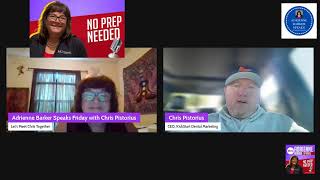
Adrienne Barker interviews Chris Pistorius, CEO of Kickstart Dental Marketing, about local marketing strategy for dentists. They cover SEO, Google Local Service Ads, paid ads versus boosts, TikTok, AI for content, and how to handle client ownership issues.
Chapters
I think you're in a car.
I am. I got caught, uh, unfortunately at an appointment that took longer than I thought.
Well, that's the thing with Zoom. You could do Zoom anywhere. So hi everyone, we're live. And as always, I— no prep needed. I have no clue who Chris is. I don't even know how Chris— did you find me? I don't even know how Chris found me. But all I could say is let's meet Chris, who's in his car, because all I know is the meeting went longer. So, who are you, Chris Pistorius?
Yeah, well, my name is Chris Pistorius. I am the CEO of Kickstart Dental Marketing. We are a local marketing agency that focuses on dentistry, but I've got a— most of my, like, marketing tips and knowledge really apply for any type of small business. So that's what I do. I've been in the business for about 20 years. I've owned this agency for 15. I live in Denver, Colorado with my wife and 2 kids and way too many dogs. So that's, that's about, that's about it for me.
I love it. So I don't, you know, I, for, for a few years I was a podcast producer for a really fantastic podcast called Financial Flossing with Ross Brannon. Amazing. And I got to enjoy listening to all, you know, producing his podcast. I don't recall that we ever had you as a guest, but you may want to reach out to Ross.
I, I, you know, yeah, the name sounds familiar. I'll have to check it out.
Yeah, he's awesome. So tell me about more about what you do. So you— and what made you like— I want to hear at what point did you realize, okay, this is a niche? And was it a dentist? Was it a dentist appointment while you're getting your teeth cleaned?
No, it was— I started my agency 15 years ago, and at the— in the beginning, we took on really anybody that would be— is willing to pay us, right? So we had a, you know, an auto mechanic, a dentist, we had the lawyer, window cleaner, you know, you name it. And we started kind of figuring this out that, you know, it's— we needed to be an expert in one industry because we believed that clients would respect that more. Um, our marketing would be more concise because we could target on one niche versus everybody. And quite frankly, it gets better results for the clients. Because if I take on an auto mechanic, for instance, I'm not an auto mechanic expert, so I have to learn that industry, right? And it takes time. And by the time, you know, I learn it, I'm wasting some of my clients' money because I'm trying to figure it out myself, right? So we decided to niche down. The reason we did is because at the time we had, I don't know, probably 5 dental practices, and we were doing really well with them. They were pretty easy to work with, and they paid their bills. So we're like, let's give it a try. And, you know, that was 15 years ago, and we haven't really looked back since.
So how do you market yourself? Are you attending any of the dentist conventions?
I do some of that. We haven't had a ton of success with conventions. It's actually something we're looking back into now. But, you know, it's things like this, like these podcasts that I do, because it helps build authority, I believe, in the market. People can get a chance to, you know, hear about the company, but they hear about me and how we use our strategies to help dental practices. And, you know, we've been doing it a long time, so hopefully they realize that we know what we're doing. So I think authority building really helps in local marketing.
I love that. The other thing I'm thinking, so you do the digital, right? Do you offer promotional products for the dentist to help them? Why not add that in?
You know, it's It's one of those things that that's a very competitive market. You know, you're competing at that point against things like Vistaprint, or a lot of companies like me will partner with Vistaprint to actually fulfill their stuff. The margins aren't great. And again, there is so much going on in digital marketing to stay on top of and to keep us busy. We just haven't really expanded out of it.
Okay, so that's the answer, 'cause I grew up with the promotional products industry And the VP, like what you just mentioned, yeah, you're not— obviously that's not gonna be successful for you. You'd really have to, but you really could do it too, because from what I know in the, in all of these niche markets is that they want someone that actually understands what they need. And then the tie-in between an actual logo merchandise and the digital marketing is just a beautiful marriage between the two. And if I just gotta say this, if your competitors are actually using the company that you mentioned called, if they're using that, then they don't know how to buy. They're not the buyer. So at that point, they're not really worth their weight in gold. So, and it's not, I mean, it's not that difficult to learn the industry, but just a thought, if you were to bring on a separate person, maybe that understood the market, I think it would be an automatic add-on because there's nothing like going to the dentist and getting— I remember growing up, they would have the little treasure chest with all the little teeth stress balls and all the things that people would love and the kids would get them. And we, at that point in time in the promotional products industry, if you, if you gave a gift to an adult for the child, it stayed in the house and was a great way to remind. So just a thought.
And of course, maybe I'll have to connect with you later and get your thoughts on the best way to do that.
Yeah, I don't sell anymore because I lost my mojo and I couldn't find it. So now I consult in the industry. But I love what you do. So now I want to first of all, tell everyone how you heard of me because I don't even know.
I have a service that helps match me up with podcasts and I think I found you through that.
Oh, a nice matchup. Okay. Because we're going to, we're going to stay connected. All right. So then the learning part of it is really interesting to me. I'm a little bit in digital marketing. I LinkedIn is my specialty. So you— so when you say learn, like, what, what are the platforms that are best for, for marketing for a dentist?
I wish it were that easy. I guess that's why people hire us. But, you know, it really— it's different on each— for each market, and it's different for each client because each client's goals are a little different. You know, you think maybe a dentist is a dentist and what works for one should work for all, but that's absolutely not the case, um, because what works in LA isn't what works in New York. You know, it's just two different demographics. And quite frankly, that's what separates, I believe, us from the market. You know, there's a bunch of agencies out there that, you know, say that they're dental marketing agencies, but really what they're doing is they're just using the same exact campaign for every client and they're hoping for the best. We're not like that. We're a small boutique agency. We customize each plan for each client, um, and we use our 15 years of experience to do that. I can tell you that, you know, websites are huge. You got to have a good converting website. You need to have a strong SEO presence, meaning you're ranking organically really well on search engines like Google. Paid ad-wise, you know, Facebook ads work well if you know how to do them, as well as Google Ads. There's a new product for dentistry now called Google Local Service Ads, which we've had some luck with. But honestly, it's not any one thing. You really need to have a strategy that allows you to have, you know, multiple baskets for your eggs, not just multiple eggs, but multiple baskets so that if one thing stops working, you still have new patients coming in from one of our other strategies.
I love that because when you think about it, there's so many changes, but at the end of the day, cookie cutters, you could tell, like we know, we could see and recognize a cookie cutter. And, but all right, so I have a question for you. So now there's been so many changes, but in the last year or so, what's been weird, Google has really made some major changes, whereas they are no longer like a search engine. To me, they're an answer engine. So like, and at one point Google made some switches. Did that in essence hurt like your SEO ranking? Did you, did you have any issues with some of the changes that Google has been making?
Not really. You know, over 15 years, I mean, we've gone through so many algorithm changes with Google that it's, uh, you know, it's just we don't even really pay attention that much anymore. You know, I think if you do the core things right— we do a ton of content in terms of SEO, so we create a ton of blogs, press releases, um, you know, just trying to build authority and get content out in the marketplace. And as long as you're building quality content that people want to read and you're not building content just to try to rank in search engines, that strategy is never gonna— it's not algorithm-proof, but it's never gonna be a bad strategy. Right? Now there's some other things we do like backlinking, things like that that can be affected by algorithms. And we may take, you know, short hits, meaning we might lose a few rankings here or there, but, you know, our SEO engineers are great at figuring out what the algorithm change is and how to, how to go about getting our clients back on top.
So a dentist comes to you and they're brand new, they just opened, just out of school, and they say to you, I want to open up a website and I'm going to call it Adrian Barker Dentistry. Would you, would you suggest that maybe they look at an older website that has authority, as you say, or just start fresh? Because I know some of the older websites may— does that make a difference?
They— it used to. In fact, just recently, a few weeks ago, a big announcement came out that Google's going to start devaluating, or however they do it, people who buy old domains and for the purpose of getting them to rank quickly on Google. A lot of spammers do this to build what's called PBNs, or private blog networks. So they basically just say they buy 10 domains, they build, you know, spammy sites on them, and they link them all together. Where they link them to client sites. That's against the terms of service for Google. It's an illegal black hat tactic, if you will. You know, it's, so we don't recommend doing that. We recommend creating a, you know, especially if you're a brand new practice, create a fresh, you know, start. And, you know, we'll get it to rank. It might just take a little bit longer because it's a brand new domain, but it's all about building trust with Google. And if you start doing things that could deter that trust, then you could be in trouble. So we would recommend in that case not to do that.
Chris, I love that. Okay, thank you. That, that's really interesting. All right, here's another one. I see this a lot. Hey, Chris, I see you've got a dentist agency. I'm kind of new. I'd like to do everything for you for free. Can you tell our, you know, 1 or 2 listeners why they shouldn't accept anyone offering to do a free website or free marketing, free digital marketing?
Yeah, it's cheaper is more expensive is my saying. Anybody that's offering that is just trying to get you on as a client and they're just trying to— at some point they'll take advantage of it. There's a bunch of those offers out there right now and we get so many new clients from those offers that I kind of like it. Because they sign up for the, you know, free, or, you know, your first 20 new patients are free, and then, you know, the fine print kicks in and, you know, they're not new patients, they're, you know, existing patients, or they're coming from insurance, or they're not the right kind of patient, you know. Um, so, you know, cheaper is more expensive. You get what you pay for in this industry. And, and just so everybody knows, you know, we're not the cheapest out there. We are not. We're a boutique agency. We're smaller. We're known for our high-quality results, but we're the ones that also get things done and we get results. That's the difference right there is results versus just numbers.
But, but let's go back to this though, because I, and I could be wrong, but I think that if they're offering you a free website, that what would scare me about that is that they have access to everything and all of a sudden they could hold you hostage. I mean, they could show you all along everything looks great, and then you're like, oh, I love it, I really want this. And then it's like, oh, but now I, you know, or they just, I mean, you could lose everything. So isn't that another reason why you should never?
Yeah. I mean, there's companies out there that will, you know, include a website into their marketing program. And in fact, you know, you think you own it, but you don't. You're actually leasing it from them and it's part of your monthly fee. And so if you want to leave them, they're like, oh, too bad, that's our website and all of our content, so you can't take it with you. So basically you've been paying for a website all this time and you don't actually own it or any other content. So you have to be careful of that. Also, you have to be careful of, you know, just— you're right, I mean, they have control of everything. So when you, when you do a website, you should make sure if you buy a domain name, make sure it's in your own account. So create a GoDaddy account or whatever. Your account, your password, and make sure that you own that domain name. That's the biggest asset, really. And then if they are building a website, ask for a backup file every once in a while. You know, maybe every month, give me a backup file to my website just in case if you quit them or if they disappear, you have that backup and you can send that to another company and they should be able to build that website out very quickly with those backup files. But yes, if you get a free website, it's likely that they own it. Or if you go to cancel and they say, hey, it's ours, they might say, or you could just give us $5,000 and then we'll give you the backup files. So just ask those questions before you sign up with a company that's offering a website, especially for free.
So this is for everyone, not just anyone in the dentist. Like, I see it a lot, and especially in women's group, because women are so nice and they want to help. And I'm just starting my business, and I'm like, oh my God, no. Don't do it. First of all, why would you want someone to work for you for free? I'm not sure I understand that. I think that you should be paying people what their value is. You should know upfront, you should have a contract, and you should make sure you're working with someone unique like Chris. I love that you said you're not the least expensive because that's a good thing too, right? So how do you stay on top of it? Is it going to masterminds? Is it reading articles? Like, what is your way of saying in the know.
I think it's all of that. You know, my team is built out where we have a website expert, we have an SEO expert, we have Facebook ads expert, and they all are really responsible for fine-tuning their craft. And that includes doing continuing education, you know, reading blogs on newest trends, being part of a mastermind group. So I really try to empower them to learn as much as they can, and I support them financially to do that. So if there's a course that they want to take or something like that You know, it helps them build their, you know, credibility for the future, and it helps us, you know, with our clients. So, um, you know, I think any one person trying to stay on top of SEO, websites, everything else, um, it's hard to do. And, you know, I don't even want to try that. So, um, that's also part of the point where I say, you know, it's— we've got plenty to do with our core business of digital marketing, um, because things in this industry change, you know, almost minute by minute, it seems like.
Yeah, that's interesting. I would be curious to know the average business, how much money do they waste when they're doing Facebook ads on their own? I'm gonna say, I bet you, I just did my taxes, so it was, it was a couple hundred dollars of my thinking I'm so cool. Oh, look at me, I'm gonna pick my audience, I'm gonna do this and that. Down inside, I know I'm just I'm just wasting my money, I'm throwing it away. And, you know, maybe I'm getting a little excitement because I see some more views or whatever, but it's somebody— tell, explain why it's so important actually not to do it yourself, to hire someone, and how. And I also want you— I'm going to do a lot here, but I'd like the difference, truly the difference between a boost and an ad.
Yeah. So, you know, I, I talked to Dennis about this a lot. I'm like, it's not like I'm gonna go, you know, on YouTube and figure out how to fix my own cavity and think I know how to do it, right? That's why you go to school all those years, and that's why you figure it out. It's the same way with both Facebook ads and especially Google ads. Um, you could do it, yeah, you can go in and click buttons and, you know, hope you get it right, but you're not going to get it right. And what happens is you spend a lot of money and you don't really get any results out of it. It is its own craft, it's its own art, and just like dentistry, you've got to go to school for it. You've got to understand it, you've got to have the experience, or you're going to wind up wasting a lot of money. There are so many different options on— like, for instance, with Facebook ads, the biggest waste I see is people use the Facebook audience, um, their partner audience. So that means that ads can be shown on all their partners' networks too. And on the surface, that sounds like, well, yeah, why wouldn't I want to do that, right? Well, it's a complete waste of money for local businesses because they put them on these spam sites— or not spam sites, but just low-level sites and people just click on them or bots click on them and it runs up your tab and you get nothing out of it. But there's so many instances like that in both Google Ads and Facebook Ads that if you don't know what you're doing, you're not going to get results out of it. It's just too complex. And then the other side of it is you guys— and I mean, YouTube maybe, but you have a marketing background. Dentists typically don't. You don't know how to write ads, right? That's its own, like, art. Right? And there's so much value in being able to write a good ad. You can do a lot of things wrong or a lot of things right, but if your ad copy isn't great, it's not going to matter. So I mean, I think it's the art of ad writing as well.
Oh, that's interesting too. Yeah, you're right, you're right. I just, I hate the thought of wasting the money but thinking that I'm doing something great. All right, we're going to throw in the elephant in the room, the AI. And so when you're writing your articles, are you using AI? Are you putting it through? Like, what is the step? Or are you just getting maybe topic ideas and then writing it?
Yeah, we don't, uh, we don't put a topic into AI and then just copy and paste into a website. That's a bad, bad thing to do. Um, there's just inaccuracies. Google can detect straight AI. Um, while they've kind of taken the high road with AI in terms of You know, we just wanna make sure it's valuable content for our readers. You know, they've got their own AI as well. We've done the testing, and when you just copy and paste AI directly into a website page, that typically does not rank as well. So we use it as topic ideas. We— topic ideas, and if it writes anything for us, there's a human that edits it and rewrites a lot of it anyway. It does save us time. Because we, you know, there's only so many topics you can think of in dentistry. It does a good job of helping us understand what people want to read about, but it is not a writer in itself. Now, could it be someday? Maybe, but right now it's not there.
Got it. And so this is really for dentists. Don't think you're going to do it yourself or you're going to have your daughter that just graduated from college and she says, I can come in and do it for you, and it may not be successful.
The thing is, you know, is that you've got to know how to use AI too, right? I mean, you've— the prompt, it's all about the prompts. You know, if you put in a kind of a quick, you know, just not high, low-level prompt, it's going to spit out pretty low-level content. So it's about understanding AI, how it works, how the back end of it works, and how to prompt it, you know, correctly.
I love that, Chris. You're, you're really filled with a lot of information. All right, before we let you go and give us all your information, Tell me your thoughts on TikTok.
TikTok, yeah, well, if it doesn't go away, I think it's great. But, you know, everybody's trying to get it banned here in the United States. I don't think that will happen. I think TikTok is great. And the reason we do have clients using it and the reason why it's great is because people think that right now it's just teenagers using it. It's not the case. We're starting to see a hockey stick effect in terms of the age of what people are using TikTok. We saw this with Facebook as well. If you remember back in the day when Facebook started, it was mostly young people using it, and that hockey stick did occur, but it took longer. It was more of a curve, I guess. We're seeing more of a sharp stick effect with TikTok, so I think it's definitely worthwhile for local businesses. Where they struggle with TikTok though is really creating the content for it because it is a video platform. And people, a lot of local business owners just don't have the time, they don't have the money to do like full production, which you don't need to do for TikTok, or they're just camera shy and they don't know what to say or what to do. So we help with that. You know, we can't really shoot all the content for our clients, but we can tell them what works and what doesn't. And with TikTok and Facebook especially, it's not about selling. Don't try to sell people all the time. You know, introduce yourself, just talk about topics people are interested with. Build some authority, and then every once in a while mix in an offer of what your business does.
Absolutely. I made a breakfast this morning from TikTok, so it's kind of cool. I actually, I'd say about a year ago, TikTok was kind of gross. Like, if you went into live, there were a lot of people that were doing weird things for views, and it would just turn me off. I noticed lately that that's all disappeared, so I guess they're cutting back on that.
Yeah.
I do want to share, so I'm very excited about this one. So I am a part of the creator with a new, new program called Chatter. And Chatter came out by 3 guys who I've enjoyed listening to. They've been controversial and, and very, very transparent. And they created, uh, Nelson Apega, Jonathan Bing worked together with a team to create Chatter. It's going to be very, very cool. It's going to be It's almost like a social audio with video with the ability to stream. We haven't gotten in yet, so we're all excited, waiting for Nelson to open up a channel so that we can actually see it. So he's getting 3,000 people to kind of be the creator and see what this looks like. So that next time when I go to do— instead of StreamYard, I'll be using Chatter. And then that is— it's very, very cool. Whole new— because have you used social audio before? Have you been on Clubhouse?
No, I haven't used any of that stuff.
No, Clubhouse had a lot of problems and a very interesting history how they changed. So if you want to read an interesting story about how Clubhouse came out strong, made a change, and then everyone left, Spaces then was able to take over. And these guys understood and love— like, there's a love, they really love this social audio app, and so they're going full in on developing it and very excited. So I'll send you more information about that, or you could go to Chatter.io, iOS, or you can even do Chatter on Spaces to learn more. And here I am selling for them. But it's— and I've enjoyed their show. It's funny because social audio apps almost remind me of like when you're on a cruise ship and you have all these like different, you know, different events that you could go to. It's kind of like that. Like you go look and you're like, oh, I want to learn this or I want to be in this room. You could be on stage, you could talk, you don't have to talk. It's fabulous. All right. How do people reach you?
Yeah, I think probably the best way is my website, kick startdental.com. And if there's a business owner out there that's not in, you know, dentistry, no worries, I'll help you out. I'll give you some free advice. There's a button on my website to schedule a free strategy session, so just feel free to do that.
I, I love that. It's so funny to me because some clients are like pulling teeth, so I feel like sometimes I'm a dentist. If it takes you that long to get back to me, I do feel like I have to pull teeth to get—
Yeah, yeah, you're right. Yeah, exactly right.
Chris, thank you for your time today. I really appreciate it. Let's stay in touch and let's make sure we're connected on LinkedIn. What happens now, just so you know, I'll say this live, is that this goes live, I leave it, and then in a couple of weeks when I release one episode, maybe I'll do two a week and I'll produce it and then I'll go on to the syndicated, the different platforms. So then I'll tag you. I really, really appreciate your time, energy. You look great. I love your hat. Love your sweatshirt too, by the way. I just have to say that. I'm in Florida, so we wouldn't be wearing a heavy sweatshirt. 80 degrees today. All right, everyone, have a great day. Thank you for joining us for No Prep Needed. Chris, you and I will stay in touch.
Thank you. Bye-bye.
Thanks, Chris. That was great.
Sure thing. Thank you.










