Live with Dr. Michael Neal
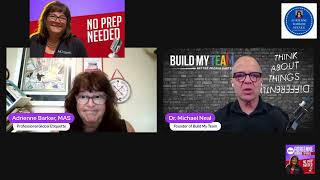
Dr. Michael Neal built Build My Team after chronic hiring problems in his optometry practice. Bad hires cost $10-15K each. His platform uses a 15-minute mobile assessment to evaluate candidates' strengths instead of resumes, delivering a 97% certainty match across 40 states.
Chapters
And then it goes into spot. Hello everyone, another episode of No Prep Needed, which means I did zero work. Zero. I have no idea who Dr. Michael Neal is. I know we, and we were supposed to meet last week and we, we didn't. Probably my fault. I feel bad. But okay, let me tell you what I do know. He's bold, he's brave, and he's bald. He's got the— he's a triple B.
I mean, we don't get lots of hair.
Oh, you do? We do, we do. But handsome as can be. And B for Build My Team. So who are you? You have to introduce yourself because I don't know who you are.
What an introduction. That's tough to follow. So I'm an entrepreneur trapped inside an eye doctor's body. That's who I am. I founded a company called Build My Team that's designed to solve hiring problems for small businesses. And I currently practice in an eye care practice in Hawley, Pennsylvania, in the middle of nowhere in northeastern PA.
Wow. Oh, while I ask you, can you just— I'm kidding you, I'm kidding you. We used to have an eye doc. My parents, you know, they were older, but we used to have an eye doctor in their building, and my dad was like— I used to say, Dad, stop asking him so many questions. He doesn't— just because he's an eye doctor doesn't mean he's going to work on you for free. I mean, really? So, okay, so I— so you still have your practice But is this what you learned with your own practice about building your team?
Yeah. So, this whole thing came about because we were having massive, continuous, ridiculous hiring problems, one after another after another. And I looked at how other companies were doing it, figuring, you know, there has to be a better way, of course. And the other companies weren't hiring the same way we were. They're essentially doing it the opposite way. I studied how they were doing it, created systems and processes around it. It worked pretty well for our practice. And then some friends wanted me to do it for them. And we automated it. And now the whole thing is about a 15-minute experience for candidates. It's all done from their cell phone. And by the time they're done, we know essentially better than they do what their natural strengths and talents are. And that's how we fit them into positions. So, what that turned into was essentially me trying to solve my problem. And now we're doing it in over 40 states for all kinds of businesses.
Oh, so you didn't just like say, oh, I should just go in the optician, right? Is it the optometrist? Yeah.
So we started there and it just grew. We're in over 10 different healthcare practice, uh, healthcare, uh, types of practice, different fields in the, the profession. And, um, you know, we've got clients from over 40 states now.
Wow. I mean, you know, I have a lot of questions. So if I ask you something that you're not allowed to tell me, or if it's like the juicy part that, um—
well, of course I'll answer then.
Okay, okay, okay. So first, I love to think about things Differently. Is that— that's your tagline?
Well, better people faster. That's what the company does. But as far as, you know, visual podcasts and stuff, we have to think about things differently because the traditional way of hiring flat out doesn't work.
Okay, so let's, let's start there because this is where I'm curious. First of all, is— are we talking before COVID or after COVID? Just so I have an understanding.
Yeah, we started in 2018.
Oh, and even back then. So what kind of challenges were you having? With finding staff?
They're the same challenges they are now. They're just harder now post-COVID. But the challenges are that when you're looking for administrative and clerical people, which is what we focus on, managers as well, most of the time their resumes don't tell you what they're good at. When I say most of the time, like virtually never. A resume as a document is a work history, nothing more. It doesn't talk to you about what they're good at. And we can all agree that virtually all resumes are made up, cooked up, embellished, you name it. They using those as a source of truth about what the candidate's good at is, well, yeah, it's just, it's you do it because you have no alternative. That's the only reason.
Okay, so, so you're bringing someone in because I mean, talk about a little bit about the cost of bringing someone in that you do think, okay, this person fits all the bill. And then you hire them, you start training them, and you're saying goodbye to them. And what does that look like?
Yeah, so that cycle for a small business runs like— there's all kinds of numbers on this. They go up to $50,000 or higher. Generally, I think for a small business, you're looking at anywhere between $10,000 to $15,000 is what it costs. That's, that's an aggregate number from what, um, what the data says. And It's not any lower than that. Anybody who's been in a hiring cycle will know that. So, it is extremely expensive to hire, not work out, and then have to let the person go. However, that's the cheapest part. The real issue comes where you're not growing your business. You as the founder or the owner have to focus all this time on these candidates that aren't working out. And instead of spending that time with clients, you know, building revenue, different sales funnels, whatever it might be. None of that stuff occurs because all you're doing is trying to cope with the wrong hires.
I have so many questions. One of the first questions I'm thinking is, what is like— so back in 2018, like, I would think a resume would be something that someone actually wrote themselves or maybe hired someone to give them a good resume. But in 2024, '25, it could be a ChatGPT that does make them look like amazing and they fit the bill exactly what the description is. So what was going on? Like, what is that the big difference right now when it comes to just starting with looking at a resume?
Well, if you're using the resume hiring method, you're not going to get very far. That's why the problems are harder. We hear it from all small businesses. There aren't enough good people out there. They're like, That's one of the things we hear. Well, it's because you're looking in the wrong way. The people are out there. We do this all the time around the country. They're there, but you have to look differently. You have to think differently. And the way that our system does this is we don't use resumes until the very, very end of our process. We will tell you as a client of ours if the person can do the job or not with 97% certainty without looking at a resume.
Oh my gosh, I love this. Okay, so can you tell me what was going right back in the day when people were able to hire a little— like, you know, I think of my parents, they would go to the grocery store, see the girl working, go, oh my God, she'd be perfect, ask her to work, and she'd stay for like 35 years. So something was working right. So, so what, what was, what was working right before we go into the what's not working?
Unemployment was high.
Oh, okay. So people just—
I don't think it was anything much more than that. Uh, people needed jobs and unemployment was high. Now what COVID did was try and convince, um, a gazillion Americans that they can earn a living from their couch because they did for a while. Now regardless of any positioning on that, um, that is simply factual. And there are a whole bunch of people in the workforce who don't want to be in the traditional workforce. They don't want to show up for work. They love PJ work. Were in their pajamas on the couch. And I'm not begrudging them. But a massive amount of the workforce was removed because PJs are superior to showing up for work for those people. And the other thing is that a lot of senior or older employees and candidates, they just decided to leave the job market and retire. So, you essentially have a massive contraction of the workforce, especially for entry-level positions like clerical and administration, that type of thing.
Okay, so I am just like so fascinated with this. Okay, so now the new style, what you're actually doing. So you found the challenges. I mean, how— it's an awful thing. I had a guy ghost me, just never showed up. I had a retail store, so I did get a taste of that and to understand how difficult it was. And I do want to say, because I want to talk about this, afterwards. So if you can remember, because I take no notes, but I do want to say that as a person that was hiring through LinkedIn and Indeed, I would like a little like badge that said I looked at every resume and I told you right away if I was going to interview you or not. I never let people wait. I let them know immediately because I could understand being on the other side of the fence and I wanted to make sure I was taking care of them. I thought that was really, um, So, you know, because as much as employers have issues, that's the biggest one I hear from employees is that nobody's getting back to them. Okay. So what juicy things can you share with us that, that we can all get? Like, we have to get the book, everyone. There's a book or the process. What are we, what are we selling today? Just so I have that first.
Oh, it's easy. You go to buildmyteam.com and schedule a consultation and our team members will talk with you about how they can help your hiring process. The thing about what we do that's completely different from what a lot of small business owners are used to is that we focus entirely on natural strengths and talents. So, follow me on this one. If you're running a small business and you're hiring people, you don't, you know, all you do is you take their word for what they're good at, right? Now, think about this. They want money. They need a paycheck. You have no idea how desperate they are. They might come across as cool, calm, and collected and freaking out on the inside. Because they're about to miss their car payment in 2 weeks, whatever it might be. They are going to tell you whatever you need to hear in order to get that job. And then they'll get hired, and then they'll continuously be interviewing elsewhere and jump. That stuff happens all the time. Oh yeah, happens all the time. And it's worse now, um, is post-COVID. So what we do is we focus on the natural strengths and talents. As I said, we have a process where We set this all up for our clients. It's completely done for you, where the candidates can apply at the client businesses in the middle of the night, whenever. It's all done online, and within 5 seconds of them applying, their cell phone buzzes. They get a text from, from the client inviting them to participate in this process. So what they do is they click the link, and all of a sudden they're answering some questions and going through our process, which tells us in a way that they can't game or rig what they're good at, what these natural strengths and talents are. Takes about 15 minutes. A whole bunch of those people, they don't even start. You know why, Adrian? Because they don't want to lift a finger. They are too busy playing Xbox to, uh, um, or PlayStation, sitting on the couch, to even want to participate in this. You— we lose about 50% of the candidates because we ask them to do something. Wild, isn't it? Now imagine those 50%, they're wasting all your time as a small business owner, all of it, because they have no interest in working for you in the first place.
So this is a whole idea now, like with Indeed or LinkedIn, where you can kind of pre-ask a lot of questions or have them do a project or do something, right? So that's kind of what you're saying is get them to do something so that you could see if they're following directions. Which reminds me, I used to work for the Muscular Dystrophy Association. Yes, I met Jerry Lewis many times. And it was the— it was honestly the best career I've ever had in my life. But, but what I used to do is I would say there's 2 parking spots right out front. I would describe it, tell them what it is, and this is where I would like you to park. And like when they pulled in, I would be watching to see, did they park at the right spot? And then I'm no expert. My mom always taught me, don't get mad at me. Sorry, Mom, she's in heaven. Um, to always listen to if someone's smoking. I know you're not supposed to say that, but like you could hear the breath. So like I had to do a phone interview first so I could just make sure, because not everyone— people will say I don't smoke, but then they do, and that could be a problem too. But the other thing is I would always ask that question, like, um, if I went outside right now and looked in your glove compartment, what would I find? To see how organized they are. But like, look how old-fashioned that sounds.
Well, you know, we take that 100x because the way that we're asking these questions is that we determine what their natural strengths and talents are. Are they detail-oriented? Will they follow process? What's their stress tolerance like? In some businesses, if you don't have a high stress tolerance, you're not going to last that afternoon, right? In other businesses like a concierge, higher service level, maybe that's not a big deal. It all depends on the client. And so, we measure the behind— all of the information we have fills about 37 printed pages when this is all said and done. And our entire process is automated. So, we don't— like I said, we don't look at resumes till the end. We don't have any idea if the person's male, female, what color they are, what they look like in any way, shape, or form. It is bias-free by design. And that's how we pick the people. So, our software will tell us with a thumbs up if they can do the job or not. That's how tight these algorithms are, and with 97% certainty. So once that happens, we send them— those finalists, um, candidates, we send them a video interview. And the video interview will tell us how they're going to represent your business. So when it's all said and done, we send the absolute A-player terrific candidates over to your business where you choose You just choose who you want. And it— this happens very frequently that they want both, they hire both of them. So this is a completely different way of hiring people, but the, the, the proof is in the pudding. It is incredibly successful because, Adrian, you're asking this person to be who they naturally are when they walk through the door at work.
I, I, I, okay, so what I'm thinking, it's so funny, I live in Daytona Beach, so we've got the, I don't know what it's called, like the, the, whoever's flying over before the race, they're doing the practices. I can hear them. It sounds amazing. Okay. So I remember we used to use the temporary employment agencies and the whole idea was, well, we don't really know, but we'll bring them in for a couple of days, see how they work, see if they pay attention. Blah, blah, blah, blah, blah. But even that got costly. It's not like, you know, they gave it to us for free and you got to work out the arrangement with the employment agency and then you're paying extra money. So I almost feel like listening to you that you're almost taking that piece out that so you don't have to try someone, right? I don't have to.
You don't need to. No, it's completely unnecessary. Yeah, we're not a temp agency. We're not a recruiting agency. What we do is we start each hire from scratch. We pour as many candidates to the top of this funnel as we possibly can. Because we're going to reject almost all of them. We're not looking for the, the needle in a haystack. We're looking for the right needle in a stack of needles, and we can produce those results all day long.
I love— okay, so now, so someone works with you, they— it, I'm sure it doesn't stop like, okay, so Sally Sue is going to be working with you, see you later. No. So then what happens after? Now they've— they're hired, and then what happens?
So we, um, we have a complete feedback loop built in for all of our clients. So we want to know all about how, like, the, the great things about the people, the areas for improvement and all that. That's how our process got to be so incredibly accurate. It's just listening to clients after the hire. And let's say somebody leaves you because in every business, people are going to leave no matter what you do. We obviously try and minimize that as business owners, but that does happen. So, what we start the conversation with is what did you like about this person? What are the areas for improvement? And so, your next hire is even better. Imagine running your, your business where you never feel trapped by your employees, because if somebody leaves, you do a call with our team and we figure out how to get you somebody who's even better each time. That's how this levels up over and over again, and it allows the business owner to focus their time and effort on creating new revenue, working with customers, and essentially more profit. A lot more profit.
I love this. Okay, so when I, I'm in the elevator with you, I would like to hear what your elevator pitch sounds like, if you wouldn't mind.
It's very simple. Better people faster for your business based solely on hiring for strengths and talents, their natural strengths and talents, versus using resumes. That's what this whole thing boils down to. It's a done-for-you service. And, uh, I forgot to mention throughout this conversation, it's We do it all for you. You can hire somebody through Build My Team with less than a net hour's worth of work, less than 60 minutes worth of work. And it's extremely affordable. I forgot to mention that as well. People think this costs a fortune. It is incredibly inexpensive and we pass the savings on to the customers.
So I don't, I don't talk politics. That's my rule, right? I said no politics and no religion because that's, that's serious. But I want to— I do want to talk about the DEI for private businesses because not what's happening in the government, but it sounds like when you said that you're not looking at anything, so you're not looking at the name, you're not— you— so right there is a good thing, right? Because you're taking away any biases anyways that someone would have or the hiring person would have. Could you share a little bit about the DEI in the, in the, uh, in the private workplace and what that was like, why you need that, or maybe you feel that you don't need it. Like, I'd like to hear a little bit from you.
Our approach doesn't care at all. The computer, the software, our algorithms don't care at all. There is zero weighting on whether you're male or female, what you're— what you look like, what your ethnicity is. It is irrelevant. There is not part of our process in any way, shape, or form. Zero. We're putting people into these positions, uh, we're recommending to our clients these, these incredible candidates without any consideration of any of that. And the reason being is they are outstanding at their jobs. These are A-players. Every small business wants these type of people. You just have no reliable way to get them. We We created that reliable way. And when you have— what our clients do usually is it takes a little bit to trust this process for most of them. They're skeptical, skeptical, of course, everybody is. And then you start to see that as we start to send these people over, holy cow, these are incredible players. One of our longest customers just has us do all the decision-making and the candidates just show up at a certain date. They don't even know if the person's male or female walking in the door.
Wow, that's fascinating. So when you're, when you're working with your, your clients, and so like, what does that look like? Are we talking, just so I have an idea, are we talking, uh, commercial, um, like, um, what do I say, uh, retail, like for retail? Is it office? Is it just anywhere?
Yeah, any of the above entry-level positions where— and what we specialize in is anything office related. We have that extremely dialed in, like secretaries or assistants or any clerical position, people who do billing, managers, any of those types of positions. We have that completely dialed. What we're also looking at are clients that are looking to hire the same type of person over and over and over again. So, if you have a position, well, usually a lot of positions where you know exactly what an excellent candidate is like, you let us know what those qualities are. And that's what we'll send you is people with those qualities.
I love that. I, you know, I was— so, I have a podcast producer out of the Philippines. And she's the second one. She left. So, I was Looking the other day and I Googled like, you know, what does it look like in call centers in Costa Rica or the Philippines? Like, are those employees stay? Because I don't know, like to me years ago it would have been if you had a job like that would be amazing, right? And, uh, but I was surprised how many actually leave because there's so many call centers being open now that they hop around. And I just never would have thought that in, you know, countries, uh, you know, like Costa Rica or the Philippines. So that would be considered very normal here, correct? To—
well, people hop around all the time. The folks that we bring to the table tend not to do that. It doesn't happen very often because they are a great fit for the roles. So they're extremely happy at work, they are satisfied, they're making an impact, which all kinds of people require. They make an impact. Now, They're helping folks. And this is by design. So, these aren't folks that walk into the office and say, "I hate my job. I can't wait to get out of here." It's the exact opposite. They're excited to go to work. These are folks that are coming from all walks of life. They've been given an opportunity. They are the undiscovered diamond in the rough over and over again. And when you give a person in that position an opportunity like this, they're grateful, they're excited, and they want to do the job. It's very fulfilling.
I love that. I think that's so important because if you don't love what you do— if, I mean, if you love what you do, you'll never work a day in your life. So taking someone— so what does the employee that's getting hired, what they— what do they know? Do they know anything about your company? Are they told anything? Like, what, what does it look like? Are they just walking in the door not realizing that they were you know, part of Build My Team?
Well, I've had the wonderful opportunity to meet a bunch of employees that Build My Team hired for the clients. And I introduced myself and they have no idea who I am. And it's perfect. It's absolutely perfect. They look at me a little funny. Like, how do you know all this information about me getting hired and all the rest of that stuff? I said, because our team did it. It's all transparent to the candidates. So, it's not a third party per se from the candidate standpoint. It's all done with your business name leading everything. And the other side of it is on the business side, what we can do as clients, because my practice is as a client of Build My Team, is when people are telling you, oh, you got to meet my daughter Susie, my niece, my nephew, whatever. They're fantastic. They'd fit right in here. Well, you can just deflect and say that we have a company that does all the hiring for us. Have them apply. And then you never have to get into a discussion with a customer about why Johnny or Susie or whomever will be an absolute disaster in your business. You just point the finger elsewhere.
Yeah. Oh, I love that. You're not giving the finger, everyone. You're pointing the finger just in case my crazy—
a nice little gentle nudge to to the company that does the hiring for you. Yeah.
Okay. So today I was on a social audio app. I was listening and someone had said the question, you can't teach empathy to people. And I thought, well, but in the workplace you can. So do you agree with me that if you are a company and you need— you're a veterinarian's office and you need your employees to be very empathetical to the people, the pets, can you teach that? Or are you already like knowing that because you're hiring that that person already has that part of their personality? So I would love to hear your thoughts.
We approach this differently. We're not trying to take anybody and make them somebody else. We don't approach it like that. It doesn't work. All you're going to do is introduce an incongruency for the candidate where they're expected to act in some form or another in order to fill this role. We don't do that. We're going to find you the person that doesn't have to act at all. They just show up and it's them. This is their authentic self. This is who they are. So, if you want a person to be empathetic in a veterinary office and love animals, that's easy. You hire those types of people. Not in an interview, "Oh, do you like animals?" Of course, they're going to say yes. It's a veterinary interview. Who would say no to that? "Do you like taking care of animals?" Of course, they're going to say yes. It's a veterinary interview. Who would say no to that? You see what I mean? So you can't ask the candidate that directly because the answer is already known. And again, they're going to tell you whatever you need to hear. It has to be determined in a way that they don't provide that direct information. And that's how Build My Team does it.
So let me make sure I understand this. So I'm the employer, I hire you, and you're looking for the employees, or am I saying to you, here's a list of 20? No, I wouldn't see that.
We do it all. We do it all.
So, you do serve as almost a recruiting— am I okay to say that?
Well, we're not a recruiter per se. What we do is we're completely outsourced for a small business. And what we do is provide those A players for you. So, it starts off by—
How are you finding them, the A players?
Well, it starts off with a discussion with our team members. Then, we write the job description. We publish it to over 20 different job boards. We get oodles and oodles of candidates in. Imagine a great big funnel. They all apply at the top, and then 15 minutes later, we know if they can do the job or not. And by the way, Adrian, these people are applying in the middle of the night. They're applying from their phone while they're sitting in their car on their lunch break at their current job. You name it, it happens all the time. It's a massive advantage for our clients because they can be hiring 24/7, and they are.
Okay, so it really is amazing. I think so. I am on Upwork. So I do have like paid and then I have other clients outside. I just have a few hours with a client and then I have other, other work. But it's funny because so I'm kind of doing the same thing as far as like I'm applying all, all times of the night. I look and see, is it something I want? I write the little cover letter and I usually get the job because I just, I'm top rated plus and I hit the 100,000 mark. So like, you know, I'm, I'm usually getting what I want. Yes, yes. But I could say, I mean, I can understand this completely, how important it is. So the question is, who gets back to say thank you, but no thank you? Or do you even, do you recommend that to the employers? Does it make a difference?
It's all automated. OK, everybody who exits our— everybody who doesn't make it to the next step in our process is graciously thanked for their time and provided with a copy of the results from the assessments that they've done. So that they can better understand themselves and move forward in their own job search.
So do you mind explaining to my listeners, the 3 of them out there in different countries, because here's the thing. If, if I was to apply at Taco Bell, right, and Taco Bell never tells me anything, I may not ever want to go back to Taco Bell. So when I worked at our gallery, our art gallery, I always felt too like part of what prompted me is Why, how, how would someone even recommend or say, oh, what a great place? So I would have people coming in, hey, you know, I applied, I didn't get it. That's okay. Thank you for getting back to me and like shop and like, that was great. And a lot of times I almost like remember the name. So please do a shout out on how important it is because I'm here in Daytona Beach, Florida, and I just read about all the time. I'm looking, I'm hiring, I'm going in and I hear nothing. Crickets.
That doesn't happen with us. With the Build My Team process, once you apply, 5 seconds after you hit the button, you've heard something. You get a text. So communication from our clients to these candidates is of the utmost importance. And I'll tell you why. The A-player team members, those superstars that you want on your team, they want, uh, they want to work with a company that is decisive, that understands their value that they bring to the table. They want to work only with A players. And I can't stress this enough. Superstar team members categorically want nothing to do with the C and the D players. If you have a team of people that keeps rotating and you can't keep great folks, You don't focus on the not keeping the great folks. You let the ones go that aren't doing a great job. And you will automatically stop repelling outstanding talent. But when you have team members that aren't in a good fit, it doesn't mean they're bad people. They can be great people, just not working in a good fit for themselves and their natural strengths and talents. They will repel outstanding talent. I've never seen an example where that doesn't happen. And the outstanding talent only wants to work with outstanding talent. So an A player will, um, wants to work with A players. They'll tolerate B players, but they're going to quit their job for C and D players. That's it. So when you're having turnover or cultural problems within your business, that's how you solve those cultural problems— by getting rid of the people that aren't contributing in the same manner as the other team members are. It sounds harsh, but boy oh boy, if you want performance, that's the only way.
And it's really hard too for the mom-and-pop shops. I think of my parents and how often some employees, you know, years ago would be, would be kept on because they were liked, maybe not because they were so great. But, you know, so the— so now you're taking away from the owner. I love it. So, all right. So we've got the buildmyteam.com schedule.
But also, Adrian, just a second on that point. You're doing them a favor if you help them find a job that they absolutely love. Like, we have to get, get over this. Uh, they, they're going to be showing up every day for work trying not to disappoint you, trying their absolute hardest not to disappoint you, even though everything they do is super hard because they're just not good at it in the first place, you know. And by helping them find a position they're good at, you, you're doing them a favor. And I've had employees that we let go come back after the fact when I was trying to find them a position that they were much better at— this is before Build My Team— and thanked me. They got a job, they love it, they're super happy. Oh, they never would have made the jump because they didn't want to disappoint.
Yeah, no, that makes sense to me. How, you know, how small do you go? I mean, are you going to help the woman that needs a VA to work with her, or are you going to help Braun here in Daytona Beach that's looking to hire 500 employees? Like, is that like the wide, widespread?
Oh, it's completely up to the client. It all depends on what they want to do. For obviously volume, higher volume, we have discounts for that. And for the small business, I mean, our smallest client was— we hired their first person.
I love this. I am so glad that we're meeting because—
Yeah, same.
I mean, you know, it's funny because like it gets to the point when you're doing interviews or, you know, I do a room on Clubhouse, a social audio app, at 7:30 in the mornings on Thursday. And you're just talking to all kinds of people and But I've never— you're the first. You're my first with a business idea and a company, Build My Team, that really makes sense.
Thanks.
I'm totally amazed.
Okay, so thank you.
So any challenges at all? I mean, you know what, there's got to be like a couple struggles that are going on.
One thing you mentioned right off the bat that you suggested I write down was the concept of hiring quickly. Okay, so I touched on a little bit those A players, those superstar team members. They require decisiveness out of their employers or else. I mean, they don't want to sit around with somebody, "Oh, maybe I'll get back to you in a week." No, they've already applied for job after job. They're gone. So, the old days of hiring slowly and firing fast, that's gone. It is over. If your business is doing that, you are going to get what's left over. That's it. You're going to be attracting those C and D players because they don't have that kind of time urgency that an A player does. They're just, they don't require decisiveness because they're not decisive themselves. So, if you really want to move the needle with this hiring, you hire fast. And I'll give you an example. In our practice, since we're a client of Build My Team, Build My Team will find the candidates sent over to our practice manager. She pretty much stops what she's doing and schedules an interview with them. We always try for the same day. Come in. Come in today at lunch. Come in this afternoon. And they're like, well, and the old days, you never wanted to appear that nervous or needy. That's complete garbage. You move because those people, those superstars require it. And they don't look at it as, oh, these guys are needy. These guys know what they want. And remember, all of the people going through our process It is magnetic to high-level talent. What they're thinking going through the process is, oh my goodness, these guys are so nitpicky about who they're, they're trying to hire. Their team must be amazing. I can't wait to meet these people. That's how it goes. We are magnetically attracting those people for your business.
I love that. You know, you're right, because I heard someone say it the other day, you know, oh, I had to go through 4 different interviews, like, and it was like a badge of honor. And I felt the same when Muscular Dystrophy Association hired me. It was 3 different directors I had to meet that all had to make a decision, and then separately, and then altogether another group. So I was like, wow, you know. So yeah, it makes you really, really proud, and I love that. So, oh, so what I also— so I was with SCORE for 8 years. I love business. I love helping businesses. And when I ask, like, oh, I'm sorry to see your business closed. What happened? The answer is usually Employees, lack of employees, right? That's—
call us, we'll stop that from happening. I mean, uh, sounds self-serving, but this is, this is something where it's, it's such an easy thing to do for our team now. But I'm not bragging about that. We just do one thing, Adrian. We do one thing over and over and over again. We are laser focused on becoming the best possible outsourced solution for hiring your team members.
I love that. Actually, where I got my eyeglasses, I won't say the name, my daughter-in-law used to work there. It was not a good experience walking in. They didn't have staff. They told me they didn't have staff. But then the one person that they had that was going to like, you know, try me and do all the work to make my glasses was like having a, like a silly conversation. So now you're keeping me waiting because you don't understand how to like stand up and like, you already made the sale, like let's move it. Okay. So I, I'm like, I got 3 glasses, paid a lot of money for them and I will not go back there. But I know my daughter says like that, that's really tough because they usually tend to only have a few people working. So the minute someone is out, then everyone has that strain.
Yeah. Yeah.
I mean, people get sick, so there's not much that you can do when that happens, but, but I love it. Okay. I'm going to spread the word. Are you guys spreading the word? Because We need to make sure, and especially if you love a restaurant, ask them if they're familiar with Build My Team and then just get them on the website, right? I will do that. I promise you, Dr. Neal, because I— sorry, I love puns. I love your laser-focused wording, but I think that it's really important. So I, as a daughter of a family business and growing up in the business, I recognize how important the hiring process is. And it's not something to be fooling around with. It is the most important thing. Oh, I know. What about the companies that just like, well, like, just have someone do the job, even when they don't know what they're really doing. Maybe they're qualified, but not everyone knows how to even hire. So build my team, build my team. I'm gonna say it in my sleep. I really thank you so much for your time. Thank you for— I know we had a little miscommunication last week. So I really, really appreciate this. This is going to be turned into the podcast and an all your flavor favorite platforms. And yeah, you're, you're, and you're a good-looking man. So wait, where is your—
I—
where's your, um, where's your optometry business?
Uh, northeastern Pennsylvania. Hawley, Pennsylvania is where we're located, right on the beautiful—
my cousin. Yeah, Alan Barker. Dr. Alan Barker. A-L-A-N. He had, he had opta— I think it was Optivision or something. He Um, um, well, he's just, he's just been known in the industry, so I wasn't sure.
I recognize his name, but I don't know him personally. No.
Okay, okay. See, I have a, I have a doctor, eye doctor looking in the car. Okay, no, I'm just kidding you. All right, so thank you so much. And, uh, is there anything I didn't set, like anything I had to ask you that you wanted to share?
I just, I would ask people listening, uh, to go to buildmyteam.com and schedule a consultation, see how we can help you. We, like I said, we only do one thing. That's it. And we are completely and utterly laser-focused on getting you the best possible team members that live in your area for your business.
Perfect. We will end with those beautiful words. And I'm going to end










