Live with Justin Abrams
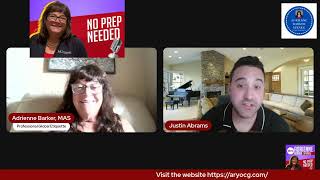
Adrienne Barker interviews Boston consultant Justin Abrams on business strategy, marketing, and automation. They audit a live website, compare business planning approaches, and discuss organic leads versus paid ads, franchising, and AI chatbots for small business owners.
Chapters
My favorite candy in the world. Hi everyone, we're live this time with Justin Abrams, who is bold, brave, and handsome, and he has hair. He's not bald, so he's only 2 Bs. He's a double B, not a triple B. But anyways, Justin, welcome to Adrienne Barker Speaks. No prep needed, which means I have no clue who you are, but I do know enough about you that you're a business coach. So can you give us your elevator pitch?
Yeah, thanks for having me. So this is, yeah, so I run a consulting firm. I really try and I guess my elevator pitch is always that things are getting harder in sales. Google, Facebook, all of these ad campaigns are extremely hard. So I try to take a more modern and organic approach to growing revenue. And then once that revenue is improving, then we really like the way I really structure my business is about as a traditional consulting firm. So, you know, how do we improve? Yes, okay, obviously sales are a hard thing, but then how can we improve the operations? How can we use financials to leverage your business and grow it and grow it and grow it? So trying to think of beyond that, like traditional marketing agency, just like, you know, increase sales, that's all the things that I care about. It's like, how can we grow with you and how can we kind of fulfill your journey as an entrepreneur and as a business owner.
I like that. So tell me about your own. First of all, where are you, uh, dialing in from?
I am in Boston, Massachusetts.
Boston! The best thing about Boston is Cindy Stumpo.
How do you know Cindy Stumpo?
So I know— I don't know, know Cindy Stumpo, but I know, uh, Sydney Stumpo and have had the pleasure and the honor of talking to her because she loves ChatterSocial. Which is an amazing marketing tool. It's a social audiovisual app, and Grant Cardone loves it too, ChatterSocial. So they're both on, and I love it too. I deliver the— I do the Debate the News True Crime with Joseph Tuesdays and Thursdays live on ChatterSocial, and then it becomes a podcast. And then we do— I do the Sunshine Scoop for Debate the News with Jonathan Bing, and that's like my absolute favorite, favorite, favorite thing to do in the world. And it's a, it's a room full of people with their voices. They can go on camera for debate the news. I don't talk about politics, but people will talk politics. Cindy's amazing. Cindy has been doing these mastermind rooms that are unbelievable. So I have an invite if you would like an invite, and it's just an amazing app. It's just all On your—
wow. So Cindy is literally in the town that I'm in. Uh, we're probably a stone's throw. If anyone doesn't really know Cindy, like, her building— like, she's a builder, builder, like a master builder. Um, you can see her properties just about all throughout this area. I mean, it really is— I mean, it's actually very, very impressive. So, um, and my, my family— my wife's family is from this area, and, um, they know, they know the Stumpbos really well. So that's crazy.
Oh, it's so lovely. Yeah, you'll have to come on the app if you, if you like it. Your wife may like it too. It's just really fun. Have you ever been on Clubhouse?
Yeah, like years and years ago, but yes. Okay, that's great.
So Nelson Apega, who is the entrepreneur— and I love this story because this is really a real entrepreneur, right? He noticed that Clubhouse, you couldn't see people. There was so much limitations on it, and it wasn't an easy platform. He would do a million marathon And Jonathan would debate the news with thousands and thousands of people on, you know, on and also on X. But now he knew, well, these are the things I would want as a social audio user and talent. And so he created it. So actually it's coming, it's been, it's public beta right now. So if you want the invite and then it's going to be the V2 is coming out and the ability to monetize, have conversations like this. Stream it right out, but have the people in the audience and not chatting where they can actually speak and say, Justin, I have a question for you. So it's amazing. So definitely we'll have to send that to you later. You'll love it. And if you do see Cindy, tell her it's Adriana. I think she, I think she calls me Adriana or something or some funny name.
Yeah, absolutely. That's classic.
She is beautiful. Daughter. I love it. So anyway, so welcome. So you're in Boston. I was born in Connecticut.
Wow. Okay. Amazing.
And do you have children?
No children. We just got married last year. So we, we just came back from London celebrating our 1-year anniversary, my wife and I.
Oh, how fun. So my parents left a legacy behind in Connecticut. So it is, if you're a kid at heart, it's 80,000 toys in the toy museum, Barker Museum, in Cheshire, Connecticut. So let me know if you ever check it out. But in the meantime, tell us about you. I want to hear about you.
Okay. So I worked in biotech for 5 years. I kind of did that right, actually, right after the pandemic, like around 2020. I really just was— I like business, like I like growing businesses. It's a— it's just a personal thing. I like thinking about businesses. I like thinking about problems. I don't really think about the business themselves. It's more about how do I just problem solve. And business is kind of like a video game on, you know, in reality, right? On steroids. And so during COVID like that was the biggest concern is how do all of these businesses continue to get sales? How do you go from having sales every month, you know, at X hundreds of thousands of dollars to now like 90% or more drop? And so a lot of people are just reaching out to me organically. I wasn't, at this time I hadn't even started my own business. And then after a bit of time, so I went on Upwork, I was like, you know, let me figure out a way to get paid for this. Took off really well. I mean, it was at the right time at the right place. And I just, you know, give my honest advice. And I think I'm like still the number 1 consultant on Upwork, maybe number 2.
Wow.
Yeah. And it's still like a good passive income stream of like people coming to me organically. But that kind of changed my mindset of like starting my own business versus, just working W-2. And so I did that for probably 4 or 5 months before I kind of tested everything out. And then I got, you know, the confidence to start my own business and kind of bring this like professional consulting to small businesses.
I love that. I'm on Upwork. I, yeah, I hit my 100,000 mark. So I was pretty proud of that. Right, right. And top rated, not top rated plus, because one of my clients after 3 years took me off. And so I'm on part-time, very part-time hours on his payroll. And then I run my business. So I know what you're saying. Upwork is if I'm like, okay, I need a little more money and I need a client, I'll go on and I'll grab a business that way. So it's, it does work. Let's go have fun. Let's look at your website. Is that cool?
Yeah, absolutely.
I'm kind of enjoying doing this and it's a little unique, but that is what we're about. And okay, so I like this. So I was already on there. So pop-up form, Fill it out to get your business playbook strategy. So tell me about your experience. What does that look like?
Yeah, like, so I would say majority of our customers are looking for— see, there's some bugs in there. We just made some—
like, wait, where did I— did I— wait, average time?
What is that? No, no, no, you're, you're making me very upset because I get to talk to my developers because we were literally making some changes today. that I, I'm glad this is a good audit that I have to fix. Um, yeah, I mean, my experience is really in just small businesses in general, like very traditional standard businesses, like, um, not, not the biotechs of the world, not anything super fancy. A lot of like, um, gyms, med spas, dentists, HVAC, um, what else, like just dog walkers all over the place. Type of businesses and just the standard processes to help them grow. And you can see some of the, in our examples, like some of the different clients which are, you know, all over the place. Like I've worked with Pfizer, Sony, Bayer, Merck, multi-billion-dollar businesses down to mom-and-pop shops. So, you know, I've had, I think over 3, it's probably over like 350 to 400 at this point. Different clients of all walks of life.
Wow. Congratulations. That's huge. That's huge. Wait, so the service area, are these just, are these cities that you're actually located in or just the—
No, we're just, we're just trying to like cover as many search volume as we can. So we just picked the largest areas, but I would say majority of my clients are just all over the place. Like I don't even have a ton of clients in Boston, although we're expanding more and more. Um, like, we're not— we're pretty location agnostic.
Okay, that makes sense. Um, I have a business, but I don't have a business plan. I don't need a business plan, right? Oh, it's so funny. I was with SCORE for 8 years, so I used to do business plans, you know, volunteer. And, uh, I can't believe how many people— I have a business plan. Oh, I would love to look at your business plan. Oh, the problem is it's up here. Oh, you got to put it on paper. You know, it's— and nowadays, like, you really, you really just— how do you work without a business plan and a SWOT analysis before you start? So how do you do it? So you— like, how does that work for you when you're doing a business plan? Do you use a template? Do you just kind of walk them through it? Do you answer the questions with them?
Yeah, so I, I've noticed the, the— it's kind of changed. It used to be in your head, and now it's like I put it on ChatGPT and I'm like, here's— I want a business plan for a restaurant in Boston. And then like, that's their business plan. I'm like, that is not gonna help you. Like, no. Okay, I'm not like— my favorite thing is the business plan because I think it does limit you a bit. With that said, I like to work to the end goal and just think about like, what is it that you really want? Okay, if you're brand new to business, I still think you should just kind of like figure it out as it goes and like kind of figure out what your bit— what your life can even do. Like, I don't want you— if we're gonna like start working out, I don't want you to be like, oh, I'm going to be the strongest person in the entire world and win every gold medal. I want you to just show up every day. Like, show up. If you can show up for 2 weeks straight in the gym, then we can start to work on your long-term plans. So for me, like, a business plan is a very like paralysis analysis, like it's better to just start. Um, if you're already a business that's been doing it and you're like, you're not really seeing the success or you're plateauing, that's where I feel like the business plan is really helpful. And so I tend to say to the people, like, what is it that you want out of this? If you're 65 years old, your, your long-term vision of your business, like, it might be to sell your business in a year or two. Uh, and you're like going to look to retire. If you're 30, like I have a client who's, uh, he has two landscaping businesses. I think he's about 35. We're thinking like almost like a financial advisor thinks about their 401k. It's like, how much do you want to retire? What does your nest egg need to be? How many people do you want to employ? Like, are you focused on just Massachusetts or do you want to expand out of there? Like, All of these questions are really important. You don't need to know exactly what they're gonna be, but if you're, you know, let's just say just going as it is currently, like, the long-term future is not gonna get solved. That kind of like, you know, we're all working this entrepreneurial job to like end up better than a W-2. And a W-2 has a lot of perks, like 401(k), normal salary every week, You know, all of these things like are, are things that we need to be better at. So that's why when I think about a business plan, it's very much focused on the person and what their journey wants to be and how that relates to their family and what they need and what's their nest egg. And then we can get into the specifics of how much they want to spend on budget and whatnot.
I like that. I also think that, that you not only like you should like when we talk business, it's asking that first question is what is your exit plan? Like that has to be first, right? And then also I love using the Lean Canvas method. Is that something that you do too?
Definitely, definitely. And a lot of clients will come to me with that Lean Canvas already, like partially filled out and just getting an idea of like what they actually want. And that's great. Like, I love using templates, but I don't want to just like pigeonhole them into like, this is the one way we need to think. Like, I'd rather just say, what do you want to do in 20 or 30 years? Where do you want to be? We'll work you towards that over time and not too constrained.
You know, so funny because, you know, you use the word, well, the business plan is going to be fluid, it's going to change, it's going to revolve. But that I have noticed almost does cause a little paralysis, like, wait, I'm going to create something and it's going to change. But I think once people— that's why I always say the SWOT to me is probably the most important part of these plans because people don't think what it could look like. Like a lot of companies didn't think, well, what if COVID happened? What if we had a huge medical? What if we all shut down? Right? But that would be part of your SWOT. Like, I'm that person that would kind of think about that. All right, let's have a little more fun. Let's go here. So we're on your site. What does ARYO stand for?
Oh, that's a great question. So ARYO is a portmanteau, like a combination of words, just meaning in Japanese, it means safe travels. So that was the original plan, was to like just make life, like, let's make it a safe travel of working with, you know, businesses.
I love that. We recognize that a robust business plan is fundamental. Okay, love, love, love that. Let's go to the top. Let's go to services. And oh, there we go. The problem. Sorry, sorry, sorry. That's why you got to audit, right? But you were working on it, so they're probably fixing it right now. Oh, oh, shoot.
Okay, I would say scroll down. Maybe, maybe it's, uh, maybe it's just the top.
Ah, okay, I like that. So you have some of the people that you worked with. Yep, I like it. I could see that professional and personable. I love that. Look at these reviews, guys. Nice. Oh, Riggs, good for you. I had him, uh, he— lovely man. I had him on a podcast 4 years ago with a lovely woman. They almost seemed attracted to each other. And she ended up— she ended up passing away in a horrible car accident. Oh, it was up visiting her mom. She got picked up at Bradley Airport, and on her way, um, she got killed right outside of Southbridge, Mass.
Oh my God.
Yeah, yeah. I always thought that— I always would like when it pops up, I'm like, it was such an interesting, um, very interesting— actually, I made her a guest host without even thinking what I was doing, which is what a lot of people do now. You got some great people here. Look at this, I love it. Okay, let's go. You guys, look what we're doing. We are literally doing— I'm doing an audit, but not really. I just wanted to see what the website is like. You could book now. Oh, so you could book you for, um, I'm thinking podcast, but you could book you to, uh, to set up an appointment. Nice. This pop-up is interesting too.
I'm a big fan of the pop-up, even though it's a little annoying, um, and the, the tech side of it has been concerning, um, You know, I think it does help.
Okay. So it's definitely annoying, but you know what? This is beautiful. This is something that most people don't do right here. 508-545-7447. Why is it that companies, people, podcast hosts, coaches, consultants are so afraid to give their cell phone number out? How? You know, you want to reach someone, it's in your head now. I'm looking for blah blah blah, or I saw Justin and I want to reach him, I got to email him, I'm not even sure. Like, you got your phone number there, dude. I know I sound cool when I said that, bruh. No, but that, that's really the way to— I, you know, I have young kids. That's really the way to do it, right?
Have your phone number. People can call me any day of the week. Like, you, you have no— you have no idea how many people call me and they're like Am I in the right place? Is this the right person? Like, or they get thrown some like AI thing. It's like, you know, dial. It's like, no, just give us a call. We'll game plan this all out and jump on an actual call, but just call me physically. It's totally fine.
I just— I— that is such a big deal, and people are not familiar with it. And the younger generation, they don't even know what a phone is because they think it's just a texting machine. But I love that you— you seem a little young, so I'm gonna say whatever, doesn't even matter your age, but I love that you're offering your phone number. Do you advise your clients too, if it makes sense, if they're going to be taking calls, to have their phone number clear on their, uh, social media and on, you know, LinkedIn and their website?
Oh yeah, I mean, I like to just hit them where the, the audience really matters. Like that pop-up, you might find it annoying and not use it, but like younger people really like to use it, right? It's like if you're under 30, I feel like you don't ever want to call. I'm 33, so like I like to call, but I'm like very old school in that way. Um, and then if you're like, you know, maybe you might want to do a pop-up, so you're maybe in between like the 30s and 40s range. But that's again, like just talk to someone directly. If you're over 50, I feel like you just prefer to call. 45 to above, I think you just call, and that's fine. Like That's who my target audience is anyways. People that own businesses are usually a bit older.
So wait, so when someone fills out your like AI bot or AI agent, what is it going to you? Is it going to someone on your team?
So when they, that chatbot, that chatbot, it will ask for your text and it will start texting you directly and getting you on, you know, if it's something basic, they might just answer it, but it will get you to talk to me. Like I can take over immediately. And start texting you. And, you know, so it works really well. It's for certain industries, it works even better. But you'd be surprised how many, like, people just don't want to talk to a human.
Hey guys, if you're lonely and you need someone to talk to— just kidding around. All right, let's have a little fun. Let's drop some golden nuggets on the people listening and those that will listen. Uh, so, so we know what you do, you're a business consultant. What kind of— you do one, I'll do one, we'll go back and forth. So you start. What's the piece of advice you want to give to someone as they're running their business? Like the generic overall.
All right. The big one I would say is everything that you're like, all of your leads that you're getting, if you're spending on Meta and Google, that cost has at least doubled in the last 2 years. And so you need to get realistic. Okay, you're, you're assuming that it's going to stay where it's at, but even if you just look historically, it's probably gone up 3 or 4x. So if you're worried about, let's just say, tariffs— like, you're, you're a DTC e-commerce brand, tariffs right now may be affecting you 30 or 40 or 50% for one part, whereas your marketing spend is going to quadruple. Like, you're not even thinking about that. That's not even part of your your thinking. So really, really try and get more organic leads and dial that in and spend less on the Facebooks and the Metas and the Googles.
I want to add to that, don't do it yourself if you don't know what you're doing, because you might as well— if you're doing that, send me your money or flush it down the toilet. Either way, that's where it's going. You need experts that really know what they're doing. Definitely right, because that's— people think, oh, I go on ChatGPT and YouTube and I'll find out how to do a Google ad. And no, that doesn't work up. The dog is— hold on, sorry, hold on, let me just mute myself. Let's do the next one.
Okay.
Okay, next one for you.
Oh, you want me to ask you one?
Oh no, you're— you know, give another one.
Okay, uh, uh, advice on a business Okay, I would say another one that's really misunderstood. So I think 90% of my clients are totally okay with figuring out marketing or figuring out organic leads, or they've run, you know, Instagram or whatever. Very few people, if you're running a business, have ever just considered buying another competitor in the area. And I would say like that's probably your fastest way to grow, honestly. If you're, let's just say, like a landscaper, because I have some landscaping clients, You know, we can organically get them. If marketing is about 5% of your total revenue, maybe you can 3x that. So, you know, a great LTV over CAC is 3x. So, okay, 15% of your revenue is coming from, from marketing, but we're never going to get that to be 50%. Like, you're never going to get a 10x. So you can buy a local landscaper that maybe is 65 and ready to retire. Or maybe it's September and it's in Massachusetts and it's, they just had a rough year and they're tired and they're exhausted and super physical. And you can come in and give them a lifeline, buy them out and 2 or 3x your revenue, like really, really quickly. Like, why would you, why would you kill yourself doing more marketing when you have contracts that are, you can just buy for like cost? So that's, that's another advice that I would say everyone understands, okay, you can figure out marketing, you can buy, hire, but like very few people are like, oh, I'll just buy a competitor.
I love that. I love that. Love, love, love. That's a great golden nugget bomb actually. Uh, cause a lot of people are like, oh, I think I will buy a franchise. And then that way it's all in a box. Uh, do you, have you had any clients that have asked you about like buying, purchasing a franchise and what that would look like?
Yeah, so I've worked with franchise owners and I've helped them kind of on the transaction side as well. I don't have anything negative to say about franchises. I think it is like just dependent on who the franchisee, the company is. But one thing I'd say is like they do help on the education side. They help you out if you're in an area that you just don't really know anything about and you want to learn. That is a good way. On the flip side, they take a fee. And if you're like, I don't want to necessarily pay 10 to 15% every year, like I would say start on your own or try and just buy a small mom and pop and maybe not super competitive, you know, franchisee areas. But yeah, I mean, I definitely have found franchises can be good and bad and just, just always speak with someone like I, my, my soon-to-be brother-in-law was considering buying into a franchise. And I said, just speak to a couple of the franchisee owners. Are they happy? Are they not? Like, you don't have to go crazy and spend tons of money in analysis. Just like, literally just talk to them.
I love that. My parents were great entrepreneurs and my dad taught me when, you know, so it's SCORE. If I had someone that said, well, I'm looking to get a retail spot and buy it, I would give my dad's advice, which was always, Go to talk to the other stores, drive like almost all day, hit them up in the morning rush hour, the afternoon dead time, the afternoon rush hour, who's taking out the garbage, go at nighttime when it's pitch dark, is there, are there lights on, like get a full look at everything. And especially he said, ask. Sometimes my dad would just sit if it was like in a shopping area or even a, because we have Barker Animation Art Gallery, our art gallery. So when he was like scoping, I got a chance to see in South Florida, it was like, okay, what does that really look like? Right? My dad would just say, okay, drop me, let's sit here and see, are people walking around with bags? What are their bags like? What are they shopping for? Such a brilliant man my father is. He's, he's pretty amazing. The business he started 75 years ago is still going strong, run by my brother. So yeah, so he's really, really an amazing dad, my mom and dad. So they taught me that. But you agree with that advice?
Totally. And also, in the same way, if you're, um, if you, if you don't own a franchise, but you just want to learn about the industry itself, like, go talk to someone who is retiring or selling their business. Even if you don't want to buy that business, just say, why are you selling it? Obviously, I get you're retiring, but like, how has the industry changed? Every, literally every single industry has changed drastically. It doesn't need to be in software or AI. Like, it's wholesalers of doors, or it's wood producers, or it's landscapers. Like, how has things changed? Has politics affected? Has regulation affected it? I mean, you can look at, has the business environment— are customers still paying top price? Like, no business is great, perfect, right? So just, just ask. Just always try and get information that you can't find online, because online stuff is like It's only as good as you're gonna find. Like, you really want to hear currently what people are thinking.
You know, by the way, there's a— SCORE is a mentor, not a coach. They don't do any of the work. They don't, um, they don't really— they, they're very different from a business consultant and what you would do. So it may make sense for you to see, uh, you know, who is in the industry that is just a mentor. They wouldn't take the business. They're not even allowed to take the business away, but they could act as a subject matter expert when you are a SCORE mentor, you cannot do business with the person that you're doing. So maybe good for you to have, like sometimes if someone said, oh, I wanna do a manufacturing plant, there may be someone that actually has been there for 40 years and can give you some help and guidance without money, but still. So just a thought on that one. I've never said that out loud before. My favorite one is, I say this at most podcasts, stop telling people you're busy if you're a business owner. What a deal breaker. And one more, because this is just happening on chatter. You're like, your brand is your personality. If you are someone that has a business and you like to go on these stages and insult and talk and yell and scream and be just plain nasty, good luck in your business because you know what, it's not cute. It's really like your personality is the one. Sometimes when I hear someone, I'm like, how crazy are they? Uh, and Cindy, if Cindy was listening, she knows what I'm talking about. That, that they would— and sometimes a few girls would, young girls would argue with Cindy, and I'm like, oh my God, you have no clue who this woman is, how smart she is. I love Cindy because she reminds me of my mom. My mom was just like as beautiful as Cindy and as brilliant as Cindy. And, uh, imagine having someone in their early 30s like trying to one-up you when you're Cindy Stumbo. Like, you're, oh, we both put our pants on it the same way. I'm like, No, not really. Cindy has a whole different way of putting on her pants because what she does is just— I have a massive amount of respect for her. But with watching like how some people treat— so you have to consistently make believe you're Disney and you are on stage, be nice and be empathetic. How crazy is that, that a lot of business owners, even the older ones, don't think they have to be nice? They will like— right, their service is awful. They, they, you know, we're just talking earlier about the leadership. Um, okay, give me another one.
There's so many. Okay, so I would say another one is just you— you— so obviously there's been big shifts in AI and technology. I feel like everyone is trying to be like AI first, and then there's a lot of people who are just not even touching it. They're like, I don't want to deal with it. I think The best approach to AI is just try to help it, try to use it to improve your humanization in the business. Let's just say, as you mentioned, going on stage, how do you leverage AI to maybe answer as I have my little chatbot, not to say that it's perfect, but it gets people faster to communicate with me. Not all people, but some people, they can communicate with me. I'm a human. I can't be reproduced in some AI thing, but it's removing some of that friction to get to me. If you want to be like a speaker, maybe have it do an annoying part of your day that you can just reduplicate over and over. It can improve KPI dashboards or something. Now you have a little bit more time to go on stage and speak once a month. Like, try to use the AI, like, really go deep into having it be AI, not try to make it like be a human. That's not the goal. Try to make yourself be more human and try to get the AI to be more like AI.
I love that. Ask AI to interview you and be honest. Show it some of your writing before AI and it'll get to know you. The— oh, you have a water bottle that disappeared in the background. That was kind of cool. The other thing too is that I AI is amazing for business. I mean, like, we're having questions. Even sometimes I'm like, can you explain what this person does? And like, as I'm a 6-year-old, because sometimes I'm not 100% sure. And it creates Excel, reads files. All of that is amazing. Speaking, it can— I have it do a lot of automation. But the one thing I don't do is I don't ask it for topics or ideas for my writing. I come up with the idea first and then I use it. But I will tell you, my youngest is 19. And I was talking to our friends, they don't like it. They're not— they're actually going to be the generation that's not using it. They're against it. Yes, I've noticed that. They, they don't like it as much. They think that it's, um, like fraud and, you know, forgery, and it's, you know, they like— they don't understand the value of it yet. And like, okay, so I, I love to speak on stages too. I use it to do the whole writing. I mean, it'll go through an Excel file for me, tell me which speaking gigs are actually good for me. It'll write the email for me. It'll do the whole thing. So I think there definitely is a, a place for AI, and I think it can help seniors too. I mean, I think that any age could really use it. So I love that. So anything you have to delegate, you continue to do it. David Meltzer— I don't know if you know David Meltzer. He's a great speaker. He says— I'll tell you what he said. He says, um, learn to love what you do and then learn to love all the things you don't love to do. And I thought, oh, that's great. It's not about if you love what you do, you'll never work a day in your life. It's about learning to love the things you don't love to do. So I love that. Do we have any more that you want to share? I know we're coming to—
I have so many, but you know, I feel like It's, it's so dependent on the industry, but I will say this. All right, I, I was a very much a lurker on, uh, Instagram, Facebook, LinkedIn, all that stuff. I, I like, I'm not like naturally trying to like go on like social media. Um, but one thing I would say is like you, you like get more warmed up to it over time. And I think it does add value, like it does add leads and there's there's like a non-egotistical way to just like try and educate people. And that's really how I would approach, like even if you are, you know, a landscaper or a power washer, I've seen some like amazing TikTok people. All they do is just like clean windows and power wash. And it's like, those get like hundreds of thousands of views because it's like very meditative. So like there's fun ways to like approach boring industries. And I think like the more you can just like reach people, uh, Ryan Serhant, the New York City real estate guy, was talking about like TikTok and people were very much against like why he would be on there and whatever, because there's no like 14-year-olds that are buying homes. And his insight was like, I don't care about the mom and the dad trying to sell. I care about the kid who's going to sit at the table and talk to their mom and dad. About this guy that they saw and how like the dinner conversation is, it's a really powerful communication method. So like I would just say try and try and like don't try and hit your ICP always. Try and just get your content out and your education out and like weird ways to like communicate with like the parents is actually in the long term very powerful.
That is excellent advice. I'll just add on to that. Make sure, because I love doing LinkedIn for people and I do their like LinkedIn profile optimization and then strategy, how to reach out. And let me tell you, I can't tell you how many I'm like, can you just check your contact information? And they'll say, oh my God, I haven't had that number in 5 years, or that's not even my website anymore. That's not it. And I'm like, that's what people are finding. That's what they're seeing is your contact information that's completely wrong. So fix it and make it visible. So you've been a great guest. I really appreciate it. Is there anything that I didn't ask you that you Wish I asked you?
No, I mean, this has been great. I know, I love this. Um, you know, I think you asked great questions.
Thank you for no prep. No, no prep. No prep. I always think when I say no prep, I think it's like a colonoscopy show, you know. But anyways, we won't talk about that because that's got a lot of prep. Um, okay, so thank you so much for being on the show. I really appreciate it. It was nice meeting you, Justin. Hopefully you'll have a chance to, uh, Tell Cindy or tell your wife to tell Cindy that you met Adrian Barker from Chatter. And again, if you want the app, let me know. You can sign up under ChatterSocial.io. So it's in both Play Stores and they're like little blue bubbles. And then when you see that, and if you sign up, just send me a, send me an email and let me know that you signed up and I'll send you the invite.
Perfect. Adrian, thank you so much again.
Thank you. Have a great rest of the day. Thank you. Bye-bye. That was great, Justin. Thank you so much. Oh yeah.










