Live with Michael Forman
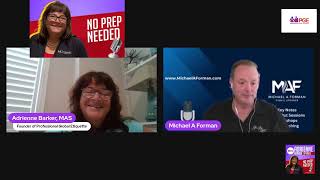
Adrienne Barker talks with Air Force veteran and networking consultant Michael Forman about handshakes, table approach, follow-up timing, and why handwritten thank-you notes still matter. Forman shares stories from his book Networking Unleashed and explains how introverts and extroverts can work a room differently.
Chapters
We're live. Okay, so today you are the fourth interview that I am having because somebody backed out because they got scared. Because you have to be brave, bold, and beautiful, right, Michael, to get on to a live. And you have to be trusting, and you have to trust me. And you probably looked and said, oh, she's credible. But it's not about me today, so I'm glad you're here. I'm so excited. Right on time. And now I get to ask you the question because I don't know who you are. I only know Michael Foreman. I literally don't know anything about you. So who is Michael Foreman and where are you? Where are you right now? Like, where are you in the United States or the country?
Well, I am in Cumming, Georgia, uh, in the South, and it's really nice. I'm a transplant from New York. I moved down here about 6 years ago. Um, starting back from way back when, I am an Air Force veteran. I'm a veteran of Desert Storm. Um, I have since gone through my own, um, my own companies. I owned a graphic design studio, a pizzeria, restaurant. Um, I was in the mortgage industry, the law industry. I've been around to gather my experience with networking and communication.
Amazing. First of all, thank you for serving, and thank you for, like, your bio. That was really interesting. And so, so you were in Cumming, Georgia. I'm familiar with that. That's a pretty area. I'm a Connecticut girl.
Oh, good. All right. So I was right up in New York, so I'm I was right next to you.
Yeah, but you were more creative. I followed everyone. I followed all the New Yorkers to Florida. You said, I'm not going to Florida, I'm going to Cumming, Georgia, because you're all not coming with me.
It's exactly the way it happened. Yep, absolutely.
Because that's unusual. Oh, and I've also— I— oh my gosh, have you been to Mount Helen?
No, not yet. Not yet.
How far is it from you?
Uh, just a couple hours. It's not bad, not a bad drive.
It's so beautiful. It's— you're going to be so shocked. It's the Swiss Alps of— it's like weird that's in Georgia. And then on your way, please go to Babyland Hospital.
Okay.
Do you know what Babyland Hospital is?
Nope, never heard of it.
Oh, it's the Cabbage Patch Hospital where the Cabbage Patch Babies are born. They're incubated, they meet other babies, they get released. No.
Okay. No, no, but I will put it on my, on my docket to go see. Yeah.
So what do you do? What do you do for a living?
What I do is I'm, I'm a corporate speaker and I go around the country and I inform and educate everybody that I can. About business networking, communications, and how that transform your business, make more profitability, but how you use it in everyday life as well.
I love it. I went to the Protocol School of Washington, so I do something similar. So let's have some fun. Let's talk. Let's— I'm going to ask you questions that I may or may not know the answer to, but I think that people really need to know. So First of all, like networking in person, networking on Zoom, networking on the internet, do you encompass all the networking?
Both. I prefer in-person networking, and because it's— there's so much more. You, you have to get a feel for the person that you're speaking with. And not only that, but you can see what's going on around you. So when I talk about business networking events, I talked to you about when you meet that person, when you build the rapport of that person, and you are listening to that person, and you're, you're responding, and everything is a one-to-one, and it feels very good, as long as you are present, as long as you are giving them your full attention. But also, with the advent of the pandemic, you know, virtual really has come into its own. Um, but I still feel it's about 50/50 now, uh, because I do workshops, I do, um, uh, coaching one-on-one. I do all that through Zoom and whatnot, but I prefer to go out to the meetups, the network meetings, the conferences, the summits, and I like to talk that way.
I love that you could do all your research of everyone that's doing things wrong because, Michael, I want to ask you, like, to me, I've always felt that Sometimes the fault lays into their sales manager or the owner of the business that says, go out there and bring me back every business card that you get. And then what happens, Michael?
Well, you know, you, you hit, you touched upon a great point because there are leaders and there are bosses. And the bosses will just yell, get me back all the business cards and everything else. The leaders will will go out there with you and show you and be part of that with you. So there's a huge difference. But I really talk about, you know, when you go to a networking event, um, you shouldn't really take back more than 15 or 20 business cards because otherwise you really didn't get to know. And I have a funny story for you. Um, when I was at one of my networking events and I was at a table of about 5 people And a guy walked right up and you saw salesman written all over him. And he said, look, here we go. Take my business card. Boom, boom, boom, boom, boom. Hey, look, let me just have all of your business cards. Boom, boom, boom, boom, boom. Hey, listen, I want to talk to you, but I can't hit everybody at this event. So I'll talk to you later. Goodbye. And all of us were sitting there like, what's going on with this card? You know, and everybody took that card and threw it out. So he took the opposite approach. My approach is walking up to the table, not saying a word. You don't talk. Okay. You listen. You listen for the conversation. Is that a conversation I want to be a part of, or I can contribute to with something educational or not? If it's not, you haven't said anything yet. So you can very politely bow out and go to the next table. But if it is, then you wait for your opportunity. You say the two sentences that you want to say about the conversation, and hopefully it was enough where at least two of the people responded to you. And then you can focus on those two people. And when they respond to you, big thing, you listen to them. You listen and respond what they're asking. A lot of people walk up to you and, and, or are already thinking the next thing that they have to say. And that's wrong. You have to listen, pause, big pause after you listen, because that's telling the person that you're listening to them. And then you respond. And that's the way. And then you go into the building the rapport and everything else.
I love that. I remember I was, uh, I was at, in, in Hollywood, Florida, my first time at the chamber event, and guy came up to me and he's like, do you have a dog? Do you have a dog? And I'm like, oh no, I don't own a dog. And he like walked away. And I'm thinking, I know people that own dogs. So my parents have a dog. Like, what are we like that? But I've always said to myself, if I make one connection, I'm happy. So that, that to me has always been important. But while you're saying what you said, I want to just say Also to everyone that's in the room networking, not to make themselves closed, right? Like, don't have— form a circle. Keep it open. So if one person in the group is smart enough to say, let's keep it open, then you're approaching the table or whatever it is comfortably. What I've noticed too is that some people will say they'll start the introductions and they'll get like 3 or 4 and then they get tired. And like, all of a sudden you don't meet the other people because whoever's doing the introduction— so if you're the introduction person, make sure you go through. And for me, I tend to want to say, oh, Michael, Michael, how do you spell your name? I know that sounds so silly, but you may be totally not like dropping the H. Like, so pretty much every name would have a different spelling. And then even that, if you had a different spelling, I'd be like, why'd your mother give you that name? Like, that's so unusual. And that's like, so I like, I love this because there's always like different tricks to the different things when you're going to a networking group. Okay, next question. Okay. I'm going to the networking group and it's okay. I'm starving. So I'm going to be able to eat all the food there while I'm talking to people. And I hope they have lamb chops on a stick.
Well, first of all, bad, bad, bad. Okay. You never talk to a, talk to anybody with a plate full of food or a mouthful of food. You know, that's unless everybody at the table already has food and then it's, kind of known. All right. But if you're walking up to a table, I don't care if you're starving. Okay. But if nobody else has food, don't bring food. Okay. Because that's a, that's a faux pas. That's bad. And you can't really talk with somebody, respond to that person, listen to that person and eat at the same time. So you're wasting your food.
I love this. I love this. All right. I'm walking into the I just walked into this networking meeting and I am nervous. I'm going for the scotch and soda and I have the drink. I'm right-handed and I'm holding it in my right hand.
Okay. Well, you should always hold it in your left hand. Okay. Because your right hand is used for shaking the hands of the person that you want it, that you're talking to. Now, there's a lot that goes into that because, all right, so let's say you're bypassing the networking event and went straight for the bar. But you know, you're going to meet somebody, you're going to walk into somebody and start talking to them. How do you do that? So you have to look at them in the eye. Okay. Look at them in the eye, give them a firm handshake. Not, not a dead fish. Not, you know, the way everybody— no, because listen, a lot of the women I network with, you know, they always feel that, oh, it's just a little handshake will do. No, because women, they come up to me and they give me a firm handshake. That tells me that A, they're confident, and B, they're ready to talk. Okay, so, you know, you can go into your, your 20-minute elevator speech, your, your 30-second elevator speech, but your 30-second elevator speech should only be 5 seconds. What is the idea between your 30-second elevator speech, and that is to get a response. That's all you want is a response, and then you can go into the second half of your elevator speech. Okay, but if you just think of something that you do that you can explain in 5 seconds, just enough to pique the interest of whomever you're talking with, that's what— that's your job.
I love it. I always try to like tell my clients to ask a question because that's always like a great start with a small answer. Love it. Mitchell TV always says, a point of— CPOP, your point of possibilities. Like, just enough just so that they ask questions. So I love that, love that. I'm loving this. This is so much fun for me. Okay, so now— okay, so now I'm in the— I'm walking in and I got a call. I gotta take the phone call. And now I'm walking around. You see me and you see me like this walking around. Am I doing the smartest thing that I should be doing? Am I representing myself, my brand, or my company if I actually walk in on my phone?
Nope. You're doing yourself a disservice. The first thing that I do before I walk in is turn my phone off. Well, turn the sound of the ringing off because then if it's important or not, doesn't make a difference. I didn't hear it. Okay, so I put the phone away. The number one distraction for anybody in today's networking world is that damn cell phone. Okay, so if you are sitting at a table and you have a cell phone out, bad. If you took the cell phone, put it upside down on the tabletop, that's bad because you can either hear it, see the light, something, and it's going to distract you. And what is that telling your prospective client? He doesn't have, or she doesn't have, your 100% attention. So take that cell phone, put it in your pocket, your pocketbook, put it away as soon as you walk through the door. Listen, unless you're a doctor and you really need it, uh, because I've said this to attorneys and I've said this to everybody else, put the cell phone away. Okay? Because for 3 hours, it's not that important.
This, this is just like so dreamy, by the way, shaking hands. I'm, you know, I said, I mentioned I was a graduate of the Protocol School of Washington. We took like half a day to learn how to shake hands. I mean, It's not like, you know, practice with your handshake people. All right, all right. I am— I was in a hurry. I had a flat tire. I, I, I all of a sudden I tripped, I fell, and now I'm up, I'm walking in, and I feel like I have to go and tell everyone what happened to me. Oh my God, hi Michael. Oh Michael, it's nice to meet you. Oh my God, do I look okay? I just got— I just had a flat tire and I came in. I'm a little sweaty because of that. That's okay to do, right Michael?
No, no. You know why? Because nobody's interested in what just happened to you. Listen, God forbid something seriously happened to you and you had to be taken away in an ambulance, but if you had a flat tire or something happened to you, you got into a traffic accident— not a bad one, a traffic accident— that's before the networking event started. You should walk through that door fresh. You know, and there was about— I was a Little League coach for about 16 years. I was an umpire for 3 years, and I was on the board of directors. And one of the other board of directors, at the end of the meeting, said, okay, I have to get home. I was in a car accident today. I said, oh, I'm sorry, you know, what happened? Oh, nothing. I was in my SUV and I rolled down a hill. And my car was totaled and the police came and everything else, but I made it to the meeting. He didn't say a word before the meeting. And that's exactly what you should do.
Wow. I love that story. I love this because it's so fun to like hear the answers and know that you know what you're talking about. You are amazing. This is so much fun. Okay. Let me come up with a couple of more for you. Hold on for a second. Um, okay. So I'm walking over to the table and the table only has 4 people. And I'm kind of standing. Should the people at the table stand up to greet me, to say hello, or should I sit down and not kind of like look at them glaringly like, you're supposed to stand up, like, come on.
What do you do? Well, usually, you know, it's, it's, you have the courtesy when a woman walks up to the table, you stand. Okay. Until she sits. And that's, that's, that's great. But if it's a huge networking event and people are coming and going, uh, generally they don't, they don't stay, they don't sit, but they really don't. If everybody's standing, everybody's standing. If everybody is sitting, then you should just be polite, go over and sit down. Okay, because in today's day and age with a networking event, I'm emphasizing a networking event because it's not the status quo. So at the networking event, if everybody's sitting down, you'll walk up to the table and you just sit down. You may say something as you're sitting down, but you sit down and then you listen. Or you may walk up to the table, you listen first, see if it's a conversation that you want to participate in. If not, you just keep on walking. Okay.
So either way, I do like to ask if I can sit there, like, may I take the seat? Because sometimes, like, you know, maybe I'm confused or they put their pocketbook there. There's not a lot of seats. So and then usually someone will say, oh, absolutely. And then that almost like warms you up, right? Because now they're making— they're inviting me to sit at their table even though I asked. So I love that.
Very nice.
Now we're going in. So from the networking, we're going in to listen to a speaker. And so we're going to hear Michael Foreman. I don't know if you've met him before, but he's an amazing speaker. You know where I'm going to sit? I'm sitting in the front and I'm not going to be on my phone because I'm going to concentrate on Michael's— what Michael's saying. Because Michael explained the importance of A, getting rid of any distractions. And actually, if I'm sitting with someone who is on their phone or tinkering or doing something, I move. And then so, so I want to hear, like, you share this golden, like, bomb about, like, the importance of really sitting and not checking your phone and not doing— even though everyone's around you, how can you make sure that you just concentrate and then, and then like, you know, just focus on the speaker?
Well, as a speaker, the first thing that I do, and I very nicely and politely, if I'm a keynote or if I'm part of a breakout session, I very politely ask everybody in the room to turn their cell phones off. Okay. And I explain that That is a distraction, whether you think so or not. It's a distraction and will take away from something that I'm telling you. And even though I may have slides, I may not, you know, you may miss something. And I really don't want you to miss something because everything that I'm telling you is going to be that important. And so I just go along with it that way. So that's from my speaker point of view. As a participant, The people around me, if I've gotten to know them or not, I will always very nicely, I will make a big thing of me turning my phone off and putting it away. So they see that that's what I'm doing. And if somebody right next to me is playing on their phone, then I just very politely say, look, you know, do you mind? I'm really trying to listen. To the speaker, you know, and just keeping it all on a very nice note. I'm never— am I going to demand somebody to turn their phone off? Because who am I to demand? Um, it's up to them if they want to receive all the information that I have to give. Exactly.
So sit in the back of the room if you want to be on your phone. Like, just go all the way in the back and don't distract anyone.
Exactly. Because you know what? I don't want to talk to those people anyway. Okay, so, you know, the people in the front, people in the middle, people almost in the back, they want to listen to me. They came there to listen to me. And so I want to give them everything for their dollar.
And by the way, when you do go like in the front, like I love sitting in the front, I'm always conscious of even where I sit. I don't sit at the end. I like kind of move over, or if I want the end seat, I would wait till the aisle is filled and then sit. I don't like You just like, there's this lack of actually like empathy to like, you just plop yourself and then people have to go around you. It's, to me, it's a little weird. So, okay, so, but the last event I went to, they had shrimp, they had shooters, they had this chocolate cake that was delicious, and the bread. I want to bring it home. I want to share with my family. I have a couple bags in my big pocketbook. Okay, couple containers, but nobody has to know I'm taking the food. Everyone else goes to sit down. I'm going to grab my food to go and then I'm going to sit down because that's like what I should do because otherwise they're going to waste the food. Michael, I'm sure the rest— I'm sure this place knows that, you know, what's— it's always going to go in the back thrown away. So I want it.
Well, the networking events I've been to, there's always enough food. There's always more than enough food. So if you have to be one of those, it's like the people online in the airport. You know, they have to be first online. Okay. The same as the people for getting the food. They have to be first getting the food or they have to be first. And it's, it's okay, but it's not okay. You know, let other people go and this way you can mingle. You can, there's always things to talk about when you're online.
I'm talking about taking the food home. I'm talking about taking the food home.
Well, you know, that's really up to you. Okay. If you don't, you know, you don't want to be seen. Filling your pocketbook up with food because that kind of gives you a bad look. But if you want to take a few things, take them off to a side and then put it in your pocketbook, that's— but that's something that's entirely up to you. That's up to you for a person, personality, and everything else. So I don't want to say whether that's right or wrong.
That's funny. But to me, I'm gonna eye you and go, I'm either on the side, I like, that's unusual. First, I want to be brave enough to do that. I have no— there's no ounce I could be brave going live and a lot of things, but I like, weirdly enough, I could be brave going over the scariest bridge, but I am not brave enough to try to take something home. I find it's weird and it would just make me feel weird. And then I know it would mess up my pocketbook too and it would get all squishy.
Yeah, no, no, it makes you feel uncomfortable. And honestly, it makes me feel uncomfortable standing next to you with you putting stuff in your pocketbook. So, you know, it's a comfort level. It's a comfort level.
I love that. A big pet peeve I have is that you're at the dining room, you're at the, you're now at a network dinner or lunch. It's delicious. And the rolls are in front of Susie, who's across the table. What do I do?
Would you mind passing me the rolls? There's nothing wrong with saying that or saying it to not Susie, but somebody in between the two of us saying, oh, Mark, would you mind passing me the rolls? You know, and if you do it nice enough, everybody— because everybody's sitting down eating, they're having a good time, and there's no reason in the world why you can't ask for something like that. If you ask for 2, 3, 4 times, that might be a little overboard. But you know what, one time asking, there's really no problem with that.
And I always try to train people when I do my networking, you know, dinner, uh, Savvy Dining. I always say take one and pass it to the left, please, so that nobody has to ask. So when you're sitting at the rolls and they're right in front of you, I'm thinking you're a little selfish if you're not like understanding. Like, like even before I knew etiquette, you know, to pass the rolls because it's sitting in front of me, why would I make some— anyways, so that's an important thing because you don't want me looking at you going, what the heck is going on with that person?
Right, right. But you're right, you— if once you take a roll, you always pass it to your left or pass it to your right, but pass it to your left and have it go around the table that way. Because if person wants something, then they'll take. If not, they'll just continue to pass it.
I, you know, this is so important because they're like the demographics too, right? Like as we're teaching, as you're teaching, you know, high school students going off to college and or college graduates getting to network is much different than the 30, like 40 years old. Even like sometimes like where I see a lot of food taken is, you know, a lot of seniors that go to the events and they'll take the food home. And, you know, which, which at the end of the day that I say to myself, they're really not here to network. There's a lot of open meetings that people come in for food. And so what do you, how do you address that?
Well, everybody has a different reason for going to a networking event. Some just make it social. They just want to go out there and just see people and talk with people. And it doesn't necessarily have to be about business. About their business, about anything like that. It's just a social event. Other people are 100% there for business, and don't get in their way because that's all they want to do. You have to find that middle of the ground. You have to be social enough, yet you have to remember that it's business. And if it costs you money, then it's even more important. And I always say When you go to a networking event, go alone. Okay? Because you don't want to go with somebody because you don't want to share anybody that you're, you're dealing with. And so that's a whole nother story. And it really goes into, because I do, uh, when I talk, uh, in breakout sessions, I talk about introverts versus extroverts. And it's great as you're an extrovert, but what if you're an introvert? Then how do you handle all of this? And I go into that also.
I love— that's another thing too, as, as like, so let's just say you're, you're the owner of the company, sends out 3 people to represent and go to the networking meeting. It doesn't really give any clear direction. And then all of a sudden you see everyone sitting together and they're— I'm like, you're, you're supposed to be networking. So I think it's important for those leaders to really explain what, what they would like to see. And you know what? Because people will, there's going to be someone in the crowd that's going to be like, I'm going to call Michael and tell him that his employees are all sitting together and they are not networking. They're all on their phone at the table.
Well, that's the difference between a leader telling you to go and a boss telling you to go. A boss will say, look, there's a networking event at 8 o'clock. I want you three to go and network. A leader is going to tell, is going to give them more advice. And he's going to see, well, this is my senior person. I don't have to really tell him about it because he knows what to do. But the two that are his junior, well, you know what, let me guide them a little bit. And let me tell them how to do it. And afterwards, I'm going to ask them, are you okay with it? Do you— now you tell me, what are you going to do? And they tell me, so I say, yes, do that. But don't do this. I give them a little bit more of the leadership that I'll do in my talks.
I love this, Michael. I had— so interesting. So I'm on this chatter app called Chatter Social, and it's like actually like sometimes being in a living room with other people, but you actually can see them and you can hear their voices. It's the most amazing app. It's just incredible. But one of the things I was— I was talking— it was a room about fear. And I have done so many networking events in my life. And then all of a sudden I was in Tucson and I was at the American Cancer Society. Work for ACS. And I think you said you— no, it was somebody else that said they work for Canadian ACS. But anyways, I work for American Cancer Society. And all of a sudden, I like, I couldn't network. I just found myself in a corner. And from that day on, I like, even when I just joined our local chamber, I'm like, I'll go to morning and lunch networking events like all day long, but I cannot go to the after-hours events. So I was on Chatter and I was like bringing it up and I got some really great advice that I was not alone. And what was going on with me and, you know, and to honor like kind of like the, the, the feelings that I were having that maybe were even more than just like being in a bar talking. But I would love to hear your advice or thoughts.
Well, if I was— because I belong to the local chamber also, and they're great for meetings and meetups, and, and, you know, the people that go to those are 90% the same people, and they go. So if you see somebody come in and I, I I call this being the host and not the guest. If you see somebody walk in and they stay against the wall and they really aren't that— because they don't know where to go— then you take it upon yourself to walk over, identify yourself. Hi, I'm Michael. I do this and that. What's your name? Right. What do you do? Oh, you know what, that table over there is filled with marketing people and they were probably would love to hear what you have to do. Come on, let's go see them. Walk over, introduce him to the whole table, and let them talk. Okay, so what did that do? That brought— in his eyes, that elevated your stature. You— he'll never forget you and what you did. And that also gave him the beginning to begin his talk. So it kind of helps both ways.
It really does. I, you know, I, I know that there have been times when I've, I've had, you know, like the ambassadors of a chamber, and that's their goal is to, you know, bring someone in and introduce them. Unfortunately, a lot of times they're just talking to each other, like they almost forget like their role. I'm sorry, my hair is bothering me. They almost forget their role and what they're supposed to do. So I, I like, I'm kind of like introvert extrovert. Everyone say I'm an extrovert, but like there's part of me that's introvert too. But I we'll actually go up to a Chamber Ambassador and I'll say, hi, I'm so-and-so and I'm just new. Would you mind showing me around? Because sometimes we have to direct them because they forget that they actually do have a role to do, right?
Yeah, but they're having fun too. They, they should be— they should forget about having fun and they should be doing their job. Because instead of you being a member and seeing that person against the wall, they should take it upon themselves. But really, you don't wait for that ambassador to do anything. You have to take it upon yourself. And really, even you as an introvert in that situation, if you see somebody walk in, that will help you because it's really one-on-one. Okay. So it'll help you as well as walking them over and getting you into the, uh, feeling of the networking event. And so it'll help both of you.
I love that. I know. I remember, like, I was at an event and I saw this woman and she was all alone. I'm like, all excited. So I'm going to go over to her. And by the time I reach her, like, her whole crew was there. Yeah, that's right.
That's right. And you go, oh, I didn't sign up for this.
Awkward. I mean, I think it really important is to be authentically yourself. But like, you're with these tips that are so important to make sure that you're doing something correctly. All right, you're at the event, the networking event. You're talking to such a lovely human being. And as they're talking to you, they have spinach between their teeth.
Well, you know, that really depends on how your conversation is going. If you feel it's that short conversation, just a hi and goodbye or hello, then you really don't say anything. But if you're talking a little bit and they have something and say, you know, I You might have a little something in, in, in your teeth or your mouth or something like that. And they'll say, oh, and fix it. And you just move on with the conversation. So you really have to gauge that on how well your conversation is going and how well you're getting to know that person.
I, you, you have such great advice. I love this. It's like my brother. You're my brother, Michael Foreman. They call you Michael Barker. No, you really are. You're, you're really great. I would love to. So are you local with your workshops or are you Do you travel? What do you do?
I am countrywide. I travel United States. I was in Texas a few weeks ago, Ohio even about one week ago. I'm going down to Florida for another workshop. Um, I go all over and I just, uh, I enjoy it so much, uh, where it's, it's, it's fun to me. It's fun because I get to go out and I meet and greet and say hello to everybody, and you never know who you're going to see at these events. So, you know, and I want to tell you that when you first meet somebody, I want to tell you before we get into everything else, when you first meet somebody, that's great because you're meeting them, you're going through the whole thing, you're building that rapport, you're breaking down their walls, you're communicating. But when you follow up with that person, The follow-up is almost as important as first meeting them. And I have a certain way, because I, I wrote a book. Oh no, Networking Unleashed. Networking Unleashed is available on Amazon, or if you go to my website, it's michaelaforman.com, you can get to it right from there. And, um, it tells you from soup to nuts exactly what you should do. And my most important thing, that the takeaway that your viewers or anybody else wants to take away from our whole conversation is after you meet the person, after you— on the back of their business card, write down the date, the name of the function, what you spoke about, and it's writing that follow-up thank you note, and they write a handwritten thank you note. So you send that email, say thank you for meeting me that night, but the next morning you have their business card, you have their address, you write a handwritten thank you note, and you— it goes on from there. But that is the best way to put yourself above everybody else. How do you make yourself stand out from everybody else that this person met. That's one way of doing it.
Well, I don't know. I'm the life of the party. I walk in there. I make sure everyone notices me. I'm telling jokes. I'm waving. Hey, I'm Sally Ann again. Hi. Hi.
Hi.
Well, I'm seeing you now. Oh, hey everyone. Like I tell story tell. Like I'm the life of the party.
So you are the life of the party.
I'm not doing anything wrong.
How many clients have you gotten? That's the key. That's the reason why you're there. So yeah, so every time I walk to a networking event, I am always the center of the conversation. Why? Because I put myself there. Okay, but that's not getting the information back. I'm only getting information back from the people that I want to get the information back from, and that's where I get their business card and everything else. So I'll tell you my surefire way of following up. I'm going to tell you that evening when you go home or go back to the office, you write a thank you note. Hey, Adrian, thank you for meeting with me. I had a great time. Hope to see you soon, Michael. And that's it. That's all I'm going to write. No date, no time, no anything about business, just a thank you note. But the next morning, I'm going to write a handwritten thank you note or actually from the last podcast, he gave me an idea of the Facebook video, but a handwritten thank you note saying, hey Adrian, this is Michael. I saw you on such and such place, such and such time. We spoke about your son Johnny. Um, I heard he got hurt in Little League. I'm sorry. I hope he feels better. Michael. Now the first email, you have about a 20% chance of them responding. By that handwritten thank you note, you just upped it to 60%. Okay, so that's incredible. But let's say that you still haven't received any word from him yet. You wait about 3 or 4 days because the mail is a little slow here and there. You know, you write an email and say, hey Adrian, this is Michael, remember me? Such and such date, such as time I spoke, we spoke about your son Johnny. Listen, my calendar just opened up From Tuesday or Wednesday of next week, how's Tuesday? And Michael. So now I upped that 60% to about 75%. Okay, because unless, unless you're— unless I really did something wrong, you're not going to answer me. Okay, but unless I did something wrong, you're going to answer me. All I'm looking for is a positive or negative response, but I'm just looking for a response. And then there's more to it after that.
I love it. What I— what's worked for me, because I have such horrible handwriting, they wouldn't be able to read it anyways, is I would say, Michael, are you on LinkedIn?
Yes.
Okay. And we just had a great conversation. Do you think you'll remember me?
Yeah, well, of course. But listen, that's always LinkedIn, Facebook, Instagram. You should— every person that you gather your cards from, you should immediately go out and send friend requests. So you, so that's called a soft touch. So you can—
thank you, it was lovely meeting you.
Yes, I know it is. That's, that's a good way. But I have my wife, because she has beautiful handwriting, write the card and I sign it. Okay. Because I too have horrible handwriting. Okay. But, um, I still think that handwritten because it's not electronic, not anything. Well, listen, what could be better is if you are sitting down in your office, they come by with the mail and there's a thank you card. They'll love it. Totally.
I mean, there's no question. There's no question. But I, for those that don't have a wife that can we, can we, can I hire her? That, that, but no, you're right. I mean, there's not a question that that is the correct way to do it and thank people for meals and dinners. But I'm not that great, so I just do the LinkedIn and then, you know, do a little, a little mention of, you know, how fun it was to meet them. And that does, that does connect us. Like, you know, the big thing is, is to make the impression. I also, by the way, Michael, this is kind of interesting advice that I do myself, is that the minute I step out my door, I make sure that there's a camera on me in my mind, right? And that so like Because you don't want to be the person— have you ever gone to a meeting and you're like, there's a weird driver and they're driving awesome and you're on the highway going, God, this person, and you kind of see them and next thing you know, they're in the meeting with you. And the first thing when I see you, I'm like, all I know is that you are a horrible driver. You know what I mean? Because people will watch, right? So even where I park, I don't park where the employees park. I make sure I park correctly. I get out of the car correctly. I never go on my phone. I don't know if that's good advice for you. For my advice, it's for me, it's good because I'm always thinking, okay, I want to make sure that I am who I am, especially as an etiquette educator, right? And especially you as a network expert, is that it follows through, right? Like me, you know, my home, I could do whatever I want. But the minute I walk out the door, I'm very careful. I drive carefully, I park carefully, I just do everything carefully. And that has worked for me for over I'm 62, so honestly, 40 years.
That's funny because so am I. I'm 62 as well.
What's your birthday? What's your birthday month?
June 6th.
June 28th.
See that? We're close. Very, very close. Um, you know, I, I too, I, I park. I don't look for the closest spot. I park not so far away, but a little far away. So that my car is not in between many cars. And I always keep myself presentable. I'm a military guy. Okay, so everything has to be perfect. Before I walk through the door, people say, you know, people aren't really, you know, you don't have to look perfect every time. No, because I have to look perfect because by the time I walk through that door, something is going to happen. Something's going to discombobulate. Okay, so if I look perfect, because I, I, on my suit, I always, because I was a police officer, so I have my shield and I have the, my Desert Storm, uh, war medal on top of it. So I always have that with me, and it's a good conversation starter as well. So, you know, I always make sure I look, make sure that's all straightened and I walk through the door, and then I can take on whatever they, they have to throw me. But I'm giving myself little advantages before I walk through that door.
I, I, I, I think I love you. Can we just call your wife and just tell her to move in with my husband and write letters for him? And I—
that's it. That's it. We'll throw her out. No, I can't throw her out.
Amazing. No, amazing. I can understand why this gives you a lot of joy and pleasure, because it's actually needed information, because Parents that haven't worked and their children are graduating from college, they will have no idea how to act in public and how to network correctly and how to do Zoom. I did a Zoom, uh, I did some Zoom, you know, the etiquette in the new area, era, in the new era of Zoom. Or, you know, I mean, how many times the judge in Miami had to tell his attorneys that no, you cannot take a case in your bed. And if you could put a shirt on, like dress up and get to the computer, would be much better than like— what crazy people. Even now I still see, you know, just— I'm not even touching my hair because my bangs are killing me. Like, not smart to do. Don't, don't follow me in this one. Just my bangs, that's my thing. My bangs are my thing. But listen, you are amazing. So I want to make sure I'll get all your information. Uh, do you have a speaker sheet?
Uh, yes, I do. Yes, I do.
Okay, awesome. Awesome. Because you know what, we— like, I, I didn't look you up. I'm assuming you probably have a lot of connections on LinkedIn. You have your speaker sheet, and so I can, I can promote you and make sure that you get the business. Because the more trained employees that you have, the better we will be. We really— because we need businesses to succeed. And it's unfortunate that a lot of businesses don't because of like a bad reputation. The other thing is, are you teaching customer service?
Absolutely, absolutely. That's all part of it. You know, the last workshop that I did, believe it or not, was a metal roofing company in Ohio. Okay, and not only their salespeople, but their back office people, their finance people, their warehouse people, And one of the questions I asked them was, who is the salesman? And only like 4 or 5 people raised their hands. I said, no, that's wrong. You're all salespeople. And you just answer the phones. You're first and foremost a salesperson. So when you speak on the phone, you have to convey that to your customer. You have to look, you have to smile. I put mirrors in front of all the customer service people. And I said, you have to look into that mirror, smile, and say, hi, how you doing? Because they can almost see on the other end that you're smiling and that you're happy to be there.
Exactly. I am loving this conversation. All right. We want to have you back to talk about customer service skills because that's important. And, well, my partner and I are having— we're doing a podcast, so we'd love to have you. We'll get you on Chatter. So we could do it live because I think it's a great conversation. My biggest tip to people when I go on interviews or talk is to never say you're busy because that is really a serious thing and that will harm your business. And you hear it all the time, this like almost ode to being business. Oh my God, I'm so swamped and I can't take another project on it. And I'm like, well, then I'm not going to give you any business and I'm not going to recommend you because you're too busy. So I just tell people stop. Saying it, and it's a relative term. You're no busier than anyone else, and it's also got the ego to it. Like, you're busier than me? Like, who are you to tell me? So do you agree with me?
I, uh, 100%. 100%. If anybody asks me to do anything, I'm saying, okay, let's try to work out a time and I'll see about working you into the schedule. Okay. I'm never going to say I'm too busy because me, I'm never too busy. Because I'm turned down work. I'm never going to turn down work, you know, unless I have two things for exactly the same time. I'm gonna have to work something else out. Okay, because, but I'm never too busy. I'm just never. And, um, it, it goes a long way because you never say you're too busy.
I love that. And also check your 'tude in the door, like check that ego 'tude and check your, uh, you know, just thinking you're better than everyone. And I think, you know, or wanting people to believe that. And so I see a lot of people coming into networking meetings with such a large ego and it just, you know, like not, oh, I just drove my Jeep on the beach. We do drive our Jeeps on the beach, by the way, but I just drove my Jeep on the beach, my— or I just drove my 2026 new brand new Jeep on the beach after I stayed at this like 5-star hotel. I'm like, what the heck? Like, is it me that I'm crazy? But like, I want to hear.
No, you know, um, one of my mentors, Barry Habib, um, he's very big in the mortgage industry. He developed countless pieces of software. He goes on TV, network, whatever. He's just, he's bigger than life. And you'd never know it when you were speaking with him. And so, you know, when I first spoke with him, I said, look, I wrote him an email. I said, hey Barry, you may not remember me, but I was with my brother and about 5 years ago. He wrote me back 15 minutes later, so I remember you, and, you know, told— and he is so unassuming until he's about 6 foot 5 and really big. But, you know, he is so unassuming, so nice that you just want to stay with him forever. So, you know, that's, that's always what I stay— what I keep in my mind, always stay unassuming. And, you know, you're never— nobody's ego is bigger than the next person.
Okay, one more, one more, then I promise, I promise. And then I'm like separating from you even though I don't want to. So I want to— I look across the room. And there's Julie, and she is the CEO of our local hospital. And I'm talking to Sally over here, who I really like, and I think Sally and Julie could work together. Sally sells logo merchandise. Maybe she can meet Julie, and Julie can give her, like, what department to contact. So how do I make that introduction?
Well, it's very simple, because as you're talking with Sally, you know, you finish whatever conversation you have and say, you know something, I noticed so-and-so is the CEO of the hospital over there, and I think you two would make a good connection. Would you mind walking over with me and letting me introduce you? So you walk over and, hi, identify yourself. Say, oh yeah, hi Michael, how you doing? Well, you know, I'd really like to introduce you to Sally. She sells whatever, and I think it would be a really good fit for the hospital. What do you think? Either yes or no, or, you know, talk to my secretary. That's always a big, you know, play well. But, um, that's always a good way to get them together.
Everyone, you need— you, you over there, you need to like actually go and talk to your HR department. If you are in sales and you are confused or you really want more information, talk to your HR department and ask them to bring Michael on. Because sometimes they may not realize that you're having that issue. So it's really important. Are you— besides workshops, do you offer one-on-ones?
Absolutely. I do keynote speeches, breakout sessions, workshops, coaching. I do one-on-one, and I have classes of 5 and 10 people. So I break it out into that if they want just a one-off job or, or something else like that, or usually have 3-month packages, but one-on-one coaching is very, very big. You can do it through Zoom and everything else. If you go to my website, michaelaforman.com, you can see everything, see the multiple podcasts that I've been on, my two talks, my book. You can get that abstract for— you can download the abstract right from there. I even have an unabridged version of my book that I give you for free. Okay, so it's really the, the, the how to get started.
This is needed. This is needed. And then I love the customer service. I think that's so important. And especially, I wish that, um, there would be more interest, like, in restaurants and hotels, you know, the hospitality industry, really understanding the need for constant, consistent customers training, not just like, okay, don't rally the troops. Rally the troops are not a bad thing if you have a big event and you want everyone to be like on top of their game, but it should be consistent. And so reach out to Michael. I put the links. I'll be adding— this will become, Michael, we're live right now, but it'll also be turned into my podcast, which I will air on other channels. I syndicate it so that we'll have it. I really enjoyed meeting with you today. Thank you so much. You are fantastic. Well, I want to have you on again, so I really want to do the deep dive into customer service. I hope you like the style because I had a lot of fun kind of giving you the scenarios and then you're giving us the answers. That has made my Friday. And you know what? I'm not feeling good, and yet you wouldn't know it. And I feel bad when we get off here. If you say I'm a little drained, it's because I sucked your energy out of you. You gave me energy and life today.
I've got plenty to go around, and I'm sorry you're not feeling well, but you'll get better. Listen, you're my brethren. You're my, you're my, my June sister and 62 years old. So you're right along there with me.
We're right at the good age to really give value to those that are younger and those that just don't understand. So thank you so much. Have a great rest of the day. You are fantastic. And I will, I will talk to you again soon. I'm going to follow you and I will support any posts that you have. And spread the word together is the best thing that we could do. So thank you, Michael. I'm so glad you said yes. Thank you for being brave, bold, and beautiful for saying yes. I did have one person that, that was like, you know, ask me about questions and I'm like, this is no prep needed. I don't, I don't know. That was the whole idea. And I had this idea back in 2020. So I've interviewed about 20, 200 people live on camera just like this. And I can't believe that, that, you know, so many people are willing to take the risk because they're confident in themselves, right? And they understand. So it's beautiful. Oh, keep doing what you're doing. I love it. Have a great rest of the day.










