Meet Aaron Ryan
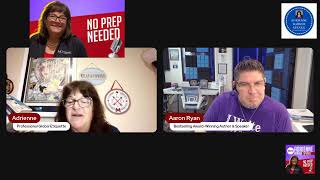
Aaron Ryan has written over 30 sci-fi and dystopian novels, including the Dissonance hexalogy, which is being pitched to streaming services as a TV pilot. He self-publishes through Amazon KDP and Draft2Digital, and funds his writing with voice-over work for brands like UnitedHealthcare and Cadillac.
Chapters
All right, I'm excited. We're live. Okay, okay, so no prep needed. Has to be today. If you could call, literally 3 minutes, like maybe 2 to 3 minutes, because Aaron wrote to me and said, where's that StreamYard link? And I'm like, okay, let me go look. And then when I looked, I'm like, oh, it was like something juicy waiting for me. I'm like, I have to go peek. So I did peek, so I know what Aaron is. And if you are looking, it may be in your comments. But here's the thing, Aaron, welcome to the show. We are live. You are brave, you're bold, you're not bald, which is good. You got like nice head of hair right there.
Bold, bold, bold.
So, okay, so now we are gonna have you introduce yourself to the audience. You guys get your ears ready, let's go. Clean them out and ready. Okay, take it away, Aaron.
Yeah, clean out the ears. Yeah, so I am author Aaron Ryan, not to be confused with awful Aaron Ryan. So just, you know, make sure that you spell that one correct, just like bold versus bald. I've been authoring since 1981, which really kind of shows you how old I am. I'm working on book number 30 and actually the COVID for book 31, and another idea I got on Sunday. But I am primarily a sci-fi and dystopian post-apocalyptic writer working on— I finished a killer series last year, an alien invasion series that seriously is killer because they kill you because they're aliens. And the new one is called The End, which is a Christian clean fiction post-apocalyptic series. And that is, um, doing really well. Two best-selling categories already. Uh, number two is gonna come out next month. And got— I gotta start on volume three. I'm just kind of taking my time with it.
Okay, so a million and a half questions are going through my mind. So I ask your questions too, by the way. You guys can make the comments. So Okay, so this is not like sci-fi like Star Trek. This is like Fallout?
Yeah, it's very grounded in reality. I don't like, um, I don't think I will ever— I mean, cross my fingers, knock on wood— write a story about a spaceship set in the year 4692 out in the middle of space. I like where they are attainable, where they're grounded in reality. And so my book, the whole Dissident series, is on Earth 16 to 19 years from now. And it's grounded in reality. The end is set in 2113 on Earth. It's dystopian and post-apocalyptic, so things have changed, but it's still Earth and recognizable.
Okay, so since I just kind of started to watch shows like this, I think you just need to explain to my listener, my audience of 3— so the 3 of you out there, like, I need you to understand this because they're like, dystopian and, and what What is those words? And what does he mean? Is he talking about my neighbors? So no, we're not talking about your neighbors. Well, maybe we are actually.
We might be.
Explain it.
Yeah. So dystopian means there's a power differential. So it's the very opposite of utopian. A utopia is an ideal environment that you're living in. Dystopian is there's disarray, there's disorder, there's power differentials. You maybe have a leader at the top that's an autocrat or a despot, or he is you know, a tyrannical ruler of some kind. And so usually in that kind of environment, there's rich versus poor, the haves and the have-nots, and they are striving, you know, for more equality. Post-apocalyptic means after an apocalypse of some kind. So whether it's a meteor or it's the end of the world or it's, you know, a virus has swept through the earth, that's what post-apocalyptic means. So I like— I thrive well in those two genres. Of dystopian and post-apocalyptic. So there you go.
Okay, so what are we living in now? I think we're in a dystopian, right?
Yeah, I mean, golly, as much as I love to talk politics, uh, it's, it's so funny because when I wrote, um, Dissonance, you know, 23 and 20— in 23 and 24, it was not at all a referendum on, you know, the imbalance between Democrats and Republicans and the Green Party and the Middle Party and everything, but it really kind of reads that way if you want it to. And it's so weird that all of the ads that I've run on Facebook that have to do with The End, which is my, which is my Christian post-apocalyptic series, they all don't, they, none of them say anything about politics. And yet when I mention a deluded techno-trillionaire, they go, oh, Elon Musk. And I'm going, oh, it's just, or, or it's Trump. And I'm going, that's not my ad. That's not my book.
It's so interesting. So, so what, what part of the population, like how many people, let's say out of 100 people, how many people actually kind of love this, listen to it, watch, read, like how many would be your fans?
Yeah, well, post-apocalyptic and dystopian genres are pretty popular. You can really only go up in such an environment. So whether it's The Hunger Games, which is very dystopian, or It's the Maze Runner, which is post-apocalyptic, or I Am Legend, which is post-apocalyptic. I draw upon visual references because oftentimes people can latch on more to the cinematic representations of those. I certainly do. I'm much more visually inspired than literarily inspired, and so they're very popular. I love— I think what epitomizes it most, there's a line from The Hunger Games spoken by President Snow to, gosh, his first game maker. And Seneca Crane, I think, was his first game maker. And he said, there's one thing that cannot be killed. It's hope. It's the only thing stronger than fear. And so in a post-apocalyptic or a dystopian environment, man, we cling to hope. That's all we have. So despite our fear, we're going to push forward in hope. And in the Dissonance, uh, uh, hexalogy of 6 books, our world's been overrun by aliens, yet we hold out hope that someday we'll be delivered.
Oh, I— okay, I just— I love this. I'm thinking to myself some of the shows I love, like Severance on Apple. I'm like, is Severance— what would that kind of be considered?
Yeah, don't get mad, I've not seen Severance, although everyone tells me that I need to see Severance. Silo is another Apple TV production, um, it might be Amazon, I don't remember. I believe it's Apple TV, and, and that is very post-apocalyptic. Um, everyone is down in this silo after a cataclysm has happened up above, above ground, and so they're living underneath in order to survive. Um, Maze Runner is again another one of those. There's also the, um, uh, what is that series? Uh, Divergent series. That's very dystopian in nature as well, but I think Anytime you think of, uh, something that is world-shattering, uh, world-ending, and creating some kind of just massive apocalyptic, you know, kill event, uh, like an ELE, an extinction-level event, it's what happens after that that is post-apocalyptic.
So wouldn't that be Fallout?
Yeah, although are you talking about the game? Because I've not played the game.
The game and the movie. So I watched both.
Yeah. So I have a 9 and a 5-year-old. So we watch, we watch Pixar and we play Minecraft.
That is okay. So tell me about 5-year-old Aaron. Like, so I want to kind of get an idea of what you were like growing up so I can understand this. So 5-year-old Aaron's interested in this or what? Like what age? What, where did you like go, ooh, the fascination began?
Well, yeah. So, so, and this is listed in my about the author shamelessly, I might add, because I think it's a really cute story. So I was in second grade, and I think second grade is, you know, you're roughly, uh, 7 or 8. Uh, we were all given an assignment by Mrs. Walker. Hi, Mrs. Walker, if you're still out there. I don't know if you're alive. Uh, but it was— our entire class was given an assignment to write a story on college rule paper, 3-hole punch, construction paper, wraparound cover, you know, crude pencil stick figure drawings. And I wrote a story called The Electric Boy. And that really, um, electrified me to, uh, to write. I loved the creative process. But man, it wasn't until I was about 9 or 10 when I set my eyes on Lord of the Rings, and mind officially blown. The world building, the level of depth and breadth inherent in The Lord of the Rings absolutely floored me and showed me the possibilities that were available as a writer. It just really opened my mind to the ability to become a writer someday.
And to make a living off of it.
Yeah, but we're not there yet. You can see behind me, this is a voiceover booth. I'm a voiceover artist, and so that officially pays our mortgage and funds the dream of pursuing authoring. But authoring is a long slog, and I'm also a self-published writer, which if you're traditionally published you may get a little bit more traction. I like a little bit more creative control and commanding higher royalties and quicker time to market, so I prefer the self-publishing route, which means it'll just take me longer to get to Suzanne Collins Hunger Games level.
Oh my God, I love it. Just for everyone out there, because I feel like people are gonna be like, wait, what kind of paper is he talking about? What holes in it? What is that? So Maybe we should explain what that paper is first, because the audience, my audience is probably like, what? No, my audience is old. You guys know what that is, right? That's like the paper with the hole. Okay, good, good. So this, okay, so there are so many questions and I find this fascinating, but all I want to ask you is what the heck is an auto— like, what do you mean a booth back there? What are you talking about? What is behind you?
What? Yeah, so I'm a voiceover artist. So right now, if you hear or see a commercial for UnitedHealthcare, for example, I am their voice. I've been the voice of Nutrisystem, Amazon, Wrangler, Cadillac, Microsoft, Uber. The list goes on, you know, Lee Jeans, Calvin Klein, Cadillac, just lots of Fortune 500 companies. And so I record them back in there on the microphones, which you can't really see through the window there. And then they, you know, if you see a commercial where no one's, someone's talking, but you don't see anybody, that's me. Or you see something happening and people are talking, but it's not their voices, it's an over— it's a voice placed over that. Voiceover. So I will audition for jobs as a voice actor. I will get those jobs, you know, cross my fingers, knock on wood, and then get awarded those jobs and then record them, send them the files, they put them wherever they want to, and there you go.
So you're really— the difference with you is you're a good-looking guy, so you actually have a face for like like TV and video.
So I have a face for radio.
No, I have the face for radio. So can you give us a little example? Because my listeners are like, what's voiceover? I don't know what he's talking about. So we need to know.
Oh my gosh. So it'd be impossible to conjure up one of those scripts, but like, you know, Cadillac, for example. I did some Cadillac commercials, and it's basically, you know, dropping the voice and going Cadillac. "Daire greatly!" You know, and you say that, and you see these Cadillacs just go speeding across the terrain, and Cadillac, "Daire greatly!" That's me saying, "Daire greatly!" Or it's me in the UnitedHealthcare commercial going, you know, "Enrollment ends December 1st. So remember, sign up today, get the all-in-one member IDU card!" You know, that's me with enthusiasm over the footage shot for the UnitedHealthcare commercial.
So you personalize it for your clients. Yeah, that's amazing. When did you even know that you had that talent? What did that look like for you?
That was '93, and I got into it accidentally because I was working as a telemarketer. Tell no one. Uh, I was bugging people during dinner and calling, you know, businesses and saying, uh, you know, calling on behalf of local radio stations and saying, hey, we are putting out PSAs, public service announcements, to encourage parents to use a kid code to prevent abduction, or to, uh, you know, encourage your kids to get into, um youth sports and activities, so they don't have time for drinking and alcohol and drugs and all that stuff. And so, you know, good sound advice brought to you by Bob's Plumbing. So we'd call Bob's Plumbing. Hopefully Bob would sponsor this spot. It would air on the radio. And one time a customer goes, yeah, that sounds great, we'll buy, but only if you get to read it on the air. And I was like, oh, hold please. And, you know, I had to talked to a manager. He wants me to read this. Can I read this? And I got in the studio and I read it, put the headphones on, and I went, I like this like a really lot. And, uh, it just turned into a career eventually. But yeah, it was a blast. It is a blast.
You know, it's so funny. So I'm on this, uh, app called Chatter Social. I talk about it a lot. It's a social audio video, uh, app. So you go on, so the first thing you do is you hear people's voices, right? Real people. So today, um, Marcel got on, and wow, his voice, like all the women, I think everyone was swooning. It was that deep bass voice or bass voice, so we're like, whoa. But, um, and now I'm doing a podcast. It's nice because I'm doing it with two other men and people are like, oh, your voice is good. And I'm like, I don't even like my voice. But that's the problem, we don't really hear our own voice, correct?
Right. Yeah, your voice sounds different to you than when you hear it in, in a recording. However, I think that's really true. I definitely remember feeling that emotion and recognizing that— I would call it a symptom maybe early on, but then you kind of just develop a familiarity with it. You get acclimated to the sound of your own voice. And so, you know, now when I'm hearing myself talking here and then I hear it later in this podcast or I hear another recording or the audiobooks for the books that I've written, I know it's me. You know, I can tell when it's me. This morning I was actually Googling or YouTubing footage from an old video game that I was a character in. And, you know, I'm skipping through the video because I never saw what the character actually looked like. I'm skipping through the video and, oh, there's Dr. Jan. And I see him and, you know, I'm using a British accent and I'm like, oh yeah, that's me, that's definitely me.
So, oh, this is so, so cool. Okay, and by the way, let me just do a shameless plug. This one is totally— I'm not ashamed. Okay, so Catch Nightly, we had our second episode of Debate the News Crime Edition with Adrian Barker, Joseph Lobosco, and JB. We can't say his last name because he's a former con. Oh, okay. So we're gonna go back to— and thank you so much, Iman, you're very sweet and I really appreciate it. So thank you so much. All right, so now you are— are you like 5 people all in one? Are you also doing your own editing? Are you doing your graphics for it? Are you like 100% all, or are you farming out some pieces of your book, books?
Definitely farming out some pieces. I think as a self-published author, you really need to be a business person who just happens to do authoring. I also think of myself as a business person who just happens to do voiceovers because without the vehicle, your craft doesn't, can't go as many places. The vehicle is your business. And so you place your craft on your vehicle, your vehicle takes it places. And so, Yeah, as a self-published author, what I really appreciate is that I can command higher royalties. I can demand to create the covers. I can, you know, publish quicker time to market rather than a traditional publisher can. I don't do the editing. My wife is a bona fide professional editor, and she edits my books. It's really frustrating for her because she has an in-house client going, where you at, where you at, where you at, you know, tell me what you think. And no other client's going to do that, you know. So I get to bug her that way. But yes, for the audiobooks, I really detest recording audiobooks as a voiceover artist. They take way too long and pay way too little. But I was not about to entrust this book or any of my other books to any other author, recording artist, or narrator. No one is going to love this story or these characters as much as me. No one's going to bring them to life as well as me. So, and there's tons of accents that I've gotten to do throughout all 6 of these books. And, you know, the one for Forecast, the one I'm doing now for The End Alpha, and I love doing those other accents.
Wait a second, so is your Audible like— is it more like— I don't know if it's— I'm just saying audiobook— is it like a theatrical performance too? Are you actually able to change your voice, which sounds like you can? So you're— it's like a theatrical production for your ears.
Yeah, well, when you read, if there's a character who is British and they've been clearly identified as British, and yet I'm going, "Hey, nice to meet you, I'm Simon," you know, the listener is going to go, you know, so— and I tend to write that way. For example, in the end alpha, the one that was just published, the protagonist was a girl, was originally an 18-year-old girl, and I'm going, "Oh shoot, I can't, I'm not going to sound like a girl for an entire book, so I had to change her to a him. And I'm not going to write in an accent that I can't do well, for example, you know, like an Indian accent, I can't do that super well. So anyway, I try to think the whole process all the way through from start to finish and then cover my bases that way.
You know, I have to say there's something to the listening to books on, on, um, and you know, whatever app you use, your favorite app, because I don't know, just closing your eyes, allowing your eyes to rest, but your mind can still see. And I just absolutely think that it's so good for people, and also those that have trouble seeing. It's a real gift to be able to go into like another land. So theater for your ears. It sounds amazing. Okay, so now Okay, so you're using this, but have you had any issues where someone wrote, Aaron, thank you, I love your book, but 25 pages were white, there was no print on it? Have you had any issues with the printing of the book?
I don't think so. I have had an issue once where that would, that would, oh, that would destroy me. No, the one issue that I have had is that they— so when you create, when you publish a new update to your book, like let's say you caught a glaring plot hole or something like that, which thankfully has never happened, but I like to tinker and improve over time as I've read all 6 books together. Then I want to go back and change this little aspect about book 1. So I go in and republish it. Well, if people, if people order a book 1 after that new version has been published, Amazon may have a few copies of these on its shelf that they want to get get rid of, and they give the old copy, uh, to the person. Additionally, I had published a manuscript that was the wrong one. Uh, it was not the finished one. I think it was for Dissonance Volume 3, I think. Um, no, I'm sorry, it was Forecast. It's my 9/11 historical fiction novel. And I published it, and then I, I published the corrected script that has been fully edited. But what they did is they printed some of the incorrect script that was not quite edited. There were still some typos and blah blah blah. And, and some clients got those, and I'm going, dang it, you know, Amazon, this is supposed to be print on demand, you know, not accumulate on your shelf.
Yeah, so how, so how did they— so they called and told you, or they left a review or something?
And, and there was one gal in particular who I knew, she's local, uh, and I said, thank you so much for the review. I'm so sorry for the, the things. I know what happened now. I want to send you a new fresh copy of this book. And I did. And she modified her review.
I'm an author of, um, It's Not My Secret to Share. I got to go back in and do my second edition and update it, but I wrote the book for myself, so I figured I'd share it with everyone else. But it's all— and it's not like a, like, like what's a secret. It's just like the burden and consequences of secrets and growing up in a family business and just how many I've spilled the beans more than I should. I've listened to someone else's beans more than I should. So I have some experience, but Very interesting. I'm sure a lot of people just took that little tidbit away. Okay, so now what happened? So now you are— so when did you— so you said 1981, and you were born— you were born in the '70s?
'73.
Yeah, you're born '73. So, oh, you are fairly young then when you got— so how old were you when you wrote your first book?
That was 1981, so I would have been 7 or 8. I don't know if I turned 8 yet, but yeah, 7 or 8.
Whoa, okay. And, and parents?
Yep, still alive. And let me be clear, that was just a school assignment, so it wasn't something that we published. It wasn't something that was available out there by, you know, a publisher. It was a school assignment. It was the very first book that I ever wrote though. Yeah.
Do you still have the paper?
No, dang it. My mom gave it to me. She kept me— she kept all of the things that she's kept over the years, like our or a certificate of achievement or whatever. Um, and, and I know that I saw it. She gave it to me in a collection of other stuff, and I cannot for the life of me find that book. Um, it drives me absolutely crazy that I can't find it.
You gotta just think about it and then let it flow to you. Okay, so now you— so you're writing all these books, and are— like, first of all, is it— I always think when I see books like this that, like, like, you, you have a dream, it's got to be in the film, and you want to, you want to play a part because you secretly love Stephen King and you're like, he plays in every movie and I just want to play in a little part of it. So is that something that you want? How do we get it in the eyes of the filmmakers?
Well, so, uh, and I know you put a comment in here, I am so delighted and privileged to, to announce and just to know and to say that Dissonance Volume 1: Reality, which is the first one I wrote, and then I went back and wrote 5 more, this one has been adapted for the screen and right now it's being pitched to streaming networks. So it is, it's very true to the book. The pilot has been created, so not the whole book has been created yet, but the pilot for this novel has been created and is being pitched. Again, it's epic, it's grounded in reality, so big studios could look at this and go, there's a real story here. And what I'm most proud of is that yes, they're aliens, yes, there's an alien invasion that happens, but strip all that away, you have a human survival story that is very human, that is loaded with parenting through trauma, that has thematic depth, that has a ton of heart, particularly the first prequel. Um, they're just— it's a survival story where they just happen to be surviving from aliens. There's just a lot of human heart at the center, and I'm grateful for that.
Well, yeah, I mean, obviously I, I believe in aliens, and you know, when they're reading the book, because they can read, they're very brilliant. And you know, I have a couple neighbors that are aliens. I, I know what's going on here. I did a 5-month road trip with my daughter, and we were in New Mexico. We were going through that like area, the alien area.
What is that?
And, um, and it was pouring rain. I'm like, Alana, look for hotels. And she's like, um, you know, or motel. And she's like, there's the Alien Motel. And I'm like, we're going there. So literally we drove up and there's aliens all around, and I'm like, oh, this is fun, let's go. And I knocked on the door. I didn't expect the real alien to like answer the door. The guy looked like he scared the crap out of me. He's like, we don't have any rooms. And I'm like, dude, I don't want to stay here because like— I ran to the car. No, actually, I said to him, I go, do you think I just sit in your parking lot for a few minutes? While the rain calms down. And as a normal alien, he said, no, leave. They're not even friendly. So that's so funny. But I do actually believe it is. So I, I just, I think this is amazing. All right, I have a question for you. So with Amazon, you have your book, but I also just found out that— is this what you mean, that Amazon will also, like, you could do the same thing as KDP? You could also do it for your films?
Well, so I've published through Amazon and through a vendor site called Draft2Digital and a distributor called IngramSpark. IngramSpark will get you into like Barnes Noble, for example. Draft2Digital predominantly for ebooks. I distribute wide, but those are just the books. So I don't know that— I don't think my screenwriter has actually taken my book and pitched it to Amazon for Prime, for Prime Video yet. He may have, I don't remember, but he's pitched to someone. We have some very big ones coming up. Whoever decides that they want it enough, they can do one of two things. They can option it, which means they're exercising their right to opt to use this script as an option for one of their, their productions in the future, which basically doesn't tell anyone else to back off, right? It's, it basically like they put a down payment and, you know, we're gonna consider this one, and then they're invested in it. Because they've, they've put that down payment on it. Or this is what we're really going for, is for someone to actually just flat out buy the rights to it, which means if they do that, that, that signifies full intent to produce this, uh, and to make it, make it, you know, big and give it the life that it deserves. Um, whether or not it flies in streaming beyond that depends on how well it's produced, how engaging it is, and all that. I know that the book and the story and everything is engaging. And big and epic and rich. It just depends how they produce it as well.
How many hours are you thinking? Is this like a 2, 3, 8 episode?
Well, so the combined length of the audiobooks of all 6 books is 54 hours. That's if you were going to read them through all the way, like the narration as well. The books are not the same, obviously. That's why you convert it to a screenplay so that it's, you know, you have this much narrative and you have this much resulting screen time. Um, so it really depends, but what they would be trying for are an episodic treatment, so like maybe a 42-minute episode or an hour-long episode or whatever, again and again and again and again in a series. And then they would have different seasons, right? So Dissonance Season 1 Episode 3 or whatever they would do. Uh, that kind of is the purview of the producers and the production studio. How they want to chop it up.
So do you— so you need to go to bed and see yourself, right? See yourself signing it over your rights and see yourself attending the premiere and see yourself saying, being like an executive producer. Like, yeah, go to bed and see yourself. You got to manifest this.
Yes, you have to visualize it. Absolutely right.
It does work.
What's really funny is that, and I know this is true for many authors, when you write something and you've immersed yourself in this world so much and you've kind of been staying in this world. Granted, I wrote this one book and I thought that was going to be it, but then it demanded two sequels. As I was writing it, I'm going, okay, I'm going to write a trilogy. There's just enough here to write a trilogy. So, so it demanded two sequels, so I have a trilogy now. And then it demanded two prequels and another sequel. So there's a ton of story here. There's six books worth of story. It was so immersive in the writing and in the reading that I've actually taken my characters, who I just love to death, I've taken their birthdays and put them in my real-life Outlook calendar. I mean, that line between fiction and reality is absolutely blurred, and I don't care. Call me crazy. I love it. It's real to me.
Oh my God. Yeah. So real. Okay, wait, sorry. Alexa was bothering me. Okay, so You like— so I'm really curious about this. So you're writing and all of a sudden there's like a little knock on the door. Dad, Dad, can you come play ball with me? Is it really hard to like be like, I'll be right there after the next book chapter or page? So you answer.
There have been times, uh, there have been times where we've had that. Thankfully my kids are pretty autonomous and independent and they're, they're good that way, but they're only 9 and 5, so they do want daddy time as well. For the most part though, they're— I'm writing during the work day, so when they're at school, or I write when they go to bed. I very rarely will pull out my laptop and start writing a story while they're awake, and that's just part of my commitment to being with my kiddos in the off hours when they're home from school, because that's— they want dad time. Quality dad time is not me sitting on my laptop writing a story.
It really isn't. I guess I want to understand, when you start to write, like, can you walk away? Like, is it like, okay, I'm gonna write the story, or I'm gonna write a couple pages, or I'm gonna write a chapter? Like, I just want to get in your head for a minute.
Yeah, what sometimes what I'll do is I'll actually take, uh, if I'm interrupted, for example, right, uh, I will, I will know kind of, you know, more or less where I'm headed with what I'm writing. And so if I need to pull away from that for any reason, I will just you know, quickly type up some bullet points of things. I'm going to remember it. I always usually do. Always usually. I will always remember what I'm going— where I was going with that. But it does help to have just some bullet points of just some key things that I know I wanted to remember, uh, in, in that writing. And, uh, and then I'll just come back when we're all done or when it's bedtime for them and then start hammering away again.
So how did you marry an editor? Is this like, what the heck? Was this your editor first, and you ended up saying, "Let's get married"?
No, she's— no, not at all. She's always been a wordsmith. My wife is a wordsmith and puts a huge— she has a great— puts a great premium on the words that she says. And she's the kind of person who will, you know, hammer out an email to someone, and her finger will hover over the Send button for a week. Because she can't take words back, and she realizes the value that words have and the power that they hold. So she's always been a wordsmith. She's a poet, and she's really helped me find ways to say things that are, you know, not par for the course. They're more unique that way. But she didn't get into editing until after I got into writing. Having edited some of my stuff and other people's stuff, she just kind of went, you know, I think I want to do this. This is very enjoyable, and it's a second income stream for us. And you don't bug me too much, hubby, when I'm editing yours. Yes, I do. But I think it's just— it's a natural fit for her, being a wordsmith.
Oh my gosh, I love that your children, 5 and 9, get to like see this and understand. You're really right, the power of words. Sticks and stones will break my words, but words will never hurt me. No. No, they hurt just as much. Yes, we have to really change that narrative. So true. So you're getting booked on podcasts. Let me ask you, why? Why do you want to be on a variety of podcasts? What's your goal?
I love sharing about it. In fact, one avenue that I have started to pursue again is public speaking. I've done it for many years. I used to be a traveling Christian performer and speaker. And I really love getting out there and sharing about a variety of things. One is something we talked about at the beginning of this podcast: being a business person first, and your craft comes second. Your identity comes first; your craft comes second. Now, I've always been a storyteller in, like, virtually every career that I've had. So, but I can go out there and talk about storytelling. I can talk about creative marketing. I can talk about adapting and overcoming. I can talk about pitching to agents, to literary agents. I can talk about just, you know, goal tracking and focus and vision and mantras and anthems and, you know, mission statements and all those things that are inherent with running a good operative business that has forward momentum and taking it seriously. I mean, treating this, this authoring pursuit— you can write all the books that you want, but if you're not putting if you're not investing your dollars behind it and you don't have a long-term belief in your own value as an author or writer, you might flame out. And I just, I'm never, this is what I was called to do. So it's never gonna be a sunk cost fallacy for me. This is what I was called to do and what I'm absolutely meant to do.
I heard David Meltzer speak a couple of weeks ago and I love what he said. You know, the saying, if you love what you do, you never work a day in your life. But he said, no, He said, if you love what you do, learn to love the parts that you don't love what you do. So are there any things that you do when writing that you're actually like, oh, I'm not loving this part?
Writing? Not necessarily, because I'm inherently a creator and I love creating the whole process. There are definitely elements of voiceovers that I don't enjoy, but those are much more client-centric So you're hands-on with clients, and some clients can be difficult, and I as a voiceover artist can be difficult, to be fair. So you're working with people, you know, you're gonna, you're gonna do this sometimes. And, uh, but as a writer, you're creating something as an offering to someone with very little input from anyone else. Um, you're, you know, you rise and fall on your own merits. I think maybe the only bit of pushback that I might say is when I write something and my editor my wife will come back and say, you know, I don't think this is necessary. And for me, I like to include everything, you know. I, I think that's, that's necessary. Yes, it is necessary. You got to keep it in. And she's like, you know, should trim this and pull it out. I'm going, okay, I will. But secretly I'll keep it in, you know.
Okay, I want you to flip the switch for a second. I'm going to have you flip for a second because I want you to— and we didn't— these questions, I believe me, I only knew just what I put in there, uh, in this, in the chat. So when you get immersed in a book like this, share what it does for the person, the reader. How does this help the reader? And I'm thinking it also helps with mental health, right? Like if you're going through something, can you share a little bit? Because we never hear an author talk about the beauty of actually helping the reader and why.
One of the things I absolutely love about being a storyteller is providing escapism. This is a very, very bizarre world that we live in. The harsh reality is that, you know, we can't really believe anything we see anymore, what with AI and the weird reels out there, and misinformation campaigns and politics are just so divisive. And so what do you do? You want— you need, not want— well, you want to, but you need that respite. You need that endearing rabbit trail that goes off this way where you can enjoy something over here and give you a, you know, come up for air, right? So, and that's what I love. I love taking people on a story that I created, and, you know, I'm like this the whole time as they're reading because I worked so hard and put so much thought, spirit, heart into it. It gives them an opportunity to receive thought, spirit, and heart and I love that connection. Some of these readers I'll never meet, but there's nothing— I mean this— nothing better than getting an email from someone that said, hey, I read your book and I absolutely loved this person, and why'd you kill off so-and-so? You know, or— but they're so invested in the story that they care, and I love that they care.
It's like brain healthy. I think when I was younger, Bobsy Twins and the Nancy Drew series, like, it's so funny. If I could do— if I knew that I could like have written to them to say, oh my gosh, I love that. So I think that's the beauty of authors too, that you can nowadays, you can find you. And so my final question to you is like actually about like the cosplays or, or co-play. Like, is that— so are there— so I know the, um, character ones, but are they the science too? Are there just like the sci-fi ones? What does that look like for like the cosplay events?
Um, so cosplay— I haven't done any cosplay, but I mean, they're easily, uh, cosplayable for sure. Is that even a word? It is now. Um, I coin cosplayable. I think the Gorgons, uh, that are the aliens in the story— they're called Gorgons because like Medusa the Gorgon, you cannot ever look them in the eye. Uh, they will, they will immobilize you, uh, they'll consume you at their leisure, and you're gonna feel every excruciating bite while they do it. They are awful, terrifying predators. They're animals. And so, you know, they, they kind of look like a little bit like a space octopus. And they— you could easily fabricate outfits like that and go cosplay. I also think that the soldiers that are involved in the story— granted, this is not too far in the future, so they're going to look very similar to the soldier and infantry outfits that we have today. The army outfits that we have today and the technology that we possess today. So very easy to get dressed up that way. Beyond that, I don't think that there's really anybody else other than people in just ragtag clothes eking out an existence in the shadows after the aliens— after the Gorgons have killed off 85% of humanity. You can throw anything on and just be a survivor. So we'll see it happen one day.
One last one. This is the last question. Do you offer like a cheat sheet? Like when I was watching Fallout, like I was like, geez, I need a little sheet that like says, okay, Gorkins, don't look them in the eye.
They'll eat you up.
Like, do you have something in the book where I could be so that when I'm reading, I'm like, wait, I forgot what they do. I could go back to this cheat sheet. You do?
Yeah, I actually have a character Bible. And the character Bible is something that you invent by way of having your book converted to the screen. So there's several things that you develop in tandem with the screenplay. One is the character bible, one is the, the treatment for it, one is the pilot, one is a pitch deck. And there are different things that you have that you can now, you know, toss out to whomever needs them. But that was really fun to create a sheet, a one-up, that has all of the key players, main protagonists, but also the tertiary tertiary characters who are going to come and go, um, and who they are and why they matter and why they don't matter, uh, who the antagonists are. I think that was really cool to create. So I do have something.
Yeah, that makes sense to me. Okay, the last— I promise, I promise. Um, so demographics, like, so who actually— does it cross all party lines? Not party lines, I'm kidding you on that one. Does it cross all age groups? So, you know, I'm 62 and I'm like, I'm kind of getting into this, but there was part of my life for 30 years, I would have been like, no, I just want to watch This Is Us. Now I kind of enjoy it. So what does that look like, or is it really just scan the ages?
It does. I mean, obviously it's going to be some scary content for some of the younger kids because the Gorgons are just no joke. They're no laughing matter. And there is some profanity in here. I really struggled with that because I wanted to write something that was clean fiction. That happens with, with the end. Series. There's no profanity. But, uh, these are aliens and they're terrifying. If they attack you, you're not going to go, oh shucks, you know, you're going to say something else. And so there are— there's some profanity, and I don't like that. I think there's enough of that for kids out there. I don't need to contribute to that cesspool. So, um, but, uh, teens and young adults and up— so I would say, you know, 13 and up, uh, is probably the age range. But I've had— I've had readers who have appreciated it in their uh, you know, high 70s. I've had readers as low as, you know, 11, I think, uh, who have read it because they tend to read up a little bit. So definitely a span. And I wrote it easy. I wrote the books to be an easy read, for sure.
Can you hold for a second? I have a call.
Yeah.
Hello? Oh, Elon. Yes, yes, I'm with Aaron Ryan. Elon, we're friends, we're friends. I have his 25th daughter. Um, So Elon, Aaron wants to know if you see— oh, you have seen the real— oh, you have seen the— what do we call them? Oh, that was William Shatner. He was a Gorgon.
Gorgon.
Gorgon. Oh, all your employees are Gorgons. Just kidding around. That was not Elon Musk, in case anyone thinks. And I'm not having a baby with him, just in case.
Right.
That really getting out there. I'm 62, for Christ's sake. Okay, this has been really fun, really interesting. Okay, so we— you kind of mentioned it, so Amazon, and then there's a couple of other places. Are you in, uh, what is that place called, the book place?
Well, you can go to— you can go to authoraaronryan.com. Um, just to be clear, it's not awfulaaronryan.com, it's authoraaronryan.com. And there's links to the, the This Is the End website uh, there's links to the Dissidents: The Series website from authoraaronryan.com. There's all my socials there, but there's also a shopping page, and on that shopping page you can go there and find all the links to wherever you can buy it in whatever medium that you want to find it.
I love that. Okay, I'm putting this in the show notes— well, in the show notes it will be, but links follow. I love that they can follow you, my friends. Do you find a lot of your readers are also, um, game players that they do the games?
Sometimes I've had suggestions that Dissidents could very, very easily and successfully be turned into a game. I think that'd be awesome. I don't know how they'd do it, but I think it'd be very cool.
There is that, like, right now it's really interesting. So Fallout is the one— my daughter's boyfriend explained all this to me because he saw me. I was— he told me to watch it because he made it so interesting. And then I'm like, oh, this is really cool. Oh, oh wait, JC Dornick, wait, is— who's your favorite public speaker? Aaron or me? No, I'm kidding.
I don't know.
You know, so many great people out there. I told you I had 3. That's exactly what's watching. So anyways, Aaron, this was an amazing, interesting— no prep needed because I really had no idea, and I was like kind of thinking another social media, which nothing wrong with that, but this is fantastic. You're cool. So, all right, so we're gonna follow you. I will tag you, and I really— I just can't thank you enough. So thank you and say hello to your beautiful wife, the editor. I love that she uses words. So she's got a talent. She should also get on podcasts because that's really interesting, talking about the power of words. I think that she would be incredible. So, all right, go off and meet an alien today, everyone. Just make believe all your friends are aliens. And next time you are with your family, pick one of them and make believe they're an alien, right? And then just start talking to them in a really funny way. How do aliens speak? So I can just make sure everyone knows.
I don't know, but some, some of my relatives are clearly aliens already. So yeah, it's—
do you remember the old— oh, when the kids are little— you have a 5-year-old— when the kids are little, you put a blanket over them and then you tell them they're— you can't see them anymore and they're invisible and watch the reaction. I kind of think of it that way. I used to love to do that. Just never could get enough. Finally, one day They're like 12 going, Mom, we finally get it. Like, stop.
Yeah.
All right, Aaron, thank you so much. And let me just say, as a reminder, catch me and Joseph and Jay on Chatter Social. We are doing DTN, Debate the News, Crime Edition, and it is really cool. We're very excited to talk about crimes. We did Casey Anthony last night. We did, um, uh, Ariel Castro. So I don't know what we're doing next, but I'm living my dream too, Aaron. I love that because when you actually do have a dream and you work towards it, it will come true. And I just feel like you had your dream when you were 9 and look at you now. So really, you're an amazing guest. So thank you so much and have a great rest of the day and week.
Thank you for having me. Appreciate it.
It was amazing. Better than I could ever expect it because I love it. All right, thank you.










